

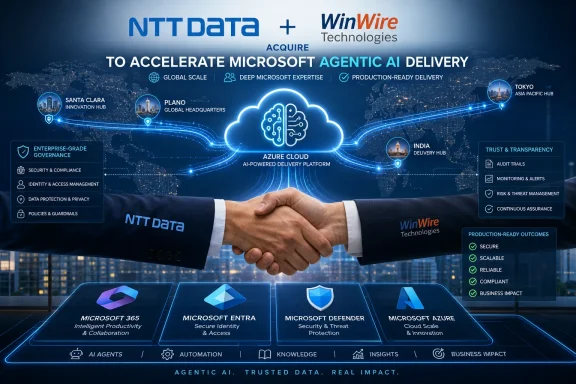
NTT DATA announced on May 18, 2026, that it has signed a definitive agreement to acquire WinWire, a Santa Clara-based Microsoft partner specializing in Azure AI, data engineering, cloud-native development, and agentic AI for enterprise customers. The deal is less a routine services roll-up than a signal flare for where Microsoft’s AI ecosystem is heading. Enterprises have spent the last two years testing copilots, chatbots, and proof-of-concept agents; NTT DATA is betting that the next phase belongs to integrators that can turn those experiments into governed, repeatable operations.
The headline number in the WinWire deal is not the purchase price, which has not been disclosed. It is the talent count: more than 1,000 Azure engineers and Microsoft specialists are expected to join NTT DATA when the transaction closes. In the services business, that is the real currency.
Microsoft has spent years building Azure into the default landing zone for enterprise AI workloads, and the post-ChatGPT boom gave that strategy a new vocabulary: Copilot, Fabric, Azure AI Foundry, agentic workflows, industry clouds, and secure AI transformation. But software platforms do not deploy themselves. They need migration architects, data engineers, identity specialists, security reviewers, governance frameworks, and application teams that understand the messy legacy systems enterprises actually run.
That is where this acquisition fits. WinWire brings a concentrated Microsoft practice to a global integrator that already operates a large Microsoft Cloud business unit across more than 50 countries. NTT DATA says the combined Microsoft organization is supported by more than 24,000 Microsoft certifications, a statistic meant to reassure CIOs that this is not a boutique AI lab bolted onto a slide deck.
The deeper point is that Microsoft’s AI push has created a capacity problem for its partner ecosystem. Customers can buy licenses and cloud credits, but they still need help turning “AI readiness” into production systems. NTT DATA’s purchase of WinWire is a bet that the bottleneck is moving from model access to implementation discipline.
WinWire’s value to NTT DATA is that it gives the larger company a more focused Microsoft-native practice around this emerging category. The company has promoted frameworks such as Agentic AI @ Scale, and NTT DATA’s announcement emphasized WinWire’s work in AI on Azure, Microsoft Fabric, Azure AI Foundry, data platforms, and cloud-native application development.
That combination matters because agents are not just another user interface. In a real enterprise setting, an AI agent needs permissions, audit trails, identity boundaries, access to curated data, predictable failure modes, and a human escalation model. The glamorous demo is the agent completing a task; the hard part is proving that it should have been allowed to do so in the first place.
For WindowsForum readers, the Microsoft angle is especially important. The enterprise AI story increasingly runs through familiar Microsoft surfaces: Microsoft 365, Entra, Defender, Purview, Teams, Power Platform, Azure, GitHub, and Windows endpoints. If agentic AI becomes operational rather than experimental, it will land squarely in the same estates that administrators already manage.
The first wave of generative AI adoption was easy to start and difficult to finish. A business unit could run a chatbot trial, wire a model to a document repository, or build a proof-of-concept assistant with a small team and a cloud budget. Scaling that into something finance, legal, security, compliance, and operations will bless is another matter entirely.
This is why large integrators are retooling around AI operations rather than merely AI strategy. The work is shifting from “what can the model do?” to “how do we run this safely every day?” That is a different kind of project, closer to ERP modernization or cloud migration than to a hackathon.
NTT DATA wants to own that transition. WinWire gives it more specialists who understand Microsoft’s AI stack, but the broader pitch is operational: data foundations, application modernization, managed services, and industry-specific delivery. In other words, the AI system is not the product. The operating model around it is.
NTT DATA says the transaction builds on its long-standing Microsoft partnership and its recognition as Microsoft’s 2025 Global System Integrator Growth Champion partner of the year. WinWire is also described as a six-time Microsoft Partner of the Year award winner or finalist and a member of the Microsoft Agentic Partner Alliance Program. Those details matter because they show how tightly this acquisition is tied to Microsoft’s channel strategy.
Microsoft’s challenge is not merely selling Azure AI services. It is making Azure the default enterprise substrate for AI systems that have real business consequences. That requires trusted partners who can speak both Microsoft and boardroom: security posture, data governance, compliance, modernization, and return on investment.
For Microsoft, a larger NTT DATA Microsoft practice means more feet on the street for co-selling and co-innovation. For NTT DATA, the deal deepens its claim to be one of the firms enterprises call when they want AI on Azure to become something more than a procurement line item.
This model is not new, but AI makes it more urgent. Enterprise AI projects require proximity to business stakeholders and deep technical delivery capacity. They also require enough specialized talent to keep up with fast-changing cloud services, model tooling, data pipelines, and security requirements.
WinWire’s India delivery footprint is therefore not an incidental detail. It is part of the economics of making AI implementation scalable. The same enterprises that cannot hire enough AI engineers internally will increasingly look to partners that can provide trained teams with repeatable delivery playbooks.
There is a risk in that model, too. AI transformation can become another outsourcing abstraction if clients treat it as a vendor-managed black box. The organizations that get the most from deals like this will still need internal ownership of architecture, risk, data governance, and business process change.
The language has changed, but the pattern is familiar. First comes experimentation, then platform consolidation, then governance, then managed operations. Vendors begin by selling possibility and end by selling reliability.
NTT DATA’s announcement leans heavily on “production-ready AI,” “enterprise-wide deployment,” and “meaningful business outcomes.” These are not accidental phrases. They are meant to distinguish serious implementation work from the current fog of AI theater, where every dashboard, search box, and workflow claims some form of intelligence.
The practical question for customers is whether production-ready AI can be delivered without importing production-ready risk. Agentic systems that can take actions across enterprise environments raise a higher bar than passive chat interfaces. The more useful the system becomes, the more dangerous a poorly governed deployment can be.
That means identity policies, endpoint posture, data classification, logging, incident response, lifecycle management, and change control. It also means uncomfortable conversations about which systems an AI agent can touch and which actions require human approval. The old “least privilege” principle does not become obsolete in an agentic world; it becomes more important.
Windows administrators should pay particular attention to the spread of AI through Microsoft’s existing estate. Copilot experiences, Azure AI services, Fabric data pipelines, Power Platform automations, and Teams-based workflows all depend on the permissions and data structures organizations already have. If those foundations are chaotic, AI will not magically make them orderly.
The biggest mistake enterprises can make is treating AI deployment as a separate innovation track. It is not separate from identity, data governance, Windows endpoint management, or cloud security. It is an accelerant layered on top of all of them.
Buying WinWire gives NTT DATA a sharper Microsoft edge at a moment when cloud partnerships are becoming more strategically important. But it also reflects a broader consolidation pattern. Large services firms can sell global scale, but they often need smaller specialists to fill gaps in fast-moving technical domains.
That makes acquisitions like this both logical and revealing. If agentic AI were easy to deliver, NTT DATA would not need to buy a company known for Microsoft-native AI and cloud engineering. The deal is an admission that the talent required to operationalize AI is scarce, valuable, and unevenly distributed.
For WinWire, the upside is reach. A specialist firm can build credibility in a platform ecosystem, but a global integrator can put that capability in front of larger accounts and more industries. The challenge will be preserving the specialization that made WinWire attractive while absorbing it into a much larger organization.
The financial terms were not disclosed, which also limits outside analysis. Without knowing the purchase price, revenue contribution, margins, retention terms, or integration plan, it is difficult to judge whether NTT DATA is getting a bargain, paying a premium, or mostly buying scarce talent. In services acquisitions, the real test often comes months later, when key employees decide whether to stay.
There is also the question of vendor concentration. Customers pursuing Microsoft-based AI transformation may welcome a stronger NTT DATA-WinWire practice, but they should still ask how portable their architecture will be. Azure AI Foundry, Microsoft Fabric, and Microsoft 365 integration can be powerful, but deep integration can also become deep dependency.
That does not make the strategy wrong. It simply means CIOs should separate platform commitment from architectural lock-in. A well-run Microsoft AI program can still preserve data discipline, API boundaries, governance portability, and exit options.
 The Microsoft AI Channel Is Becoming an Arms Race for Delivery Capacity
The headline number in the WinWire deal is not the purchase price, which has not been disclosed. It is the talent count: more than 1,000 Azure engineers and Microsoft specialists are expected to join NTT DATA when the transaction closes. In the services business, that is the real currency.Microsoft has spent years building Azure into the default landing zone for enterprise AI workloads, and the post-ChatGPT boom gave that strategy a new vocabulary: Copilot, Fabric, Azure AI Foundry, agentic workflows, industry clouds, and secure AI transformation. But software platforms do not deploy themselves. They need migration architects, data engineers, identity specialists, security reviewers, governance frameworks, and application teams that understand the messy legacy systems enterprises actually run.
That is where this acquisition fits. WinWire brings a concentrated Microsoft practice to a global integrator that already operates a large Microsoft Cloud business unit across more than 50 countries. NTT DATA says the combined Microsoft organization is supported by more than 24,000 Microsoft certifications, a statistic meant to reassure CIOs that this is not a boutique AI lab bolted onto a slide deck.
The deeper point is that Microsoft’s AI push has created a capacity problem for its partner ecosystem. Customers can buy licenses and cloud credits, but they still need help turning “AI readiness” into production systems. NTT DATA’s purchase of WinWire is a bet that the bottleneck is moving from model access to implementation discipline.
WinWire Gives NTT DATA a More Credible Agentic AI Story
The phrase agentic AI has become one of the most abused terms in enterprise technology. Vendors use it to describe everything from scripted workflow automation to semi-autonomous systems that can reason across tools, data, and business processes. That ambiguity is useful in marketing, but dangerous in operations.WinWire’s value to NTT DATA is that it gives the larger company a more focused Microsoft-native practice around this emerging category. The company has promoted frameworks such as Agentic AI @ Scale, and NTT DATA’s announcement emphasized WinWire’s work in AI on Azure, Microsoft Fabric, Azure AI Foundry, data platforms, and cloud-native application development.
That combination matters because agents are not just another user interface. In a real enterprise setting, an AI agent needs permissions, audit trails, identity boundaries, access to curated data, predictable failure modes, and a human escalation model. The glamorous demo is the agent completing a task; the hard part is proving that it should have been allowed to do so in the first place.
For WindowsForum readers, the Microsoft angle is especially important. The enterprise AI story increasingly runs through familiar Microsoft surfaces: Microsoft 365, Entra, Defender, Purview, Teams, Power Platform, Azure, GitHub, and Windows endpoints. If agentic AI becomes operational rather than experimental, it will land squarely in the same estates that administrators already manage.
The Deal Says the Pilot Era Is Not Enough
NTT DATA’s language around the acquisition is revealing. The company says the deal is designed to help clients move from experimentation to enterprise-wide deployment. That is a polite way of saying what many IT departments already know: a lot of AI projects have not yet escaped the pilot zone.The first wave of generative AI adoption was easy to start and difficult to finish. A business unit could run a chatbot trial, wire a model to a document repository, or build a proof-of-concept assistant with a small team and a cloud budget. Scaling that into something finance, legal, security, compliance, and operations will bless is another matter entirely.
This is why large integrators are retooling around AI operations rather than merely AI strategy. The work is shifting from “what can the model do?” to “how do we run this safely every day?” That is a different kind of project, closer to ERP modernization or cloud migration than to a hackathon.
NTT DATA wants to own that transition. WinWire gives it more specialists who understand Microsoft’s AI stack, but the broader pitch is operational: data foundations, application modernization, managed services, and industry-specific delivery. In other words, the AI system is not the product. The operating model around it is.
Microsoft Gets a Stronger Systems Integrator Without Buying One
Microsoft is not the acquirer here, but it is one of the clear beneficiaries. The company depends on global systems integrators to convert its platforms into enterprise deployments, especially in heavily regulated industries where internal IT teams cannot simply experiment their way into production.NTT DATA says the transaction builds on its long-standing Microsoft partnership and its recognition as Microsoft’s 2025 Global System Integrator Growth Champion partner of the year. WinWire is also described as a six-time Microsoft Partner of the Year award winner or finalist and a member of the Microsoft Agentic Partner Alliance Program. Those details matter because they show how tightly this acquisition is tied to Microsoft’s channel strategy.
Microsoft’s challenge is not merely selling Azure AI services. It is making Azure the default enterprise substrate for AI systems that have real business consequences. That requires trusted partners who can speak both Microsoft and boardroom: security posture, data governance, compliance, modernization, and return on investment.
For Microsoft, a larger NTT DATA Microsoft practice means more feet on the street for co-selling and co-innovation. For NTT DATA, the deal deepens its claim to be one of the firms enterprises call when they want AI on Azure to become something more than a procurement line item.
The Geography of the Deal Is Also the Strategy
The acquisition has a notably global shape. NTT DATA is part of Tokyo-based NTT Group, has its North American headquarters in Plano, Texas, and is using the deal to buy a Santa Clara company with delivery centers in India. That map tells a familiar enterprise services story: strategy near the customer, engineering scale across regions, and platform alignment with a hyperscaler.This model is not new, but AI makes it more urgent. Enterprise AI projects require proximity to business stakeholders and deep technical delivery capacity. They also require enough specialized talent to keep up with fast-changing cloud services, model tooling, data pipelines, and security requirements.
WinWire’s India delivery footprint is therefore not an incidental detail. It is part of the economics of making AI implementation scalable. The same enterprises that cannot hire enough AI engineers internally will increasingly look to partners that can provide trained teams with repeatable delivery playbooks.
There is a risk in that model, too. AI transformation can become another outsourcing abstraction if clients treat it as a vendor-managed black box. The organizations that get the most from deals like this will still need internal ownership of architecture, risk, data governance, and business process change.
“Production-Ready AI” Is the New Cloud Migration
A decade ago, the enterprise services market was organized around cloud migration. Every consultancy had a modernization pitch, every CIO had a data center exit plan, and every hyperscaler needed partners to move workloads into its orbit. AI is now producing a similar services cycle.The language has changed, but the pattern is familiar. First comes experimentation, then platform consolidation, then governance, then managed operations. Vendors begin by selling possibility and end by selling reliability.
NTT DATA’s announcement leans heavily on “production-ready AI,” “enterprise-wide deployment,” and “meaningful business outcomes.” These are not accidental phrases. They are meant to distinguish serious implementation work from the current fog of AI theater, where every dashboard, search box, and workflow claims some form of intelligence.
The practical question for customers is whether production-ready AI can be delivered without importing production-ready risk. Agentic systems that can take actions across enterprise environments raise a higher bar than passive chat interfaces. The more useful the system becomes, the more dangerous a poorly governed deployment can be.
IT Departments Will Inherit the Agentic Hangover
The acquisition may look like boardroom news, but its consequences will land on administrators, developers, and security teams. If NTT DATA and Microsoft succeed in pushing more AI systems into production, those systems will eventually require the same care and feeding as every other enterprise platform.That means identity policies, endpoint posture, data classification, logging, incident response, lifecycle management, and change control. It also means uncomfortable conversations about which systems an AI agent can touch and which actions require human approval. The old “least privilege” principle does not become obsolete in an agentic world; it becomes more important.
Windows administrators should pay particular attention to the spread of AI through Microsoft’s existing estate. Copilot experiences, Azure AI services, Fabric data pipelines, Power Platform automations, and Teams-based workflows all depend on the permissions and data structures organizations already have. If those foundations are chaotic, AI will not magically make them orderly.
The biggest mistake enterprises can make is treating AI deployment as a separate innovation track. It is not separate from identity, data governance, Windows endpoint management, or cloud security. It is an accelerant layered on top of all of them.
The Services Giants Are Buying Specialization Because Hype Is Not Enough
NTT DATA is not alone in recognizing that AI services require deeper specialization. Across the industry, consultancies and integrators are racing to package expertise around cloud AI platforms, data modernization, cybersecurity, and industry-specific automation. The reason is simple: clients want outcomes, not model demos.Buying WinWire gives NTT DATA a sharper Microsoft edge at a moment when cloud partnerships are becoming more strategically important. But it also reflects a broader consolidation pattern. Large services firms can sell global scale, but they often need smaller specialists to fill gaps in fast-moving technical domains.
That makes acquisitions like this both logical and revealing. If agentic AI were easy to deliver, NTT DATA would not need to buy a company known for Microsoft-native AI and cloud engineering. The deal is an admission that the talent required to operationalize AI is scarce, valuable, and unevenly distributed.
For WinWire, the upside is reach. A specialist firm can build credibility in a platform ecosystem, but a global integrator can put that capability in front of larger accounts and more industries. The challenge will be preserving the specialization that made WinWire attractive while absorbing it into a much larger organization.
Customers Should Read the Fine Print Behind the Vision
The announcement says the transaction is subject to customary closing conditions and regulatory approvals. That is standard language, but it is worth remembering that the deal is not closed yet. Until it is, customers should treat roadmap claims as directional rather than guaranteed.The financial terms were not disclosed, which also limits outside analysis. Without knowing the purchase price, revenue contribution, margins, retention terms, or integration plan, it is difficult to judge whether NTT DATA is getting a bargain, paying a premium, or mostly buying scarce talent. In services acquisitions, the real test often comes months later, when key employees decide whether to stay.
There is also the question of vendor concentration. Customers pursuing Microsoft-based AI transformation may welcome a stronger NTT DATA-WinWire practice, but they should still ask how portable their architecture will be. Azure AI Foundry, Microsoft Fabric, and Microsoft 365 integration can be powerful, but deep integration can also become deep dependency.
That does not make the strategy wrong. It simply means CIOs should separate platform commitment from architectural lock-in. A well-run Microsoft AI program can still preserve data discipline, API boundaries, governance portability, and exit options.
The WinWire Deal Turns AI Ambition Into an IT Operations Problem
The practical reading of this acquisition is less glamorous than the press-release language, but more useful. NTT DATA is buying Microsoft AI delivery capacity because enterprises are reaching the point where AI must be implemented, governed, secured, and measured like any other critical system.- NTT DATA has signed a definitive agreement to acquire WinWire, a Microsoft-focused AI and cloud engineering specialist headquartered in Santa Clara.
- The deal is expected to add more than 1,000 Azure engineers and Microsoft specialists to NTT DATA after closing.
- WinWire strengthens NTT DATA’s capabilities around Azure AI, Microsoft Fabric, Azure AI Foundry, data engineering, cloud-native development, and agentic AI.
- Microsoft stands to benefit from a larger global partner capable of turning Azure AI demand into production deployments.
- Enterprise customers should treat agentic AI as an operations, identity, security, and governance challenge rather than a standalone innovation project.
- The transaction’s long-term value will depend on integration, talent retention, and whether customers can convert AI pilots into measurable business outcomes.
References
- Primary source: Dallas Innovates
Published: Tue, 19 May 2026 22:33:22 GMT
NTT DATA To Acquire WinWire To Boost Microsoft Partnership and Support For AI-Powered Operations
“By combining WinWire’s deep expertise in cloud-native development and agentic AI with NTT DATA’s global scale," NTT DATA CEO Abhijit Dubey said, "this positions us to lead the shift to enterprise AI, enabling clients to move from experimentation to enterprise-wide deployment and achieve... dallasinnovates.com
- Related coverage: intelligentcio.com
- Related coverage: winwire.com
Press Release
Stay updated with WinWire's latest news and announcements. Read our press releases for recent updates and milestoneswww.winwire.com
- Related coverage: businesschief.com
NTT Data Acquires WinWire Amid AI Market Growth | Business Chief
NTT Data will absorb 1,000 Microsoft Azure Engineers, enhancing its global business unit for cloud transformation businesschief.com
- Related coverage: unite.ai
NTT DATA Acquires WinWire to Expand Agentic AI and Microsoft Azure Enterprise Transformation Capabilities – Unite.AI
NTT DATA has announced plans to acquire WinWire, a Santa Clara-based Microsoft partner focused on agentic AI, Azure-native development, cloud modernization, and enterprise data engineering. The deal reflects a broader sh...www.unite.ai
- Related coverage: omm.com
O’Melveny Advises NTT DATA in Acquisition of WinWire - O'Melveny
O’Melveny is advising NTT DATA, a global leader in AI, digital business and IT services, in its acquisition of WinWire, a Microsoft partner specializing in Agentic AI, AI on Azure, data engineering and cloud-native development as foundational capabilities for enterprise AI.www.omm.com

- Related coverage: services.global.ntt
Agentic AI is creating a seismic shift in healthcare. Are you ready?
We uncover agentic AIs potential to transform healthcare at both a macro and micro level, and its risks and limitationsservices.global.ntt
- Related coverage: nttdata.com
