

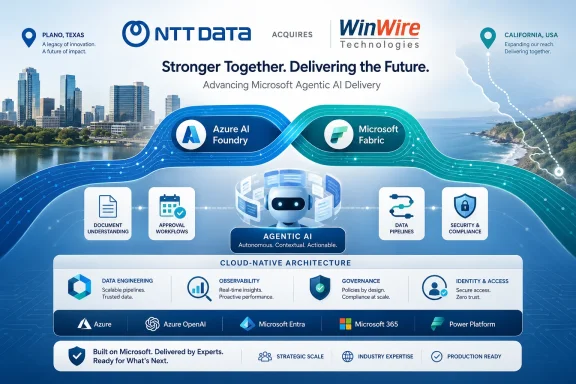
NTT DATA announced on May 15, 2026, from Plano, Texas, that it has signed a definitive agreement to acquire WinWire, a California-based Microsoft partner specializing in agentic AI, Azure cloud development, data engineering, and enterprise application modernization. The deal is not just another services roll-up with an AI label pasted on the box. It is a bet that the next phase of enterprise AI will be won less by model access than by the consultants, engineers, governance frameworks, and cloud-native delivery teams able to turn promising demos into production systems. For Microsoft customers, that makes this acquisition worth watching: it shows how quickly the Azure partner ecosystem is reorganizing around agents, Fabric, AI Foundry, and the hard work of operational deployment.
The headline number in the announcement is more than 1,000 Azure engineers and Microsoft specialists joining NTT DATA’s global Microsoft practice once the transaction closes. In an ordinary IT services acquisition, that would sound like a capacity story. In 2026, it reads more like a land grab for scarce implementation talent.
Enterprise AI has created an awkward imbalance. Vendors can ship copilots, agent frameworks, data platforms, and model catalogs faster than most organizations can absorb them. CIOs have been encouraged to “move beyond experimentation” for the better part of two years, but moving beyond experimentation requires a very different skill set from building a boardroom proof of concept.
WinWire sits in that gap. The company has built its reputation around Microsoft-centric transformation work, particularly across Azure, Microsoft Fabric, Azure AI Foundry, cloud-native application development, and data engineering. NTT DATA is not buying a consumer AI brand or a foundation model lab. It is buying the implementation muscle needed when an enterprise asks whether an AI agent can safely interact with claims systems, patient workflows, financial approvals, manufacturing telemetry, or a thicket of legacy applications that were never designed for probabilistic automation.
That distinction matters. The AI market is still drenched in language about disruption, autonomy, and transformation. But the services opportunity is more prosaic and, for companies like NTT DATA, potentially more durable. Enterprises need data cleaned, applications modernized, identity boundaries enforced, governance policies mapped, prompts tested, workflows redesigned, and monitoring systems deployed. That is not glamorous work, but it is where AI spending becomes repeatable revenue.
NTT DATA’s announcement leans heavily on WinWire’s “Agentic AI @ Scale” framework, which the companies describe as a way to design and deploy autonomous systems directly into enterprise workflows. The important word there is not “autonomous.” It is “workflows.” Enterprises do not buy autonomy in the abstract; they buy shorter case resolution times, faster document processing, fewer support escalations, better forecasting, and lower operational drag.
That is why Microsoft’s ecosystem is so central to the deal. Azure AI Foundry gives customers a place to build, evaluate, and manage AI applications and agents. Microsoft Fabric ties analytics, data engineering, data science, real-time intelligence, and business intelligence into a more unified data platform. Microsoft 365 Copilot and Copilot Studio push the agent conversation closer to everyday business users. The stack is increasingly coherent, but coherence on a product slide does not guarantee coherence in a regulated enterprise.
WinWire’s appeal is that it already speaks this Microsoft dialect. It has Microsoft Partner of the Year recognition, participates in Microsoft’s Agentic Partner Alliance, and focuses on the cloud-native and data foundations that Microsoft needs partners to deliver. For NTT DATA, the acquisition accelerates a strategy it could have tried to build organically, but likely not at the same speed.
NTT DATA already had a substantial Microsoft business, with a Microsoft Cloud practice operating across more than 50 countries and backed by more than 24,000 Microsoft certifications. Adding WinWire deepens that bench and, just as importantly, gives NTT DATA more credibility in the North American market for Azure-led AI transformation. The company also frames itself as a fast-growing Microsoft global systems integrator partner, which is exactly the lane where co-selling matters.
Co-selling is the unromantic machinery behind many cloud deals. Microsoft brings product gravity, account relationships, and platform incentives. Systems integrators bring delivery capacity, industry specialization, and the ability to absorb the blame when a transformation project turns out to be harder than the sales deck suggested. A partner that can show Microsoft it has real agentic AI delivery capability becomes more valuable in that motion.
This is also why the acquisition has significance beyond NTT DATA’s own balance sheet. The Microsoft partner ecosystem is being sorted into tiers of credibility around AI. It is no longer enough to have Azure certifications, migration playbooks, and a few Copilot workshops. The new premium is the ability to connect AI agents to actual enterprise processes while satisfying security, governance, observability, and industry compliance requirements.
That is the wave NTT DATA is chasing. The company’s announcement explicitly talks about helping organizations move from experimentation to enterprise-wide deployment. This is now the central sales pitch for major IT services firms: the promise that they can turn AI curiosity into repeatable, governed, measurable business systems.
The move also reflects a broader M&A pattern. Large services firms are not waiting for their internal training programs to produce enough AI-capable engineers. They are buying specialized consultancies with cloud-native credentials, data engineering depth, and vendor-specific relationships. In a market where every large enterprise is asking similar questions about AI readiness, experienced Azure and AI delivery teams are strategic assets.
There is a practical reason for that urgency. Agentic systems are not isolated applications. They sit at the intersection of data platforms, identity systems, business applications, APIs, security controls, and user workflows. A service provider that wants to sell agentic AI at scale needs people who understand not only models and prompts, but also the architecture underneath them.
That does not make Windows irrelevant. If anything, it makes endpoint management and identity hygiene more important. AI agents that act on behalf of users need trustworthy identity, device posture, conditional access, data-loss prevention, and audit trails. The agent running in the cloud still depends on the user, device, and policy environment around it.
For sysadmins, the lesson is familiar: every new abstraction eventually becomes an operational responsibility. Yesterday’s problem was shadow IT. Today’s is shadow AI. Tomorrow’s may be fleets of semi-autonomous agents interacting with SaaS applications, internal APIs, documents, tickets, email, and line-of-business systems.
The WinWire acquisition points toward a world in which Microsoft partners will sell not just cloud migrations or Copilot enablement, but packaged agentic workflows for industries. A healthcare customer might want agents that summarize clinical documentation or coordinate administrative workflows. A financial services firm might want agents that support compliance review or customer onboarding. A manufacturer might want agents that connect maintenance records, sensor data, and procurement systems. In each case, the Windows and Microsoft admin estate becomes part of the trust boundary.
The barriers are mundane but formidable. Data is fragmented across applications, tenants, warehouses, SharePoint sites, file shares, SaaS systems, and aging databases. Permissions are often overbroad or poorly maintained. Business processes depend on exceptions that live in employees’ heads rather than in documented rules. Audit requirements vary by jurisdiction and industry. Model behavior changes as tools, prompts, retrieval sources, and policies are updated.
This is the territory where consultancies earn their fees. A credible agentic AI deployment needs discovery, architecture, integration, testing, monitoring, rollback planning, and governance. It also needs change management because users will not trust an agent merely because a vendor says it is intelligent.
NTT DATA’s acquisition of WinWire is therefore best understood as an investment in deployment realism. The company is not claiming that agentic AI is simple. It is positioning itself as one of the firms that can make it survivable for enterprises that cannot afford uncontrolled automation.
This is where NTT DATA’s broader portfolio matters. The announcement frames the combined capabilities across infrastructure, applications, data, managed services, and security. That is the right set of nouns. Agentic AI cannot be treated as an application development project alone; it has to be governed like a new class of workload.
For Microsoft customers, the security conversation will likely revolve around identity, data classification, policy enforcement, logging, and lifecycle management. Which agents exist? Who owns them? What data can they see? What actions can they take? How are outputs reviewed? How are failures detected? How are agents retired when a process changes or a vendor tool is replaced?
Those questions are exactly why large systems integrators are circling the market. A company can buy AI tooling directly from Microsoft, but it may still need a partner to design the operating model. The winners in this services wave will not be the firms with the flashiest agent demo. They will be the firms that can convince CISOs, compliance teams, and business leaders that automation will remain inside enforceable boundaries.
The geography matters because the North American enterprise AI market is not just large; it is influential. Successful deployments there become reference architectures, partner playbooks, and co-selling templates that can travel. NTT DATA can use WinWire’s Microsoft credibility and engineering bench to deepen its own industry-specific offerings, then scale those offerings through its global footprint.
There is also a cultural advantage to buying a focused specialist rather than trying to bolt AI language onto a generic consulting practice. WinWire’s identity is already tied to Azure, data, AI, and cloud-native development. That gives NTT DATA an acquired center of expertise around precisely the themes it wants to emphasize.
The integration challenge, of course, is whether that specialist energy survives inside a much larger organization. Services acquisitions can dilute the very capabilities they are meant to capture if the acquired teams become trapped in bureaucracy, internal reporting, or generic delivery models. The best outcome for NTT DATA is not to absorb WinWire into anonymity, but to use it as an accelerant for its Microsoft AI practice.
The lack of disclosed terms also reminds us that the AI services market is still difficult to price. Everyone agrees that enterprise AI demand is rising, but the durability of that spending remains uneven. Some customers will scale aggressively. Others will discover that data readiness, governance, cost, and organizational resistance slow adoption more than expected.
That uncertainty does not weaken the strategic logic of the deal. It may strengthen it. If the market is still sorting out which AI services are genuinely repeatable, owning a focused Microsoft AI specialist gives NTT DATA more room to shape the offer rather than chase it from the outside.
The acquisition remains subject to customary closing conditions. Until it closes, the companies are describing intent rather than completed integration. But in strategic terms, the direction is already clear: NTT DATA wants a larger role in Microsoft-centered enterprise AI, and WinWire gives it the talent and narrative to pursue that role more aggressively.
This is where the services giants see their opening. They know that AI adoption will not be a simple matter of turning on a subscription. It will involve redesigning processes, refactoring applications, building data products, creating governance models, training employees, and measuring outcomes. That is a multi-year services motion.
NTT DATA’s acquisition of WinWire is a signal that AI services are becoming more vertical, more platform-specific, and more operational. The generic “we do AI” consultancy pitch is losing power. Buyers want firms that can show familiarity with their cloud estate, their industry requirements, and their preferred vendor ecosystem.
For Microsoft, that is good news. The more capable its partners become, the easier it is to convert Azure AI, Fabric, Copilot, and related services into enterprise consumption. For customers, it is more complicated. A stronger partner ecosystem can reduce deployment risk, but it can also deepen platform dependence if every AI workflow is built around one vendor’s tools, identity model, and data architecture.
Organizations considering similar AI programs should ask hard questions before they are swept into the “at scale” narrative. What process is being automated? What is the human review model? What data does the agent need? What systems can it modify? What happens when the model is wrong? How will costs be monitored? How will security teams see what agents are doing? How will success be measured after the pilot phase?
These questions are not anti-AI. They are the conditions under which enterprise AI becomes sustainable. A services partner that welcomes them is more useful than one that treats them as obstacles to transformation.
For NTT DATA, the opportunity is to prove that WinWire’s specialist strengths can be expanded without being flattened. For WinWire, the opportunity is global reach and bigger enterprise programs. For Microsoft, the acquisition strengthens a partner channel that increasingly functions as the bridge between product ambition and customer reality.
The concrete takeaways are less dramatic than the phrase “agentic AI” suggests, but they are more useful.
 NTT DATA Buys Scarcity, Not Just Scale
The headline number in the announcement is more than 1,000 Azure engineers and Microsoft specialists joining NTT DATA’s global Microsoft practice once the transaction closes. In an ordinary IT services acquisition, that would sound like a capacity story. In 2026, it reads more like a land grab for scarce implementation talent.Enterprise AI has created an awkward imbalance. Vendors can ship copilots, agent frameworks, data platforms, and model catalogs faster than most organizations can absorb them. CIOs have been encouraged to “move beyond experimentation” for the better part of two years, but moving beyond experimentation requires a very different skill set from building a boardroom proof of concept.
WinWire sits in that gap. The company has built its reputation around Microsoft-centric transformation work, particularly across Azure, Microsoft Fabric, Azure AI Foundry, cloud-native application development, and data engineering. NTT DATA is not buying a consumer AI brand or a foundation model lab. It is buying the implementation muscle needed when an enterprise asks whether an AI agent can safely interact with claims systems, patient workflows, financial approvals, manufacturing telemetry, or a thicket of legacy applications that were never designed for probabilistic automation.
That distinction matters. The AI market is still drenched in language about disruption, autonomy, and transformation. But the services opportunity is more prosaic and, for companies like NTT DATA, potentially more durable. Enterprises need data cleaned, applications modernized, identity boundaries enforced, governance policies mapped, prompts tested, workflows redesigned, and monitoring systems deployed. That is not glamorous work, but it is where AI spending becomes repeatable revenue.
Agentic AI Moves From Slogan to Delivery Problem
The phrase agentic AI has become one of the most overused terms in enterprise technology, and that is precisely why this acquisition is interesting. In marketing copy, an agent is an intelligent system that can reason, plan, and take actions across tools. In production, an agent is also a permissions problem, a logging problem, a compliance problem, a cost-control problem, and a user-trust problem.NTT DATA’s announcement leans heavily on WinWire’s “Agentic AI @ Scale” framework, which the companies describe as a way to design and deploy autonomous systems directly into enterprise workflows. The important word there is not “autonomous.” It is “workflows.” Enterprises do not buy autonomy in the abstract; they buy shorter case resolution times, faster document processing, fewer support escalations, better forecasting, and lower operational drag.
That is why Microsoft’s ecosystem is so central to the deal. Azure AI Foundry gives customers a place to build, evaluate, and manage AI applications and agents. Microsoft Fabric ties analytics, data engineering, data science, real-time intelligence, and business intelligence into a more unified data platform. Microsoft 365 Copilot and Copilot Studio push the agent conversation closer to everyday business users. The stack is increasingly coherent, but coherence on a product slide does not guarantee coherence in a regulated enterprise.
WinWire’s appeal is that it already speaks this Microsoft dialect. It has Microsoft Partner of the Year recognition, participates in Microsoft’s Agentic Partner Alliance, and focuses on the cloud-native and data foundations that Microsoft needs partners to deliver. For NTT DATA, the acquisition accelerates a strategy it could have tried to build organically, but likely not at the same speed.
Microsoft’s Partner Economy Becomes the Real AI Distribution Channel
Microsoft’s own role in the story is easy to understate. The company does not merely sell Azure capacity and AI services; it relies on a global partner network to translate those services into industry-specific deployments. That is especially true when the buyer is not a startup experimenting with a chatbot, but a hospital network, insurer, bank, manufacturer, retailer, or government agency trying to automate parts of its operating model.NTT DATA already had a substantial Microsoft business, with a Microsoft Cloud practice operating across more than 50 countries and backed by more than 24,000 Microsoft certifications. Adding WinWire deepens that bench and, just as importantly, gives NTT DATA more credibility in the North American market for Azure-led AI transformation. The company also frames itself as a fast-growing Microsoft global systems integrator partner, which is exactly the lane where co-selling matters.
Co-selling is the unromantic machinery behind many cloud deals. Microsoft brings product gravity, account relationships, and platform incentives. Systems integrators bring delivery capacity, industry specialization, and the ability to absorb the blame when a transformation project turns out to be harder than the sales deck suggested. A partner that can show Microsoft it has real agentic AI delivery capability becomes more valuable in that motion.
This is also why the acquisition has significance beyond NTT DATA’s own balance sheet. The Microsoft partner ecosystem is being sorted into tiers of credibility around AI. It is no longer enough to have Azure certifications, migration playbooks, and a few Copilot workshops. The new premium is the ability to connect AI agents to actual enterprise processes while satisfying security, governance, observability, and industry compliance requirements.
The Deal Shows Where the AI Services Money Is Going
The first wave of generative AI spending was dominated by experimentation. Organizations bought licenses, ran pilots, convened AI councils, and asked every department to produce use cases. Some of that work was productive; much of it was performative. The second wave is less forgiving because it asks whether those experiments can survive contact with production.That is the wave NTT DATA is chasing. The company’s announcement explicitly talks about helping organizations move from experimentation to enterprise-wide deployment. This is now the central sales pitch for major IT services firms: the promise that they can turn AI curiosity into repeatable, governed, measurable business systems.
The move also reflects a broader M&A pattern. Large services firms are not waiting for their internal training programs to produce enough AI-capable engineers. They are buying specialized consultancies with cloud-native credentials, data engineering depth, and vendor-specific relationships. In a market where every large enterprise is asking similar questions about AI readiness, experienced Azure and AI delivery teams are strategic assets.
There is a practical reason for that urgency. Agentic systems are not isolated applications. They sit at the intersection of data platforms, identity systems, business applications, APIs, security controls, and user workflows. A service provider that wants to sell agentic AI at scale needs people who understand not only models and prompts, but also the architecture underneath them.
For Windows Shops, This Is an Azure Story First
WindowsForum readers should view this less as a distant consulting-industry transaction and more as a signal about where the Microsoft enterprise stack is headed. The center of gravity for Microsoft customers is shifting from Windows endpoints and Office productivity toward an integrated cloud, data, identity, and AI control plane. Windows remains essential, but the strategic action is increasingly happening across Azure, Entra, Fabric, Defender, Purview, Power Platform, and Copilot.That does not make Windows irrelevant. If anything, it makes endpoint management and identity hygiene more important. AI agents that act on behalf of users need trustworthy identity, device posture, conditional access, data-loss prevention, and audit trails. The agent running in the cloud still depends on the user, device, and policy environment around it.
For sysadmins, the lesson is familiar: every new abstraction eventually becomes an operational responsibility. Yesterday’s problem was shadow IT. Today’s is shadow AI. Tomorrow’s may be fleets of semi-autonomous agents interacting with SaaS applications, internal APIs, documents, tickets, email, and line-of-business systems.
The WinWire acquisition points toward a world in which Microsoft partners will sell not just cloud migrations or Copilot enablement, but packaged agentic workflows for industries. A healthcare customer might want agents that summarize clinical documentation or coordinate administrative workflows. A financial services firm might want agents that support compliance review or customer onboarding. A manufacturer might want agents that connect maintenance records, sensor data, and procurement systems. In each case, the Windows and Microsoft admin estate becomes part of the trust boundary.
The Hard Part Is Not Building the Agent
The industry’s obsession with agent demos has obscured the harder engineering problem. Building an agent that can perform a narrow task in a controlled environment is increasingly straightforward. Building one that can operate safely inside a large organization is not.The barriers are mundane but formidable. Data is fragmented across applications, tenants, warehouses, SharePoint sites, file shares, SaaS systems, and aging databases. Permissions are often overbroad or poorly maintained. Business processes depend on exceptions that live in employees’ heads rather than in documented rules. Audit requirements vary by jurisdiction and industry. Model behavior changes as tools, prompts, retrieval sources, and policies are updated.
This is the territory where consultancies earn their fees. A credible agentic AI deployment needs discovery, architecture, integration, testing, monitoring, rollback planning, and governance. It also needs change management because users will not trust an agent merely because a vendor says it is intelligent.
NTT DATA’s acquisition of WinWire is therefore best understood as an investment in deployment realism. The company is not claiming that agentic AI is simple. It is positioning itself as one of the firms that can make it survivable for enterprises that cannot afford uncontrolled automation.
Security Becomes the Sales Objection and the Sales Opportunity
The more capable AI agents become, the more security teams will scrutinize them. That is not obstructionism; it is risk management. An agent with access to email, documents, CRM records, code repositories, finance systems, or operational dashboards can create real damage if misconfigured, compromised, or tricked.This is where NTT DATA’s broader portfolio matters. The announcement frames the combined capabilities across infrastructure, applications, data, managed services, and security. That is the right set of nouns. Agentic AI cannot be treated as an application development project alone; it has to be governed like a new class of workload.
For Microsoft customers, the security conversation will likely revolve around identity, data classification, policy enforcement, logging, and lifecycle management. Which agents exist? Who owns them? What data can they see? What actions can they take? How are outputs reviewed? How are failures detected? How are agents retired when a process changes or a vendor tool is replaced?
Those questions are exactly why large systems integrators are circling the market. A company can buy AI tooling directly from Microsoft, but it may still need a partner to design the operating model. The winners in this services wave will not be the firms with the flashiest agent demo. They will be the firms that can convince CISOs, compliance teams, and business leaders that automation will remain inside enforceable boundaries.
WinWire Gives NTT DATA a Sharper North American Edge
NTT DATA is already a global services heavyweight, but the WinWire deal has a clear North American dimension. WinWire is based in California, was founded in 2007, and has built a Microsoft-focused business around enterprise transformation. That gives NTT DATA a more targeted presence in a market where Microsoft AI services demand is intense and competition is crowded.The geography matters because the North American enterprise AI market is not just large; it is influential. Successful deployments there become reference architectures, partner playbooks, and co-selling templates that can travel. NTT DATA can use WinWire’s Microsoft credibility and engineering bench to deepen its own industry-specific offerings, then scale those offerings through its global footprint.
There is also a cultural advantage to buying a focused specialist rather than trying to bolt AI language onto a generic consulting practice. WinWire’s identity is already tied to Azure, data, AI, and cloud-native development. That gives NTT DATA an acquired center of expertise around precisely the themes it wants to emphasize.
The integration challenge, of course, is whether that specialist energy survives inside a much larger organization. Services acquisitions can dilute the very capabilities they are meant to capture if the acquired teams become trapped in bureaucracy, internal reporting, or generic delivery models. The best outcome for NTT DATA is not to absorb WinWire into anonymity, but to use it as an accelerant for its Microsoft AI practice.
The Missing Price Tag Is Part of the Story
The companies did not disclose financial terms, which limits any precise judgment about valuation. That omission is common in private services acquisitions, but it also leaves the market to infer the strategic price from the capabilities being acquired. In this case, the asset is not just revenue; it is certified talent, Microsoft alignment, delivery frameworks, customer relationships, and agentic AI credibility at a moment when all of those are in short supply.The lack of disclosed terms also reminds us that the AI services market is still difficult to price. Everyone agrees that enterprise AI demand is rising, but the durability of that spending remains uneven. Some customers will scale aggressively. Others will discover that data readiness, governance, cost, and organizational resistance slow adoption more than expected.
That uncertainty does not weaken the strategic logic of the deal. It may strengthen it. If the market is still sorting out which AI services are genuinely repeatable, owning a focused Microsoft AI specialist gives NTT DATA more room to shape the offer rather than chase it from the outside.
The acquisition remains subject to customary closing conditions. Until it closes, the companies are describing intent rather than completed integration. But in strategic terms, the direction is already clear: NTT DATA wants a larger role in Microsoft-centered enterprise AI, and WinWire gives it the talent and narrative to pursue that role more aggressively.
The Services Giants Are Rewriting the AI Adoption Curve
The most revealing phrase in the announcement is the promise to move clients “from experimentation to enterprise-wide deployment.” That line could appear in nearly every major AI services pitch in 2026 because it captures the anxiety of the moment. Enterprises have experimented enough to believe there is value, but not enough to know how to industrialize it.This is where the services giants see their opening. They know that AI adoption will not be a simple matter of turning on a subscription. It will involve redesigning processes, refactoring applications, building data products, creating governance models, training employees, and measuring outcomes. That is a multi-year services motion.
NTT DATA’s acquisition of WinWire is a signal that AI services are becoming more vertical, more platform-specific, and more operational. The generic “we do AI” consultancy pitch is losing power. Buyers want firms that can show familiarity with their cloud estate, their industry requirements, and their preferred vendor ecosystem.
For Microsoft, that is good news. The more capable its partners become, the easier it is to convert Azure AI, Fabric, Copilot, and related services into enterprise consumption. For customers, it is more complicated. A stronger partner ecosystem can reduce deployment risk, but it can also deepen platform dependence if every AI workflow is built around one vendor’s tools, identity model, and data architecture.
Microsoft Customers Should Read the Fine Print in the Strategy
This deal should not be mistaken for proof that agentic AI is mature everywhere. It is proof that major services firms believe enterprises are ready to spend on making it mature. That distinction matters because buyers still need to separate vendor ambition from operational reality.Organizations considering similar AI programs should ask hard questions before they are swept into the “at scale” narrative. What process is being automated? What is the human review model? What data does the agent need? What systems can it modify? What happens when the model is wrong? How will costs be monitored? How will security teams see what agents are doing? How will success be measured after the pilot phase?
These questions are not anti-AI. They are the conditions under which enterprise AI becomes sustainable. A services partner that welcomes them is more useful than one that treats them as obstacles to transformation.
For NTT DATA, the opportunity is to prove that WinWire’s specialist strengths can be expanded without being flattened. For WinWire, the opportunity is global reach and bigger enterprise programs. For Microsoft, the acquisition strengthens a partner channel that increasingly functions as the bridge between product ambition and customer reality.
The Real Message Inside NTT DATA’s WinWire Bet
The NTT DATA-WinWire deal is not about one consultancy disappearing into another. It is about the shape of enterprise AI delivery becoming clearer. The market is moving from AI as a feature to AI as an operating model, and that shift rewards firms that can combine cloud architecture, data engineering, security, application modernization, and industry knowledge.The concrete takeaways are less dramatic than the phrase “agentic AI” suggests, but they are more useful.
- NTT DATA has signed a definitive agreement to acquire WinWire, with closing still subject to customary conditions.
- WinWire is expected to add more than 1,000 Azure engineers and Microsoft specialists to NTT DATA’s global Microsoft practice.
- The acquisition strengthens NTT DATA’s position around Microsoft Fabric, Azure AI Foundry, cloud-native development, data engineering, and agentic AI delivery.
- The deal reflects a broader shift from AI pilots toward governed, production-scale enterprise deployments.
- Microsoft customers should expect more partner-led offerings that package agents, data platforms, cloud modernization, and security into industry-specific transformation programs.
- IT teams should treat agentic AI as a new operational surface that requires identity controls, observability, governance, and lifecycle management from the beginning.
References
- Primary source: IT Pro
Published: Wed, 20 May 2026 08:23:46 GMT
NTT Data to acquire WinWire in enterprise AI services push | ChannelPro
The deal will expand the firm's Microsoft practice and AI capabilities with an additional 1,000 Azure engineers and specialistswww.itpro.com - Related coverage: winwire.com
Microsoft Partner | Azure Partner | Bay Area | WinWire
WinWire is a Microsoft Partner, helping clients accelerate their frontier firm journeywww.winwire.com
- Related coverage: businesschief.com
NTT Data Acquires WinWire Amid AI Market Growth | Business Chief
NTT Data will absorb 1,000 Microsoft Azure Engineers, enhancing its global business unit for cloud transformation businesschief.com
- Related coverage: unite.ai
NTT DATA Acquires WinWire to Expand Agentic AI and Microsoft Azure Enterprise Transformation Capabilities – Unite.AI
NTT DATA has announced plans to acquire WinWire, a Santa Clara-based Microsoft partner focused on agentic AI, Azure-native development, cloud modernization, and enterprise data engineering. The deal reflects a broader sh...www.unite.ai
- Related coverage: chiefit.me
NTT DATA to acquire WinWire to expand Microsoft-focused enterprise AI capabilities
NTT DATA has signed a definitive agreement to acquire WinWire, a Microsoft partner focused on agentic AI, AI on Azure, data engineering and cloud-native development. chiefit.me
- Related coverage: nttdata.com
1195455865
High speed train driving along the rails through a train station tunnel at night. Motion Blur. Long Exposure. Edited, Composite Night Skyline. Odaiba, Tokyo, Japan, Asiawww.nttdata.com
- Related coverage: services.global.ntt
Print
Group of professionals collaborating in a bright, modern office space designed for co-working and teamwork.services.global.ntt
