

On May 15, 2026, NTT DATA said it had signed a definitive agreement to acquire WinWire, a Santa Clara-based Microsoft partner focused on Azure, data engineering, cloud-native development, and agentic AI, with the deal subject to customary closing conditions and regulatory approvals. The announcement is not just another services roll-up dressed in AI language. It is a bet that the next phase of enterprise AI will be won less by model announcements than by the firms that can wire those models into messy production systems. For Microsoft customers, that makes the transaction worth watching: it tightens the relationship between Azure’s AI platform ambitions and the global integrators that turn those ambitions into invoices, migrations, governance projects, and operational change.
The most important thing about this deal is not the phrase “agentic AI,” though the announcement uses it generously. The important thing is capacity. NTT DATA says WinWire will add more than 1,000 Azure engineers and Microsoft specialists, including experience with Microsoft Fabric and Azure AI Foundry, to a global Microsoft practice that already spans more than 50 countries.
That is the unglamorous bottleneck in enterprise AI. A CIO can buy Copilot licenses, approve Azure spend, and invite vendors to present roadmaps. None of that answers the harder questions: where the data lives, whether it is clean enough to trust, which workflows are safe to automate, how permissions propagate, how agents are monitored, and who is accountable when an automated decision takes a wrong turn.
WinWire’s value, at least as NTT DATA is framing it, sits in that gap between AI enthusiasm and operational reality. The company has built its reputation around Microsoft cloud modernization, data platforms, healthcare and software-sector work, and more recently agent-oriented frameworks. NTT DATA is effectively buying a Microsoft-native delivery engine at the moment when enterprise customers are trying to move from proofs of concept to production systems.
That matters because the AI market has entered a more demanding phase. In 2023 and 2024, many organizations were still asking what generative AI could do. By 2026, the boardroom question has shifted: which use cases can be made durable, governed, repeatable, and worth the cost? The winners in this stage are not necessarily the vendors with the best demo. They are the ones that can make AI survive procurement, security review, compliance testing, data integration, user adoption, and day-two operations.
That combination tells us where the deal is aimed. This is not a generic AI acquisition. It is an Azure and Microsoft Cloud scaling move.
For WindowsForum readers, the Microsoft specificity matters because the center of gravity in enterprise computing is no longer just Windows Server, Active Directory, Office, or endpoint management in isolation. The modern Microsoft estate is a stack: Entra ID, Microsoft 365, Defender, Purview, Fabric, Azure, Power Platform, GitHub, Copilot, Azure AI Foundry, and a growing collection of agent frameworks and orchestration services. The practical challenge is making those layers work together without producing a security, licensing, or governance hairball.
Microsoft’s own enterprise strategy increasingly depends on partners who can do that integration work. Redmond can ship platforms, reference architectures, and copilots, but many large customers still need an army of specialists to rationalize data estates, modernize applications, connect identity and governance, and build industry-specific workflows. NTT DATA buying WinWire is a signal that global systems integrators see Microsoft’s AI stack as a high-growth services battlefield.
There is also a defensive reading. Microsoft’s AI platform push has created opportunity, but also partner congestion. Every major consulting firm now claims AI transformation expertise. Every cloud integrator has an “AI factory.” Every managed services vendor has a governance framework. Buying WinWire gives NTT DATA more depth in a specific ecosystem rather than just more slogans in a crowded market.
NTT DATA and WinWire are pitching the deal around that frontier. WinWire’s “Agentic AI @ Scale” framework is described as a way to design and deploy intelligent autonomous systems embedded directly into enterprise workflows. The phrasing is exactly what buyers want to hear: not experiments, not toy demos, but agents that live inside the business.
The catch is that agentic AI makes the old enterprise problems sharper. If a chatbot gives a bad answer, the damage may be reputational or operational. If an agent can trigger workflows, modify records, create tickets, approve exceptions, summarize regulated data, or call internal APIs, the blast radius changes. Suddenly the questions are about authorization, observability, rollback, audit trails, human approval thresholds, and whether the agent’s actions can be reconstructed after the fact.
That is where a services acquisition becomes more than corporate chess. Enterprise AI adoption is not being slowed only by model quality. It is being slowed by institutional fear, fragmented data, old applications, security review, and the painful reality that business processes are rarely as clean as vendor demos suggest. A firm that can package agent design, data readiness, governance, and managed operations into a Microsoft-aligned offering has something customers may actually buy.
This is the classic systems integrator playbook, updated for the AI era. First, the client buys technology faster than the organization can absorb it. Then complexity spreads across departments. Then executives demand consolidation, governance, and ROI. Finally, a global integrator arrives to turn the chaos into a transformation program with workstreams, controls, dashboards, and a multiyear services contract.
NTT DATA has the scale to play that game. The company describes itself as a more than $30 billion business and technology services provider serving 75 percent of the Fortune Global 100, with experts in more than 70 countries. WinWire does not change NTT DATA’s size category. It changes the texture of its Microsoft AI bench.
That distinction is important. A 1,000-person addition is not transformational in headcount terms for a company of NTT DATA’s scale. But if those people sit in the right capability pocket — Azure AI, Fabric, data engineering, application modernization, healthcare, software platforms — they can become disproportionately useful. In services, the value of an acquisition is often not the number of employees added, but whether those employees can be deployed into large accounts where demand already exists.
NTT DATA’s client base gives WinWire a larger stage. WinWire’s Microsoft specialization gives NTT DATA more credibility in a hot segment where vague AI claims are no longer enough. The strategic logic is straightforward: combine global account access with specialized Azure execution, then sell AI transformation as an industrialized service rather than bespoke experimentation.
This is especially true in Microsoft environments. Many organizations have data scattered across SQL Server, SharePoint, OneDrive, Teams, Dynamics, third-party SaaS platforms, legacy file shares, data lakes, warehouses, and custom line-of-business applications. Microsoft Fabric is meant to bring more of that analytics estate into a unified SaaS-like platform, but adoption still requires architecture, migration planning, semantic modeling, governance, and training.
WinWire’s background in data engineering and Azure modernization is therefore central to the deal. The glamorous part of AI is the agent that completes a workflow. The costly part is making sure the agent has access to the right knowledge, under the right permissions, with the right metadata, and without leaking sensitive information into places it does not belong.
For administrators and IT architects, that means this acquisition should be read less as “NTT DATA buys an AI company” and more as “NTT DATA buys Microsoft data-and-app modernization capacity for the AI wave.” That is a more useful framing because it reflects where budgets will actually go. Enterprises may say they want AI transformation, but they often end up paying for identity cleanup, app refactoring, data governance, integration plumbing, security architecture, and managed operations.
The uncomfortable truth is that AI has become the new business justification for old modernization work. That does not make the work fake. It may make it more urgent.
AI has reversed some of that logic. The more powerful the platforms become, the more context they need. The more context they need, the more integration matters. The more integration matters, the more large organizations turn back to the firms that can assemble cross-functional teams, manage risk, and sit between vendor promises and enterprise reality.
That is why the NTT DATA-WinWire deal fits a broader industry pattern. Accenture, IBM, Capgemini, Cognizant, Deloitte, Infosys, TCS, Wipro, HCLTech, and others are all trying to claim the AI transformation layer. Some build practices organically. Some acquire specialist firms. Most do both. The target is not just advisory work; it is the long tail of implementation and managed services that follows.
Microsoft benefits from this competition. Every integrator that builds Azure AI capability becomes another route to consumption. Every successful Fabric implementation makes Microsoft’s data platform stickier. Every agentic workflow built on Azure services makes it harder for a customer to shift that workload elsewhere. In cloud economics, the partner ecosystem is not merely a channel. It is a force multiplier.
Customers should understand the incentive structure. A global integrator aligned closely with Microsoft can bring speed, expertise, and access to product engineering channels. It can also create a gravitational pull toward Microsoft-first architectures, even when a mixed-cloud or vendor-neutral approach might deserve consideration. That does not make the advice bad. It means buyers need to ask sharper questions.
That labor dynamic is central to the AI services market. Enterprises can purchase software subscriptions quickly, but they cannot instantly manufacture senior data engineers, Azure architects, AI governance specialists, prompt-and-agent designers, MLOps engineers, security architects, and industry-specific consultants. The constraint is human capability as much as platform maturity.
WinWire’s more than 1,000 engineers and specialists give NTT DATA a larger bench for delivery. Just as importantly, they give NTT DATA a workforce already oriented around Microsoft’s enterprise cloud. In a market where every services company is retraining staff on AI, acquiring a focused partner can be faster than building the same capability from scratch.
There is a cultural risk, too. Specialist firms often win because they are focused, close to customers, and able to move faster than the giants. Once absorbed into a global services organization, they can gain reach but lose some of that sharpness. NTT DATA’s challenge will be to scale WinWire’s expertise without flattening it into generic delivery capacity.
That challenge is familiar in technology acquisitions. The acquiring company wants repeatable offerings and global leverage. The acquired company’s value often lives in relationships, craft knowledge, and a concentration of specialists who know how to solve problems before they become playbooks. Whether the deal succeeds will depend partly on how much of WinWire’s operating DNA survives the integration.
NTT DATA can credibly argue that WinWire’s capabilities become more useful inside a larger machine. A healthcare customer modernizing data platforms and deploying AI-assisted workflows may need Azure engineering, security, regulatory awareness, app modernization, change management, and 24/7 operations. Few specialist firms can provide all of that globally.
But scale introduces trade-offs. Bigger providers can bring more process than agility. They can steer clients toward standardized offerings even when the business problem is idiosyncratic. They can also become deeply embedded in a customer’s operations, making later vendor changes expensive and politically difficult.
For IT leaders, the right response is not cynicism. It is procurement discipline. If NTT DATA comes to the table with WinWire-enhanced Microsoft AI offerings, customers should ask how the proposed architecture handles identity, permissions, logging, model evaluation, data lineage, cost controls, fallback procedures, and exit options. The AI demo is the beginning of the conversation, not the end.
This is especially true for agentic systems. A workflow agent that saves time in a pilot can become a liability if it lacks monitoring, role-based controls, test coverage, and clear human escalation paths. Buyers should demand evidence that the integrator can operate the system safely after launch, not just build it convincingly before the steering committee meeting.
That creates an opportunity and a burden for administrators. On the opportunity side, Microsoft-centric AI deployments can use existing identity, compliance, device management, and productivity investments. On the burden side, weaknesses in those foundations become AI risks. Over-permissive SharePoint sites, stale groups, unmanaged devices, weak data classification, and sprawling service principals are no longer just hygiene problems. They are potential fuel for automated systems that can act faster than humans can audit.
The NTT DATA-WinWire combination should therefore be seen as part of a broader shift in enterprise IT. AI is pushing organizations to revisit the fundamentals of Microsoft administration. Entra ID configuration, conditional access, Purview policies, Defender posture, data governance, endpoint compliance, and application modernization all become prerequisites for trustworthy automation.
That is why the deal has practical significance beyond the M&A headline. If you manage Microsoft environments, you will likely see more service offerings framed around “AI readiness” that are really assessments of identity, data, security, and application estates. Some will be marketing fluff. Some will be necessary. The trick is telling the difference.
A useful AI-readiness engagement should produce more than a slide deck. It should identify which data sources are safe to expose, which workflows are candidates for automation, which permissions need remediation, which systems require integration work, and which use cases should be deferred because the governance model is not ready. Anything less is just transformation theater.
The near-term work is more prosaic. Organizations need to inventory data. They need to decide which AI use cases have business value. They need to establish governance bodies that can move faster than traditional risk committees without becoming rubber stamps. They need to budget for consumption costs that may be difficult to forecast. They need to train users without pretending that a one-hour webinar creates AI literacy.
That is the market NTT DATA is positioning itself to serve. The company is not merely chasing a futuristic vision of autonomous enterprises. It is chasing the backlog of tasks that must happen before that vision becomes safe enough for large organizations to trust.
This is also where Microsoft’s platform strategy intersects with customer anxiety. Azure AI Foundry, Fabric, Copilot, and Microsoft’s security and governance tools give enterprises a coherent path if they are already committed to the ecosystem. But coherence is not the same as simplicity. The stack is powerful because it is broad, and difficult because it is broad.
NTT DATA’s acquisition of WinWire is an attempt to make that breadth sellable as a managed transformation journey. For Microsoft, that is helpful. For customers, it could be useful. For competitors, it is another sign that the AI services race is consolidating around platform-specific depth rather than generic AI branding.
Those questions matter because acquisition announcements are optimized for strategic clarity. Integration is where clarity meets incentives, systems, reporting structures, compensation plans, delivery methodologies, and customer politics. A good acquisition can stall if the acquiring company cannot preserve what made the target valuable.
There is also the question of differentiation. Every major services provider now claims to help clients move from AI pilots to enterprise scale. NTT DATA and WinWire will need to prove that their combined approach is not just another branded framework. In practice, that proof will come through reference customers, repeatable deployments, measurable productivity gains, reduced operational risk, and the ability to manage AI systems after go-live.
The Microsoft connection gives them a credible wedge. WinWire’s existing Azure specialization and NTT DATA’s global Microsoft recognition create a stronger story than a generic AI consultancy pitch. But credibility is not permanence. In the AI services market, the shelf life of differentiation is short unless it is backed by delivery quality.
The best version of this deal gives NTT DATA a sharper Microsoft AI practice and gives WinWire’s customers access to broader global capabilities. The weaker version turns a focused specialist into one more practice inside a large consulting portfolio. The difference will show up not in the announcement language, but in the quality of projects that follow.
Source: STT Info NTT DATA Announces Intent to Acquire WinWire to Scale Enterprise AI Adoption and Accelerate Industry Transformation with Microsoft | Business Wire
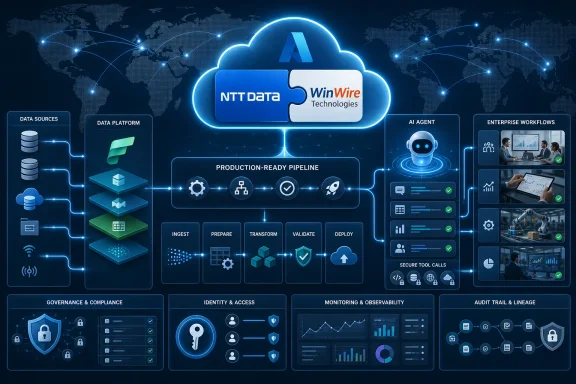 NTT DATA Is Buying the Part of AI That Enterprises Cannot Download
The most important thing about this deal is not the phrase “agentic AI,” though the announcement uses it generously. The important thing is capacity. NTT DATA says WinWire will add more than 1,000 Azure engineers and Microsoft specialists, including experience with Microsoft Fabric and Azure AI Foundry, to a global Microsoft practice that already spans more than 50 countries.That is the unglamorous bottleneck in enterprise AI. A CIO can buy Copilot licenses, approve Azure spend, and invite vendors to present roadmaps. None of that answers the harder questions: where the data lives, whether it is clean enough to trust, which workflows are safe to automate, how permissions propagate, how agents are monitored, and who is accountable when an automated decision takes a wrong turn.
WinWire’s value, at least as NTT DATA is framing it, sits in that gap between AI enthusiasm and operational reality. The company has built its reputation around Microsoft cloud modernization, data platforms, healthcare and software-sector work, and more recently agent-oriented frameworks. NTT DATA is effectively buying a Microsoft-native delivery engine at the moment when enterprise customers are trying to move from proofs of concept to production systems.
That matters because the AI market has entered a more demanding phase. In 2023 and 2024, many organizations were still asking what generative AI could do. By 2026, the boardroom question has shifted: which use cases can be made durable, governed, repeatable, and worth the cost? The winners in this stage are not necessarily the vendors with the best demo. They are the ones that can make AI survive procurement, security review, compliance testing, data integration, user adoption, and day-two operations.
The Microsoft Angle Is the Story, Not the Footnote
NTT DATA’s announcement leans heavily on Microsoft, and for good reason. WinWire is a Microsoft-focused firm with a long-standing Azure practice, Microsoft awards, Azure Marketplace offerings, and membership in Microsoft’s Agentic Partner Alliance. NTT DATA, meanwhile, was named Microsoft’s 2025 Global System Integrator Growth Champion Partner of the Year and has been expanding a dedicated Microsoft Cloud business unit covering cloud, security, and AI.That combination tells us where the deal is aimed. This is not a generic AI acquisition. It is an Azure and Microsoft Cloud scaling move.
For WindowsForum readers, the Microsoft specificity matters because the center of gravity in enterprise computing is no longer just Windows Server, Active Directory, Office, or endpoint management in isolation. The modern Microsoft estate is a stack: Entra ID, Microsoft 365, Defender, Purview, Fabric, Azure, Power Platform, GitHub, Copilot, Azure AI Foundry, and a growing collection of agent frameworks and orchestration services. The practical challenge is making those layers work together without producing a security, licensing, or governance hairball.
Microsoft’s own enterprise strategy increasingly depends on partners who can do that integration work. Redmond can ship platforms, reference architectures, and copilots, but many large customers still need an army of specialists to rationalize data estates, modernize applications, connect identity and governance, and build industry-specific workflows. NTT DATA buying WinWire is a signal that global systems integrators see Microsoft’s AI stack as a high-growth services battlefield.
There is also a defensive reading. Microsoft’s AI platform push has created opportunity, but also partner congestion. Every major consulting firm now claims AI transformation expertise. Every cloud integrator has an “AI factory.” Every managed services vendor has a governance framework. Buying WinWire gives NTT DATA more depth in a specific ecosystem rather than just more slogans in a crowded market.
“Agentic AI” Is Becoming the New Consulting Wrapper
The phrase agentic AI is doing a lot of work in this announcement. It refers, broadly, to AI systems that can take actions, use tools, follow multi-step instructions, and operate inside workflows with some degree of autonomy. That is a meaningful evolution from chatbot-style interfaces, but it is also a phrase vendors are now stretching to cover everything from scripted automation with a language-model front end to genuinely adaptive multi-agent systems.NTT DATA and WinWire are pitching the deal around that frontier. WinWire’s “Agentic AI @ Scale” framework is described as a way to design and deploy intelligent autonomous systems embedded directly into enterprise workflows. The phrasing is exactly what buyers want to hear: not experiments, not toy demos, but agents that live inside the business.
The catch is that agentic AI makes the old enterprise problems sharper. If a chatbot gives a bad answer, the damage may be reputational or operational. If an agent can trigger workflows, modify records, create tickets, approve exceptions, summarize regulated data, or call internal APIs, the blast radius changes. Suddenly the questions are about authorization, observability, rollback, audit trails, human approval thresholds, and whether the agent’s actions can be reconstructed after the fact.
That is where a services acquisition becomes more than corporate chess. Enterprise AI adoption is not being slowed only by model quality. It is being slowed by institutional fear, fragmented data, old applications, security review, and the painful reality that business processes are rarely as clean as vendor demos suggest. A firm that can package agent design, data readiness, governance, and managed operations into a Microsoft-aligned offering has something customers may actually buy.
NTT DATA Wants to Own the Journey from Pilot to Production
The announcement repeatedly contrasts experimentation with operationalization. That is not accidental. The AI services market is full of companies that helped clients launch pilots. The next wave of revenue belongs to firms that can convert scattered pilots into platforms, operating models, and measurable business outcomes.This is the classic systems integrator playbook, updated for the AI era. First, the client buys technology faster than the organization can absorb it. Then complexity spreads across departments. Then executives demand consolidation, governance, and ROI. Finally, a global integrator arrives to turn the chaos into a transformation program with workstreams, controls, dashboards, and a multiyear services contract.
NTT DATA has the scale to play that game. The company describes itself as a more than $30 billion business and technology services provider serving 75 percent of the Fortune Global 100, with experts in more than 70 countries. WinWire does not change NTT DATA’s size category. It changes the texture of its Microsoft AI bench.
That distinction is important. A 1,000-person addition is not transformational in headcount terms for a company of NTT DATA’s scale. But if those people sit in the right capability pocket — Azure AI, Fabric, data engineering, application modernization, healthcare, software platforms — they can become disproportionately useful. In services, the value of an acquisition is often not the number of employees added, but whether those employees can be deployed into large accounts where demand already exists.
NTT DATA’s client base gives WinWire a larger stage. WinWire’s Microsoft specialization gives NTT DATA more credibility in a hot segment where vague AI claims are no longer enough. The strategic logic is straightforward: combine global account access with specialized Azure execution, then sell AI transformation as an industrialized service rather than bespoke experimentation.
The Data Estate Is Still the Real AI Platform
The announcement mentions Microsoft Fabric and data engineering for a reason. AI agents may be the marketing hook, but data readiness is the foundation. Without governed, accessible, well-modeled, and contextually accurate data, enterprise AI systems become expensive guessers with polished user interfaces.This is especially true in Microsoft environments. Many organizations have data scattered across SQL Server, SharePoint, OneDrive, Teams, Dynamics, third-party SaaS platforms, legacy file shares, data lakes, warehouses, and custom line-of-business applications. Microsoft Fabric is meant to bring more of that analytics estate into a unified SaaS-like platform, but adoption still requires architecture, migration planning, semantic modeling, governance, and training.
WinWire’s background in data engineering and Azure modernization is therefore central to the deal. The glamorous part of AI is the agent that completes a workflow. The costly part is making sure the agent has access to the right knowledge, under the right permissions, with the right metadata, and without leaking sensitive information into places it does not belong.
For administrators and IT architects, that means this acquisition should be read less as “NTT DATA buys an AI company” and more as “NTT DATA buys Microsoft data-and-app modernization capacity for the AI wave.” That is a more useful framing because it reflects where budgets will actually go. Enterprises may say they want AI transformation, but they often end up paying for identity cleanup, app refactoring, data governance, integration plumbing, security architecture, and managed operations.
The uncomfortable truth is that AI has become the new business justification for old modernization work. That does not make the work fake. It may make it more urgent.
The Systems Integrator Is Back in Fashion
For years, cloud vendors sold a story of abstraction. Infrastructure would become elastic. Platforms would become managed. Low-code tools would reduce dependence on traditional development. SaaS would simplify operations. In that story, the systems integrator remained useful, but less central.AI has reversed some of that logic. The more powerful the platforms become, the more context they need. The more context they need, the more integration matters. The more integration matters, the more large organizations turn back to the firms that can assemble cross-functional teams, manage risk, and sit between vendor promises and enterprise reality.
That is why the NTT DATA-WinWire deal fits a broader industry pattern. Accenture, IBM, Capgemini, Cognizant, Deloitte, Infosys, TCS, Wipro, HCLTech, and others are all trying to claim the AI transformation layer. Some build practices organically. Some acquire specialist firms. Most do both. The target is not just advisory work; it is the long tail of implementation and managed services that follows.
Microsoft benefits from this competition. Every integrator that builds Azure AI capability becomes another route to consumption. Every successful Fabric implementation makes Microsoft’s data platform stickier. Every agentic workflow built on Azure services makes it harder for a customer to shift that workload elsewhere. In cloud economics, the partner ecosystem is not merely a channel. It is a force multiplier.
Customers should understand the incentive structure. A global integrator aligned closely with Microsoft can bring speed, expertise, and access to product engineering channels. It can also create a gravitational pull toward Microsoft-first architectures, even when a mixed-cloud or vendor-neutral approach might deserve consideration. That does not make the advice bad. It means buyers need to ask sharper questions.
The Deal Also Shows How AI Is Repricing Talent
NTT DATA is not acquiring only frameworks, accelerators, and customer relationships. It is acquiring people. More specifically, it is acquiring scarce Microsoft AI and Azure talent at a time when enterprises are struggling to staff cloud, data, security, and AI programs simultaneously.That labor dynamic is central to the AI services market. Enterprises can purchase software subscriptions quickly, but they cannot instantly manufacture senior data engineers, Azure architects, AI governance specialists, prompt-and-agent designers, MLOps engineers, security architects, and industry-specific consultants. The constraint is human capability as much as platform maturity.
WinWire’s more than 1,000 engineers and specialists give NTT DATA a larger bench for delivery. Just as importantly, they give NTT DATA a workforce already oriented around Microsoft’s enterprise cloud. In a market where every services company is retraining staff on AI, acquiring a focused partner can be faster than building the same capability from scratch.
There is a cultural risk, too. Specialist firms often win because they are focused, close to customers, and able to move faster than the giants. Once absorbed into a global services organization, they can gain reach but lose some of that sharpness. NTT DATA’s challenge will be to scale WinWire’s expertise without flattening it into generic delivery capacity.
That challenge is familiar in technology acquisitions. The acquiring company wants repeatable offerings and global leverage. The acquired company’s value often lives in relationships, craft knowledge, and a concentration of specialists who know how to solve problems before they become playbooks. Whether the deal succeeds will depend partly on how much of WinWire’s operating DNA survives the integration.
For Customers, Bigger Can Be Better — Until It Isn’t
Large enterprises often prefer large vendors because accountability matters. If an AI deployment touches regulated data, customer service, clinical workflows, supply chains, or financial operations, a boutique consultancy may not be enough. Global delivery, managed services, compliance experience, and executive-level escalation all have value.NTT DATA can credibly argue that WinWire’s capabilities become more useful inside a larger machine. A healthcare customer modernizing data platforms and deploying AI-assisted workflows may need Azure engineering, security, regulatory awareness, app modernization, change management, and 24/7 operations. Few specialist firms can provide all of that globally.
But scale introduces trade-offs. Bigger providers can bring more process than agility. They can steer clients toward standardized offerings even when the business problem is idiosyncratic. They can also become deeply embedded in a customer’s operations, making later vendor changes expensive and politically difficult.
For IT leaders, the right response is not cynicism. It is procurement discipline. If NTT DATA comes to the table with WinWire-enhanced Microsoft AI offerings, customers should ask how the proposed architecture handles identity, permissions, logging, model evaluation, data lineage, cost controls, fallback procedures, and exit options. The AI demo is the beginning of the conversation, not the end.
This is especially true for agentic systems. A workflow agent that saves time in a pilot can become a liability if it lacks monitoring, role-based controls, test coverage, and clear human escalation paths. Buyers should demand evidence that the integrator can operate the system safely after launch, not just build it convincingly before the steering committee meeting.
The Windows Estate Is Becoming an AI Control Plane
This deal is not about Windows in the narrow sense, but it is very much about the Microsoft estate that Windows anchors in most enterprises. The modern workplace runs through Windows endpoints, Microsoft 365 identities, Teams collaboration, SharePoint content, Defender telemetry, and Azure-hosted applications. AI systems that touch enterprise work will inevitably touch that fabric.That creates an opportunity and a burden for administrators. On the opportunity side, Microsoft-centric AI deployments can use existing identity, compliance, device management, and productivity investments. On the burden side, weaknesses in those foundations become AI risks. Over-permissive SharePoint sites, stale groups, unmanaged devices, weak data classification, and sprawling service principals are no longer just hygiene problems. They are potential fuel for automated systems that can act faster than humans can audit.
The NTT DATA-WinWire combination should therefore be seen as part of a broader shift in enterprise IT. AI is pushing organizations to revisit the fundamentals of Microsoft administration. Entra ID configuration, conditional access, Purview policies, Defender posture, data governance, endpoint compliance, and application modernization all become prerequisites for trustworthy automation.
That is why the deal has practical significance beyond the M&A headline. If you manage Microsoft environments, you will likely see more service offerings framed around “AI readiness” that are really assessments of identity, data, security, and application estates. Some will be marketing fluff. Some will be necessary. The trick is telling the difference.
A useful AI-readiness engagement should produce more than a slide deck. It should identify which data sources are safe to expose, which workflows are candidates for automation, which permissions need remediation, which systems require integration work, and which use cases should be deferred because the governance model is not ready. Anything less is just transformation theater.
The Market Forecasts Are Huge, but the Near-Term Work Is Mundane
The announcement cites analyst estimates suggesting the global AI market could grow from $390 billion to nearly $3.5 trillion over the next decade. Numbers that large tend to blur more than they clarify. They are useful as a signal of investor and enterprise expectations, but they do not tell an IT department what to do on Monday morning.The near-term work is more prosaic. Organizations need to inventory data. They need to decide which AI use cases have business value. They need to establish governance bodies that can move faster than traditional risk committees without becoming rubber stamps. They need to budget for consumption costs that may be difficult to forecast. They need to train users without pretending that a one-hour webinar creates AI literacy.
That is the market NTT DATA is positioning itself to serve. The company is not merely chasing a futuristic vision of autonomous enterprises. It is chasing the backlog of tasks that must happen before that vision becomes safe enough for large organizations to trust.
This is also where Microsoft’s platform strategy intersects with customer anxiety. Azure AI Foundry, Fabric, Copilot, and Microsoft’s security and governance tools give enterprises a coherent path if they are already committed to the ecosystem. But coherence is not the same as simplicity. The stack is powerful because it is broad, and difficult because it is broad.
NTT DATA’s acquisition of WinWire is an attempt to make that breadth sellable as a managed transformation journey. For Microsoft, that is helpful. For customers, it could be useful. For competitors, it is another sign that the AI services race is consolidating around platform-specific depth rather than generic AI branding.
The Real Test Will Come After the Press Release
The announcement does not disclose financial terms, and the transaction still needs to close. That leaves important questions unanswered. How will WinWire be integrated? Will its leadership remain in place? How much autonomy will its Microsoft practice retain? How quickly will its frameworks be folded into NTT DATA’s broader offerings?Those questions matter because acquisition announcements are optimized for strategic clarity. Integration is where clarity meets incentives, systems, reporting structures, compensation plans, delivery methodologies, and customer politics. A good acquisition can stall if the acquiring company cannot preserve what made the target valuable.
There is also the question of differentiation. Every major services provider now claims to help clients move from AI pilots to enterprise scale. NTT DATA and WinWire will need to prove that their combined approach is not just another branded framework. In practice, that proof will come through reference customers, repeatable deployments, measurable productivity gains, reduced operational risk, and the ability to manage AI systems after go-live.
The Microsoft connection gives them a credible wedge. WinWire’s existing Azure specialization and NTT DATA’s global Microsoft recognition create a stronger story than a generic AI consultancy pitch. But credibility is not permanence. In the AI services market, the shelf life of differentiation is short unless it is backed by delivery quality.
The best version of this deal gives NTT DATA a sharper Microsoft AI practice and gives WinWire’s customers access to broader global capabilities. The weaker version turns a focused specialist into one more practice inside a large consulting portfolio. The difference will show up not in the announcement language, but in the quality of projects that follow.
The Azure AI Land Grab Now Has a Services Supply Chain
The concrete meaning of the deal is easier to see when stripped of the celebratory language. NTT DATA is increasing its Microsoft AI delivery capacity at the moment enterprises are discovering that AI deployment is an integration problem, not just a licensing decision.- NTT DATA announced the definitive agreement to acquire WinWire on May 15, 2026, and the deal remains subject to customary closing conditions and regulatory approvals.
- WinWire is expected to add more than 1,000 Azure engineers and Microsoft specialists to NTT DATA after closing.
- The acquisition strengthens NTT DATA’s Microsoft Cloud and AI practice, particularly around Azure AI, Microsoft Fabric, data engineering, cloud-native applications, and agentic AI.
- The strategic bet is that enterprises will spend heavily on moving AI from pilots into governed production workflows.
- The practical risk for customers is that agentic AI raises the stakes for identity, permissions, observability, data governance, and operational accountability.
- The deal is best understood as part of a broader consolidation race among global systems integrators seeking scarce AI and cloud engineering talent.
Source: STT Info NTT DATA Announces Intent to Acquire WinWire to Scale Enterprise AI Adoption and Accelerate Industry Transformation with Microsoft | Business Wire
