

NTT DATA signed a definitive agreement in May 2026 to acquire Santa Clara-based WinWire, a Microsoft-focused AI and Azure services partner, adding more than 1,000 Azure engineers and AI specialists to expand enterprise AI, agentic AI, data engineering, and cloud-native transformation work. The deal is not just another services roll-up dressed in AI language. It is a bet that the next phase of enterprise AI will be won less by model demos than by the unglamorous capacity to wire data, applications, identity, security, governance, and operations into production systems. For Microsoft customers, that makes this acquisition worth watching: it strengthens one of the big global integrators at precisely the moment Azure AI projects are moving from pilot budgets into board-level transformation programs.
The most important number in the announcement is not the projected size of the AI market, nor the familiar promise of “enterprise-wide transformation.” It is the addition of more than 1,000 Azure engineers and Microsoft specialists. In services, headcount with the right certifications, customer scars, and platform muscle is not an input; it is the product.
WinWire gives NTT DATA a sharper Microsoft edge in areas that are now central to AI modernization: Microsoft Fabric, Azure AI Foundry, cloud-native application development, data engineering, and agentic AI. These are not standalone practices anymore. A serious AI deployment depends on modern data pipelines, application refactoring, secure access patterns, observability, and change management.
That is why the acquisition lands differently from a pure software deal. NTT DATA is not buying a model, a chatbot, or a narrow AI tool. It is buying a delivery organization that can help turn Microsoft’s rapidly expanding AI stack into working systems inside regulated, complex, and politically difficult enterprises.
The timing matters. The first wave of generative AI adoption rewarded experimentation. The next wave will punish companies that confuse a successful proof of concept with a production platform.
That gap is where systems integrators thrive. Microsoft can ship Azure AI services, Copilot tooling, Fabric, and developer frameworks at cloud speed. But a hospital network, bank, manufacturer, or global retailer still needs someone to connect those tools to existing applications, compliance regimes, identity systems, and operating models.
WinWire’s appeal is that it sits in that messy middle. Its profile is not merely “AI consulting,” a phrase now so overused that it can mean anything from prompt workshops to full-stack modernization. The company’s public positioning emphasizes Azure-native engineering, data modernization, application modernization, and agentic AI frameworks embedded into business workflows.
That is the part NTT DATA wants. The enterprise market is no longer asking whether generative AI can draft text or summarize documents. It is asking whether AI can safely trigger actions, coordinate across systems, assist employees in line-of-business processes, and produce measurable business outcomes.
NTT DATA’s WinWire deal shows why the term has become so commercially important. If AI agents are going to move from toy workflows to enterprise operations, customers need architecture, governance, monitoring, exception handling, and integration patterns. That is services-heavy work, and it favors firms that can bring both domain knowledge and platform depth.
WinWire’s “Agentic AI @ Scale” framing fits directly into that demand. The promise is not simply to create autonomous systems, but to embed them into enterprise workflows. That distinction is critical. An agent that can retrieve a document is interesting; an agent that can help a claims processor, clinical administrator, procurement analyst, or support engineer complete a governed process is where budgets start to move.
The risk, of course, is that agentic AI becomes the new transformation theater. Enterprises have seen this movie before with robotic process automation, low-code platforms, and early cloud migrations. The technology can be valuable, but only when the process work is real and the operating model changes with it.
This is where NTT DATA’s Microsoft practice becomes strategically important. The company says its Microsoft Cloud business spans more than 50 countries and is supported by more than 24,000 Microsoft certifications. Those figures are designed to signal scale, but they also point to the real challenge: Microsoft transformation is now a global operating model problem, not a local migration project.
Adding WinWire deepens NTT DATA’s bench in the part of the Microsoft ecosystem where demand is hottest. Fabric and Azure AI Foundry are not merely product names in a slide deck. They are the places where data strategy, AI application development, governance, and developer productivity increasingly collide.
For IT leaders, the practical takeaway is that the Microsoft partner ecosystem is consolidating around production AI. The smaller specialist partners that proved they could modernize apps, engineer data, and build AI on Azure are becoming attractive acquisition targets for global firms that need credibility and capacity.
The WinWire acquisition reinforces that dependency. Microsoft’s own executive endorsement of the combination makes sense: a stronger NTT DATA Microsoft practice helps Microsoft sell more Azure, more AI services, and more industry transformation work. The cloud platform wins when partners can reduce friction for customers.
That does not mean customers should see every partner-backed transformation as neutral advice. Global systems integrators have incentives. Microsoft has incentives. Customers have to separate architectural necessity from platform gravity.
Still, the partner model is not going away. If anything, agentic AI makes it more important. The more AI systems act across applications and business processes, the more customers will need implementation partners that understand not just cloud services but also security boundaries, data contracts, workflow design, and organizational risk.
That is why a services acquisition can matter more than a flashy product launch. Most large organizations already have fragments of the Microsoft stack. They may have Azure commitments, Microsoft 365 licenses, Power Platform adoption, GitHub usage, Defender deployments, and data estates spread across SQL Server, lakehouses, warehouses, SaaS applications, and legacy systems.
The real question is whether those pieces can support AI at scale. Are permissions clean enough? Is the data reliable enough? Are applications modern enough to expose useful interfaces? Are risk teams comfortable with agent actions? Can the business measure outcomes beyond “hours saved” anecdotes?
NTT DATA is positioning the WinWire acquisition as an answer to those questions. The pitch is that combining global managed services and industry expertise with WinWire’s Azure and AI specialization will help customers move from experimentation to enterprise deployment. That is plausible, but it will be tested one implementation at a time.
For North American customers, this can mean faster access to Microsoft-specialized talent. For NTT DATA, it adds depth in a market where cloud and AI modernization projects are increasingly constrained by available expertise. The talent market for experienced Azure AI, Fabric, and cloud-native engineers remains competitive, especially when customers need people who understand both Microsoft tooling and enterprise delivery.
The acquisition also fits a broader pattern in IT services: global integrators are buying specialist cloud and AI firms not because they lack slogans, but because they need teams that have already built repeatable delivery methods. Hiring and training that capacity organically is slower. Buying it compresses the timeline.
That compression is valuable in a market where every major consultancy is trying to look credible on enterprise AI. The winners will be those that can show not just thought leadership, but implementation throughput.
That budget shift changes buyer behavior. A small proof of concept can be funded by innovation teams. A production AI platform usually involves the CIO, CISO, CFO, legal, procurement, business unit leaders, and sometimes regulators. The buying cycle becomes more serious because the blast radius becomes larger.
In that environment, Microsoft’s platform breadth is an advantage, but only if customers can make it operational. NTT DATA’s bet is that enterprises will prefer a partner that can combine AI engineering, cloud migration, data modernization, security, and managed services under one umbrella. WinWire gives it more credibility in the Microsoft-specific version of that story.
The pressure will be on NTT DATA to prove that the acquisition creates more than a larger bench. Customers will expect reusable accelerators, faster deployments, better governance patterns, and industry-specific solutions that do not collapse into generic consulting decks.
Agentic AI makes the security question sharper. A chatbot that answers a question can leak data or hallucinate. An AI agent that takes action can create, modify, delete, approve, route, or escalate business activity. The more useful the agent, the more dangerous it becomes if identity, permissions, logging, and human oversight are poorly designed.
Microsoft customers already live with complex identity and access environments. Entra ID, conditional access, privileged identity management, Defender, Purview, and application-specific permissions all become part of the AI governance picture. A partner that claims to deliver agentic AI at scale must understand these controls deeply.
This is where WinWire’s Microsoft focus could prove valuable. AI governance is not an abstract policy layer that can be bolted on after deployment. In Microsoft-heavy environments, it must be built through the data estate, app architecture, identity model, and operational monitoring.
That is not automatic. Specialist firms often succeed because they are focused, entrepreneurial, and close to customers. Large integrators succeed because they can scale, govern, sell globally, and manage complex accounts. Combining those strengths is the theory; burying the specialist inside a larger bureaucracy is the risk.
There is also the question of talent retention. In services acquisitions, the assets go home every night. If key architects, practice leaders, and delivery managers leave, the strategic value of the deal can erode quickly. NTT DATA will need to make WinWire’s engineers and leaders feel that the larger platform expands their opportunity rather than absorbs their identity.
Customers should watch how the combined company packages WinWire’s capabilities over the next year. If the acquisition results in clearer offerings, stronger delivery, and more industry-specific Azure AI patterns, it will look smart. If WinWire becomes just another logo in a global services brochure, the market will notice.
Windows administrators have already watched their roles stretch into identity, endpoint management, cloud security, automation, and Microsoft 365 governance. AI will stretch them further. When enterprises deploy AI agents against internal systems, the operational burden lands on the same teams that manage access, devices, data protection, service reliability, and incident response.
A stronger NTT DATA Microsoft practice means more large customers may be pushed toward Azure-centered AI architectures. That does not make Azure the only viable path, but it does reinforce Microsoft’s position as the default enterprise AI platform for organizations already invested in its stack.
The practical consequences will show up in less glamorous ways than keynote demos. Expect more demand for clean identity groups, better data classification, application modernization, API exposure, logging standards, and policy enforcement. AI transformation will sound like a boardroom initiative, but it will generate tickets in the admin queue.
This matters because enterprise software is not sold purely on technical merit. It is sold through relationships, procurement channels, marketplace commitments, cloud consumption targets, and executive confidence. A combined NTT DATA-WinWire practice can walk into customers with both global scale and specialist Microsoft AI credentials.
For Microsoft, that is useful. For NTT DATA, it is leverage. For customers, it is both an opportunity and a reason to stay alert.
The opportunity is access to a partner with enough depth to execute across multiple layers of the stack. The caution is that co-sell alignment can narrow the field of recommended options. A Microsoft-first partner may be exactly what a Microsoft-first enterprise needs, but architecture decisions should still be tested against workload requirements, data realities, cost models, and operational risk.
That demand favors companies with repeatable methods. It also favors firms with enough scale to staff complex programs and enough specialization to avoid generic transformation sprawl. NTT DATA is trying to occupy that middle ground by adding WinWire’s Microsoft-centered expertise to its global delivery model.
The deal also signals that AI services are becoming more vertical. Horizontal demos can attract attention, but enterprise budgets often unlock around industry-specific problems: claims, clinical workflows, manufacturing quality, supply chain exceptions, financial risk, customer service, software engineering, and compliance operations. WinWire’s industry specialization gives NTT DATA more material to build around.
The broader market should expect more acquisitions like this. The AI implementation bottleneck is real, and large integrators cannot meet demand through hiring alone. Specialist firms with cloud-native engineering, data modernization, and AI deployment credibility are now strategic assets.
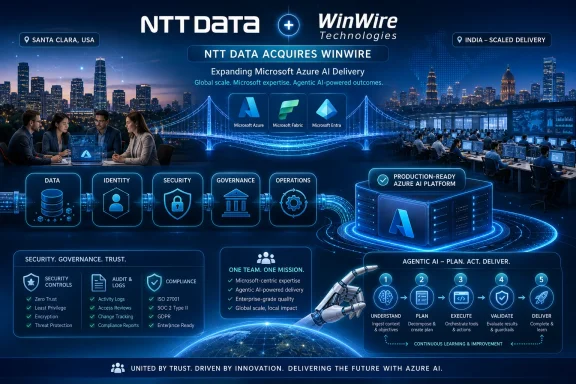 NTT DATA Is Buying Delivery Capacity, Not Just AI Branding
The most important number in the announcement is not the projected size of the AI market, nor the familiar promise of “enterprise-wide transformation.” It is the addition of more than 1,000 Azure engineers and Microsoft specialists. In services, headcount with the right certifications, customer scars, and platform muscle is not an input; it is the product.WinWire gives NTT DATA a sharper Microsoft edge in areas that are now central to AI modernization: Microsoft Fabric, Azure AI Foundry, cloud-native application development, data engineering, and agentic AI. These are not standalone practices anymore. A serious AI deployment depends on modern data pipelines, application refactoring, secure access patterns, observability, and change management.
That is why the acquisition lands differently from a pure software deal. NTT DATA is not buying a model, a chatbot, or a narrow AI tool. It is buying a delivery organization that can help turn Microsoft’s rapidly expanding AI stack into working systems inside regulated, complex, and politically difficult enterprises.
The timing matters. The first wave of generative AI adoption rewarded experimentation. The next wave will punish companies that confuse a successful proof of concept with a production platform.
The Enterprise AI Story Has Moved Past the Demo Room
For the last two years, enterprise AI has lived in a strange split-screen reality. Executives have demanded rapid experimentation, vendors have promised productivity breakthroughs, and IT teams have been left to answer the practical questions: where does the data live, who is allowed to see it, how is output audited, and what happens when the workflow breaks at 2 a.m.?That gap is where systems integrators thrive. Microsoft can ship Azure AI services, Copilot tooling, Fabric, and developer frameworks at cloud speed. But a hospital network, bank, manufacturer, or global retailer still needs someone to connect those tools to existing applications, compliance regimes, identity systems, and operating models.
WinWire’s appeal is that it sits in that messy middle. Its profile is not merely “AI consulting,” a phrase now so overused that it can mean anything from prompt workshops to full-stack modernization. The company’s public positioning emphasizes Azure-native engineering, data modernization, application modernization, and agentic AI frameworks embedded into business workflows.
That is the part NTT DATA wants. The enterprise market is no longer asking whether generative AI can draft text or summarize documents. It is asking whether AI can safely trigger actions, coordinate across systems, assist employees in line-of-business processes, and produce measurable business outcomes.
Agentic AI Is Becoming the New Consulting Battleground
The phrase agentic AI deserves skepticism because it has already been inflated by vendor marketing. At its most useful, it refers to AI systems that do more than answer a prompt: they plan, use tools, call APIs, retrieve data, interact with business systems, and complete multi-step tasks under defined controls. At its worst, it is a glossy label for brittle automation with a chatbot attached.NTT DATA’s WinWire deal shows why the term has become so commercially important. If AI agents are going to move from toy workflows to enterprise operations, customers need architecture, governance, monitoring, exception handling, and integration patterns. That is services-heavy work, and it favors firms that can bring both domain knowledge and platform depth.
WinWire’s “Agentic AI @ Scale” framing fits directly into that demand. The promise is not simply to create autonomous systems, but to embed them into enterprise workflows. That distinction is critical. An agent that can retrieve a document is interesting; an agent that can help a claims processor, clinical administrator, procurement analyst, or support engineer complete a governed process is where budgets start to move.
The risk, of course, is that agentic AI becomes the new transformation theater. Enterprises have seen this movie before with robotic process automation, low-code platforms, and early cloud migrations. The technology can be valuable, but only when the process work is real and the operating model changes with it.
Microsoft’s Cloud Stack Is Turning Into an Integration Problem
Microsoft’s enterprise advantage has always been breadth. Azure, Microsoft 365, Dynamics, Power Platform, GitHub, Fabric, Defender, Entra, and Copilot together form a sprawling estate that touches nearly every layer of modern corporate IT. That breadth is also a problem. Customers need help deciding what to use, how to connect it, and how to avoid building yet another expensive platform maze.This is where NTT DATA’s Microsoft practice becomes strategically important. The company says its Microsoft Cloud business spans more than 50 countries and is supported by more than 24,000 Microsoft certifications. Those figures are designed to signal scale, but they also point to the real challenge: Microsoft transformation is now a global operating model problem, not a local migration project.
Adding WinWire deepens NTT DATA’s bench in the part of the Microsoft ecosystem where demand is hottest. Fabric and Azure AI Foundry are not merely product names in a slide deck. They are the places where data strategy, AI application development, governance, and developer productivity increasingly collide.
For IT leaders, the practical takeaway is that the Microsoft partner ecosystem is consolidating around production AI. The smaller specialist partners that proved they could modernize apps, engineer data, and build AI on Azure are becoming attractive acquisition targets for global firms that need credibility and capacity.
The Deal Also Reveals Microsoft’s Dependency on Partners
Microsoft often speaks as if platform adoption flows naturally from product innovation. The reality is more complicated. The company needs a large partner ecosystem to turn cloud services into enterprise deployments, especially in industries where buying technology is easier than changing operations.The WinWire acquisition reinforces that dependency. Microsoft’s own executive endorsement of the combination makes sense: a stronger NTT DATA Microsoft practice helps Microsoft sell more Azure, more AI services, and more industry transformation work. The cloud platform wins when partners can reduce friction for customers.
That does not mean customers should see every partner-backed transformation as neutral advice. Global systems integrators have incentives. Microsoft has incentives. Customers have to separate architectural necessity from platform gravity.
Still, the partner model is not going away. If anything, agentic AI makes it more important. The more AI systems act across applications and business processes, the more customers will need implementation partners that understand not just cloud services but also security boundaries, data contracts, workflow design, and organizational risk.
For CIOs, The Problem Is No Longer Finding AI Tools
The enterprise AI market is crowded with tools. There are copilots, agents, orchestration layers, vector databases, model gateways, AI governance products, data catalogs, workflow engines, and vertical accelerators. The bottleneck is increasingly the ability to assemble them into something coherent.That is why a services acquisition can matter more than a flashy product launch. Most large organizations already have fragments of the Microsoft stack. They may have Azure commitments, Microsoft 365 licenses, Power Platform adoption, GitHub usage, Defender deployments, and data estates spread across SQL Server, lakehouses, warehouses, SaaS applications, and legacy systems.
The real question is whether those pieces can support AI at scale. Are permissions clean enough? Is the data reliable enough? Are applications modern enough to expose useful interfaces? Are risk teams comfortable with agent actions? Can the business measure outcomes beyond “hours saved” anecdotes?
NTT DATA is positioning the WinWire acquisition as an answer to those questions. The pitch is that combining global managed services and industry expertise with WinWire’s Azure and AI specialization will help customers move from experimentation to enterprise deployment. That is plausible, but it will be tested one implementation at a time.
The Geography of the Deal Matters
WinWire is headquartered in Santa Clara, California, with delivery centers in India. That geography is not incidental. It gives NTT DATA a familiar but powerful services pattern: proximity to U.S. enterprise customers and Microsoft’s West Coast ecosystem, combined with scaled engineering delivery from India.For North American customers, this can mean faster access to Microsoft-specialized talent. For NTT DATA, it adds depth in a market where cloud and AI modernization projects are increasingly constrained by available expertise. The talent market for experienced Azure AI, Fabric, and cloud-native engineers remains competitive, especially when customers need people who understand both Microsoft tooling and enterprise delivery.
The acquisition also fits a broader pattern in IT services: global integrators are buying specialist cloud and AI firms not because they lack slogans, but because they need teams that have already built repeatable delivery methods. Hiring and training that capacity organically is slower. Buying it compresses the timeline.
That compression is valuable in a market where every major consultancy is trying to look credible on enterprise AI. The winners will be those that can show not just thought leadership, but implementation throughput.
The Market Forecast Is Less Important Than The Budget Shift
The announcement cites analyst estimates that the global AI market could grow from hundreds of billions of dollars to several trillion over the next decade. Such numbers are useful for investor decks, but they can obscure the nearer-term reality. Enterprises are not waiting for a trillion-dollar abstraction; they are reallocating current budgets from experimentation to implementation.That budget shift changes buyer behavior. A small proof of concept can be funded by innovation teams. A production AI platform usually involves the CIO, CISO, CFO, legal, procurement, business unit leaders, and sometimes regulators. The buying cycle becomes more serious because the blast radius becomes larger.
In that environment, Microsoft’s platform breadth is an advantage, but only if customers can make it operational. NTT DATA’s bet is that enterprises will prefer a partner that can combine AI engineering, cloud migration, data modernization, security, and managed services under one umbrella. WinWire gives it more credibility in the Microsoft-specific version of that story.
The pressure will be on NTT DATA to prove that the acquisition creates more than a larger bench. Customers will expect reusable accelerators, faster deployments, better governance patterns, and industry-specific solutions that do not collapse into generic consulting decks.
Security Is The Clause Hidden Inside Every AI Promise
The announcement repeatedly frames the combined capability as secure, scalable, and enterprise-ready. That language is predictable, but it is not filler. Security is the issue that separates AI experimentation from AI adoption in serious organizations.Agentic AI makes the security question sharper. A chatbot that answers a question can leak data or hallucinate. An AI agent that takes action can create, modify, delete, approve, route, or escalate business activity. The more useful the agent, the more dangerous it becomes if identity, permissions, logging, and human oversight are poorly designed.
Microsoft customers already live with complex identity and access environments. Entra ID, conditional access, privileged identity management, Defender, Purview, and application-specific permissions all become part of the AI governance picture. A partner that claims to deliver agentic AI at scale must understand these controls deeply.
This is where WinWire’s Microsoft focus could prove valuable. AI governance is not an abstract policy layer that can be bolted on after deployment. In Microsoft-heavy environments, it must be built through the data estate, app architecture, identity model, and operational monitoring.
The Integration Risk Sits Behind The Celebration
Every acquisition announcement describes complementarity. The harder work begins after closing. NTT DATA will have to integrate WinWire’s people, delivery methods, customer relationships, and culture without diluting the specialization that made the company worth buying.That is not automatic. Specialist firms often succeed because they are focused, entrepreneurial, and close to customers. Large integrators succeed because they can scale, govern, sell globally, and manage complex accounts. Combining those strengths is the theory; burying the specialist inside a larger bureaucracy is the risk.
There is also the question of talent retention. In services acquisitions, the assets go home every night. If key architects, practice leaders, and delivery managers leave, the strategic value of the deal can erode quickly. NTT DATA will need to make WinWire’s engineers and leaders feel that the larger platform expands their opportunity rather than absorbs their identity.
Customers should watch how the combined company packages WinWire’s capabilities over the next year. If the acquisition results in clearer offerings, stronger delivery, and more industry-specific Azure AI patterns, it will look smart. If WinWire becomes just another logo in a global services brochure, the market will notice.
Windows Shops Should Read This As An Azure Signal
For WindowsForum readers, the deal matters because Microsoft’s AI strategy is not confined to consumer Copilot or Windows features. The enterprise side of the Microsoft ecosystem is being rebuilt around Azure AI, Fabric, security, developer tooling, and managed cloud transformation. That affects the architectures IT pros will be asked to support.Windows administrators have already watched their roles stretch into identity, endpoint management, cloud security, automation, and Microsoft 365 governance. AI will stretch them further. When enterprises deploy AI agents against internal systems, the operational burden lands on the same teams that manage access, devices, data protection, service reliability, and incident response.
A stronger NTT DATA Microsoft practice means more large customers may be pushed toward Azure-centered AI architectures. That does not make Azure the only viable path, but it does reinforce Microsoft’s position as the default enterprise AI platform for organizations already invested in its stack.
The practical consequences will show up in less glamorous ways than keynote demos. Expect more demand for clean identity groups, better data classification, application modernization, API exposure, logging standards, and policy enforcement. AI transformation will sound like a boardroom initiative, but it will generate tickets in the admin queue.
The Co-Sell Machine Is Part Of The Product
NTT DATA’s recognition as Microsoft’s Global System Integrator Growth Champion Partner of the Year is not just an award plaque. In the Microsoft ecosystem, partner status affects access, co-selling, customer introductions, technical alignment, and credibility. WinWire’s own Microsoft awards and partner standing add to that machinery.This matters because enterprise software is not sold purely on technical merit. It is sold through relationships, procurement channels, marketplace commitments, cloud consumption targets, and executive confidence. A combined NTT DATA-WinWire practice can walk into customers with both global scale and specialist Microsoft AI credentials.
For Microsoft, that is useful. For NTT DATA, it is leverage. For customers, it is both an opportunity and a reason to stay alert.
The opportunity is access to a partner with enough depth to execute across multiple layers of the stack. The caution is that co-sell alignment can narrow the field of recommended options. A Microsoft-first partner may be exactly what a Microsoft-first enterprise needs, but architecture decisions should still be tested against workload requirements, data realities, cost models, and operational risk.
The AI Services Market Is Consolidating Around Proof
The services market is full of firms claiming AI transformation expertise. The difference now is that customers are beginning to ask for proof: production deployments, industry accelerators, measurable outcomes, responsible AI frameworks, and teams that can operate beyond the pilot stage.That demand favors companies with repeatable methods. It also favors firms with enough scale to staff complex programs and enough specialization to avoid generic transformation sprawl. NTT DATA is trying to occupy that middle ground by adding WinWire’s Microsoft-centered expertise to its global delivery model.
The deal also signals that AI services are becoming more vertical. Horizontal demos can attract attention, but enterprise budgets often unlock around industry-specific problems: claims, clinical workflows, manufacturing quality, supply chain exceptions, financial risk, customer service, software engineering, and compliance operations. WinWire’s industry specialization gives NTT DATA more material to build around.
The broader market should expect more acquisitions like this. The AI implementation bottleneck is real, and large integrators cannot meet demand through hiring alone. Specialist firms with cloud-native engineering, data modernization, and AI deployment credibility are now strategic assets.
The WinWire Deal Narrows The Gap Between AI Ambition And IT Reality
The clearest reading of the acquisition is that NTT DATA wants to own more of the difficult middle: the space between Microsoft’s AI platform roadmap and the customer’s messy operating environment. That is where enterprise value will be created or lost.- NTT DATA is acquiring WinWire to deepen Microsoft Azure, data engineering, cloud-native development, and agentic AI delivery capacity.
- WinWire brings more than 1,000 Azure engineers and AI specialists, which gives the deal immediate services scale rather than just strategic positioning.
- The acquisition strengthens NTT DATA’s ability to pursue production AI programs built on Microsoft Fabric, Azure AI Foundry, and modern application architectures.
- Microsoft benefits because stronger global systems integrator capacity can accelerate Azure AI adoption among large enterprise customers.
- Customers should treat the deal as a sign that AI projects are moving from pilots into governed, integrated, production-grade transformation programs.
- The main execution risks are talent retention, integration complexity, and whether NTT DATA can preserve WinWire’s specialist edge inside a much larger organization.
References
- Primary source: Intelligent CIO
Published: 2026-05-18T06:30:08.016753
- Related coverage: us.nttdata.com
NTT DATA Announces Intent to Acquire WinWire | NTT DATA
NTT DATA announces plans to acquire WinWire to expand Microsoft-focused AI and cloud capabilities, accelerating enterprise AI adoption, scaling Azure expertise, and driving industry transformation worldwide. us.nttdata.com
- Related coverage: unite.ai
NTT DATA Acquires WinWire to Expand Agentic AI and Microsoft Azure Enterprise Transformation Capabilities – Unite.AI
NTT DATA has announced plans to acquire WinWire, a Santa Clara-based Microsoft partner focused on agentic AI, Azure-native development, cloud modernization, and enterprise data engineering. The deal reflects a broader sh...www.unite.ai
- Related coverage: winwire.com
Microsoft Partner | Azure Partner | Bay Area | WinWire
WinWire is a Microsoft Partner, helping clients accelerate their frontier firm journeywww.winwire.com
- Related coverage: rcpmag.com
NTT DATA Plans Acquisition of WinWire to Expand Enterprise AI Services -- Redmond Channel Partner
Deal is aimed at accelerating AI adoption and Microsoft-focused transformation initiatives across industries.rcpmag.com - Related coverage: windowsforum.com
NTT DATA Acquires WinWire to Scale Production AI on Microsoft Azure | Windows Forum
NTT DATA announced on May 18, 2026, that it has signed a definitive agreement to acquire WinWire, a Santa Clara-based Microsoft partner with delivery...windowsforum.com

- Related coverage: teamnames.online
NTT DATA Acquires WinWire to Scale Enterprise AI and Azure Services - Team Names
NTT DATA has officially entered into a definitive agreement to acquire WinWire, a specialized Microsoft cloud and AI consultancy based in Silicon Valley. This move...teamnames.online - Related coverage: nttdata.com
notice regarding the disposal of fixed assets data center by consolidated subsidiaries en
PDF documentwww.nttdata.com
