

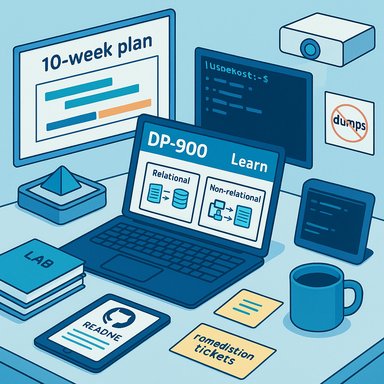
The Server Side’s DP-900 practice-exam guide reframes exam prep as a hands‑on engineering exercise: use Microsoft Learn as the syllabus, run reproducible sandbox labs, treat practice tests as diagnostics, and avoid leaked “brain dumps” that promise shortcut passes but carry legal, ethical, and career risks.
Microsoft’s DP-900: Microsoft Azure Data Fundamentals exam measures foundational knowledge of core data concepts and how Microsoft Azure implements them. The official skills outline groups the exam into four domains — core data concepts; relational data on Azure; non‑relational data on Azure; and analytics workloads — with domain weights that show where to focus study time. A passing score is 700 on Microsoft’s scale, and Microsoft explicitly offers a free practice assessment and an exam sandbox to preview question types and timing. The Server Side piece positions itself as a pragmatic companion to those official resources: it supplies curated sample Q&A sets that emphasize scenario-driven reasoning, a reproducible 10‑week study plan built around labs and remediation tickets, and a set of vendor‑selection criteria for paid practice tests. That material is meant to convert transient familiarity with question wording into operational competence you can show in interviews and on the job.
Conclusion
Effective DP‑900 preparation is not a race to memorize question phrasing — it’s a disciplined engineering practice. The Server Side’s guidance helps candidates turn practice tests into learning instruments, offers clear vendor selection criteria, and warns about the legal and career costs of exam dumps. When paired with Microsoft Learn, a sandbox for labs, and a reputable timed simulator, the Server Side approach becomes a powerful, ethical, and practical route to both passing the Microsoft Azure Data Fundamentals exam and gaining the foundational skills employers expect.
Source: The Server Side DP-900 Microsoft Data Fundamentals Practice Exams
 Background / Overview
Microsoft’s DP-900: Microsoft Azure Data Fundamentals exam measures foundational knowledge of core data concepts and how Microsoft Azure implements them. The official skills outline groups the exam into four domains — core data concepts; relational data on Azure; non‑relational data on Azure; and analytics workloads — with domain weights that show where to focus study time. A passing score is 700 on Microsoft’s scale, and Microsoft explicitly offers a free practice assessment and an exam sandbox to preview question types and timing. The Server Side piece positions itself as a pragmatic companion to those official resources: it supplies curated sample Q&A sets that emphasize scenario-driven reasoning, a reproducible 10‑week study plan built around labs and remediation tickets, and a set of vendor‑selection criteria for paid practice tests. That material is meant to convert transient familiarity with question wording into operational competence you can show in interviews and on the job.What the Server Side guide actually recommends
High‑level philosophy
- Learn by doing. Map each skill objective to a Microsoft Learn module, then validate each concept with a short lab in an Azure sandbox.
- Use practice tests as diagnostics, not cheats. Timed practice normalizes pacing and reveals weak points; every incorrect item becomes a remediation ticket.
- Avoid leaked exam banks. The article warns that brain‑dumps and “real exam” collections can produce brittle knowledge and may trigger enforcement actions from vendors.
The 10‑week, hands‑on plan (practical cadence)
The article supplies a reproducible schedule that balances breadth and depth:- Weeks 1–2 — Foundations and mapping: read the DP‑900 skills outline, map objectives to Learn modules, and provision a sandbox subscription.
- Weeks 3–5 — Core storage and relational concepts: labs that cover Azure SQL family options, blob/file/table storage, and fundamental SQL concepts.
- Weeks 6–7 — Non‑relational and analytics basics: Cosmos DB mechanics, storage account scenarios, and a single analytics pipeline demo (ingest → process → store).
- Week 8 — Monitoring and observability (analytics side): practice end‑to‑end data ingestion and basic performance telemetry so you can reason about analytical workloads.
- Weeks 9–10 — Timed practice and remediation: full timed mock exams from reputable providers; convert every mistake into a lab and remediation note.
Why this approach fits DP‑900 (and where candidates commonly go wrong)
DP‑900 is about concepts and service mapping, not memorized commands
DP‑900 tests whether you can recognize the right data primitive for a problem — for example, when to use a relational Azure SQL product vs. an open‑source database offering, or when blob storage is appropriate for unstructured files. These are conceptual, architecture decisions rather than trivia. Microsoft’s study guide lists the exam’s skills and the domain weights precisely so candidates can map study time to what matters.Common candidate errors
- Studying only question banks without building anything in Azure. That produces false confidence because the exam scenarios reward practical reasoning.
- Trusting anonymous vendors that claim “actual exam” content or impossible success rates. These claims are marketing, often unverifiable, and carry enforcement risk.
- Failing to re‑verify numbers or UI behaviors against Microsoft documentation shortly before the exam. Cloud services change; static PDFs can be stale.
Picking practice exams and simulators: the Server Side checklist
Practice exams are a necessary tool for pacing and confidence, but selection matters. The Server Side recommends a vendor‑selection checklist that protects both learning value and ethics:- The vendor declares content is original and aligned to Microsoft’s skills outline.
- Each question includes a detailed explanation tied back to Microsoft Learn or official docs.
- The vendor publishes an update cadence and methodology (so you can avoid stale banks).
- The vendor does not promise “verbatim” exam reproduction or guaranteed pass rates. Treat any such marketing claim skeptically.
Converting every practice mistake into lasting knowledge (step‑by‑step remediation loop)
The Server Side lays out a practical workflow that scales for busy professionals. Follow this loop after each practice test:- Capture the question text and the answer you chose.
- Identify the core concept the item tests (e.g., relational vs non‑relational choice, indexing, partitioning, or ingestion pattern).
- Run a short lab in your sandbox that specifically exercises the concept (30–90 minutes). For example: deploy a small Azure SQL Database, load sample data, run a simple normalization exercise, or ingest JSON into Blob storage and query it with Synapse or Fabric.
- Write a 200–500 word remediation note in a personal repo describing the failure modes, why the model/choice is correct, and what you learned.
- Re‑test with a similar question and repeat until the concept is solid.
Practical DP‑900 study tasks and micro‑labs (high yield)
- Provision a small Azure sandbox (free, student, or pay‑as‑you‑go trial) and keep it minimal to control cost.
- Build a tiny relational demo: Azure SQL Database (single‑db tier), create tables, load sample transactional data, and exercise basic SQL queries and normalization.
- Build a tiny non‑relational demo: store JSON blobs in Blob storage, examine access tiers, and add a simple Cosmos DB container to explore partition keys and consistency models.
- Create an analytics demo: ingest CSV blobs into a basic Fabric/Databricks workflow or use Azure Synapse Analytics to run a simple aggregation, and visualize results in Power BI.
The ethics and enforcement conversation — why “dumps” are a career risk
The Server Side calls out three concrete downsides to using leaked exam banks:- Credential revocation and bans. Microsoft’s candidate agreement and proctoring analytics can result in invalidated scores and bans from future exams. These are real, enforceable consequences.
- Reputational harm. Employers now often request repo walkthroughs or short take‑home tasks; a memorized pass with no applied skill shows quickly.
- Staleness and inaccuracy. Dumps tend to be old or wrong, so memorization can teach incorrect facts.
Vendor claims to treat with caution
Many third‑party sites advertise high pass rates (for example, “98% first‑try success”). The Server Side explicitly labels those figures as marketing claims that are typically unverified and therefore unreliable. Treat them with skepticism unless a vendor publishes an auditable methodology explaining sample size, timeframe, and candidate selection bias. If the claim can’t be verified, label it unverifiable and deprioritize the vendor.Cross‑checks and verifiable facts you should confirm before test day
- Passing score: Microsoft’s study guide states a required passing score of 700; verify this on the Exam DP‑900 study guide and the certification page shortly before sitting the exam.
- Skills measured and domain weights: Microsoft publishes the current skills measured and weights; use that as your definitive syllabus.
- Official practice assessment & exam sandbox: Microsoft Learn provides a free practice assessment and an exam sandbox to preview the interface and timing; use these to normalize pacing.
- Recognized practice‑test partner: MeasureUp lists official DP‑900 practice products; where you buy paid practice, MeasureUp is a safe, widely‑used option.
Critical analysis — strengths and limitations of the Server Side approach
Strengths
- Applied, evidence‑based learning. Emphasizing reproducible labs and remediation notes directly aligns study time with skills that employers value. This reduces the gap between passing an exam and doing the job.
- Clear vendor selection and ethical guidance. The article gives concrete, defensible rules for picking vendors and avoids moralizing; it spells out career risk in practical terms.
- A usable cadence for busy people. The 10‑week plan breaks preparation into reasonable, trackable milestones rather than a frantic cram.
Limitations and risks
- Potential for staleness. Third‑party guides can lag Microsoft updates. Always verify commands, UI elements, and domain weights against the official DP‑900 pages immediately before the exam. The Server Side itself repeats this caveat.
- Not a substitute for deep compute or analytics training. DP‑900 is foundational; if your career goal is data engineering, the guide is a launchpad, not the end of study. Expect to follow up with role‑level learning paths afterward.
- Overbroad reuse across exams. Some Server Side Q&A examples reference architecture patterns common to higher‑level Azure exams; apply those lessons carefully to the DP‑900 scope (focus on core concepts and service mapping rather than deep operational configurations).
Practical checklist — the last two weeks before your DP‑900 attempt
- Run one full timed practice assessment on Microsoft Learn or a reputable vendor (MeasureUp is a common choice).
- Review every wrong answer: write the remediation note, run a 30–60 minute lab, and re‑test a related question.
- Re‑verify any numeric limits, feature availability, or product naming against Microsoft Learn (avoid memorizing UI screenshots).
- Prepare three short artifacts to show a hiring manager: a README describing a sample ingestion pipeline, a tiny SQL demo repo, and a short Power BI sample that visualizes the output. These artifacts are useful post‑exam proof of competence.
Final verdict — how to use the Server Side DP‑900 material responsibly
The Server Side DP‑900 practice content is best treated as a scenario‑driven study accelerator: use it to sharpen engineering instincts and identify gaps, but always cross‑check facts against Microsoft Learn and the vendor’s update log. Combine the Server Side Q&A sets with:- Microsoft Learn’s DP‑900 study guide and practice assessment.
- A low‑cost Azure sandbox for labs.
- A reputable paid simulator (MeasureUp or an editorially transparent vendor) for timed practice.
Quick reference: SEO‑friendly action items for DP‑900 practice
- Start with “DP‑900 practice exams” on Microsoft Learn and launch the free practice assessment.
- Follow the Server Side 10‑week, hands‑on plan and turn each failed practice question into a lab and a remediation note.
- Use reputable paid simulators (MeasureUp) to practice timing and question types; avoid vendors claiming “actual exam” dumps.
- Publish short GitHub artifacts that demonstrate core data scenarios (relational table, blob ingestion, and a small analytics visualization).
Conclusion
Effective DP‑900 preparation is not a race to memorize question phrasing — it’s a disciplined engineering practice. The Server Side’s guidance helps candidates turn practice tests into learning instruments, offers clear vendor selection criteria, and warns about the legal and career costs of exam dumps. When paired with Microsoft Learn, a sandbox for labs, and a reputable timed simulator, the Server Side approach becomes a powerful, ethical, and practical route to both passing the Microsoft Azure Data Fundamentals exam and gaining the foundational skills employers expect.
Source: The Server Side DP-900 Microsoft Data Fundamentals Practice Exams
