

The DP-100 exam and TheServerSide’s Q&A roundup together point to a simple truth for cloud-era data science: passing a Microsoft certification matters less than being able to reproduce the work the certificate claims you can do. The Server Side collection of DP-100 practice questions and study guidance reframes preparation as an engineering practice—map objectives to hands‑on labs, treat practice exams as diagnostic tools, and avoid shortcut “exam dump” materials that trade short‑term pass rates for long‑term risk and brittle skills.
Microsoft’s role-based Azure certifications are designed to test practical ability to design, implement, and operate solutions on Azure rather than pure memorization of commands. The DP-100 exam — officially titled Designing and Implementing a Data Science Solution on Azure — focuses squarely on Azure Machine Learning, MLflow integration, model training and deployment, and increasingly on optimizing language models and retrieval-augmented generation (RAG) patterns. Microsoft’s certification page confirms the exam’s intent, duration, and renewal cadence: the DP-100 exam experience is aimed at applied data scientists, runs for 100 minutes, and the certification renews annually through a free Microsoft Learn assessment. The Server Side writeup supplies scenario‑level Q&A and an ethical study plan that stitches Microsoft Learn modules, sandbox labs, and timed practice into a repeatable 10‑week cadence. That material emphasizes applied reasoning (service selection, SDK vs REST tradeoffs, identity patterns, and observability) and pairs each practice question with remediation guidance so failures turn into reproducible artifacts candidates can show to employers.
Reputable starting points include Microsoft’s free practice assessment and recognized partners such as MeasureUp for paid practice. Use vendor analytics to target remediation — not to memorize question wording.
Caveat: always verify time‑sensitive technical details (CLI flags, SDK class names, numeric limits) against Microsoft Learn and official docs immediately before the exam; cloud platforms and exam blueprints change, and the only reliable source is the vendor’s published guidance.
Source: The Server Side DP-100 Azure Data Scientist Questions and Answers
 Background
Microsoft’s role-based Azure certifications are designed to test practical ability to design, implement, and operate solutions on Azure rather than pure memorization of commands. The DP-100 exam — officially titled Designing and Implementing a Data Science Solution on Azure — focuses squarely on Azure Machine Learning, MLflow integration, model training and deployment, and increasingly on optimizing language models and retrieval-augmented generation (RAG) patterns. Microsoft’s certification page confirms the exam’s intent, duration, and renewal cadence: the DP-100 exam experience is aimed at applied data scientists, runs for 100 minutes, and the certification renews annually through a free Microsoft Learn assessment. The Server Side writeup supplies scenario‑level Q&A and an ethical study plan that stitches Microsoft Learn modules, sandbox labs, and timed practice into a repeatable 10‑week cadence. That material emphasizes applied reasoning (service selection, SDK vs REST tradeoffs, identity patterns, and observability) and pairs each practice question with remediation guidance so failures turn into reproducible artifacts candidates can show to employers.What TheServerSide offers — concise summary
The Server Side DP-100 material is not a dump of answers and it is not intended to be. Instead, it delivers:- Scenario-driven practice questions that mirror the exam’s architecture and operational focus.
- Short, explicit technical clarifications (e.g., when to use Azure Cognitive Services Read vs. Document Intelligence, or why SpeechRecognizer from the Speech SDK is the correct tool for real‑time transcription).
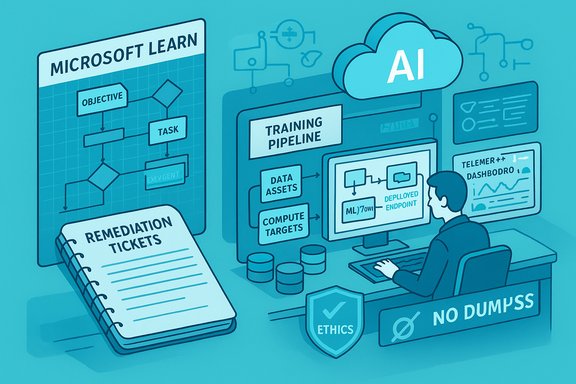
- A reproducible study cadence focused on hands‑on labs, remediation tickets, and publishing demonstrable artifacts (GitHub repos, runbooks).
- Clear ethical guidance: avoid leaked “actual exam” banks and pick reputable practice-test vendors that publish methodology and remediation content.
Exam basics and official verification
Before relying on any third‑party guidance, verify the canonical facts on Microsoft Learn. Microsoft’s certification pages and the DP-100 study guide list the skills measured, the domain weights, the exam duration, the languages offered, and renewal policy. Notable, verifiable points:- The DP-100 exam is centered on applying data science and machine learning on Azure with hands-on tools like Azure Machine Learning and MLflow.
- Skills measured break into distinct functional groups: designing and preparing solutions; exploring data and running experiments; training and deploying models; and optimizing language models for AI applications. The current study guide lists these groups and their approximate weights.
- Microsoft publishes a free practice assessment and an exam sandbox to preview question types and timing; MeasureUp is the recognized third‑party partner for official practice tests. Use these official channels as anchors.
- The certification requires ongoing renewal and Microsoft emphasizes hands‑on and live documentation as the authoritative syllabus.
Why scenario-first questions matter for DP-100
Role‑based Microsoft exams focus more on decision-making than trivia. This is reflected in the Server Side question design: items are micro-case studies that require weighing trade‑offs such as latency vs durability, ordering vs throughput, and managed identity choices vs service principals. These are the skills employers actually need, and they’re what the DP-100 blueprint measures. Key patterns the Server Side material highlights:- Service selection matters: pick Event Grid when you need subscription semantics, advanced filtering, long retry windows, and dead‑lettering; pick Service Bus when strict FIFO and session semantics are required. These aren’t trivia — they’re architectural instincts to test in a sandbox.
- Use platform identity when possible: prefer managed identities to avoid secret sprawl. Choose system‑assigned for lifecycle‑tied identities; user‑assigned identities when you need persistence beyond a resource.
- Observability matters in production: Application Insights features (Live Metrics, Profiler, Snapshot Debugger) and telemetry initializers are practical tools you must know how to enable and interpret.
The Server Side study plan — practical roadmap
The article provides a disciplined, reproducible 10‑week study plan that is intentionally pragmatic for working professionals. The plan’s core idea is to convert every practice-test failure into a short lab and a remediation artifact. Condensed, the plan looks like this:- Weeks 1–2 — Foundation and mapping
- Map official DP-100 objectives to Microsoft Learn modules.
- Provision a small Azure sandbox (free/trial/student).
- Weeks 3–5 — Core compute, storage, and training pipelines
- Build labs covering Azure Machine Learning workspaces, datastores, and compute targets.
- Practice data ingestion and feature engineering tasks.
- Weeks 6–7 — Non‑relational and analytics basics
- Explore Cosmos DB partitioning and Fabric/Synapse basics.
- Integrate small analytics pipelines and visualize results.
- Week 8 — Monitoring and MLOps
- Practice model registration, deployments to managed endpoints, and monitoring/model drift checks.
- Weeks 9–10 — Timed practice and remediation
- Use Microsoft Learn practice assessment and reputable paid simulators for timed mocks.
- Turn each incorrect answer into a documented lab and remediation note that you publish to a repository.
Choosing practice exams: checklist and vendor risk
Practice tests are indispensable for pacing and diagnosis, but vendor selection matters. The Server Side piece gives a vendor checklist that is both practical and defensible:- Vendor declares content is original and aligned to Microsoft’s skills outline.
- Each question includes detailed explanations tied to Microsoft Learn or official docs.
- The vendor publishes an update cadence and methodology.
- The vendor avoids claims of “verbatim exam” reproduction or guaranteed pass rates.
Reputable starting points include Microsoft’s free practice assessment and recognized partners such as MeasureUp for paid practice. Use vendor analytics to target remediation — not to memorize question wording.
Strengths of the Server Side approach
- Emphasizes applied reasoning over memorization; questions mimic real engineering trade‑offs.
- Provides technical clarifications for common confusions (SDK vs REST, which OCR tool to use, identity patterns). These are practical testable rules you can validate in a sandbox.
- Enforces ethical study practice and replacement of brittle shortcuts with demonstrable evidence (labs/public artifacts), which reduces career risk.
- Delivers a reproducible cadence that fits a working professional’s schedule and converts mistakes into documented learning artifacts.
Where to be cautious — limitations and risks
No single third‑party Q&A or guide is a substitute for the official skills outline and live hands‑on experience. Notable limitations:- Staleness: cloud services and SDKs evolve rapidly. Static question sets and PDFs can become misleading or incorrect; always cross‑check against Microsoft Learn for the latest skills measured and change log. The Server Side itself flags this risk.
- Over‑simplification: exam‑style short answers sometimes mask real‑world nuance. For production architectures you may need hybrid patterns (e.g., Event Grid + Service Bus) that the simplified exam stem excludes. Treat Q&A verdicts as guidance, not immutable rules.
- Vendor marketing claims: examine any third‑party “success rate” or “guarantee” with skepticism. Unless the vendor publishes transparent methodology and audit data, treat such claims as unverifiable.
- Ethics and enforcement: using leaked exam content can lead to revocation and bans. The Server Side emphasizes that legal and reputational risk are real and enforceable. Candidates should default to vendor‑aligned practice and Microsoft Learn.
A practical checklist for DP-100 candidates
Follow these high‑impact steps to convert practice into competence:- Map the DP-100 skills outline to Microsoft Learn modules and note domain weights. Prioritize according to weight.
- Provision a minimal Azure sandbox account and keep costs controlled (free tier, student, or short trial). Use this for all labs.
- Build three short reproducible projects and publish them:
- A basic training pipeline using Azure Machine Learning (data asset → experiment → model → managed endpoint).
- A small RAG demo using embeddings + Azure OpenAI and an indexed retrieval store.
- A vision/form-processing demo using Document Intelligence for structured invoices.
Each artifact should be a compact repo with a README describing decisions and tradeoffs. - Use Microsoft’s free practice assessment to get baseline timing, then move to reputable timed simulators for full-length practice. Log every error and convert it into a remediation ticket and a short lab (30–90 minutes).
- Avoid exam dumps and any vendor that claims to reproduce the “actual” exam verbatim. If a vendor advertises guaranteed pass rates without transparent methodology, treat the claim as suspect and deprioritize that vendor.
- Run a diagnostic practice test.
- Map weak areas to Learn modules and create lab tickets.
- Implement labs and write remediation notes (200–500 words each).
- Re-test those domains until you’re consistently correct under time constraints.
- Publish one or two artifacts to public repos to prove you can execute.
Cross‑checks and independent verification
Key claims in the Server Side guidance were cross‑checked against Microsoft Learn and other reputable sources:- Microsoft Learn’s certification page and study guide confirm the DP-100’s role orientation, exam duration, renewal frequency, and skills groups. These are the authoritative references for what the exam measures.
- Third‑party training vendors, community roadmaps, and learning platforms corroborate the emphasis on hands‑on labs, timed practice, and the relative domain weights emphasized by Microsoft. Use multiple reputable sources (official docs, vendor course outlines, community writeups) to triangulate any ambiguous detail.
Final analysis — how to use TheServerSide DP‑100 material responsibly
The Server Side Q&A is best treated as a high‑quality, scenario‑based drill set and a planning scaffold — not as a shortcut. Use it to:- Train your architectural instincts on concrete scenarios (service selection, identity patterns, observability).
- Convert mistaken answers into labs and reproducible artifacts that become your interview portfolio.
- Vet third‑party practice tools with the vendor checklist and prefer vendors that publish methodology and remediation content.
Conclusion
Certification should be a milestone on a career narrative of evidence, not a checkbox obtained by memorizing leaked material. The Server Side DP‑100 Q&A collection is valuable because it teaches how to think about Azure Machine Learning problems: choose the right service for the right constraint, validate ambiguous details in a sandbox, and document your remediation so every practice mistake becomes durable knowledge. When combined with Microsoft Learn’s official study guide, the free practice assessment, and a reputable paid simulator for timing practice, the Server Side method forms a defensible, ethical, and effective route to both passing DP‑100 and building skills that matter in production.Caveat: always verify time‑sensitive technical details (CLI flags, SDK class names, numeric limits) against Microsoft Learn and official docs immediately before the exam; cloud platforms and exam blueprints change, and the only reliable source is the vendor’s published guidance.
Source: The Server Side DP-100 Azure Data Scientist Questions and Answers
