

The Server Side’s short, hard‑nosed take on “365 Administration Expert Exam Dumps and MS‑102 Braindumps” reframes a familiar controversy into practical guidance: practice questions and simulated exams are legitimate study tools when sourced and used responsibly, but leaked “braindumps” are ethically wrong, legally risky, and pedagogically useless for producing on‑the‑job competence.
Microsoft role‑based certifications (including Microsoft 365‑focused exams such as MS‑102) are designed to measure applied capability—architectural judgment, configuration patterns, troubleshooting, and governance—not the memorization of static Q&A. The Server Side piece places the current marketplace of study materials into three broad categories: official Microsoft Learn content, reputable third‑party practice simulators, and an underground of leaked question banks that promise verbatim exam reproduction. It argues that candidates should treat these categories very differently and align study strategy to produce durable skill, not a brittle credential.
Microsoft’s exam policies and delivery partners make the stakes concrete: candidate agreements explicitly forbid copying or distributing exam items, and exam integrity programs—proctoring, statistical forensics, and post‑exam investigations—can result in score cancellation, credential revocation, and bans for misuse. The Server Side coverage and allied community writeups repeatedly stress this enforcement reality and the career harm it can cause.
The Server Side’s approach is therefore particularly relevant for MS‑102 candidates because:
Beyond formal enforcement, there is a growing practical check: employers now commonly ask for short technical take‑home tasks, repo walkthroughs, or live demos to validate that a badge corresponds to operational ability. A memorized pass without artifacts or demonstrable skills is increasingly easy to detect—and easy to penalize in hiring decisions. The Server Side recommends producing small, inspectable artifacts precisely to strengthen the certification signal.
The ethical, high‑ROI path is clear and verifiable: map the official skills, run short labs, use reputable timed practice for pacing (favor vendors with transparent editorial policies), convert mistakes into documented remediation, and produce small artifacts you can show an employer. That disciplined loop not only increases the odds of passing MS‑102 but—more importantly—ensures the badge you earn actually signals value in professional settings.
Source: The Server Side 365 Administration Expert Exam Dumps and MS-102 Braindumps
 Background
Microsoft role‑based certifications (including Microsoft 365‑focused exams such as MS‑102) are designed to measure applied capability—architectural judgment, configuration patterns, troubleshooting, and governance—not the memorization of static Q&A. The Server Side piece places the current marketplace of study materials into three broad categories: official Microsoft Learn content, reputable third‑party practice simulators, and an underground of leaked question banks that promise verbatim exam reproduction. It argues that candidates should treat these categories very differently and align study strategy to produce durable skill, not a brittle credential.Microsoft’s exam policies and delivery partners make the stakes concrete: candidate agreements explicitly forbid copying or distributing exam items, and exam integrity programs—proctoring, statistical forensics, and post‑exam investigations—can result in score cancellation, credential revocation, and bans for misuse. The Server Side coverage and allied community writeups repeatedly stress this enforcement reality and the career harm it can cause.
What the Server Side article actually says
Concise summary
The article delivers three practical claims:- Practice tests are useful when they are original, well‑explained, and vendor‑aligned. Good simulators help normalize timing, expose conceptual gaps, and provide remediation that maps back to documentation or labs.
- Exam dumps and verbatim “braindump” collections are unethical and risky. They violate candidate agreements, often contain stale or incorrect items, and can lead to revoked credentials and reputational damage.
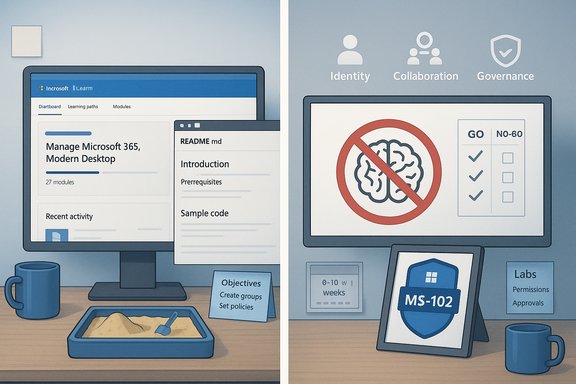
- The sustainable study path is hands‑on learning plus disciplined remediation. Map each missed practice question to Microsoft Learn or a lab, fix the gap with a short sandbox exercise, and produce tiny artifacts (README, GitHub repo, or runbook) you can show to employers.
The practical uplift
The Server Side supplies an actionable cadence (a typical 8–10 week schedule across exams like AZ‑104, DP‑900, and related role tests) that centers on mapping the official skills outline to hands‑on tasks, using timed practice as diagnostics, and converting each incorrect answer into a remediation ticket backed by a short lab and written notes. This loop—map → lab → test → remediate—is the article’s core pedagogical recommendation.Why this matters for MS‑102 (Microsoft 365 Administrator)
MS‑102 (Microsoft 365 Administrator) tests a mixture of identity, device management, collaboration services, security basics, and governance practices across Microsoft 365 and Entra ID. The exam rewards integrative judgment: choosing the right tenant configuration, identity flow, or compliance control for a constrained scenario. That kind of reasoning does not survive rote memorization of static Q&A.The Server Side’s approach is therefore particularly relevant for MS‑102 candidates because:
- The exam domain structure emphasizes trade‑offs (security vs. usability, compliance controls vs. productivity) that are best learned by doing.
- Microsoft product names, feature flags, and administrative interfaces evolve; static dumps age quickly and can teach obsolete procedures.
- Employers increasingly treat a certification as one signal among several and expect artifacts or live demonstrations to validate competence.
Critical analysis: strengths and limitations of the Server Side position
What the approach gets right
- Applied learning over trivia. The insistence on laboratories and small artifacts ensures study time produces transferable skills, closing the gap between “can pick the right multiple‑choice answer” and “can configure the tenant under time pressure.” This is the single highest‑value point in the article.
- Clear, pragmatic vendor selection criteria. The article’s checklist for practice‑test vendors (original content, mapping to Microsoft Learn, update cadence, and transparent explanations) is defensible and actionable for candidates trying to avoid low‑quality providers. MeasureUp is repeatedly recommended as a reputable third‑party simulator.
- Ethical clarity and career framing. The piece does not moralize without reason: it explains the forensic and contractual mechanisms that enable Microsoft and test partners to detect misuse, and it connects misuse to real‑world consequences—revocation, bans, and damaged hiring prospects. That combination of ethics and pragmatic risk assessment strengthens the article’s credibility.
Where the guidance needs careful application
- Staleness remains a real hazard. Third‑party practice questions—even those produced in good faith—can lag Microsoft’s changes. The Server Side repeatedly warns readers to re‑verify specific commands, numeric limits, or UI flows against Microsoft Learn immediately before test day. Candidates must operationalize that admonition rather than treating it as optional.
- Not a substitute for deep role training. MS‑102 is an administrator‑level exam with many operational details; the Server Side approach accelerates readiness but cannot replace prolonged, domain‑specific experience (for example, complex tenant migrations or enterprise compliance design). Use the plan as a scaffold, not an endpoint.
- Vendor trust still needs human judgment. The article names rightful selection criteria, but it cannot audit every vendor. Some sites still package recycled community Q&A without clear provenance; treat such offerings as supplemental at best. The Server Side specifically flags sites that promise “verbatim exam” reproduction.
Practical study plan for MS‑102 — hands‑on, ethical, employer‑ready
This is a condensed, exam‑aligned workflow adapted from the Server Side recommendations and tuned for Microsoft 365 Administrator candidates.Weeks 1–2: Map and provision
- Read the official MS‑102 skills measured page and list domain weights.
- Provision a small lab tenant or use a student/trial subscription. Keep resources minimal to control cost.
- Create a study backlog that maps each official objective to a Microsoft Learn module and a planned mini‑lab.
Weeks 3–5: Identity, access, and security (high leverage)
- Hands‑on tasks:
- Configure Entra ID tenants: users, groups, conditional access, and SSPR.
- Implement RBAC scenarios across subscription and resource scopes.
- Practice Conditional Access policies with least privilege and test failure modes.
- Deliverables:
- A short GitHub repo or README describing the policy scenarios and test steps.
Weeks 6–7: Device and endpoint management
- Hands‑on:
- Configure Intune device profiles, compliance policies, and app deployment.
- Test Windows Update rings and feature deployment strategies.
- Deliverable:
- A 1–2 page runbook showing targeted device rollout and recovery steps.
Week 8: Collaboration services and governance
- Hands‑on:
- Configure Teams tenant policies, Exchange Online mailbox basics, and SharePoint site governance.
- Run a mini retention and compliance policy exercise.
- Deliverable:
- A short demonstration (screenshots + steps) that you can present in an interview.
Weeks 9–10: Timed practice, remediation, and final verification
- Use reputable timed practice tests (MeasureUp or similar editorially transparent vendors). Don’t use dumps.
- After each timed exam, for every incorrect answer:
- Identify the core concept.
- Run a 30–90 minute lab to reproduce the scenario.
- Write a 200–500 word remediation note and store it in your study repo.
- Final deliverables:
- A small demo pack: two‑page README + links to 2–3 short GitHub artifacts.
Vendor selection and red‑flag checklist
When buying practice tests or browsing free question sets, insist on the following vendor behaviors and label other claims as suspicious.- The vendor publishes an explicit mapping of practice items to the official Microsoft skills outline.
- Each practice question includes a detailed explanation that cites Microsoft Learn or official docs.
- The vendor publishes an update cadence (how often items are refreshed) and a change log.
- The vendor does not claim to sell or reproduce “verbatim” exam content or guarantee implausible pass rates (for example “98% first‑time success”) without verifiable methodology. Treat such marketing as a red flag.
- Static PDF banks with no update history.
- Anonymous authorship or no editorial policy.
- Claims that rely solely on user testimonials and sealed success rates.
Ethics, enforcement, and the long game
The Server Side coverage is explicit: using or distributing exam questions obtained from test content violates Microsoft’s candidate agreement and the exam delivery partners’ policies. Consequences can include score cancellation, credential revocation, bans from future exams, withheld refunds, and reputational damage. The enforcement posture is not theoretical—proctoring and statistical forensics are used to detect anomalous patterns tied to leaked content.Beyond formal enforcement, there is a growing practical check: employers now commonly ask for short technical take‑home tasks, repo walkthroughs, or live demos to validate that a badge corresponds to operational ability. A memorized pass without artifacts or demonstrable skills is increasingly easy to detect—and easy to penalize in hiring decisions. The Server Side recommends producing small, inspectable artifacts precisely to strengthen the certification signal.
Common claims to verify and where the record is thin
- “Certificationexams.pro provides hundreds of free MS‑102 practice questions.” The Server Side mentions certificationexams.pro as a publicly visible practice site; however, the provenance and editorial quality of those free items are not independently verifiable from the site alone. Treat such collections as supplemental and verify every fact in a sandbox.
- “Microsoft’s passing score is 700 (out of 1,000).” Many community and vendor materials report Microsoft’s scaled pass threshold as 700 for technical exams, and this is a commonly cited figure, but Microsoft’s public pages do not always display pass thresholds consistently. Candidates should treat “700” as a widely reported target but confirm the current exam passing policy on the Microsoft exam details page when registering. The Server Side material flags this as a claim to verify for each exam sitting.
How hiring managers and teams should respond
- Treat a certification as one signal among many. Require short practical tasks, repo walkthroughs, or live demos for role‑relevant skills. This is a pragmatic, low‑friction way to neutralize candidates who relied on dumps.
- Ask candidates to share remediation artifacts or short lab repos. A two‑page README and a tiny GitHub repo are low effort for the candidate and high value for verification. The Server Side emphasizes these artifacts as evidence that the certification maps to practice.
- Use vendor‑aligned practice assessments for internal certification validation. If you run internal certification programs or expect employees to prepare, favor editorially transparent simulators and insist on documented methodology.
Conclusion
The Server Side’s treatment of MS‑102 “braindumps” reframes the debate from moralizing to pragmatic risk management. Practice tests, when properly sourced and used as diagnostic tools paired with hands‑on labs and written remediation, are powerful accelerants for learning. By contrast, leaked exam banks offer short‑lived advantage at potentially catastrophic professional cost: revoked credentials, hiring disqualification, and brittle knowledge that doesn’t survive interview or on‑the‑job tests.The ethical, high‑ROI path is clear and verifiable: map the official skills, run short labs, use reputable timed practice for pacing (favor vendors with transparent editorial policies), convert mistakes into documented remediation, and produce small artifacts you can show an employer. That disciplined loop not only increases the odds of passing MS‑102 but—more importantly—ensures the badge you earn actually signals value in professional settings.
Source: The Server Side 365 Administration Expert Exam Dumps and MS-102 Braindumps
