Droga5 Becomes Microsoft Copilot Creative Partner: Fixing the “Narrative” Problem

Droga5 has reportedly been named Microsoft Copilot’s global creative partner in June 2026, replacing Panay Films as lead creative agency on an account said to be worth $20 million to $30 million in annual fees. The move is not just another agency shuffle. It is Microsoft admitting, without quite saying so, that Copilot’s biggest problem is no longer only technical. It is narrative.

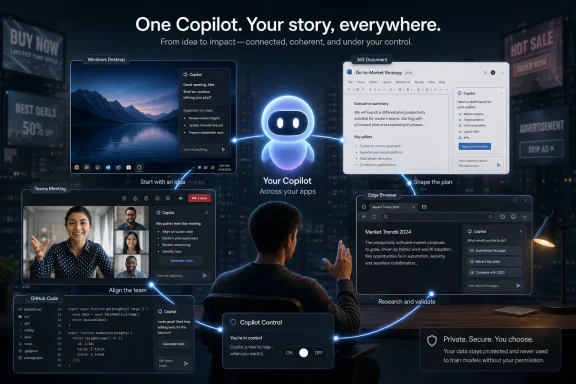
Promotional ad showing Microsoft Copilot’s AI assistant interfaces guiding work across apps.Microsoft Hands Copilot to an Agency That Knows How to Sell Platforms​

Droga5 is not arriving as a stranger to Redmond. The Accenture Song-owned agency has worked with Microsoft before, including on Xbox and Windows 11, which matters because Copilot is not a conventional product launch. It is a layer Microsoft is trying to stretch across Windows, Microsoft 365, Edge, Bing, GitHub, security tooling, and enterprise workflows.
That breadth is the opportunity and the problem. Microsoft has spent the past several years making “Copilot” the umbrella name for nearly every AI-assisted interaction in its ecosystem. The result is a brand that is everywhere and, for many users, still strangely hard to describe.
A global creative partner can help with that, but only up to a point. Advertising can sharpen the promise, reduce confusion, and make a product feel culturally inevitable. It cannot, by itself, make an assistant consistently useful inside Excel, Windows settings, Outlook, Teams, or the browser.
That is why the reported Droga5 appointment is more interesting than the usual agency-of-record news. Microsoft is not simply buying campaigns. It is buying coherence.

Copilot’s Branding Problem Is Really a Product Problem​

Microsoft has been unusually aggressive in making Copilot visible. The company has put the brand into Windows, Office apps, browsers, developer tools, and enterprise admin conversations with a speed that feels less like a rollout and more like a land grab. That strategy has one obvious advantage: users cannot miss it.
But visibility is not the same as understanding. For consumers, Copilot can mean a chatbot in the Windows taskbar, an assistant in Edge, a search-adjacent AI answer engine, or a creative tool. For businesses, it can mean Microsoft 365 Copilot, Copilot Studio, GitHub Copilot, Security Copilot, role-specific agents, or a broader pitch about AI transformation.
The word Copilot was supposed to solve that fragmentation by giving Microsoft one simple metaphor. A copilot assists, does not replace, and sits beside the user. The metaphor is elegant. The implementation has become cluttered.
That clutter creates a hard assignment for Droga5. The agency is not being asked merely to make Copilot seem exciting. It is being asked to make a sprawling family of AI products feel like a single, trustworthy idea.

The Panay Films Exit Signals a Change in Microsoft’s AI Storytelling​

The reported replacement of Panay Films is symbolically loaded, even if the mechanics are ordinary agency business. Panos Panay, before leaving Microsoft for Amazon, was closely associated with the Surface-era style of Microsoft product storytelling: tactile devices, emotional demos, polished launch videos, and hardware-as-lifestyle presentation. That mode worked when Microsoft needed Windows PCs to feel desirable again.
Copilot needs a different kind of persuasion. It is not a laptop hinge, a touchscreen, or a magnesium chassis. It is an invisible system that touches documents, calendars, code, meetings, searches, and potentially sensitive corporate data.
That makes the creative brief harder. Microsoft has to persuade users that Copilot is useful without making it seem intrusive, powerful without making it seem reckless, and integrated without making it feel forced. In other words, the advertising challenge mirrors the product challenge.
Droga5’s best-known work has often succeeded by simplifying a complex product into a human idea. Microsoft now needs exactly that discipline. But the agency will also have to avoid the trap that has hurt much AI marketing: promising magic when the daily experience is still full of caveats.

The AI Market Has Moved Faster Than Microsoft’s Message​

When Microsoft first attached itself to OpenAI’s rise, the strategic logic was brutally clear. Google looked vulnerable, enterprise customers were suddenly curious about generative AI, and Microsoft had a once-in-a-generation chance to make Office feel new again. Copilot was the banner under which all of that could happen.
But AI markets do not wait for brand architecture to settle. ChatGPT became the default mental model for mainstream AI assistants. Claude built a reputation among many knowledge workers for writing and reasoning. Google pushed Gemini across its own productivity and Android ecosystems. Specialized tools kept appearing in code, design, research, customer service, and data analysis.
Microsoft’s advantage is distribution. Its weakness is that distribution can look like imposition when users do not feel the product has earned the space it occupies. A Copilot button in the right place can feel like convenience. A Copilot button that interrupts a spreadsheet can feel like an ad inside paid software.
That distinction is everything. Microsoft is trying to turn Copilot into a default behavior, not merely an optional feature. To do that, it needs users to experience the product as help rather than pressure.

Enterprise IT Wants Value, Not Vibes​

For WindowsForum’s audience, the consumer advertising angle is only half the story. The more consequential fight is inside businesses, where Microsoft is trying to justify AI licensing, governance changes, training programs, and new data practices across Microsoft 365 tenants.
Enterprise buyers do not need another inspirational video about “unlocking creativity.” They need to know whether Copilot saves measurable time, whether it respects permissions, whether it leaks sensitive context into unexpected places, whether it can be audited, and whether employees actually use it after the first week. A $30-per-user-per-month AI license changes the internal politics of productivity software.
That is where Microsoft’s brand challenge becomes operational. If Copilot is sold as a transformative assistant but behaves like a search box with better grammar, admins will hear about it. If it summarizes meetings well but struggles with structured workflows, departments will notice. If employees need prompt training, policy guardrails, and app-by-app explanation before they see value, the product is not yet self-explanatory.
Droga5 can help Microsoft tell a cleaner story to executives and end users. But CIOs and sysadmins will still judge Copilot by deployment friction, telemetry, adoption, security posture, and support tickets. The campaign may open the door. The admin console closes the deal.

Windows Is the Most Dangerous Place to Overpromise​

Copilot’s presence in Windows carries special risk because Windows is not merely another app. It is the environment in which users do everything else. When Microsoft changes Windows, it changes the daily weather for hundreds of millions of people.
That makes AI integration in Windows more sensitive than AI integration in a standalone web service. If Copilot helps a user find a setting, summarize a file, or automate a small task, it feels native and useful. If it gives vague guidance, points to the wrong control, or interrupts an established workflow, it feels like the operating system has become a sales surface.
Microsoft knows this tension because it has lived through versions of it before. Internet Explorer bundling, Edge promotion, Teams integration, Start menu ads, Microsoft account nudges, and OneDrive prompts all taught users to be suspicious when Microsoft says a feature is “integrated.” Integration can be convenient. It can also be coercive.
Copilot inherits that baggage. Droga5’s job will be to make Copilot feel like a companion, not another Microsoft upsell. That is a high-wire act, because the more Microsoft pushes AI into Windows, the more users will ask whether they are getting assistance or being enrolled in a strategy.

A Better Campaign Cannot Hide a Confusing Portfolio​

One uncomfortable truth for Microsoft is that “Copilot” now carries too many meanings. There is consumer Copilot, Microsoft 365 Copilot, GitHub Copilot, Copilot in Windows, Copilot Chat, Copilot Studio, Security Copilot, industry copilots, and agentic experiences wearing the same family name. Some are mature. Some are experimental. Some are bundled. Some are premium. Some are aimed at individuals; others are aimed at entire organizations.
This is not merely a branding inconvenience. It affects user trust. If someone has a poor experience with one Copilot surface, that disappointment can bleed into their perception of the whole brand. A weak Windows demo can undermine confidence in a business tool. A confusing Office integration can make the broader AI pitch feel inflated.
Microsoft’s answer has often been to argue that context matters. Copilot in Microsoft 365 is not just a general chatbot; it works with organizational data and Microsoft Graph permissions. GitHub Copilot is not the same thing as Copilot in Edge. Security Copilot has a different audience and risk model.
That explanation is true, but it is not simple. Great brands compress complexity. Copilot currently expands it.

Droga5 Gets the Account Because Microsoft Needs Taste as Much as Scale​

Microsoft has never lacked distribution, engineering capacity, or enterprise relationships. What it has sometimes lacked is taste: the editorial sense of what to emphasize, what to withhold, and when to let a product prove itself quietly before shouting about it. That matters in AI because the category is already saturated with exaggerated claims.
The strongest Copilot story is probably not “AI everywhere.” It is more likely “the right help, in the right context, with the right controls.” That is less spectacular but more credible. It also maps better to how real people adopt productivity software.
The agency’s task, then, is not simply to make Copilot look futuristic. It is to make restraint feel like confidence. If Microsoft can show Copilot solving ordinary problems reliably—finding the right document, preparing a useful meeting brief, explaining a confusing spreadsheet, drafting a reply that sounds like the user, helping an admin investigate an incident—it may do more for the brand than another cinematic montage of glowing interfaces.
That is the irony of AI advertising in 2026. The companies most tempted to sell wonder may win more trust by selling competence.

The Competitive Fight Is for Habit, Not Awareness​

Copilot does not suffer from obscurity. Anyone using modern Microsoft software has almost certainly seen the name. The question is whether they have formed a habit around it.
Habit is harder than awareness because it depends on repeated reward. Users return to ChatGPT, Claude, Gemini, or GitHub Copilot when the tool reliably helps them finish something. They avoid tools that require too much correction, too much explanation, or too much patience.
Microsoft’s advantage is that Copilot can appear at the exact moment of work. It does not need users to open a separate tab if it is already inside Word, Excel, Teams, Outlook, Edge, or Windows. That should be a formidable advantage.
But embedded AI also raises the bar. If a standalone chatbot fails, the user blames the chatbot. If Copilot fails inside Excel, Outlook, or Windows, the user may blame Microsoft for degrading the workspace. The closer AI gets to the operating system and productivity suite, the less tolerance users have for theatrical imperfection.
Droga5 can help create desire, but habit will come from usefulness. In AI, the product demo is not a launch event. It is Tuesday afternoon.

The Trust Story Has to Include the Off Switch​

There is another reason Copilot’s positioning is delicate: AI assistants operate near personal and corporate context. They summarize, infer, draft, retrieve, and increasingly act. That creates a different emotional contract than a normal software feature.
Users want control. Admins want policy. Security teams want logging, boundaries, and assurances that experimental capabilities will not outrun governance. Developers want clarity on training, code handling, and intellectual-property exposure. Consumers want to know why an assistant is appearing and what it can see.
A credible Copilot campaign must therefore treat control as part of the value proposition, not as a compliance appendix. Microsoft’s best argument is not that Copilot is unavoidable. It is that Copilot is useful when invited, governed when deployed, and removable or suppressible when unwanted.
That may sound less glamorous than “the future of work,” but it is closer to the concerns of the people who actually manage Windows environments. The AI assistant that earns trust will not be the one with the loudest icon. It will be the one that knows when not to appear.

The Real Brief Is to Make Copilot Feel Earned​

Microsoft’s reported agency change comes at a moment when the company’s AI ambition is both obvious and contested. The company has invested heavily, integrated quickly, and pushed Copilot as a defining layer of its future. Yet the user experience has not always matched the scale of the campaign.
That gap is dangerous. When marketing outruns product reality, users become cynical. When product reality is strong but the story is muddled, users become indifferent. Copilot has shown signs of both problems depending on where it appears.
Droga5’s opportunity is to help Microsoft narrow that gap. The agency can give Copilot a sharper public identity, better demonstrations, and a more emotionally intelligent tone. It can help Microsoft stop talking about AI as a destiny and start showing it as a tool.
But the burden remains with Microsoft. Creative work can frame the promise. Engineering, design, pricing, support, and governance must make the promise feel earned.
The Copilot Campaign Microsoft Actually Needs​

The reported Droga5 appointment gives Microsoft a chance to reset how it talks about Copilot before user skepticism hardens into habit. The most useful campaign would be less about declaring an AI era and more about proving that Microsoft understands why people are wary.
  • Microsoft needs to explain which Copilot it is selling in each context, because the same brand now covers very different products and expectations.
  • Microsoft needs to show mundane, repeatable productivity wins rather than cinematic AI magic that collapses under real-world use.
  • Microsoft needs to make controls, admin policy, privacy boundaries, and opt-out paths part of the story instead of treating them as fine print.
  • Microsoft needs to stop assuming distribution equals affection, especially inside Windows and Office where users are sensitive to forced surfaces.
  • Microsoft needs to win over practitioners as well as executives, because Copilot’s reputation will be shaped by daily workflows rather than keynote language.
The stakes are larger than one advertising account. If Droga5 helps Microsoft make Copilot legible, restrained, and credible, the appointment could become a quiet turning point in the company’s AI push. If the work merely gives a confusing product family a more expensive gloss, users will notice that too. Microsoft does not need Copilot to sound more inevitable; it needs Copilot to feel more useful, more respectful, and more worthy of the space it is taking up across Windows and work.

References​

  1. Primary source: Exchange4Media
    Published: Fri, 05 Jun 2026 03:09:22 GMT
  2. Official source: microsoft.com
  3. Related coverage: techspot.com
  4. Related coverage: pcworld.com
  5. Related coverage: techcrunch.com
  6. Official source: news.microsoft.com
  1. Related coverage: arstechnica.com
  2. Related coverage: windowscentral.com
  3. Related coverage: mediapost.com
  4. Related coverage: campaignlive.com
  5. Related coverage: four.agency
  6. Related coverage: techradar.com
  7. Related coverage: tomshardware.com
  8. Related coverage: axios.com
  9. Official source: cdn-dynmedia-1.microsoft.com
 

Droga5 has reportedly been appointed global creative agency for Microsoft Copilot in June 2026, taking over lead creative duties from Panay Films on an account said to be worth $20 million to $30 million annually. The move is not just another agency shuffle; it is a signal that Microsoft believes Copilot’s biggest problem is no longer only technical capability, but public meaning. After years of putting the Copilot name on nearly every surface in its software empire, Microsoft now needs to make the brand feel coherent, useful, and emotionally legible. That is a harder creative assignment than selling a laptop, a console, or a subscription.

Futuristic AI productivity dashboard with a woman using a computer, maps, apps, and secure code tools holograms.Microsoft’s AI Problem Has Become a Messaging Problem​

Microsoft has spent the last three years making Copilot unavoidable. It sits in Windows, Microsoft 365, Edge, Bing, Teams, GitHub, security products, developer tools, and a growing constellation of agentic workflows. The company’s pitch has been simple in theory: wherever work happens, an AI assistant should be there too.
But ubiquity is not the same as clarity. For many users, “Copilot” still describes several overlapping things at once: a chatbot, a productivity assistant, a Windows feature, a paid Microsoft 365 add-on, a consumer AI companion, an enterprise platform, and a strategic banner for the company’s post-Office future. That breadth is powerful inside a product roadmap, but it is punishing in advertising.
This is why Droga5’s appointment matters. Microsoft does not need an agency merely to make Copilot look modern; it needs one to make Copilot feel inevitable without making it feel intrusive. The company has already bought its way into attention through product placement and operating-system integration. The next phase is persuasion.
That persuasion has to work across audiences that do not want the same thing. Consumers want help without surveillance. Enterprises want productivity without governance chaos. Developers want leverage without lock-in. Windows users want AI features that improve the PC without turning every task into a prompt-engineering exercise.

Droga5 Inherits a Brand That Microsoft Has Stretched to Its Limits​

The reported handoff from Panay Films to Droga5 comes after Microsoft has already pushed Copilot through multiple identities. It began publicly as a cousin of the “new Bing,” then became a brand architecture for AI assistants across Microsoft’s portfolio, then was reframed as a more personal companion under Microsoft AI leadership. Along the way, the name became both useful shorthand and branding fog.
That fog matters because Copilot is now carrying more strategic weight than almost any Microsoft consumer brand since Windows itself. Office became Microsoft 365. Bing’s AI identity was folded into Copilot. Windows PCs gained a Copilot key, then Copilot+ PC branding, then a broader promise that local AI hardware would make the operating system feel new again. The word “Copilot” has become Microsoft’s answer to almost every question investors, customers, and competitors ask about AI.
The risk is that the name becomes less a product than a reflex. Microsoft has been here before. The company has a long history of technically capable products trapped inside complicated naming systems, licensing tiers, and internal organizational logic. If users have to stop and ask which Copilot is being discussed, the brand is already spending attention it should be earning.
Droga5’s job, then, is not simply to produce a campaign. It is to impose a story on an ecosystem that has grown faster than the public’s understanding of it. That is the kind of brief agencies like to call “brand-building,” but in Microsoft’s case it is closer to translation.

The Creative Brief Is Bigger Than Consumer Advertising​

The reported $20 million to $30 million in annual agency fees suggests Microsoft is treating this as more than a one-off consumer push. That scale points to a sustained global assignment, the kind that can span brand films, product launches, social campaigns, enterprise messaging, retail, partner channels, and event work. Copilot is not a seasonal product. It is Microsoft’s preferred interface for the next decade of computing.
That creates an unusual marketing challenge. Most technology campaigns sell either a device, a service, or a discrete software feature. Copilot is supposed to be all three depending on where the customer encounters it. In Windows, it is part of the operating-system experience. In Microsoft 365, it is a productivity layer. In GitHub, it is a coding assistant. In enterprise environments, it becomes a governance, data, and workflow story. In consumer marketing, Microsoft increasingly talks about companionship, memory, creativity, and everyday help.
Those strands can reinforce one another, but only if they are edited ruthlessly. Otherwise, the brand collapses into a montage of people asking an assistant to summarize meetings, draft emails, plan trips, make images, analyze spreadsheets, and explain why the printer still does not work. That may be accurate, but it is not a position.
The best technology advertising usually does not enumerate features. It makes a product’s role in life obvious. Apple sold the Mac as creative empowerment, the iPod as music made intimate, the iPhone as the internet in your pocket. Microsoft’s challenge is to make Copilot feel like a new computing habit rather than a hovering autocomplete box.

Microsoft Is Trying to Sell Trust in a Category Built on Suspicion​

The generative AI market is not suffering from lack of awareness. People know AI is here. They may not know which service they should trust, whether the output is reliable, what data is being used, or whether a company is quietly replacing human judgment with software confidence.
That is where Microsoft’s position is both strong and awkward. On one hand, the company can credibly argue that it understands enterprise identity, compliance, data residency, admin controls, and regulated customers better than most AI-native startups. Microsoft can put Copilot next to Outlook, Excel, Teams, SharePoint, Entra, Purview, Defender, and Azure and say: this is not a toy bolted onto your work; this is AI inside the stack you already govern.
On the other hand, consumers do not experience brand trust as an architecture diagram. They experience it as anxiety or comfort. Does this assistant remember too much? Is it reading my screen? Is it training on my files? Why did Windows add this? Can I turn it off? Will it hallucinate in front of my boss?
A good Copilot campaign cannot dodge those concerns by bathing them in optimism. It has to make the technology feel bounded, accountable, and useful. The promise is not that AI will think for you. The promise must be that it will reduce friction while leaving agency intact. That distinction is the difference between an assistant and a creep.

Droga5 Knows Microsoft, but Copilot Is a Different Animal​

Droga5’s reported win expands an existing relationship with Microsoft. The agency has previously worked on Microsoft properties including Xbox and Windows 11, and recent Windows creative work has leaned into visually memorable storytelling rather than pure spec-sheet messaging. That familiarity helps. Microsoft is a large, matrixed organization, and an agency that already understands its internal rhythms has an advantage.
But Copilot is not Xbox, and it is not a Windows student campaign. Xbox sells identity, community, performance, and entertainment. Windows campaigns can sell versatility, compatibility, mobility, or creativity. Copilot has to sell a behavior that many users have not fully adopted and some actively distrust.
It also has to do so while the product keeps changing. AI assistants are not like operating systems that ship a major visual identity and then iterate around it for years. Copilot’s features, models, integrations, and packaging are moving quickly. A campaign that is too specific risks aging in months. A campaign that is too abstract risks saying nothing.
That may explain why Microsoft would want a high-end global creative shop rather than a narrow product-marketing partner. The brief is not “tell people what button to press.” It is “make the Copilot idea durable enough to survive the product’s own velocity.”

The Panay Films Chapter Was Cinematic; the Next One Must Be Systemic​

Panay Films brought a Hollywood-inflected storytelling sensibility to Microsoft’s Copilot advertising. That made sense during an early phase when Microsoft needed to dramatize AI as approachable, magical, and consumer-friendly. Filmic campaigns can humanize abstract software better than dashboards and product demos ever will.
But the reported move to Droga5 suggests Microsoft wants a broader creative operating system. Copilot is no longer a novelty launch that needs a charming spot. It is a platform brand that needs consistency across markets, products, and audiences. The next creative partner must manage not just tone, but architecture.
That distinction is important. An ad can make Copilot look delightful for 60 seconds. A brand platform has to make the same idea work in a keynote, a Windows settings screen, a Microsoft 365 admin center, a retail display, a security webinar, a Surface launch, and a small-business campaign. Microsoft’s AI push has too many fronts for isolated creative bursts to carry the load.
The best outcome for Droga5 would be a campaign language that can flex without dissolving. It needs to be human enough for consumers, concrete enough for IT, and disciplined enough to keep Microsoft from turning every new AI feature into a separate slogan.

Copilot’s Real Rival Is Not Just ChatGPT​

It is tempting to frame the assignment as Microsoft versus OpenAI, Google Gemini, Anthropic Claude, Perplexity, Meta AI, and Apple Intelligence. That is true at the market level, but it misses the more subtle fight. Copilot’s most dangerous rival is inertia.
Most people already have ways of working. They search the web, write emails manually, ask a colleague, use templates, copy from an old document, or simply avoid tasks that feel too tedious. Enterprise software is full of features that are technically useful and practically ignored. Microsoft has to move Copilot from novelty use to default habit.
That requires more than feature parity. ChatGPT benefits from being perceived as a destination: you go there to ask an AI something. Copilot is often pitched as ambient: it appears where you already are. Ambient software can be powerful, but it is harder to market because the value is dispersed. There may be no single “aha” screen.
Google has its own ambient advantage through search, Android, Gmail, Docs, and Workspace. Apple is trying to make AI feel native to devices and privacy-conscious by design. OpenAI still owns much of the cultural imagination around generative AI. Microsoft must therefore argue that Copilot is not merely another chatbot, but the assistant with the most useful context for your work and life.
That is a strong claim if the product lives up to it. It is also a fragile claim if the experience feels inconsistent, overbranded, or gated behind licensing fine print.

Windows Users Are the Test Case Microsoft Cannot Avoid​

For WindowsForum readers, the most interesting part of this story is not the agency fee. It is what a global Copilot brand push implies for Windows itself. Microsoft has been steadily recasting the PC as an AI endpoint, with Copilot+ PCs, neural processing units, local AI features, and a renewed emphasis on agentic workflows inside the operating system.
This is a risky but understandable bet. Windows remains Microsoft’s broadest consumer computing surface, even as the company’s profits increasingly flow through cloud, enterprise software, and subscriptions. If Microsoft wants Copilot to be a daily habit, Windows is one of the few places where it can put the assistant in front of hundreds of millions of users without asking them to download a new app.
But Windows users are not a captive focus group with infinite patience. The modern Windows experience already contains ads, recommendations, account prompts, OneDrive nudges, Edge promotions, Microsoft 365 upsells, and occasional design inconsistencies that make enthusiasts roll their eyes. If Copilot arrives as another promotional layer, it will be treated accordingly.
A smarter creative strategy would emphasize control and usefulness. Show Copilot reducing Windows friction: finding settings, explaining system errors, helping with accessibility, summarizing local files with permission, assisting with device migration, organizing windows and workflows, or making complex PC tasks less intimidating. That is where Microsoft can make AI feel native rather than sprayed on.

Enterprise IT Will Judge the Brand by the Admin Experience​

For sysadmins, Copilot’s branding is secondary to governance. A clever campaign may get executives excited, but IT departments are left to answer harder questions. Which data can Copilot access? How are permissions enforced? What audit trails exist? How do organizations prevent oversharing through bad SharePoint hygiene? What happens when generated content is wrong?
Microsoft knows this, and it has spent much of its enterprise Copilot pitch emphasizing security, compliance, and integration with existing Microsoft 365 controls. That is a genuine advantage. The company can sell Copilot as a layer over systems enterprises already manage rather than as a rogue AI tool being expensed on corporate cards.
Still, branding and administration are more connected than they look. If Microsoft’s public campaign tells employees Copilot can do everything, admins will inherit unrealistic expectations. If it presents Copilot as magic, governance will feel like obstruction. If it presents Copilot as a controlled accelerator, IT has a fighting chance to turn enthusiasm into policy.
This is where Droga5’s work has to respect the enterprise buyer even when speaking to the end user. The brand should make Copilot desirable, but not lawless. In AI, overpromising is not merely a marketing sin; it becomes a deployment problem.

The Consumer Copilot Has to Escape the Clippy Trap​

Microsoft has been explicit about wanting Copilot to feel more personal, conversational, and companion-like. That is a delicate line for a company whose history includes Clippy, Cortana, and years of attempts to anthropomorphize assistance without quite making it stick. The danger is not that users dislike friendly software. The danger is that friendliness without competence becomes parody.
Clippy failed not because the idea of help was bad, but because the help felt intrusive and shallow. Cortana suffered from platform constraints, unclear positioning, and a consumer assistant market that tilted toward phones and smart speakers. Copilot enters a more promising moment because generative AI can actually perform a wide range of language and reasoning tasks. But the old lesson remains: personality cannot compensate for weak utility.
A consumer campaign that leans too hard into emotional companionship risks sounding uncanny or needy. A campaign that leans only into productivity risks becoming another montage of busy professionals summarizing meetings. Microsoft has to find a middle tone: warm, capable, restrained, and unembarrassing.
That is harder than it sounds. The most successful AI brands so far have often benefited from minimalism. ChatGPT’s brand is almost anti-brand: a box, a prompt, an answer. Microsoft, by contrast, wants Copilot to have presence across a sprawling ecosystem. Presence can become pressure if the creative work is not careful.

The Agency Win Reflects a Bigger Accenture Song Bet​

Droga5 is part of Accenture Song, which gives the appointment another layer. Copilot is not only a marketing account; it is a symbol of how consulting, creative, data, and platform transformation are merging. The agency world has spent years arguing that brand strategy and business transformation now belong in the same room. Microsoft Copilot is almost a perfect test case for that thesis.
A traditional campaign can increase awareness. A modern AI campaign may also need to shape onboarding, usage patterns, customer education, partner enablement, and internal change management. If users do not understand when to use Copilot, the ad has failed. If enterprises buy licenses but employees do not adopt them, the brand promise collapses into shelfware.
Accenture’s broader consulting footprint may help Droga5 connect the glossy external story with the messier organizational reality of AI adoption. That does not guarantee success. Big consultancies can produce expensive abstractions as easily as they produce useful strategy. But for a product as sprawling as Copilot, the ability to think beyond the campaign could matter.
The question is whether the creative output will have teeth. Microsoft does not need another set of airy AI platitudes about unlocking potential. It needs a memorable, disciplined argument for why Copilot belongs in the user’s day.

Microsoft’s Brand Architecture Is Now a Competitive Surface​

The Copilot assignment lands at a moment when Microsoft has been reorganizing its AI leadership and product structure. The company has sought to unify consumer and commercial Copilot experiences while also investing in its own AI models and agentic capabilities. That organizational motion reflects a deeper realization: fragmented AI products create fragmented trust.
Brand architecture may sound like a concern for marketers, but in software it affects user comprehension. If the Copilot in Windows behaves differently from the Copilot in Microsoft 365, and both differ from the Copilot in Edge or the Copilot experience on mobile, users will not distinguish between product boundaries. They will simply decide whether “Copilot” is helpful or confusing.
That makes consistency a product requirement, not a brand luxury. Visual identity, tone, onboarding, permissions language, and feature naming all teach users how to think about AI. If those signals conflict, no amount of media spending will fix it.
Droga5 can help articulate the story, but Microsoft has to make the product honor it. The most damaging outcome would be a beautiful global campaign that promises simplicity while the actual experience remains a maze of SKUs, toggles, account types, and regional availability caveats.

The Best Copilot Campaign Would Be Less About AI Than Agency​

The word “Copilot” contains the best version of Microsoft’s argument. A copilot does not replace the pilot. It assists, watches, suggests, reduces load, and helps navigate complexity. That metaphor is strong because it implies both power and hierarchy: the human remains in command.
Microsoft’s challenge is that the broader AI industry often talks as if replacing the pilot is the destination. Vendors celebrate autonomy, agents, superintelligence, and end-to-end task completion. Investors reward visions of software that does more with fewer people. Workers hear those promises and understandably wonder whether “assistant” is just a transitional euphemism.
A credible Copilot brand has to defend the human-in-command premise. Not defensively, and not with bland assurances, but through concrete demonstrations. It should show people making better decisions, creating better work, understanding systems faster, and controlling outcomes more deliberately.
That would also distinguish Microsoft from AI-native competitors. OpenAI can be the frontier lab. Google can be the search and Android giant. Apple can be the device-and-privacy company. Microsoft can be the company that makes AI operational inside the tools people and organizations already depend on. That is not the flashiest position, but it may be the most commercially durable.

The Real Test Will Be Whether Copilot Becomes Boring​

The paradox of successful platform technology is that it eventually stops feeling futuristic. Spellcheck, search, cloud sync, autocomplete, live captions, and translation all felt remarkable before they became expected. Microsoft’s long-term goal is not for Copilot to remain dazzling. It is for Copilot to become part of the ordinary grammar of computing.
Advertising can accelerate that normalization, but only if it resists hype. The AI market is already saturated with cinematic claims of transformation. The more every company says AI will change everything, the less any individual claim means. Microsoft has the advantage of distribution, but distribution cannot force affection.
The best creative work for Copilot may therefore be surprisingly practical. It should show the small moments where the assistant saves a user from drudgery, confusion, or delay. It should make the benefit feel specific enough to believe and broad enough to repeat. It should avoid pretending that every prompt is a revelation.
If Droga5 can make Copilot feel less like a campaign and more like a habit, Microsoft will have bought something more valuable than awareness. It will have bought a story that can survive contact with daily use.

The Copilot Brief Now Belongs to the Hard Part of AI​

The reported Droga5 appointment is best read as Microsoft moving from launch-era spectacle to adoption-era discipline. Copilot is already visible; the harder task is making it trusted, understood, and habit-forming across Windows, Microsoft 365, and the enterprise stack.
  • Droga5 is reportedly taking over global creative duties for Microsoft Copilot from Panay Films on an account valued at $20 million to $30 million in annual agency fees.
  • The win expands Droga5’s existing Microsoft relationship, which has included work connected to Xbox and Windows 11.
  • Microsoft’s central challenge is that Copilot is both a product and an umbrella brand spread across consumer, enterprise, developer, and Windows experiences.
  • The campaign will need to clarify Copilot’s value without inflating expectations that enterprise IT departments must later manage.
  • Windows users will judge Copilot less by brand films than by whether AI features make the operating system more useful, controllable, and less cluttered.
  • The strongest positioning for Copilot remains the one embedded in its name: AI that assists human judgment rather than pretending to replace it.
Microsoft has the distribution, the enterprise relationships, the Windows footprint, and the AI investment to make Copilot a defining software brand of the next decade. What it does not yet fully have is a public story simple enough for ordinary users and rigorous enough for IT professionals to believe at the same time. Droga5’s assignment is to help create that story, but the campaign will only work if Microsoft’s products become as coherent as the promise.

References​

  1. Primary source: IMPACT Magazine
    Published: 2026-06-05T03:38:23.201987
  2. Official source: microsoft.com
  3. Official source: about.ads.microsoft.com
  4. Related coverage: creativebrandsmag.com
  5. Related coverage: thedrum.com
  6. Related coverage: 1920vfx.com
  1. Related coverage: shots.net
  2. Related coverage: tomsguide.com
  3. Related coverage: techradar.com
  4. Official source: blogs.microsoft.com
  5. Official source: news.microsoft.com
  6. Related coverage: geekwire.com
  7. Related coverage: windowscentral.com
  8. Related coverage: mediapost.com
  9. Official source: learn.microsoft.com
  10. Related coverage: laptopmag.com
  11. Related coverage: axios.com
  12. Related coverage: pcgamer.com
  13. Official source: wwps.microsoft.com

  14. Official source: cdn.techcommunity.microsoft.com
  15. Related coverage: newsroom.ibm.com
 

Microsoft has named Droga5 as global lead creative agency for Microsoft Copilot in June 2026, according to Adgully, shifting the account from Panay Films as the company tries to sharpen the AI assistant’s consumer and enterprise story worldwide. The reported $20 million to $30 million annual agency-fee range makes this more than a routine roster shuffle. It is a branding intervention for a product Microsoft has already embedded almost everywhere, but has not yet made equally legible to everyone. Copilot’s next challenge is not whether Microsoft can distribute it; it is whether Microsoft can make people understand why they should want it.

Collage of multiple screens in an office with cloud security icons and a central shield.Microsoft Has Won the Shelf Space, Not the Story​

Copilot is one of the strangest products in modern Microsoft history because it is both unavoidable and, for many users, still conceptually slippery. It appears in Windows, Edge, Microsoft 365, Teams, Outlook, Word, Excel, PowerPoint, GitHub, Dynamics, Security, and a growing constellation of agent experiences. That ubiquity should be a marketer’s dream.
Instead, it has created the kind of brand problem only a platform company can manufacture. When everything is Copilot, the word risks becoming less a product name than a texture applied across the Microsoft estate. Users see the icon, the side panel, the prompt box, the rewrite button, the meeting summary, the search assistant, and the agent builder, but they do not always see one coherent promise.
That is the job Droga5 is inheriting. Microsoft does not need an agency to explain that AI is important. It needs one to turn Copilot from a bundle of capabilities into a believable everyday habit.
The timing matters. Generative AI has moved from novelty to procurement line item, from breathless demos to messy deployment. The first wave rewarded spectacle: instant essays, surreal images, code completion, synthetic meeting notes. The next wave will reward trust, specificity, and proof that the software actually changes the workday rather than merely decorating it.

Droga5 Arrives After the Demo Era​

Droga5 is not being asked to introduce Microsoft to the public. The agency already has a history with Microsoft, including campaigns around Xbox and Windows 11. That makes the appointment less a cold start than an expansion of an existing creative relationship into Microsoft’s most strategically sensitive product category.
The more interesting question is why Microsoft needs that expansion now. Copilot has had enormous distribution advantages from day one. Microsoft owns the productivity suite, the operating system, the enterprise identity layer, the collaboration stack, the developer tooling, and much of the cloud infrastructure through which work already flows.
Yet the market has not treated Copilot as inevitable in the way Windows or Office once felt inevitable. OpenAI’s ChatGPT remains culturally synonymous with consumer AI. Google has pushed Gemini across search, Android, Workspace, and cloud services. Anthropic has won attention among developers, writers, and AI-safety-minded enterprise buyers. Smaller tools have carved out sharper reputations in coding, research, design, note-taking, automation, and vertical business workflows.
Microsoft’s advantage is integration. Its weakness is that integration can look like clutter when the message is not disciplined. A feature that appears everywhere can feel less magical over time if users cannot predict what it is good at, what data it can see, what it costs, and why its answer should be trusted.
Droga5’s task, then, is not simply to make Copilot sound warmer. It is to impose narrative order on a product family that has expanded faster than ordinary people’s mental models.

The Name Copilot Carries More Weight Than One Product Can Bear​

Microsoft chose a strong metaphor when it settled on Copilot. It suggests assistance without replacement, partnership without surrender, acceleration without abdication. For a company selling AI into regulated enterprises, public-sector institutions, schools, hospitals, banks, and security teams, that is a useful posture.
But metaphors decay when they are stretched too far. A copilot in GitHub helps write code. A copilot in Word drafts and rewrites prose. A copilot in Teams summarizes meetings. A copilot in Windows opens settings and answers questions. A copilot in Security triages threats. A copilot agent may eventually complete transactions across business systems.
Those are not the same job. They are not even the same emotional proposition. Some are productivity aids, some are search interfaces, some are automation layers, and some are early attempts at software agents. Microsoft’s branding problem is that it has used one umbrella word to cover all of them before users have learned the differences.
This creates a practical problem for IT departments. When employees ask whether “Copilot” is approved, admins have to ask which Copilot, in which tenant, under which license, with access to which data, enabled through which controls. The brand promises simplicity while the deployment reality demands governance.
That gap is exactly where advertising can either help or make things worse. If Droga5 sells Copilot as a magical intelligence that simply “understands your work,” it will intensify skepticism among administrators who know that permission hygiene, data classification, retention rules, and training all matter. If it sells Copilot as a set of narrowly useful assistants embedded in familiar workflows, it has a better chance of building durable trust.

Microsoft’s Real Audience Is Split in Two​

Consumer AI and enterprise AI now share interfaces but not anxieties. Consumers ask whether the assistant is useful, cheap, fast, and fun. Enterprises ask whether it is governable, auditable, secure, compliant, and worth the license uplift. Microsoft has to speak to both without flattening the distinction.
That is hard because Copilot’s best consumer pitch is emotional, while its enterprise pitch is operational. For the consumer, Microsoft wants Copilot to feel like a helpful companion across Windows and the web. For the CIO, it wants Copilot to be a productivity layer over Microsoft Graph, Microsoft 365 apps, enterprise search, and business data with inherited permissions and administrative controls.
The two stories can reinforce each other, but only if they are staged carefully. A warm consumer campaign can make Copilot feel approachable. A hard-nosed enterprise campaign can reassure buyers that it is not a toy bolted onto corporate data. The danger is muddle: a brand that sounds cheerful in a TV spot but opaque on an invoice.
Microsoft knows this tension well. The company has spent decades selling products that live simultaneously in bedrooms, classrooms, boardrooms, and server closets. Windows itself is a consumer brand, a developer platform, an OEM ecosystem, and a corporate standard. Office became Microsoft 365 by turning productivity apps into a subscription, collaboration layer, and identity-tethered service.
Copilot is more complicated because the stakes are higher. Users are not just learning a new ribbon button or subscription plan. They are being asked to invite generative AI into documents, meetings, inboxes, chats, spreadsheets, codebases, and business processes.

The Market Positioning Problem Is Also a Product Problem​

It is tempting to treat the Droga5 appointment as a marketing story because, formally, that is what it is. But Copilot’s brand challenges are inseparable from its product challenges. No campaign can permanently solve confusion that the software continues to reproduce.
Microsoft has repeatedly adjusted Copilot packaging, naming, entry points, and feature tiers. There is Microsoft 365 Copilot, Copilot Chat, Copilot Pro, Copilot in Windows, Copilot Studio, GitHub Copilot, Security Copilot, and an increasing emphasis on agents. Some of those distinctions make architectural and licensing sense. They do not always make human sense.
A normal user does not wake up wondering whether they need a chat experience grounded in web data, a Microsoft Graph-aware workplace assistant, an app-specific drafting tool, or a custom agent attached to a business process. They wonder whether the thing can help them finish a report, find a buried decision, explain a spreadsheet, summarize a meeting, triage an inbox, or automate a repetitive task.
That is where the Copilot message has often felt overdetermined. Microsoft has leaned heavily into the notion of AI “in the flow of work,” a phrase that sounds plausible because it is true in the abstract. But “flow of work” is a vendor phrase. It does not describe the irritation of reopening a document at 10 p.m., the dread of a meeting backlog, or the embarrassment of missing a decision buried in a Teams thread.
Droga5’s best work, historically, has tended to find the human situation behind the product feature. Copilot needs exactly that discipline. It needs fewer abstractions about transformation and more scenes where the value is concrete enough that a skeptical Windows user can see themselves in it.

Windows Is the Most Powerful Billboard and the Most Dangerous One​

For WindowsForum readers, the most sensitive piece of this story is not the agency fee. It is the fact that Copilot’s brand campaign sits on top of an operating system Microsoft can use as a distribution engine. Windows gives Copilot visibility no independent AI rival can buy.
That visibility is powerful, but it is also risky. Windows users have long memories. They remember forced defaults, Start menu experiments, Edge prompts, Microsoft account nudges, OneDrive setup pressure, and shifting control surfaces. A helpful assistant can quickly become another symbol of platform overreach if the product feels imposed rather than earned.
Microsoft has spent the past few years trying to make Copilot feel native to Windows. The problem is that “native” can mean two things. It can mean genuinely integrated into settings, files, search, troubleshooting, accessibility, and local context. Or it can mean placed prominently in the shell because Microsoft wants adoption numbers.
The first version could be valuable. A Windows-aware assistant that explains system settings, helps diagnose errors, summarizes local documents with clear permission boundaries, and assists less technical users would be a genuine evolution of help and search. The second version is just another button asking for attention.
Droga5 cannot control Windows engineering decisions, but it can influence how Microsoft frames them. If the campaign suggests Copilot is an ambient intelligence woven into the PC, the product had better feel useful at the OS level. If it behaves mostly like a web chatbot with a Windows-shaped doorway, users will notice.

Enterprise IT Is Not Waiting for a Better Slogan​

Microsoft’s enterprise customers are not hostile to Copilot. Many are experimenting aggressively, especially where the use cases are easy to measure: meeting summaries, email drafting, document synthesis, knowledge retrieval, service-desk workflows, sales preparation, and developer productivity. The question is not whether AI assistants will enter the workplace. They already have.
The question is whether Copilot becomes the sanctioned default or merely one of several tools employees use around the edges. Microsoft wants the former, and its enterprise advantage is substantial. It can tell customers that Copilot respects existing Microsoft 365 permissions, works inside familiar apps, can be managed by IT, and fits into broader security and compliance investments.
But enterprise adoption is gated by more than procurement. Administrators have to prepare data estates, clean up overshared SharePoint sites, define acceptable-use policies, train employees, monitor outputs, and explain to executives why a premium AI license is worth paying for at scale. In many organizations, the limiting factor is not model capability. It is readiness.
That makes marketing delicate. If Microsoft overpromises effortless transformation, it risks alienating the very IT professionals who know the deployment work involved. If it emphasizes governance too heavily, it risks making Copilot sound like yet another enterprise platform project rather than a tool employees might actually enjoy using.
The strongest enterprise message is probably neither hype nor caution. It is competence. Copilot should be positioned as useful because it is close to the work, bounded by the organization’s controls, and honest about what administrators must do to make it succeed.

The AI Assistant Race Is Becoming a Trust Race​

The first public phase of generative AI rewarded models that sounded astonishing. The next phase will reward systems that are dependable enough to delegate to. That distinction is brutal for marketing because “astonishing” is easy to dramatize and “dependable” is harder to make cinematic.
Microsoft’s trust pitch has several layers. It can point to enterprise data protection, identity controls, compliance tooling, tenant boundaries, and the fact that Copilot can draw from work content a user is already permitted to access. It can also point to its broader responsible AI messaging and its long history selling to conservative institutions.
But trust is not only a policy document. It is an experience. Users decide whether they trust an AI assistant when it cites the right file, admits uncertainty, avoids inventing details, respects context, and does not turn a simple task into a scavenger hunt across product surfaces.
Copilot has sometimes suffered from expectation mismatch. A user asks for a straightforward answer and receives generic prose. Another asks it to reason over work data and discovers that permissions, indexing, licensing, or app context limit the result. Another sees a feature demo that looks magical, then tries it on messy real-world files and gets something merely adequate.
This does not mean Copilot is failing. It means Microsoft is selling a class of software that is still uneven by nature. The brand has to make room for that reality without sounding apologetic.

Droga5 Must Sell Usefulness Without Selling Fantasy​

Advertising loves transformation stories. AI loves them even more. The temptation will be to show Copilot as a frictionless partner that turns chaos into clarity, blank pages into polished documents, meetings into decisions, and scattered data into strategy.
Some of that is fair. Copilot can genuinely reduce drudgery in the right setting. It can summarize, draft, translate, reformat, search, extract, brainstorm, and accelerate repetitive work. For developers, AI assistance is already becoming part of the professional toolkit. For office workers drowning in communications, even an imperfect summary can be valuable.
But the fantasy version of Copilot will age badly. Users do not need another video in which an assistant instantly produces executive brilliance from a vague prompt. They need to know where the tool saves five minutes, where it saves an hour, where it should be checked carefully, and where it is the wrong tool altogether.
The best campaign would make Copilot feel less like a genius and more like leverage. That may sound less glamorous, but it is more durable. A tool does not need to be omniscient to be indispensable; it needs to be reliably helpful at the moments people most resent wasting time.
For Microsoft, this is also a defensive move. If Copilot is framed as a miracle, every hallucination is a betrayal. If it is framed as a practical assistant that improves when grounded in the right data and guided by the right user, its limitations become manageable rather than disqualifying.

The Accenture Song Connection Gives This Appointment a Consulting Shadow​

Droga5 is part of Accenture Song, and that matters. This is not the old advertising world where a creative agency makes the anthem spot and hands it off to media buyers. AI adoption sits at the intersection of brand, product design, business process, data architecture, change management, and measurement.
Accenture’s proximity gives Droga5 a broader context for Microsoft’s pitch. Many of the companies Microsoft wants to win are also the kinds of organizations that hire consultancies to redesign workflows, migrate systems, rationalize data, and train employees. Copilot is not just a product to advertise; it is a product that often requires organizational change to extract value.
That can be an advantage if the brand story is tied to credible deployment realities. It can also be a danger if the campaign becomes consultancy-speak with better typography. The world does not need more AI language about unlocking potential, empowering teams, and reinventing work. It needs sharper claims.
The strongest Copilot narrative would connect three things Microsoft can credibly own: the apps where work happens, the data graph that gives work context, and the controls that let organizations deploy AI without surrendering governance. That is a better story than “AI everywhere,” because it gives Copilot a reason to exist beyond category participation.
It also helps distinguish Copilot from standalone chatbots. Microsoft’s bet is that AI becomes more valuable when it is embedded in the systems people already use. Droga5’s challenge is to make that sound like a benefit rather than a lock-in strategy.

Developers Already Know the Copilot Argument Microsoft Wants Everyone Else to Learn​

GitHub Copilot remains Microsoft’s clearest proof that the brand can work. Developers understood the bargain early: the tool suggests code, reduces boilerplate, accelerates familiar tasks, and sometimes gets things wrong. The user remains responsible, but the workflow changes anyway.
That model is instructive because GitHub Copilot did not need to be mystical. It was useful in context. It appeared where developers were already working. It gave suggestions that could be accepted, edited, ignored, or rejected. It became part of the rhythm of work rather than a separate destination.
Microsoft wants the same thing across knowledge work. The difficulty is that office work is less formally structured than code. A developer can often test whether code compiles or passes a unit test. A sales strategy, legal summary, financial explanation, or executive memo is harder to validate automatically. The cost of a confident error can be subtle and political rather than immediate and technical.
That is why Copilot’s broader campaign needs to be more mature than the usual AI boosterism. It should normalize review, context, and judgment. It should make the user feel empowered, not replaced, and it should avoid implying that delegation to AI is the same as completed work.
The original Copilot metaphor still helps here. A copilot assists, monitors, and shares workload, but the pilot remains accountable. That is a sound framing for AI in Windows and Microsoft 365 if Microsoft has the discipline to stick to it.

The Consumer Pitch Has to Escape the Productivity Trap​

Microsoft is most comfortable selling productivity. It is the company of documents, spreadsheets, calendars, mailboxes, directories, dashboards, and management consoles. Copilot naturally extends that lineage.
But consumer AI has not been driven only by productivity. People use AI assistants for curiosity, advice, creative play, learning, planning, image generation, coding side projects, translation, and emotional low-stakes experimentation. ChatGPT’s cultural power came partly from the fact that people could try it without first understanding Microsoft licensing or corporate data governance.
Copilot has to compete in that world too. Windows gives it reach, but reach alone does not create affection. If consumers experience Copilot mainly as another Microsoft service asking them to sign in, set defaults, or accept a new interface, it will struggle to become beloved.
The consumer campaign therefore has to make Copilot feel personally useful without collapsing into gimmickry. It should show ordinary situations where Windows users need help: explaining a cryptic setting, comparing options before a purchase, turning notes into a plan, learning a concept, organizing a trip, rewriting a message, or making sense of a document.
The risk is that these use cases are generic. Every AI assistant claims them. Microsoft needs to show why Copilot is better because it is connected to the PC, the browser, the documents, and the productivity environment—not merely because it can answer a prompt.

Copilot’s Brand Will Be Judged by the Product’s Restraint​

One of the most underrated questions in AI product design is when the assistant should stay out of the way. Microsoft has sometimes learned this lesson the hard way. Windows users tolerate power, but they punish nagging. Office users appreciate features, but they resent clutter. Administrators value integration, but they distrust surprise enablement.
If Copilot becomes too insistent, it will inherit the backlash attached to every unwanted platform prompt. If it is too hidden, Microsoft will not get the adoption it wants. The middle path is contextual invitation: offer help when the user’s intent is clear, explain what data is being used, and let people dismiss the feature without feeling scolded.
That is not only a UX principle. It is a brand principle. A trustworthy assistant asks for attention differently from an advertising surface. It earns recurrence through successful moments, not merely placement.
Droga5 can help Microsoft express that restraint publicly. A campaign built around confidence, competence, and user agency would do more for Copilot than another montage of glowing screens and frictionless genius. The product should feel like it is on the user’s side, not like it is pursuing Microsoft’s quarterly AI narrative.
This is especially important for Windows. The PC is personal infrastructure. Users may accept cloud services, subscriptions, and AI features, but they still want the machine to feel like theirs. Copilot’s success on Windows will depend as much on consent and control as on model quality.

The Droga5 Brief Is Really a Microsoft Self-Discipline Test​

The appointment says Microsoft recognizes that Copilot needs a clearer global story. That recognition is healthy. But clarity cannot be outsourced completely.
Agencies can sharpen language, dramatize use cases, build emotional memory, and create a campaign architecture that travels across markets. They can help Microsoft avoid jargon and make the product feel less like a corporate initiative. They can find the human scenes where AI assistance makes intuitive sense.
They cannot fix inconsistent naming, confusing packaging, premature feature placement, or overbroad product claims. If Microsoft wants Copilot to become the default AI layer for work and Windows, the advertising has to be matched by product discipline. Users should not need a glossary to understand what Copilot they are using.
The company also has to accept that Copilot’s adoption curve will not be measured only by availability. Preinstalls, bundled access, and enterprise agreements can produce usage, but durable preference comes from repeated usefulness. That is harder, slower, and less easily forced.
For a company of Microsoft’s size, the temptation is always to treat distribution as destiny. Copilot may prove that distribution is necessary but not sufficient. The AI assistant people choose every day will be the one that feels most helpful, most trustworthy, and least exhausting.

The Copilot Campaign Has One Job: Make the Button Mean Something​

The immediate lesson from the Droga5 appointment is not that Microsoft is spending heavily on advertising. It is that Microsoft’s AI strategy has reached the point where brand meaning is now a product dependency. If users cannot explain what Copilot is for, they are less likely to build habits around it, and if administrators cannot explain where it fits, they are less likely to scale it confidently.
The concrete stakes are already visible:
  • Microsoft has reportedly moved the global Copilot creative mandate to Droga5 after Panay Films, expanding an existing agency relationship that already touched Windows 11 and Xbox.
  • The account is reportedly worth between $20 million and $30 million in annual agency fees, signaling that Microsoft sees Copilot’s public narrative as strategically important.
  • Copilot’s biggest advantage remains Microsoft’s distribution across Windows, Microsoft 365, Teams, Edge, GitHub, security products, and enterprise identity.
  • Copilot’s biggest weakness is the confusion created by using one brand across many different products, licensing tiers, workflows, and technical contexts.
  • Droga5’s best opportunity is to make Copilot feel practically useful and trustworthy, not merely futuristic.
  • Microsoft’s campaign will succeed only if the product experience backs up the promise with restraint, clarity, and repeatable value.
The appointment of Droga5 is a sign that Microsoft understands the next phase of the AI race will be fought as much in perception as in model benchmarks. Copilot does not lack ambition, distribution, or executive backing. What it lacks is a crisp public meaning that survives contact with the real workday. If Microsoft and Droga5 can turn Copilot from a ubiquitous AI label into a tool people recognize, trust, and deliberately reach for, the company’s platform advantage may finally become a brand advantage; if not, Copilot risks becoming the most visible assistant in tech that users still have to be persuaded to use.

References​

  1. Primary source: adgully.com
    Published: Fri, 05 Jun 2026 06:35:00 GMT
  2. Related coverage: windowsforum.com
  3. Related coverage: lbbonline.com
  4. Related coverage: bandt.com.au
  5. Related coverage: fortune.com
  6. Related coverage: creative.salon
 

Back
Top