Microsoft has handed the creative account for Microsoft Copilot to Droga5, according to Ad Age reporting published June 4, 2026, as the company tries to sharpen Copilot’s public identity during an increasingly crowded AI assistant race. The move matters because Copilot is no longer just a feature sprinkled through Windows, Edge, Bing, and Microsoft 365. It is now one of Microsoft’s defining bets, and the company needs ordinary users and enterprise buyers to understand why they should care. Droga5’s job is not merely to make the ads prettier; it is to make Copilot feel inevitable without making it feel imposed.
Microsoft does not suffer from a shortage of Copilot visibility. Windows users have seen the button, Microsoft 365 customers have seen the prompts, Edge users have seen the sidebar, and enterprise admins have seen the licensing decks. The harder problem is that visibility and comprehension are not the same thing.
That gap is where the Droga5 win becomes interesting. Microsoft has spent the last three years turning Copilot into an umbrella brand for AI assistance across consumer and enterprise products. The word now appears in contexts as varied as Excel formulas, Windows settings, Teams meeting recaps, Bing search, GitHub coding, and security workflows. That breadth is powerful, but it also muddies the pitch.
A user can understand ChatGPT as “the AI app.” A developer can understand GitHub Copilot as “the coding assistant.” But Microsoft Copilot has been asked to mean nearly everything Microsoft does with generative AI. That makes it strategically valuable and creatively slippery.
Droga5 is stepping into an account where the product has distribution, funding, and executive support, but not yet the cultural shorthand enjoyed by some rivals. The challenge is to turn a platform story into a human one without pretending that a chatbot can magically resolve every frustration in modern work.
Microsoft also told investors that product quality and execution were driving accelerating seat additions, and it projected sequential growth in net paid seats. In plain terms, Redmond wants Wall Street and CIOs to hear that Copilot is not a science fair project bolted onto Office. It wants them to see a paid productivity platform that is moving from pilot budgets into standard enterprise planning.
That gives Droga5 better material than most AI advertisers have. Many AI campaigns still sell vibes: creativity, speed, ambition, the vague promise of “unlocking potential.” Microsoft can sell something more concrete: lots of companies are already paying for this, and the company claims usage is intensifying.
But the number also raises the bar. Once Copilot is positioned as a real enterprise product with millions of paid seats, the campaign cannot rely solely on dreamy shots of people becoming more creative. IT departments will ask whether it reduces busywork, whether data boundaries hold, whether licensing is worth it, and whether employees actually use it after the launch webinar ends.
But the Copilot brand quickly outgrew Bing. Microsoft shifted toward presenting Copilot as a standalone assistant that could travel across work, browsing, coding, and Windows itself. Its 2024 “big game” advertising framed Copilot as a tool for people whose ambitions had been dismissed, leaning into empowerment rather than search disruption.
That repositioning was necessary, but it also created a new burden. If Copilot is everywhere, what exactly is it? A chatbot? A work assistant? A Windows feature? A productivity tax? A new interface for computing? Microsoft’s answer has often been “yes,” which is strategically coherent but creatively dangerous.
Droga5’s task is to make the sprawl legible. The agency does not need to explain every Copilot SKU. It needs to give the brand a point of view strong enough that users can understand why Microsoft keeps putting this thing in front of them.
The company has experimented with Copilot entry points in Windows 11, reworked how the assistant appears in the taskbar, and increasingly tied AI features to new classes of PCs. The branding has sometimes moved faster than the product experience. Users have seen Copilot promoted as the next great interface even when the actual interaction felt more like a web app, a sidebar, or a guided support layer.
That mismatch creates risk. Windows users are famously allergic to features that feel more like corporate strategy than user benefit. The more prominently Microsoft pushes Copilot into Windows, the more the company must prove that it helps with real PC tasks rather than merely occupying premium interface space.
This is where creative strategy and product strategy collide. A campaign can make Copilot feel approachable, but it cannot permanently compensate for moments when the assistant misunderstands a setting, produces a generic answer, or punts users back into conventional menus. The best advertising in the world cannot make a bad first-run experience feel native.
That is why the paid-seat count matters. A CIO does not buy Copilot merely because it can summarize text. A CIO buys it because Microsoft can bundle AI into the productivity estate the company already governs, audits, secures, and renews. Procurement gravity is a real feature.
But enterprise strength does not automatically translate into consumer love. ChatGPT became a household name because people used it directly and voluntarily. Gemini benefits from Google’s consumer surfaces and Android reach. Copilot, by contrast, often arrives as part of something else: Windows, Edge, Microsoft 365, or a work account.
That makes the brand feel less like a destination and more like an ambient layer. Droga5 can lean into that if it is honest: Copilot does not have to be the place users go to “do AI.” It can be the assistance layer that shows up when the task is already underway. But that requires restraint, and Microsoft has not always been restrained with product prompts.
Microsoft has a different advantage: it owns the workplace desktop and the commercial productivity stack. That is not as glamorous as topping consumer app charts, but it may be more durable in revenue terms. Enterprises pay for seats, renew contracts, and standardize tooling.
The problem is that distribution can look like imposition when users do not perceive value. A Copilot button in Windows is only helpful if users think it earns the space. A Copilot panel in Office is only welcome if it saves time instead of adding another place to check. A Teams recap is only persuasive if it captures the meeting accurately enough to trust.
That is why the creative account matters. The market is past the phase where simply saying “AI” creates excitement. Every major technology company now has an assistant story. Microsoft needs to persuade people that Copilot is not just the company’s answer to ChatGPT, but a practical layer for the tools they already use.
The temptation will be to turn Copilot into a generic empowerment machine. That is the default mode of AI advertising: a montage of ideas becoming prototypes, meetings becoming summaries, and workers smiling at the sudden disappearance of drudgery. It is easy to make and easy to ignore.
The better route would be more specific. Copilot’s most persuasive moments are not grand transformations. They are the small recoveries of time and attention: finding the right document before a meeting, turning scattered notes into a usable draft, explaining a spreadsheet, summarizing a long email chain, or helping a user navigate a PC setting that should have been easier in the first place.
If Droga5 can make those moments feel credible, the campaign could do real work. If it leans too hard into AI mysticism, it will sound like every other 2026 tech ad.
That is a delicate proposition. Windows has survived because it is boring in the best possible way: compatible, manageable, known, and broad enough to serve everyone from gamers to accountants to factory operators. When Microsoft tries to make Windows feel futuristic, it must avoid making it feel less dependable.
Copilot sits at the center of that tension. It is supposed to make Windows feel modern, but Windows users judge features by usefulness, not investor-day ambition. If Copilot helps explain errors, locate settings, automate repetitive steps, and connect local context with cloud intelligence, the Windows story improves. If it becomes another promotional layer, resentment builds.
Droga5’s proximity to both Windows and Copilot suggests Microsoft wants a more unified creative language across the PC and AI narratives. That is sensible. The risk is that the campaign promises an AI PC future that ordinary users cannot yet consistently experience.
Microsoft has a better trust story than many consumer AI startups because it can point to enterprise controls, tenant boundaries, admin tooling, and existing security relationships. But trust is not only a compliance posture. It is also a user feeling. People need to believe that Copilot understands the context, respects the boundary, and knows when not to overreach.
That is especially true in Windows and Microsoft 365. These are not novelty environments. They contain confidential documents, financial models, HR records, legal drafts, customer data, private calendars, and the operational memory of organizations. An assistant operating there must be useful, but it must also be boringly reliable.
A mature Copilot campaign should therefore avoid the fantasy that AI replaces judgment. The stronger message is that Copilot reduces the distance between intent and action while leaving humans in control. That is less dazzling than “AI changes everything,” but it is far more believable.
The 20 million paid-seat milestone helps answer skepticism, but it does not end it. Paid seats are not the same as daily active users, and adoption inside a company can vary widely by role, training, data readiness, and management pressure. Some organizations will find clear value in meeting summaries, document drafting, analytics, and workflow assistance. Others will discover that without clean data and process redesign, Copilot becomes an expensive autocomplete.
This is another reason Microsoft needs better storytelling. The company cannot merely say that Copilot is powerful. It has to explain where the value appears and what kind of work changes. That is a creative challenge, but it is also a product education challenge.
For IT pros, the practical issue is deployment discipline. Copilot works best when organizations understand permissions, content hygiene, sensitivity labels, retention, user enablement, and governance. A national campaign will not fix sloppy SharePoint permissions. It may, however, increase pressure on admins to make Copilot-ready environments out of estates that were not built with generative AI in mind.
That creates a strange burden for advertising. The campaign must make a massive infrastructure strategy feel personal. It has to translate GPUs, models, indexes, connectors, compliance controls, and cloud economics into a moment where a user says, “Yes, that would help me.”
The companies that win consumer imagination in AI tend to hide the machinery. ChatGPT feels like a conversation. Gemini feels increasingly embedded in Google’s surfaces. Copilot often exposes Microsoft’s architecture: work account versus personal account, web grounding versus tenant grounding, free chat versus paid Microsoft 365 Copilot, Copilot in Windows versus Copilot in Office.
Some of that complexity is unavoidable because Microsoft serves consumers, small businesses, developers, governments, schools, and global enterprises. But complexity is also the enemy of brand preference. Droga5’s opportunity is to make Copilot feel less like a licensing matrix and more like an assistant with a recognizable purpose.
That mess is precisely where Copilot should be strongest. Microsoft does not need to claim that Copilot turns everyone into a visionary. It can argue that Copilot helps people survive the ambient chaos of modern knowledge work. That is a more grounded and more Microsoft-like pitch.
Windows users know this reality too. The PC is where the polished cloud dream meets drivers, settings, legacy apps, local files, peripherals, and user habits accumulated over decades. A useful assistant in that environment would not be a sci-fi companion. It would be a patient interpreter of systems that have become too complex for their own good.
If Droga5 understands that, the campaign could shift Copilot away from generic AI aspiration and toward something more defensible: practical fluency. Not “the future of intelligence,” but help finding the next right step.
But they are also experienced enough to distrust marketing that outruns implementation. If a campaign suggests that Copilot can control Windows with natural language, users will test it. If it says Copilot can reason over work content, admins will ask which content, under which permissions, with what logging, and at what cost. If it says the assistant saves time, workers will compare that claim against the friction of checking its output.
That is why Microsoft should not treat skepticism as a communications failure. Skepticism is the correct response to a technology that can be both useful and unreliable. The campaign should invite trial without implying that doubt is backward-looking.
A credible Copilot story for this audience would emphasize boundaries as much as capabilities. It would show the assistant helping without pretending to be omniscient. It would make room for the admin, the power user, and the employee who wants fewer interruptions, not a new personality living in the taskbar.
That contract should answer three questions without requiring a licensing guide. Where does Copilot help? What data does it use? Why is Microsoft’s version better in the places Microsoft is asking users to adopt it?
The answers will differ by audience. In Microsoft 365, Copilot’s value is context and workflow. In Windows, it should be assistance, discoverability, and eventually local-device intelligence. In Edge and Bing, it is search, browsing, and task completion. In developer tools, the Copilot name already has a clearer identity through GitHub.
The danger is that Microsoft tries to collapse all of those into a single emotional promise. “Copilot helps you achieve more” may be true, but it is too soft for a market that has heard every variation of that phrase. The campaign needs sharper edges.
For Windows users and IT pros, the most concrete implications are already visible:
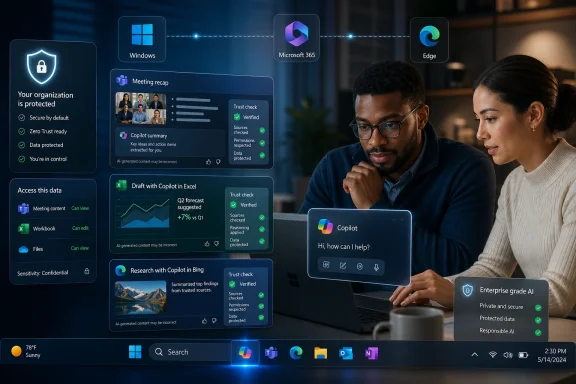 Microsoft’s AI Problem Is No Longer Awareness
Microsoft does not suffer from a shortage of Copilot visibility. Windows users have seen the button, Microsoft 365 customers have seen the prompts, Edge users have seen the sidebar, and enterprise admins have seen the licensing decks. The harder problem is that visibility and comprehension are not the same thing.That gap is where the Droga5 win becomes interesting. Microsoft has spent the last three years turning Copilot into an umbrella brand for AI assistance across consumer and enterprise products. The word now appears in contexts as varied as Excel formulas, Windows settings, Teams meeting recaps, Bing search, GitHub coding, and security workflows. That breadth is powerful, but it also muddies the pitch.
A user can understand ChatGPT as “the AI app.” A developer can understand GitHub Copilot as “the coding assistant.” But Microsoft Copilot has been asked to mean nearly everything Microsoft does with generative AI. That makes it strategically valuable and creatively slippery.
Droga5 is stepping into an account where the product has distribution, funding, and executive support, but not yet the cultural shorthand enjoyed by some rivals. The challenge is to turn a platform story into a human one without pretending that a chatbot can magically resolve every frustration in modern work.
The Seat Count Gives Microsoft a Real Story to Tell
The strongest argument for Copilot is no longer hypothetical. Microsoft said during its fiscal 2026 third-quarter earnings cycle that Microsoft 365 Copilot had surpassed 20 million paid enterprise seats, up from 15 million earlier in the year. That is a meaningful number, especially because enterprise adoption of new productivity layers usually moves through procurement, security review, training, and internal politics before it reaches scale.Microsoft also told investors that product quality and execution were driving accelerating seat additions, and it projected sequential growth in net paid seats. In plain terms, Redmond wants Wall Street and CIOs to hear that Copilot is not a science fair project bolted onto Office. It wants them to see a paid productivity platform that is moving from pilot budgets into standard enterprise planning.
That gives Droga5 better material than most AI advertisers have. Many AI campaigns still sell vibes: creativity, speed, ambition, the vague promise of “unlocking potential.” Microsoft can sell something more concrete: lots of companies are already paying for this, and the company claims usage is intensifying.
But the number also raises the bar. Once Copilot is positioned as a real enterprise product with millions of paid seats, the campaign cannot rely solely on dreamy shots of people becoming more creative. IT departments will ask whether it reduces busywork, whether data boundaries hold, whether licensing is worth it, and whether employees actually use it after the launch webinar ends.
Droga5 Inherits a Brand That Microsoft Has Been Rebuilding in Public
Copilot began life, in the public imagination, with a search problem. Microsoft’s early AI push was strongly associated with Bing and the company’s OpenAI partnership. That made sense in early 2023, when the industry was still stunned by ChatGPT and when Microsoft had a rare chance to make Google look reactive in search.But the Copilot brand quickly outgrew Bing. Microsoft shifted toward presenting Copilot as a standalone assistant that could travel across work, browsing, coding, and Windows itself. Its 2024 “big game” advertising framed Copilot as a tool for people whose ambitions had been dismissed, leaning into empowerment rather than search disruption.
That repositioning was necessary, but it also created a new burden. If Copilot is everywhere, what exactly is it? A chatbot? A work assistant? A Windows feature? A productivity tax? A new interface for computing? Microsoft’s answer has often been “yes,” which is strategically coherent but creatively dangerous.
Droga5’s task is to make the sprawl legible. The agency does not need to explain every Copilot SKU. It needs to give the brand a point of view strong enough that users can understand why Microsoft keeps putting this thing in front of them.
The Windows Angle Makes This More Than an Ad Account
For WindowsForum readers, the Copilot account is not just a marketing story. It is a Windows story, because Microsoft has repeatedly tried to make Copilot part of the operating system’s future-facing identity. That effort has been uneven.The company has experimented with Copilot entry points in Windows 11, reworked how the assistant appears in the taskbar, and increasingly tied AI features to new classes of PCs. The branding has sometimes moved faster than the product experience. Users have seen Copilot promoted as the next great interface even when the actual interaction felt more like a web app, a sidebar, or a guided support layer.
That mismatch creates risk. Windows users are famously allergic to features that feel more like corporate strategy than user benefit. The more prominently Microsoft pushes Copilot into Windows, the more the company must prove that it helps with real PC tasks rather than merely occupying premium interface space.
This is where creative strategy and product strategy collide. A campaign can make Copilot feel approachable, but it cannot permanently compensate for moments when the assistant misunderstands a setting, produces a generic answer, or punts users back into conventional menus. The best advertising in the world cannot make a bad first-run experience feel native.
The Enterprise Pitch Is Stronger Than the Consumer Pitch
Microsoft’s most defensible Copilot story remains enterprise productivity. The company owns the work surface for millions of organizations: Outlook, Teams, Word, Excel, PowerPoint, SharePoint, OneDrive, Entra, Defender, and the broader Microsoft 365 admin stack. Copilot’s advantage is not that it is always the cleverest chatbot in isolation. It is that it can operate where enterprise data and workflows already live.That is why the paid-seat count matters. A CIO does not buy Copilot merely because it can summarize text. A CIO buys it because Microsoft can bundle AI into the productivity estate the company already governs, audits, secures, and renews. Procurement gravity is a real feature.
But enterprise strength does not automatically translate into consumer love. ChatGPT became a household name because people used it directly and voluntarily. Gemini benefits from Google’s consumer surfaces and Android reach. Copilot, by contrast, often arrives as part of something else: Windows, Edge, Microsoft 365, or a work account.
That makes the brand feel less like a destination and more like an ambient layer. Droga5 can lean into that if it is honest: Copilot does not have to be the place users go to “do AI.” It can be the assistance layer that shows up when the task is already underway. But that requires restraint, and Microsoft has not always been restrained with product prompts.
The Chatbot Race Has Become a Distribution War
The AI assistant market is often discussed as a model race, but for users it increasingly looks like a distribution war. OpenAI has the ChatGPT habit. Google has Search, Chrome, Android, Gmail, Workspace, and Gemini. Apple is trying to make Apple Intelligence part of the device experience. Anthropic has Claude’s reputation among many power users and developers. Perplexity has carved out a search-like answer niche.Microsoft has a different advantage: it owns the workplace desktop and the commercial productivity stack. That is not as glamorous as topping consumer app charts, but it may be more durable in revenue terms. Enterprises pay for seats, renew contracts, and standardize tooling.
The problem is that distribution can look like imposition when users do not perceive value. A Copilot button in Windows is only helpful if users think it earns the space. A Copilot panel in Office is only welcome if it saves time instead of adding another place to check. A Teams recap is only persuasive if it captures the meeting accurately enough to trust.
That is why the creative account matters. The market is past the phase where simply saying “AI” creates excitement. Every major technology company now has an assistant story. Microsoft needs to persuade people that Copilot is not just the company’s answer to ChatGPT, but a practical layer for the tools they already use.
Droga5 Brings Cultural Polish to a Utilitarian Product
Droga5 is not a random procurement choice. The agency has long been associated with high-concept brand work that tries to attach products to broader emotional or cultural narratives. For Microsoft, that kind of storytelling is useful because Copilot’s functional pitch can become painfully dry.The temptation will be to turn Copilot into a generic empowerment machine. That is the default mode of AI advertising: a montage of ideas becoming prototypes, meetings becoming summaries, and workers smiling at the sudden disappearance of drudgery. It is easy to make and easy to ignore.
The better route would be more specific. Copilot’s most persuasive moments are not grand transformations. They are the small recoveries of time and attention: finding the right document before a meeting, turning scattered notes into a usable draft, explaining a spreadsheet, summarizing a long email chain, or helping a user navigate a PC setting that should have been easier in the first place.
If Droga5 can make those moments feel credible, the campaign could do real work. If it leans too hard into AI mysticism, it will sound like every other 2026 tech ad.
The Windows Campaign Was a Signal, Not a Side Quest
The Ad Age report notes that Droga5 launched a Windows campaign last month. That detail matters because Microsoft’s Copilot and Windows stories are increasingly intertwined. Windows is no longer being marketed only as the familiar operating system for apps, games, files, and enterprise management. It is being repositioned as the local surface for AI-era computing.That is a delicate proposition. Windows has survived because it is boring in the best possible way: compatible, manageable, known, and broad enough to serve everyone from gamers to accountants to factory operators. When Microsoft tries to make Windows feel futuristic, it must avoid making it feel less dependable.
Copilot sits at the center of that tension. It is supposed to make Windows feel modern, but Windows users judge features by usefulness, not investor-day ambition. If Copilot helps explain errors, locate settings, automate repetitive steps, and connect local context with cloud intelligence, the Windows story improves. If it becomes another promotional layer, resentment builds.
Droga5’s proximity to both Windows and Copilot suggests Microsoft wants a more unified creative language across the PC and AI narratives. That is sensible. The risk is that the campaign promises an AI PC future that ordinary users cannot yet consistently experience.
Microsoft Must Sell Trust Before It Sells Magic
The central difficulty in AI marketing is that the most exciting claims are also the least trustworthy. “Ask anything” sounds liberating until the answer is wrong. “Create anything” sounds empowering until the output is generic. “Automate your work” sounds efficient until legal, compliance, and data-governance teams enter the room.Microsoft has a better trust story than many consumer AI startups because it can point to enterprise controls, tenant boundaries, admin tooling, and existing security relationships. But trust is not only a compliance posture. It is also a user feeling. People need to believe that Copilot understands the context, respects the boundary, and knows when not to overreach.
That is especially true in Windows and Microsoft 365. These are not novelty environments. They contain confidential documents, financial models, HR records, legal drafts, customer data, private calendars, and the operational memory of organizations. An assistant operating there must be useful, but it must also be boringly reliable.
A mature Copilot campaign should therefore avoid the fantasy that AI replaces judgment. The stronger message is that Copilot reduces the distance between intent and action while leaving humans in control. That is less dazzling than “AI changes everything,” but it is far more believable.
The Pricing Story Still Hangs Over the Brand
Microsoft 365 Copilot’s enterprise price has been a persistent point of debate. At $30 per user per month for many commercial customers, it is not a casual add-on. For a large organization, broad deployment can become a major budget line, which means every seat invites an ROI conversation.The 20 million paid-seat milestone helps answer skepticism, but it does not end it. Paid seats are not the same as daily active users, and adoption inside a company can vary widely by role, training, data readiness, and management pressure. Some organizations will find clear value in meeting summaries, document drafting, analytics, and workflow assistance. Others will discover that without clean data and process redesign, Copilot becomes an expensive autocomplete.
This is another reason Microsoft needs better storytelling. The company cannot merely say that Copilot is powerful. It has to explain where the value appears and what kind of work changes. That is a creative challenge, but it is also a product education challenge.
For IT pros, the practical issue is deployment discipline. Copilot works best when organizations understand permissions, content hygiene, sensitivity labels, retention, user enablement, and governance. A national campaign will not fix sloppy SharePoint permissions. It may, however, increase pressure on admins to make Copilot-ready environments out of estates that were not built with generative AI in mind.
The AI Race Is Forcing Microsoft to Humanize an Infrastructure Bet
Microsoft’s AI investment is not only a product bet; it is an infrastructure bet of staggering scale. Azure growth, data-center capacity, model partnerships, custom silicon efforts, and enterprise AI services all feed the Copilot narrative. When Microsoft sells Copilot, it is also justifying the capital and organizational focus behind its AI buildout.That creates a strange burden for advertising. The campaign must make a massive infrastructure strategy feel personal. It has to translate GPUs, models, indexes, connectors, compliance controls, and cloud economics into a moment where a user says, “Yes, that would help me.”
The companies that win consumer imagination in AI tend to hide the machinery. ChatGPT feels like a conversation. Gemini feels increasingly embedded in Google’s surfaces. Copilot often exposes Microsoft’s architecture: work account versus personal account, web grounding versus tenant grounding, free chat versus paid Microsoft 365 Copilot, Copilot in Windows versus Copilot in Office.
Some of that complexity is unavoidable because Microsoft serves consumers, small businesses, developers, governments, schools, and global enterprises. But complexity is also the enemy of brand preference. Droga5’s opportunity is to make Copilot feel less like a licensing matrix and more like an assistant with a recognizable purpose.
The Best Copilot Ad May Be the One That Admits Work Is Messy
The worst AI advertising pretends that work is a clean sequence of prompts and outcomes. Real work is messier. Meetings ramble. Documents contradict each other. Teams rename files badly. Calendars collide. Spreadsheets encode institutional folklore. Email threads become archaeological digs.That mess is precisely where Copilot should be strongest. Microsoft does not need to claim that Copilot turns everyone into a visionary. It can argue that Copilot helps people survive the ambient chaos of modern knowledge work. That is a more grounded and more Microsoft-like pitch.
Windows users know this reality too. The PC is where the polished cloud dream meets drivers, settings, legacy apps, local files, peripherals, and user habits accumulated over decades. A useful assistant in that environment would not be a sci-fi companion. It would be a patient interpreter of systems that have become too complex for their own good.
If Droga5 understands that, the campaign could shift Copilot away from generic AI aspiration and toward something more defensible: practical fluency. Not “the future of intelligence,” but help finding the next right step.
The Forum Crowd Will Judge the Product, Not the Spot
The Windows enthusiast and IT pro audience is not hostile to AI by default. Many of these users were early adopters of scripting, automation, search operators, PowerShell, virtualization, and developer assistants. They understand the appeal of tools that collapse repetitive work.But they are also experienced enough to distrust marketing that outruns implementation. If a campaign suggests that Copilot can control Windows with natural language, users will test it. If it says Copilot can reason over work content, admins will ask which content, under which permissions, with what logging, and at what cost. If it says the assistant saves time, workers will compare that claim against the friction of checking its output.
That is why Microsoft should not treat skepticism as a communications failure. Skepticism is the correct response to a technology that can be both useful and unreliable. The campaign should invite trial without implying that doubt is backward-looking.
A credible Copilot story for this audience would emphasize boundaries as much as capabilities. It would show the assistant helping without pretending to be omniscient. It would make room for the admin, the power user, and the employee who wants fewer interruptions, not a new personality living in the taskbar.
The Real Creative Brief Is Discipline
The Copilot brand needs discipline more than volume. Microsoft already has reach. It already has executive airtime. It already has product placement across the stack. What it lacks is a crisp public contract.That contract should answer three questions without requiring a licensing guide. Where does Copilot help? What data does it use? Why is Microsoft’s version better in the places Microsoft is asking users to adopt it?
The answers will differ by audience. In Microsoft 365, Copilot’s value is context and workflow. In Windows, it should be assistance, discoverability, and eventually local-device intelligence. In Edge and Bing, it is search, browsing, and task completion. In developer tools, the Copilot name already has a clearer identity through GitHub.
The danger is that Microsoft tries to collapse all of those into a single emotional promise. “Copilot helps you achieve more” may be true, but it is too soft for a market that has heard every variation of that phrase. The campaign needs sharper edges.
Redmond’s New Ad Shop Has to Make the Button Earn Its Place
The Droga5 win is important because Microsoft has moved from launching Copilot to normalizing it. That second phase is harder. Launch marketing can sell possibility; normalization requires proof, repetition, and trust.For Windows users and IT pros, the most concrete implications are already visible:
- Microsoft is treating Copilot as a flagship brand, not a temporary AI label attached to Bing or Office experiments.
- The reported Droga5 account win arrives after Microsoft said Microsoft 365 Copilot had passed 20 million paid enterprise seats.
- The creative challenge is to explain Copilot’s practical value across Windows, Microsoft 365, Edge, Bing, and enterprise workflows without making the brand feel incoherent.
- The enterprise case is stronger than the consumer case because Microsoft can tie Copilot to existing work data, security models, and productivity habits.
- The Windows case will depend on whether Copilot becomes genuinely useful inside the operating system rather than merely visible inside it.
- The next wave of Copilot advertising will be judged less by its cinematic polish than by whether the product experience can match the promise.
References
- Primary source: Ad Age
Published: Thu, 04 Jun 2026 20:10:00 GMT
Droga5 wins Microsoft Copilot creative account - Ad Age
Droga5 launched a campaign for Windows last month.adage.com - Related coverage: techcrunch.com
Microsoft says it has over 20M paid Copilot users, and they really are using it | TechCrunch
Despite the lingering perception that no one really uses Copilot, Microsoft said on Wednesday that the number of users and engagement is growing.techcrunch.com - Official source: support.microsoft.com
Get started with Create in the Microsoft 365 Copilot app | Microsoft Support
Create in the Microsoft 365 Copilot app helps you quickly make images, banners, and videos in your browser, with easy OneDrive integration.support.microsoft.com - Related coverage: nojitter.com
Microsoft 365 Copilot hits 20 million paid seats
Context from data and AI agent activity spins a flywheel that generates still more context, Microsoft CEO said.www.nojitter.com - Related coverage: selfemployed.com
Microsoft Copilot Hits 20 Million Paid Seats As Accenture Deploys to 743,000 Workers - Self Employed
Microsoft Copilot now has 20M paid seats and Accenture is rolling it out to 743,000 staff. Here is what self-employed pros should change about their offer.www.selfemployed.com - Related coverage: aibusinessreview.org
Microsoft: 20M paid Copilot users with engagement
Microsoft reports 20 million paid Copilot users with strong engagement metrics, validating enterprise AI monetisation strategy and countering adoption scepticism. www.aibusinessreview.org
- Related coverage: windowsforum.com
Microsoft 365 Copilot Hits 20M Paid Seats: Enterprise AI Adoption, Governance, ROI | Windows Forum
Microsoft said on April 29, 2026, that Microsoft 365 Copilot had passed 20 million paid enterprise seats, with CEO Satya Nadella telling investors that paid...windowsforum.com - Related coverage: computerworld.com
Microsoft now has more than 20M paying Copilot users – Computerworld
According to CEO Satya Nadella, the AI assistant is used just as much as Outlook. www.computerworld.com
- Related coverage: sourcetrail.com
Microsoft Copilot tops 20M paid seats with Outlook-level use
Microsoft 365 Copilot passes 20M paid seats, with Outlook-level usage, big deals and new agent features reshaping how enterprises adopt AI.www.sourcetrail.com - Official source: about.ads.microsoft.com
Win across all three eras of the web | Microsoft Advertising
Today’s generative AI updates help you show up where decisions are made—so you’re chosen when it matters most.about.ads.microsoft.com - Related coverage: windowscentral.com
Microsoft spends big on Copilot influencers | Windows Central
Microsoft doubles down on AI marketing with lucrative creator deals worth hundreds of thousands of dollars.www.windowscentral.com - Related coverage: winbuzzer.com
Microsoft Azure Grows 40% as Copilot Reaches 20M Users
Microsoft cloud growth accelerated as Azure rose 40% and Microsoft 365 Copilot reached 20 million paid users, sharpening focus on its $190B spend plan. winbuzzer.com
- Related coverage: brainstorminc.com
Copilot just hit 20 million paid seats. The next test is governance and ROI.
Microsoft 365 Copilot hits 20 million paid seats, marking a shift in enterprise AI. Discover key strategies for governance and maximizing ROI for your organization.www.brainstorminc.com - Related coverage: techradar.com
Microsoft spent billions on Copilot, but only 3.3% of users are actually paying for the AI tools | TechRadar
Microsoft spent $37.5 billion on AI tools, with limited returns so farwww.techradar.com - Related coverage: androidcentral.com
Microsoft taps ex-Meta marketing boss to boost Copilot AI | Android Central
Mark D’Arcy, the creative force from Meta and Time Warner, joins Microsoft AI as a creative director.www.androidcentral.com - Related coverage: itpro.com
Everything you need to know about the new E7 Microsoft 365 tier, including features, pricing, and release date | IT Pro
The new premium bundle for Microsoft 365 adds AI capabilities to traditional tierswww.itpro.com - Official source: pulse.microsoft.com
- Official source: dmc.partner.microsoft.com
- Official source: download.microsoft.com
- Related coverage: 20737069.fs1.hubspotusercontent-na1.net
- Official source: techcommunity.microsoft.com
- Official source: microsoft.com
- Related coverage: axios.com
Microsoft Copilot Super Bowl ad promises AI will empower individuals
The technology, far from stealing jobs, will help people make their dreams come true, the firm promises.www.axios.com
- Related coverage: geekwire.com
Microsoft's Copilot Super Bowl ad signals an AI strategy shift – GeekWire
The ad reflects Microsoft's shift to presenting Copilot as a standalone product, no longer framing the AI primarily as a search feature.www.geekwire.com