

Dropbox Dash is Dropbox Inc.’s AI-powered universal search and work hub, first introduced in 2023 and now being pushed more broadly as a paid productivity layer for teams that want to search across Dropbox, Google Workspace, Microsoft 365, Slack, Salesforce, and other work apps from one place. The pitch, as reflected in ad hoc news’s July 4 write-up and Dropbox’s own product materials, is simple enough: the file cabinet is no longer the center of office work, the browser tab is. Dash is Dropbox’s attempt to turn that sprawl into a new control surface before Microsoft and Google finish absorbing the same job into their suites. The real question is not whether Dash can find a missing deck faster; it is whether Dropbox can make search feel strategic again in a market where storage has become infrastructure.
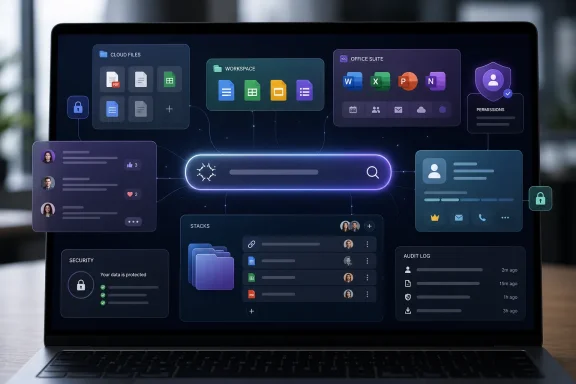
The most revealing thing about Dropbox Dash is that it does not look like the old Dropbox. It is not organized around folders, sync status, or the quiet comfort of a shared drive. It starts with a search bar, recent work, and curated collections called Stacks, effectively conceding that modern knowledge work begins before anyone remembers where a document lives.
That is a sharp pivot for a company whose original magic was making files appear everywhere. Dropbox made sync feel invisible at a time when emailing attachments to yourself was still normal behavior. But in 2026, the problem is no longer that workers cannot reach their files; it is that they cannot remember whether the thing they need is a file, a Slack thread, a Notion page, a Salesforce record, or a link buried in a calendar invite.
Ad hoc news frames Dash as a decluttering tool, and that description is accurate as far as it goes. But it undersells the strategic bet. Dash is Dropbox trying to move from storage provider to work memory provider, a company that does not merely hold the artifacts of work but mediates access to them.
Dropbox’s own Dash pages describe the product as universal search, knowledge discovery, and content organization. That language matters because it places Dash in the same conceptual arena as Microsoft 365 Copilot, Google Gemini for Workspace, Glean, and a growing class of enterprise AI search tools. Dropbox is not just polishing its web app; it is trying to persuade customers that the mess between their apps is valuable territory.
That is why Dash is more than an interface experiment. If Dropbox remains “the place where files are stored,” it competes against suites that can include storage as a line item in a much larger contract. If Dropbox becomes “the place where scattered work becomes findable,” it has a better argument for existing alongside those suites rather than being displaced by them.
Drew Houston has spent the last few years describing Dropbox’s future in broader terms than files. In company presentations and interviews, Dropbox has positioned itself around organizing cloud content, reducing busywork, and helping users navigate fragmented work. Dash is the clearest product expression of that strategy.
The timing is not accidental. AI has made search feel newly important because natural language queries can cut across messy content types in ways keyword search often could not. A user typing “the Q3 pricing deck we discussed with Acme” expects more than a filename match. They expect the system to infer context from documents, messages, relationships, and recent activity.
That expectation is also dangerous. Once a product promises to understand work across systems, it inherits the governance headaches of every system it touches. Dropbox is selling simplicity to end users and reassurance to IT, and those two promises are not always easy to reconcile.
Dash’s Stacks feature is Dropbox’s neatest answer to that mess. A Stack is essentially a curated bundle of links and content around a project, team, client, or workflow. Instead of forcing users to remember the location of each asset, Dash turns the collection itself into an object that can sit on the home screen.
That sounds small, but it points to a broader shift in workplace software. The unit of work is no longer a file; it is a cluster of related items scattered across systems. A product launch might include a Figma board, a strategy doc, a spreadsheet, a campaign calendar, Slack decisions, meeting notes, and a support-readiness page. The worker does not care which app owns each piece. They care whether the cluster appears when needed.
Dropbox is also trying to make Dash ambient. The product can appear as a browser start page, a web destination, and a desktop-adjacent workflow. Dropbox help materials describe access through Dropbox itself and through the standalone Dash experience, with browser support that lets users search from Chrome or Microsoft Edge. The goal is obvious: Dash must be closer than the app-specific search boxes it wants to replace.
This is where the product’s restraint may help it. According to the ad hoc news hands-on description, Dash feels more like a minimalist command center than a chatty AI companion. That is a wise choice. The workplace does not need another animated assistant begging for attention; it needs fewer moments of “where did we put that?”
Dropbox says Dash respects existing file permissions and only surfaces content a user is authorized to access. Its security materials emphasize permission-aware search, encryption, and the claim that customer content is not used to train general-purpose models for other users. The company’s security whitepaper and AI compliance materials lean heavily on the idea that Dash extends Dropbox’s existing security model rather than inventing a new one.
That is the right message, but IT departments will still want proof in the form of controls, logs, retention policies, connector governance, and admin visibility. A universal search tool is only as safe as the permissions underneath it. If a company has sloppy sharing practices in Google Drive or stale Slack channel access, Dash may not create the exposure, but it can make the exposure easier to discover.
This is the underappreciated tension in AI search. Better retrieval can feel like a data leak when the underlying permissions were already too broad. The worker says, “I didn’t know I could see that.” The security team says, “That is exactly the problem.”
Dropbox’s challenge is therefore twofold. It must convince users that Dash is more useful than searching each app separately, and it must convince admins that usefulness will not become uncontrolled visibility. In enterprise software, the second sale is often harder than the first.
Dash’s AI layer is meant to close that gap. Dropbox describes Dash as capable of not just finding content but summarizing, answering, organizing, and helping users act on it. Dropbox’s Spring 2025 materials highlighted broader AI functions, including search across richer media and tools for writing, analyzing, and summarizing.
That makes Dash more than a better index. It becomes a reasoning layer over company context, though “reasoning” should be handled carefully here. These systems are still probabilistic, still dependent on source quality, and still prone to producing confident answers from incomplete context.
The practical benefit is nevertheless real. A vague query such as “summary of contract,” as described in the ad hoc news piece, is the kind of prompt a human might naturally type when they do not remember the exact document title. If Dash can return the relevant PDF alongside related notes, emails, or messages, it saves not only time but cognitive load.
The danger is that convenience can blur source boundaries. A summary that mixes a signed contract, a negotiation email, and an internal note may be useful, but it also requires careful presentation. Users need to know what the answer is based on, what system it came from, and whether they are looking at a final artifact or a conversational fragment.
Many companies do not live entirely inside one suite. They may use Microsoft 365 for Office documents, Google Workspace for parts of collaboration, Slack for messaging, Salesforce for sales, Jira for engineering, and a patchwork of wikis and repositories for institutional memory. In that environment, a cross-platform search layer has an obvious appeal.
This is the opening Dropbox is trying to exploit. Dash can present itself as the layer above the stack rather than another silo inside it. That pitch will resonate most with organizations that already treat Dropbox as a trusted repository but have work spread across many SaaS tools.
The risk is that neutrality is not the same as leverage. Microsoft can place Copilot where users already work. Google can weave Gemini into Workspace. Salesforce can embed AI into CRM workflows. Dropbox has to persuade users to adopt Dash as a daily starting point, not merely as another destination.
That is why the start-page experience matters. If Dash becomes the first screen workers see when they open a browser tab, Dropbox gets a foothold in the daily flow. If it remains a tool users remember only after search fails elsewhere, it becomes a nice utility rather than a platform.
That ambiguity is not unusual for SaaS packaging in motion, but it matters. AI features have moved rapidly from “included preview” to “paid add-on” across the software industry. Vendors trained customers to expect experimentation, then began asking finance departments to fund another per-seat line item.
For Dropbox, this is a delicate balance. If Dash is included too broadly, it may improve retention but fail to generate enough incremental revenue to satisfy investors. If it is priced too separately, customers may view it as yet another AI surcharge layered on top of tools they already pay for.
The value case will depend on measurable time savings and workflow consolidation. A team that can retire a separate enterprise search product, reduce duplicated work, or speed up onboarding may justify the cost. A team that merely gets a prettier search box will not.
Dropbox also has to contend with AI fatigue. By 2026, every vendor claims to summarize, search, write, and reason over business content. Buyers are no longer impressed by the word “AI” on a product page. They want to know whose data is indexed, how permissions are enforced, what happens when an employee leaves, and whether the tool actually reduces work rather than creating another surface to manage.
Dash could help Dropbox in three ways. It could reduce churn by making Dropbox more central to daily work. It could increase average revenue per user through paid AI plans. And it could make Dropbox more attractive to teams that use many tools but lack a coherent knowledge layer.
Those are meaningful possibilities, but they are not automatic. The graveyard of productivity software is full of tools that looked useful in demos and then failed to become habit. Search products in particular face a high bar: users notice immediately when results are irrelevant, stale, or incomplete.
The habit question is especially important. If a worker starts every morning in Dash, maintains Stacks, searches across connected apps, and uses Dash Chat or summaries throughout the day, Dropbox has created a new behavior. If the worker opens Dash twice, forgets it exists, and returns to Slack search and Google Drive search, the strategic story weakens.
This is why Dropbox’s product design may matter as much as its model quality. A clean start page, fast results, obvious source attribution, and low-friction connectors are not cosmetic. They are the difference between becoming muscle memory and becoming another AI tab in the pile.
That is a necessary foundation. It is not the end of the conversation. In real deployments, administrators will need to inspect how connectors are authorized, how indexes are updated, how deleted or permission-revoked content disappears, how audit logs are exposed, and how sensitive results are handled in AI-generated answers.
The rise of AI search also makes old hygiene problems more visible. A misfiled HR document or broadly shared financial model might sit unnoticed in a cloud drive for years. Once a semantic search tool can surface it in response to a vague query, the organization experiences the discovery as a new risk.
That does not mean tools like Dash are inherently unsafe. In fact, they can help expose broken governance if deployed carefully. But companies should not confuse permission-aware AI with permission cleanup. Dash can respect the rules it is given; it cannot magically fix years of oversharing unless paired with administrative review and policy enforcement.
This is where Dropbox’s “protect everything at work” language will be tested. The strongest enterprise version of Dash is not merely a search layer for employees, but a governance-aware workspace that helps IT understand what is accessible, where sensitive content lives, and how AI is using it. If Dropbox can connect productivity and control, it has a better shot at standing apart.
Microsoft understands this with Copilot. Google understands it with Gemini. OpenAI understands it with ChatGPT’s move into work connectors and task workflows. Dropbox understands it with Dash.
For WindowsForum readers, that shift should feel familiar. The old fight was over defaults: browser defaults, search defaults, file associations, start menus, taskbars. The new fight is over the first prompt. Whoever controls the box where workers ask for things can steer attention, surface data, and shape workflow.
Dash is therefore not just competing with Dropbox’s own file list. It is competing with the Microsoft 365 app launcher, the Google Workspace home screen, Slack search, browser history, Windows Search, enterprise portals, and the increasingly crowded universe of AI assistants. That is a brutal neighborhood.
But it is also the right place for Dropbox to fight. The company is unlikely to beat Microsoft by building a better Word processor or Google by building a better spreadsheet. It can plausibly compete by being the connective tissue among tools customers already use.
These are not footnotes. They are the product. Enterprise search fails when users stop trusting it, and trust erodes one bad result at a time.
Dropbox has an advantage here because its brand has long been associated with reliability and simplicity. Users may be more willing to try an AI search layer from Dropbox than from a no-name startup asking for access to every work app. But that trust can be spent quickly if the product feels opaque.
The company must also avoid overloading Dash with too much “AI assistant” theater. The ad hoc news description of a clean, restrained interface is encouraging because the best version of Dash is not a chatbot pretending to be a coworker. It is a fast, explainable work surface that finds the right thing and shows why it is the right thing.
If Dropbox can keep that discipline, Dash may become one of the more practical AI products in the collaboration market. If it chases every agentic workflow trend, it risks becoming exactly what it was built to reduce: another source of work clutter.
The catch is that the same fragmentation that frustrates workers often protects companies by accident. Information hidden in separate tools is inefficient, but it is also less likely to appear casually in one unified answer. Dash reduces friction, and reduced friction is both the product benefit and the security concern.
This is why the best deployments will start with governance rather than enthusiasm. IT teams should treat Dash like an enterprise search and AI access layer, not a harmless browser convenience. That means scoping connectors, reviewing permissions, testing with sensitive data classes, and making sure users understand the difference between a source document and an AI-generated summary.
Dropbox’s strongest argument is that workers are already pasting, searching, forwarding, and improvising their way around the problem. A governed tool like Dash may be safer than unmanaged AI use or endless shadow workflows. But that argument only holds if the governed tool is actually governed.
That is a more ambitious and more difficult job. Files are discrete objects. Context is relational, temporal, permissioned, and often contradictory. The “latest” plan may be in a document, but the real decision may be in a Slack thread, and the customer promise may be in Salesforce.
AI search is useful precisely because it can traverse those boundaries. It is risky for the same reason. Dash sits at that junction, promising to make scattered work legible without flattening the controls that keep companies safe.
The market will not give Dropbox endless time to prove it. Microsoft and Google will keep improving their built-in assistants. Startups will keep selling dedicated enterprise search. Security vendors will increasingly pitch AI governance as the missing layer. Dropbox must show that Dash is not merely convenient, but central.
The future of Dash will not be decided by whether it can produce an impressive demo query. It will be decided by whether workers make it the first place they look and whether administrators believe it can be trusted with the map of the company’s knowledge. If Dropbox can win both sides of that equation, Dash may give the company something more valuable than another AI feature: a credible role in the next interface for work.
 Dropbox Wants to Own the Moment Before You Open the File
The most revealing thing about Dropbox Dash is that it does not look like the old Dropbox. It is not organized around folders, sync status, or the quiet comfort of a shared drive. It starts with a search bar, recent work, and curated collections called Stacks, effectively conceding that modern knowledge work begins before anyone remembers where a document lives.That is a sharp pivot for a company whose original magic was making files appear everywhere. Dropbox made sync feel invisible at a time when emailing attachments to yourself was still normal behavior. But in 2026, the problem is no longer that workers cannot reach their files; it is that they cannot remember whether the thing they need is a file, a Slack thread, a Notion page, a Salesforce record, or a link buried in a calendar invite.
Ad hoc news frames Dash as a decluttering tool, and that description is accurate as far as it goes. But it undersells the strategic bet. Dash is Dropbox trying to move from storage provider to work memory provider, a company that does not merely hold the artifacts of work but mediates access to them.
Dropbox’s own Dash pages describe the product as universal search, knowledge discovery, and content organization. That language matters because it places Dash in the same conceptual arena as Microsoft 365 Copilot, Google Gemini for Workspace, Glean, and a growing class of enterprise AI search tools. Dropbox is not just polishing its web app; it is trying to persuade customers that the mess between their apps is valuable territory.
The Old Dropbox Problem Has Become Everyone’s Problem
Dropbox’s dilemma is familiar to any company that won an earlier platform shift. The product that made it famous became so reliable that customers stopped thinking about it. Sync-and-share is still useful, but as a category it has been squeezed by bundled storage from Microsoft and Google on one side and specialized collaboration apps on the other.That is why Dash is more than an interface experiment. If Dropbox remains “the place where files are stored,” it competes against suites that can include storage as a line item in a much larger contract. If Dropbox becomes “the place where scattered work becomes findable,” it has a better argument for existing alongside those suites rather than being displaced by them.
Drew Houston has spent the last few years describing Dropbox’s future in broader terms than files. In company presentations and interviews, Dropbox has positioned itself around organizing cloud content, reducing busywork, and helping users navigate fragmented work. Dash is the clearest product expression of that strategy.
The timing is not accidental. AI has made search feel newly important because natural language queries can cut across messy content types in ways keyword search often could not. A user typing “the Q3 pricing deck we discussed with Acme” expects more than a filename match. They expect the system to infer context from documents, messages, relationships, and recent activity.
That expectation is also dangerous. Once a product promises to understand work across systems, it inherits the governance headaches of every system it touches. Dropbox is selling simplicity to end users and reassurance to IT, and those two promises are not always easy to reconcile.
Dash Turns Tab Overload Into a Product Category
The phrase “tab overload” sounds like marketing until you watch a typical office worker start the day. Email, calendar, chat, CRM, project board, docs, spreadsheets, dashboards, and half a dozen links from yesterday’s meeting all compete to become the first stop. The browser has become a junk drawer with a search field attached.Dash’s Stacks feature is Dropbox’s neatest answer to that mess. A Stack is essentially a curated bundle of links and content around a project, team, client, or workflow. Instead of forcing users to remember the location of each asset, Dash turns the collection itself into an object that can sit on the home screen.
That sounds small, but it points to a broader shift in workplace software. The unit of work is no longer a file; it is a cluster of related items scattered across systems. A product launch might include a Figma board, a strategy doc, a spreadsheet, a campaign calendar, Slack decisions, meeting notes, and a support-readiness page. The worker does not care which app owns each piece. They care whether the cluster appears when needed.
Dropbox is also trying to make Dash ambient. The product can appear as a browser start page, a web destination, and a desktop-adjacent workflow. Dropbox help materials describe access through Dropbox itself and through the standalone Dash experience, with browser support that lets users search from Chrome or Microsoft Edge. The goal is obvious: Dash must be closer than the app-specific search boxes it wants to replace.
This is where the product’s restraint may help it. According to the ad hoc news hands-on description, Dash feels more like a minimalist command center than a chatty AI companion. That is a wise choice. The workplace does not need another animated assistant begging for attention; it needs fewer moments of “where did we put that?”
Universal Search Is Easy to Say and Hard to Trust
The most attractive version of Dash is the one Dropbox demos: a single query pulls from Dropbox, Google Drive, Slack, Microsoft 365, Salesforce, and internal knowledge systems, with results ranked by relevance and source icons showing where each item originated. For a worker, that is immediately understandable. For an administrator, it is the beginning of a long checklist.Dropbox says Dash respects existing file permissions and only surfaces content a user is authorized to access. Its security materials emphasize permission-aware search, encryption, and the claim that customer content is not used to train general-purpose models for other users. The company’s security whitepaper and AI compliance materials lean heavily on the idea that Dash extends Dropbox’s existing security model rather than inventing a new one.
That is the right message, but IT departments will still want proof in the form of controls, logs, retention policies, connector governance, and admin visibility. A universal search tool is only as safe as the permissions underneath it. If a company has sloppy sharing practices in Google Drive or stale Slack channel access, Dash may not create the exposure, but it can make the exposure easier to discover.
This is the underappreciated tension in AI search. Better retrieval can feel like a data leak when the underlying permissions were already too broad. The worker says, “I didn’t know I could see that.” The security team says, “That is exactly the problem.”
Dropbox’s challenge is therefore twofold. It must convince users that Dash is more useful than searching each app separately, and it must convince admins that usefulness will not become uncontrolled visibility. In enterprise software, the second sale is often harder than the first.
The AI Layer Makes Search Feel Less Mechanical
Traditional enterprise search has always struggled with language. It is good when the user knows the file name, author, or exact phrase. It is worse when the user remembers the meeting, the client, the project nickname, or the rough idea.Dash’s AI layer is meant to close that gap. Dropbox describes Dash as capable of not just finding content but summarizing, answering, organizing, and helping users act on it. Dropbox’s Spring 2025 materials highlighted broader AI functions, including search across richer media and tools for writing, analyzing, and summarizing.
That makes Dash more than a better index. It becomes a reasoning layer over company context, though “reasoning” should be handled carefully here. These systems are still probabilistic, still dependent on source quality, and still prone to producing confident answers from incomplete context.
The practical benefit is nevertheless real. A vague query such as “summary of contract,” as described in the ad hoc news piece, is the kind of prompt a human might naturally type when they do not remember the exact document title. If Dash can return the relevant PDF alongside related notes, emails, or messages, it saves not only time but cognitive load.
The danger is that convenience can blur source boundaries. A summary that mixes a signed contract, a negotiation email, and an internal note may be useful, but it also requires careful presentation. Users need to know what the answer is based on, what system it came from, and whether they are looking at a final artifact or a conversational fragment.
Dropbox Is Trying to Be Neutral Ground in a Suite War
Dash’s strongest competitive argument is that Dropbox is not Microsoft or Google. That sounds odd, because Microsoft and Google have enormous advantages: identity, email, calendars, documents, meetings, security tooling, and admin consoles already embedded in the enterprise. But those strengths can also make their AI assistants suite-first by design.Many companies do not live entirely inside one suite. They may use Microsoft 365 for Office documents, Google Workspace for parts of collaboration, Slack for messaging, Salesforce for sales, Jira for engineering, and a patchwork of wikis and repositories for institutional memory. In that environment, a cross-platform search layer has an obvious appeal.
This is the opening Dropbox is trying to exploit. Dash can present itself as the layer above the stack rather than another silo inside it. That pitch will resonate most with organizations that already treat Dropbox as a trusted repository but have work spread across many SaaS tools.
The risk is that neutrality is not the same as leverage. Microsoft can place Copilot where users already work. Google can weave Gemini into Workspace. Salesforce can embed AI into CRM workflows. Dropbox has to persuade users to adopt Dash as a daily starting point, not merely as another destination.
That is why the start-page experience matters. If Dash becomes the first screen workers see when they open a browser tab, Dropbox gets a foothold in the daily flow. If it remains a tool users remember only after search fails elsewhere, it becomes a nice utility rather than a platform.
Pricing Turns the AI Bet Into a Customer Test
The ad hoc news piece describes Dash as tied to broader Dropbox plans and available across business-oriented tiers, but Dropbox’s current Dash materials present it more distinctly as Dash for Teams and Dash for Business, with trial access and plan-specific packaging. Independent Dropbox-focused reporting has also described Dash as a separate per-user add-on in the roughly $15 to $35 monthly range, depending on plan and billing terms, though customers on existing Dropbox business plans may see discounts or account-specific offers.That ambiguity is not unusual for SaaS packaging in motion, but it matters. AI features have moved rapidly from “included preview” to “paid add-on” across the software industry. Vendors trained customers to expect experimentation, then began asking finance departments to fund another per-seat line item.
For Dropbox, this is a delicate balance. If Dash is included too broadly, it may improve retention but fail to generate enough incremental revenue to satisfy investors. If it is priced too separately, customers may view it as yet another AI surcharge layered on top of tools they already pay for.
The value case will depend on measurable time savings and workflow consolidation. A team that can retire a separate enterprise search product, reduce duplicated work, or speed up onboarding may justify the cost. A team that merely gets a prettier search box will not.
Dropbox also has to contend with AI fatigue. By 2026, every vendor claims to summarize, search, write, and reason over business content. Buyers are no longer impressed by the word “AI” on a product page. They want to know whose data is indexed, how permissions are enforced, what happens when an employee leaves, and whether the tool actually reduces work rather than creating another surface to manage.
Investors Are Looking for Stickiness, Not Just Sparkle
For Dropbox shareholders, Dash is interesting because it tries to answer a long-running concern: how does a mature subscription software company grow when its core category is no longer novel? Storage alone is not a glamorous growth story. AI-assisted workflow, if it sticks, is at least a more plausible one.Dash could help Dropbox in three ways. It could reduce churn by making Dropbox more central to daily work. It could increase average revenue per user through paid AI plans. And it could make Dropbox more attractive to teams that use many tools but lack a coherent knowledge layer.
Those are meaningful possibilities, but they are not automatic. The graveyard of productivity software is full of tools that looked useful in demos and then failed to become habit. Search products in particular face a high bar: users notice immediately when results are irrelevant, stale, or incomplete.
The habit question is especially important. If a worker starts every morning in Dash, maintains Stacks, searches across connected apps, and uses Dash Chat or summaries throughout the day, Dropbox has created a new behavior. If the worker opens Dash twice, forgets it exists, and returns to Slack search and Google Drive search, the strategic story weakens.
This is why Dropbox’s product design may matter as much as its model quality. A clean start page, fast results, obvious source attribution, and low-friction connectors are not cosmetic. They are the difference between becoming muscle memory and becoming another AI tab in the pile.
Security Is the Feature That Decides the Enterprise Sale
The central enterprise question is not whether Dash can search across apps. It is whether Dash can do so without becoming a permissions amplifier. Dropbox’s public security posture is clearly designed to answer that concern: preserve existing access controls, encrypt data, avoid training general models on customer content, and provide enterprise governance.That is a necessary foundation. It is not the end of the conversation. In real deployments, administrators will need to inspect how connectors are authorized, how indexes are updated, how deleted or permission-revoked content disappears, how audit logs are exposed, and how sensitive results are handled in AI-generated answers.
The rise of AI search also makes old hygiene problems more visible. A misfiled HR document or broadly shared financial model might sit unnoticed in a cloud drive for years. Once a semantic search tool can surface it in response to a vague query, the organization experiences the discovery as a new risk.
That does not mean tools like Dash are inherently unsafe. In fact, they can help expose broken governance if deployed carefully. But companies should not confuse permission-aware AI with permission cleanup. Dash can respect the rules it is given; it cannot magically fix years of oversharing unless paired with administrative review and policy enforcement.
This is where Dropbox’s “protect everything at work” language will be tested. The strongest enterprise version of Dash is not merely a search layer for employees, but a governance-aware workspace that helps IT understand what is accessible, where sensitive content lives, and how AI is using it. If Dropbox can connect productivity and control, it has a better shot at standing apart.
The Browser Start Page Is the New Enterprise Desktop
There is something quietly significant about Dash living on a new browser tab. In the Windows era, the desktop was the launchpad. In the cloud era, the browser became the operating surface. In the AI era, vendors are trying to own the intent layer: the place where a user states what they need before choosing an app.Microsoft understands this with Copilot. Google understands it with Gemini. OpenAI understands it with ChatGPT’s move into work connectors and task workflows. Dropbox understands it with Dash.
For WindowsForum readers, that shift should feel familiar. The old fight was over defaults: browser defaults, search defaults, file associations, start menus, taskbars. The new fight is over the first prompt. Whoever controls the box where workers ask for things can steer attention, surface data, and shape workflow.
Dash is therefore not just competing with Dropbox’s own file list. It is competing with the Microsoft 365 app launcher, the Google Workspace home screen, Slack search, browser history, Windows Search, enterprise portals, and the increasingly crowded universe of AI assistants. That is a brutal neighborhood.
But it is also the right place for Dropbox to fight. The company is unlikely to beat Microsoft by building a better Word processor or Google by building a better spreadsheet. It can plausibly compete by being the connective tissue among tools customers already use.
The Product Will Succeed or Fail on Boring Details
The big AI story is seductive, but Dash’s future will be decided by mundane product details. Does it index fast enough? Are results ranked sensibly? Do permissions changes propagate quickly? Are Stacks easy to maintain? Does the browser extension stay out of the way? Can admins disable risky connectors? Does search work well with messy naming conventions, acronyms, and duplicated files?These are not footnotes. They are the product. Enterprise search fails when users stop trusting it, and trust erodes one bad result at a time.
Dropbox has an advantage here because its brand has long been associated with reliability and simplicity. Users may be more willing to try an AI search layer from Dropbox than from a no-name startup asking for access to every work app. But that trust can be spent quickly if the product feels opaque.
The company must also avoid overloading Dash with too much “AI assistant” theater. The ad hoc news description of a clean, restrained interface is encouraging because the best version of Dash is not a chatbot pretending to be a coworker. It is a fast, explainable work surface that finds the right thing and shows why it is the right thing.
If Dropbox can keep that discipline, Dash may become one of the more practical AI products in the collaboration market. If it chases every agentic workflow trend, it risks becoming exactly what it was built to reduce: another source of work clutter.
The Decluttering Promise Comes With a Governance Bill
Dash’s appeal is easy to understand because the pain is universal. Work is scattered, search is fragmented, and employees waste time reconstructing context that already exists somewhere in the company’s systems. Dropbox is right that this is a real problem.The catch is that the same fragmentation that frustrates workers often protects companies by accident. Information hidden in separate tools is inefficient, but it is also less likely to appear casually in one unified answer. Dash reduces friction, and reduced friction is both the product benefit and the security concern.
This is why the best deployments will start with governance rather than enthusiasm. IT teams should treat Dash like an enterprise search and AI access layer, not a harmless browser convenience. That means scoping connectors, reviewing permissions, testing with sensitive data classes, and making sure users understand the difference between a source document and an AI-generated summary.
Dropbox’s strongest argument is that workers are already pasting, searching, forwarding, and improvising their way around the problem. A governed tool like Dash may be safer than unmanaged AI use or endless shadow workflows. But that argument only holds if the governed tool is actually governed.
Dropbox’s Dash Bet Is Really a Bet on Work Memory
The most interesting thing about Dash is that it reframes Dropbox’s old mission. The company used to help users keep files in sync across devices. Now it wants to keep context in sync across apps.That is a more ambitious and more difficult job. Files are discrete objects. Context is relational, temporal, permissioned, and often contradictory. The “latest” plan may be in a document, but the real decision may be in a Slack thread, and the customer promise may be in Salesforce.
AI search is useful precisely because it can traverse those boundaries. It is risky for the same reason. Dash sits at that junction, promising to make scattered work legible without flattening the controls that keep companies safe.
The market will not give Dropbox endless time to prove it. Microsoft and Google will keep improving their built-in assistants. Startups will keep selling dedicated enterprise search. Security vendors will increasingly pitch AI governance as the missing layer. Dropbox must show that Dash is not merely convenient, but central.
The Dash Decision Comes Down to Habit, Control, and Cost
Dash is not just another Dropbox feature to toggle on and forget. It is a new layer in the workday, and layers either become indispensable or they become clutter.- Dropbox Dash is best understood as an AI-powered work hub that searches across connected apps, not as a replacement for Dropbox storage.
- Its strongest user-facing feature is the ability to turn scattered project links and documents into searchable, reusable Stacks.
- Its strongest enterprise claim is permission-aware search, but companies still need to clean up source-system permissions before rolling it out broadly.
- Its competitive opening is cross-platform neutrality in organizations that do not live entirely inside Microsoft 365 or Google Workspace.
- Its pricing and packaging will matter because customers are increasingly skeptical of separate AI add-ons unless the productivity gains are measurable.
- Its long-term value to Dropbox depends on whether Dash becomes a daily starting point for work rather than an occasional rescue tool for lost files.
The future of Dash will not be decided by whether it can produce an impressive demo query. It will be decided by whether workers make it the first place they look and whether administrators believe it can be trusted with the map of the company’s knowledge. If Dropbox can win both sides of that equation, Dash may give the company something more valuable than another AI feature: a credible role in the next interface for work.
References
- Primary source: ad-hoc-news.de
Published: 2026-07-04T12:50:11.961519
Dropbox Dash from Dropbox Inc. - AI search tool aims to declutter cloud work
Dropbox Dash brings AI-powered universal search and link collections to Dropbox users across web and desktop. Anyone holding Dropbox Inc. stock (NASDAQ: DBX, ISIN US26210C1045) should know this product.www.ad-hoc-news.de - Related coverage: dash.dropbox.com
AI Universal Search & Knowledge Workspace - Dropbox
Dropbox Dash is an AI-powered universal search workspace that connects your files, messages, and context across connected apps so you can find and act faster.dash.dropbox.com - Related coverage: help.dropbox.com
How to try Dash for Teams - Dropbox Help
Learn how to try Dropbox Dash in your Dropbox account to quickly search, organize, and find your files with AI-powered tools.help.dropbox.com
- Related coverage: dropboxwatchdog.com
Dropbox Dash: AI search sold as a separate $15–$35 per-user add-on · Dropbox Watchdog
Dropbox's AI-powered universal search, Dash, is billed separately from storage at roughly $15 per user per month for teams and $35 per user per month for business — meaning the 'AI era' Dropbox used to justify layoffs arrives as an extra charge rather than an included feature.dropboxwatchdog.com - Related coverage: developers.dropbox.com
Dropbox OAuth Guide - Dropbox
This guide covers how to implement an OAuth flow using the Dropbox API. Topics include access tokens, PKCE, scopes, and authorizing your app to access a users' Dropbox data. - Related coverage: investors.dropbox.com
Introducing Dropbox Dash for Business — AI-powered Universal Search That Finds Anything and Protects Everything at Work
PDF documentinvestors.dropbox.com
- Related coverage: blog.dropbox.com
Spring 2025 release | Dropbox Blog
Search videos and images—and create content fast—with the updated Dropbox Dash. - Related coverage: techradar.com
Dropbox is bringing more of its Dash AI features to all users | TechRadar
Dropbox is bringing Dash AI to a wider crowdwww.techradar.com - Related coverage: dropbox.com
Dropbox Dash Security Whitepaper
Dash is a productivity platform that combines smart universal search and knowledge management with in-depth content access control.www.dropbox.com