

Dropbox’s latest AI push, embodied in Dash for Business, is the company’s most explicit effort yet to reposition itself from a file‑sync vendor into a content‑intelligence provider — but investors and many enterprise buyers should treat this moment as a leap fraught with both technical promise and acute competitive risk. Morningstar’s recent stance — excerpted by the user as recommending to “sit out on Dropbox” — captures a wider skepticism: another midsize software firm attempting to build a halo product in a market already stalked by the largest cloud and AI platforms. I attempted to retrieve Morningstar’s full report directly but the site was inaccessible to me; where I rely on the supplied excerpt I flag that specific recommendation as user‑provided and thus subject to confirmation. s what Dash for Business actually delivers, why Dropbox thinks it can compete, who the real competitors are (and why they matter), and the practical and market risks that should temper excitement. I cross‑check Dropbox’s public product claims and company positioning against vendor documentation, Microsoft and Google product pages, independent reviews of enterprise LLM search offerings such as Glean, and recent analyst coverage and financial filings to give readers a clear, skeptical, and operational view of the opportunity and the hazards.
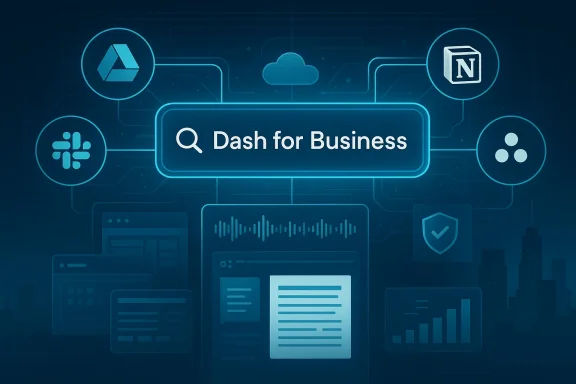
Dropbox launched Dash for Business as an AI‑powered, universal search and content governance layer intended to unify a company’s scattered information: files in Dropbox, documents in Google Drive or OneDrive, notes in Notion, messages in Slack, and so on. Dropbox positions Dash as a single search box that not only retrieves items across apps but also summarizes content, answers follow‑up questions, groups results into sharable collections (Stacks), and gives IT teams visibility and permission‑controls across connected platforms. The product announcement and Dropbox’s fall‑2024 product update outline these capabilities and the intended go‑to‑market approach.
Why it matters: knowledge fragmentation is real. Enterprises today run dozens, sometimes hundreds, of cloud apps. Even when those apps provide internal search, the lack of a single, permission‑aware, AI semantic layer creates repeated friction for knowledge workers. Dropbox’s pitch is straightforward: build that layer, do it securely, and monetize higher‑value business seats. The pitch aligns with broader enterprise demand for “one place to look” driven by LLMs.
But the competitive and economic reality is stark. The companies most able to host a universal, enterprise‑grade, LLM‑powered search engine are the hyperscalers — principally Microsoft and Google — because they can (1) embed AI search directly into their productivity suites, (2) operate deep, end‑to‑end connectors into their own collaboration stacks, and (3) amortize model costs across massive installed bases. Independent specialist vendors — notably Glean — argue they can compete by focusing narrowly on search quality, permission safety, and enterprise workflows. The market question is whether Dropbox can thread the needle between hyperscaler scale and specialist execution.
Why the claims are fragile:
Key investor concerns:
Yet the broader market reality is sobering. Microsoft and Google can weaponize their productivity stacks to offer deeply integrated AI search experiences that advantaged by identity and native data access. Specialist vendors like Glean demonstrate that focus and quality can win in the niche, but they also face scale and margin pressures. For investors, the question is whether Dash meaningfully changes Dropbox’s long‑term revenue profile — a high bar that carries nontrivial technical and commercial risk. Recent analyst skepticism and past downgrades reflect precisely that uncertainty.
Morningstar’s view — as quoted in the user excerpt — to “sit out” aligns with a cautious interpretation of these dynamics. From a pure product and engineering perspective, Dash is noteworthy and potentially useful for specific enterprise scenarios. From a market and valuation perspective, the road to outcompeting Microsoft and Google — or to becoming the universal search standard — is still long and uncertain. Readers should therefore treat Dash as a tactical tool to trial, not as definitive evidence of a strategic transformation that guarantees investor upside.
If you are evaluating Dash as an IT buyer, pilot it with strict security and governance tests and measure time‑to‑value in real workflows. If you are watching Dropbox as an investor, use Dash engagement metrics, customer conversion rates, and margin trajectory as the real signal — and be prepared for a multi‑quarter to multi‑year outcome. For now, disciplined skepticism is not only warranted — it is the prudent stance.
Source: Morningstar https://www.morningstar.com/company...software-we-recommend-sitting-out-on-dropbox/
 Background / Overview
Dropbox launched Dash for Business as an AI‑powered, universal search and content governance layer intended to unify a company’s scattered information: files in Dropbox, documents in Google Drive or OneDrive, notes in Notion, messages in Slack, and so on. Dropbox positions Dash as a single search box that not only retrieves items across apps but also summarizes content, answers follow‑up questions, groups results into sharable collections (Stacks), and gives IT teams visibility and permission‑controls across connected platforms. The product announcement and Dropbox’s fall‑2024 product update outline these capabilities and the intended go‑to‑market approach.Why it matters: knowledge fragmentation is real. Enterprises today run dozens, sometimes hundreds, of cloud apps. Even when those apps provide internal search, the lack of a single, permission‑aware, AI semantic layer creates repeated friction for knowledge workers. Dropbox’s pitch is straightforward: build that layer, do it securely, and monetize higher‑value business seats. The pitch aligns with broader enterprise demand for “one place to look” driven by LLMs.
But the competitive and economic reality is stark. The companies most able to host a universal, enterprise‑grade, LLM‑powered search engine are the hyperscalers — principally Microsoft and Google — because they can (1) embed AI search directly into their productivity suites, (2) operate deep, end‑to‑end connectors into their own collaboration stacks, and (3) amortize model costs across massive installed bases. Independent specialist vendors — notably Glean — argue they can compete by focusing narrowly on search quality, permission safety, and enterprise workflows. The market question is whether Dropbox can thread the needle between hyperscaler scale and specialist execution.
What Dash for Business actually does
Core capabilities
- Universal indexing and search — Dash connects to a broad set of SaaS apps and on‑prem sources, indexing content and returning semantic search results that are permission‑aware. Dropbox’s product page describes connectors to Google Drive, OneDrive, Notion, Asana, Slack, and others, and emphasizes cross‑app query understanding.
- AI summaries and Q&A — users can ask Dash to summarize documents or answer follow‑ups without opening the original file. This is an increasingly standard LLM‑driven interface for enterprise search.
- Multimodal search — Dash transcribes and searches audio/video and extracts text from images and scans, allowing multimedia assets to be indexed and queried. Dropbox specifically highlights improvements for creative teams (video transcription and image OCR/search).
- Intelligent collections (Stacks) — saved, shareable collections of search results or content, with admin‑level sharing and permission features designed for IT governance.
- Security and admin controls — Dropbox emphasizes content access control, permission visibility across connected platforms, and features intended for compliance and data leakage prevention. These are central to its go‑to‑market sales pitch to IT.
Availability and adoption signals
Dropbox announced general availability for Dash for Business in the U.S. (web and desktop) with broader rollouts planned for early 2025, and reported early customer tests (e.g., McLaren Racing) and engagement metrics. Management and earnings commentary in filings and presentations have called out Dash as a key part of Dropbox’s “generational transition” from pure file sync to AI content intelligence. Those company metrics should be treated as early indicators, not proof of scale.How Dropbox says Dash differentiates — and where that claim is fragile
Dropbox’s explicit differentiation thesis has three parts:- Platform‑agnostic semantic search — Dash is promoted as neutral toward ecosystems; it doesn’t force customers into a single vendor stack. That matters for organizations already spread across Google, Microsoft, Slack, and niche apps.
- Security and permission‑first design — unlike consumer LLMs, Dash is built for the enterprise with admin controls and connectors that respect access lists.
- Experience for creative and SMB customers — Dropbox claims multimodal strengths and a target customer profile of creative teams and SMBs that feel ignored by enterprise incumbents.
Why the claims are fragile:
- Platform‑agnostic connectors are only as powerful as their depth. Being able to connect to Google Drive or Slack is necessary but not sufficient; the quality of indexing, the freshness of updates, and the degree of integration (e.g., contextual signals from a document’s collaboration history) require engineering and long‑term maintenance that scale with the number and variety of app APIs.
- Security and permission correctness is a major engineering and legal surface. Mistakes in permission mapping or RAG (retrieval‑augmented generation) chains can leak sensitive content. Smaller vendors often under‑estimate the edge cases that enterprises demand.
- The “neutral” third‑party model competes directly with the vendors who own both the data and the client endpoints; Microsoft and Google can offer tighter experiences by virtue of owning the OS or productivity suite, and can bundle AI features into existing licensing — a difficult dynamic for an independent provider to counter.
The competitive set: who wins if universal AI search becomes table stakes?
Microsoft: Copilot + Copilot Search (and Microsoft Graph)
Microsoft has deliberately turned Copilot and Copilot Search into a universal, enterprise search layer integrated with Microsoft Graph and Microsoft 365. Copilot connectors are explicitly designed to pull in non‑Microsoft sources via Graph connectors, and Microsoft’s documentation positions Copilot Search as an enterprise‑grade universal search experience that will be available across the Copilot app, Edge, and other entry points. The practical advantage for Microsoft: native knowledge of Outlook, Teams, SharePoint, OneDrive, and Windows endpoints — plus deep enterprise identity integration (Azure AD/Entra) — giving it a holistic data context that independent players find very hard to match.- Strengths: massive installed base, identity integration, bundled licensing possibilities, and a wide set of native data sources.
- Weaknesses for Microsoft (relative): some customers prefer multi‑cloud neutrality; Microsoft must still earn trust on external connector privacy and on LLM hallucination controls.
Google: Gemini, Google Cloud Search and Workspace AI
Google has folded its Gemini models into Workspace (formerly Duet), Cloud Search, and other assistant services. Google’s product family also includes Cloud Search Platform for enterprises, and the company is evolving AI features inside Workspace to provide cross‑product search and summarization. Google’s advantages are its AI model investments, search expertise, and integration with Gmail, Drive, and Workspace.- Strengths: leader in search technology and LLM model stack; deep integration across Gmail, Drive, and Workspace.
- Weaknesses: enterprise customers sometimes prefer not to be single‑vendor locked; Google must meet strict enterprise controls and compliance demands in highly regulated industries.
Glean and specialist vendors
Glean (and similar startups) focus purely on enterprise search: building high‑quality connectors, permission‑aware ranking, personalized relevance, and chat interfaces. Independent reviews praise Glean for search quality, permission trimming, and enterprise controls; these vendors often sell into organizations that want a best‑in‑class search without major vendor lock‑in. Glean can sometimes out‑perform generalized vendors because it is less distracted by adjacent product lines.- Strengths: focus, speed of product iteration, and deep attention to enterprise relevance and connectors.
- Weaknesses: smaller scale, higher per‑seat cost, and dependence on connectors/APIs that can be rate‑limited or changed by platform vendors.
Why hyperscalers still have the edge
Owning a productivity stack (email, calendar, docs, identity) produces a privileged signal set that meaningfully improves relevance and context. When an AI assistant can see a user’s calendar, email threads, or the organization chart, it can give richer, personalized answers. Independents like Dropbox must replicate or integrate with many such signals to match that experience — a costly and brittle path.Financial and market context: why investors worry
Dropbox’s core File Sync & Share (FSS) business has matured; growth has slowed and management has signaled the need for new revenue engines. Analysts have noted flat or mildly declining ARR in certain periods, and Dropbox has relied on cost discipline and buybacks while investing in AI. The company’s push into Dash is therefore not just product innovation — it’s existential: can Dropbox create a differentiated, sellable product that generates meaningful incremental ARR? Recent analyst downgrades and volatility around Dropbox stock have reflected skepticism about this transition.Key investor concerns:
- Monetization: Can Dash convert free or low‑value users into a durable, high‑ARPU enterprise segment?
- Customer acquisition: Will IT buyers purchase a third‑party layer instead of leaning into Microsoft/Google bundles?
- API risk: Dependence on connectors exposes Dropbox to third‑party API changes or restrictions (e.g., Slack’s past API policy changes affected several vendors).
- Margins: Running LLMs, multimodal indexing, and real‑time connectors consumes infrastructure and talent; can Dropbox scale gross margins while investing in AI?
Technical and operational risks IT teams must consider
- Permission correctness and leakage risk
Universal search must return results only to those authorized to see them. Small errors in permission mapping, caching logic, or RAG pipelines can leak sensitive information. Enterprises must validate permission models in real‑world scenarios before wide deployment. - Data residency and compliance
Connecting many SaaS apps may surface data governed by regulatory protections. Customers should insist on SOC 2/ISO certifications, clear data residency options, and contractual commitments about model training and data retention. - Latency and scale
Indexing high volumes of multimedia content (video, images) requires heavy processing and storage. Dropbox claims latency and quality improvements, but operations at scale — millions of users and billions of documents — remain a non‑trivial engineering problem. - Dependency on connectors and platform policies
Connectors rely on third‑party APIs and authentication flows. Changes to those APIs or commercial terms can degrade functionality unexpectedly. - Model hallucination and explainability
LLMs sometimes generate plausible but incorrect summaries. Enterprises need explainability, citation of sources, and robust fallback to original content in workflows. - Vendor consolidation or acquisition risk
Many search specialists have been acquisition targets of hyperscalers; Dropbox itself could be acquired or must compete with acquirers who will pull capabilities in‑house.
Where Dropbox has legitimate strengths
- Product focus on content workflows — historically, Dropbox has built elegant, fast UIs for content storage and sharing. Product design and UX matter in user adoption.
- Multimodal capabilities for creative teams — the company’s emphasis on video transcription and multimedia search resonates for creative and media customers who face real pain in indexing assets.
- Permission visibility for IT — built‑in admin tooling that surfaces outdated permissions and external sharing risks can materially reduce data leakage risk if implemented correctly.
Strategic scenarios: best‑case and worst‑case outcomes
- Best‑case (win): Dropbox establishes Dash as the standard search layer for SMBs and creative teams that value cross‑app neutrality; the company converts higher‑ARPU seats, achieves strong engagement, and scales margins through improved indexing efficiency and enterprise deals.
- Middle (niche leader): Dash becomes a respected product for specific verticals (creative agencies, media teams) and for companies with heterogeneous stacks, but Dropbox never dislodges Microsoft/Google in large enterprise deals; growth is steady but limited.
- Worst‑case (lose): The hyperscalers bundle equivalent capabilities into their suites, undercutting third‑party value; connector changes or security incidents limit Dash’s adoption; Dropbox’s R&D spend does not translate into meaningful ARR, depressing valuation. Analyst downgrades and investor skepticism intensify in this outcome.
How to read Morningstar’s posture — and what I verified
The user‑provided Morningstar excerpt frames the recommendation as cautionary: “we recommend sitting out on Dropbox” because Dash is a continuation of an uphill battle against better‑equipped tech giants. That framing is consistent with independent reporting and product comparisons: Microsoft and Google have structural advantages in data access, identity, and bundling; specialist vendors like Glean bring focused quality that challenges generalists. I verified Dropbox’s Dash claims on the company’s official product blog and product update pages and confirmed the existence of the Microsoft and Google product strategies via official documentation, and I cross‑checked independent reviews of Glean and analyst commentary about Dropbox’s financial context. Where I could not access Morningstar’s full text directly (the site returned an access error), the user excerpt serves as the proximate statement; readers should consult Morningstar directly for the full rationale and valuation details.Practical guidance for IT and procurement leaders
- Proof‑of‑value first: Run Dash (or any universal search pilot) against a representative subset of your content and workflows. Test permission mapping, query relevance, latency, and summarization accuracy in real tasks — not synthetic demos.
- Audit trails and fallbacks: Require clear auditing, source citation in summaries, and the ability to revert or correct generated answers. If an AI answer includes assertions, the tool should provide the underlying document references.
- Network and API resilience: Validate how Dash handles connector outages or rate limits; ensure local workflows remain productive if a connector fails.
- Vendor neutrality vs. bundling economics: Compare the total cost and feature parity between a third‑party layer (Dropbox Dash) and the hyperscaler bundles your organization already pays for. Freeing users from vendor lock‑in has value — but it must be balanced against licensing economies and end‑to‑end support.
- Security validation: Insist on SOC 2/ISO attestation, thorough penetration testing reports, and a clear legal position around whether connected data is used to train vendor models.
Conclusion: promising product, high hurdles — caution is warranted
Dropbox’s Dash for Business is a credible, well‑designed attempt to solve a genuine enterprise pain: fractured content and poor cross‑app discovery. Technically, the product ticks many boxes — multimodal search, AI summarization, and admin controls — and Dropbox has the product design chops to make the experience sticky for certain customer segments.Yet the broader market reality is sobering. Microsoft and Google can weaponize their productivity stacks to offer deeply integrated AI search experiences that advantaged by identity and native data access. Specialist vendors like Glean demonstrate that focus and quality can win in the niche, but they also face scale and margin pressures. For investors, the question is whether Dash meaningfully changes Dropbox’s long‑term revenue profile — a high bar that carries nontrivial technical and commercial risk. Recent analyst skepticism and past downgrades reflect precisely that uncertainty.
Morningstar’s view — as quoted in the user excerpt — to “sit out” aligns with a cautious interpretation of these dynamics. From a pure product and engineering perspective, Dash is noteworthy and potentially useful for specific enterprise scenarios. From a market and valuation perspective, the road to outcompeting Microsoft and Google — or to becoming the universal search standard — is still long and uncertain. Readers should therefore treat Dash as a tactical tool to trial, not as definitive evidence of a strategic transformation that guarantees investor upside.
If you are evaluating Dash as an IT buyer, pilot it with strict security and governance tests and measure time‑to‑value in real workflows. If you are watching Dropbox as an investor, use Dash engagement metrics, customer conversion rates, and margin trajectory as the real signal — and be prepared for a multi‑quarter to multi‑year outcome. For now, disciplined skepticism is not only warranted — it is the prudent stance.
Source: Morningstar https://www.morningstar.com/company...software-we-recommend-sitting-out-on-dropbox/
