

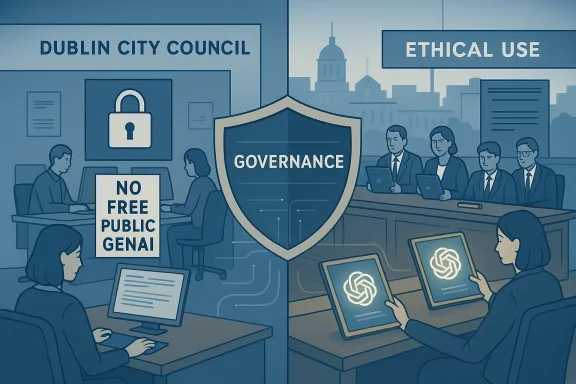
Dublin’s decision to bar council staff from using free, public generative AI tools while simultaneously running training for elected councillors on the same class of tools has exposed a live policy tension: how do public institutions balance the operational promise of generative AI with legal, privacy, and reputational risk — and should the rules differ between employees and elected representatives? The city’s guidance, which forbids staff from using public GenAI for council business because of data‑privacy and security concerns, sits uneasily alongside an Association of Irish Local Government (AILG) seminar that taught councillors how to use the free ChatGPT service for drafting press lines, social media ideas and public speaking notes. That contrast — a strict prohibition for staff and permissive training for councillors — is now a practical test case for local‑government AI governance.
Dublin City Council’s internal guidance warns that “the use of free and publicly accessible Gen AI tools present a significant risk for organisations due to a lack of effective safeguards ensuring data privacy and safety,” and explicitly requires enterprise-approved, licensed tools for business purposes. At the same time, councillors were circulated a recording of an hour‑long AILG webinar demonstrating how ChatGPT’s free tier can be used to draft communications — a session originally produced for councillor digital‑communications skill development. The webinar explicitly cautioned against entering personal data or confidential material into public AI systems, yet nonetheless modelled practical use cases that are central to daily elected‑member work: press releases, social posts and speaking points.
This split is not unique to Dublin. Several other local authorities are pursuing cautious, mixed strategies: some buy limited corporate licences for Microsoft Copilot for staff and run tightly scoped pilots to evaluate operational gains; others prohibit staff from using public GenAI entirely while leaving councillors’ behaviour to be governed by ethical rules that primarily address donations and conduct rather than tool usage. That fragmentation mirrors a wider international pattern in municipal AI policy: an instinct to harness productivity gains coupled with an equally strong instinct to lock down uncontrolled endpoints that can leak personal data or undermine public trust.
Dublin’s approach reflects this legal and managerial fault line: the internal staff prohibition is designed to enforce data governance, procurement and accountability; the councillor training, delivered as part of the Elected Member Training Programme, was framed as a communications‑skills exercise with explicit caveats on confidentiality. But the policy gap invites real questions about records management, FOI obligations and how to ensure consistent public‑sector standards when the same organisation has different rules for two classes of official actors.
Benefits:
Advantages of councillor training:
That difference matters: when a public servant includes a citizen’s name, address and clinical detail in a prompt, the legal exposure is real; with enterprise products the licensor can be held to account and specific protections negotiated. With free services, there is often no equivalent recourse. This contractual asymmetry is a central reason Dublin’s staff guidance forbids public models for business use.
Public-interest technologists emphasize this core reality: these systems are probabilistic, not factual. Expecting them to be accurate is often "more out of a fluke than a design." That observation should inform any training regime and policy — councillors and staff must treat AI outputs as drafts requiring verification rather than final authoritative text.
The safe path for public bodies is to make risk reduction the default: require licences and contractual protections for official use, and treat AI outputs as provisional drafts that must be verified before being used for decision‑making or formal communications. Failure to do so shifts the burden back onto citizens and weakens public trust.
Public bodies should aim for a single, coherent approach: enterprise‑grade tools for official workflows, clear behavioural rules for elected members when they act in their public roles, robust training that emphasizes verification and records, and technical and contractual controls that mitigate leakage. If councils can combine capability building with practical governance — including human oversight, contractual safeguards and transparent recordkeeping — they can harness AI to improve service delivery without ceding control of citizen data or institutional trust. The alternative is a patchwork of ad hoc practices that erode accountability and create avoidable legal risk.
The Dublin case is a useful cautionary tale: training without enforceable boundaries and procurement discipline without civic transparency will not be enough. What municipal leaders need is not simply smarter tools, but smarter governance.
Source: Dublin InQuirer While council staff are barred from using free AI chatbots, councillors are trained on them
 Background
Dublin City Council’s internal guidance warns that “the use of free and publicly accessible Gen AI tools present a significant risk for organisations due to a lack of effective safeguards ensuring data privacy and safety,” and explicitly requires enterprise-approved, licensed tools for business purposes. At the same time, councillors were circulated a recording of an hour‑long AILG webinar demonstrating how ChatGPT’s free tier can be used to draft communications — a session originally produced for councillor digital‑communications skill development. The webinar explicitly cautioned against entering personal data or confidential material into public AI systems, yet nonetheless modelled practical use cases that are central to daily elected‑member work: press releases, social posts and speaking points.This split is not unique to Dublin. Several other local authorities are pursuing cautious, mixed strategies: some buy limited corporate licences for Microsoft Copilot for staff and run tightly scoped pilots to evaluate operational gains; others prohibit staff from using public GenAI entirely while leaving councillors’ behaviour to be governed by ethical rules that primarily address donations and conduct rather than tool usage. That fragmentation mirrors a wider international pattern in municipal AI policy: an instinct to harness productivity gains coupled with an equally strong instinct to lock down uncontrolled endpoints that can leak personal data or undermine public trust.
Why the Dublin split matters: roles, responsibilities and risk
Councillors are not staff — but they are public actors
Elected councillors occupy a complex position: they are political actors, independent mandate‑holders and public officeholders whose daily work includes public communications, constituency casework and formal participation in official meetings. Dublin’s guidance treats councillors differently from staff because councillors are not managed as employees; their tools and communications are often rightly seen as political expression. Yet when councillors use AI in the course of public business — drafting a constituency response to a complaint, preparing a policy briefing or circulating material that influences council decisions — the line between political speech and official action becomes operationally important.Dublin’s approach reflects this legal and managerial fault line: the internal staff prohibition is designed to enforce data governance, procurement and accountability; the councillor training, delivered as part of the Elected Member Training Programme, was framed as a communications‑skills exercise with explicit caveats on confidentiality. But the policy gap invites real questions about records management, FOI obligations and how to ensure consistent public‑sector standards when the same organisation has different rules for two classes of official actors.
Practical risks created by the split
- Data privacy and inadvertent disclosure: free public models capture prompts and outputs, and those prompts can include personally identifiable information (PII) or details of casework. That exposure may violate data‑protection law and institutional confidentiality rules.
- Misinformation and accuracy: public GenAI systems are probabilistic — they produce plausible text, not guaranteed facts. Relying on them in public communications risks spreading inaccuracies and damaging the council’s credibility.
- Records and retention: if councillors use a public chatbot to compose official texts, where do those outputs live for public‑records laws, audit trails and FOI requests?
- Contractual and vendor accountability: licensed enterprise products offer contractual recourse and specific data‑handling guarantees that free services do not.
- Security and prompt‑injection: open chat interfaces increase attack surface; malicious content or cleverly crafted prompts can coax systems into exposing data or executing workflows that lead to leakage.
What Dublin did — and what that choice buys (and costs)
The staff ban: governance through procurement and technical control
Dublin City Council’s staff guidance is unambiguous: public GenAI models should not be used for council business, and only "DCC‑approved" enterprise tools with licences, contractual protections and data‑security assurances should be used for official work. This is a textbook risk‑management position: it reduces uncontrolled data exfiltration by preventing staff from pasting internal case notes, budgets or service‑user information into uncontrolled third‑party systems. The ban also forces the council to evaluate a small set of vendor‑approved tools, giving IT and legal teams a feasible way to provide secure integrations and training.Benefits:
- Reduces accidental leakage of PII and business secrets.
- Ensures procurement and contractual obligations are met.
- Simplifies auditability and records management.
- Slower onboarding of innovative use cases for frontline staff.
- Potential workarounds as employees seek convenience via personal devices.
- Perceived inconsistency when elected officials are shown how to use public tools.
Councillor training on ChatGPT: capability building with caveats
The AILG session circulated to councillors taught practical communications uses — how to craft press releases, construct speaking points, and brainstorm social media ideas — using ChatGPT’s free version. The session included warnings against processing personal data or confidential council systems through public GenAI, but the fact that a recorded demonstration existed and was distributed (possibly by mistake instead of a Copilot session requested by a councillor) underlines how training and operational practice can drift apart.Advantages of councillor training:
- Rapid upskilling on tools constituents are already using.
- Improved communications efficiency for public-facing work.
- Better informed councillors who can evaluate digital tools critically.
- Without enforceable rules, councillors may still use free tools for sensitive tasks.
- Training that models uncontrolled use — even with caveats — risks normalising unsafe practices.
- The difference in tooling for staff and councillors can create operational friction and legal ambiguity.
The technical and legal fault lines: why free public models are different
Data handling, training pipelines and contractual protections
Licensed enterprise GenAI offerings (for example, vendor Copilot integrations licensed through Microsoft or closed, on‑premise models) typically come with contractual terms that guarantee data handling, non‑retention of prompts, or data residency. Those contractual levers are vital for public bodies that must comply with national data‑protection law and public‑records legislation. Free, publicly accessible models, by contrast, are governed by general consumer terms and limited assurances: prompts may be logged, used for model training, or stored without the same regulatory constraints.That difference matters: when a public servant includes a citizen’s name, address and clinical detail in a prompt, the legal exposure is real; with enterprise products the licensor can be held to account and specific protections negotiated. With free services, there is often no equivalent recourse. This contractual asymmetry is a central reason Dublin’s staff guidance forbids public models for business use.
Hallucinations, provenance and the illusion of authority
Generative models create fluent narratives that can sound authoritative. That fluency can mislead both the creator and the reader. Public communications composed or edited by a model may contain fabricated facts, misattributed statistics or outdated claims. For an elected official, distributing such output to constituents or to a formal council meeting can have downstream policy and legal consequences.Public-interest technologists emphasize this core reality: these systems are probabilistic, not factual. Expecting them to be accurate is often "more out of a fluke than a design." That observation should inform any training regime and policy — councillors and staff must treat AI outputs as drafts requiring verification rather than final authoritative text.
Attack vectors: prompt injection and data exfiltration
Recent technical research and community reporting have shown how carefully crafted prompts and user inputs can coerce AI assistants into leaking data, executing workflows or acting as a covert command relay. When assistants are embedded into workflows — or when users paste confidential snippets into open chat windows — the risk of inadvertent exfiltration rises. For public bodies, where data sensitivity is high, this is not theoretical: campaigns, community casework, licensing files and planning applications routinely include PII and commercially sensitive data. Robust technical controls and careful procurement are the practical mitigations.What other councils and public bodies are doing: a comparative view
- Some councils adopt a "single‑tool, staff‑only" model: approve a single enterprise assistant (e.g., Copilot) for staff, prohibit free public tools, and require structured pilot projects before wider rollout. This pattern reduces sprawl and centralises governance. Evidence from other municipal pilots shows a consistent emphasis on human oversight, recordability and DPIA (Data Protection Impact Assessment).
- A handful of councils run principled, human‑in‑the‑loop policies permitting limited AI assistance for specific, non‑sensitive tasks while insisting on human sign‑off for outputs that affect service delivery or legal rights. These programmes often pair training with retention obligations (i.e., keep the model outputs and prompt history within corporate records systems). Examples from smaller jurisdictions show that enforced process — not outright prohibition — can unlock efficiency without sacrificing traceability.
- Others favour conservative bans for staff and limited, elective training for elected officials. That is Dublin’s practical choice today: protect staff workflows via procurement and technical policy while educating councillors — though this leaves open the thorny question of how to govern councillors’ subsequent choices.
Critical analysis: strengths, blind spots and governance gaps
Strengths in Dublin’s approach
- Clear procurement discipline for staff reduces the risk of systemic data leakage and simplifies auditability.
- Active councillor upskilling recognises that elected members need digital literacy to engage constituents and use modern platforms.
- Explicit warnings in training that public models should not process personal or confidential information show an awareness of core risks.
Blind spots and unresolved questions
- Policy asymmetry without enforcement: advising councillors is not the same as restricting their actions. Elected members can still choose to use public tools in ways that affect the council’s operations, creating legal and operational exposures that current staff rules may not cover. This gap has not been closed by existing ethical guidance, which typically addresses conduct and donations rather than operational tool use.
- Records and FOI liability: when councillors use a third‑party chat tool to draft a statement that later becomes part of official business, it is unclear where those outputs reside for public‑records retention and FOI compliance. Municipal recordkeeping frameworks must be updated to capture AI‑generated content and the prompts that produced it.
- Normalization risk: training that demonstrates practical uses of public GenAI — even with clear caveats — risks normalizing unsafe practices among councillors and their staff. The distribution of a ChatGPT seminar recording in place of a Copilot session suggests process controls around training materials need strengthening.
- Verification and provenance: public AI outputs require verification. Councillors and staff must be resourced to fact‑check model outputs before publication; otherwise the risk of reputational damage and downstream harm increases. Independent audits and vendor transparency are required to assess model behavior and provenance claims.
Practical recommendations for councils and political offices
Below is a pragmatic checklist that local authorities should consider to reconcile capability, responsibility and risk.- Create a single enterprise‑approved assistant for staff, procured under an IT, legal and data‑protection review, with documented contractual data‑handling commitments.
- Require a DPIA for any system that touches personal data; do not permit staff to use public GenAI for business processes without an approved mitigation plan.
- For councillors, issue a clear behavioural policy specifying permitted uses, prohibited inputs (e.g., PII, confidential case files), and retention obligations for AI outputs used in any official capacity. This policy should be co‑designed with the legal, records and IT teams.
- Update records‑management rules to capture AI outputs and associated prompts when they relate to council business, ensuring FOI and archival obligations can be met.
- Deliver role‑specific training: communications‑focused sessions for councillors that emphasise verification and draft‑status of AI output; operational training for staff that enforces guardrails and auditing.
- Institute human‑in‑the‑loop sign‑off for all AI‑assisted public communications and decisions that affect citizen rights.
- Run time‑boxed pilots with monitoring and metrics (accuracy, rework, FOI incidents, privacy leak attempts) before scaling to other departments.
- Build technical mitigations: disable copy/paste of sensitive fields into external tools from council devices, use managed browsers and DLP rules to reduce accidental leakage.
- Maintain a public log of AI pilots and policies so citizens know which tools handle their data and under what safeguards. Transparency supports trust and democratic accountability.
- Vendor accountability: require vendors to commit contractually to prompt‑retention, non‑use for model training (if possible), and breach notifications compatible with public‑sector obligations.
How to train councillors responsibly: curricula and guardrails
Councillor training should teach practical skills without normalising risky behaviors. A recommended module structure:- Module 1: What AI is and isn’t — clarify probabilistic nature, hallucination risk and the difference between drafting and authoritative sources.
- Module 2: Privacy and confidentiality — explicit examples of what not to paste into a public model, with legal rationale and real‑world consequences.
- Module 3: Prompt craft and verification — teach how to construct prompts that help produce drafts, plus mandatory verification steps (cite two trusted sources at minimum).
- Module 4: Records and retention — how to save drafts in council systems and what constitutes an official record.
- Module 5: Red‑team awareness — introduce prompt‑injection examples and social‑engineering risks so councillors recognise hostile inputs.
The accountability question: who is liable when AI goes wrong?
Accountability is not purely technological; it is institutional. If a councillor publishes misleading material generated by a public chatbot, the reputational harm is immediate and the council’s duty to correct misinformation is clear. But legal liability — for data breaches, for instance — depends on where the data exposure occurred and whether the council had adequate policies and training in place.The safe path for public bodies is to make risk reduction the default: require licences and contractual protections for official use, and treat AI outputs as provisional drafts that must be verified before being used for decision‑making or formal communications. Failure to do so shifts the burden back onto citizens and weakens public trust.
Conclusion: governance, not technophobia
The heart of the Dublin episode is not a debate about technology per se but a governance problem: how to align procurement, legal obligations, records management and democratic accountability with the operational promise of generative AI. Dublin’s staff ban and councillor training capture two legitimate priorities — data protection and democratic competence — but they do not, by themselves, resolve the deeper coordination issues.Public bodies should aim for a single, coherent approach: enterprise‑grade tools for official workflows, clear behavioural rules for elected members when they act in their public roles, robust training that emphasizes verification and records, and technical and contractual controls that mitigate leakage. If councils can combine capability building with practical governance — including human oversight, contractual safeguards and transparent recordkeeping — they can harness AI to improve service delivery without ceding control of citizen data or institutional trust. The alternative is a patchwork of ad hoc practices that erode accountability and create avoidable legal risk.
The Dublin case is a useful cautionary tale: training without enforceable boundaries and procurement discipline without civic transparency will not be enough. What municipal leaders need is not simply smarter tools, but smarter governance.
Source: Dublin InQuirer While council staff are barred from using free AI chatbots, councillors are trained on them
