

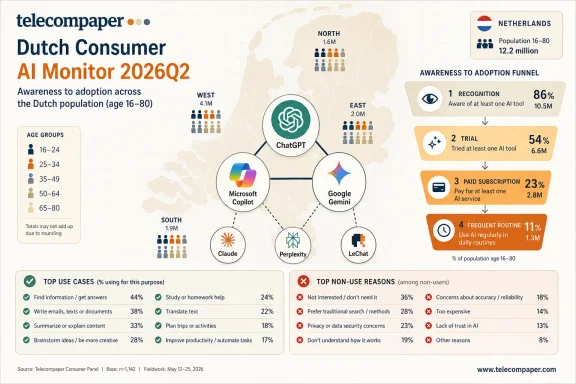
Telecompaper’s Dutch Consumer AI Monitor 2026Q2 maps how Dutch adults aged 16 to 80 recognize and use six consumer AI tools: ChatGPT, Microsoft Copilot, Google Gemini, Claude, Perplexity, and LeChat. It also drills into actual use, paid subscriptions, and frequency for the three leading tools in the report: ChatGPT, Copilot, and Gemini. The point is not simply that generative AI has become familiar. The more useful question is whether recognition is turning into regular, paid, task-based use among Dutch consumers.
The report is not a model benchmark, a vendor ranking, or a global adoption forecast. It is a Dutch consumer study about awareness, usage, payment, frequency, use cases, non-use, and differences across demographic and work-related groups. That narrower scope is its strength. It gives organisations, policymakers, educators, and technology providers a grounded view of where consumer AI adoption appears to be maturing, where it remains limited, and where the numbers should be read carefully.
The Dutch Consumer AI Monitor 2026Q2 is framed as a consumer report, but its audience is broader than consumer marketers. Telecompaper says the research is especially useful for organisations, policymakers, educators, and technology providers that want to understand who is using AI tools, how frequently they use them, and where adoption remains limited.
That framing matters because AI use is no longer only a matter of curiosity. A Dutch adult may encounter AI as a private consumer, a student, a worker, a parent, or a user of public and commercial digital services. The same person may know one tool by reputation, use another occasionally, pay for a third, and avoid others altogether.
Telecompaper’s report focuses on six named tools: ChatGPT, Microsoft Copilot, Google Gemini, Claude, Perplexity, and LeChat. It measures familiarity across all six, while providing deeper analysis of actual use, paid subscriptions, and frequency for ChatGPT, Copilot, and Gemini. That distinction keeps the report from flattening “AI” into one vague category. It separates brand recognition from behaviour.
That is the central news value. In 2026Q2, the question is no longer only whether consumers have heard of generative AI. The question is who uses it, how often, whether they pay, what they use it for, and why some people do not use it at all.
A consumer can know the name ChatGPT without using it every week. They can recognize Copilot or Gemini without paying for either. They can have tried an AI tool once and still not treat it as part of everyday digital life. Telecompaper’s decision to look at usage depth, paid subscriptions, and frequency for ChatGPT, Copilot, and Gemini is therefore more useful than a headline awareness figure.
The table should be read conservatively. Telecompaper’s summary supports the distinction between familiarity across six tools and deeper usage analysis for three. It does not, by itself, prove why any one provider is gaining or losing ground, nor does it establish a complete strategy for Microsoft, Google, OpenAI, Anthropic, Perplexity, or Mistral.
That restraint is important. The consumer AI market changes quickly, and vendors often describe their own products in expansive terms. Telecompaper’s report is more modest and more useful: it asks what Dutch consumers recognize, use, pay for, and use frequently.
That said, the report should not be stretched beyond what it claims. It is not a Windows deployment study. It is not an enterprise licensing analysis. It does not, from the public summary alone, prove how Copilot is being used inside organisations or how Microsoft’s broader AI strategy is performing. It does, however, provide a consumer signal that can be useful to people who manage technology, teach digital skills, or design AI services.
The useful lesson is the separation of exposure from adoption. A person may have heard of a tool, may have tried it, may use it occasionally, may use it often, or may pay for it. Those are different levels of commitment. For any organisation trying to understand AI behaviour among staff, students, customers, or citizens, that distinction is more actionable than a single awareness number.
Telecompaper’s segmentation also matters. The report analyzes differences by gender, age, education, company size, and work situation. It also looks at non-users and low-adoption segments. Those categories are directly relevant to planning, but they should be used carefully and within the report’s limits.
The strongest takeaway for organisations is not “standardize on this tool” or “block that tool.” It is simpler: measure what people actually know, use, pay for, and avoid before making policy decisions.
Awareness can come from news coverage, social conversations, school, work, advertising, app placement, or one-time experimentation. Usage requires a stronger connection. Paid subscriptions suggest another level of perceived value. Frequency is stronger still because it shows whether an AI tool has become part of a routine.
Telecompaper’s deeper analysis of ChatGPT, Copilot, and Gemini therefore gives readers a better adoption lens. The important questions are layered:
Telecompaper’s summary also includes an important methodological caution: low base sizes should be interpreted carefully, and significant differences are only shown when statistically relevant. That matters because smaller groups, especially among less-used tools or narrower segments, can produce unstable conclusions if readers overinterpret them.
That structure addresses several problems that often weaken AI adoption claims.
First, it asks about named tools rather than treating “AI” as a single category. That matters because consumers do not necessarily think about AI in technical terms. They may think in terms of brands, apps, chat interfaces, search tools, writing helpers, or services they have seen at school or work.
Second, it separates familiarity from actual use. This is essential because awareness can rise faster than meaningful adoption.
Third, it includes paid subscriptions. Payment is not a perfect measure of value, because users may receive access through broader arrangements or may subscribe for reasons not captured in a short summary. Still, payment is a stronger signal than mere recognition.
Fourth, it examines frequency. That helps separate occasional experimentation from repeated use.
Fifth, it analyzes differences across demographic and work-related groups. The report summary says it looks at gender, age, education, company size, and work situation. That is important because AI adoption is unlikely to be evenly distributed across the adult population.
Finally, the report explicitly warns that low base sizes should be interpreted carefully and says significant differences are shown only when statistically relevant. That caution should stay attached to any reading of the findings. It is especially important when discussing smaller groups, less-used tools, or narrow demographic cuts.
October and November — The Consumer Insights survey panel fieldwork described in the report asked Dutch adults aged 16 to 80 about awareness and use of named AI tools.
2026Q2 — The Dutch Consumer AI Monitor 2026Q2 reports familiarity across six tools and deeper usage patterns for ChatGPT, Copilot, and Gemini.
A person’s work situation may affect whether they encounter AI tools, whether they are allowed to use them, whether they see value in them, and whether they pay for access privately. Company size may also matter because larger and smaller employers often differ in policy maturity, software environments, training capacity, and risk tolerance. The report’s inclusion of these categories gives organisations a reason to look at AI behaviour in a more segmented way.
For organisations, the practical response should be evidence-led. Do not assume employees, members, students, or customers all use AI in the same way. Do not assume recognition equals competence. Do not assume non-use means resistance. The report’s topics point to a better internal checklist: awareness, use, frequency, payment, use cases, non-use reasons, and differences by group.
Non-use can mean many things. A person may not see a need. They may not trust the outputs. They may not know how to start. They may have concerns about privacy or reliability. They may lack access, confidence, time, or relevant examples. They may have tried a tool and found it unhelpful. Those possibilities lead to different responses.
This is where policymakers and educators should pay attention. A low-adoption segment should not automatically be treated as a group that needs persuasion. First, it needs diagnosis. Is the issue awareness, access, skill, relevance, trust, cost, language, or confidence? Telecompaper’s inclusion of reasons for non-use gives the public debate a more practical starting point.
Students and adult learners may recognize different tools, use them for different purposes, and have different levels of access. Some may use AI frequently. Others may have only heard of it. Some may pay for a tool; others may not. Some may understand the limitations of AI-generated answers; others may overtrust them or avoid them entirely.
That makes AI literacy more than prompt-writing. Learners need to understand when AI assistance is appropriate, when it is risky, how to check outputs, what kinds of data should not be entered, and how to disclose use when required. They also need practical examples tied to real tasks, not just general warnings.
Telecompaper’s report also supports a more careful equity conversation. If usage differs by age, education, or other demographic factors, then institutions should not assume all learners start from the same place. Some may already be frequent users. Others may be non-users. Both groups need guidance.
Providers should read the findings as a consumer-behaviour study, not as a blank cheque for strategic claims. The public summary supports questions such as: Which tools do Dutch consumers recognize? Which ones do they actually use? Which ones do they pay for? How often do they use them? What tasks do they use them for? Which groups are less engaged? Why do some people not use AI?
Those questions are more useful than broad statements about which platform will win. A tool that is well known may still struggle to convert recognition into use. A tool that is used occasionally may not become a paid habit. A tool that works well for one group may not be relevant to another.
That specificity helps avoid two common mistakes. The first is importing global AI narratives into a national market without evidence. The second is treating AI adoption as a single curve. Telecompaper’s summary suggests a more segmented reality. Different people may know different tools, use them with different frequency, pay or not pay, and have different reasons for avoiding them.
The report also matters because it connects consumer behaviour with audiences that have to make decisions: organisations, policymakers, educators, and providers. Each audience can misuse the data if it reads too narrowly. Organisations may look only for workplace implications. Policymakers may focus only on low-adoption groups. Educators may look only at students. Providers may look only at competitive positioning.
The better reading is that these questions now overlap. Consumer familiarity affects workplace expectations. Education affects future use. Policy affects trust and access. Product design affects whether recognition becomes regular use. But the evidence still has to be handled carefully, especially where base sizes are low.
AI adoption data is easy to overstate. Tool names change. Product boundaries blur. Consumers may recognize a brand without knowing exactly which product version they used. A one-time trial can be mistaken for adoption. A small subgroup can look more meaningful than it is. A paid subscription can reflect many different situations. A single percentage can hide large differences by age, education, work situation, or other factors.
Telecompaper’s structure helps reduce that risk by separating familiarity, use, payment, frequency, use cases, non-use, and segmentation. Readers should keep those categories separate when discussing the findings. The most responsible interpretation is not “AI has arrived” or “AI is failing to reach everyone.” It is that Dutch consumer AI adoption now needs to be measured in layers.
Those layers are the story:
For organisations, the next step is to measure actual behaviour before writing policy or buying tools. For policymakers, it is to examine adoption gaps and non-use reasons without overreading small base sizes. For educators, it is to teach responsible, task-specific AI use while recognizing that learners do not all start from the same level of familiarity or access. For providers, it is to convert recognition into repeated, useful, trusted behaviour.
That is the value of the report. It does not need to prove that every Dutch consumer is becoming an AI power user. It shows that the AI adoption conversation has matured. The important question is no longer whether people have heard the names. It is whether those names have become useful enough, trusted enough, and accessible enough to become part of ordinary digital life.
The report is not a model benchmark, a vendor ranking, or a global adoption forecast. It is a Dutch consumer study about awareness, usage, payment, frequency, use cases, non-use, and differences across demographic and work-related groups. That narrower scope is its strength. It gives organisations, policymakers, educators, and technology providers a grounded view of where consumer AI adoption appears to be maturing, where it remains limited, and where the numbers should be read carefully.
 AI Has Moved From Curiosity to Measured Consumer Behaviour
The Dutch Consumer AI Monitor 2026Q2 is framed as a consumer report, but its audience is broader than consumer marketers. Telecompaper says the research is especially useful for organisations, policymakers, educators, and technology providers that want to understand who is using AI tools, how frequently they use them, and where adoption remains limited.That framing matters because AI use is no longer only a matter of curiosity. A Dutch adult may encounter AI as a private consumer, a student, a worker, a parent, or a user of public and commercial digital services. The same person may know one tool by reputation, use another occasionally, pay for a third, and avoid others altogether.
Telecompaper’s report focuses on six named tools: ChatGPT, Microsoft Copilot, Google Gemini, Claude, Perplexity, and LeChat. It measures familiarity across all six, while providing deeper analysis of actual use, paid subscriptions, and frequency for ChatGPT, Copilot, and Gemini. That distinction keeps the report from flattening “AI” into one vague category. It separates brand recognition from behaviour.
That is the central news value. In 2026Q2, the question is no longer only whether consumers have heard of generative AI. The question is who uses it, how often, whether they pay, what they use it for, and why some people do not use it at all.
The Three-Tool Core Is the Story
The public summary does not present the 2026Q2 release as a simple horse race. Instead, it distinguishes between awareness of six tools and deeper usage patterns for the three leading tools. That is the right split because recognition and active use are different things.A consumer can know the name ChatGPT without using it every week. They can recognize Copilot or Gemini without paying for either. They can have tried an AI tool once and still not treat it as part of everyday digital life. Telecompaper’s decision to look at usage depth, paid subscriptions, and frequency for ChatGPT, Copilot, and Gemini is therefore more useful than a headline awareness figure.
| Tool | Provider named in report | Covered for familiarity | Covered for actual use, paid subscriptions, and frequency | What the report scope supports |
|---|---|---|---|---|
| ChatGPT | OpenAI | Yes | Yes | One of the three leading tools receiving deeper usage analysis |
| Microsoft Copilot | Microsoft | Yes | Yes | One of the three leading tools receiving deeper usage analysis |
| Google Gemini | Yes | Yes | One of the three leading tools receiving deeper usage analysis | |
| Claude | Anthropic | Yes | No | Included in the familiarity layer |
| Perplexity | Perplexity | Yes | No | Included in the familiarity layer |
| LeChat | Mistral | Yes | No | Included in the familiarity layer |
That restraint is important. The consumer AI market changes quickly, and vendors often describe their own products in expansive terms. Telecompaper’s report is more modest and more useful: it asks what Dutch consumers recognize, use, pay for, and use frequently.
Copilot’s Inclusion Matters, But the Report Is Still Consumer Research
For WindowsForum readers, Microsoft Copilot’s inclusion among the three tools receiving deeper analysis is notable. It means Copilot is not only measured for familiarity in this Dutch consumer study; it is also part of Telecompaper’s deeper look at actual use, paid subscriptions, and frequency.That said, the report should not be stretched beyond what it claims. It is not a Windows deployment study. It is not an enterprise licensing analysis. It does not, from the public summary alone, prove how Copilot is being used inside organisations or how Microsoft’s broader AI strategy is performing. It does, however, provide a consumer signal that can be useful to people who manage technology, teach digital skills, or design AI services.
The useful lesson is the separation of exposure from adoption. A person may have heard of a tool, may have tried it, may use it occasionally, may use it often, or may pay for it. Those are different levels of commitment. For any organisation trying to understand AI behaviour among staff, students, customers, or citizens, that distinction is more actionable than a single awareness number.
Telecompaper’s segmentation also matters. The report analyzes differences by gender, age, education, company size, and work situation. It also looks at non-users and low-adoption segments. Those categories are directly relevant to planning, but they should be used carefully and within the report’s limits.
The strongest takeaway for organisations is not “standardize on this tool” or “block that tool.” It is simpler: measure what people actually know, use, pay for, and avoid before making policy decisions.
Awareness Is Only the First Gate
The report’s structure makes one point especially clear: familiarity is only the first gate. By 2026Q2, asking whether someone has heard of a named AI tool is useful, but it is not enough.Awareness can come from news coverage, social conversations, school, work, advertising, app placement, or one-time experimentation. Usage requires a stronger connection. Paid subscriptions suggest another level of perceived value. Frequency is stronger still because it shows whether an AI tool has become part of a routine.
Telecompaper’s deeper analysis of ChatGPT, Copilot, and Gemini therefore gives readers a better adoption lens. The important questions are layered:
- Has the consumer heard of the tool?
- Has the consumer used it?
- Does the consumer pay for it?
- How often does the consumer use it?
- What does the consumer use it for?
- Why do some consumers not use AI at all?
- Which groups show lower or higher adoption?
Telecompaper’s summary also includes an important methodological caution: low base sizes should be interpreted carefully, and significant differences are only shown when statistically relevant. That matters because smaller groups, especially among less-used tools or narrower segments, can produce unstable conclusions if readers overinterpret them.
The Methodology Is a Guardrail Against Overclaiming
Telecompaper bases the monitor on its Consumer Insights survey panel and describes the results as representative of Dutch adults aged 16 to 80. Respondents were asked about awareness and use of specific AI tools, including ChatGPT, Copilot, and Gemini. Usage was further explored by frequency and whether respondents pay for the tool.That structure addresses several problems that often weaken AI adoption claims.
First, it asks about named tools rather than treating “AI” as a single category. That matters because consumers do not necessarily think about AI in technical terms. They may think in terms of brands, apps, chat interfaces, search tools, writing helpers, or services they have seen at school or work.
Second, it separates familiarity from actual use. This is essential because awareness can rise faster than meaningful adoption.
Third, it includes paid subscriptions. Payment is not a perfect measure of value, because users may receive access through broader arrangements or may subscribe for reasons not captured in a short summary. Still, payment is a stronger signal than mere recognition.
Fourth, it examines frequency. That helps separate occasional experimentation from repeated use.
Fifth, it analyzes differences across demographic and work-related groups. The report summary says it looks at gender, age, education, company size, and work situation. That is important because AI adoption is unlikely to be evenly distributed across the adult population.
Finally, the report explicitly warns that low base sizes should be interpreted carefully and says significant differences are shown only when statistically relevant. That caution should stay attached to any reading of the findings. It is especially important when discussing smaller groups, less-used tools, or narrow demographic cuts.
Timeline
2025Q2 — Telecompaper uses this period as the comparison point for growth trends in AI tool awareness.October and November — The Consumer Insights survey panel fieldwork described in the report asked Dutch adults aged 16 to 80 about awareness and use of named AI tools.
2026Q2 — The Dutch Consumer AI Monitor 2026Q2 reports familiarity across six tools and deeper usage patterns for ChatGPT, Copilot, and Gemini.
Work Situation Belongs in the Consumer Picture
The phrase “consumer AI” can sound separate from work, but Telecompaper’s summary makes clear that work-related segmentation is part of the report. It analyzes usage by work situation and company size. That does not turn the report into an enterprise IT survey, but it does show that consumer AI behaviour cannot be understood only as a private leisure activity.A person’s work situation may affect whether they encounter AI tools, whether they are allowed to use them, whether they see value in them, and whether they pay for access privately. Company size may also matter because larger and smaller employers often differ in policy maturity, software environments, training capacity, and risk tolerance. The report’s inclusion of these categories gives organisations a reason to look at AI behaviour in a more segmented way.
For organisations, the practical response should be evidence-led. Do not assume employees, members, students, or customers all use AI in the same way. Do not assume recognition equals competence. Do not assume non-use means resistance. The report’s topics point to a better internal checklist: awareness, use, frequency, payment, use cases, non-use reasons, and differences by group.
Action checklist for organisations
- Survey actual AI familiarity and use among relevant groups rather than relying on assumptions.
- Separate awareness, trial, regular use, and paid use in internal research.
- Ask what tasks people use AI for, not just which tool names they recognize.
- Identify non-users and ask why they do not use AI.
- Compare patterns by role, work situation, education level, and other relevant internal segments.
- Treat small subgroup findings cautiously, especially where the number of respondents is low.
- Use the findings to design training, policy, and support around real behaviour rather than vendor messaging.
The Non-User Is Central to the Report
One of the most important parts of Telecompaper’s summary is its attention to non-users and low-adoption segments. AI coverage often focuses on the most active users, but broad adoption depends just as much on those who do not use the tools.Non-use can mean many things. A person may not see a need. They may not trust the outputs. They may not know how to start. They may have concerns about privacy or reliability. They may lack access, confidence, time, or relevant examples. They may have tried a tool and found it unhelpful. Those possibilities lead to different responses.
This is where policymakers and educators should pay attention. A low-adoption segment should not automatically be treated as a group that needs persuasion. First, it needs diagnosis. Is the issue awareness, access, skill, relevance, trust, cost, language, or confidence? Telecompaper’s inclusion of reasons for non-use gives the public debate a more practical starting point.
What policymakers can do next
- Use the report’s segmentation approach to identify which groups show lower familiarity, lower use, or lower frequency.
- Avoid treating AI adoption as a single national percentage.
- Pay attention to non-use reasons before designing interventions.
- Distinguish between people who lack access, people who lack skills, and people who choose not to use AI.
- Support public AI literacy that includes verification, limitations, appropriate use, and data sensitivity.
- Treat findings based on low base sizes cautiously and avoid overclaiming from small subgroups.
Education Cannot Treat AI as One Undifferentiated Tool
For educators, the Dutch Consumer AI Monitor 2026Q2 is useful because it looks at named tools, actual use, frequency, paid subscriptions, use cases, and demographic differences. Education debates often collapse these into a single question: should students use AI or not? The report points toward a more useful discussion.Students and adult learners may recognize different tools, use them for different purposes, and have different levels of access. Some may use AI frequently. Others may have only heard of it. Some may pay for a tool; others may not. Some may understand the limitations of AI-generated answers; others may overtrust them or avoid them entirely.
That makes AI literacy more than prompt-writing. Learners need to understand when AI assistance is appropriate, when it is risky, how to check outputs, what kinds of data should not be entered, and how to disclose use when required. They also need practical examples tied to real tasks, not just general warnings.
Telecompaper’s report also supports a more careful equity conversation. If usage differs by age, education, or other demographic factors, then institutions should not assume all learners start from the same place. Some may already be frequent users. Others may be non-users. Both groups need guidance.
What educators can do next
- Ask learners which AI tools they recognize and use rather than assuming uniform behaviour.
- Separate occasional experimentation from frequent use.
- Discuss paid and unpaid access as part of the digital equity conversation.
- Create assignment rules that specify whether AI assistance is allowed, how it must be disclosed, and what verification is required.
- Teach evaluation of outputs, not just tool operation.
- Pay attention to non-users and low-adoption groups so that AI literacy efforts do not only serve confident early adopters.
- Avoid drawing strong conclusions from small subgroup data unless the differences are statistically relevant.
Technology Providers Are Competing for Repeated Use
For technology providers, the Dutch monitor is a reminder that recognition is not enough. The report measures familiarity across six tools, but it reserves deeper analysis of actual use, paid subscriptions, and frequency for ChatGPT, Copilot, and Gemini. That structure highlights the difference between being known and being used often enough to matter.Providers should read the findings as a consumer-behaviour study, not as a blank cheque for strategic claims. The public summary supports questions such as: Which tools do Dutch consumers recognize? Which ones do they actually use? Which ones do they pay for? How often do they use them? What tasks do they use them for? Which groups are less engaged? Why do some people not use AI?
Those questions are more useful than broad statements about which platform will win. A tool that is well known may still struggle to convert recognition into use. A tool that is used occasionally may not become a paid habit. A tool that works well for one group may not be relevant to another.
What providers can do next
- Measure the conversion path from familiarity to trial, regular use, and paid use.
- Study use cases by audience rather than assuming one general AI assistant fits all needs.
- Treat non-use reasons as product feedback, not just a marketing problem.
- Make onboarding clearer for users who have heard of AI but do not know where it fits into daily tasks.
- Be cautious when interpreting small segments or less-used tools.
- Compare frequency of use with claimed value: if users say a tool is useful but do not return to it, the product may not yet be embedded in routine behaviour.
- Avoid relying only on brand awareness as a success metric.
The Dutch Signal Is Useful Because It Is Specific
The Netherlands is a useful market to watch, but the report should be kept in its proper frame. It is a Dutch consumer monitor covering adults aged 16 to 80. Its value lies in specificity: named tools, consumer awareness, actual use, paid subscriptions, frequency, use cases, non-users, low-adoption segments, and demographic or work-related differences.That specificity helps avoid two common mistakes. The first is importing global AI narratives into a national market without evidence. The second is treating AI adoption as a single curve. Telecompaper’s summary suggests a more segmented reality. Different people may know different tools, use them with different frequency, pay or not pay, and have different reasons for avoiding them.
The report also matters because it connects consumer behaviour with audiences that have to make decisions: organisations, policymakers, educators, and providers. Each audience can misuse the data if it reads too narrowly. Organisations may look only for workplace implications. Policymakers may focus only on low-adoption groups. Educators may look only at students. Providers may look only at competitive positioning.
The better reading is that these questions now overlap. Consumer familiarity affects workplace expectations. Education affects future use. Policy affects trust and access. Product design affects whether recognition becomes regular use. But the evidence still has to be handled carefully, especially where base sizes are low.
The Monitor Is Also a Warning About Measurement
The most important methodological point in Telecompaper’s summary may be its caution. Low base sizes should be interpreted carefully, and significant differences are shown only when statistically relevant. In a fast-moving category like AI, that warning is not a footnote. It is a guardrail.AI adoption data is easy to overstate. Tool names change. Product boundaries blur. Consumers may recognize a brand without knowing exactly which product version they used. A one-time trial can be mistaken for adoption. A small subgroup can look more meaningful than it is. A paid subscription can reflect many different situations. A single percentage can hide large differences by age, education, work situation, or other factors.
Telecompaper’s structure helps reduce that risk by separating familiarity, use, payment, frequency, use cases, non-use, and segmentation. Readers should keep those categories separate when discussing the findings. The most responsible interpretation is not “AI has arrived” or “AI is failing to reach everyone.” It is that Dutch consumer AI adoption now needs to be measured in layers.
Those layers are the story:
- Familiarity shows whether people recognize the tools.
- Actual use shows whether recognition has turned into action.
- Paid subscriptions suggest perceived recurring value.
- Frequency shows whether use is occasional or habitual.
- Use cases show what people are trying to accomplish.
- Non-use reasons show where adoption stops.
- Segmentation shows which groups differ, when the differences are statistically relevant.
What Comes Next
The next phase of consumer AI adoption in the Netherlands will not be explained by awareness alone. Telecompaper’s Dutch Consumer AI Monitor 2026Q2 points to a more practical set of questions: who uses which tools, how often, whether they pay, what they use them for, and why others stay away.For organisations, the next step is to measure actual behaviour before writing policy or buying tools. For policymakers, it is to examine adoption gaps and non-use reasons without overreading small base sizes. For educators, it is to teach responsible, task-specific AI use while recognizing that learners do not all start from the same level of familiarity or access. For providers, it is to convert recognition into repeated, useful, trusted behaviour.
That is the value of the report. It does not need to prove that every Dutch consumer is becoming an AI power user. It shows that the AI adoption conversation has matured. The important question is no longer whether people have heard the names. It is whether those names have become useful enough, trusted enough, and accessible enough to become part of ordinary digital life.