

Microsoft’s Dynamics 365 2026 release wave 1 is more than a seasonal update; it is Microsoft’s clearest statement yet that agentic AI is becoming the operating model for enterprise ERP. Across finance, supply chain, and midmarket business applications, the company is shifting Copilot from a helpful assistant into an action-taking layer that can reconcile, match, route, and trigger work with far less human prompting. The planning window runs from April 2026 through September 2026, and the release plans were published on March 18, 2026, making this a near-term architectural change rather than a distant roadmap promise .
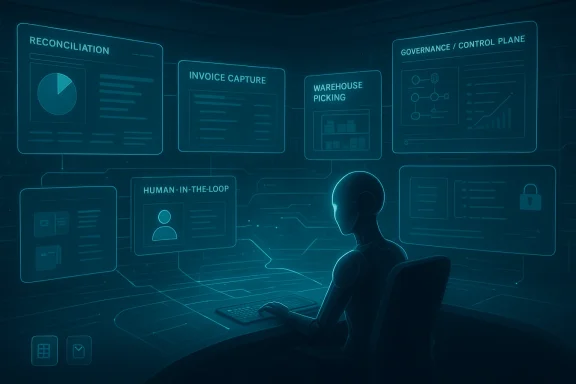
For ERP leaders, the implication is straightforward: automation is no longer an add-on. Microsoft is tying agentic features to core business processes such as reconciliation, invoice capture, supplier communications, warehouse picking, and demand planning, while also extending cross-app AI into tools like Excel and Outlook. That means the next competitive battleground in ERP will not be who has the nicest chatbot, but who can embed governed, explainable, and resilient agents into the systems where transactions actually happen .
Microsoft’s Dynamics 365 roadmap has been evolving toward deeper automation for several release cycles, but wave 1 in 2026 feels different because it treats agents as the default interface for enterprise work. Instead of surfacing AI as a suggestion engine, Microsoft is building workflows where software can interpret context, take prescribed action, and hand exceptions back to people. That is a meaningful shift in how ERP is designed, governed, and measured .
The language around the release is also telling. Microsoft is no longer selling AI as a productivity layer bolted on top of business applications. It is positioning AI as a structural layer inside the application stack itself, which is why the wave spans Dynamics 365, Power Platform, and role-based Copilot offerings together. In practical terms, that bundling tells customers that ERP, workflow automation, and AI governance are now being developed as one system rather than three separate investments .
That matters because ERP software lives or dies on trust. Finance and supply chain teams are not evaluating novelty; they are evaluating whether the system can close books, match invoices, protect cash flow, and avoid operational mistakes. Microsoft’s pitch is that agentic AI can remove manual friction without removing control, but that promise only works if the exceptions remain auditable and the humans stay in the loop where judgment matters most .
It also matters because Microsoft is making a category argument. If agents are now “first-class enterprise assets,” then ERP vendors that merely add chat-based copilots will look dated very quickly. The company is effectively telling the market that the next generation of business software must be event-driven, context-aware, and governed from day one, not retrofitted with AI after the fact .
This is also a shift in user expectation. In older ERP models, a finance manager might review a matching queue, an AP clerk might manually chase a supplier, and a planner might re-run scenarios after a problem was already visible. In the new model, the system is expected to surface the issue earlier, summarize the likely cause, and in some cases act on the organization’s behalf under predefined guardrails .
This is especially consequential in ERP, where value tends to come from precision and throughput rather than flashy interaction design. A reconciliation agent that matches balances automatically and flags only the exceptions has a very different business profile from a chatbot that explains how reconciliation works. The first changes workload; the second changes only the interface .
Microsoft is also improving invoice capture AI so it learns from user corrections over time, which makes the system more adaptive without forcing finance teams into a fresh training project every quarter. In a high-volume environment, even a modest improvement in match accuracy can translate into fewer escalations, fewer manual touches, and less downstream rework in procurement and AP operations .
This is a subtle but powerful design choice. Finance professionals often resist tools that force them to leave familiar workflows, especially when the underlying data must be checked against the ERP of record. By embedding the agent into Excel and Outlook, Microsoft lowers adoption friction and raises the chance that the automation becomes part of the team’s habits rather than a pilot project that never escapes novelty status.
The practical impact is not just speed, but resilience. If the system can detect when a promise date is at risk, or when inventory should be shifted before a shortage becomes visible to a planner, then the organization can act before customer commitments are broken. That is the kind of value supply chain leaders remember because it protects revenue and service levels, not just labor minutes .
This also changes the role of planners. Instead of acting as the first line of detection, they become the final line of judgment. That is a healthier use of expertise, but it also raises the bar for the quality of the signals the system produces, because a noisy agent can waste just as much time as a human bottleneck if it interrupts too often or with the wrong priorities .
Microsoft is also shipping built-in agents such as the Sales Order Agent and Payables Agent, which can automate invoice processing, purchase order matching, and sales document creation. In a midmarket environment, those are the kinds of workflows that often have enough volume to justify automation but not enough in-house engineering capacity to build and maintain it from scratch .
This is also where the partner ecosystem becomes decisive. The more Microsoft standardizes the agent framework, the easier it becomes for ISVs and system integrators to package repeatable workflows around it. That should help adoption, but it will also raise expectations that partners can deliver business outcomes instead of just implementation hours .
That matters because the real enterprise challenge is not just building one good agent. It is orchestrating multiple agents across systems without creating a brittle tangle of one-off integrations. If Microsoft can make cross-system orchestration more standardized, it can reduce implementation complexity and make agentic automation more repeatable across customers .
It also creates a new partner opportunity. System integrators can focus less on building bespoke integration glue and more on packaging higher-value business logic. ISVs, meanwhile, can design extensions that assume a common orchestration pattern rather than rewriting their approach for every client environment .
That design choice is important because agentic systems can quickly become opaque if users cannot see what is running, what is waiting, and what needs intervention. A visible workspace helps restore trust by showing not just outcomes, but process. In enterprise software, visibility is a feature, not an aesthetic extra .
For CIOs, the question is whether such a workspace becomes a real control layer or just a polished presentation layer. Microsoft seems to be betting that the answer can be both, which would be valuable if the data model underneath is robust enough to support audit, escalation, and role-based visibility across functions .
This is also why ISVs should pay attention. A mature agent framework can become the substrate for packaged solutions in finance operations, procurement, retail, distribution, and shared services. If Microsoft keeps the orchestration layer stable enough, partners will have a better chance of building durable assets instead of redoing the same integration work for every client deployment .
The opportunity is especially strong in regulated or process-heavy verticals. Healthcare, distribution, manufacturing, and financial services all have repeatable work patterns that can benefit from standardized agent design, provided the governance model is strong enough to satisfy compliance and audit requirements .
That governance story matters because ERP agents are not toy assistants. They can access business data, trigger downstream actions, and potentially influence cash flow, inventory, customer commitments, and accounting outcomes. Once that happens, every agent becomes a privileged workload that needs lifecycle management, auditability, and policy enforcement .
But there is still a harder question underneath: can the controls stay granular enough to reflect actual business processes? A broad policy may stop obvious misuse, but ERP workflows are full of exceptions, edge cases, and context-specific approvals. The more autonomy you give the system, the more important it becomes that the policy engine understands real operational nuance .
Competitors now face a strategic choice. They can emphasize neutrality and openness, arguing that no single vendor should control the full agent stack. Or they can specialize, focusing on niche strengths such as finance intelligence, industry workflows, or data governance. Either way, they will need a clearer answer than “we also have Copilot-like chat” because Microsoft has moved the conversation past chat entirely .
The market may split into two camps: platform-first buyers who want a single control plane and best-of-breed buyers who prefer modularity. Microsoft’s advantage is that it can appeal to both productivity and ERP teams at once, while many competitors can only address one side of the stack.
The main things to watch are not just feature availability, but how Microsoft explains trust, permissions, exception handling, and cross-app behavior. If those pieces come together cleanly, the company will have a compelling case that ERP can enter the agentic era without losing its control-first discipline. If they do not, then the market will keep treating AI as an overlay rather than an operating layer.
What makes this wave so important is that it redefines the center of gravity in ERP. The system of record is no longer enough on its own; the winning platform will be the one that can connect records, decisions, and action inside a governed agentic framework. If Microsoft executes well, Dynamics 365 wave 1 may be remembered as the moment ERP stopped asking AI for help and started letting AI take the first pass at the work.
Source: ERP Today Dynamics 365 Wave 1 Puts Agentic AI at the Heart of ERP
For ERP leaders, the implication is straightforward: automation is no longer an add-on. Microsoft is tying agentic features to core business processes such as reconciliation, invoice capture, supplier communications, warehouse picking, and demand planning, while also extending cross-app AI into tools like Excel and Outlook. That means the next competitive battleground in ERP will not be who has the nicest chatbot, but who can embed governed, explainable, and resilient agents into the systems where transactions actually happen .
 Overview
Microsoft’s Dynamics 365 roadmap has been evolving toward deeper automation for several release cycles, but wave 1 in 2026 feels different because it treats agents as the default interface for enterprise work. Instead of surfacing AI as a suggestion engine, Microsoft is building workflows where software can interpret context, take prescribed action, and hand exceptions back to people. That is a meaningful shift in how ERP is designed, governed, and measured .The language around the release is also telling. Microsoft is no longer selling AI as a productivity layer bolted on top of business applications. It is positioning AI as a structural layer inside the application stack itself, which is why the wave spans Dynamics 365, Power Platform, and role-based Copilot offerings together. In practical terms, that bundling tells customers that ERP, workflow automation, and AI governance are now being developed as one system rather than three separate investments .
That matters because ERP software lives or dies on trust. Finance and supply chain teams are not evaluating novelty; they are evaluating whether the system can close books, match invoices, protect cash flow, and avoid operational mistakes. Microsoft’s pitch is that agentic AI can remove manual friction without removing control, but that promise only works if the exceptions remain auditable and the humans stay in the loop where judgment matters most .
It also matters because Microsoft is making a category argument. If agents are now “first-class enterprise assets,” then ERP vendors that merely add chat-based copilots will look dated very quickly. The company is effectively telling the market that the next generation of business software must be event-driven, context-aware, and governed from day one, not retrofitted with AI after the fact .
The New ERP Baseline
The most important strategic point in wave 1 is that agentic AI becomes the baseline, not the premium tier. Microsoft’s updates imply that core ERP tasks should increasingly be executed by software that can read signals, apply rules, and move work forward without waiting for a user to click through every step. That changes the economics of ERP because labor savings and cycle-time reductions can now be built into the application layer itself .This is also a shift in user expectation. In older ERP models, a finance manager might review a matching queue, an AP clerk might manually chase a supplier, and a planner might re-run scenarios after a problem was already visible. In the new model, the system is expected to surface the issue earlier, summarize the likely cause, and in some cases act on the organization’s behalf under predefined guardrails .
Why “agentic” matters more than “AI-assisted”
The term agentic is doing a lot of work here. It implies persistence, task completion, and initiative, not merely assistance or suggestion. That matters because a conversational assistant can speed up a user, but an agent can compress the workflow itself by removing steps, reducing handoffs, and pre-processing work before a person even sees it .This is especially consequential in ERP, where value tends to come from precision and throughput rather than flashy interaction design. A reconciliation agent that matches balances automatically and flags only the exceptions has a very different business profile from a chatbot that explains how reconciliation works. The first changes workload; the second changes only the interface .
- Agentic systems execute work.
- Assistive systems merely guide users.
- ERP value depends on workflow compression.
- Exception handling remains the critical human checkpoint.
- Governance becomes as important as model quality.
Finance Goes First
Finance is where Microsoft’s wave 1 story becomes most concrete. The Account Reconciliation Agent automatically matches subledger balances to the general ledger and elevates exceptions for review, which is exactly the kind of repetitive, rules-heavy work that lends itself to automation. That is important because close processes are often slowed not by one major problem, but by countless small reconciliation delays that add up across teams and entities .Microsoft is also improving invoice capture AI so it learns from user corrections over time, which makes the system more adaptive without forcing finance teams into a fresh training project every quarter. In a high-volume environment, even a modest improvement in match accuracy can translate into fewer escalations, fewer manual touches, and less downstream rework in procurement and AP operations .
The finance agent moves into daily workflow tools
The Finance Agent expanding in wave 1 is particularly interesting because it supports reconciliation, variance analysis, and data preparation in Excel, while also helping with customer communications in Outlook. That means Microsoft is pushing finance intelligence into the apps finance teams already live in, which reduces context switching and makes the AI experience feel less like a separate product and more like part of the day’s actual work .This is a subtle but powerful design choice. Finance professionals often resist tools that force them to leave familiar workflows, especially when the underlying data must be checked against the ERP of record. By embedding the agent into Excel and Outlook, Microsoft lowers adoption friction and raises the chance that the automation becomes part of the team’s habits rather than a pilot project that never escapes novelty status.
- Reconciliation becomes exception-based rather than manual-first.
- Variance analysis moves closer to the spreadsheet workflow.
- Email-driven finance interactions become machine-readable.
- Improved capture models learn from correction loops.
- Close cycles should shorten if governance holds up.
Supply Chain Becomes Proactive
If finance is about control, supply chain is about timing, and wave 1 pushes that timing closer to real-time decision-making. Microsoft says Dynamics 365 Supply Chain Management will gain AI-powered warehouse picking, inventory rebalancing, hands-free scanning, and demand planning improvements that factor in price-demand correlation and capacity-to-promise date protection. That combination suggests the company is trying to make planning less reactive and execution more anticipatory .The practical impact is not just speed, but resilience. If the system can detect when a promise date is at risk, or when inventory should be shifted before a shortage becomes visible to a planner, then the organization can act before customer commitments are broken. That is the kind of value supply chain leaders remember because it protects revenue and service levels, not just labor minutes .
Why this matters operationally
Warehouse and fulfillment environments are unforgiving because the cost of a missed handoff can ripple quickly through transportation, customer service, and finance. Agentic workflows that reduce scanning friction or surface inventory issues sooner can therefore create outsized operational returns. In other words, a small improvement in decision latency can produce a large improvement in throughput .This also changes the role of planners. Instead of acting as the first line of detection, they become the final line of judgment. That is a healthier use of expertise, but it also raises the bar for the quality of the signals the system produces, because a noisy agent can waste just as much time as a human bottleneck if it interrupts too often or with the wrong priorities .
- Warehouse work becomes less scan-heavy.
- Inventory decisions can shift from reactive to predictive.
- Capacity-to-promise logic becomes more protective.
- Planners receive context before commitments are finalized.
- Operational exceptions should become narrower and more meaningful.
Business Central Raises the Midmarket Bar
For midmarket customers, the most important story may be Business Central because Microsoft is making low-code agent creation more accessible. Wave 1 introduces custom AI agent design through a natural language interface, with general availability planned for May 2026. That matters because it lowers the barrier for partner-built and customer-built automation in organizations that do not have large development teams on payroll .Microsoft is also shipping built-in agents such as the Sales Order Agent and Payables Agent, which can automate invoice processing, purchase order matching, and sales document creation. In a midmarket environment, those are the kinds of workflows that often have enough volume to justify automation but not enough in-house engineering capacity to build and maintain it from scratch .
The low-code angle is the real wedge
The strategic play here is not merely convenience. It is about distribution. If functional teams can define custom agents in natural language and deploy them with governance controls, then Microsoft can spread agentic AI deeper into the market than a vendor that requires heavy coding or complex orchestration layers. That gives Business Central a real advantage in organizations that want automation without a long implementation cycle.This is also where the partner ecosystem becomes decisive. The more Microsoft standardizes the agent framework, the easier it becomes for ISVs and system integrators to package repeatable workflows around it. That should help adoption, but it will also raise expectations that partners can deliver business outcomes instead of just implementation hours .
- Custom agent design lowers the skill threshold.
- Built-in agents provide quick wins for common workflows.
- Midmarket customers get AI without large development programs.
- Partners can build on a more consistent architectural layer.
- Business Central becomes a more credible automation platform.
MCP and Cross-App Orchestration
The mention of MCP, or model context protocol, is easy to overlook, but it may be one of the most strategically important pieces of the wave. Microsoft’s MCP server improvements provide a governed pathway for extending agent capabilities across ERP and productivity tools without custom API development, which could be a major benefit for partners and system integrators building connected workflows .That matters because the real enterprise challenge is not just building one good agent. It is orchestrating multiple agents across systems without creating a brittle tangle of one-off integrations. If Microsoft can make cross-system orchestration more standardized, it can reduce implementation complexity and make agentic automation more repeatable across customers .
Why standards matter more than demos
A lot of AI announcements look impressive in isolation and then fall apart when they have to interact with legacy systems, custom workflows, and governance rules. MCP offers a way to normalize that interaction layer so agents can operate across tools more predictably. In enterprise terms, that is the difference between a clever demo and a deployable architecture.It also creates a new partner opportunity. System integrators can focus less on building bespoke integration glue and more on packaging higher-value business logic. ISVs, meanwhile, can design extensions that assume a common orchestration pattern rather than rewriting their approach for every client environment .
- MCP reduces custom integration work.
- Governed orchestration is easier to operationalize.
- Partners can build repeatable extensions.
- Cross-app work becomes less brittle.
- Microsoft strengthens its platform narrative.
Immersive Home and the New Work Surface
The introduction of Immersive Home as an AI-powered workspace is another sign that Microsoft wants users to experience agentic ERP through a unified operational dashboard rather than a collection of disconnected screens. By surfacing agent activity, task priorities, and workflow status in one adaptive view, Microsoft is trying to make the system feel more like an intelligent command center and less like a traditional application menu .That design choice is important because agentic systems can quickly become opaque if users cannot see what is running, what is waiting, and what needs intervention. A visible workspace helps restore trust by showing not just outcomes, but process. In enterprise software, visibility is a feature, not an aesthetic extra .
A dashboard for managed autonomy
Immersive Home also reflects a broader UX challenge in AI software: users need to know when to delegate and when to intervene. If the workspace surfaces the status of pending actions and unresolved exceptions, it can reduce uncertainty and keep autonomous work aligned with policy. That is especially important in ERP, where silent automation can be more dangerous than visible inefficiency .For CIOs, the question is whether such a workspace becomes a real control layer or just a polished presentation layer. Microsoft seems to be betting that the answer can be both, which would be valuable if the data model underneath is robust enough to support audit, escalation, and role-based visibility across functions .
- Unified status views reduce cognitive overload.
- Users can distinguish automation from exception handling.
- Task prioritization becomes visible across workflows.
- Autonomy becomes easier to trust when it is observable.
- The interface itself becomes part of the governance model.
The Partner and ISV Opportunity
Microsoft’s wave 1 is not just a customer story; it is a partner story. The company is creating a layered architecture where in-product ERP execution, cross-system orchestration, and custom agent design can be handled through a more standardized stack. That creates room for system integrators to specialize in governance, workflow design, and industry-specific automation rather than low-level plumbing.This is also why ISVs should pay attention. A mature agent framework can become the substrate for packaged solutions in finance operations, procurement, retail, distribution, and shared services. If Microsoft keeps the orchestration layer stable enough, partners will have a better chance of building durable assets instead of redoing the same integration work for every client deployment .
Why the ecosystem may matter more than the features
Enterprise software history suggests that platform shifts often succeed when partners can monetize the new model. Microsoft understands this well, which is why its release strategy consistently emphasizes extensibility and ecosystem hooks. In this wave, the hooks are agents, MCP, Copilot Studio, and role-based automation across business apps.The opportunity is especially strong in regulated or process-heavy verticals. Healthcare, distribution, manufacturing, and financial services all have repeatable work patterns that can benefit from standardized agent design, provided the governance model is strong enough to satisfy compliance and audit requirements .
- Partners can sell outcomes, not just deployments.
- ISVs can package industry-specific agents.
- System integrators can focus on governance and process design.
- Standardized orchestration lowers implementation friction.
- Vertical solutions become easier to repeat at scale.
Enterprise Governance Becomes the Real Differentiator
The big technical question in wave 1 is not whether the agents can do useful work. It is whether the organization can govern those agents with enough precision to satisfy finance, operations, security, and audit teams at the same time. Microsoft’s broader 2026 messaging makes clear that it views governance as the foundation of agent adoption, not a cleanup activity after deployment.That governance story matters because ERP agents are not toy assistants. They can access business data, trigger downstream actions, and potentially influence cash flow, inventory, customer commitments, and accounting outcomes. Once that happens, every agent becomes a privileged workload that needs lifecycle management, auditability, and policy enforcement .
The control-plane problem
Microsoft’s answer is to bring agents into a more formal control plane, using the same logic enterprises already apply to identities, applications, and cloud workloads. That should make procurement easier because buyers can map the new model onto familiar governance concepts such as inventory, permissions, logs, and response workflows .But there is still a harder question underneath: can the controls stay granular enough to reflect actual business processes? A broad policy may stop obvious misuse, but ERP workflows are full of exceptions, edge cases, and context-specific approvals. The more autonomy you give the system, the more important it becomes that the policy engine understands real operational nuance .
- Agents need inventory and classification.
- Permissions must map to business roles.
- Actions should be auditable and replayable.
- Policy needs to be granular enough for real workflows.
- Security teams will demand lifecycle controls from day one.
Competitive Pressure Across the ERP Market
Wave 1 should not be read only as a Microsoft release note. It is also a challenge to the rest of the ERP market. Microsoft is setting a high bar by tying agentic behavior to core business processes, governance, and productivity tools all at once, which makes it harder for rivals to claim that an AI assistant alone is enough.Competitors now face a strategic choice. They can emphasize neutrality and openness, arguing that no single vendor should control the full agent stack. Or they can specialize, focusing on niche strengths such as finance intelligence, industry workflows, or data governance. Either way, they will need a clearer answer than “we also have Copilot-like chat” because Microsoft has moved the conversation past chat entirely .
What rivals will likely stress
Expect the next phase of competitive marketing to focus on interoperability, vertical specialization, and governance transparency. Rival vendors will likely argue that enterprise buyers should avoid overconcentration in one platform, especially where mixed clouds, custom apps, or multi-ERP estates are involved. That message may resonate with large enterprises that want freedom of choice, but it will have to compete against Microsoft’s convenience and breadth .The market may split into two camps: platform-first buyers who want a single control plane and best-of-breed buyers who prefer modularity. Microsoft’s advantage is that it can appeal to both productivity and ERP teams at once, while many competitors can only address one side of the stack.
- Platform-first buyers will like the consolidation story.
- Best-of-breed buyers will demand interoperability.
- Governance will become a differentiator, not a checkbox.
- Niche vendors may double down on specialization.
- ERP procurement will increasingly include AI architecture questions.
Strengths and Opportunities
Microsoft’s wave 1 has several strengths that could make it a landmark ERP release rather than just another AI feature set. It aligns customer pain points, platform design, and partner economics in one coherent direction. That kind of alignment is rare, and it is why the announcement feels strategically heavier than a normal release cycle.- Native agentic workflows can reduce manual ERP toil.
- Finance automation should shorten close and reconciliation cycles.
- Supply chain agents can improve timing and resilience.
- Business Central gets a more accessible AI authoring model.
- MCP can standardize cross-app orchestration.
- Immersive Home improves visibility into autonomous work.
- Partners gain a clearer platform for repeatable solutions.
Risks and Concerns
The risks are just as significant as the opportunities. Agentic systems can create operational dependency, governance complexity, and false confidence if customers assume automation is smarter than it really is. In ERP, that can quickly become expensive because errors affect cash, inventory, compliance, and customer trust at the same time.- Over-automation could hide exceptions instead of solving them.
- Poor governance could create new audit and compliance issues.
- Integrating across multiple systems may be harder than the demos suggest.
- Customers may struggle with platform lock-in concerns.
- False positives or misrouted actions could disrupt operations.
- Functional teams may need new skills to manage agent behavior.
- The UX could become more complex if too many agents are exposed at once.
Looking Ahead
The next six months will tell us whether Dynamics 365 wave 1 becomes a real operating shift or simply the first major checkpoint in a longer transition. The release window itself runs from April through September 2026, so many customers will be evaluating the changes in parallel with live deployment planning, partner workshops, and internal governance reviews .The main things to watch are not just feature availability, but how Microsoft explains trust, permissions, exception handling, and cross-app behavior. If those pieces come together cleanly, the company will have a compelling case that ERP can enter the agentic era without losing its control-first discipline. If they do not, then the market will keep treating AI as an overlay rather than an operating layer.
- How quickly customers deploy reconciliation and AP agents
- Whether supply chain improvements prove durable in production
- How well MCP supports partner-built extensions
- Whether Business Central’s low-code agent design gains traction
- How Microsoft communicates auditability and control
- Whether rivals respond with stronger open or specialized alternatives
What makes this wave so important is that it redefines the center of gravity in ERP. The system of record is no longer enough on its own; the winning platform will be the one that can connect records, decisions, and action inside a governed agentic framework. If Microsoft executes well, Dynamics 365 wave 1 may be remembered as the moment ERP stopped asking AI for help and started letting AI take the first pass at the work.
Source: ERP Today Dynamics 365 Wave 1 Puts Agentic AI at the Heart of ERP
