

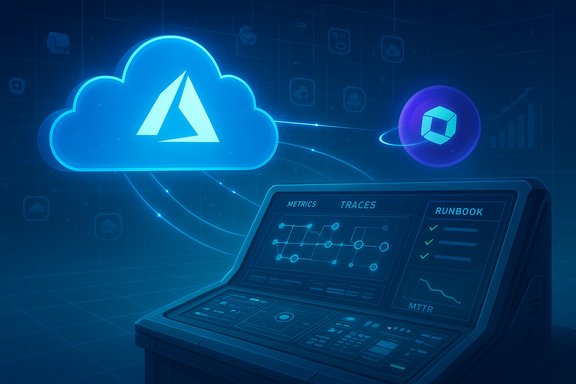
Dynatrace’s new integration with Microsoft’s Azure SRE Agent promises to stitch together causal observability and an agentic reliability layer inside Azure, a move both vendors say will accelerate automated cloud operations and reduce mean time to repair for large-scale enterprises. The announcement frames Dynatrace as the first observability platform to join Azure SRE Agent inside the Azure portal and positions the partnership as a way to combine Dynatrace’s AI-driven root-cause analysis with Microsoft’s resource-aware remediation assistant — a combination intended to move customers from alerting to closed-loop remediation.
Conclusion
Dynatrace’s integration with Azure SRE Agent is an important moment in the evolution of cloud operations: it pairs causal observability with environment-aware agentic automation in a way that could materially reduce toil and outages for Azure-centric enterprises. The partnership is well-aligned with market demand for AI-enabled infrastructure tooling, but its success will be determined by careful, evidence-driven adoption. Organizations that treat the integration as a platform for staged automation, backed by strong telemetry, governance, and human oversight, will be best positioned to realize the productivity and reliability gains vendors promise.
Source: varindia.com Dynatrace and Microsoft partner to scale enterprise
 Background
Why this matters now
Enterprise adoption of AI is rapidly changing the way teams operate cloud services. Market forecasts show AI-related spending surging across infrastructure, software, and services, making reliability automation and observability core requirements for modern operations teams. Gartner’s September 2025 forecast projected that worldwide spending on AI would approach $1.5 trillion in 2025 — a scale that underlines why vendors are racing to offer integrated, agentic tools that reduce operational toil.What Microsoft’s Azure SRE Agent is
Azure SRE Agent is Microsoft’s AI-powered reliability assistant for Azure that can monitor resources continuously, answer natural-language questions about the environment, produce explainable root-cause analysis, and orchestrate incident workflows either with human oversight or autonomously within configured guardrails. It integrates with Azure Monitor, ServiceNow, PagerDuty, GitHub, and Azure DevOps, and is designed to act as a “virtual SRE” that automates routine diagnostics and runbook actions while surfacing findings for engineers. Microsoft’s documentation also explains preview constraints, regional availability during preview, and a billing model based on Azure Agent Units (AAUs).What the Dynatrace–Azure SRE Agent integration actually does
Technical surface: telemetry correlation and causal analysis
At a technical level, the integration connects Dynatrace’s causal AI and full-stack telemetry with the Azure SRE Agent’s environment-aware automation. Together they aim to correlate Dynatrace’s metrics, traces, logs, and deployment metadata with Azure-native telemetry so that the SRE Agent has richer context when it diagnoses incidents or proposes mitigations. In practice this means the SRE Agent can surface remediation hints and runbook steps informed by Dynatrace’s causal chains, rather than relying solely on Azure-level signals.Automated remediation and runbook execution
A core part of the announcement is the promise of automated runbook actions and diagnostic workflows. The integration enables the SRE Agent to execute routine remediation flows — either autonomously or after human approval — using the correlated insights from Dynatrace. The intended result is a reduction in mean time to repair (MTTR) for common incidents and the offloading of repetitive tasks from SRE teams. Microsoft’s SRE Agent explicitly supports human-in-the-loop and autonomous execution models, allowing teams to define guardrails and approval steps for higher-risk actions.Operational telemetry and proactive reliability
By pairing Dynatrace’s historical and real-time analysis with Azure SRE Agent’s continuous monitoring, the integration is designed to detect leading indicators of failure — subtle signals that precede incidents — and recommend or enact mitigations before customers are affected. This proactive posture is the practical expression of “autonomous operations” as vendors describe it: move from reactive firefighting to early intervention informed by correlated data.Verified claims and areas that need scrutiny
Verified, cross-checked facts
- The integration announcement is publicly confirmed by Dynatrace’s press release and simultaneous Business Wire distribution, which detail the technical partnership and the joint messaging.
- Azure SRE Agent is a published Microsoft service with documentation describing its capabilities — explainable RCA, incident orchestration, integrations with major ITSM systems, and the ability to run with human approvals or autonomously. Microsoft’s Learn documentation includes preview notes and billing details.
- The macroeconomic context for AI spending is consistent with Gartner forecasts published in 2025, which emphasize the rapid growth of AI-related IT spending and infrastructure investment.
Claims requiring caution
- Dynatrace’s statement that it is the first observability platform to integrate with Azure SRE Agent is a vendor positioning claim. Independent public disclosures from other observability vendors indicate active development of agentic or assistant-like features and tight Azure integrations, so buyers should treat “first” as marketing language and verify exclusivity in procurement contracts. The assertion cannot be treated as a durable competitive moat without direct confirmation from Microsoft or a formal exclusivity agreement.
- Broad promises of autonomous operations should be weighed against real-world complexity: agentic automation is powerful for routine, well-understood remediation patterns, but it is not a substitute for careful policy design, staging, and human judgment on high-risk operations. Industry analysts have warned about the early-stage nature and high failure rates of some agentic projects, a risk that organizations must manage explicitly.
How this changes cloud operations for enterprises
Immediate benefits IT teams should expect
- Faster triage: correlated telemetry and Dynatrace’s causal analysis should reduce time spent gathering context during incidents.
- Actionable remediation hints: SRE Agent’s runbook suggestions informed by Dynatrace aim to shorten decision cycles.
- Reduced toil: automating routine diagnostics and sanctions for predictable failures frees engineers to focus on strategic work.
What must change internally for these benefits to materialize
- Instrumentation and governance: teams must ensure telemetry completeness (traces, logs, metrics) across services and enforce tagging/ownership conventions so automated decisions are reliable.
- Runbook standardization: remediation playbooks must be codified, tested, and scoped to enable safe autonomous execution.
- Human-in-loop policy: initially enabling approvals and gradually expanding autonomy will reduce blast radius while building trust.
- Observability consolidation: many organizations will need to consolidate signals into a single causal engine (like Dynatrace) or ensure reliable cross-platform integrations to avoid conflicting automation.
Security, privacy and compliance considerations
Data residency, telemetry sharing, and privacy
Azure SRE Agent’s preview notes and Microsoft's documentation indicate region-specific availability during preview and highlight considerations about how data is managed; organizations with strict data residency needs should validate where agent resources and supporting services run and how telemetry is retained. Any integration that surfaces internal telemetry to an automation agent must be examined for retention policies, access controls, and logging of automated actions.Permission model and least privilege
Automated remediation often requires elevated permissions to execute environment changes. Best practice requires narrow managed identities, explicit consent for the agent to perform actions, and auditable trails of every action the automation takes. Teams should treat these integrations as privileged automation endpoints and apply the same scrutiny as they would to CI/CD systems or infrastructure-as-code pipelines.Auditability and explainability
One of the selling points for Azure SRE Agent is explainable RCA — the agent’s reports should include the telemetry and causal links used to arrive at recommendations. Organizations should require explainability and full audit logs for any automated remediation to make post-incident reviews reliable and support compliance obligations.Competitive landscape and market implications
Where this fits among observability vendors
The Dynatrace–Microsoft tie-up accelerates the trend of observability vendors moving beyond dashboards into agentic automation. Competitors like Datadog and New Relic have been developing their own AI assistants and agent-like features — Datadog’s Bits AI and other vendors’ SRE-like assistants show that the concept of integrating observability with automation is industry-wide. That means customers will have multiple routes to agentic SRE functionality: choose a vendor-native agentic layer (Datadog Bits AI, New Relic enhancements) or pair a best-of-breed observability platform with cloud-provider assistants.Commercial and go-to-market angle
This integration dovetails with Dynatrace’s long-standing go-to-market relationship with Microsoft — including Azure Marketplace availability and consumption commitments — making Dynatrace a natural partner for Azure-native customers. From a commercial perspective, integration with Azure’s agent ecosystem simplifies procurement and may make Dynatrace more attractive to enterprises standardizing on Microsoft cloud services.Practical adoption checklist for engineering leaders
- Inventory telemetry: confirm metrics, traces, logs, and deployment metadata coverage across key services.
- Define safe runbooks: document remediation steps, approvals, and rollback procedures for common incidents.
- Phase autonomy: start with read-only diagnostics and human-in-loop action approvals; expand only after measured success.
- Harden identities: create least-privilege managed identities for SRE Agent and Dynatrace integration points.
- Monitor the monitor: extend observability to automated actions themselves so automation outcomes are tracked and audited.
- Plan a pilot on non-critical services.
- Validate RCA and remediation recommendations for false positives.
- Gradually expand to higher-value services as confidence grows.
Risks and unresolved questions
Overreliance on automation
Agentic automation is susceptible to systemic errors if it misinterprets correlated signals or acts on faulty inputs. SRE teams must avoid a brittle “set and forget” posture where automation acts without sufficient monitoring and rollback capabilities.Vendor marketing vs. independent verification
Phrases like “first observability platform” or “autonomous operations” are useful marketing hooks but require verification. Independent checks show multiple observability vendors are actively delivering agentic features or integrations with cloud provider tooling; buyer diligence should extend to contract terms and technical proof-of-concept work.Agentic project failure rate and hype risk
Analyst research has warned that a sizable percentage of early agentic AI projects will be scrapped in coming years due to unclear business value and execution challenges. That caution suggests organizations should measure outcomes carefully and avoid over-investing in hype-driven projects without demonstrable operational ROI.Real-world scenarios: where this integration helps most
- Large-scale cloud migrations: when customers are moving dozens or hundreds of services to Azure, combined observability and agentic automation can shorten stabilization windows.
- Customer-facing SaaS with strict SLAs: automated remediation on known failure modes can reduce customer-impacting outages.
- Highly regulated environments (with caveats): automation can help with proactive checks, but teams must prove auditability and control.
- Platform engineering teams offering internal developer platforms: automation allows platform teams to enforce safe guardrails and reduce repetitive tickets.
Cost model and operational economics
Azure SRE Agent’s preview documentation notes a billing model measured in Azure Agent Units (AAUs); organizations should model the steady-state cost of continuous monitoring plus variable costs for mitigation executions when assessing operational economics. Similarly, Dynatrace’s licensing and its placement in Azure Marketplace may influence procurement decisions depending on existing enterprise agreements and cloud consumption commitments. Cost modeling should include:- Baseline AAU consumption for continuous agent presence.
- Variable AAU charges for active remediation flows.
- Dynatrace licensing or Azure Marketplace costs, including any discounts tied to consumption commitments.
The strategic verdict: pragmatic optimism with guardrails
The Dynatrace–Microsoft integration is a meaningful step toward mature, agentic operations: it combines a proven causal observability engine with an Azure-native reliability assistant that can execute runbooks and provide explainable RCA. For organizations that have invested in telemetry, ownership and runbooks, the integration promises measurable reductions in MTTR and operational toil. However, the real value hinges on disciplined rollout — complete telemetry, tested playbooks, least-privilege identities, and conservative autonomy expansion. Organizations should treat vendor “first” and “autonomous” claims as a starting point for technical validation rather than procurement gospel, and they should account for the ongoing governance work required to keep agentic automation safe and effective.What to watch next
- Broader ecosystem integrations: whether other observability vendors pursue equivalent integrations with Azure SRE Agent or whether Microsoft formalizes additional partner programs.
- Real-world customer case studies: measured MTTR reductions, automation error rates, and any incidents where agentic automation required rollback.
- Regulatory and compliance guidance: how auditors and regulators respond to agentic automation performing privileged actions in production.
- Analyst reviews and comparative tests that benchmark effectiveness across competing agentic stacks.
Conclusion
Dynatrace’s integration with Azure SRE Agent is an important moment in the evolution of cloud operations: it pairs causal observability with environment-aware agentic automation in a way that could materially reduce toil and outages for Azure-centric enterprises. The partnership is well-aligned with market demand for AI-enabled infrastructure tooling, but its success will be determined by careful, evidence-driven adoption. Organizations that treat the integration as a platform for staged automation, backed by strong telemetry, governance, and human oversight, will be best positioned to realize the productivity and reliability gains vendors promise.
Source: varindia.com Dynatrace and Microsoft partner to scale enterprise
