

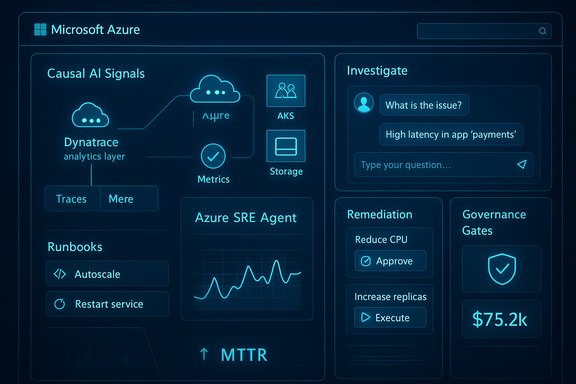
Dynatrace’s new integration with Microsoft’s Azure SRE Agent turns observability from passive insight into a portal‑native operational surface that can suggest and, under governance, execute remediations inside Azure — a significant step toward agentic, AI‑driven cloud operations that promises faster MTTR, fewer context switches for SRE teams, and clearer pathways for rightsizing and cost control.
Background / Overview
Dynatrace has announced a purpose‑built cloud operations solution for Microsoft Azure, now available in preview, and a formal integration that surfaces Dynatrace’s causal AI signals directly into Microsoft’s Azure SRE Agent experience. This positions Dynatrace as the first observability vendor publicly to integrate with Microsoft’s portal‑native reliability assistant — a positioning Dynatrace emphasizes as evidence of tighter, production‑grade partner engineering between the two companies. Microsoft’s Azure SRE Agent is an “agentic” reliability assistant that continuously monitors resources, offers a chat‑style investigative surface in the Azure portal, and can propose or, with customer approval, carry out mitigation steps. Its consumption model uses Azure Agent Units (AAUs): a baseline hourly charge per agent plus usage‑based charging for active tasks. The vendor documentation states each agent is billed at 4 AAUs per hour as the baseline and that active tasks are billed in AAUs per second while they run. Why this matters right now: enterprises are accelerating AI investments and demanding observability that both explains incidents and helps operate systems reliably at scale. Dynatrace brings Davis, its causal/predictive AI layer, and GRAIL, its long‑term telemetry lakehouse, while Microsoft provides the portal and governance surface via SRE Agent. Together they aim to shorten diagnosis loops and reduce operational toil — but they also introduce new cost, governance, and security trade‑offs that deserve careful evaluation.What the announcement actually delivers
Key capabilities (vendor summary)
- Portal‑native remediation hints: Dynatrace will surface causal root‑cause analysis and remediation guidance into Azure SRE Agent so suggested fixes appear inside the Azure portal where operators already work.
- Deeper Azure telemetry ingestion: The Dynatrace solution expands ingestion across Azure Monitor and related services to build richer full‑stack maps and causal models.
- Automated prevention and remediation: The preview includes templates and workflows for automated risk detection, gated remediation, and low‑risk automations tied to runbooks.
- Continuous cost optimization: Rightsizing recommendations, idle resource cleanup, and cost‑control signals are integrated into operational workflows to help showback/chargeback and FinOps programs.
What’s new versus traditional observability
Traditional monitoring surfaces alerts and dashboards; this integration aims to convert high‑fidelity diagnostics into actionable runbook steps that can be surfaced and executed — with audit trails and identity controls — directly inside Azure. That removes a frequent operational friction: the need to jump between vendor consoles, portal controls, tickets, and runbook systems during incidents.How the integration works — technical view
Telemetry ingestion and causal context
Dynatrace ingests traces, metrics, logs, and business telemetry, correlates them through its causal AI engine (Davis), and stores long‑term context in GRAIL. For Azure, Dynatrace expands Azure Monitor coverage so causal models have higher‑fidelity inputs. That enriched context is exported or linked into Azure SRE Agent incident workflows so diagnostic suggestions are grounded in multi‑plane causal signals rather than surface alerts alone.Mapping diagnostics into the Azure control plane
The integration maps Dynatrace causal outputs into Azure SRE Agent’s incident and chat surface. In practice this means the SRE Agent’s investigative UI will receive remediation hints and recommended runbook steps packaged with context (traces, implicated resources, timestamps, confidence scores) so operators can evaluate or approve actions without leaving the portal. This bi‑directional context exchange can also reconcile incident state with third‑party tools like PagerDuty or ServiceNow via Azure connectors.Automation, runbooks, and guardrails
Automation is designed to be incremental: read‑only diagnostics → recommended steps → gated automated actions. The integration supports runbook templates and approval gates, and ties actions to Azure identities so every automated change produces an auditable trail. That design acknowledges the real risk of over‑automation and aims to keep human oversight where it matters most.Performance and scale considerations
High‑cardinality telemetry — common in large AKS clusters and AI training workloads — can impose heavy ingestion, storage, and processing costs. The combined system must therefore handle telemetry sampling, aggregation, and performant causal inference at scale; teams should validate that pipelines remain responsive under peak loads. Dynatrace’s GRAIL is designed to handle large volumes of telemetry, but customers must test specific high‑cardinality scenarios before enabling broad automation.Costs and commercial model — what to budget for
Azure SRE Agent billing uses Azure Agent Units (AAUs). Microsoft’s pricing documentation sets a baseline of 4 AAUs per hour per agent for the always‑on monitoring flow and charges additional AAUs per second for active tasks the agent executes, making total cost a function of agent count, baseline runtime, and active mitigation activity. Customers must convert AAUs into currency using regional AAU pricing in the Azure pricing calculator. Beyond AAUs, enabling richer telemetry from Dynatrace will increase ingestion and storage charges. Observability cost factors to model include:- Telemetry ingestion and retention (metrics, traces, logs).
- Egress or integration costs when exporting data or invoking APIs across tenancies.
- AAU consumption for SRE Agent baseline and active flows.
- Operational overhead for maintaining runbooks as code, CI/CD testing, and guardrail tooling.
Measurable benefits for SRE and platform teams
When implemented carefully, the Dynatrace–Azure SRE Agent integration can deliver measurable operational improvements:- Faster root cause analysis by surfacing causal signals and relevant traces inside the portal, cutting time spent aggregating cross‑tool data.
- Reduced context switching: incident responders can review diagnostics and approve remediations where they work (the Azure portal) rather than hopping among consoles and tickets.
- Automation of routine, idempotent remediation tasks (cache clears, targeted restarts, scaling adjustments) under human‑in‑the‑loop governance, freeing SREs for resilience engineering.
- Continuous cost optimization via rightsizing and idle‑resource cleanup recommendations that feed FinOps showbacks and chargeback workflows.
Real risks and operational caveats
- Over‑automation hazard: Agentic remediation can cascade undesired changes if runbooks are incorrect or approvals are misconfigured. Always begin in observational mode and progress incrementally to gated automation.
- Opaque or variable billing: AAU consumption and telemetry costs can be non‑obvious. Customers should forecast AAU usage and telemetry budgets during pilots to avoid surprise bills. Microsoft documents the AAU baseline (4 AAUs/hour) and per‑task usage, but currency conversion and region pricing vary.
- Identity and privilege scope: Automated remediations require elevated permissions. Implement least‑privilege principals for SRE Agent and Dynatrace connectors and capture immutable audit trails for all actions. Misconfigured service principals can create systemic risk.
- Data residency and compliance: Preview region availability may be limited; enterprises with strict residency or compliance needs must confirm that telemetry paths and SRE Agent operations align with regulations in their target regions.
- Multi‑cloud parity and vendor lock‑in: The integration is Azure‑native. Organizations with multicloud strategies must assess whether comparable automated capabilities exist on other clouds or whether the integration will create asymmetric operational playbooks that hinder portability.
- Marketing claims vs. field reality: Dynatrace’s claim to be “the first observability platform to integrate with Azure SRE Agent” is a vendor statement and should be validated by customers. “First” claims often rely on specific definitions of integration depth and public announcements; procurement teams should ask for technical details and references.
How to pilot this integration successfully — a practical checklist
- Define explicit success metrics before you start: MTTR reduction targets, percentage of incidents diagnosed automatically, percentage of remediations automated without human rollback, and realized cloud cost savings.
- Start in read‑only mode: Enable Dynatrace telemetry and feed diagnostics into Azure SRE Agent in observational mode so you can evaluate remediation suggestions without executing changes. Collect confidence scores, false positive rates, and suggested runbook accuracy.
- Pilot on low‑risk workloads: Use dev/test AKS namespaces, sandboxed Function apps, or non‑critical AI training runs to validate runbooks and action flows. Validate how the agent’s active tasks consume AAUs and map that to cost.
- Implement human‑in‑the‑loop gating: Require approvals for stateful or high‑impact actions. Automate only idempotent, low‑risk tasks (e.g., cache flushes, service restarts) first.
- Treat runbooks as code: Version runbooks, test them in CI, and link them to incident post‑mortems so automation improves iteratively. Maintain a rollback playbook for every automated action.
- Model costs up front: Convert expected AAU consumption into currency using regional AAU prices and add telemetry ingestion/storage estimates. Include expected growth for AI workloads in your budget scenarios.
- Validate RBAC and audit trails: Ensure every automated action is captured in Azure Activity Logs and that identity bindings follow least‑privilege principles. Integrate logs into your SIEM for immutable auditability.
- Require vendor proof‑of‑value: Ask Dynatrace for pilot KPIs, named references using similar scale and tech stacks, and a clear definition of the integration surface (telemetry export vs. bi‑directional runbook execution). Insist on measurable outcomes before scaling to production.
Market context and vendor positioning
The Dynatrace–Microsoft integration arrives amid surging enterprise AI spend and a vendor race to operationalize observability into action. Analysts have forecast material AI investments across enterprises, and cloud providers are productizing agentic surfaces (like Azure SRE Agent) to host partner automation flows. Dynatrace is leaning into this trend with an Azure‑native product experience and expanded go‑to‑market commitments with Microsoft, including marketplace availability and joint sales programs. From a vendor strategy standpoint, Dynatrace benefits two ways:- It strengthens Azure‑native appeal to large enterprises seeking deep platform integration and consolidated procurement via Azure Marketplace.
- It locks its causal‑AI signal set (Davis + GRAIL) closer to the control plane where remediation occurs, which raises switching costs but also raises expectations for demonstrable operational ROI.
Two concrete verification points customers should demand
- Integration depth documentation: Ask for a technical runbook that shows exactly how Dynatrace contextual diagnostics appear inside Azure SRE Agent, what fields are exchanged, and whether actions are executed via API, webhook, or managed Azure control‑plane calls. Confirm whether the integration supports bi‑directional reconciliation (incident state updates back into Dynatrace) and which incident managers are supported out of the box.
- Billing and AAU impact analysis: Require a sample billing demo showing expected AAU consumption for typical incident patterns (baseline AAU cost for an agent per hour, plus per‑task AAU usage during an active incident), converted to expected monthly spend for pilot scope. This will expose cost sensitivities early.
Final analysis — strengths, practical value, and remaining unknowns
Strengths- Practical operational leverage: Merging causal AI signals with a portal‑native execution surface reduces context switching and accelerates decision cycles for Azure‑focused SRE teams.
- Governance‑centric automation: Azure SRE Agent’s design (approval gates, Entra identity binding, AAU billing) encourages cautious adoption of automation with an auditable trail.
- Cost control emphasis: Rightsizing and idle‑resource detection are practical FinOps features for AI workloads that can quickly balloon cloud spend.
- Cost and telemetry overhead: The interplay of AAU billing and increased telemetry ingestion creates non‑trivial cost modeling needs; teams must quantify this before broad rollout.
- Over‑automation and systemic risk: Without robust runbook testing and human‑in‑the‑loop controls, automated remediations can cause change cascades. Start conservative.
- “First” claim caution: Dynatrace’s assertion that it is the first observability platform to integrate with Azure SRE Agent is a vendor positioning statement; independent verification of exclusivity depends on how “integration” is defined and on public disclosures from other vendors. Treat this as marketing until validated in technical due diligence.
Enterprises preparing to evaluate or pilot the preview should schedule time with both vendors to obtain:
- A technical integration design document and sample payloads for runbook actions.
- A modeled AAU and telemetry cost estimate for the pilot scope.
- A list of reference customers with comparable scale and workload types (AKS, Functions, AI training/inference).
Source: Investing.com Nigeria Dynatrace integrates with Microsoft Azure SRE Agent to automate cloud ops By Investing.com
