

Dynatrace’s preview of a purpose-built cloud operations solution for Microsoft Azure — and its direct integration with Microsoft’s new Azure SRE Agent — marks a significant shift in how observability vendors are attempting to convert insight into safe, auditable action inside a hyperscaler control plane.
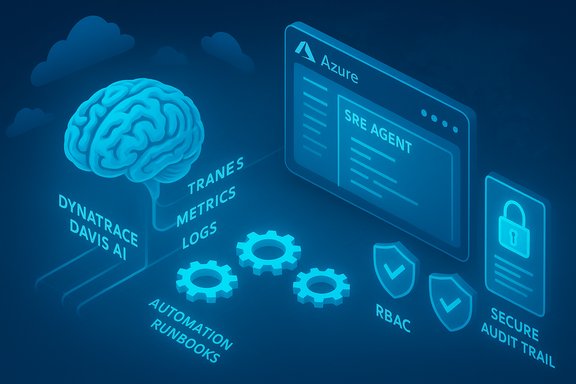
Dynatrace, long positioned as an AI-first observability vendor with its Davis causal-AI engine and GRAIL telemetry lakehouse, has announced a next‑generation cloud operations experience specifically tailored for Microsoft Azure. The offering is available now in preview and is showcased alongside Microsoft Ignite demonstrations, with broader general availability planned for early 2026. The vendor frames the release as enabling deeper telemetry ingestion, AI-driven prevention, automated remediation, and continuous resource optimization for Azure-native and hybrid estates. Parallel to the preview, Dynatrace announced a formal integration with Microsoft’s Azure SRE Agent — a portal-native, “agentic” reliability assistant that continuously monitors resources in the Azure tenancy, surfaces diagnostics in a conversational UI, and can execute remediation tasks subject to governance and approval. Dynatrace says it is the first observability platform to integrate directly with Azure SRE Agent, routing its causal diagnostics and remediation hints into the Azure control plane. That joint vision is explicitly pitched as a route to reduce mean time to repair (MTTR), cut operational toil, and accelerate enterprise adoption of agentic and generative-AI workloads on Azure.
The new Dynatrace cloud operations preview for Azure is available for early testing today; platform and SRE teams planning to experiment should register for preview access, design a narrow, measurable pilot, and include FinOps and security stakeholders in the evaluation from day one.
Source: IT Brief UK Dynatrace expands AI cloud operations with new Azure integration
 Background / Overview
Dynatrace, long positioned as an AI-first observability vendor with its Davis causal-AI engine and GRAIL telemetry lakehouse, has announced a next‑generation cloud operations experience specifically tailored for Microsoft Azure. The offering is available now in preview and is showcased alongside Microsoft Ignite demonstrations, with broader general availability planned for early 2026. The vendor frames the release as enabling deeper telemetry ingestion, AI-driven prevention, automated remediation, and continuous resource optimization for Azure-native and hybrid estates. Parallel to the preview, Dynatrace announced a formal integration with Microsoft’s Azure SRE Agent — a portal-native, “agentic” reliability assistant that continuously monitors resources in the Azure tenancy, surfaces diagnostics in a conversational UI, and can execute remediation tasks subject to governance and approval. Dynatrace says it is the first observability platform to integrate directly with Azure SRE Agent, routing its causal diagnostics and remediation hints into the Azure control plane. That joint vision is explicitly pitched as a route to reduce mean time to repair (MTTR), cut operational toil, and accelerate enterprise adoption of agentic and generative-AI workloads on Azure. What the integration delivers: key capabilities
The announcement bundles several headline capabilities designed for platform engineering and SRE teams operating in Azure:- Comprehensive Azure telemetry ingestion — expanded capture of Azure Monitor traces, metrics and logs to enrich topology mapping and causal modeling. This increases the signal fidelity feeding Dynatrace’s causal engine.
- Auto‑Prevention — automated health and risk scoring that surfaces early warnings aligned to SLA/SLO templates to help teams resolve issues before they escalate.
- Auto‑Remediation — remediation hints and pre-built automation workflows that can be surfaced in Azure SRE Agent; actions may be gated for human approval or executed automatically for low‑risk, idempotent steps.
- Auto‑Optimization — continuous rightsizing, cost‑saving recommendations and idle‑resource reclamation designed to control spend — particularly important as AI workloads drive GPU and infrastructure costs upward.
How the integration works (high level)
- Dynatrace expands ingestion of Azure telemetry (Azure Monitor signals and service metadata).
- Dynatrace’s causal AI correlates traces, metrics, logs and topology, producing diagnostic payloads and remediation hints.
- Those diagnostic outputs are piped into the Azure SRE Agent incident workflows, where operators see context‑rich recommendations inside the portal UI and can execute or approve runbook steps.
Verifiable technical specifics and pricing mechanics
Several concrete technical and commercial details are spelled out in published vendor materials and Microsoft documentation — these are verifiable and important to model during procurement and pilots.- Preview and availability: Dynatrace has stated the Azure cloud operations solution is in preview now, with broader availability targeted for early 2026. This timing appears in Dynatrace’s press materials and investor communications.
- Azure SRE Agent consumption model: Microsoft prices the SRE Agent using Azure Agent Units (AAUs). The public Microsoft product pages specify a baseline charge of 4 AAUs per hour per agent for always‑on monitoring, plus 0.25 AAU per second for each active task executed by the agent while it runs. These unit measures feed into region-specific currency pricing. These mechanics are explicitly documented on Microsoft’s Azure SRE Agent pages and pricing details.
- Dynatrace claim of “first” integration: Dynatrace’s press release and partner messaging assert it is “the first observability platform to integrate with Azure SRE Agent.” Independent press coverage repeated the same claim at announcement time; procurement teams should treat “first” as vendor positioning and validate integration depth and technical artifacts during evaluation.
Why this matters: strategic benefits
For Azure-first enterprises and platform teams, the Dynatrace–Azure SRE Agent integration could deliver several tangible benefits:- Faster diagnosis and recovery (lower MTTR): By surfacing causal root‑cause analysis with resource‑level context inside Azure, responders can skip context‑switching and act faster. This is the central operational promise from both vendors.
- Reduced toil and clearer operator focus: Automation of routine runbook steps — when properly gated — frees SREs to concentrate on higher‑value engineering and platform work. Vendors position this as a lever to scale engineering velocity without proportional headcount increases.
- Integrated FinOps and showback: Rightsizing and idle resource cleanup suggestions can be surfaced directly within operational workflows, making cost optimization a first‑class operational process rather than a separate analytics activity.
- Portal‑native remediation: Keeping remediation inside Azure’s control plane simplifies governance, auditing, and compliance — the portal has native identity integration (Azure Entra), RBAC, and audit logs. Packaging observability outputs for the portal surface reduces friction in enterprise environments with strict change controls.
Critical analysis — strengths, realistic outcomes, and limitations
The announcement is substantive and strategically sensible for both sides: Dynatrace deepens its reach into Azure’s operational fabric, and Microsoft populates its agentic SRE surface with partner‑grade telemetry. However, the real value and risk reduction depend on how organizations design guardrails, govern automation, and measure outcomes.Strengths and notable positives
- Depth of telemetry + causal AI: Combining high‑fidelity Azure Monitor inputs with Dynatrace’s causal models increases the probability of accurate root‑cause suggestions, reducing noisy alert churn. This higher signal quality is exactly what SRE teams need in complex, distributed systems.
- Portal‑native execution surface: Feeding remediation hints into Azure SRE Agent means actions occur in a familiar, governed surface with audit trails, which reduces friction for change approval and incident response.
- Integrated cost controls: Tying rightsizing and idle removal recommendations into operational workflows helps organizations align operations and FinOps practices more directly, potentially yielding measurable cost reductions if acted upon.
Risks, caveats and practical constraints
- Automation safety & model accuracy: Any agentic or generative automation implies operational risk. Incorrect remediation — for example, automated scale-down during a recovery window or an unsafe restart of a stateful service — can create cascading outages. The quality of Dynatrace’s remediation hints and the SRE Agent’s decision logic must be validated under controlled conditions. Vendor claims of reduced MTTR should be validated with pilot metrics.
- AAU-driven cost exposure: Microsoft’s AAU model creates two cost vectors — baseline AAUs for always‑on operations and per‑task AAUs for active automation. Organizations that deploy many agents, or permit frequent automated remediation tasks, should expect nontrivial consumption. Forecasting AAU spend requires incident frequency modeling and test runs under expected operational patterns.
- Telemetry ingestion and storage cost: Expanding telemetry collection across Azure Monitor and other services increases data egress, storage, and processing costs. Observability platforms often charge for ingestion and retention; combined with Azure charges, the total TCO must be measured empirically.
- Governance, compliance and conformance: Agentic actions that can mutate production state must be constrained with clear policies, RBAC, and audit trails. Regulatory controls (data residency, auditability) and internal change control regimes must be extended to cover agentic operations. Preview-region availability and data residency limits may constrain early pilots for global enterprises.
- Vendor positioning vs. operational reality: The claim of being the “first” observability platform to integrate with Azure SRE Agent is a meaningful marketing point, but organizations should validate the technical depth — e.g., whether the integration supports bi‑directional incident state, runbook-as-code templates, or only exported diagnostics — before committing to reliance on the vendor’s workflows.
What remains unproven (and should be tested)
- Reliability of automated remediations at scale: How frequently will the combined system take automated actions without human oversight, and what fraction of those actions will be safe and effective? Measured pilot metrics (false positive rate, reversal rate, post‑action incident frequency) are required.
- Net cost impact: Vendors claim rightsizing and auto‑optimization will lower cloud bills, but expanded telemetry and AAU usage could offset savings. Only real account-level pilots with FinOps measurement will reveal net savings.
- Operational maturity for agentic use: The organizational capability to maintain runbook-as-code, guardrails, and post‑action postmortems at scale is a prerequisite — not an automatic outcome of technology adoption.
Practical rollout blueprint: how platform teams should pilot this integration
To convert vendor promises into reliable outcomes, a phased pilot and governance plan is essential. The following numbered roadmap compresses best practices for a safe, measurable rollout.- Inventory & scope selection
- Choose a limited set of non‑mission‑critical workloads (e.g., dev/staging or low‑risk production slices) across one subscription and one region. Map dependencies and identify critical SLOs.
- Cost and AAU modeling
- Model AAU baseline and active flows using Microsoft’s AAU units (4 AAU/hour baseline per agent; 0.25 AAU/sec per active task) and estimate expected automation frequency under normal and incident scenarios. Obtain region unit pricing from Azure sales to convert AAUs to currency.
- Runbook hardening & runbook-as-code
- Convert remediation steps into versioned runbooks with automated tests. Implement “idempotent, low‑risk” actions first (cache clears, process restarts for stateless services).
- Human‑in‑the‑loop gates
- Default to manual approval for any remediation with potential data loss or stateful effects; automate only after demonstrable safety and repeatability.
- Metricized pilots & KPIs
- Define pilot KPIs: MTTR delta, auto‑action success rate, rollback rate, AAU consumption, telemetry cost delta, and post‑action SLO outcomes. Measure continuously for 30–90 days.
- Governance & auditability
- Tie all actions to Azure Entra identities, log approvals and actions centrally, and run regular compliance reviews. Maintain a feedback loop to evolve runbooks based on postmortems.
- Gradual scope expansion
- Only scale automation after sustained pilot success and validated cost projections. Iterate on runbooks and guardrails as the operational baseline stabilizes.
Security, privacy and compliance considerations
Agentic automation that can touch production configurations increases the attack surface if not tightly governed. Key defensive controls include RBAC‑based approvals, secure secrets handling for automation steps, end‑to‑end audit trails, and isolation of automation playbooks from developer pipelines until approved. Enterprises in regulated industries must also validate data residency and telemetry residency for preview regions before deploying cross‑region production automation. The announcement highlights regional preview limitations; verify region availability for SRE Agent and Dynatrace features before designing a global rollout.Competitive and market context
This integration is consistent with an industry trend: observability vendors and cloud providers competing to make operations more autonomous and less manual. Microsoft’s AAU model and Azure SRE Agent aim to create a standardized execution surface for partner signals; vendors like Dynatrace, by integrating deeply, position themselves as the telemetry and causal‑analysis layer that feeds the agentic control plane. Market coverage and analyst commentary suggest investor interest but also cautious buyer behavior: the technical promise is strong, but outcomes depend upon integration depth, governance, and measurable pilot results.What buyers should ask Dynatrace and Microsoft during evaluation
- Can you provide a documented mapping of the integration surface (APIs, data payloads, and runbook templates)? Is it bi‑directional or one‑way telemetry export?
- Which regions support the integration in preview, and what are the data‑residency guarantees for telemetry and remediation actions?
- Provide customer pilot references and anonymized metrics showing MTTR reduction, number of automated remediations executed, and post‑action success rates.
- Show a worked example of AAU cost modelling for a small, medium and large incident load profile. Include the AAU-to-currency rate for your region.
- How are runbooks tested, versioned and gated? Is there native support to store runbooks as code in your chosen CI/CD system?
Bottom line — measured optimism for agentic observability
Dynatrace’s integration with Microsoft Azure SRE Agent and the preview of a cloud operations solution for Azure represent a meaningful advance in the trajectory from passive observability to agentic observability — systems that not only identify problems but help enact fixes inside cloud control planes. The design decisions (portal‑native execution, AAU consumption model, human‑in‑the‑loop gates) show a pragmatic approach to automation that recognizes the operational fragility of cloud ecosystems. However, the technology is not a turnkey magic bullet. The promise of faster MTTR, lower costs and reduced toil is real only when paired with conservative pilots, robust runbook engineering, disciplined FinOps modeling, and stringent governance. Organizations should treat early previews as the time to validate: confirm integration depth, model AAU and telemetry costs, and ensure that automation is introduced incrementally with auditable controls. When executed with discipline, the Dynatrace + Azure SRE Agent combination could substantially reduce manual firefighting and free SRE capacity for higher‑value engineering — but the operational, financial and security trade‑offs must be tested and measured before large‑scale deployment.The new Dynatrace cloud operations preview for Azure is available for early testing today; platform and SRE teams planning to experiment should register for preview access, design a narrow, measurable pilot, and include FinOps and security stakeholders in the evaluation from day one.
Source: IT Brief UK Dynatrace expands AI cloud operations with new Azure integration
