

Dynatrace’s newest offering stitches its causal AI and telemetry lakehouse directly into Microsoft’s portal-native Azure SRE Agent, pushing observability from “tell me what happened” toward “recommend—and under governance—act on it,” with a preview now available and general availability planned for early 2026.
Dynatrace has announced a purpose-built cloud operations solution for Microsoft Azure, plus a direct integration with Microsoft’s preview service, Azure SRE Agent. The vendor frames the work as part of an “agentic AI” strategy: combining Dynatrace’s causal analysis engine (Davis) and its GRAIL telemetry lakehouse with Azure’s portal-native automation surface to deliver remediation hints, automated runbook actions, and continuous optimization across Azure workloads. The preview is active now; Dynatrace has targeted broader availability for early 2026. Microsoft positions the Azure SRE Agent itself as an AI-powered reliability assistant that continuously monitors resources, supports conversational diagnostics in the Azure portal, and can suggest or execute mitigations under customer governance; Microsoft documents the agent and its billing model publicly as part of the SRE Agent preview. These announcements arrive against a macro backdrop of surging enterprise AI investment: Gartner forecasts worldwide AI spending of nearly $1.5 trillion in 2025, a figure vendors cite to justify investments in agentic operations and platform-level automation.
The strategic upside is real: durable reductions in MTTR, measurable reductions in toil, and operationalized FinOps can produce strong ROI for cloud-first and AI-heavy teams. However, the technical and commercial details matter: AAU pricing, integration depth, runbook testing practices, and data governance are all critical variables that determine whether the integration delivers more value than risk. Pilots, careful cost modeling, and strict automation guardrails will be the difference between an operational win and an avoidable outage.
Dynatrace and Microsoft have set the technical path toward agentic, governed operations in Azure; execution will decide the outcome for each organization.
Conclusion: the preview is now available for early adopters, and enterprises should approach with measured pilots and robust governance to convert the promise of agentic observability into dependable operational advantage.
Source: SecurityBrief Australia Dynatrace expands AI cloud operations with new Azure integration
 Background
Dynatrace has announced a purpose-built cloud operations solution for Microsoft Azure, plus a direct integration with Microsoft’s preview service, Azure SRE Agent. The vendor frames the work as part of an “agentic AI” strategy: combining Dynatrace’s causal analysis engine (Davis) and its GRAIL telemetry lakehouse with Azure’s portal-native automation surface to deliver remediation hints, automated runbook actions, and continuous optimization across Azure workloads. The preview is active now; Dynatrace has targeted broader availability for early 2026. Microsoft positions the Azure SRE Agent itself as an AI-powered reliability assistant that continuously monitors resources, supports conversational diagnostics in the Azure portal, and can suggest or execute mitigations under customer governance; Microsoft documents the agent and its billing model publicly as part of the SRE Agent preview. These announcements arrive against a macro backdrop of surging enterprise AI investment: Gartner forecasts worldwide AI spending of nearly $1.5 trillion in 2025, a figure vendors cite to justify investments in agentic operations and platform-level automation. What Dynatrace and Microsoft Announced
Key technical components
- Direct integration with Azure SRE Agent — Dynatrace says it is the first observability platform to integrate directly with Microsoft’s SRE Agent, surfacing causal diagnostics and remediation hints into Azure’s incident workflows. This linkage is intended to let teams see high-confidence root-cause analysis inside the Azure portal and then either approve or let the SRE Agent perform low-risk remediation tasks.
- Expanded Azure telemetry ingestion — Dynatrace will ingest and correlate richer Azure Monitor telemetry (traces, metrics, logs, service metadata) into its GRAIL store to produce more accurate topology maps and causal inferences. That deeper telemetry is the foundation for higher-confidence automation.
- Four headline capabilities:
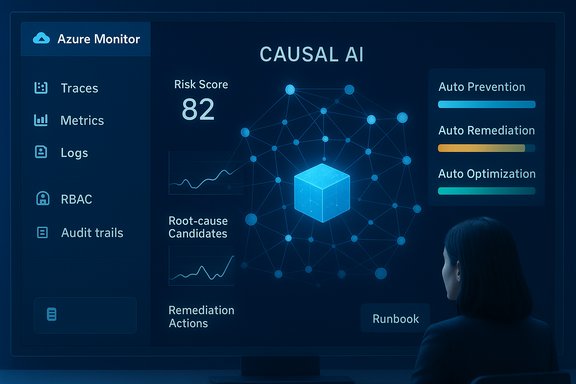
- Auto‑Prevention — early warning, health templates and risk scoring to stop issues before they impact customers.
- Auto‑Remediation — remediation hints, runbook wiring and gated automation to handle common failure modes.
- Auto‑Optimization — continuous rightsizing, idle-resource reclamation, and FinOps signals.
- Comprehensive Visibility — full-stack context across AKS, VMs, Functions and Azure AI services.
- Automation with guardrails — both vendors emphasise incremental automation: diagnostics → suggested actions → gated low-risk executions → broadened automation as confidence grows. Audit trails, RBAC, and identity-tied approvals are cited as built-in safety mechanics.
Commercial and availability notes
- The Dynatrace cloud operations solution for Azure is in preview now; Dynatrace has announced plans for wider availability in early 2026. Microsoft’s Azure SRE Agent is also a preview product with region and tenancy constraints during the preview. Pricing for SRE Agent is consumption-based using Azure Agent Units (AAUs) (a baseline always-on component plus usage-based AAUs for active tasks). Microsoft’s public pages list the baseline and per-task AAU mechanics; organizations must model AAU run rates when planning automation.
Deep dive: how the integration works in practice
Telemetry, causality, and context
Dynatrace’s operational model has two pillars that matter to this integration: Davis causal AI and GRAIL, the long-term telemetry lakehouse. In the new Azure offering, Dynatrace intensifies ingestion of Azure Monitor data and enriches that with application-level traces and historical context in GRAIL. The causal engine then produces a ranked set of probable root causes, implicated resources, confidence scores, and recommended remediation steps. Those artifacts are packaged into a format that the Azure SRE Agent can display inside the portal. That combination matters: better telemetry + causal inference = fewer false positives and higher-confidence remediation hints. The integration’s value hinges on the precision of the causal outputs and how well those map to safely automatable runbook actions inside Azure.Portal-native action surface
Where traditional observability required SREs to switch contexts between vendor consoles, ticketing systems, and cloud portals, the Dynatrace + SRE Agent model surfaces context-rich diagnostics and remediation options inside the Azure portal. That means operators can see trace-level evidence and one-click remediation hints in the same place they approve escalations or run runbooks—reducing cognitive load and context switching. The SRE Agent’s chat-based investigative surface and its connectors to incident tools (PagerDuty, ServiceNow) are foundational to this workflow.Automation lifecycle and safety gates
Enterprise adoption will typically follow a progressive lifecycle:- Read-only diagnostics (validate Dynatrace signals in portal investigations).
- Suggested remediation hints (human-in-the-loop reviews).
- Low-risk automated actions (idempotent steps like cache clears, targeted restarts) under approval gates.
- Broader automation (conditional policies and runbook-as-code once reliability is proven).
What this means for SREs, platform teams and Windows/DevOps admins
Tangible operational benefits
- Lower MTTR: context-rich root-cause analysis paired with portal-native remediation reduces diagnosis time and speeds fixes. Dynatrace and Microsoft both claim this outcome for early adopters.
- Reduced toil: automating routine runbooks can free engineers to work on higher-value tasks rather than repeated manual recovery steps. This is central to the “agentic operations” pitch.
- Integrated FinOps: rightsizing suggestions surfaced during incidents or as part of continuous optimization can feed chargeback, showback and cost-control programs more directly into operational workflows.
Practical caveats and immediate tasks for teams
- Model AAU usage and cost: Azure SRE Agent billing uses Azure Agent Units; baseline always-on monitoring across many agents and usage during mitigation events can create meaningful costs. Teams must model realistic incident scenarios to predict AAU spend. Microsoft documents the AAU unit mechanics but leaves currency pricing region-specific.
- Validate “first” claims: Dynatrace markets itself as the first observability platform to integrate with Azure SRE Agent. That appears accurate as a public announcement, but “first” can be a marketing construct—buyers should validate integration depth (API-level, runbook execution, bi-directional context) during vendor evaluation.
- Runbook as code and test suites: treat every automated remediation as code. Create unit and integration tests for runbooks, and require canaryed rollouts for automated steps to avoid widespread operational impact.
Security, compliance and governance considerations
Data residency and telemetry flow
Expanded telemetry ingestion increases the volume and variety of data leaving service boundaries. For regulated workloads, customers must evaluate where telemetry is stored (GRAIL lakehouse), how it is transmitted to Azure SRE Agent, and how logs and traces containing PII or sensitive signals are handled. Microsoft’s SRE Agent preview includes notes about data management and region availability that organizations must review before enabling automation.Authorization, audit trails and RBAC
The ability for an agent to execute actions is powerful — and risky. The integration emphasises gating via Azure identity and RBAC, and the SRE Agent provides audit trails for actions taken. Enterprises should ensure:- Runbook execution is tied to service principals or managed identities with minimal privileges.
- Human approvals are required for non-idempotent or high-risk actions.
- All automated actions generate immutable audit records for post-incident reviews and compliance needs.
Supply chain and model risk
Agentic automation relies on models that interpret telemetry and recommend actions. These models can drift, or respond incorrectly to novel failure modes. Organizations should maintain validation pipelines, periodic re-training or calibration schedules, and alerting if model confidence drops below predefined thresholds. Treat remediation suggestions as opinions until validated in the field.Cost modeling and pilot plan (practical guide)
A small, structured pilot minimizes risk while proving value. Recommended 90–180 day pilot steps:- Inventory & scope:
- Identify a small set (2–4) of non-critical environments and representative services (AKS, VM scale sets, Functions).
- Map existing runbooks and incident playbooks.
- Telemetry baseline:
- Enable expanded Azure Monitor ingestion into Dynatrace for pilot scope.
- Record baseline alert volumes and false-positive rates for comparison.
- Read-only validation (30–45 days):
- Route Dynatrace remediation hints into Azure SRE Agent in read-only mode.
- Require human review for all suggested actions; track confidence vs. correctness.
- Controlled automation (45–90 days):
- Enable low-risk automations (cache clears, targeted restarts) with one-button approvals.
- Introduce automated execution for idempotent, tested steps with rollback safeguards.
- Scale & optimize (post-90 days):
- Gradually expand to more services, introduce custom FinOps triggers, and instrument runbook-as-code tests.
- Model AAU consumption and set budget alarms.
- KPIs to measure:
- Mean time to detect (MTTD) and mean time to repair (MTTR).
- Incident frequency and severity.
- Number of automated vs. manual runbook executions.
- AAU consumption and net cost savings from rightsizing recommendations.
Strengths and strategic value
- Operational convergence: embedding causal diagnostics into the cloud provider’s control plane reduces context switching and can materially shorten incident loops, which is a high-value outcome for platform teams.
- Agentic automation with governance: the integration’s emphasis on gated automation, audit trails and RBAC acknowledges enterprise risk while enabling progressive automation — a practical path toward more autonomous operations.
- Alignment with AI-driven cloud spend: with Gartner forecasting nearly $1.5 trillion in AI spending for 2025, the ability to control operational costs and automate reliability is a timely commercial proposition for enterprises running GPU-intensive AI workloads in Azure.
Risks and open questions
- Cost unpredictability from AAUs: baseline AAUs for always-on agents plus usage AAUs during active remediation mean automation can change ongoing cloud consumption profiles; teams must model running costs under real incident workloads.
- Vendor “first” claims need technical validation: Dynatrace’s positioning as “first” to integrate is public messaging; procurement teams must confirm integration depth—does the partnership represent a telemetry export, API-level orchestration, or tightly co-engineered runbook execution? Depth affects both value and risk.
- Automation-induced outages: improperly tested or overly-broad automated actions can worsen incidents. Strong runbook testing, canarying, and manual approval gates are essential.
- Data governance and compliance: richer telemetry can contain sensitive information. Organizations with strict residency or privacy requirements must assess telemetry flows and retention policies before enabling broad ingestion or automation.
Tactical recommendations for WindowsForum readers (platform engineers and SREs)
- Start with conservative pilots limited to idempotent, low-risk runbook actions; validate Dynatrace’s causal outputs in parallel before enabling automation.
- Create cost models that include both telemetry ingestion costs and AAU run-rate forecasts; simulate spike scenarios to understand worst-case billing.
- Implement runbook-as-code with CI gates and integration tests; automated actions must be subject to the same release controls as application code.
- Lock down RBAC and managed identity use; ensure that any automation operates with the least privilege necessary and action approvals are enforceable through Azure Entra.
- Maintain a periodic model-confidence dashboard: surface model confidence metrics and require human review when confidence drops below a threshold.
Final assessment
Dynatrace’s Azure-focused cloud operations preview and its integration with Microsoft’s Azure SRE Agent are a consequential step in the evolution of cloud operations. By marrying high-fidelity observability with a portal-native agentic surface, organizations can expect faster diagnosis, fewer context switches, and more repeatable automation—if the rollout is disciplined.The strategic upside is real: durable reductions in MTTR, measurable reductions in toil, and operationalized FinOps can produce strong ROI for cloud-first and AI-heavy teams. However, the technical and commercial details matter: AAU pricing, integration depth, runbook testing practices, and data governance are all critical variables that determine whether the integration delivers more value than risk. Pilots, careful cost modeling, and strict automation guardrails will be the difference between an operational win and an avoidable outage.
Dynatrace and Microsoft have set the technical path toward agentic, governed operations in Azure; execution will decide the outcome for each organization.
Conclusion: the preview is now available for early adopters, and enterprises should approach with measured pilots and robust governance to convert the promise of agentic observability into dependable operational advantage.
Source: SecurityBrief Australia Dynatrace expands AI cloud operations with new Azure integration
