

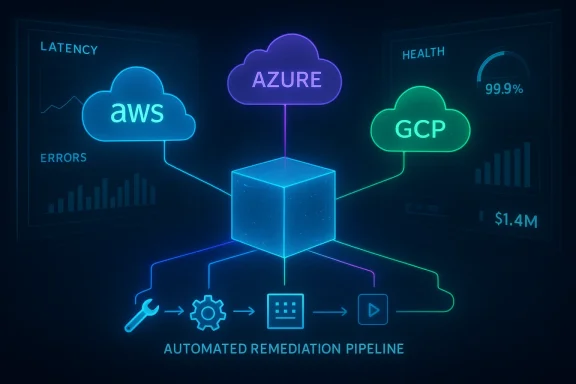
Dynatrace’s latest push to tighten multi-cloud observability landed squarely on the industry stage at Perform, as the vendor unveiled expanded integrations with Amazon Web Services, Microsoft Azure, and Google Cloud Platform designed to unify telemetry, accelerate remediation, and surface cost and resilience signals across hybrid and multi-cloud estates. The company says the new capabilities — powered by the Grail data lakehouse, the Smartscape real-time dependency graph, and Dynatrace Intelligence — bring deeper metadata and telemetry ingestion, built-in health indicators and alerting, automated remediation playbooks, and continuous cost/performance assessment into a single pane of glass for platform and SRE teams. AWS support is being rolled out as generally available, while Azure and Google Cloud integrations are launching in preview, reflecting a staged, pragmatic approach to multi-cloud parity.
Dynatrace has been transitioning beyond traditional application performance monitoring into a unified, AI-driven observability and automation platform for several years. The firm’s strategic architecture centers on three platform pillars that reappear in this announcement:
Benefits:
What this buys you:
Why this matters:
Key advantages:
That said, the initiative is not without trade-offs. Organizations should weigh vendor dependency, data residency and cost implications, and the governance burden of automation. The most successful adopters will be those that treat this rollout like a platform transformation: pilot thoughtfully, harden governance around automated actions, and tune observability signals to reflect real business risk.
For platform teams wrestling with multi-cloud complexity and the operational demands of AI workloads, the Dynatrace offering is worth evaluating. But as with any foundational tool, value will come to those who combine the platform’s capabilities with disciplined operational practices, clear runbooks, and strict safety controls — turning observability into an enabler of autonomous, reliable cloud operations rather than a new management burden.
Source: Techzine Global Dynatrace expands integrations with AWS, Azure, and Google Cloud
 Background
Dynatrace has been transitioning beyond traditional application performance monitoring into a unified, AI-driven observability and automation platform for several years. The firm’s strategic architecture centers on three platform pillars that reappear in this announcement:- Grail — Dynatrace’s scalable data lakehouse that stores traces, metrics, logs, events, and topology context together for fast, cross-data-type analytics.
- Smartscape — the continuously updated topology and service-dependency graph that provides entity relationships in real time.
- Dynatrace Intelligence — the platform’s causal and generative AI layers that analyze data to identify root causes, surface risk indicators, and drive automation.
What’s new: four practical enhancements for cloud operations
Dynatrace characterized the announcement around four practical improvements for Cloud Operations teams. Each is worth unpacking because they tie directly into how platform engineering and SRE teams organize work.1. Expanded telemetry and richer metadata across AWS, Azure, and GCP
The core of any observability improvement is data. Dynatrace’s update focuses on broader ingestion of native cloud telemetry and metadata so platform teams can see cloud services — managed databases, serverless functions, container platforms, IAM relationships, and more — in the same contextual model as applications.Benefits:
- Unified view of cloud services and application components without stitching multiple consoles.
- Contextualized telemetry that links cloud resource metrics (e.g., burstable CPU, managed storage IOPS) to application transactions and user experience.
- Enables quicker triage by reducing the number of cross-system lookups.
2. Early risk indicators, built-in signals, and customizable alerts
Beyond raw data, Dynatrace stresses ready-to-use indicators for environment health and automated warning signals that can be customized. This moves teams from reactive incident response toward early detection.What this buys you:
- Faster detection of service degradation or risky configuration changes.
- Pre-built heuristics for common cloud failure modes (e.g., throttling, cold-start spikes, autoscaling exhaust).
- Ability to tailor alert thresholds and suppression rules to business-critical workloads.
3. Built-in automation and automated remediation
A headline capability is automation tied to observability: when Dynatrace detects an issue, it can automatically trigger remediation flows. For example, it can coordinate runbooks to scale resources, restart failed pods, or open a ticket with contextual evidence attached.Why this matters:
- Reduces mean time to repair (MTTR) by automating repeatable tasks.
- Frees engineers from rote incident steps so they can focus on problem solving and reliability improvements.
- Provides a way to codify best-practice mitigations across teams.
- Automation is powerful but requires robust guardrails. Misconfigured or overly permissive remediation can cascade failures or increase cost.
- Implement role-based controls, change approvals, and canary/soft-restart patterns before enabling automated actions on production-critical systems.
4. Continuous assessment of cloud resource usage for performance and cost efficiency
Dynatrace frames this capability as continuous, contextualized cost-performance assessment across multi-cloud deployments. That is, rather than separate cost dashboards, teams get cost signals aligned to application performance and user impact.Key advantages:
- Prioritizes cost optimization where it matters to user experience and business metrics (not just raw spend).
- Helps identify overprovisioned services and opportunities to right-size or move workloads.
- Supports multi-cloud decision-making by comparing cost/perf tradeoffs across providers in the same model.
Why this matters now: multi-cloud, AI workloads, and the platform team
Enterprise cloud estates are increasingly polyglot — multiple clouds, multiple managed services, and a growing set of AI/ML workloads that introduce unpredictable resource patterns. This release attempts to solve for three simultaneous pressures:- Deliver consistent performance and reliability across multiple public clouds.
- Control spiraling cloud costs while scaling AI and containerized workloads.
- Reduce human toil with automated detection and remediation.
Critical analysis: strengths, realistic expectations, and blind spots
No enterprise tool is a silver bullet. The Dynatrace expansion brings meaningful capabilities but also raises implementation questions platform teams should evaluate.Strengths
- Unified data model: Storing traces, metrics, logs and topology in Grail removes the friction of correlating issues across data silos.
- Causal and generative AI: Smart causal reasoning that points to root causes (not just symptoms) can materially reduce MTTR when precision is good.
- Automation-first approach: Built-in automation helps scale remediation and reduces repetitive incident work for SRE teams.
- Multi-cloud parity direction: Bringing AWS GA while staging Azure and GCP previews is practical — it lets customers assess parity and maturity per provider before full-scale adoption.
Risks and pragmatic caveats
- Data gravity and vendor reliance: Centralizing observability into a single commercial platform increases dependence on Dynatrace for ops-critical diagnostics. Organizations should evaluate exit and data portability plans.
- Cost and data volume: Rich metadata plus long retention in a single lakehouse can be expensive. Teams must balance retention policies against investigative needs.
- Automation hazards: Automated remediation without conservative safety controls can worsen incidents—especially when cloud autoscaling, ephemeral infra, and multi-region routing are involved.
- False-positive risk with new indicators: New out-of-the-box signals are helpful, but they can also surface noisy alerts. Expect tuning cycles and runbook updates.
- Cloud-native blind spots: New hyperscaler features and specialized managed services sometimes expose observability gaps. Previews for Azure and GCP indicate integration maturity may vary across providers and services.
Security, governance, and compliance considerations
Observability platforms ingest highly sensitive telemetry, including user behavior, PII in traces, and configuration secrets if not properly masked. Before broad rollout:- Audit data collection scopes and ensure PII redaction and masking are enforced at the ingestion layer.
- Confirm compliance with regional data residency and export control policies, especially when Grail stores long-tail data.
- Validate that access control and least-privilege principles are enforced for remediation automation.
Practical adoption guidance for platform teams
If your organization is considering Dynatrace’s expanded cloud integrations, follow a staged, governance-first rollout to maximize value while limiting risk. Below is a recommended path.- Start with a pilot project on a non-critical service or a single cloud region to validate telemetry, ingestion costs, and Smartscape mappings.
- Run a “dual-panel” phase: keep existing monitoring in parallel while configuring Dynatrace to avoid blind spots during the transition.
- Validate alert fidelity and tune out-of-the-box signals to reduce false positives; document changes in a shared observability playbook.
- Gradually enable automation for low-risk remediation tasks (e.g., restarting non-critical pods, scaling dev/test environments) before any production-critical actions.
- Implement strict RBAC and approval workflows for all automated remediation; apply canary conditions and throttles.
- Align cost-optimization rules to SLOs: let Dynatrace flag cost savings only when performance and user impact are neutral or improved.
- Regularly review data retention policies and archive historical Grail content to cold storage when feasible to lower costs.
- Integrate Dynatrace alerts with ticketing and incident lifecycle tools and enforce post-incident reviews that update automation and runbooks.
How Dynatrace’s approach stacks up against alternatives
The observability market is crowded, with competitors emphasizing different trade-offs: telemetry depth, pricing model, AI-driven analysis, or ecosystem integrations. Dynatrace differentiators are its unified data model, real-time dependency graph, and deep automation baked into the platform.- Compared with some rivals that assemble observability from separate products for logs, metrics, and traces, Dynatrace’s Grail aims to reduce the overhead of cross-data correlation.
- The Smartscape dependency graph is a practical advantage for distributed systems because it surfaces relationships that are often hidden in ephemeral cloud-native environments.
- Dynatrace’s automation-first posture contrasts with vendors that stop at detection and notification; integrating remediation is compelling but increases the importance of governance.
Security and privacy: what to check before enabling cloud integrations
Because these integrations increase the breadth of telemetry flowing into a central store, security and privacy assessments are essential.- Ensure the platform’s collection agents and cloud connectors follow least-privilege principles and use short-lived credentials where possible.
- Verify that the Grail lakehouse supports encryption-at-rest and in-transit, and that key management meets your compliance controls.
- Check capabilities for data masking and sampling to avoid ingesting sensitive PII into observability traces.
- Review audit trails and immutable logging for automated actions taken by the AutomationEngine to support post-incident forensics.
Real-world impact scenarios
To illustrate how these capabilities might play out, here are a few realistic situations where the expanded integrations could change outcomes:- Scenario: A sudden latency spike hits an e-commerce checkout path. With cloud-native telemetry and Smartscape context, Dynatrace correlates a throttled managed database instance to increased checkout errors, triggers a scaled read-replica spin-up, and notifies the SRE team with a causal explanation — all within minutes.
- Scenario: A batch of deployments to AKS introduces a memory leak. The platform’s health indicators flag rising OOM restarts tied to a specific microservice image. Automated rollback or pod restart playbooks are executed for the affected deployment while the team patches the container image.
- Scenario: AI training jobs on GCP cause unexpected network egress charges. Cost-performance analysis highlights the tradeoff and recommends scheduling or provisioning GPU resources differently to reduce cost without hurting training throughput.
Recommendations for CIOs, platform leads, and SRE managers
- Treat the Dynatrace cloud integrations as a platform rollout, not a point upgrade. Plan for resourcing (onboarding, tuning, governance).
- Start with clear, measurable goals: reduce MTTR by X%, lower cloud waste by Y%, and automate N runbooks within 90 days.
- Insist on pilot-level cost and data retention analysis before committing to enterprise-wide Grail retention. Make retention and egress cost controls explicit in budgeting.
- Maintain vendor-agnostic escape proofs: ensure you can export essential telemetry and dependency topology if you need to migrate tools later.
- Pair automation enablement with a strong post-incident review (PIR) culture to refine playbooks and avoid automated missteps.
Conclusion: a pragmatic step toward autonomous cloud operations — but with caveats
Dynatrace’s expanded integrations across AWS, Azure, and Google Cloud represent a meaningful advance toward unified, AI-driven cloud operations. The combination of richer native telemetry, a unified Grail data model, Smartscape topology, and automation capabilities offers a credible path to reducing toil, shortening incident lifecycles, and aligning cost to performance outcomes.That said, the initiative is not without trade-offs. Organizations should weigh vendor dependency, data residency and cost implications, and the governance burden of automation. The most successful adopters will be those that treat this rollout like a platform transformation: pilot thoughtfully, harden governance around automated actions, and tune observability signals to reflect real business risk.
For platform teams wrestling with multi-cloud complexity and the operational demands of AI workloads, the Dynatrace offering is worth evaluating. But as with any foundational tool, value will come to those who combine the platform’s capabilities with disciplined operational practices, clear runbooks, and strict safety controls — turning observability into an enabler of autonomous, reliable cloud operations rather than a new management burden.
Source: Techzine Global Dynatrace expands integrations with AWS, Azure, and Google Cloud
