

E-learning is becoming both a lifeline and a stress test for African education in 2026, as governments, schools, telecom operators, and private platforms push digital learning into systems still constrained by electricity gaps, expensive data, uneven teacher training, and outdated curricula. That is the central contradiction Patrick Belebang Yagsori’s essay captures: technology is arriving faster than the institutions meant to make it equitable. The danger is not that Africa is adopting digital education too quickly. The danger is that it may adopt it shallowly, mistaking access to platforms for access to learning.
Africa’s e-learning debate is often framed as a choice between optimism and skepticism. That framing is too neat. The same mobile phone that gives a rural student access to a coding lesson can also expose how little electricity, bandwidth, device ownership, and instructional support that student actually has.
The pandemic made this contradiction impossible to ignore. School closures forced ministries and universities across the continent to experiment with online lessons, radio and television instruction, learning management systems, WhatsApp classrooms, and downloadable materials. What began as emergency continuity has since hardened into policy ambition.
That ambition is visible at the continental level. The African Union’s digital education strategy for 2023–2028 treats digital learning not as a side project, but as part of a broader education transformation agenda. Ghana and other countries have also pursued ICT-in-education reforms, digital content, teacher training, and online delivery models.
But policy language is the easy part. The harder question is whether African education systems are building the boring foundations that make e-learning work: power, connectivity, devices, teacher support, curriculum redesign, assessment reform, local-language content, and maintenance budgets. Without those, e-learning becomes a glossy layer on top of old scarcity.
For decades, critics have argued that many African school systems reward examination performance more than problem-solving. Students often learn to reproduce approved answers rather than interrogate problems, build things, collaborate, or adapt. In that environment, e-learning can become another mechanism for distributing notes and past questions at scale.
That is not transformation. It is logistics.
The deeper opportunity is different: e-learning can shift education from coverage to competence. A student can replay a difficult lesson, use simulations, join peer communities, access global instructors, build a portfolio, and learn practical skills outside the rigid timetable of a school day. A teacher can use digital tools to diagnose gaps, personalize assignments, and supplement scarce textbooks.
But that requires changing what schools value. If national exams continue to privilege rote recall, digital platforms will be bent toward rote recall. If universities continue to reward credential accumulation over demonstrable skills, online learning will become another certificate factory. Technology follows incentives.
That matters because the continent’s device reality is uneven. A learner may have access to a phone but not a laptop. A household may share one device among several children. A student may have enough data to download notes but not enough to attend daily live video classes. A platform designed for stable broadband can fail immediately in this environment.
This is where too much imported edtech thinking collapses. A platform optimized for an urban private school in Accra, Nairobi, Lagos, or Johannesburg may be nearly useless in a village where electricity is intermittent and data costs compete with food, transport, and household bills. Africa does not need merely “online learning.” It needs resilient learning systems designed for constraint.
That means offline-first architecture, compressed content, radio and television integration, SMS support, downloadable assessments, local caching, and community learning hubs. It also means designing for the fact that learning often happens in noisy homes, shared spaces, and multilingual environments. The best African e-learning systems will not be the most glamorous; they will be the most forgiving.
A connected student can take free or low-cost courses in programming, design, entrepreneurship, languages, mathematics, and AI literacy. An unconnected student may remain dependent on an under-resourced school, an overworked teacher, and outdated materials. Over time, the difference compounds.
This is why e-learning can be both democratic and exclusionary. It lowers barriers for those with minimum access, but it can raise the ceiling faster for the already advantaged. Urban students with smartphones, laptops, stable electricity, and educated parents may benefit first and most. Rural and low-income learners may be told that the future is online while lacking the means to enter it.
That is the moral hazard in the current enthusiasm. If governments announce digital learning platforms without solving affordability and infrastructure, they can appear modern while shifting the burden onto families. Parents buy the data. Students hunt for charging points. Teachers improvise without training. The state gets a press release; the learner gets a fragile connection.
Online teaching is not simply classroom teaching through a webcam. It requires different pacing, assessment, feedback, classroom management, content design, and student support. A teacher who is excellent in person may struggle online without training; a teacher who is weak in person may become worse when hidden behind a platform.
Many African educators were pushed into emergency remote teaching during the pandemic with little preparation. Some adapted heroically. Others were expected to use tools they had never been trained to use, often while paying for their own data or using personal devices. That experience should have taught policymakers a lesson: teacher readiness cannot be an afterthought.
If e-learning is to mature, teacher professional development must move beyond one-off ICT workshops. Educators need ongoing coaching, peer communities, practical content libraries, technical support, and time to redesign lessons. They also need incentives. A system that evaluates teachers only by old metrics should not be surprised when they use new tools in old ways.
Yagsori’s essay lands hardest when it asks whether African education systems are producing graduates or unemployment. That line may sound harsh, but it reflects a widely felt frustration. Families make enormous sacrifices for education, only to find that credentials do not guarantee employability.
Digital learning can help close that gap, but only if it is tied to skills that have real economic value. Coding bootcamps, online apprenticeships, digital marketing courses, design portfolios, agricultural extension platforms, teacher training modules, and small-business education can all matter. So can remedial literacy and numeracy tools, which are less glamorous but foundational.
The mistake would be to treat digital skills as a separate subject rather than a layer across learning. A future-ready student does not merely know how to open a spreadsheet. She can use digital tools to analyze a local problem, communicate findings, collaborate with others, and build something useful. That is a curriculum question, not a software question.
If platforms become the default solution, education policy risks being shaped by whichever vendor offers the most attractive pilot. That can lead to fragmentation: one tool for one district, another for a donor-funded program, another for a ministry initiative, and no durable national architecture tying them together. Schools then inherit logins, dashboards, procurement cycles, and abandoned projects.
The better model is public strategy with private participation. Governments should set standards for accessibility, data protection, interoperability, curriculum alignment, teacher training, procurement transparency, and evidence of learning outcomes. Platforms should compete to serve those goals, not define them.
This matters especially for children’s data. E-learning systems collect information about attendance, performance, behavior, location, device use, and sometimes identity. In countries where data protection enforcement is still developing, educational technology can create new risks. The classroom of the future should not become a surveillance market by accident.
AI could help address teacher shortages by providing practice exercises, explanations, and feedback at scale. It could support local-language learning, generate examples relevant to local contexts, and help teachers prepare lessons faster. Used carefully, it could make personalized learning less expensive.
But AI can also deepen existing inequalities. Students with better devices and connectivity will gain access to stronger tools. Schools with trained teachers will use AI to extend learning; schools without support may use it as a substitute for instruction. Bias, misinformation, language gaps, and overreliance are not abstract risks when learners are already navigating fragile systems.
This is why digital education policy cannot lag behind technology. The conversation has moved from “Can we put lessons online?” to “Who controls the learning environment, the data, the algorithms, and the standards?” Africa’s education ministries need to answer those questions before market momentum answers them on their behalf.
A rural school with solar power, a local server, offline digital textbooks, teacher training, and periodic internet synchronization may do more for learning than a national portal nobody can afford to use. A WhatsApp-based tutoring group may outperform an expensive platform if it fits the way students already communicate. A radio lesson paired with printed exercises and teacher follow-up may reach learners that video never will.
This is not a retreat from innovation. It is innovation grounded in reality.
African e-learning should be judged by outcomes, not aesthetics. Does it improve literacy? Does it help teachers? Does it reduce cost? Does it reach girls, rural learners, disabled students, displaced children, and working youth? Does it build skills that matter outside the exam hall? If not, it is not a revolution. It is procurement.
That can be liberating. It can also be destabilizing. Students need guidance to navigate abundant information. Teachers need support to become mentors and designers, not just content deliverers. Parents need confidence that digital learning is not merely screen time with a certificate attached.
This requires a public contract around digital education. Governments should be honest about what e-learning can and cannot do. Schools should integrate it deliberately rather than treating it as a panic button. Telecom companies should be part of affordability solutions. Communities should have a voice in how tools are deployed.
Above all, digital learning must be built as a public good. If it becomes another privilege for the connected, it will reproduce the very inequalities education is supposed to challenge.
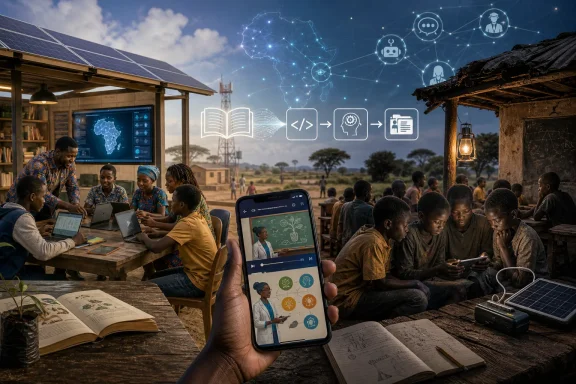 The Revolution Is Real, but So Is the Risk
Africa’s e-learning debate is often framed as a choice between optimism and skepticism. That framing is too neat. The same mobile phone that gives a rural student access to a coding lesson can also expose how little electricity, bandwidth, device ownership, and instructional support that student actually has.The pandemic made this contradiction impossible to ignore. School closures forced ministries and universities across the continent to experiment with online lessons, radio and television instruction, learning management systems, WhatsApp classrooms, and downloadable materials. What began as emergency continuity has since hardened into policy ambition.
That ambition is visible at the continental level. The African Union’s digital education strategy for 2023–2028 treats digital learning not as a side project, but as part of a broader education transformation agenda. Ghana and other countries have also pursued ICT-in-education reforms, digital content, teacher training, and online delivery models.
But policy language is the easy part. The harder question is whether African education systems are building the boring foundations that make e-learning work: power, connectivity, devices, teacher support, curriculum redesign, assessment reform, local-language content, and maintenance budgets. Without those, e-learning becomes a glossy layer on top of old scarcity.
Digitizing a Weak System Does Not Make It Strong
Yagsori’s sharpest point is that Africa must not confuse digital delivery with educational reform. A bad lecture streamed over Zoom is still a bad lecture. A curriculum built around memorization does not become future-ready because it is uploaded to Google Classroom.For decades, critics have argued that many African school systems reward examination performance more than problem-solving. Students often learn to reproduce approved answers rather than interrogate problems, build things, collaborate, or adapt. In that environment, e-learning can become another mechanism for distributing notes and past questions at scale.
That is not transformation. It is logistics.
The deeper opportunity is different: e-learning can shift education from coverage to competence. A student can replay a difficult lesson, use simulations, join peer communities, access global instructors, build a portfolio, and learn practical skills outside the rigid timetable of a school day. A teacher can use digital tools to diagnose gaps, personalize assignments, and supplement scarce textbooks.
But that requires changing what schools value. If national exams continue to privilege rote recall, digital platforms will be bent toward rote recall. If universities continue to reward credential accumulation over demonstrable skills, online learning will become another certificate factory. Technology follows incentives.
The Mobile Phone Is Africa’s Classroom and Its Bottleneck
One reason e-learning feels plausible in Africa is the mobile phone. Unlike the desktop-first story of early online education in the West, African digital learning is likely to be mobile-first, low-bandwidth, and socially distributed through messaging apps, short videos, offline downloads, and community access points.That matters because the continent’s device reality is uneven. A learner may have access to a phone but not a laptop. A household may share one device among several children. A student may have enough data to download notes but not enough to attend daily live video classes. A platform designed for stable broadband can fail immediately in this environment.
This is where too much imported edtech thinking collapses. A platform optimized for an urban private school in Accra, Nairobi, Lagos, or Johannesburg may be nearly useless in a village where electricity is intermittent and data costs compete with food, transport, and household bills. Africa does not need merely “online learning.” It needs resilient learning systems designed for constraint.
That means offline-first architecture, compressed content, radio and television integration, SMS support, downloadable assessments, local caching, and community learning hubs. It also means designing for the fact that learning often happens in noisy homes, shared spaces, and multilingual environments. The best African e-learning systems will not be the most glamorous; they will be the most forgiving.
The Digital Divide Is Becoming an Education Divide
The phrase “digital divide” is so familiar that it risks sounding harmless. It is not. In education, the digital divide becomes a learning divide, then a skills divide, then an income divide.A connected student can take free or low-cost courses in programming, design, entrepreneurship, languages, mathematics, and AI literacy. An unconnected student may remain dependent on an under-resourced school, an overworked teacher, and outdated materials. Over time, the difference compounds.
This is why e-learning can be both democratic and exclusionary. It lowers barriers for those with minimum access, but it can raise the ceiling faster for the already advantaged. Urban students with smartphones, laptops, stable electricity, and educated parents may benefit first and most. Rural and low-income learners may be told that the future is online while lacking the means to enter it.
That is the moral hazard in the current enthusiasm. If governments announce digital learning platforms without solving affordability and infrastructure, they can appear modern while shifting the burden onto families. Parents buy the data. Students hunt for charging points. Teachers improvise without training. The state gets a press release; the learner gets a fragile connection.
Teachers Are the Missing Infrastructure
The debate often treats devices and connectivity as the main infrastructure for e-learning. They are necessary, but they are not sufficient. Teachers are infrastructure too.Online teaching is not simply classroom teaching through a webcam. It requires different pacing, assessment, feedback, classroom management, content design, and student support. A teacher who is excellent in person may struggle online without training; a teacher who is weak in person may become worse when hidden behind a platform.
Many African educators were pushed into emergency remote teaching during the pandemic with little preparation. Some adapted heroically. Others were expected to use tools they had never been trained to use, often while paying for their own data or using personal devices. That experience should have taught policymakers a lesson: teacher readiness cannot be an afterthought.
If e-learning is to mature, teacher professional development must move beyond one-off ICT workshops. Educators need ongoing coaching, peer communities, practical content libraries, technical support, and time to redesign lessons. They also need incentives. A system that evaluates teachers only by old metrics should not be surprised when they use new tools in old ways.
Curriculum Reform Is the Real Fight
E-learning becomes powerful when it helps students learn what the old system struggles to teach. That includes digital literacy, critical thinking, collaboration, entrepreneurship, media literacy, data reasoning, and the ability to learn independently. These are not fashionable extras; they are survival skills in a labor market being reshaped by automation and remote work.Yagsori’s essay lands hardest when it asks whether African education systems are producing graduates or unemployment. That line may sound harsh, but it reflects a widely felt frustration. Families make enormous sacrifices for education, only to find that credentials do not guarantee employability.
Digital learning can help close that gap, but only if it is tied to skills that have real economic value. Coding bootcamps, online apprenticeships, digital marketing courses, design portfolios, agricultural extension platforms, teacher training modules, and small-business education can all matter. So can remedial literacy and numeracy tools, which are less glamorous but foundational.
The mistake would be to treat digital skills as a separate subject rather than a layer across learning. A future-ready student does not merely know how to open a spreadsheet. She can use digital tools to analyze a local problem, communicate findings, collaborate with others, and build something useful. That is a curriculum question, not a software question.
Governments Cannot Outsource the Future to Platforms
Private edtech companies will play an important role in African e-learning. So will nonprofits, universities, telecom operators, cloud vendors, and international development agencies. But the state cannot outsource the public purpose of education.If platforms become the default solution, education policy risks being shaped by whichever vendor offers the most attractive pilot. That can lead to fragmentation: one tool for one district, another for a donor-funded program, another for a ministry initiative, and no durable national architecture tying them together. Schools then inherit logins, dashboards, procurement cycles, and abandoned projects.
The better model is public strategy with private participation. Governments should set standards for accessibility, data protection, interoperability, curriculum alignment, teacher training, procurement transparency, and evidence of learning outcomes. Platforms should compete to serve those goals, not define them.
This matters especially for children’s data. E-learning systems collect information about attendance, performance, behavior, location, device use, and sometimes identity. In countries where data protection enforcement is still developing, educational technology can create new risks. The classroom of the future should not become a surveillance market by accident.
The AI Wave Raises the Stakes Again
E-learning is no longer just about recorded lectures and virtual classrooms. AI tutoring, automated feedback, translation, content generation, adaptive quizzes, and chat-based learning assistants are already changing what digital education can do. For Africa, that creates both opportunity and urgency.AI could help address teacher shortages by providing practice exercises, explanations, and feedback at scale. It could support local-language learning, generate examples relevant to local contexts, and help teachers prepare lessons faster. Used carefully, it could make personalized learning less expensive.
But AI can also deepen existing inequalities. Students with better devices and connectivity will gain access to stronger tools. Schools with trained teachers will use AI to extend learning; schools without support may use it as a substitute for instruction. Bias, misinformation, language gaps, and overreliance are not abstract risks when learners are already navigating fragile systems.
This is why digital education policy cannot lag behind technology. The conversation has moved from “Can we put lessons online?” to “Who controls the learning environment, the data, the algorithms, and the standards?” Africa’s education ministries need to answer those questions before market momentum answers them on their behalf.
The Best E-Learning Will Look Less Like Silicon Valley
There is a temptation to imagine the future of African e-learning as a sleek app, a tablet in every hand, and AI tutors humming in the background. Some of that will happen. But the most consequential models may look more modest.A rural school with solar power, a local server, offline digital textbooks, teacher training, and periodic internet synchronization may do more for learning than a national portal nobody can afford to use. A WhatsApp-based tutoring group may outperform an expensive platform if it fits the way students already communicate. A radio lesson paired with printed exercises and teacher follow-up may reach learners that video never will.
This is not a retreat from innovation. It is innovation grounded in reality.
African e-learning should be judged by outcomes, not aesthetics. Does it improve literacy? Does it help teachers? Does it reduce cost? Does it reach girls, rural learners, disabled students, displaced children, and working youth? Does it build skills that matter outside the exam hall? If not, it is not a revolution. It is procurement.
The Quiet Revolution Needs a Public Contract
The most important shift may be cultural. E-learning changes the relationship between school and learner. It makes education less tied to a building, less limited by the timetable, and less dependent on a single authority at the front of the room.That can be liberating. It can also be destabilizing. Students need guidance to navigate abundant information. Teachers need support to become mentors and designers, not just content deliverers. Parents need confidence that digital learning is not merely screen time with a certificate attached.
This requires a public contract around digital education. Governments should be honest about what e-learning can and cannot do. Schools should integrate it deliberately rather than treating it as a panic button. Telecom companies should be part of affordability solutions. Communities should have a voice in how tools are deployed.
Above all, digital learning must be built as a public good. If it becomes another privilege for the connected, it will reproduce the very inequalities education is supposed to challenge.
The Test Is Whether the Offline Child Still Counts
The e-learning debate in Africa should not be settled by the success stories alone. It should be judged by the learner most likely to be excluded: the child without reliable power, the student sharing a phone, the teacher with no training, the rural school beyond stable broadband, the graduate holding a certificate but lacking marketable skills.- E-learning can expand access only if electricity, internet affordability, and device availability are treated as education infrastructure.
- Digital platforms will not transform learning if curricula remain built around memorization and exam performance.
- Teachers need continuous digital pedagogy support, not symbolic ICT workshops after platforms have already been launched.
- Mobile-first and offline-first design are essential in African contexts where broadband assumptions often fail.
- Governments must set standards for privacy, accessibility, interoperability, and evidence before platforms become policy by default.
- The real measure of success is whether e-learning improves outcomes for rural, low-income, and marginalized learners, not whether ministries can announce modern tools.
References
- Primary source: Modern Ghana
Published: 2026-06-27T10:42:07.939325
E-Learning in Africa: Is It the Lifeline for Education or a Quiet Revolution We Are Not Ready For?
Across Africa, a quiet but powerful shift is taking place in classrooms, homes, and mobile phones: e-learning .www.modernghana.com - Related coverage: au.int
- Related coverage: dig.watch
African Union's Digital Education Strategy and Implementation Plan | Digital Watch Observatory
This text is sourced from the official African Union website and is intended to serve as a foundation for expert analysis and as a teaching resource. dig.watch
- Related coverage: africa-newsroom.com
APO Group - Africa Newsroom / Press release | African Ministers Adopt Landmark Continental Artificial Intelligence Strategy, African Digital Compact to drive Africa’s Development and Inclusive Growth
African Ministers Adopt Landmark Continental Artificial Intelligence Strategy, African Digital Compact to drive Africa’s Development and Inclusive Growthwww.africa-newsroom.com - Related coverage: unesco.org
Digital Learning in Africa: Bridging the Gap in Low-Resource Contexts
To mark the second International Day for Digital Learning, UNESCO organized a webinar on 19 March 2025 under the theme of “Digital learning realities in low-resource contexts”. As digital educationwww.unesco.org - Related coverage: worldbank.org
Ghana: Online Education for Delivering Learning Outcomes during the COVID-19 School Closure
When the COVID-19 pandemic struck in 2020, the education sector in Ghana faced significant disruption. In order to avert learning losses, the International Development Association (IDA) funded the Ghana Accountability for Learning Outcomes Project (GALOP). It supported the Government of Ghana in...www.worldbank.org
- Related coverage: moe.gov.gh
- Related coverage: un.org
Young african boy uses his computer at the market, young people and technology in africa
Young african boy uses his computer at the market, young people and technology in africawww.un.org
