

Ed Reed’s short, Copilot‑assisted film study of the Eagles’ offense compresses high‑level coaching insight, visual pedagogy, and a product demo for Microsoft’s Copilot tooling into a shareable, social‑ready lesson that is both instructive and emblematic of how AI is reshaping sports media production.
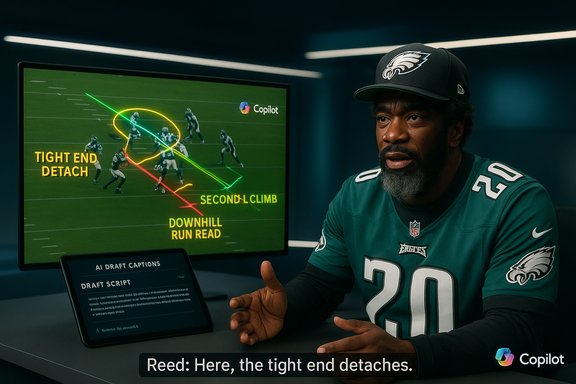
Ed Reed’s credibility as a Hall of Fame safety gives the segment instant authority for fans and aspiring coaches; the production’s addition of Microsoft Copilot overlays turns Reed’s verbal film notes into visually explicit teaching moments. The short‑form “Blueprint” format packages film‑room thinking into sub‑five‑minute explainers, a move publishers are using to reach mobile and social audiences while demonstrating Copilot’s capacity for on‑screen annotation, script assistance, and distribution automation.
The format is notable for three reasons. First, it democratizes film‑room literacy by showing reads, protections, and leverage in real time. Second, it lowers production barriers for publishers by automating tedious editorial steps (captions, SEO metadata, cutdowns). Third, it raises editorial and privacy questions that teams, publishers, and IT teams must address before adopting agentic workflows at scale.
Important caveat: the uploaded analysis files discuss the Blueprint format, Copilot overlays, and multiple film‑room vignettes across teams, but not all dossier items explicitly transcribe Reed’s comments on every specific play shown in the Yardbarker Blueprint episode referenced by the user. Treat fine‑grained claims about a single series (for example, exact yardage numbers or a play labeled as the definitive “tush push” counter) as provisional until cross‑checked against the original gamebook or the clip’s shown captions. The film‑room materials explicitly recommend pairing clip‑level lessons with snap‑by‑snap metrics before elevating single clips into season‑level evidence.
For Windows users and OEMs, the episode underscores why vendor clarity matters: Copilot+ PCs and on‑device inferencing can improve latency and protect some telemetry footprints, but claims about local processing and NPU performance require independent verification before they become procurement rationales. Enterprises should insist on datasheet disclosures and controlled pilots.
Source: Yardbarker Watch: Saquon Barkley & Jalen Hurts Film Study with Ed Reed | Blueprint Ep. 3
 Background: why this clip matters now
Ed Reed’s credibility as a Hall of Fame safety gives the segment instant authority for fans and aspiring coaches; the production’s addition of Microsoft Copilot overlays turns Reed’s verbal film notes into visually explicit teaching moments. The short‑form “Blueprint” format packages film‑room thinking into sub‑five‑minute explainers, a move publishers are using to reach mobile and social audiences while demonstrating Copilot’s capacity for on‑screen annotation, script assistance, and distribution automation.The format is notable for three reasons. First, it democratizes film‑room literacy by showing reads, protections, and leverage in real time. Second, it lowers production barriers for publishers by automating tedious editorial steps (captions, SEO metadata, cutdowns). Third, it raises editorial and privacy questions that teams, publishers, and IT teams must address before adopting agentic workflows at scale.
Overview of the clip and core teaching points
What the Reed segment is designed to teach
The clip takes a two‑play sequencing approach familiar to coaches: use a field‑flipping timing pass to force pursuit and widen defensive angles, then finish with a low‑variance downhill run that exploits the vacated lanes. Overlays annotate route stems, blocking windows, and the runner’s decisive read to show — in frame — why the sequence works. This pedagogy reduces the cognitive load that typically accompanies long film‑room sessions and makes specific micro‑traits visible to casual viewers.How the segment converts film notes into a scannable lesson
- Visual callouts trace receiver stems, blocking combos, and quarterback timing in exact sync with Reed’s narration.
- Tight, Copilot‑assisted voiceover reduces a longer film‑room monologue to a concise, teachable narration suitable for mobile attention spans.
- The production produces social‑ready assets (captions, thumbnails, short cuts) that increase discoverability while making the learning repeatable.
Technical anatomy: what Microsoft Copilot brings to sports film study
Visual annotation and alignment
Copilot Vision‑style overlays let Reed point to micro‑moments — e.g., a tight end’s detach, a combo block finishing to the second level, or the exact shoulder leverage that forces a linebacker’s hesitation — while the viewer sees the same pixel‑level evidence he references. This visual synchronization is the segment’s pedagogical core.Script drafting and editorial assistance
Generative tools convert longform film notes into tight voiceover scripts, draft captions, and suggest SEO copy for publisher CMS systems. That saves editorial time but must be followed by human verification to avoid narrative drift or AI hallucination.Hybrid runtime and on‑device inference claims
Practical deployments described around these clips use a hybrid runtime: light on‑device spotting for latency‑sensitive overlay placement, with heavier cloud reasoning for script generation and metadata. Vendor claims about NPUs and TOPS figures are useful marketing signals but should be treated as vendor statements until verified with OEM datasheets or independent benchmarks.Coaching insights: what Reed emphasizes about the Eagles’ run game (and what’s verifiable)
Ed Reed’s narrative — when read alongside the clip’s on‑screen callouts — stresses repeatable, coachable mechanisms that create consistent run success: combo blocks that climb to linebackers, tight‑end detachments to seal backside pursuit, and decisive runner reads that pick seams rather than chasing extra yards. Those micro‑traits are the repeatable ingredients that allow a team to convert short‑yardage and red‑zone situations reliably.Important caveat: the uploaded analysis files discuss the Blueprint format, Copilot overlays, and multiple film‑room vignettes across teams, but not all dossier items explicitly transcribe Reed’s comments on every specific play shown in the Yardbarker Blueprint episode referenced by the user. Treat fine‑grained claims about a single series (for example, exact yardage numbers or a play labeled as the definitive “tush push” counter) as provisional until cross‑checked against the original gamebook or the clip’s shown captions. The film‑room materials explicitly recommend pairing clip‑level lessons with snap‑by‑snap metrics before elevating single clips into season‑level evidence.
What Reed would do to prevent the “tush push”
The clip reportedly touches on tush push concerns — Reed outlines schematic and assignment‑level counters that emphasize gap integrity, low‑center‑of‑gravity leverage, and defensive pre‑snap alignment discipline. However, the precise play‑by‑play countermeasures Reed proposes should be validated against the episode transcript; the uploaded materials recommend treating such single‑clip prescriptions as coachable starts that require practice reps and personnel alignment to work reliably. If your intent is to implement these counters on the field, combine the clip’s prescriptions with controlled practice work and objective snap‑charting.Editorial strengths and methodological limits
Strengths — why this format works
- Accessibility: Hall of Famer commentary plus synchronized overlays accelerates learning for fans and youth coaches.
- Pedagogical clarity: Visual cues make abstract concepts like “climb to linebacker” or “route stem to manipulate leverage” instantly readable.
- Production efficiency: Copilot reduces mechanical editorial tasks (captioning, SEO copy, cuts), freeing humans to focus on verification and storytelling nuance.
Limits and risks — what the clip cannot (and should not) prove
- Selection bias: Short highlights are curated; they show one successful sequence but cannot by themselves prove a systemic trend. The film‑room materials explicitly caution against extrapolating season‑level conclusions from a single vignette.
- AI hallucination risk: Generative scripts and metadata can overstate causality or invent details without human verification. Copilot outputs should be treated as drafts, not final editorial copy.
- Metric verification needed: Individual player superlatives visible on tape still require snap‑by‑snap grading and third‑party metrics (grades, pressures, PFF‑style snap charts) before they are elevated to definitive claims.
Privacy, telemetry, and enterprise governance: practical concerns for Windows users and publishers
Viewer privacy on highlight pages
Publisher pages hosting highlight clips are telemetry endpoints: video players, ad tech, and measurement tags collect audience signals. Cookie preference centers help but do not erase server‑side IDs or fingerprinting; privacy‑conscious users should use InPrivate/Incognito modes and strict tracking prevention when watching. The film‑room materials recommend these consumer practices for minimizing unintended data exposure.Governance for production teams using Copilot
Enterprises and publishers should adopt conservative governance before embedding Copilot Vision or agentic features into production workflows:- Require DLP and Intune policies for devices used in production.
- Keep primary media and sensitive payloads in controlled environments with consent and logging.
- Demand vendor clarity on what processing happens on device versus in the cloud.
Hardware claims and verification
Vendor messaging about on‑device NPUs and TOPS performance underpins the Copilot+ PC pitch, but those hardware performance and privacy claims should be verified against OEM technical documentation and independent benchmarks before they are used in procurement decisions. Treat these numbers as vendor statements until corroborated.Practical checklists and recommendations
For fans who want to learn from the clip (privacy‑smart)
- Watch in a fresh browser profile or InPrivate window.
- Open the site’s cookie preferences and disable Targeting/Performance cookies if available.
- Use browser tracking prevention (Balanced/Strict) and block third‑party cookies.
- Cross‑check any yardage or numeric claim against the official play‑by‑play if you plan to reuse the clip in analysis.
For publishers and editors
- Use Copilot to draft overlays and captions, but keep a mandatory human verification step for all factual claims.
- Publish a short methodology note on highlight pages stating how yardage and game context were verified.
- Pilot on‑device spotting with minimal privileges and log all agent actions in production environments.
For IT leaders and rights holders
- Require DLP, admin‑approved Copilot agents, and audit trails before any integration with production asset pipelines.
- Prefer private‑cloud or on‑prem handling of raw media when legal or competitive considerations demand strict control.
- Contractually require vendor transparency about what processing occurs locally and what goes to the cloud.
Defensive coaching takeaways and tactical counters (practical football steps)
The clip’s schematic prescriptions for stopping short‑yardage scripts and controlled downhill runs can be summarized into coachable drills and alignment rules:- Rehearse gap‑integrity assignments against combo‑block finishes; defenders must practice climbing to the second level and securing inside shoulders.
- Practice low‑center‑of‑gravity anchor points for interior linemen and linebackers to defeat surge‑style pushes used in short‑yardage fronts.
- Install pre‑snap sabotage checks and stunt recognition reps so defenders can disrupt protection timing that creates the 3–3.5 second windows Reed highlights.
Critical analysis: the broader implications for sports media and Windows users
Ed Reed’s Copilot‑augmented Blueprint episode is a visible example of AI’s double‑edged promise for sports storytelling: it makes expert insight accessible and producible at scale, but also accelerates risks of editorial overreach and privacy exposure if governance lags. The trend will raise the baseline quality of short explanatory clips, forcing publishers to decide whether they will pair production speed with transparent verification practices or simply chase virality.For Windows users and OEMs, the episode underscores why vendor clarity matters: Copilot+ PCs and on‑device inferencing can improve latency and protect some telemetry footprints, but claims about local processing and NPU performance require independent verification before they become procurement rationales. Enterprises should insist on datasheet disclosures and controlled pilots.
Verification flags and what still needs checking
- Exact play‑by‑play yardage and any single‑number claims visible in the clip should be cross‑checked against the official gamebook; the film‑room uploads themselves recommend this practice.
- Any hardware performance numbers (TOPS, NPU throughput) referenced in vendor marketing should be validated against OEM documentation and independent benchmarks before being relied on for privacy or procurement decisions.
- When using Copilot‑generated copy or overlays in editorial products, treat AI output as a first draft and maintain a human‑in‑the‑loop verification step to prevent hallucination and maintain trust.
Conclusion
The Ed Reed Blueprint segment — built around quick, Copilot‑assisted film lessons — demonstrates a new, high‑value format for sports pedagogy: expert voice plus synchronized AI visuals that make micro‑mechanics easy to see and easier to scale. That combination is a clear win for fan education and publisher efficiency, but it comes with non‑trivial responsibilities: verify numeric claims with play‑by‑play data, keep Copilot agents and media processing within governed environments, and retain human editorial control to prevent persuasive but incomplete narratives from becoming the dominant story. When publishers and teams pair these short, rich explainers with transparent verification and strong enterprise governance, Copilot‑augmented film study can genuinely raise public understanding of the game without sacrificing accuracy or user privacy.Source: Yardbarker Watch: Saquon Barkley & Jalen Hurts Film Study with Ed Reed | Blueprint Ep. 3
