

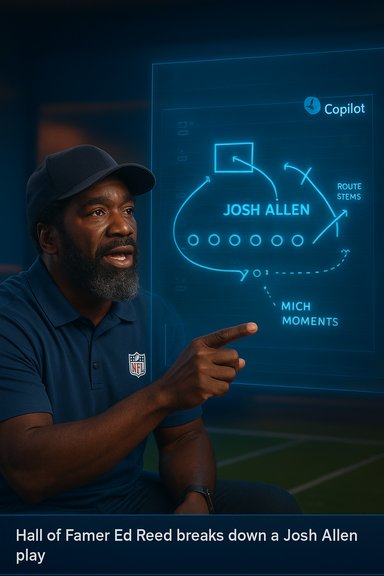
Ed Reed’s short, film‑room breakdown of Josh Allen — repackaged with Microsoft Copilot’s visual overlays and scripted voiceover — is a tidy demonstration of where sports media is headed: expert insight made instantly consumable, optimized for social feeds and built with AI tools that speed production and sharpen on‑screen pedagogy.
Background
Ed Reed, a Pro Football Hall of Famer and one of the game’s most respected defensive minds, appears in a series of short “Blueprint” film segments that translate film‑room thinking into bite‑sized lessons for fans and coaches. Recently, those segments have been retooled with Microsoft Copilot overlays and editorial assistance so Reed can point to route stems, protection windows, and micro‑moments with on‑screen callouts that sync with his narration. The publisher metadata for the clip explicitly identifies Copilot as an enabling technology, and the piece was distributed through sports publishers and aggregators that emphasize the Copilot branding.This article explains what the Reed–Allen clip shows, how Microsoft Copilot is being used in the production workflow, why the format matters for sports fans and creators, and what privacy, editorial, and governance trade‑offs publishers and IT teams should be watching.
Overview: What the clip actually is
The short form film lesson
The clip compresses a repetitive coaching template into a sub‑five‑minute video. It highlights a two‑play sequence — a timing pass that flips the field, followed by a downhill finish — and uses slow‑motion and overlays to isolate the protection clarity, route stems, and contested‑catch fundamentals that make the sequence teachable. Reed narrates the reads and keys while onscreen annotations trace receiver stems, blocking windows, and defensive leverage.Why the Reed segment matters
- It packages Hall‑of‑Fame expertise in a scannable format for casual fans.
- It functions as a product demo for Copilot’s editorial and visual‑annotation capabilities, showing publishers how short, high‑quality breakdowns can be produced at scale.
- It highlights the tension between editorial storytelling and statistical rigor: a highlight is persuasive, but not necessarily representative.
How Microsoft Copilot is being used in sports film study
Core capabilities applied to the clip
Microsoft’s Copilot tooling — surfaced in several product names (Copilot Vision, Copilot+ PC, agentic features) — is being applied to the Reed breakdown in three primary ways:- Visual annotation and overlays that highlight route stems, blocking concepts, and camera‑angle callouts so the presenter can point to exact micro‑details as the play unfolds. This makes the film lesson visually explicit rather than purely verbal.
- Script and editorial assistance that converts long film‑room notes into concise narration suitable for short‑form consumption. AI helps editors craft a tight voiceover that preserves the teachable moments.
- Distribution optimization: automatic captions, SEO‑friendly metadata, and social‑ready cuts that improve discoverability and reduce manual production work.
The hybrid runtime the vendors promote
Practical deployments rely on a hybrid runtime model. Lightweight on‑device processing handles low‑latency visual spotting while cloud reasoning performs heavier generative steps like script drafting and metadata generation. Vendor messaging around Copilot+ PCs and on‑device acceleration (NPUs with high TOPS claims) is used to argue for lower latency and privacy‑sensitive processing; treat specific hardware numbers as vendor claims that should be verified against OEM documentation before you take them as definitive.The editorial value: pedagogy meets production
Why the format teaches better
Short, annotated breakdowns solve a longstanding problem for mass audiences: film‑room thinking is usually talky and slow. By overlaying visual cues at the exact moment a concept matters, the Reed clip makes abstract reads and leverage decisions visible. That reduces cognitive load and increases retention for viewers who would otherwise be lost in a 20‑minute tape study session.Production benefits for publishers
- Faster turnaround times for highlight reels and explainers.
- Scalable editorial workflows: AI drafts scripts, creates captions, and generates metadata so a single editorial team can publish many more short explainers.
- Improved accessibility: automatic subtitles and on‑screen callouts broaden the audience to non‑experts and hearing‑impaired viewers.
Critical analysis: strengths and the trade‑offs
Strengths — where the Reed + Copilot combo adds real value
- Accessibility to expert insight. A Hall of Famer’s voice, combined with AI overlays, democratizes the mechanics of the game for casual fans and youth coaches alike. That has educational value beyond the click.
- Pedagogical clarity. Visual callouts remove ambiguity and let analysts show — not just tell — why a play worked. This is especially useful for explaining complex timing concepts and micro‑leverage decisions.
- Production efficiency. Draft scripts, captions, and SEO copy produced by Copilot reduce manual labor and let editorial teams focus on verification rather than basic composition.
Risks and trade‑offs — what to watch closely
- Editorial selection bias. Short‑form highlights are selection engines: editors choose the most persuasive plays. A single Reed‑annotated play is instructive, not conclusive. Relying on highlights alone to make season‑level claims is methodologically risky.
- AI hallucination and narrative drift. Generative assistants can overstate causality or invent contextual details unless editorial teams verify every factual claim (yardage, game context, player status). Copilot outputs should be treated as drafts, not final copy.
- Privacy and telemetry on hosting pages. Highlight pages are telemetry endpoints with ad tech and tracking. Cookie toggles reduce some tracking but server‑side identifiers, fingerprinting, and cross‑site matching can still persist. Windows users and privacy‑conscious readers should be aware that watching a clip can feed profile data into advertising and measurement systems.
Verification and governance concerns
What the publisher metadata shows
Multiple republishing outlets and the clip’s hosting pages include publisher metadata and credits that identify Microsoft Copilot as the enabling technology; some pages include direct promotional links to Microsoft‑branded campaign pages. These visible cues confirm a commercial partnership and show that Copilot is not merely a background analytics tool but a branded production partner in this workflow.Enterprise governance considerations
If a publisher or studio uses Copilot Vision or agentic features in production workflows, they must consider:- Data Loss Prevention (DLP) policies for creative assets and raw footage.
- Audit trails and logging for agent actions and editorial changes.
- Role‑based access and revocable permissions for any agent that can read, edit, or publish content.
Privacy and consumer security: the practical reality
The telemetry problem
Watching the Reed clip is a benign fan activity — but the page hosting the clip is also a commercial product. Cookie preference centers and visible opt‑outs can mitigate some tracking, yet persistent server‑side signals and fingerprinting techniques can maintain identifiers despite client‑side toggles. Fans concerned about profiling should apply layered defenses: stronger browser tracking prevention, InPrivate or Incognito sessions, and targeted ad‑blocking (with the caveat that some players restrict playback when blockers are active).What Copilot does (and doesn’t) imply for user data
Copilot features vary in how much processing is local versus cloud‑based. Vendors promote on‑device acceleration and NPU claims to reduce cloud egress for sensitive tasks, but exact splits are often under‑specified in publisher copy and require verification from OEM documentation or Microsoft’s technical notes. Where sensitive corporate footage or embargoed material is used in AI workflows, conservative governance dictates keeping primary media and plan payloads inside a controlled environment with explicit consent and logging.Practical recommendations
For fans and casual viewers
- Watch the Reed clip for technique and insight, but treat it as a teaching vignette rather than statistical proof.
- Use privacy tools: Edge’s tracking prevention, InPrivate browsing, or a privacy‑first browser to reduce telemetry. Be aware that publisher pages can still collect non‑cookie signals.
For content editors and producers
- Use Copilot to draft overlays, captions, and voiceover scripts — but institute a human verification step for all factual claims (yardage, time, player availability).
- Publish a short methodology line on highlight pages stating how facts were verified when important numbers are cited; transparency builds trust.
For IT administrators and enterprise customers
- Pilot Copilot Vision and agent features in a controlled environment. Require DLP, Intune policies, and audit logging before production rollout.
- Demand vendor clarity on what processing runs locally versus in the cloud. For high‑value content, prefer on‑prem or private‑cloud handling of raw media.
Broader implications: what this trend means for sports media and Windows users
A new norm for short‑form expertise
AI‑assisted film breakdowns will likely become a standard part of sports content strategies. The combination of recognized expert voices (Hall of Famers, coaches) plus AI overlays is a high‑engagement format that publishers can replicate quickly. That will raise the baseline for quality and likely increase the volume of explainer clips across every major sport.Business model and attention economy effects
Publishers gain production leverage, but the attention economy amplifies the risk of narrative overreach: bite‑sized explanations can be persuasive and go viral, but they rarely tell the whole story. Audiences and advertisers will need new heuristics to separate vivid storytelling from robust evidence.The long view on governance
AI helps scale content, but governance must scale as well. The next phase of this trend will test whether publishers embed consistent editorial checklists, whether platform vendors strengthen telemetry transparency, and whether enterprises integrate runtime protections for agentic features. If those elements lag behind the production advantages, the industry will face recurrent issues around misinformation, privacy complaints, and content reliability.A technical note on vendor claims and verification
Vendor materials frequently tout on‑device acceleration numbers (for example, high TOPS figures for NPUs) and hybrid runtime claims. These marketing numbers can be meaningful in context, but they should be verified against OEM technical documentation and independent benchmarks when making security or procurement decisions. Treat hardware performance and privacy‑preserving claims as vendor statements until corroborated with independent testing or detailed datasheets.Conclusion
The Ed Reed breakdown of Josh Allen — presented with Microsoft Copilot’s visual overlays and scripting — is a clear example of what AI can do for sports storytelling: it makes expert film‑room thinking accessible, visually precise, and fast to produce. For fans and amateur coaches, that’s a net positive — high‑quality coaching points delivered in digestible form. For publishers and enterprise teams, though, the clip is also a case study in the balance they must strike between production efficiency and editorial rigor.The Reed segment highlights three immutable lessons for the near future of AI‑assisted media production: adopt the tools to reach modern audiences, but deploy them with transparent editorial guardrails; protect viewer privacy by being explicit about telemetry and processing locality; and verify every AI‑drafted factual claim before publishing. Done well, Copilot‑augmented film study can raise public understanding of the game. Done poorly, it will accelerate persuasive yet incomplete narratives and create governance headaches that are harder to undo.
Source: Yardbarker Watch: This breakdown from one of the best defenders of all time @Microsoft.Copilot
