

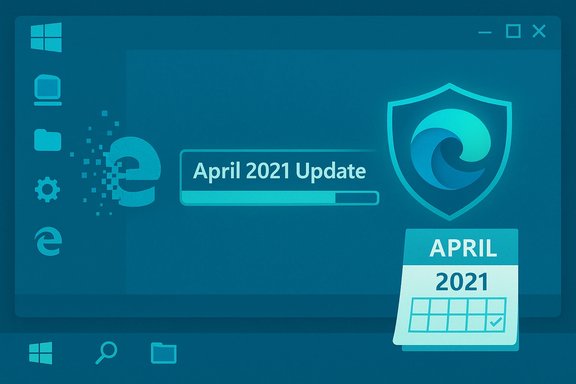
Microsoft’s April 13, 2021 cumulative updates for Windows 10 — shipped as KB5001330 (for Windows 10 versions 2004 and 20H2) and KB5001337 (for Windows 10 version 1909) — completed a long‑running migration by removing the Microsoft Edge Legacy (EdgeHTML) desktop application and replacing it with the newer Chromium‑based Microsoft Edge, and they did so in a way that caught many users and administrators off guard.
Microsoft announced its intention to rebuild Edge on the Chromium engine in late 2019 and released the Chromium‑based Edge to the public in early 2020. That long transition culminated in an official end‑of‑support decision: Microsoft Edge Legacy reached end of support on March 9, 2021, and Microsoft used its April 13, 2021 Update Tuesday (monthly “B” release) to remove the old app from supported Windows 10 SKUs and install the new, Chromium‑based Edge. The April cumulative updates were not created solely to replace Edge Legacy — they were normal monthly LCUs (latest cumulative updates) that also carried the Edge replacement action as an explicit component. Microsoft’s support notes for the April releases clearly state the reminder that the legacy desktop application was out of support and that the April cumulative updates will install the new Microsoft Edge when applied. Why this mattered: the Edge migration moves Windows’ built‑in web runtime to a modern, widely used engine that supports contemporary web features, wider extension availability, and a faster security cadence via evergreen updates. For Microsoft the change reduces fragmentation for developers and simplifies browser security patching; for users it generally improves compatibility with modern web apps. But the mechanics and side effects of an automated replacement embedded into a monthly OS rollup sold the change as a security and compatibility win even as it introduced operational and compatibility risks for some environments.
For web developers and users, the Chromium alignment reduces site breakage and improves extension compatibility, which is particularly helpful on older Windows installations that would otherwise rely on an unmaintained browser engine for critical tasks. Microsoft also prioritized compatibility features like Internet Explorer mode inside the new Edge to ease enterprise transitions for legacy web apps.
For administrators and power users who still run legacy Edge‑dependent workloads, the immediate priorities after April’s releases were clear: test the new Edge in your environment, validate kiosk and legacy app behavior under the Chromium runtime, and adopt controlled deployment practices so future rollouts deliver security without unnecessary disruption.
Source: BetaNews Microsoft issues KB5001330 and KB5001337 updates for Windows 10, killing off legacy Edge
 Background and overview
Microsoft announced its intention to rebuild Edge on the Chromium engine in late 2019 and released the Chromium‑based Edge to the public in early 2020. That long transition culminated in an official end‑of‑support decision: Microsoft Edge Legacy reached end of support on March 9, 2021, and Microsoft used its April 13, 2021 Update Tuesday (monthly “B” release) to remove the old app from supported Windows 10 SKUs and install the new, Chromium‑based Edge. The April cumulative updates were not created solely to replace Edge Legacy — they were normal monthly LCUs (latest cumulative updates) that also carried the Edge replacement action as an explicit component. Microsoft’s support notes for the April releases clearly state the reminder that the legacy desktop application was out of support and that the April cumulative updates will install the new Microsoft Edge when applied. Why this mattered: the Edge migration moves Windows’ built‑in web runtime to a modern, widely used engine that supports contemporary web features, wider extension availability, and a faster security cadence via evergreen updates. For Microsoft the change reduces fragmentation for developers and simplifies browser security patching; for users it generally improves compatibility with modern web apps. But the mechanics and side effects of an automated replacement embedded into a monthly OS rollup sold the change as a security and compatibility win even as it introduced operational and compatibility risks for some environments.What KB5001330 and KB5001337 actually ship
The core facts
- KB5001330 applies to Windows 10, version 2004 and version 20H2; the update advances those builds to OS builds 19041.928 and 19042.928 respectively.
- KB5001337 applies to Windows 10, version 1909, advancing that branch to OS build 18363.1500.
- Both cumulative updates include the explicit action: remove Microsoft Edge Legacy (EdgeHTML) and install the new Chromium‑based Microsoft Edge as part of the LCU. Microsoft’s release notes call this out as a new item in the April release notes.
How the replacement behaves in practice
- On modern Windows 10 releases that shipped with Edge Legacy, the LCU removes Edge Legacy and installs the Chromium Edge as a separate, supported desktop application. The new Edge will generally be pinned to the taskbar and receive its own independent update cadence. Microsoft documented that installations made through Windows Update will perform this transition automatically; installations using custom offline media or slipstreamed images must include the correct servicing stack update (SSU) to avoid incomplete replacement.
- Enterprise considerations: Microsoft intentionally preserves management controls for organizations through enterprise distribution channels (MSI packages, Intune, Configuration Manager) and does not silently change enterprise policy defaults such as IE mode configuration or default browser settings. Nevertheless, the automatic removal of Edge Legacy for consumer/managed devices still took place via the Windows Update path when applicable.
The rationale: security and compatibility
Microsoft framed the removal as necessary because Edge Legacy was no longer supported and therefore represented a lingering security exposure. Replacing an out‑of‑support browser with an actively maintained Chromium‑based browser reduces the browser attack surface and brings faster patching for web engine vulnerabilities to affected devices. That evergreen model means the browser can receive frequent security and feature updates independent of OS feature servicing.For web developers and users, the Chromium alignment reduces site breakage and improves extension compatibility, which is particularly helpful on older Windows installations that would otherwise rely on an unmaintained browser engine for critical tasks. Microsoft also prioritized compatibility features like Internet Explorer mode inside the new Edge to ease enterprise transitions for legacy web apps.
How this affected different audiences
Consumers and home users
- For the majority of consumer PCs that receive cumulative updates automatically, the transition was uneventful: Edge Legacy was removed, the new Edge was installed and pinned, and user data such as favorites and passwords were carried over by the installer in most cases. Microsoft documented this behavior and publicly recommended the new Edge.
- Several home users reported unexpected side effects after installing the April LCUs: reports ranged from startup slowdowns to reduced gaming performance or stuttering on some GPU/driver combinations, and in some cases audio anomalies. Community threads and early troubleshooting guidance surfaced soon after rollouts began. Microsoft acknowledged a small subset of users experiencing reduced game performance and documented workarounds and follow‑up fixes in later updates.
Enterprises, managed environments and kiosks
- Enterprises were expected to use the Microsoft Edge for Business distribution channels and management tooling rather than relying on the consumer Windows Update path. Domain‑joined devices were intentionally treated differently in earlier Chromium Edge rollouts, but the April 2021 LCUs still required administrators to plan for kiosk and assigned access scenarios because Edge Legacy removal could disrupt kiosk configurations unless the new Edge had been prepared beforehand. Microsoft published guidance to test and set up kiosk mode in the new Edge prior to applying the April updates.
- A specific deployment caveat: devices imaged from custom offline media that had the April LCU slipstreamed in without the appropriate SSU could end up with Edge Legacy removed but without the new Edge installed. Microsoft’s KB notes described this slipstreaming pitfall and offered explicit extraction and sequencing steps to avoid it. That detail made it essential for IT teams that use custom media to follow the SSU + LCU ordering guidance.
Known issues, regressions and community reaction
Reported regressions
Shortly after the April updates began to roll out, community reports accumulated about new or worsened problems on some hardware configurations. The most prominent issues included:- Gaming performance regressions (stuttering, lower FPS) for systems using multiple monitors or running games in full‑screen/borderless windowed modes on certain GPU drivers. Early community posts and vendor replies identified KB5001330 as a common denominator in many affected systems. Microsoft acknowledged the issue in the KB’s known‑issues section and later delivered fixes.
- Audio anomalies (Dolby Digital 5.1 high‑pitched noise) and other localized behavior issues that Microsoft addressed in subsequent rollups or hotfixes.
- Imaging/slipstream edge case where custom media missing the latest SSU would remove Edge Legacy but not install the new Edge, requiring administrators to manually install the Chromium Edge or recreate media with the correct SSU sequencing.
Vendor and Microsoft remediation
- Hardware vendors such as NVIDIA publicly suggested rollback as a triage step for some users who experienced lower game performance after applying the updates. That advice produced debate because rolling back removes security fixes in some cases, and Microsoft prefers using mechanisms like Known Issue Rollback (KIR) to minimize functional regressions without completely removing security updates. Microsoft used KIR and subsequent updates to mitigate the compatibility problems while leaving security fixes intact.
- Microsoft documented the April KB known issues and issued follow‑up updates (for example, KB5003690 addressed certain performance issues) and guidance for administrators to use enterprise deployment tooling to control when and how Edge is installed in managed environments.
Community reaction and mitigation attempts
- Many advanced users noted that previously used “workarounds” (registry keys or policy tweaks that prevented the new Edge from being installed) were ineffective against the April LCUs, producing complaints that Windows Update was bypassing those custom blocks. Community threads and posts documented attempts to block the replacement and mixed success with hide/decline mechanisms versus full blocking through enterprise tools. Those reports were user‑driven and varied by system configuration; Microsoft’s position remained that Edge Legacy was out of support and that the new Edge would be installed through the update channels.
Practical implications and recommended actions
The April replacement is a textbook example of how a broadly distributed OS rollup can have outsize secondary effects because it changes the installed application surface on devices. The practical guidance below reflects what Microsoft documented and what the community found useful after the April rollout.For enterprise administrators
- Use the Microsoft Edge for Business MSI packages, Configuration Manager, Intune, or other enterprise installers to control which Edge builds are installed and when. Do not rely on the consumer Windows Update path for controlled corporate deployment.
- Test kiosk, assigned‑access and legacy web app workflows in the new Edge well before applying the April cumulative updates; Microsoft warned kiosk scenarios could break if not preconfigured.
- If deploying images, ensure SSU sequencing is correct when slipstreaming updates into custom offline media; otherwise you risk incomplete replacement or other image‑based inconsistencies. Microsoft’s KB includes extraction steps and sequencing guidance.
- Maintain phased testing rings for LCUs and monitor telemetry for regressions such as driver interactions or application regressions — broad rollouts will always carry a small chance of compatibility fallout. Community experience underscores the value of a staged rollout with rollback and recovery plans.
For home and power users
- Keep Edge updated: the Chromium Edge updates independently and is the primary vehicle for browser security fixes going forward. Use About → Edge to confirm you’re on the latest build.
- If you experienced new gaming or audio problems immediately after the April update, test basic mitigations (update GPU drivers, test single‑monitor/fullscreen vs. borderless windowed configurations) and consult Microsoft’s KB and vendor advisories before rolling back security updates. Microsoft later issued a fix and recommended using KIR when practical rather than uninstalling security patches outright.
- If you must reinstall or manually deploy the new Edge (for example, after imaging issues), Microsoft supplies the standalone Edge installers and enterprise packages; manual install will reintroduce the Chromium Edge when needed.
Strengths, weaknesses and long‑term outlook — a critical analysis
Strengths
- Security uplift at the browser level. Replacing an unsupported engine with a modern, actively patched Chromium engine reduces the browser attack surface and speeds delivery of critical browser fixes. That’s a material security improvement for browsing‑related threats.
- Compatibility and ecosystem parity. Chromium alignment reduces site breakage and exposes Windows users to a broader extension ecosystem and modern web APIs. For organizations running mixed environments, this simplifies developer testing and reduces fragmentation.
- Enterprise controls remain available. Microsoft delivered enterprise packages, IE mode, and Group Policy support to make gradual migration feasible for managed fleets, rather than a blunt consumer‑only push.
Weaknesses and risks
- Update‑induced regressions are real. The April rollups highlighted how cumulative updates that include application substitutions can interact with drivers, games and device‑specific configurations in unexpected ways, producing regressions that sometimes require vendor or OS vendor mitigation. Community and vendor posts showed rolling back an LCU could restore functionality — but at the cost of losing security fixes. Microsoft’s KIR mechanism is the safer path but is not immediate for all environments.
- False sense of security. A modern browser does not make an unsupported or unpatched OS secure. Kernel and driver vulnerabilities remain unaddressed by browser upgrades, so users should not treat the Chromium Edge as a substitute for migrating to supported OS versions. Microsoft and independent analysis both emphasize that Edge improves browser security but does not replace OS servicing.
- Operational surprises from forced replacements. Administrators and advanced users who rely on custom configurations, registry blocks, or specialized kiosk workflows found that an automatic replacement embedded in the monthly rollup can upset carefully tuned setups. While enterprise channels exist, the mixed consumer/enterprise behavior of Windows Update created friction for some operators.
What to watch next (and unverifiable claims to be cautious about)
- When Microsoft moves application replacement or major bundling operations into monthly cumulative updates, the surface area for regressions increases. The most responsible mitigation is to plan phased testing, maintain quick rollback options, and monitor vendor responses for fixes distributed via KIR or subsequent LCUs. Community evidence supports this approach, but the timing and completeness of vendor fixes (and Microsoft’s KIR rollouts) will vary by issue and by region.
- Some online posts initially claimed registry hacks or Group Policy blocks were ineffective in all cases; community accounts are mixed and dependent on configuration. That claim should be treated cautiously: while many users reported that common consumer workarounds failed to prevent the April replacement, enterprise‑grade management and properly applied policies remain the authoritative way to control deployments. Those granular outcomes vary by setup and were not uniformly reproducible across all environments.
Conclusion
The April 13, 2021 LCUs (KB5001330 and KB5001337) closed the book on Microsoft Edge Legacy by removing the unsupported EdgeHTML desktop application and installing the Chromium‑based Microsoft Edge across affected Windows 10 releases. That move delivered clear security and compatibility benefits at the browser level, aligning Microsoft for the modern web with an evergreen update model and enterprise management paths. At the same time, the rollout illustrated the perennial trade‑offs in large‑scale OS servicing: automatic, wide distribution accelerates protection for millions of devices but increases the chance that subtle interactions with drivers, games, kiosk configurations, or custom imaging processes will surface as regressions. The proper operational response is disciplined testing, use of enterprise deployment tooling for managed systems, and readiness to apply vendor or OS vendor mitigations such as Known Issue Rollbacks — while remembering that a modern browser is an important layer, not a substitute, for a supported operating system.For administrators and power users who still run legacy Edge‑dependent workloads, the immediate priorities after April’s releases were clear: test the new Edge in your environment, validate kiosk and legacy app behavior under the Chromium runtime, and adopt controlled deployment practices so future rollouts deliver security without unnecessary disruption.
Source: BetaNews Microsoft issues KB5001330 and KB5001337 updates for Windows 10, killing off legacy Edge
