

Google’s Nano Banana, OpenAI’s GPT‑4o image mode, Midjourney V7, Seedream 4.0, Ideogram 3.0 and a handful of newer specialist models have reshaped the AI image landscape in 2025 — not just by improving fidelity, but by turning image editing into a conversational, iterative workflow that can fit into everyday creator tools and enterprise pipelines. The Beebom roundup of “The 10 Best AI Image Generators in 2025” captures this shift and highlights ten practical contenders for creators and teams, but the short list understates how rapidly the competitive positions, performance metrics, availability, and governance controls have been changing this year.
AI image generation has moved from novelty to production-capable utility in a single leap. Early 2020s systems focused on single-shot synthesis; by 2025, the leading models are natively multimodal, support multi-image references, do precise inpainting/outpainting, and are increasingly integrated into productivity apps. This progression enables two related shifts: (1) image generation is becoming a conversational, iterative craft — you edit an image by instructing the model in natural language — and (2) the marketplace is bifurcating into broad multipurpose engines (Gemini, GPT‑4o, Midjourney) and specialist engines optimized for tasks like typography, logo/vector output, or multi-image contextual editing (Ideogram, Recraft, Reve). The Beebom list reflects both categories and maps their strengths for everyday users.
Below I summarize the key claims from that roundup, verify technical assertions where possible, and provide a critical analysis for Windows users, designers, and IT teams weighing integration or production use.
Source: Beebom The 10 Best AI Image Generators in 2025
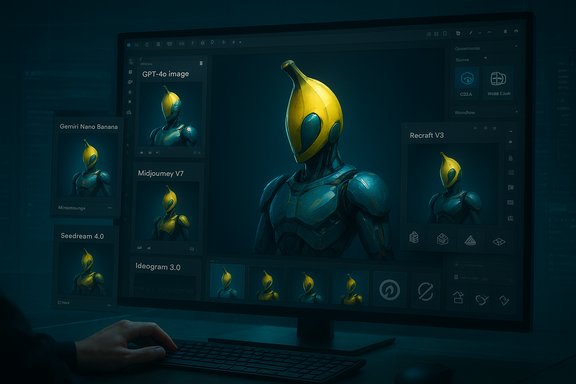 Background / Overview
AI image generation has moved from novelty to production-capable utility in a single leap. Early 2020s systems focused on single-shot synthesis; by 2025, the leading models are natively multimodal, support multi-image references, do precise inpainting/outpainting, and are increasingly integrated into productivity apps. This progression enables two related shifts: (1) image generation is becoming a conversational, iterative craft — you edit an image by instructing the model in natural language — and (2) the marketplace is bifurcating into broad multipurpose engines (Gemini, GPT‑4o, Midjourney) and specialist engines optimized for tasks like typography, logo/vector output, or multi-image contextual editing (Ideogram, Recraft, Reve). The Beebom list reflects both categories and maps their strengths for everyday users.Below I summarize the key claims from that roundup, verify technical assertions where possible, and provide a critical analysis for Windows users, designers, and IT teams weighing integration or production use.
Quick summary of the Beebom pick (what the list says)
- Gemini Nano Banana (Gemini 2.5 Flash Image): praised for conversational image editing and strong consistency when iteratively modifying a photo; noted as “best for image editing.”
- Imagen 4: listed as a high-fidelity text-to-image generator focused on photorealism and good text rendering.
- Midjourney (V7): recommended for conceptual, stylized art and unique aesthetics; V7 advances coherence in hands/bodies and introduces Draft Mode.
- ChatGPT (GPT‑4o image mode): presented as a strong, free option for image transformations and character reimaginings, though with some consistency caveats.
- Seedream 4.0 (ByteDance): called out for 4K output, top ELO leaderboard placement, and excellent text rendering.
- Leonardo AI, Higgsfield AI, Flux .1 Kontext [Max], Recraft V3, Ideogram 3.0, and Reve V1: positioned for creators, model aggregation, editing consistency, typography/logo design, and multi-image contextual editing respectively.
Verifying the major technical claims (what’s confirmed, and by whom)
Gemini Nano Banana (Gemini 2.5 Flash Image): editing-first model
- Verification: Adobe’s Firefly documentation explicitly lists “Gemini 2.5 Flash Image (Nano Banana)” as a partner model available in Firefly’s Text-to-Image module and Photoshop beta for generative fill and editing workflows. That confirms vendor-level integration and editorial positioning as an editing-first engine.
- Independent reporting from mainstream outlets and tech press describes Nano Banana as emphasizing fast conversational editing and “3D figurine” style outputs that circulated widely in social media. There are also accounts noting tradeoffs in font/text rendering and occasional over-smoothing artifacts — real-world behavior that matches community feedback.
GPT‑4o image generation in ChatGPT (ChatGPT’s images)
- Verification: OpenAI has published that GPT‑4o now includes image-generation capabilities (the “4o image generation” addendum) and that ChatGPT uses GPT‑4o for native image creation and editing. OpenAI’s product notes explain multi-turn image refinement, C2PA provenance metadata, and that GPT‑4o is the new default image engine in ChatGPT. Independent reporting confirms the rollout (and the viral “Ghibli” examples that circulated when it launched).
Midjourney V7 — aesthetics and Draft Mode
- Verification: Midjourney’s version history documents V7 and the related feature set (Draft Mode, Turbo/Relax flavors, Omni Reference), and flagship press coverage confirms the April 2025 V7 release. Community commentary and reviews note higher coherence for hands, bodies, and object rendering — though some users report remaining issues with upscaling artefacts in certain cases.
Seedream 4.0 (ByteDance) — 4K, leaderboard performance, text rendering
- Verification: ByteDance’s Seedream 4.0 pages advertise support for higher-resolution outputs (1K/2K/4K mode options), multi-reference inputs, and strong performance on internal MagicBench style metrics. Third‑party media coverage reports that Seedream 4.0 topped some public head‑to‑head leaderboards (Artificial Analysis text-to-image scoreboard) at various times in 2025, although the absolute ELO value reported differs between outlets. Seedream’s official pages and multiple tech outlets confirm Seedream 4.0’s focus on high-resolution outputs and superior text rendering.
Ideogram 3.0 — text rendering and typography
- Verification: Ideogram’s official announcement (March 26, 2025) confirms Ideogram 3.0’s focus on text rendering improvements, style references, and enhanced prompt‑to‑image alignment. Independent coverage and user testing documentation note Ideogram 3.0’s demonstrable strengths at legible, embedded text layouts versus many peers.
Leonardo AI, Higgsfield, Flux, Recraft, Reve — platforms and specialist models
- Verification: Leonardo AI publishes new model announcements and model pages (for example Lucid Origin / Lucid Origin Ultra on Leonardo.ai), confirming the vendor’s practice of hosting both in-house and partner engines; likewise, Recraft’s V3 documentation and Recraft press releases confirm its emphasis on brand consistency and vector/vectorized outputs for icons and logos. Black Forest Labs’ Flux models and niche players like Reve have mixed coverage but appear on platform listings and integration partners. These vendors are real and their claimed specializations line up with product docs and press.
Cross‑checks and cautionary flags (what’s solid and what’s volatile)
- Solid: GPT‑4o’s integration into ChatGPT; Midjourney V7’s release and Draft Mode; Adobe Firefly carrying Nano Banana; Ideogram 3.0’s typography focus. These are supported by official vendor docs and multiple reputable outlets.
- Verified but fluid: Seedream 4.0’s leaderboard position and exact ELO number. Multiple outlets show Seedream leading various leaderboards in late 2025, but ELO values and rankings vary slightly by snapshot and the specific head-to-head testing pool. Treat leaderboards as indicative, not definitive.
- Region / rollout caveats: Some models or variants are gated by region or integrations (for instance, vendor rollouts to the EU or enterprise plans can lag consumer launches). This affects availability and licensing conditions — always test from your target region and check the provider’s terms.
- Performance claims vs. production needs: Benchmarks (ELO, MagicBench) measure perceived or human-judged quality on curated prompts; they don’t directly prove low risk in production contexts (bias, memorization, legal risk). Independent audits and model cards are still inconsistent between providers; enterprise teams should demand explicit model cards and data provenance documentation before large-scale adoption.
Strengths: why the Beebom picks make sense for creators and teams
- Conversational editing reduces iteration friction. Models like Nano Banana and GPT‑4o allow “fix this spot” instructions in plain language, which shortens the loop between idea and usable asset. Adobe’s integration of Gemini 2.5 Flash demonstrates how this capability is moving into authoring tools.
- Specialist models reduce post-processing. Ideogram for typographic graphics, Recraft for logos/icons, and Seedream for high‑resolution photorealism let creators pick a targeted engine that minimizes downstream retouching. This saves time for designers and marketing teams.
- Aggregator platforms (Leonardo, Higgsfield) lower switching costs. If you want to compare Nano Banana vs Seedream vs Flux without multiple vendor sign-ups, these platforms provide a unified workflow and shared editing tools for side‑by‑side evaluation. That’s practical for teams exploring model choice.
- Speed vs. quality tiers. Midjourney V7’s Draft Mode is a clear UX win: low-cost, high-speed drafts then upgrade to final quality when composition choices are set. It’s a useful pattern for ideation pipelines.
Risks, legal concerns, and governance — what enterprises must evaluate
- Copyright & style-mimicry risk
- Many models are trained on large public and licensed datasets. The legal landscape for whether outputs can replicate an artist’s style or contain copyrighted elements remains unsettled. Enterprises should require model cards and training-data provenance before using outputs commercially. Vendor statements alone are not sufficient for legal due diligence.
- Attribution, provenance, and detection
- Providers are adding C2PA metadata and visible/invisible watermarks to help provenance (OpenAI and Google have added such measures), but detection and cross-platform tracing remain imperfect. Put detection and watermark checks into any production pipeline that might publish images externally.
- Safety, moderation, and bias
- Models differ in how they block or allow sensitive content. Some community reports show stricter filtering on certain engines; others are more permissive. If your use includes political, public-figure, or sensitive subject matter, adopt a human-review layer and test moderation edge cases.
- Regional availability and compliance
- The EU AI Act and local privacy laws can affect rollouts and contractual obligations. Some vendors delay EU launches to meet regulatory demands; teams operating globally should confirm regional compliance and export controls.
- Benchmark volatility and decision risk
- Public leaderboards (ELO) are useful signals but reflect snapshot preferences and specific prompt sets. Use internal evaluation suites that reflect your creative brief, brand constraints, text‑in‑image needs, and production formats before committing to a single model.
Practical guidance for Windows users, creators, and IT teams
Choosing the right model — a short decision flow
- If you need conversational, in-place photo editing (product shots, headshots, packaging tweaks): prioritize Gemini Nano Banana (Gemini 2.5 Flash) via Gemini/Firefly integrations. Confirm C2PA metadata support and watermark behavior for published content.
- If you require photorealism and high-resolution output (print, large-format art): evaluate Seedream 4.0 and Imagen 4 side‑by‑side on your specific prompts and text-rendering needs; seed images and typography tests matter. Treat leaderboards as starting points, not final answers.
- If you produce stylized art, mood boards, or concept visuals: use Midjourney V7 for its aesthetic range, layering Draft Mode for fast ideation.
- For logos, icons, and vector-friendly outputs: test Recraft V3 for raster→vector conversion and typography accuracy; confirm license terms for commercial use.
- For text-heavy graphics and labels (ads, posters, product packaging): prefer Ideogram 3.0 for its better-in-class embedded text rendering.
- If you want to compare engines rapidly and standardize an internal workflow: use aggregator platforms like Leonardo AI and Higgsfield to run A/Bs and save metadata for governance.
Integration tips for Windows workflows
- Use desktop authoring plugin routes: Adobe Firefly (with Nano Banana partner model in Firefly/Photoshop beta), and native export to PSD, PNG, or layered assets that plug into Paint, Photoshop, or Affinity. Confirm which Plug‑Ins your enterprise allows and whether local machine inference is required for sensitive assets.
- Maintain an assets ledger: for every generated image store prompt, model name & version, seed, client account, and C2PA metadata. This ledger is critical for provenance and risk audits.
- Automate quality gates with human review: generate at scale in low-res/draft mode, route only candidate finals to designers for retouching and legal sign-off. Draft Mode (Midjourney) and “fast” modes on many models are ideal for this iterative pipeline.
Final analysis — strengths, tradeoffs, and a short-term forecast
- Strengths: The 2025 crop of image models makes high-quality image editing and generation accessible and fast. Native multimodal models (GPT‑4o, Gemini 2.5 Flash) and specialist engines (Ideogram, Recraft) let teams pick the right tool for the job rather than compromise on a single jack-of-all-trades model. Integration into creative suites (Photoshop, Firefly) and aggregated platforms reduces friction for Windows-based design workflows.
- Tradeoffs: Rapid releases and leaderboard churn mean that today’s “best” can change quickly. Leaderboard ELOs are helpful but not decisive; legal and provenance guarantees lag model quality. Expect some workflows to require hybrid toolchains (generate in one model, edit in another, finalize in a traditional editor), which creates complexity for governance and rights management.
- Short-term forecast: The next 6–12 months are likely to emphasize (a) tighter product integrations (more partner plugins and in-app image editing), (b) improved provenance tooling (C2PA and watermarks becoming standard), and (c) regulatory-driven documentation (model cards and training‑data summaries for enterprise customers). Providers who publish clear model cards, commercial license terms, and reliable provenance tooling will win enterprise adoption even if their raw ELO is not top-ranked.
Closing recommendations for WindowsForum readers and IT decision‑makers
- If you’re experimenting: try ChatGPT (GPT‑4o) and Midjourney V7 for free/low-cost ideation, and test Nano Banana via Firefly for editing workflows that need tight photo consistency. Keep a checklist for provenance metadata and watermark verification before publishing externally.
- If you’re shipping commercial assets: require a model card and written license terms that permit your intended commercial usage. Run a small proof-of-concept that checks for text legibility, brand matching, and sensitive-content failure modes before enterprise-wide rollout.
- If you manage creative budgets: use Draft/Fast modes for ideation (Midjourney Draft Mode, Leonardo “fast” variants) and reserve high‑cost, high‑quality renders for final deliverables. Track generation credits and attach usage metadata to each asset.
Source: Beebom The 10 Best AI Image Generators in 2025
