

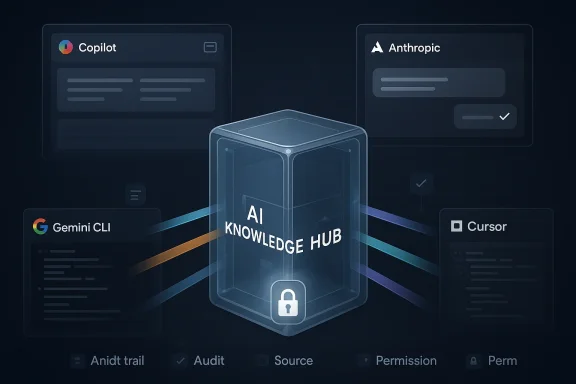
eGain’s new AI platform connectors are a sign that enterprise AI is moving past the novelty phase and into the harder work of governance, consistency, and operational trust. The company is pairing its AI Knowledge Hub with Microsoft Copilot, Anthropic Claude, Google Gemini CLI, and Cursor, framing the release as a way to give AI systems a single governed source of truth instead of forcing employees and developers to improvise across scattered repositories. That pitch matters because AI success in the enterprise is increasingly judged not by flashy demos, but by whether answers are repeatable, auditable, and safe enough to act on. The announcement also lands at exactly the right moment in the market: Model Context Protocol has become one of the clearest interoperability trends in enterprise AI, and both Anthropic and Microsoft have publicly documented support for MCP-style connections in their ecosystems, which makes eGain’s move feel less like a stunt and more like a bid to own the governed layer beneath the model. com]
For years, eGain has positioned itself as a knowledge management company first and an AI company second, and that framing turns out to be an asset in the current market. The company’s 2025 product direction centered on eGain Composer, a modular platform built on its AI Knowledge Hub with explicit emphasis on trusted knowledge, compliance, and composable integration, and the new connectors look like the next logical step in that roadmap. Instead of asking customers to live inside one assistant or one interface, eGain is tryinge layer portable across the broader AI ecosystem.
That shift matters because the industry’s conversation has changed. The first wave of generative AI was mostly about answering questions, but the current wave is about agentic AI: systems that can take actions, trigger workflows, and operate inside business processes. Once AI is doing more than drafting text, the quality of the underlying knowledge becomes operationally important. If the source is stale, contradictory, or poorly governed, the error does not stop at a bad answer; it can spread through approvals, customer interaoivery.
The company is also making a fairly sophisticated market bet. It is not trying to outbuild foundation models or challenge the major AI vendors at the model layer. Instead, it is aiming to become the knowledge governance layer that sits underneath them, a layer that can certify answers, trace provenance, and keep enterprise content current. That is a useful position precisely because the model market is volatile while the governance problem is dso a timing element that should not be ignored. The enterprise AI market has spent the last year wrestling with disappointing pilot programs and awkward rollouts, and the broader message from the market has been clear: organizations do not just need more AI, they need AI they can trust. In that environment, eGain’s focus on certified knowledge, auditable trails, and MCP-based interoperability feels like an answer to a very specific buyer anxiety rather than a generic growth pitch.
It is also worth noting that eGain is not merely bolting together ad hoc connectors. The company is explicitly leaning into MCP, which reduces the friction of mainrations for every AI client. In practical enterprise terms, that is the difference between a scalable architecture and a patchwork of brittle hand-built bridges.
At the strategic level, the announcement says something larger about enterprise softwr by AI as a standalone feature; they want AI embedded into the systems they already run, but only if those systems enforce policy, identity, and traceability. eGain is clearly trying to own that “trust layer” conversation.
The release also emphasizes that these connectors are part of a broader AI Knowledge Connector family. eGain says the family spans content connectors, data connectors, experience connectors, and process connectors, which together are meant to ver answers into the tools where work happens, and enforce policy, identity, and access rules. This is not just a retrieval story; it is a control-plane story.
That architecture is important because it addresses a common enterprise complaint: most AI initiatives start with a demo but collapse when they meet the reality of fragmented content, inconsistent permissions, and weak ownership. By presenting knowledge manf connected layers rather than a single search index, eGain is trying to make the operational challenge feel solvable.
The company also says the platform delivers certified answers with source citations, which is an important distinction. Many AI systems can retrieve information; fewer can do so in a way that makes it easy for governance teams to trace where an answer came from, who approved it, and whether it still reflects current policy. That traceabiactly the kind of feature procurement teams notice when the stakes are high.
It is also a subtle but important defensive move against hallucination rhetoric. The industry loves to frame AI safety as a model problem, but in enterprise settings the more immediate problem is often content quality. If the source content is stale, a better model still produces an unreliable result. eGain’s pitch is that you hwdel second.
That framing also makes the release more durable than a simple point integration. Platform vendors can add native connectors, but they do not automatically solve knowledge lifecycle management. If eGain can prove that its governance produces cleaner outcomes, the connectors become an entry point to a broader platform story rather than just another integrati# MCP Is the Real Technical Story
The most important technical element in the announcement is not the list of brands. It is the use of Model Context Protocol as the integration pattern. MCP is increasingly becoming the common language for linking AI assistants to external tools and data sources, and that is why it matters that both Microsoft and Anthropic now document support for MCP-based connections in their ecosystems.
eGain appears to understand that very well. Its own positioning describes MCP support as part of an open architecture that can serve Claude, Cursor, Gemini CLI, and other compatible agents or frameworks. That means the company is not betting on a single assistant winning; it is betting h for enterprises to standardize around.
That also explains why eGain is leaning into interoperability instead of lock-in. Enterprises increasingly run mixed environments: Microsoft for productivity, Google for some cloud and collaboration workflows, Anthropic or Claude for certain agentic tasks, and Cursor or VS Code for devet can serve all those surfaces without forcing a rip-and-replace has a better shot at becoming infrastructure rather than a one-off tool.
The strategic implication is simple but powerful. If the protocol becomes standardized, then the competitive battleground shifts to content quality, answer certification, and governance. That is ents to compete. It is trying to sell the most reliable source of context, not the flashiest assistant on the screen.
This is especially relevant for organizations that are already worried about shadow AI. If employees are going to use AI assistants anyway, then IT leaders would rather connect those tools to approved knowledge sources than let workers paste in random documents or unven’s connector model gives them a sanctioned path that is easier to govern.
There is, however, an important caveat. Standards solve interoperability, not quality. MCP can move the request, but it cannot magically ensure that the content behind the request is current, complete, or properly permissioned. That is why eGain’s value proposition depends less on MCP itsiscipline of the knowledge layer that sits behind it.
That means eGain is not trying to create a new behavior from scratch. It is trying to improve the trustworthiness of a place where many workers already expect to ask questions. If the assistant is already wings, documents, and search, then the quality of its answers becomes a daily productivity issue rather than a niche IT concern.
That is why eGain’s emphasis on certification and traceability is more than marketing. It is a response to the reality that enterprises need answers they can defend, not just answers they can generate. The mecomes, the more attractive a governed source of truth becomes as a complement to it.
It is also why this announcement may resonate most with large enterprises already invested in Microsoft’s ecosystem. If a customer can improve the quality of Copilot output without changing identity systems, desktop conventions, or collaboration nt hurdle gets a lot lower. That is a real commercial advantage.
The release suggests eGain understands that. The company is not positioning Copilot as an isolated endpoint; it is positioning it as one node in a broader governed knowledge fabric. That should appeal to CIOs and knowledge managers who are tired of treatingas a separate project.
A more subtle point is that Copilot also gives eGain a route into enterprise buying behavior. Microsoft often functions as the default shortlist in many organizations, so anything that integrates cleanly into the Microsoft stack gains legitimacy faster than a standalone niche tool might. That is a force multiplier for eGain if the compa.
Claude matters for a slightly differenas made MCP a central part of its connectivity story, so eGain’s support for Claude is as much about protocol alignment as it is about brand coverage. That makes the integration feel less opportunistic and more architectural.
For Google, Gemini CLI represents a fast-growing developer-facing entry point that already works with MCP servers and toolchains. eGain’s inclusion of Gemini in the connector set suggests the company is targeting organizations that mix Microsoft, Google, and developer-first tools rather than betting all-in on a single vendor stack.
That is an important nuance. This is not about making developers use a separate portal. It is about bringing the sanctioned answer into the tools they already prefer. If eGain could become part of the informal operating system of the engineering team.
The flip side is that technical users are often the first to spot weak content. If internal documentation is incomplete, permissions are messy, or the knowledge model is too rigid, developers will notice quickly. So while the opportunity iso higher than it is for ordinary search or FAQ systems.
That is why the market’s recent obsession with ROI, governance, and workflow fit matters so much. The latest wave of enterprise AI skepticism has not been about whether models can produce text; it has been about whether they can deliver measurable business value in real workflows. eGain is arguing that the answer starts with the content layer.
eGain’s pitch also benefits from a broader at “AI-ready” content is not the same as content that is merely stored somewhere. Enterprises increasingly need content that is current, approved, searchable, and properly permissioned. Without that, AI just accelerates the chaos.
The company’s annual and product messaging around open APIs, third-party connectors, t reinforces that story. It suggests eGain is trying to move from being a knowledge vendor to being an orchestration layer for enterprise trust. That is a more ambitious and potentially more valuable position.
That creates a commercial challenge. The value is real, but the implementationnd enterprises sometimes underestimate that cost. If eGain cannot make governance feel simpler, customers may admire the architecture but hesitate to adopt it broadly.
Still, the market has been moving in this direction for some time.cceed with AI are increasingly the ones that treat context as a managed asset rather than a byproduct. eGain is leaning directly into that shift.
The company also benefits from a market trend in which platform vendors are increasingly embracing ecosystems rather than closed gardens. Microsoft supports MCP in its enterprise AI tooling, Anthropic is actively promoting MCP, and Google has built broad MCP compatibility into its developer-facing offerings. That creates room for a specialist that can supply the trusted knowledge substrate.
The company also has a practical advantage in familiarity. Longstanding knowledge management customers alralue of editorial control, approved content, and structured workflows. That makes eGain’s AI positioning easier to explain than a brand-new AI tool with no operational lineage.
Still, this is not a safe niche. Larger platform companies could eventually bundle more governance and retrieval capabilities into their own staress the market for third-party specialists. eGain therefore has to keep proving that its depth is worth the additional procurement and integration effort.
That will depend on whether the company can show measurable results. Better answer consistency, lower compliance risk, faster resolution, and fewer duplicate knowledge systems would all support the case points, the release risks being remembered as another well-positioned but incremental integration announcement.
That distinction matters because enterprise AI is now judged by business process outcomes, not demo quality. A consumer assistant can be charming and occasionally wrong. An enterprise assistant that getent guidance, or incident-response advice wrong can trigger real cost.
There is also a compliance advantage. If responses are tied back to approved sources, governance teams gain a more usable audit trail. That is especially valuable in regulated sectors, where “trust acceptable control strategy.
And there is a change-management advantage. Enterprises are often wary of new AI tools because they create more places for employees to improvise. A system that centralizes knowledge while delivering it into familiar tools can reduoption.
There is also a vertical opportunity. Service-heavy industries, regulated terprises with sprawling content estates are all plausible buyers for a trusted knowledge backbone. Those customers are less interested in novelty and more willing to pay for lower risk and higher consistency.
Finally, eGain benefits from a broader industry shift toward interoperability. As more vendors ses will look for layers that can sit above the protocol and add actual business value. eGain is trying to become that layer.
itive pressure from the platforms themselves. Microsoft, Anthropic, and Google may continue improving native knowledge and connector capabilities, which could reduce the need for a specialized third-party layer. If that happens, eGain will need to prove that its depth is worth the added procurement and integration burden.
There is also a security and permissions challenge. The more systems an assistant can reach, the more careful the organization must be about access rules and policy boundaries. A connector architecture only works if the governances the access model.
A subtler risk is overpromising around AI reliability. The industry still tends to market every new integration as a cure for hallucinations, but that is too simplistic. A governed source improves the odds of correctness, yet it does not eliminate the need for human review, escalation paths, and oper
The most important sdoption patterns and proof points. Does Microsoft Copilot become the main entry point, or do developers in Cursor and Gemini CLI adopt faster? Do customers in regulated industries lead, or do service organizations get there first? And can eGain demonstrate measurable improvements in compliance posture or resolution speed? Those are the questions that will determine whether the story has staying power.
In the end, the biggest lesson from this announcement is that the AI stack is maturlonger just about who has the best model or the flashiest assistant; it is about who can provide the most reliable context, the cleanest governance, and the fewest surprises. If eGain can keep making that case with real customer traction, the humble knowledge layer may turn out to be one of the most valuable positions in the AI economy.
Source: manilatimes.net eGain Announces Enterprise AI Platform Connectors for Copilot, Claude, Gemini, and Cursor
 Overview
For years, eGain has positioned itself as a knowledge management company first and an AI company second, and that framing turns out to be an asset in the current market. The company’s 2025 product direction centered on eGain Composer, a modular platform built on its AI Knowledge Hub with explicit emphasis on trusted knowledge, compliance, and composable integration, and the new connectors look like the next logical step in that roadmap. Instead of asking customers to live inside one assistant or one interface, eGain is tryinge layer portable across the broader AI ecosystem.That shift matters because the industry’s conversation has changed. The first wave of generative AI was mostly about answering questions, but the current wave is about agentic AI: systems that can take actions, trigger workflows, and operate inside business processes. Once AI is doing more than drafting text, the quality of the underlying knowledge becomes operationally important. If the source is stale, contradictory, or poorly governed, the error does not stop at a bad answer; it can spread through approvals, customer interaoivery.
The company is also making a fairly sophisticated market bet. It is not trying to outbuild foundation models or challenge the major AI vendors at the model layer. Instead, it is aiming to become the knowledge governance layer that sits underneath them, a layer that can certify answers, trace provenance, and keep enterprise content current. That is a useful position precisely because the model market is volatile while the governance problem is dso a timing element that should not be ignored. The enterprise AI market has spent the last year wrestling with disappointing pilot programs and awkward rollouts, and the broader message from the market has been clear: organizations do not just need more AI, they need AI they can trust. In that environment, eGain’s focus on certified knowledge, auditable trails, and MCP-based interoperability feels like an answer to a very specific buyer anxiety rather than a generic growth pitch.
Why this release matters now
The new connectors are significant because they span both business-user surfaces and developer surfaces. Copilot and Claude target the employees and knowledge workers who want answers in the flow of work, while Gemini CLI and Cursor speak to the builders who increasingly shape enterprise wtThat combination broadens the addressable market without changing the core thesis: the same governed knowledge should power both customer-facing service and internal technical work.It is also worth noting that eGain is not merely bolting together ad hoc connectors. The company is explicitly leaning into MCP, which reduces the friction of mainrations for every AI client. In practical enterprise terms, that is the difference between a scalable architecture and a patchwork of brittle hand-built bridges.
At the strategic level, the announcement says something larger about enterprise softwr by AI as a standalone feature; they want AI embedded into the systems they already run, but only if those systems enforce policy, identity, and traceability. eGain is clearly trying to own that “trust layer” conversation.
What eGain Actually Announced
At the center of the release is a family of AI platform connectors that link eGain AI Knowledge Hub to Microsoft Copilot, Anthropic Claude, Google Gemini CLI, and Cursor. The company’s stated goal is to provide untraceable answers wherever employees or developers are working. That is a meaningful shift from isolated knowledge portals toward a knowledge experience that travels with the user across multiple tools.The release also emphasizes that these connectors are part of a broader AI Knowledge Connector family. eGain says the family spans content connectors, data connectors, experience connectors, and process connectors, which together are meant to ver answers into the tools where work happens, and enforce policy, identity, and access rules. This is not just a retrieval story; it is a control-plane story.
The four connector categories
The categories matter because they reveal how eGain wants buyers to think about deployment. Content connectors pull knowledge from places like SharePoint, Confluence, CRM repositories, policy stores, and conversation archives. Data connectors expose enterprise data in real time. Experience connectors place trusted answers into Salesforce, SAP, Zendesk, Amazon Connect, Genesys, Talkdeskopment environments. Process connectors govern identity, model choices, approval paths, and business rules so outputs remain compliant.That architecture is important because it addresses a common enterprise complaint: most AI initiatives start with a demo but collapse when they meet the reality of fragmented content, inconsistent permissions, and weak ownership. By presenting knowledge manf connected layers rather than a single search index, eGain is trying to make the operational challenge feel solvable.
The company also says the platform delivers certified answers with source citations, which is an important distinction. Many AI systems can retrieve information; fewer can do so in a way that makes it easy for governance teams to trace where an answer came from, who approved it, and whether it still reflects current policy. That traceabiactly the kind of feature procurement teams notice when the stakes are high.
Why certified answers are different
There is a big practical difference between generic retrieval and governed knowledge. Retrieval can surface a document; certified knowledge can tell an organization that the surfaced answer is the approved one, with provenance and policy context attached. In a regulated workflow, that difference can determine wh is a productivity multiplier or a liability generator.It is also a subtle but important defensive move against hallucination rhetoric. The industry loves to frame AI safety as a model problem, but in enterprise settings the more immediate problem is often content quality. If the source content is stale, a better model still produces an unreliable result. eGain’s pitch is that you hwdel second.
That framing also makes the release more durable than a simple point integration. Platform vendors can add native connectors, but they do not automatically solve knowledge lifecycle management. If eGain can prove that its governance produces cleaner outcomes, the connectors become an entry point to a broader platform story rather than just another integrati# MCP Is the Real Technical Story
The most important technical element in the announcement is not the list of brands. It is the use of Model Context Protocol as the integration pattern. MCP is increasingly becoming the common language for linking AI assistants to external tools and data sources, and that is why it matters that both Microsoft and Anthropic now document support for MCP-based connections in their ecosystems.
eGain appears to understand that very well. Its own positioning describes MCP support as part of an open architecture that can serve Claude, Cursor, Gemini CLI, and other compatible agents or frameworks. That means the company is not betting on a single assistant winning; it is betting h for enterprises to standardize around.
Why standards matter more than hype
The enterprise software market has seen this movie before. When a standard starts to gain traction, value shifts from the pipe itself to what flows through it, how well it is governed, and who controls the source. MCP is now at that stage, which is why companies are racing to show real implementations rather than vague support statements.That also explains why eGain is leaning into interoperability instead of lock-in. Enterprises increasingly run mixed environments: Microsoft for productivity, Google for some cloud and collaboration workflows, Anthropic or Claude for certain agentic tasks, and Cursor or VS Code for devet can serve all those surfaces without forcing a rip-and-replace has a better shot at becoming infrastructure rather than a one-off tool.
The strategic implication is simple but powerful. If the protocol becomes standardized, then the competitive battleground shifts to content quality, answer certification, and governance. That is ents to compete. It is trying to sell the most reliable source of context, not the flashiest assistant on the screen.
MCP and the enterprise control plane
MCP also matters because it lowers the cost of integration in a way that enterprise IT can actually appreciate. Custom connectors are expensive, brittle, and hard to maintain across multiple plased approach reduces the need to rebuild the same logic repeatedly for every assistant or IDE.This is especially relevant for organizations that are already worried about shadow AI. If employees are going to use AI assistants anyway, then IT leaders would rather connect those tools to approved knowledge sources than let workers paste in random documents or unven’s connector model gives them a sanctioned path that is easier to govern.
There is, however, an important caveat. Standards solve interoperability, not quality. MCP can move the request, but it cannot magically ensure that the content behind the request is current, complete, or properly permissioned. That is why eGain’s value proposition depends less on MCP itsiscipline of the knowledge layer that sits behind it.
Why Copilot Matters Most
Microsoft Copilot is the most strategically important of the four surfaces because it sits inside the productivity and identity stack that so many enterprises already use. Microsoft’s own documentation shows that Copilot Studio and Microsoft 365 Copilot can use knowledge sources, connectors, and MCP-style integrations, which makes Copilot a natural distribution point for governed enterprise content.That means eGain is not trying to create a new behavior from scratch. It is trying to improve the trustworthiness of a place where many workers already expect to ask questions. If the assistant is already wings, documents, and search, then the quality of its answers becomes a daily productivity issue rather than a niche IT concern.
Enterprise desktop gravity
The reason Copilot matters is that it inherits the gravity of the Microsoft desktop. Once employees start relying on it for routine information retrieval, policy interpretation, and workflow support, the tolerance for incorrect or outdated answers drops sharpvelty chatbot is annoying; a mistake in a mainstream productivity assistant can become a governance event.That is why eGain’s emphasis on certification and traceability is more than marketing. It is a response to the reality that enterprises need answers they can defend, not just answers they can generate. The mecomes, the more attractive a governed source of truth becomes as a complement to it.
It is also why this announcement may resonate most with large enterprises already invested in Microsoft’s ecosystem. If a customer can improve the quality of Copilot output without changing identity systems, desktop conventions, or collaboration nt hurdle gets a lot lower. That is a real commercial advantage.
What Copilot buyers will want to know
Copilot buyers will not care much about abstract AI claims. They will care about whether the integration reduces support tickets, improves policy consistency, and keeps sensitive information under control. They will also want to know who owns the content lifecycle, because once the assistant becomes a firface, stale information is a business risk.The release suggests eGain understands that. The company is not positioning Copilot as an isolated endpoint; it is positioning it as one node in a broader governed knowledge fabric. That should appeal to CIOs and knowledge managers who are tired of treatingas a separate project.
A more subtle point is that Copilot also gives eGain a route into enterprise buying behavior. Microsoft often functions as the default shortlist in many organizations, so anything that integrates cleanly into the Microsoft stack gains legitimacy faster than a standalone niche tool might. That is a force multiplier for eGain if the compa.
Claude, Gemini CLI, and Cursor Signal a Broader Bet
The inclusion of Claude, Gemini CLI, and Cursor tells you a lot about where eGain thinks enterprise AI is going. These are not traditional customer-service surfaces. They are increasingly part of the software development and AI-building workflow, which means eGain is trying to reach both the people using AI and the people building with AIove because developers tend to be the first group inside an organization to adopt AI tools in a serious way. Once they trust a knowledge source inside an editor or terminal, that source can become part of the architecture of the company’s workflows. In that sense, the connector story is also a distribution story.Developer envabits form
Cursor and Gemini CLI matter because they sit inside the daily habits of engineers. If a developer can ask an assistant for internal runbook guidance, coding standards, or deployment policy without leaving the IDE, the productivity gain is immediate. More importantly, the organization gets a better chance of keeping the answer aligned with approved technical practice.Claude matters for a slightly differenas made MCP a central part of its connectivity story, so eGain’s support for Claude is as much about protocol alignment as it is about brand coverage. That makes the integration feel less opportunistic and more architectural.
For Google, Gemini CLI represents a fast-growing developer-facing entry point that already works with MCP servers and toolchains. eGain’s inclusion of Gemini in the connector set suggests the company is targeting organizations that mix Microsoft, Google, and developer-first tools rather than betting all-in on a single vendor stack.
Why developers care about governed knowledge
Developers are usually impatient with knowledge systems that feel heavy or stale. They want the answer in the moment, inside the workflow, with minimal context switching. eGain is betting thater is trustworthy enough, developers will accept the governance because it saves them time later.That is an important nuance. This is not about making developers use a separate portal. It is about bringing the sanctioned answer into the tools they already prefer. If eGain could become part of the informal operating system of the engineering team.
The flip side is that technical users are often the first to spot weak content. If internal documentation is incomplete, permissions are messy, or the knowledge model is too rigid, developers will notice quickly. So while the opportunity iso higher than it is for ordinary search or FAQ systems.
The Enterprise Knowledge Management Thesis
This release is really a vote for knowledge management as AI infrastructure. That may sound old-fashioned in a market obsessed with foundation models, but the logic is increasingly hard to dismiss. A more capable model cannot fully compensate for fragmontradictory enterprise knowledge.That is why the market’s recent obsession with ROI, governance, and workflow fit matters so much. The latest wave of enterprise AI skepticism has not been about whether models can produce text; it has been about whether they can deliver measurable business value in real workflows. eGain is arguing that the answer starts with the content layer.
Knowledge quality is operational quality
In service environments, knowledge quality affects handle time, customer sat, and escalations. In technical environments, it affects incident response, onboarding, and code-adjacent decision-making. That means the knowledge layer is not an abstract repository; it is an operational system with measurable business consequences.eGain’s pitch also benefits from a broader at “AI-ready” content is not the same as content that is merely stored somewhere. Enterprises increasingly need content that is current, approved, searchable, and properly permissioned. Without that, AI just accelerates the chaos.
The company’s annual and product messaging around open APIs, third-party connectors, t reinforces that story. It suggests eGain is trying to move from being a knowledge vendor to being an orchestration layer for enterprise trust. That is a more ambitious and potentially more valuable position.
The downside of the thesis
The problem with knowledge management as a thesis is that it is harder to make glamorous than model innovation. Buyers often agree with the istruggle with the discipline required to maintain it in practice. Content ownership, editorial governance, and lifecycle management are not one-time projects. They are ongoing commitments.That creates a commercial challenge. The value is real, but the implementationnd enterprises sometimes underestimate that cost. If eGain cannot make governance feel simpler, customers may admire the architecture but hesitate to adopt it broadly.
Still, the market has been moving in this direction for some time.cceed with AI are increasingly the ones that treat context as a managed asset rather than a byproduct. eGain is leaning directly into that shift.
Competitive Positioning
From a competitive standpoint, eGain is not fighting the frontier model vendors head-on. It is trying to sit beneath them as the governed content layer that makes their outputs safe enough for enterprise use. That is ate because the big AI brands are still changing rapidly, while the need for reliable enterprise knowledge is not going away.The company also benefits from a market trend in which platform vendors are increasingly embracing ecosystems rather than closed gardens. Microsoft supports MCP in its enterprise AI tooling, Anthropic is actively promoting MCP, and Google has built broad MCP compatibility into its developer-facing offerings. That creates room for a specialist that can supply the trusted knowledge substrate.
Where eGain can still differentiate
eGain’s best route to differentiation is probably not breadth, but depth. If it can demonstrate stronger governance, cleantter knowledge lifecycle control than generic connector stacks, it can stay relevant even as the market consolidates. That is especially true in regulated environments and service-heavy industries.The company also has a practical advantage in familiarity. Longstanding knowledge management customers alralue of editorial control, approved content, and structured workflows. That makes eGain’s AI positioning easier to explain than a brand-new AI tool with no operational lineage.
Still, this is not a safe niche. Larger platform companies could eventually bundle more governance and retrieval capabilities into their own staress the market for third-party specialists. eGain therefore has to keep proving that its depth is worth the additional procurement and integration effort.
The practical competitive question
The real question is whether buyers see eGain as a platform or as a utility. Platform vendors usually win broader budget authority, while utilities win only when they are inhallenge is to make its governed knowledge layer feel indispensable enough that it becomes part of the enterprise AI operating model.That will depend on whether the company can show measurable results. Better answer consistency, lower compliance risk, faster resolution, and fewer duplicate knowledge systems would all support the case points, the release risks being remembered as another well-positioned but incremental integration announcement.
Enterprise vs. Consumer Impact
The enterprise use case is much stronger than any consumer angle here. Consumers care about convenience and novelty; enterprises care about accuracy, compliance, reproducibility, and auditability. eGaxplicitly designed for the latter, and that is where the economic case is easier to defend.That distinction matters because enterprise AI is now judged by business process outcomes, not demo quality. A consumer assistant can be charming and occasionally wrong. An enterprise assistant that getent guidance, or incident-response advice wrong can trigger real cost.
Why the enterprise story wins
The enterprise story wins because it is grounded in operational reality. Knowledge work in large organizations is already fragmented across service desks, document systems, internal portals, chat tools, and code repositories. A governed connector layer reduces the chance thas produce different answers to the same question.There is also a compliance advantage. If responses are tied back to approved sources, governance teams gain a more usable audit trail. That is especially valuable in regulated sectors, where “trust acceptable control strategy.
And there is a change-management advantage. Enterprises are often wary of new AI tools because they create more places for employees to improvise. A system that centralizes knowledge while delivering it into familiar tools can reduoption.
The consumer story is mostly indirect
Consumers will not care much about eGain itself, but they will shape the expectations that employees bring to work. People who use AI at home expect fast, natural, context-aware answers at the office too. That pressure is one reason enterprise software vendors are being pushed toward better knowledge plumer impact is indirect but real. Consumer AI has raised the baseline expectation for convenience, and enterprise vendors now have to deliver that convenience without sacrificing control. eGain is betting that it can help enterprises do exactly that.Stries
eGain’s release lands in a market that is finally recognizing that AI quality depends on knowledge quality. The opportunity is not just to connect to fashionable tools, but to become the trusted infrastructure that keeps those tools useful in real enterprise settings. If the company executes well, this could strengthen its role as a knowledge governance specialist with unusually broad reach.- *Strong fit with enterprise gMCP alignment reduces integration friction**
- Cross-platform reach across Microsoft, Anthropic, Google, and Cursor
- Traceable answers support compliance-heavy workflows
- Developer accessibility broadens adoption beyond service teams
- Composable architecture helps customers avoid lock-in
- Knowledge lifecycle controls can improve content freshness
Why the upside is real
The most important opports selling a layer enterprises increasingly need but often underestimate: the governed knowledge fabric behind AI. That fabric becomes more valuable as agents and assistants move from answering questions to performing actions. In that world, the vendor that can keep context clean and current may matter as much as the model vendor.There is also a vertical opportunity. Service-heavy industries, regulated terprises with sprawling content estates are all plausible buyers for a trusted knowledge backbone. Those customers are less interested in novelty and more willing to pay for lower risk and higher consistency.
Finally, eGain benefits from a broader industry shift toward interoperability. As more vendors ses will look for layers that can sit above the protocol and add actual business value. eGain is trying to become that layer.
Risks and Concerns
The biggest risk is that “governed knowledge” sounds essential but proves hard to operationalize at scale. Enterprises may like the idea of connectors, then discover that the real work is content cleanup, ownership, approval workflows, and continuous maintenance. If the knowledge base is weak, the connector will not hide that weakness for long.itive pressure from the platforms themselves. Microsoft, Anthropic, and Google may continue improving native knowledge and connector capabilities, which could reduce the need for a specialized third-party layer. If that happens, eGain will need to prove that its depth is worth the added procurement and integration burden.
Operational and market risks
Another concern is implementation complexity. Enterprises like the promise of unified knowledge, but they often underestimate the change management required to keep that knowledge accurate and governed over time. Thounds simple, executes slowly* problems.There is also a security and permissions challenge. The more systems an assistant can reach, the more careful the organization must be about access rules and policy boundaries. A connector architecture only works if the governances the access model.
A subtler risk is overpromising around AI reliability. The industry still tends to market every new integration as a cure for hallucinations, but that is too simplistic. A governed source improves the odds of correctness, yet it does not eliminate the need for human review, escalation paths, and oper
- Implementation complexity may slow enterprise adoption
- Content quality debt can undermine the value of the connectors
- Native platform features could compete with third-party layers
- Security and permissions must be handled with great care
- Buyer confusion may arise if governance is not clearly differentiated
- Change management could become the hidden cost of deployment
- Market consolidation might compress specialized vendors over time
d
The most important sdoption patterns and proof points. Does Microsoft Copilot become the main entry point, or do developers in Cursor and Gemini CLI adopt faster? Do customers in regulated industries lead, or do service organizations get there first? And can eGain demonstrate measurable improvements in compliance posture or resolution speed? Those are the questions that will determine whether the story has staying power.
What to watch next
- New customer re or high-compliance industries
- Expansions beyond pilot deployments into production use
- Evidence of measurable gains in answer accuracy or deflection
- Broader support for additional AI clients and agent tools
- Deeper proof that the MCP layer simplifies enterprise integration
- Signs that eGain can translate connector adoption into platform stickiness
- Competitive responses from Microsoft-centric and AI-native rivals
In the end, the biggest lesson from this announcement is that the AI stack is maturlonger just about who has the best model or the flashiest assistant; it is about who can provide the most reliable context, the cleanest governance, and the fewest surprises. If eGain can keep making that case with real customer traction, the humble knowledge layer may turn out to be one of the most valuable positions in the AI economy.
Source: manilatimes.net eGain Announces Enterprise AI Platform Connectors for Copilot, Claude, Gemini, and Cursor
