

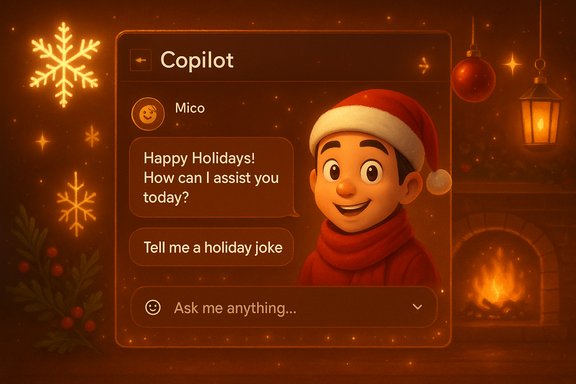
Microsoft Copilot’s seasonal twist arrived this week with the introduction of “Eggnog Mode,” a limited-time persona overlay that dresses the Copilot experience in holiday visuals, themed responses and micro‑interactions — part playful ornament, part product test that signals how major AI platforms are using personality and temporal theming to drive engagement. The feature, announced via Microsoft Copilot’s social channels and mirrored in Microsoft’s official pages, flips Mico — the animated Copilot avatar introduced in October’s Fall Release — into a festive guise and toggles Copilot’s tone, micro‑activities and UI flourishes for the holiday period.
The biggest open question is whether themed personas actually deliver durable utility beyond the novelty window. Engagement spikes driven by holidays are useful for acquisition, but long‑term retention depends on meaningful productivity gains, trust, and control. Microsoft is in a strong position to learn: its large installed base, feature telemetry and enterprise contracts enable rapid iteration. The counterbalance for enterprise and privacy teams is to ensure those learnings do not come at the cost of data governance, inclusion or regulatory compliance.
Viewed from an enterprise lens, Eggnog Mode is a reminder that even seemingly trivial interface changes require governance thinking. From a product lens, it’s a practical lab for learning how persona and tone influence behavior. And for the broader AI ecosystem, it’s a marker of where conversational assistants are headed: toward interfaces that are not only useful but also emotionally fluent — provided that fluency is matched by transparency, inclusion and robust controls.
Source: Blockchain News Microsoft Copilot Launches Eggnog Mode: New AI Feature Enhances Productivity in 2025 | AI News Detail
 Background
Where Eggnog Mode fits in Copilot’s roadmap
Copilot has evolved from a productivity assistant into a family of first‑party copilots and platform features across Windows, Edge and Microsoft 365. The October “Copilot Fall Release” introduced Mico — an expressive, non‑photoreal animated avatar for voice interactions — alongside shared group sessions, long‑term memory, connectors and agentic browser actions. That foundation is exactly the context Eggnog Mode overlays: a cosmetic, persona‑level toggle that adjusts tone, micro‑animations and themed suggestions without altering data access policies or core capabilities. Microsoft’s public metrics underline why small, experiential changes can matter. Executives reported roughly 900 million monthly active users of AI features across Microsoft products and over 150 million monthly users of first‑party Copilots, figures the company reiterated in recent earnings calls and filings — numbers that turn even minor engagement gains into large absolute user impacts. Eggnog Mode therefore reads as a low‑risk, high‑reach experiment in seasonal personalization.What Eggnog Mode is — and what it isn’t
The feature profile
Eggnog Mode is a time‑bounded UX/persona overlay designed to add seasonal cheer to Copilot voice and conversational flows. Observed behaviors include:- Festive visual cosmetics: Mico gains holiday accessories, cozy backgrounds and subtle animations (hat, scarf, fireplace motifs).
- Themed phrasing: replies and prompts assume a warmer, celebratory voice with holiday metaphors and short seasonal suggestions.
- Micro‑activities: lightweight suggestions such as sharing trivia, humming a carol, proposing a festive recipe or prompting a mindful pause to enjoy a treat.
- Easy activation: the toggle appears as a seasonal icon (snowman / ornament) inside the Copilot app, making discovery straightforward for casual users.
Announcement and availability
The announcement surfaced on Copilot’s official social channels in mid‑December and was mirrored in Microsoft’s corporate pages and third‑party coverage; the rollout appears targeted at major English‑language markets (U.S., U.K., Canada) for the holiday window. Early social clips and posts show short demo videos and hands‑on reactions from users.Why Microsoft built a holiday persona: product and business logic
Engagement through seasonal relevance
Seasonal themes are a time‑tested user‑engagement lever in consumer apps: they create shareable moments, reduce friction for newcomers and can convert curiosity into retained usage. For a product like Copilot — already positioned at the intersection of productivity and consumer convenience — a light, short‑lived persona offers three concrete advantages:- Low friction acquisition: playful features lower the barrier for non‑professional users to try voice and persona features.
- Brand amplification: social shorts, screenshots and influencer posts spread awareness with minimal marketing spend.
- Product experimentation: a temporary persona is a safe A/B test environment for measuring whether tone and character materially affect session length, share rates and subsequent retention.
Commercial angles
The business case is subtle but actionable. Seasonal flourishes can accelerate downloads for freemium and subscription funnels, provide hooks for promotional creative, and serve as a gateway to premium experiences (e.g., richer voices, themed asset packs, or enterprise white‑labeling of persona overlays). Given Microsoft’s scale — with hundreds of millions of AI feature users — even fractional improvements in engagement can move significant revenue and retention levers. Microsoft’s recent subscription packaging moves also make consumer discovery more valuable for long‑term monetization.Technical anatomy and engineering tradeoffs
Built on persona overlays, not new models
Eggnog Mode is implemented as a persona overlay: presentation layer changes (avatar visuals, canned seasonal phrases), mild prompt‑conditioning for tone, and UI assets. The core text and reasoning stack appears unchanged; Copilot continues to route tasks through the platform’s model routing and grounded retrieval systems. That approach minimizes compute overhead while enabling quick activation on client devices and web surfaces.Model routing and runtime considerations
Copilot’s modern architecture uses model routing — selecting specialized models (voice, vision, text) for tasks — and Microsoft’s in‑house MAI models for audio and vision workloads (MAI‑Voice‑1, MAI‑Vision‑1) have been discussed as being deployed across Copilot surfaces. Persona overlays can be realized with lightweight prompt templates and client rendering logic while keeping heavy reasoning on the cloud side; this reduces incremental inference costs but still requires careful telemetry to ensure latency and cost targets hold under holiday traffic spikes.Edge vs. cloud tradeoffs
To avoid noticeable latency in voice and animation, teams typically offload avatar rendering and micro‑interactions to the client while retaining core language and retrieval queries on the cloud. For enterprises or devices with limited connectivity, a cached persona layer or degraded fallback (text‑only festive phrasing) is a sensible engineering choice to preserve UX without large model downloads. These patterns are standard in recent Copilot updates and platform documentation.Risks, regulatory guardrails and ethical considerations
Privacy, data collection and governance
Even when cosmetic, seasonal overlays intersect with privacy and governance because they influence user behavior. The fundamental questions:- Does themed interaction encourage sharing of personal or sensitive information under a false sense of intimacy?
- Are metadata signals (engagement, micro‑activity acceptance) stored and used to tune personalization models?
- Do enterprise tenants require admin controls to disable seasonal persona layers for regulated environments?
Regulatory disclosure and transparency
Under the EU AI Act’s transparency obligations, users must be informed when they interact with AI and when outputs are AI‑generated; similar disclosure norms apply to synthetic media. Seasonal persona overlays that produce stylized content should therefore be explicit about their artificial nature — both to comply with legal expectations in EU markets and to maintain trust. Designers should include clear UI disclosures and settings that explain when a persona is active and how it modifies responses.Bias, cultural sensitivity and inclusion
Holiday personas risk cultural narrowness. Not every user celebrates the same holidays, and defaulting to a Christmas/eggnog theme can feel exclusionary. Responsible design should:- Offer localized or neutral seasonal options (winter motifs, New Year themes, multiple cultural packages).
- Make persona activation opt‑in and tenant‑manageable for workplace deployments.
- Test prompts and assets for stereotyping and unintended insensitivity.
What Eggnog Mode means for IT teams and businesses
Practical guidance for IT administrators
- Treat Eggnog Mode as a UX toggle that still warrants governance: ensure tenant policies control persona exposure in enterprise tenants.
- Review telemetry contracts: confirm what event data Copilot will record when the persona is active and whether that telemetry is used to train models or tune personalization.
- Pilot in non‑sensitive groups: use a staged rollout to measure engagement lift and any change in prompt patterns before wider deployment.
Ways marketers and product teams can leverage seasonal modes
- Short, themed campaigns that introduce non‑technical users to voice features.
- Branded persona skins for campaigns or partner co‑marketing (careful: watch for policy and trademark constraints).
- A/B tests to measure whether themed prompts increase downstream conversion to premium features.
Prompt engineering and human workflows
Teams that integrate Copilot into content workflows should train users on “persona aware” prompting — how to instruct Copilot to return to neutral tone or to prioritize factual rigor over voice when creating customer‑facing artifacts (e.g., legal disclaimers, regulatory texts). This prevents accidental inclusion of playful language in formal deliverables.Market context and competitive landscape
Persona experiments are industry‑wide
The idea of themed or persona modes is not unique to Microsoft. Platform providers have tested themed experiences (custom GPTs, persona packs, holiday “skins”) to increase novelty and retention. The strategic logic is consistent: personality can be a distribution vector in crowded AI markets while offering low incremental cost.Adoption backdrop
Analyst forecasts project broad enterprise uptake for generative AI; Gartner predicted that a large majority of enterprises would deploy or use generative AI by mid‑decade, framing Copilot’s experiments as part of a broader shift toward AI as a routine workplace tool. Microsoft’s own user metrics (hundreds of millions of AI‑feature users and 150M+ Copilot users monthly) give the company scale to make even small UX changes noticeable at population level. Those macro trends make seasonal personalization a plausible engagement lever for both consumer and enterprise channels.Strengths — what Eggnog Mode gets right
- Low friction with measurable signal: Persona overlays are cheap to ship and easy to A/B test; they can produce measurable engagement signals without heavy model retraining.
- Brand differentiation: A visible avatar like Mico, combined with time‑limited themes, creates shareable moments that help Microsoft compete for consumer mindshare.
- Safety‑forward implementation: By limiting Eggnog Mode to presentation and tone, Microsoft reduces regulatory and data‑risk surface compared with changes that expand data access or model behavior.
Weaknesses and risks to monitor
- Emotional over‑attachment & persuasion: Persona charm can increase user trust and emotional engagement, which may cause users to disclose more personal data or accept suggestions uncritically. Product teams must balance delight with guardrails.
- Cultural narrowness: If the default persona centers on a single holiday, it risks alienating non‑celebrating users; localization and opt‑out are necessary.
- Regulatory friction: Transparency obligations under the EU AI Act and similar rules require explicit disclosures when AI is shaping content or personas. Implementations that obscure AI involvement could invite scrutiny.
Implementation checklist for product and security teams
- Build clear persona toggles and admin controls (enable/disable, regional targeting).
- Publish an in‑app disclosure explaining what the persona does and how it affects outputs.
- Treat persona telemetry as part of the privacy assessment: list logged events, retention windows and whether data is used to tune models.
- Localize persona options and provide culturally neutral alternatives (e.g., “winter mode”) to be inclusive.
- Design fallback behavior for low‑connectivity or high‑latency environments (text‑only or neutral response).
- Define metrics up front: session length, conversion to feature use, retention, error rates and user reports of inappropriate output.
Future outlook: what Eggnog Mode signals for AI UX
Eggnog Mode is evidence of a broader trend: AI assistants will increasingly adopt dynamic theming and persona layers as a lever for discoverability and emotional resonance. Expect the following developments in coming releases:- More contextual theming: persona behavior that adapts not only to seasons but to local events and personal milestones.
- Enterprise persona governance: IT controls that let organizations white‑label or suppress personas for compliance reasons.
- Persona ecosystems: third‑party persona packs or partner integrations that let brands ship temporary skins for campaigns.
Critical appraisal
Eggnog Mode is cleverly engineered: it captures holiday joy while minimizing technical and regulatory risk by remaining a presentation‑layer overlay. That makes it a plausible win for broad consumer reach and a modest marketing success. However, the feature’s broader significance lies less in the eggnog pun and more in what it reveals about how major platforms are experimenting with personality, temporality and emotional design to increase habitual use of AI assistants.The biggest open question is whether themed personas actually deliver durable utility beyond the novelty window. Engagement spikes driven by holidays are useful for acquisition, but long‑term retention depends on meaningful productivity gains, trust, and control. Microsoft is in a strong position to learn: its large installed base, feature telemetry and enterprise contracts enable rapid iteration. The counterbalance for enterprise and privacy teams is to ensure those learnings do not come at the cost of data governance, inclusion or regulatory compliance.
FAQ (short)
- What is Eggnog Mode?
Eggnog Mode is a seasonal persona overlay for Microsoft Copilot that adds holiday visuals, warmer phrasing and micro‑activities centered around festive themes; it was announced on Microsoft Copilot’s channels in mid‑December and is available in major English‑language markets as a limited‑time feature. - Does Eggnog Mode change Copilot’s data or privacy behavior?
No. The rollout is described as a cosmetic/persona overlay and does not change baseline data access policies; nevertheless, administrators should verify telemetry and memory‑use settings for tenant‑managed Copilot deployments. - Should organizations disable Eggnog Mode for employees?
Consider a measured approach: pilot the feature with non‑sensitive user groups, review telemetry and content behavior, and use tenant settings to disable seasonal personas for regulated teams.
Conclusion
Eggnog Mode is small, but purposeful: a seasonal experiment that blends personality with product engineering. It capitalizes on an existing investment — the Mico avatar and Copilot’s fall feature set — to test whether moments of delight can convert casual interest into habitual use. The move is commercially sensible for a company that reports hundreds of millions of AI‑feature users, and it’s an instructive case study in modern AI productization: ship lightweight, measurable experiences that respect privacy boundaries and let data and governance guide broader adoption.Viewed from an enterprise lens, Eggnog Mode is a reminder that even seemingly trivial interface changes require governance thinking. From a product lens, it’s a practical lab for learning how persona and tone influence behavior. And for the broader AI ecosystem, it’s a marker of where conversational assistants are headed: toward interfaces that are not only useful but also emotionally fluent — provided that fluency is matched by transparency, inclusion and robust controls.
Source: Blockchain News Microsoft Copilot Launches Eggnog Mode: New AI Feature Enhances Productivity in 2025 | AI News Detail
