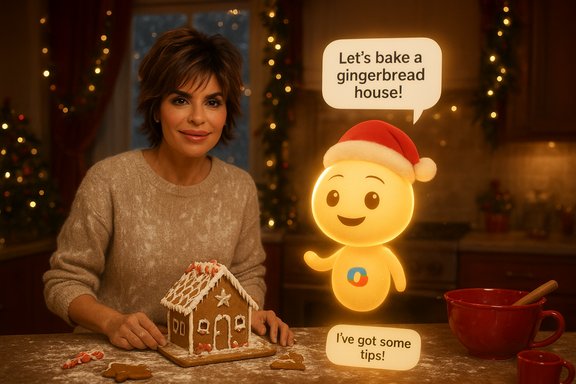
Microsoft’s Copilot briefly traded its productivity blazer for a holiday sweater this season: a time‑limited “Eggnog Mode” that dresses the expressive Mico avatar in seasonal visuals, softens Copilot’s tone, and pushes a 12‑day micro‑engagement cadence designed for light, family‑friendly interactions and social sharing. The activation — rolled out across Copilot surfaces and social channels in mid‑December as a serialized “12 Days of Eggnog” campaign — is small in scale but instructive in purpose: it is a deliberate, telemetry‑driven experiment in persona design, safety defaults, and low‑risk behavioral testing that reveals how platform owners are using episodic, persona‑based features to broaden appeal without changing core data or model policies.
That said, the long‑term question is whether platforms can convert episodic delight into sustained trust. Seasonal cheer is useful for short‑term engagement, but the deciding factor for broad adoption of persona‑led assistants will be consistent transparency, auditable safety controls, clear parental and privacy settings, and measurable governance — not just clever creative prompts. For product teams, the playbook is clear: instrument everything, design conservative defaults for family audiences, and treat trust as a product metric rather than an afterthought.
Conclusion
Microsoft’s “12 Days of Eggnog” Mico activation is a concise case study in modern AI product marketing: it’s playful, data‑informed, and deliberately scoped to reduce risk while surfacing useful product telemetry. For marketers and product builders, the experiment offers a repeatable pattern — persona layer, family defaults, staged rollout, RAG grounding and human‑in‑the‑loop moderation — that balances delight with duty. The technical and regulatory complexity behind even a small seasonal mode is nontrivial, however; the teams that win will be those that measure outcomes rigorously, bind persona design tightly to governance, and convert short seasonal lifts into durable product value without sacrificing user trust.
Source: Blockchain News Microsoft Copilot Integrates AI for Enhanced Holiday Engagement: Day 8 of 12 Days of Eggnog Mico Campaign | AI News Detail
 Background
Where Copilot came from and why a seasonal mode matters
Copilot became a cross‑surface Microsoft product in 2023 as the company consolidated conversational AI across Bing, Edge, Windows and Microsoft 365 — a strategic move documented in Microsoft’s product announcements during that year. The vendor positioned Copilot as a contextual assistant that blends web knowledge, app context and user data (with controls) to assist with writing, summarization and task automation across familiar productivity apps. Microsoft’s official posts from the rollout and subsequent general availability describe the product’s intent to be both productivity enhancer and accessible companion across work and life. That platform reach matters for seasonal activations. Copilot’s footprint across Windows, Microsoft 365 and Bing — combined with a visible investment in voice, avatar and multimodal UI from recent releases — means even cosmetic persona overlays can reach hundreds of millions of devices and produce measurable changes to daily active use and social conversation. Independent community reporting and internal analysis show Eggnog Mode was intentionally scoped as a cosmetic, togglable persona rather than a model or data‑access change, precisely to limit regulatory and privacy exposure while enabling rapid product learning.What the “12 Days of Eggnog (Mico)” campaign actually is
Campaign mechanics and user experience
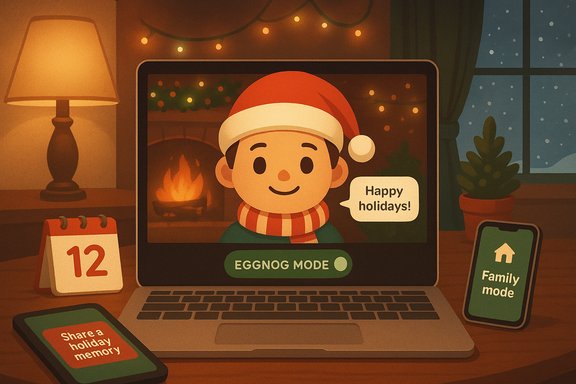
Eggnog Mode places a seasonal persona layer on top of Copilot’s existing voice and chat flows. The observable features and UX choices reported by early hands‑on coverage and community threads include:- A togglable “Eggnog Mode” icon in the Copilot UI that applies festive phrasing and visuals.
- Cosmetic skins for the animated Mico avatar (hat, scarf, fireplace/backdrop) and subtle micro‑animations synchronized with text or TTS playback.
- A 12‑day cadence of short, shareable “micro‑experiences” — one‑line toasts, holiday trivia, recipe tweaks, quick kid‑friendly crafts, and holiday movie‑marathon prompts.
- Kid‑friendly defaults and a “family” toggle to reduce risk of adult content and retain simplified language.
Product goals: experiment over new capability
The campaign pursues three practical goals:- Drive short, repeatable sessions and social sharing during a high‑attention seasonal window.
- Test persona conditioning, moderation pipelines, and family defaults at scale.
- Collect behavioral signals to inform future persona design without committing to permanent product changes.
Technical foundations: how Eggnog Mode is built and governed
Persona tuning, not model surgery
The practical engineering pattern for Eggnog Mode is widely used: rather than retraining a foundation model, teams layer persona‑conditioning, curated prompt templates and UI assets on top of existing inference pipelines. This keeps compute costs and governance complexity manageable while producing a reliable “holiday voice.” Safety overlays — classification filters, family mode toggles and curated response templates — gate outputs for age‑appropriate behavior. Independent write‑ups and community logs emphasize the persona overlay as presentation layer change rather than a change to data handling.Retrieval‑augmented generation and grounding
When Copilot needs to give fact‑based suggestions (recipe facts, movie availability, brief local event pointers), the system uses retrieval‑augmented generation (RAG) patterns to ground replies and reduce hallucinations. Microsoft Research and the wider academic community have published numerous papers and surveys showing modern RAG variants and multi‑step retrieval strategies that help LLMs reference up‑to‑date and accurate external indices — a core technique for keeping conversational assistants trustworthy when they must speak about facts.Hybrid delivery: cloud scale, on‑device fallbacks
The rollout relies on Microsoft’s cloud infrastructure for scale with optional on‑device inference fallbacks (where available on Copilot+ certified machines) to reduce latency and improve privacy for sensitive interactions. This hybrid architecture helps manage holiday traffic spikes and supports scenarios where local inference is preferable. Staged rollouts, telemetry and human‑in‑the‑loop remediation are typical safety practices visible in the deployment pattern for this activation.Business implications and the monetization question
Who benefits and how
Seasonal persona experiments serve both product and marketing goals. Low‑cost activations can:- Boost short‑term daily active use and retention (acquisition funnel).
- Generate shareable content that drives earned media and free social distribution.
- Provide a controlled R&D environment for exploring persona monetization (branded prompts or paid persona packs).
- Supply marketing teams with easy creative material (quick holiday posts, themed recommendations) while channeling users toward core paid offerings or subscriptions.
Clarifying user/monetization numbers
Headline user and revenue numbers are worth specifying carefully. Microsoft executives have reported large adoption of Copilot features across products; however, not all “Copilot” metrics refer to the same product.- The “over 1 million paid Copilot users” figure cited on Microsoft earnings calls in 2023 refers to GitHub Copilot — the developer tool — and was announced by Satya Nadella during an earnings briefing. That subscriber count applies to the GitHub Copilot product line and GitHub Copilot for Business, not to Microsoft 365 Copilot consumer subscriptions.
- Microsoft’s Intelligent Cloud business has been a significant growth engine. Public filings and investor materials show the Intelligent Cloud segment grew strongly in 2023/2024 (reported year‑over‑year increases in the high‑teens to low‑20s percent range), illustrating the scale of cloud economics that underpins Copilot delivery. Use the vendor’s financials as the source of truth when tying product moves to revenue impact.
Market context: demand, competitors and forecasts
Why marketers are investing in AI
Analyst and market forecasts show rapid growth for AI in marketing and customer engagement. Multiple market trackers estimate the AI marketing ecosystem will expand substantially over the next several years; commonly cited headline projections put the AI‑in‑marketing market near the low‑hundreds of billions across various definitions and forecast windows. Statista and market research compilations report a projection in the general range of roughly $100–110 billion for the AI‑in‑marketing market by the late 2020s, depending on segment definitions and methodology. These projections underwrite the rationale marketers use when experimenting with generative assistants for holiday campaigns and automated creative workflows.Competitive landscape
Google’s Gemini/Bard work, Anthropic’s Claude and specialist offerings (from enterprise vendors to vertical players) continue to push innovation in persona design, multimodal output and safer, controllable LLMs. Microsoft’s strategic advantage is its deep ecosystem reach — Windows, Office, Teams and Azure — which makes persona experiments easier to distribute and measure across productivity funnels. But distribution is not a substitute for trust: the long‑term prize goes to platforms that combine reach with verifiable safety, transparent controls and robust compliance frameworks.Risks, governance and ethical considerations
Three practical risks
- Privacy and data governance: Any persona overlay that changes tone or prompts users must be clearly bounded from data‑sharing or memory changes. Changing presentation without altering data access is safer, but marketing activations may tempt engineers to add convenience features that expand data exposure. Keep the layers separate.
- Hallucination and factual errors: Even playful prompts can produce misleading “facts” (wrong recipe measurements, invented movie details). RAG grounding is essential for factual items, and outputs that could affect purchasing or safety must be more strictly checked.
- Child safety and content moderation: Family‑facing features require conservative defaults, robust classification models, and easily accessible parental controls. The activation’s emphasis on kid‑friendly defaults and staging are best practice.
Regulatory terrain
The EU AI Act and other emerging regulatory frameworks change the compliance calculus for persona overlays. The Act’s classification schemes, obligations for high‑risk systems and the separate regime for general‑purpose AI mean that even cosmetic features should be evaluated for placement within those rules — especially when the tool is embedded into services used by minors or in regulated sectors. Transparency obligations (including indicating AI‑generated content) and traceability requirements will become enforceable in coming implementation windows. Vendors should map persona overlays to regulatory obligations early in design.Operational best practice checklist
- Keep persona overlays as presentation-layer changes unless business needs demand deeper integration.
- Use RAG with provenance and clear fallback policies whenever providing factual suggestions.
- Stage rollouts, instrument with telemetry, and route flagged outputs to human review.
- Offer explicit parental/family toggles and conservative defaults for any family‑facing UX.
- Mark AI‑generated content explicitly where regulations or platform policy require it.
Measurement and what to watch after the season
The real test for Copilot’s Eggnog Mode will be whether the 12‑day push delivers durable product insights that move long‑term metrics, not just seasonal headlines. Useful evaluation metrics include:- Daily active users and session length lift during the campaign window.
- Social share rate and earned media volume (content virality).
- Behavior signals that indicate safe persona acceptance (low moderation flags, family toggle usage).
- Conversion or retention effects (does the activation increase subsequent usage of Copilot’s core productivity features?.
Technical outlook: what’s next for persona experiences
Looking ahead, the same engineering patterns that produced Eggnog Mode will scale into more ambitious, multimodal episodic features:- Richer audio/visual outputs (song snippets, short animated scenes) as models support better TTS, music and short‑form video.
- Agentic micro‑workflows that perform permissioned multi‑step actions (book a table, buy a movie ticket) if governance and UX consent flows are clearly defined.
- On‑device model variants for privacy‑sensitive persona modes that can run locally on Copilot+ certified hardware.
What to believe — and what to treat with caution
Several high‑level claims about productivity and market size are widely reported, but they vary by source and methodology.- Verified: Microsoft publicly documented Copilot’s consolidation across products in 2023 and subsequent product updates; GitHub Copilot reached over 1M paid users as announced by company leadership in 2023. Use company financial filings and the earnings call transcript for exact phrasing and product scope.
- Corroborated market estimates: Market research firms and aggregators place AI‑in‑marketing forecasts in the tens of billions to low‑hundreds‑of‑billions by the late 2020s depending on definitions. Different vendors’ methodologies can produce materially different headline numbers; treat them as directional, not precise.
- Not fully verifiable: Attributions such as “Forrester reported up to 40% productivity gains” require precise citation to the named study — at the time of reporting, no single Forrester public study with that exact headline phrasing was located. Independent research from McKinsey, Penn Wharton and others documents substantial but variable productivity gains from generative AI across tasks and industries; the measured uplift depends heavily on task, role and deployment rigor. Because productivity claims have large variance, attribute specific percentages to the originating study and verify the study’s scope before using the number in business planning.
Final assessment: useful stunt, valuable signals — but trust remains the currency
Eggnog Mode is a textbook example of how modern AI product teams can run lightweight, high‑reach experiments: cosmetic persona overlays are low‑cost, produce shareable content, and generate telemetry that product, safety and policy teams can learn from. Microsoft’s Mico avatar and the 12‑day campaign show the mechanics of persona testing — UX skins, micro‑activities and family defaults — executed with conservative boundaries to limit privacy and regulatory exposure.That said, the long‑term question is whether platforms can convert episodic delight into sustained trust. Seasonal cheer is useful for short‑term engagement, but the deciding factor for broad adoption of persona‑led assistants will be consistent transparency, auditable safety controls, clear parental and privacy settings, and measurable governance — not just clever creative prompts. For product teams, the playbook is clear: instrument everything, design conservative defaults for family audiences, and treat trust as a product metric rather than an afterthought.
Conclusion
Microsoft’s “12 Days of Eggnog” Mico activation is a concise case study in modern AI product marketing: it’s playful, data‑informed, and deliberately scoped to reduce risk while surfacing useful product telemetry. For marketers and product builders, the experiment offers a repeatable pattern — persona layer, family defaults, staged rollout, RAG grounding and human‑in‑the‑loop moderation — that balances delight with duty. The technical and regulatory complexity behind even a small seasonal mode is nontrivial, however; the teams that win will be those that measure outcomes rigorously, bind persona design tightly to governance, and convert short seasonal lifts into durable product value without sacrificing user trust.
Source: Blockchain News Microsoft Copilot Integrates AI for Enhanced Holiday Engagement: Day 8 of 12 Days of Eggnog Mico Campaign | AI News Detail