

Embee Software’s latest strategic pivot—doubling down on AI-led productivity, cloud optimisation and managed cybersecurity—signals an aggressive move to convert decades of channel experience into a scalable services business focused on Microsoft platforms and recurring revenue. In an exclusive interview with TechCircle, CEO Sudhir Kothari laid out a practical, execution-oriented roadmap: scale Microsoft Copilot rollouts, expand a 24×7 Cyber Defence Centre built on Microsoft Sentinel/Defender/Purview, and push fixed-price cloud bundles into India’s Tier‑2 and Tier‑3 markets to capture SMB demand. These plans are rooted in recent partner credentials and product wins: Embee’s public announcements confirm a Microsoft Copilot Advanced Specialization and recognition in Microsoft’s AI programs, while company-built IP such as ArogyaSaathi and EmSupport emerged from its Agentic AI hackathon wins earlier in 2025.
Embee began in the 1980s as a hardware and software reseller and has spent the last decade repositioning itself as a Microsoft-first systems integrator and managed services provider. The company now markets an “infrastructure‑to‑intelligence” stack spanning Microsoft Azure, Microsoft 365, SAP modernisation, cloud managed services/FinOps and enterprise security. Embee publicly frames this transition as more than branding: it is moving from project‑based revenue to recurring managed services and platform‑led outcomes. Two publicly disclosed touchpoints underpin this shift:
Verified or independently confirmable:
Source: Techcircle Embee Software taps AI, cloud optimisation and cybersecurity bets
 Background / Overview
Embee began in the 1980s as a hardware and software reseller and has spent the last decade repositioning itself as a Microsoft-first systems integrator and managed services provider. The company now markets an “infrastructure‑to‑intelligence” stack spanning Microsoft Azure, Microsoft 365, SAP modernisation, cloud managed services/FinOps and enterprise security. Embee publicly frames this transition as more than branding: it is moving from project‑based revenue to recurring managed services and platform‑led outcomes. Two publicly disclosed touchpoints underpin this shift:- A set of Microsoft partner recognitions—Copilot Advanced Specialization, inclusion in Microsoft’s AI First Movers program, and Microsoft Fabric Featured Partner—position Embee to sell generative AI productivity workstreams.
- Corporate IP and hackathon wins (ArogyaSaathi, EmSupport) show the firm is building solutions on Azure OpenAI and Copilot Studio, not merely reselling vendor products.
What Embee Is Betting On: AI, Cloud Optimisation, and Security
AI as the next growth engine
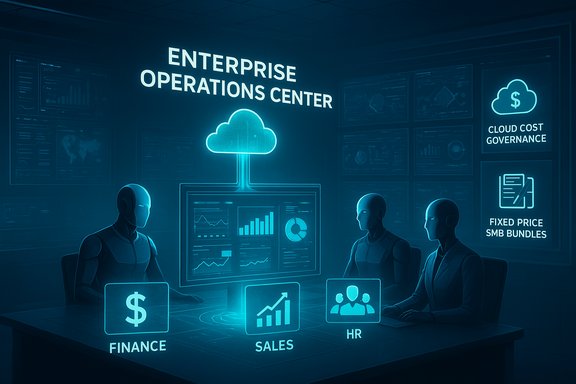
Embee’s strategic bet is simple: make Copilot and generative AI a repeatable, governed service that customers can buy and scale. The company claims early advantage because it has secured a Copilot Advanced Specialization and other Microsoft partner recognitions, which require demonstrable deployments, governance controls and customer references. Embee says it intends to roll Copilot and agentic workflows across sales, finance, HR and customer service to drive measurable productivity improvements. What this means operationally:- Embee will offer Copilot advisory, Copilot Studio agent development and managed adoption programs (skilling, telemetry, MAU targets).
- The company is packaging industry‑specific accelerators (for BFSI, manufacturing, logistics and education) to move pilots into production faster.
- Embee is building own IP (ArogyaSaathi for healthcare triage; EmSupport for IT helpdesk) to showcase reusable assets and reduce time‑to‑value for customers.
Cloud optimisation and FinOps
A second pillar is cloud cost governance and performance optimisation. Embee argues many enterprises migrated rapidly during the pandemic and are now asking whether their cloud spend delivers tangible ROI. To capture that opportunity Embee expanded Cloud Managed Services and FinOps offerings, and cites specific wins—an Azure Virtual Desktop migration for a major private bank—as proof points for reduced downtime and tighter compliance. These sorts of infrastructure‑to‑productivity stories are the exact use cases CIOs now prioritize. Key capabilities emphasized:- Cloud cost audits and FinOps implementation to reduce waste and identify rightsizing opportunities.
- Azure Virtual Desktop and secure remote access projects for regulated institutions.
- Recurring managed services contracts that convert one‑time projects into predictable revenue streams.
Cybersecurity as a product, not an afterthought
Embee is doubling down on security by expanding a 24×7 Cyber Defence Centre that layers Microsoft Sentinel for SIEM, Microsoft Defender XDR for endpoint/identity protections and Microsoft Purview for data governance/compliance. The company is pitching this combination as a turnkey managed detection and response (MDR) plus compliance service targeted especially at BFSI clients subject to RBI and SEBI rules. Embee positions security as essential to digital transformation, not optional. What this stack delivers in practical terms:- Continuous monitoring, threat hunting and incident response capabilities outsourced to Embee’s SOC.
- Policy and compliance frameworks mapped to RBI/SEBI expectations for Indian banks and financial firms.
- Integration of telemetry from cloud workloads and SaaS applications to give a single pane of visibility.
Verifiable Facts and Where to Be Cautious
The most load‑bearing claims in Embee’s narrative can be corroborated by public records and partner program pages—but some financial and market assertions should be treated cautiously.Verified or independently confirmable:
- Embee’s Microsoft partner credentials and program recognition (Copilot Advanced Specialization, AI First Movers inclusion, Microsoft Fabric Featured Partner) are documented on Microsoft and Embee pages. These are authoritative signals of technical skilling and partner alignment.
- Embee’s win at Microsoft’s Agentic AI Hackathon (Azure OpenAI category) and the resulting IP (ArogyaSaathi; EmSupport) are described on Embee’s own news pages and are demonstrable examples of solution development on Azure.
- The technical stack Embee advertises for its Cyber Defence Centre—Sentinel, Defender XDR, Purview—is consistent with Microsoft’s recommended reference architecture for integrated security operations and data governance, and this makes the claim technically plausible.
- The TechCircle interview states Embee now derives “nearly two‑thirds of its revenue from cloud and security services.” That is a CEO statement to a journalist and is meaningful as a directional indicator, but independent audited financial data with line‑item breakdowns is not publicly available to corroborate the exact percentage. Treat the figure as a company assertion rather than a verified accounting fact.
- Embee’s corporate materials and some trade stories reference turnover figures (examples: $250 million revenue cited in marketing pages or partner narratives). These numbers appear across company profiles and trade press but are not accompanied by audited disclosures in public filings; therefore they should be considered company claims until independently audited accounts are produced.
Market Context: Why Embee’s Timing Makes Sense
The macro tailwinds in India favour Embee’s strategy:- Hyperscale cloud and AI investments continue to grow across India; Microsoft, other hyperscalers and domestic cloud players are expanding infrastructure, partner programs and skilling initiatives. This creates demand for integrators who can convert platform capabilities into enterprise outcomes.
- Enterprises—especially regulated BFSI firms and large manufacturers—are seeking measurable returns from cloud projects, driving demand for FinOps, cloud managed services and cloud‑native security operations. Embee’s packaging of FinOps and managed security aligns with that buyer pain point.
- SMB adoption in Tier‑2 and Tier‑3 cities is accelerating, particularly when vendors present plug‑and‑play, fixed‑price bundles that lower procurement friction. Embee’s Copilot SME program and fixed‑price cloud bundles are tailored for this segment.
Strengths: What Embee Brings to the Table
- Deep Microsoft alignment and certifications. Advanced specializations and Microsoft program participation give Embee technical credibility for Copilot, Fabric and Azure delivery—this materially reduces buyer risk when selecting a partner for generative AI projects.
- Productised IP and demonstrable prototypes. ArogyaSaathi and EmSupport are tangible outputs of Embee’s Azure OpenAI work and act as accelerators for industry use cases. Owning IP shortens delivery cycles and increases margins versus pure SI labor models.
- Security-first managed services approach. A 24×7 SOC built on Sentinel/Defender/Purview matches how enterprise buyers now evaluate partners—security integrated into cloud operations, not bolted on later. This aligns with regulatory pressures in BFSI and helps convert security projects into recurring ARR.
- Channel and geographic reach. Embee’s stated intent to expand across Tier‑2/3 cities and SMBs—when combined with fixed‑price bundles—addresses a large market segment that often lacks enterprise‑grade integration capability. This could be an advantage if execution and local go‑to‑market are effective.
Risks and Execution Challenges
- Proof of large‑scale Copilot ROI at enterprise scale. Copilot pilots are widespread; converting them to enterprise adoption requires governance, compliance, integration with line‑of‑business systems and measurable KPIs (MAUs, time‑saved, revenue uplift). Earning and demonstrating those metrics consistently across verticals is non‑trivial. Embee will need robust adoption playbooks and independent case studies to scale.
- Talent and specialist shortage. Operating a 24×7 Cyber Defence Centre, building agentic AI, and running FinOps at scale requires security analysts, AI engineers and cloud architects. The Indian market for these skills is competitive and the company must invest in hiring and retention to avoid delivery bottlenecks.
- Vendor lock‑in and multi‑cloud realities. Heavy reliance on Microsoft (Copilot, Azure, Sentinel) is a double‑edged sword: it simplifies product integration but can make customers wary of single‑vendor dependency. Embee’s ability to articulate multi‑cloud or hybrid options will matter for large customers.
- Regulatory and data‑sovereignty complications. For regulated customers in BFSI and government, model hosting choices, data residency and auditability of generative models pose governance challenges. Embee must ensure its Copilot/agentic deployments satisfy audit and traceability requirements.
- Claims vs. audited metrics. Company statements about revenue mix and growth targets can be optimistic. Journalists and buyers should demand audited evidence for large financial claims. Several of Embee’s cited business metrics exist in company materials and trade press but lack independent audited confirmation.
What This Means for Enterprise IT Buyers
Enterprises evaluating Embee (or similar Microsoft‑centric partners) should ask for:- Case studies with measurable KPIs. Request MAU growth, time‑saved metrics, FTE reductions and cost savings from FinOps engagements.
- Architecture and governance blueprints. How will Copilot agents be hosted, which models are used, how is retrieval-augmented generation (RAG) handled, and what audit trails exist? Insist on data lineage and model‑explainability documentation.
- Security & compliance SLAs. For BFSI customers: demand proof of RBI/SEBI mapping, incident response playbooks, and third‑party SOC attestations where applicable.
- Clear commercial mechanics. Understand recurring fees vs. consumption charges, cost governance for Copilot tokens/model inference, and penalties for underperformance.
Practical Roadmap: How Embee’s Customers Can Adopt AI Safely
- Establish a business outcome and KPIs (productivity, revenue, compliance).
- Run a time‑boxed pilot with Copilot/agent that includes a documented governance plan.
- Implement FinOps baseline and tagging strategy to measure cloud spend impact.
- Integrate Copilot with identity (Azure AD), DLP and Purview classification to limit sensitive data exposure.
- Operationalise monitoring with Sentinel and set clear SOC runbooks for AI‑related incidents.
- Upskill end users and IT staff with targeted training and adoption programs; measure MAUs and time saved.
- Iterate: scale from pilot to production with runbooks and SLOs tied to commercial terms.
Strategic Takeaways and Outlook
Embee’s strategy is coherent: convert Microsoft‑led platform momentum into recurring managed services, proprietary AI IP and a security proposition that appeals to regulated verticals. The company’s partner recognitions (Copilot Advanced Specialization, AI First Movers participation) and hackathon wins are meaningful signals that it can build and deploy agentic AI and Azure OpenAI solutions. If executed well, three outcomes are possible for Embee over the next 24–36 months:- Solidify recurring ARR from managed cloud & security contracts while layering on Copilot‑based productivity services for existing enterprise customers.
- Capture SMB market share in smaller cities through fixed‑price bundles that lower procurement friction and accelerate time to value.
- Emerge as a Microsoft‑centric regional integrator with repeatable IP, improving margins compared with pure project‑based delivery.
Conclusion
Embee Software’s pivot to an “infrastructure‑to‑intelligence” model is a textbook response to enterprise demand: customers want measurable cloud ROI, secure operations and practical AI that improves day‑to‑day work. Embee’s Microsoft partner recognitions and hackathon roots give it a strong starting point; its challenge now is to convert credentials into scaled, audited outcomes across enterprises and SMBs alike. For CIOs, the practical value will be decided not by badges, but by whether Copilot initiatives deliver repeatable productivity gains, whether FinOps reduces waste, and whether 24×7 Cyber Defence truly reduces risk and compliance overhead. Embee’s roadmap is sensible; its success will depend on disciplined execution, transparent metrics, and the hard work of turning pilots into predictable, measurable business value.Source: Techcircle Embee Software taps AI, cloud optimisation and cybersecurity bets
