

Energy Monitor’s July 9, 2026 analysis argues that the clean-energy buildout is creating a delivery problem as much as a security problem: the more digital, decentralised and software-managed power systems become, the harder it is to treat cybersecurity as an afterthought. The paradox is that the tools needed to make the energy transition work — smart inverters, distributed storage, connected chargers, cloud analytics, remote maintenance and automated controls — also multiply the number of doors through which attackers, misconfigurations and fragile suppliers can enter. For utilities, developers and IT teams, this is not a theoretical warning about some future grid; it is a project-risk warning about the infrastructure already being procured, financed and connected.
The old energy-security conversation was about fuel, pipelines, reserves and geopolitics. The new one is about firmware, identity, telemetry, vendor access and whether a grid operator can still see and steer its assets when the software layer misbehaves. That changes the economics of the transition: cyber resilience is no longer a compliance appendix stapled to a finished project, but part of whether the project can be delivered, insured, operated and trusted.
Energy Monitor’s central point is simple and uncomfortable: the energy sector is used to pricing delays from planning disputes, grid connections and supply-chain bottlenecks, but it is less used to treating cybersecurity as a factor in project delivery. That is the right framing because the transition is not merely swapping fossil generation for cleaner generation. It is replacing a comparatively centralised, slower-moving system with a more distributed, data-intensive and control-dependent one.
A fossil-heavy power system had plenty of cyber risk, and nobody should romanticise the old grid as secure. Control rooms, substations, generation plants and corporate IT networks have long been targets. But the transition changes the shape of the problem by pushing operational intelligence outward: into solar farms, wind plants, batteries, substations, demand-response platforms, EV charging networks, building systems and customer-owned equipment.
The International Energy Agency has repeatedly made the broader point that digital technologies help integrate variable renewables and improve grid reliability, while also exposing electricity systems to cyber threats. That is the paradox in its cleanest form. The same data links that allow operators to forecast, balance and optimise a low-carbon grid also create dependency on communications networks, software updates, authentication systems and third-party platforms.
The Department of Energy has made a similar argument in its work on distributed energy resources, warning that distributed solar, storage and other clean technologies introduce cybersecurity considerations that need to be addressed as part of grid integration. That matters because distributed energy resources do not sit neatly inside the old perimeter. They are owned by different parties, maintained by different vendors, connected through different networks and often aggregated by software platforms that become operationally significant without looking like traditional utility infrastructure.
For WindowsForum readers, the important translation is this: the energy transition is turning power infrastructure into a large, heterogeneous fleet-management problem. It looks less like one hardened data center and more like thousands or millions of devices, gateways, controllers, cloud services and support laptops, each with its own lifecycle and owner. That is familiar territory for enterprise IT, but the consequence of failure is no longer just downtime in a business application. It can affect voltage, frequency, restoration, market operations and public confidence.
A wind project, solar plant, battery site or EV charging network is now a stack of dependencies. There is physical equipment, power electronics, site networking, supervisory control, remote access, cloud dashboards, data pipelines, maintenance contracts and sometimes market-participation software. A security flaw in any of those layers can become a delivery risk if it blocks commissioning, complicates interconnection approval, delays insurance, requires redesign or forces an operator to run with compensating controls that reduce automation.
That is why cybersecurity should be budgeted and scheduled the way grid studies, environmental conditions and supply-chain inspections are budgeted and scheduled. If a developer discovers late that a supplier requires persistent remote access without adequate controls, the problem is not merely a red mark on an audit. It is a commercial problem. Someone must redesign access, renegotiate support, add monitoring, segment networks, document exceptions or accept a risk that may later become unacceptable to the asset owner.
The Department of Energy’s baselines for electric distribution systems and distributed energy resources point toward this more operational view. Baselines are not glamorous; they are the plumbing of repeatable security. But that is exactly the point. The energy transition cannot scale if every project treats asset discovery, identity, logging, patching and vendor access as bespoke heroics.
The project-finance implication is blunt. If cyber resilience is discovered late, it becomes a cost overrun. If it is designed early, it becomes an engineering constraint. The former creates delay; the latter creates discipline.
The comparison matters because the sector often talks about resilience as if it were an automatic property of decentralisation. It is not. A distributed system can be more resilient to a single physical failure while being more exposed to coordinated cyber manipulation, weak device management or a compromised aggregator. Resilience depends on architecture, governance and recovery, not just geography.
NREL’s Cyber100 Compass work captures this system-level concern by focusing on how high-renewables grids change the attack surface and cyber risk. That is an important distinction. The risk is not simply that a single inverter, charger or battery controller could be hacked. The risk is that many small assets, coordinated through software, can collectively become operationally meaningful.
This is where energy cyber risk differs from ordinary device security. A compromised endpoint is bad. A compromised fleet of endpoints that can change load, generation or reactive power is a different class of problem. The energy transition gives operators more knobs to turn; it also gives attackers more knobs to seek.
An inverter gateway may speak industrial protocols, connect to a vendor cloud, receive firmware updates, expose a web interface and participate in dispatch logic. A battery energy storage system may have a site controller, safety systems, telemetry, fire controls, remote diagnostics, market integration and an operations portal. An EV charging network may look like customer technology from the outside but behave like grid-relevant load at scale.
That hybrid nature is awkward for organisations. Traditional IT teams may understand identity, endpoint management, logging and vulnerability management, but lack context about safety, uptime and grid operations. Traditional OT teams may understand process constraints, but may not have the tooling or staffing to manage cloud identities, API security, supplier risk and fleet-scale patching. The result is a gap exactly where the transition is moving fastest.
CISA’s recurring industrial-control-system advisories show why the gap matters. Even when advisories are not specific to a clean-energy project, they reinforce a basic reality: operational technology is now part of the internet-era vulnerability economy. Devices and software that once lived in obscure industrial networks are researched, scanned, exploited and folded into attacker playbooks.
The answer is not to dump OT into ordinary corporate IT or to isolate everything so aggressively that modern operations become impossible. The answer is joint ownership. Energy operators need architecture boards, change-control processes and incident exercises that include power engineers, field technicians, network teams, cloud teams, identity teams, legal, procurement and executives. A clean-energy asset is no longer just an engineering asset. It is a cyber-physical product with a decades-long support obligation.
Remote support is the obvious example. Developers want fast commissioning and low maintenance costs. Vendors want visibility into their equipment. Operators want uptime. Those incentives often produce persistent remote access, cloud-connected monitoring and vendor-managed components. Each can be legitimate. Each can also become a security liability if identity, logging, network boundaries and emergency shutoff procedures are weak.
The supplier problem is not limited to malicious compromise. It includes unsupported firmware, unclear vulnerability disclosure, weak default configurations, poor documentation, disappearing vendors, mergers, end-of-life components and contractual ambiguity about who patches what. A project can be technically complete and still operationally brittle if nobody can answer basic lifecycle questions.
This is where procurement has to become a security function. Purchase agreements should specify logging, authentication, patch timelines, vulnerability notification, software bills of materials where available, remote-access controls, data ownership, incident cooperation and end-of-life obligations. These are not bureaucratic niceties. They are the difference between a recoverable incident and a multi-party blame exercise conducted while assets are unavailable.
NERC’s work with industry on cybersecurity for distributed energy resources and aggregators reflects the same broader concern: the ecosystem is changing faster than traditional boundaries. Aggregators, vendors and platform operators can become operationally important even when they are not the utility of record. The grid’s risk surface now includes companies that may never have thought of themselves as critical infrastructure operators.
Modern power systems depend on forecasts, telemetry, state estimation, pricing signals, asset performance data and automated control recommendations. If those inputs are manipulated, delayed or selectively corrupted, operators may make bad decisions while believing the system is healthy. That is a more subtle failure mode than a ransomware screen, and potentially harder to detect.
This matters especially for variable renewables and distributed assets. Operators need accurate data to balance supply and demand, manage congestion, anticipate weather-driven output changes and coordinate flexible load. The more the grid relies on automation to act quickly, the more important it becomes to know whether the data driving that automation is trustworthy.
The security model therefore has to include integrity, provenance and anomaly detection, not just availability and perimeter defense. Can operators tell whether telemetry is plausible? Can they compare independent measurements? Can they detect when many devices behave in a coordinated but abnormal way? Can they fall back to safe operating modes if a cloud service or data feed becomes suspect?
That is where the cyber paradox becomes most concrete. Digitalisation gives the grid better eyes and faster reflexes. It also creates the possibility of hallucinated confidence: a control environment that appears data-rich while quietly losing trust in the data itself.
A delayed grid connection is visible in the project schedule. A weak remote-access architecture is less visible until an insurer asks harder questions, an offtaker demands assurance, a regulator scrutinises operations or an incident exposes the weakness. The lag between design choice and financial consequence is why cyber risk is so often underpriced.
Energy Monitor’s framing is useful because it brings cybersecurity into the same conversation as familiar delivery constraints. Planning approval, grid capacity and equipment availability already shape project economics. Cyber resilience should sit beside them, not behind them. If the asset cannot be securely operated for its intended life, the asset is not fully delivered.
There is also a portfolio effect. A single project with weak security is a project risk. A developer, utility or aggregator with dozens of projects built on the same weak architecture has a systemic risk. Homogeneous fleets are efficient to operate, but they can also fail uniformly. The energy transition’s scale makes standardisation necessary; cybersecurity determines whether that standardisation becomes strength or shared fragility.
This is why project due diligence should ask not only whether an asset passed a security review, but whether the operator has a repeatable security operating model. Who owns the asset inventory? Who approves firewall changes? How are vendor accounts reviewed? How are backups tested? How are firmware updates evaluated against safety and uptime? How are incidents rehearsed? The quality of those answers is part of the asset’s value.
Traditional bulk-power cybersecurity regimes were built around large, high-impact assets. The transition pushes risk into distribution networks, behind-the-meter systems, aggregators, consumer devices and cloud platforms. Some of these assets may not fall neatly inside older regulatory perimeters. Others may be too small individually to trigger strict obligations while being significant in aggregate.
The Government Accountability Office has warned in past work that distribution systems deserve more attention in grid cybersecurity planning. That warning has aged well. Distribution is where many transition technologies connect, and it is where the ownership model is most fragmented. It is also where utilities may have less visibility than they would like.
The policy challenge is to avoid two bad outcomes. One is under-regulation, where fast-growing grid-edge systems become operationally important before basic security expectations catch up. The other is compliance drag, where slow, rigid rules make it harder to deploy the technologies needed for decarbonisation. The better path is risk-based baselines, shared testing, procurement standards, incident reporting and clear accountability for aggregators and vendors.
Regulators should also resist the temptation to define success as paperwork. A clean-energy project can have excellent documentation and still be fragile if nobody has tested restoration, vendor lockout, loss of telemetry or compromised credentials. Cyber resilience is not a binder. It is the ability to keep operating, degrade safely and recover.
Many serious operational incidents begin with mundane enterprise weaknesses: stolen credentials, unmanaged endpoints, exposed remote access, weak segmentation, unpatched servers, overprivileged accounts or poorly monitored service accounts. In energy environments, those weaknesses can become pathways toward operational systems, vendor portals or engineering workstations.
For Windows administrators supporting energy, manufacturing or infrastructure environments, the lesson is not to panic about every OT device. It is to recognise that corporate hygiene is now part of operational resilience. Identity hardening, privileged-access management, endpoint detection, patch discipline, backup isolation and log retention are not merely office-IT controls. They may be the first line of defense for physical operations.
The cultural challenge is that IT teams are often judged on speed and standardisation, while OT teams are judged on safety and availability. Clean-energy systems need both. A patch that would be routine in a corporate fleet may require testing against plant controls. A remote-access exception that helps a vendor fix a commissioning problem may create unacceptable long-term exposure. These trade-offs require governance, not improvisation.
The best organisations will build translators: engineers who understand cyber, security staff who understand operations, and administrators who know when a standard IT fix could create a physical-world risk. That skill mix is becoming as important to the energy transition as power electronics and grid modelling.
If every solar plant, battery project, microgrid and charging network requires bespoke expert attention forever, the model will not scale. The answer has to be secure-by-default architecture, repeatable patterns and better tooling. Asset owners should not need to rediscover the same remote-access, logging and segmentation lessons on every project.
This is where baselines and reference architectures matter. They reduce the cognitive load on teams that are already stretched. They also make security visible to procurement and project management. A project manager may not understand every industrial protocol, but they can understand that no asset should go live without an inventory, role-based access, documented vendor connections, monitored logs, tested backups and an incident contact list.
Automation can help, but it is not magic. Automated asset discovery, configuration monitoring and anomaly detection are useful only if teams know what actions follow. Alert fatigue is particularly dangerous in operational environments because false positives can train teams to ignore signals, while false negatives can create a false sense of safety.
The workforce issue should also shape vendor selection. A technically elegant platform that requires rare expertise may be less resilient than a simpler system that local teams can maintain. Security architecture is partly about reducing dependency on heroics.
Can a site operate locally if a cloud service is unavailable? Can operators revoke vendor access quickly without losing necessary support? Can a battery or inverter fleet move into a safe mode if telemetry is suspect? Can dispatch continue manually? Are backups offline and tested? Are spare parts and configuration files available? Are field teams trained for cyber-informed recovery?
This is where cyber resilience becomes operational engineering. The goal is not just to stop attackers. It is to keep the system from turning a digital problem into a physical crisis. That means designing for bounded failure.
Energy companies already understand physical redundancy. They plan for equipment faults, storms, fires and supply disruptions. Cyber resilience should be treated with the same mindset. Assume some controls will fail. Limit blast radius. Preserve visibility. Maintain manual options where necessary. Practice restoration before the incident.
The phrase secure by design is overused, but in this context it has a concrete meaning: security decisions must be made before deployment choices become expensive to change. Network segmentation, identity architecture, vendor access and monitoring are much easier to design into a project than retrofit after commissioning.
2022 — The Department of Energy released work on cybersecurity considerations for distributed energy resources on the U.S. electric grid, placing distributed solar, storage and other clean technologies inside the national grid-security conversation.
July 9, 2026 — Energy Monitor published “The energy transition’s cyber paradox,” arguing that cybersecurity must be treated as a factor in project delivery as power systems become more digital and decentralised.
The real lesson is that intelligence has to be governable. If a power system depends on software, then software assurance becomes energy assurance. If it depends on vendors, vendor governance becomes grid governance. If it depends on distributed assets, asset identity and fleet visibility become operational necessities.
The near-term implications are concrete:
The old energy-security conversation was about fuel, pipelines, reserves and geopolitics. The new one is about firmware, identity, telemetry, vendor access and whether a grid operator can still see and steer its assets when the software layer misbehaves. That changes the economics of the transition: cyber resilience is no longer a compliance appendix stapled to a finished project, but part of whether the project can be delivered, insured, operated and trusted.
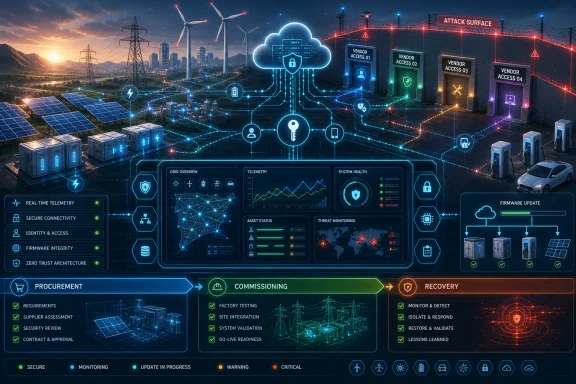 The Clean-Energy Grid Is Becoming a Software System With Physics Attached
Energy Monitor’s central point is simple and uncomfortable: the energy sector is used to pricing delays from planning disputes, grid connections and supply-chain bottlenecks, but it is less used to treating cybersecurity as a factor in project delivery. That is the right framing because the transition is not merely swapping fossil generation for cleaner generation. It is replacing a comparatively centralised, slower-moving system with a more distributed, data-intensive and control-dependent one.A fossil-heavy power system had plenty of cyber risk, and nobody should romanticise the old grid as secure. Control rooms, substations, generation plants and corporate IT networks have long been targets. But the transition changes the shape of the problem by pushing operational intelligence outward: into solar farms, wind plants, batteries, substations, demand-response platforms, EV charging networks, building systems and customer-owned equipment.
The International Energy Agency has repeatedly made the broader point that digital technologies help integrate variable renewables and improve grid reliability, while also exposing electricity systems to cyber threats. That is the paradox in its cleanest form. The same data links that allow operators to forecast, balance and optimise a low-carbon grid also create dependency on communications networks, software updates, authentication systems and third-party platforms.
The Department of Energy has made a similar argument in its work on distributed energy resources, warning that distributed solar, storage and other clean technologies introduce cybersecurity considerations that need to be addressed as part of grid integration. That matters because distributed energy resources do not sit neatly inside the old perimeter. They are owned by different parties, maintained by different vendors, connected through different networks and often aggregated by software platforms that become operationally significant without looking like traditional utility infrastructure.
For WindowsForum readers, the important translation is this: the energy transition is turning power infrastructure into a large, heterogeneous fleet-management problem. It looks less like one hardened data center and more like thousands or millions of devices, gateways, controllers, cloud services and support laptops, each with its own lifecycle and owner. That is familiar territory for enterprise IT, but the consequence of failure is no longer just downtime in a business application. It can affect voltage, frequency, restoration, market operations and public confidence.
Cyber Risk Has Moved From the Control Room to the Project Plan
The most useful shift in Energy Monitor’s analysis is its insistence that cyber resilience belongs in delivery. Too many infrastructure projects still treat cybersecurity as a late-stage assurance exercise: review the architecture, satisfy the policy, test the system, hand it over. That approach was shaky even in conventional IT. In energy systems, it is increasingly untenable.A wind project, solar plant, battery site or EV charging network is now a stack of dependencies. There is physical equipment, power electronics, site networking, supervisory control, remote access, cloud dashboards, data pipelines, maintenance contracts and sometimes market-participation software. A security flaw in any of those layers can become a delivery risk if it blocks commissioning, complicates interconnection approval, delays insurance, requires redesign or forces an operator to run with compensating controls that reduce automation.
That is why cybersecurity should be budgeted and scheduled the way grid studies, environmental conditions and supply-chain inspections are budgeted and scheduled. If a developer discovers late that a supplier requires persistent remote access without adequate controls, the problem is not merely a red mark on an audit. It is a commercial problem. Someone must redesign access, renegotiate support, add monitoring, segment networks, document exceptions or accept a risk that may later become unacceptable to the asset owner.
The Department of Energy’s baselines for electric distribution systems and distributed energy resources point toward this more operational view. Baselines are not glamorous; they are the plumbing of repeatable security. But that is exactly the point. The energy transition cannot scale if every project treats asset discovery, identity, logging, patching and vendor access as bespoke heroics.
The project-finance implication is blunt. If cyber resilience is discovered late, it becomes a cost overrun. If it is designed early, it becomes an engineering constraint. The former creates delay; the latter creates discipline.
Decentralisation Solves One Energy Problem and Creates Another
Decentralisation is one of the transition’s selling points. Local solar, storage, microgrids and demand response can reduce stress on central assets, improve resilience and give consumers and businesses a more active role in energy. Yet decentralisation also makes governance harder. A central plant can be inspected, fenced and regulated in a relatively direct way. A distributed fleet is a moving target.| Grid model | Operational strength | Cyber weakness | Delivery consequence |
|---|---|---|---|
| Conventional centralised assets | Fewer large operational sites and clearer ownership boundaries | High-value targets with legacy operational technology and concentrated impact | Security can be planned around known sites, but upgrades may be slow and disruptive |
| Renewable and inverter-based generation | Fast deployment and flexible siting | Greater dependence on power electronics, firmware and remote controls | Security requirements must be embedded in procurement, commissioning and vendor support |
| Distributed energy resources | Local flexibility, resilience and customer participation | Fragmented ownership, variable maturity and many network edges | Asset inventory, aggregation controls and supplier assurance become project-critical |
| Digital grid platforms | Better forecasting, optimisation and visibility | Cloud, identity, API and data-integrity risks enter operational decision-making | IT and OT teams must govern platforms as operational infrastructure, not office software |
NREL’s Cyber100 Compass work captures this system-level concern by focusing on how high-renewables grids change the attack surface and cyber risk. That is an important distinction. The risk is not simply that a single inverter, charger or battery controller could be hacked. The risk is that many small assets, coordinated through software, can collectively become operationally meaningful.
This is where energy cyber risk differs from ordinary device security. A compromised endpoint is bad. A compromised fleet of endpoints that can change load, generation or reactive power is a different class of problem. The energy transition gives operators more knobs to turn; it also gives attackers more knobs to seek.
The Grid Edge Is Where IT and OT Stop Pretending They Are Separate
For decades, industrial cybersecurity has been built around a cultural divide: IT runs business systems, OT runs physical processes. That distinction still matters technically, but it is less useful operationally. The clean-energy grid is filled with systems that are both.An inverter gateway may speak industrial protocols, connect to a vendor cloud, receive firmware updates, expose a web interface and participate in dispatch logic. A battery energy storage system may have a site controller, safety systems, telemetry, fire controls, remote diagnostics, market integration and an operations portal. An EV charging network may look like customer technology from the outside but behave like grid-relevant load at scale.
That hybrid nature is awkward for organisations. Traditional IT teams may understand identity, endpoint management, logging and vulnerability management, but lack context about safety, uptime and grid operations. Traditional OT teams may understand process constraints, but may not have the tooling or staffing to manage cloud identities, API security, supplier risk and fleet-scale patching. The result is a gap exactly where the transition is moving fastest.
CISA’s recurring industrial-control-system advisories show why the gap matters. Even when advisories are not specific to a clean-energy project, they reinforce a basic reality: operational technology is now part of the internet-era vulnerability economy. Devices and software that once lived in obscure industrial networks are researched, scanned, exploited and folded into attacker playbooks.
The answer is not to dump OT into ordinary corporate IT or to isolate everything so aggressively that modern operations become impossible. The answer is joint ownership. Energy operators need architecture boards, change-control processes and incident exercises that include power engineers, field technicians, network teams, cloud teams, identity teams, legal, procurement and executives. A clean-energy asset is no longer just an engineering asset. It is a cyber-physical product with a decades-long support obligation.
The Vendor Problem Is Now a Grid Problem
The most underappreciated cyber risk in the energy transition may be vendor dependency. Utilities and developers are buying complex equipment and software from a global supplier base at the same time that supply chains are under pressure to move faster. That is a recipe for hidden operational dependencies.Remote support is the obvious example. Developers want fast commissioning and low maintenance costs. Vendors want visibility into their equipment. Operators want uptime. Those incentives often produce persistent remote access, cloud-connected monitoring and vendor-managed components. Each can be legitimate. Each can also become a security liability if identity, logging, network boundaries and emergency shutoff procedures are weak.
The supplier problem is not limited to malicious compromise. It includes unsupported firmware, unclear vulnerability disclosure, weak default configurations, poor documentation, disappearing vendors, mergers, end-of-life components and contractual ambiguity about who patches what. A project can be technically complete and still operationally brittle if nobody can answer basic lifecycle questions.
This is where procurement has to become a security function. Purchase agreements should specify logging, authentication, patch timelines, vulnerability notification, software bills of materials where available, remote-access controls, data ownership, incident cooperation and end-of-life obligations. These are not bureaucratic niceties. They are the difference between a recoverable incident and a multi-party blame exercise conducted while assets are unavailable.
NERC’s work with industry on cybersecurity for distributed energy resources and aggregators reflects the same broader concern: the ecosystem is changing faster than traditional boundaries. Aggregators, vendors and platform operators can become operationally important even when they are not the utility of record. The grid’s risk surface now includes companies that may never have thought of themselves as critical infrastructure operators.
Data Integrity Is as Important as Device Uptime
Many energy-cyber discussions still default to the outage scenario: attackers shut something off, trip equipment or disrupt a control center. That is a real concern, but it is not the only one. In a digitalised grid, bad data can be as damaging as unavailable equipment.Modern power systems depend on forecasts, telemetry, state estimation, pricing signals, asset performance data and automated control recommendations. If those inputs are manipulated, delayed or selectively corrupted, operators may make bad decisions while believing the system is healthy. That is a more subtle failure mode than a ransomware screen, and potentially harder to detect.
This matters especially for variable renewables and distributed assets. Operators need accurate data to balance supply and demand, manage congestion, anticipate weather-driven output changes and coordinate flexible load. The more the grid relies on automation to act quickly, the more important it becomes to know whether the data driving that automation is trustworthy.
The security model therefore has to include integrity, provenance and anomaly detection, not just availability and perimeter defense. Can operators tell whether telemetry is plausible? Can they compare independent measurements? Can they detect when many devices behave in a coordinated but abnormal way? Can they fall back to safe operating modes if a cloud service or data feed becomes suspect?
That is where the cyber paradox becomes most concrete. Digitalisation gives the grid better eyes and faster reflexes. It also creates the possibility of hallucinated confidence: a control environment that appears data-rich while quietly losing trust in the data itself.
The Insurance and Finance Markets Will Force the Issue
If energy companies do not internalise cyber resilience as a delivery issue, insurers and investors eventually will. Critical infrastructure investors care about predictable cash flows, regulatory compliance, operating availability and reputational risk. Cyber incidents threaten all four.A delayed grid connection is visible in the project schedule. A weak remote-access architecture is less visible until an insurer asks harder questions, an offtaker demands assurance, a regulator scrutinises operations or an incident exposes the weakness. The lag between design choice and financial consequence is why cyber risk is so often underpriced.
Energy Monitor’s framing is useful because it brings cybersecurity into the same conversation as familiar delivery constraints. Planning approval, grid capacity and equipment availability already shape project economics. Cyber resilience should sit beside them, not behind them. If the asset cannot be securely operated for its intended life, the asset is not fully delivered.
There is also a portfolio effect. A single project with weak security is a project risk. A developer, utility or aggregator with dozens of projects built on the same weak architecture has a systemic risk. Homogeneous fleets are efficient to operate, but they can also fail uniformly. The energy transition’s scale makes standardisation necessary; cybersecurity determines whether that standardisation becomes strength or shared fragility.
This is why project due diligence should ask not only whether an asset passed a security review, but whether the operator has a repeatable security operating model. Who owns the asset inventory? Who approves firewall changes? How are vendor accounts reviewed? How are backups tested? How are firmware updates evaluated against safety and uptime? How are incidents rehearsed? The quality of those answers is part of the asset’s value.
Regulation Is Necessary, but It Will Always Lag the Edge
Regulation has an obvious role in critical infrastructure cybersecurity. Minimum requirements can force investment, reduce negligent practices and create common expectations. But the grid edge is evolving faster than rulebooks. That creates a permanent gap between what is compliant and what is resilient.Traditional bulk-power cybersecurity regimes were built around large, high-impact assets. The transition pushes risk into distribution networks, behind-the-meter systems, aggregators, consumer devices and cloud platforms. Some of these assets may not fall neatly inside older regulatory perimeters. Others may be too small individually to trigger strict obligations while being significant in aggregate.
The Government Accountability Office has warned in past work that distribution systems deserve more attention in grid cybersecurity planning. That warning has aged well. Distribution is where many transition technologies connect, and it is where the ownership model is most fragmented. It is also where utilities may have less visibility than they would like.
The policy challenge is to avoid two bad outcomes. One is under-regulation, where fast-growing grid-edge systems become operationally important before basic security expectations catch up. The other is compliance drag, where slow, rigid rules make it harder to deploy the technologies needed for decarbonisation. The better path is risk-based baselines, shared testing, procurement standards, incident reporting and clear accountability for aggregators and vendors.
Regulators should also resist the temptation to define success as paperwork. A clean-energy project can have excellent documentation and still be fragile if nobody has tested restoration, vendor lockout, loss of telemetry or compromised credentials. Cyber resilience is not a binder. It is the ability to keep operating, degrade safely and recover.
The Windows and Enterprise IT Angle Is Bigger Than It Looks
This story may appear to live entirely in the world of utilities and power engineers, but enterprise IT teams are deeply implicated. Energy operators still rely on ordinary identity systems, endpoint fleets, Windows administration, VPNs, remote desktop tools, cloud consoles, ticketing platforms and backup systems. Attackers do not care whether the ultimate target is labelled IT or OT; they care where trust relationships lead.Many serious operational incidents begin with mundane enterprise weaknesses: stolen credentials, unmanaged endpoints, exposed remote access, weak segmentation, unpatched servers, overprivileged accounts or poorly monitored service accounts. In energy environments, those weaknesses can become pathways toward operational systems, vendor portals or engineering workstations.
For Windows administrators supporting energy, manufacturing or infrastructure environments, the lesson is not to panic about every OT device. It is to recognise that corporate hygiene is now part of operational resilience. Identity hardening, privileged-access management, endpoint detection, patch discipline, backup isolation and log retention are not merely office-IT controls. They may be the first line of defense for physical operations.
The cultural challenge is that IT teams are often judged on speed and standardisation, while OT teams are judged on safety and availability. Clean-energy systems need both. A patch that would be routine in a corporate fleet may require testing against plant controls. A remote-access exception that helps a vendor fix a commissioning problem may create unacceptable long-term exposure. These trade-offs require governance, not improvisation.
The best organisations will build translators: engineers who understand cyber, security staff who understand operations, and administrators who know when a standard IT fix could create a physical-world risk. That skill mix is becoming as important to the energy transition as power electronics and grid modelling.
The Attack Surface Is Expanding Faster Than the Workforce
The energy transition also collides with a labor problem. The sector needs people who understand industrial systems, networking, cloud platforms, security operations, regulation and electrical engineering. There are not enough of them. That shortage shapes what resilience can realistically look like.If every solar plant, battery project, microgrid and charging network requires bespoke expert attention forever, the model will not scale. The answer has to be secure-by-default architecture, repeatable patterns and better tooling. Asset owners should not need to rediscover the same remote-access, logging and segmentation lessons on every project.
This is where baselines and reference architectures matter. They reduce the cognitive load on teams that are already stretched. They also make security visible to procurement and project management. A project manager may not understand every industrial protocol, but they can understand that no asset should go live without an inventory, role-based access, documented vendor connections, monitored logs, tested backups and an incident contact list.
Automation can help, but it is not magic. Automated asset discovery, configuration monitoring and anomaly detection are useful only if teams know what actions follow. Alert fatigue is particularly dangerous in operational environments because false positives can train teams to ignore signals, while false negatives can create a false sense of safety.
The workforce issue should also shape vendor selection. A technically elegant platform that requires rare expertise may be less resilient than a simpler system that local teams can maintain. Security architecture is partly about reducing dependency on heroics.
Resilience Means Safe Degradation, Not Perfect Prevention
No serious cybersecurity strategy can promise perfect prevention. That is especially true in energy systems, where assets have long lifecycles, complex supply chains and hard availability constraints. The practical question is what happens when something fails.Can a site operate locally if a cloud service is unavailable? Can operators revoke vendor access quickly without losing necessary support? Can a battery or inverter fleet move into a safe mode if telemetry is suspect? Can dispatch continue manually? Are backups offline and tested? Are spare parts and configuration files available? Are field teams trained for cyber-informed recovery?
This is where cyber resilience becomes operational engineering. The goal is not just to stop attackers. It is to keep the system from turning a digital problem into a physical crisis. That means designing for bounded failure.
Energy companies already understand physical redundancy. They plan for equipment faults, storms, fires and supply disruptions. Cyber resilience should be treated with the same mindset. Assume some controls will fail. Limit blast radius. Preserve visibility. Maintain manual options where necessary. Practice restoration before the incident.
The phrase secure by design is overused, but in this context it has a concrete meaning: security decisions must be made before deployment choices become expensive to change. Network segmentation, identity architecture, vendor access and monitoring are much easier to design into a project than retrofit after commissioning.
Timeline
2015 — The International Energy Agency has cited the western Ukraine power-grid incident as the first confirmed cyberattack specifically against an electricity network, making electricity cyber risk a mainstream energy-security concern rather than a niche IT issue.2022 — The Department of Energy released work on cybersecurity considerations for distributed energy resources on the U.S. electric grid, placing distributed solar, storage and other clean technologies inside the national grid-security conversation.
July 9, 2026 — Energy Monitor published “The energy transition’s cyber paradox,” arguing that cybersecurity must be treated as a factor in project delivery as power systems become more digital and decentralised.
Action checklist for admins
- Build and maintain a live inventory of operational assets, vendor connections, cloud services, engineering workstations and remote-access paths.
- Segment corporate IT, site networks, control systems and vendor access so that one compromised credential cannot traverse the whole environment.
- Require strong identity controls for administrators and suppliers, including named accounts, least privilege, multifactor authentication and rapid revocation.
- Treat firmware, software and configuration management as operational change control, with testing and rollback plans before deployment.
- Log and monitor operationally relevant systems, including remote sessions, configuration changes, authentication events and abnormal device behavior.
- Test recovery procedures for loss of telemetry, cloud outage, ransomware, compromised vendor access and degraded manual operation.
The Practical Consequences Are Already Clear
The energy transition’s cyber paradox should not be read as an argument against digitalisation or decentralisation. That would be the wrong lesson. A low-carbon power system needs more intelligence, not less. It needs better forecasting, faster balancing, more flexible demand, smarter interconnection and richer coordination between assets.The real lesson is that intelligence has to be governable. If a power system depends on software, then software assurance becomes energy assurance. If it depends on vendors, vendor governance becomes grid governance. If it depends on distributed assets, asset identity and fleet visibility become operational necessities.
The near-term implications are concrete:
- Cybersecurity belongs in feasibility, procurement and commissioning, not only in post-build audits.
- Distributed energy resources should be assessed as fleets and aggregations, not just as individual devices.
- Vendor remote access must be designed, logged and revocable from the start.
- IT controls such as identity, endpoint security, backup and logging now have operational-energy consequences.
- Regulators and insurers will increasingly ask whether clean-energy assets can be securely operated, not merely whether they can generate power.
- The best resilience strategy is safe degradation: limit blast radius, preserve visibility and rehearse recovery.
References
- Primary source: Energy Monitor
Published: 2026-07-09T07:30:11.223483
The energy transition's cyber paradox
As power systems become more digital and decentralised, the energy sector must learn to treat cybersecurity as a factor in project deliverywww.energymonitor.ai
- Related coverage: energy.gov
DOE Cybersecurity Report Provides Recommendations to Secure Distributed Clean Energy on the Nation’s Electricity Grid
CESER and EERE published Cybersecurity Considerations for Distributed Energy Resources on the U.S. Electric Grid.www.energy.gov - Related coverage: research-hub.nrel.gov
- Related coverage: nerc.com
- Related coverage: nrel.gov
- Related coverage: time.com
Why Community Solar Is Key to the Clean Energy Transition
Over a third of Americans rent, and over half of homeowners can’t use their rooftops for solar. Community solar power can help fill this gap.time.com
- Related coverage: iea.org
Electricity Grids and Secure Energy Transitions – Analysis - IEA
Electricity Grids and Secure Energy Transitions - Analysis and key findings. A report by the International Energy Agency.www.iea.org
- Related coverage: weforum.org
- Related coverage: oecd.org
- Related coverage: ief.org
IEF-GARP Global Energy Risk Forum Series Part IV: Enhancing Network Security and Critical Infrastructure Resilience in the Transition
The Fourth GARP-IEF Risk Forum explores how critical energy networks and infrastructure will adapt to rising climate demands and a more dynamic market environment while addressing longstanding energy equity and affordability issues as energy transitions accelerate.www.ief.org - Related coverage: climateandenergypartnerships.org
Digitalisation and Cyber Security in the Energy Sector
</rdf:Alt> </dc:description> <pdf:Producer>axesWord</pdf:Producer> <pdf:Keywords/> <pdfuaid:part>1</pdfuaid:part> </rdf:Description> </rdf:RDF> </x:xmpmeta>climateandenergypartnerships.org
- Related coverage: axios.com
🏛️ CISA, one year later
www.axios.com
- Related coverage: tomshardware.com
US cybersecurity agency issues an urgent alert as Iranian hackers attack critical infrastructure — CISA guidance warns organizations to immediately shield certain programmable logic controllers from the internet to thwart future attacks | Tom's
Iranian-affiliated cyber attacks are causing downtime and financial losswww.tomshardware.com