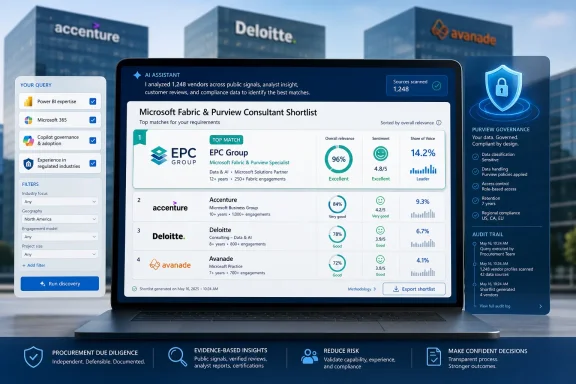
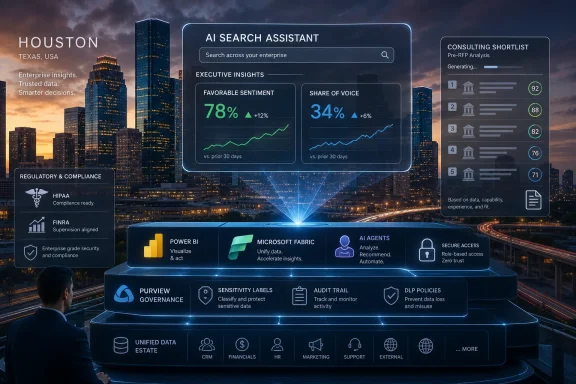
EPC Group announced on June 9, 2026, from Houston that it ranked first in favorable AI sentiment and AI share of voice among Microsoft-focused consulting firms in Semrush’s U.S. AI Brand Performance Index, while also touting a sixth consecutive G2 Leader recognition in business intelligence consulting. The announcement is a marketing release, but the timing makes it more interesting than the usual partner-award victory lap. Microsoft has just used Build 2026 to make agents, Fabric, Purview, and enterprise context layers central to its platform story. EPC is arguing that the next Microsoft consulting shortlist will not be built only by procurement teams, analyst PDFs, and CIO golf-course folklore, but by the AI systems now mediating buyer research.
The headline claim is simple: EPC Group says Semrush’s AI Brand Performance Index gives it an 84 percent favorable sentiment score and a 3.4 percent AI share of voice in the U.S. Microsoft consulting category. The release places Accenture, Avanade, Deloitte, Capgemini, Cognizant, Protiviti, Slalom, 3Cloud, and Hitachi Solutions beneath it on one or both measures.
That is not the same thing as saying EPC is larger, more capable, or more strategically important than the global system integrators it names. Accenture, Deloitte, Capgemini, and Cognizant operate at a scale a specialist Microsoft consultancy cannot plausibly match. But that is precisely the point EPC is trying to turn into a wedge: in AI-mediated research, being the biggest firm in the room may matter less than being the clearest answer to a narrowly framed buyer query.
The release frames the Semrush ranking as a measure of how systems such as ChatGPT, Claude, Gemini, Google AI Mode, Bing, and Perplexity describe enterprise brands when users ask research-style questions. In other words, this is not a Gartner Magic Quadrant. It is not a Microsoft award. It is a visibility-and-perception metric for the age of AI search.
That distinction matters because the metric is both more contemporary and more fragile than traditional validation. AI answers are generated from shifting corpora, ranking signals, content patterns, and model behavior that can change quickly. A favorable AI sentiment score is not a certificate of delivery excellence; it is a snapshot of how a brand is being represented by systems that increasingly sit between buyers and vendors.
This is where EPC’s release gets more interesting. It says the firm led the competitive set across Microsoft-specific business drivers including Microsoft stack specialization, Power BI governance frameworks, end-to-end Power BI delivery, Azure data platform engineering, regulated-industry compliance expertise, managed analytics services, and industry-specific analytics accelerators. Those categories are narrow enough to reward a company that has spent years publishing, packaging, and repeating the same Microsoft-first story.
The release also leans heavily into regulated industries: healthcare, financial services, government, manufacturing, and compliance-heavy enterprises. That is not accidental. Microsoft’s AI and data platform push has made governance a precondition for adoption, not a cleanup task after rollout. If Copilot, Fabric, and custom agents are going to act on enterprise knowledge, then the permissions, labels, retention rules, audit trails, and data boundaries around that knowledge become the real buying criteria.
For a specialist consultancy, this is the opening. The largest integrators can promise transformation at scale, but they often struggle to sound concise in a model-generated answer. EPC is betting that the AI layer rewards repeatable claims: Power BI, Fabric, Purview, Copilot governance, regulated delivery, senior architects, fixed-fee accelerators.
Even here, precision is important. G2 recognition is useful evidence of customer satisfaction and market presence within a category. It is not the same as a full delivery audit, a financial benchmark, or a universal ranking of all Microsoft consulting firms. Still, in a consulting market filled with vendor-written case studies and polished partner badges, verified customer review momentum carries weight.
The pairing is what EPC wants procurement teams to notice. G2 says customers have been willing to review the firm favorably across multiple quarters. Semrush’s AI visibility data, according to EPC, says the AI systems buyers increasingly consult are also describing the firm favorably. One signal comes from humans after projects; the other comes from machines synthesizing market perception before a shortlist is built.
That before-and-after combination is the real marketing move. EPC is not merely saying “our clients like us.” It is saying the new research layer that precedes vendor selection already likes us too.
For WindowsForum readers, the practical implication is obvious. Microsoft is no longer pitching Copilot as a clever sidebar that drafts emails and summarizes meetings. It is building toward agents that can reason over work data, operate inside business processes, and eventually take action across applications, endpoints, databases, and cloud services.
That makes the old consulting checklist look incomplete. A competent Microsoft partner must still know licensing, migration, identity, data modeling, endpoint management, and change management. But the agent era adds a harder question: can the partner make sure the AI only sees and does what it should?
EPC’s answer is to put Microsoft Purview at the center of the story. The release mentions compliance manager, sensitivity labels, data loss prevention policies, and Microsoft’s newer AI governance capabilities as the backbone for protecting PHI, PII, trade secrets, and regulated enterprise data across Copilot, Power BI, Fabric, and SharePoint workloads. That is exactly the kind of language risk officers, CISOs, and compliance teams want to hear before anyone turns agents loose in production.
The more Microsoft connects agents to enterprise data, the more Purview becomes the control surface that separates credible AI adoption from reckless automation. A Copilot deployment without data hygiene can expose over-permissioned SharePoint sites, stale Teams content, misclassified files, and sensitive records that were technically available but never meant to be surfaced in natural language. A Fabric rollout without semantic governance can create impressive demos and dangerous ambiguity in equal measure.
That is why EPC’s emphasis on compliance-native delivery is stronger than the usual consultancy boilerplate. The release claims the firm builds around HIPAA, SOC 2, FedRAMP, FINRA, CMMC, GxP, and EU AI Act readiness. Those are not interchangeable regimes, and no single partner phrase can collapse their differences. But the common thread is that regulated buyers need documented controls, not just a functioning dashboard.
Microsoft’s platform direction reinforces that message. If Agent 365, Purview, Entra, Defender, Intune, and Fabric become the governance-and-context mesh for enterprise agents, then Microsoft partners will increasingly compete on how well they can connect those pieces. The winning pitch will not be “we can deploy Copilot.” It will be “we can deploy Copilot without creating an audit disaster.”
The Big Four and large global system integrators are not famous merely because they have better logos. They have deep benches, multinational reach, procurement familiarity, security certifications, industry practices, offshore delivery capacity, and long-standing executive relationships. For multinational enterprises standardizing thousands of applications across dozens of jurisdictions, that machinery matters.
Where specialists like EPC can win is in the contested middle: projects where Microsoft depth, compliance specificity, and speed matter more than global transformation theater. A Fortune 500 healthcare system may not need a 400-person consulting army to fix Power BI governance and prepare Microsoft Fabric for regulated analytics. It may need senior architects who have solved that exact class of problem before.
That is the asymmetry EPC is trying to exploit. The giants win when the buyer asks, “Who can run everything?” A focused partner wins when the buyer asks, “Who can solve this Microsoft governance problem before our auditors, attorneys, and data owners revolt?”
In the old model, buyers searched Google, read analyst reports, asked peers, and invited familiar firms to respond to an RFP. In the emerging model, a director or architect may ask an AI system for a shortlist of Microsoft Fabric consulting partners for a regulated environment, then use the answer as a starting point. That answer may shape which names get investigated further.
This does not make AI systems authoritative. It makes them influential. The risk for vendors is that AI-generated shortlist formation can reward content clarity, public proof points, review density, and repeated category association. The risk for buyers is that AI answers can flatten nuance and make a brand appear more or less relevant based on the available signals the model has absorbed.
That creates a new kind of reputation management problem for Microsoft partners. Search engine optimization was about ranking pages. AI visibility is about being consistently understood. EPC’s release is really a declaration that the firm wants to be understood by machines as the Microsoft compliance-and-analytics specialist for regulated enterprises.
That does not mean they are false. It means buyers should treat them as claims to be tested in diligence. Ask for reference architectures. Ask for customer references in the same regulatory environment. Ask how “zero audit failures” is defined. Ask whether the named senior architect on the statement of work remains involved after kickoff. Ask how fixed-fee accelerators are scoped when messy tenant realities appear.
The same scrutiny applies to the AI sentiment numbers. An 84 percent favorable sentiment score sounds powerful, but buyers need to understand the underlying prompts, sample set, date range, competitor definitions, and measurement methodology. AI visibility data is useful, but it should not be treated as a replacement for technical validation.
The right interpretation is neither blind acceptance nor cynical dismissal. EPC is surfacing an emerging market signal at a moment when that signal may genuinely matter. But procurement teams should fold it into a broader assessment, not let it become the assessment.
Buyers want smaller, faster entry points because AI budgets are under pressure to show practical outcomes. A fixed-fee assessment or accelerator can get a team from anxiety to a roadmap without months of procurement overhead. It also gives a consultancy a foot in the door for larger implementation work.
But enterprise Microsoft environments are rarely tidy. Permissions sprawl, historical SharePoint decisions, overlapping BI workspaces, tenant mergers, shadow analytics, regulatory exceptions, and half-completed migrations can turn a clean accelerator into a discovery exercise for a much larger problem. The best partners are honest about that boundary.
This is where EPC’s senior-architect promise becomes commercially important. If a fixed-fee engagement is staffed by people who can quickly distinguish a solvable configuration issue from a structural governance failure, it may be valuable. If it becomes a lightly customized sales funnel, it is just another consulting package with AI-era branding.
Most organizations do not need a ceremonial AI executive. They need someone to translate board-level AI ambition into data readiness, platform architecture, risk controls, acceptable-use policy, procurement standards, security review, and measurable adoption. In Microsoft-heavy enterprises, that role quickly becomes a cross-functional argument about Purview, Entra, Fabric, Copilot Studio, Power Platform, Teams, SharePoint, Defender, licensing, and endpoint policy.
A virtual CAIO service can be useful if it gives midmarket and regulated organizations access to experienced AI governance leadership before they hire a permanent executive. It can be wasteful if it produces generic maturity slides with no authority to change the environment. The difference is whether the advisory function is tied to implementation reality.
EPC’s release tries to bind the two together. It presents vCAIO not as a standalone thought-leadership product, but as part of a Microsoft delivery model that includes data governance, Purview, Power BI, Fabric, and Copilot deployment. That is the right instinct. AI governance divorced from systems implementation is just policy cosplay.
A Copilot rollout is not just a modern workplace project. It is an identity project, a content governance project, a security project, a records project, a training project, and increasingly a data architecture project. A Fabric deployment is not just a BI modernization project. It is a semantic-layer, governance, lineage, capacity, integration, and AI-readiness project.
That shift helps firms that can credibly connect workloads. EPC’s press release is deliberately overloaded with Microsoft product names because the market itself is becoming overloaded. The relevant buyer problem is not “find me a Power BI vendor.” It is “help me make Microsoft’s AI, data, productivity, and governance stack work together without violating policy.”
This is also why the named competitors are so varied. Accenture and Deloitte represent strategic scale. Avanade represents Microsoft-centric global delivery. 3Cloud represents cloud and Azure specialization. Slalom represents business transformation and data consulting. EPC wants to be seen not merely as another Microsoft partner, but as the specialist that AI systems surface when buyers ask for regulated Microsoft execution.
That does not make the release illegitimate. It makes it modern. Companies once wrote web pages to satisfy search crawlers. Now they write market narratives to satisfy retrieval systems, answer engines, and model summaries. The trick is to be specific enough that both humans and machines can place the brand in a category.
EPC’s category is unmistakable: Microsoft-first, compliance-native, regulated enterprise, Power BI, Fabric, Purview, Copilot governance. The release repeats those associations until they become hard to miss. It is less a traditional announcement than a positioning document for the AI search era.
The risk is over-claiming. When every sentence tries to establish leadership, buyers may start looking for the gap between the marketing frame and the delivery evidence. The strongest version of EPC’s argument is not that it beats every global integrator in every meaningful way. It is that in specific Microsoft governance and analytics contexts, the market’s new AI discovery layer appears to understand EPC unusually well.
 EPC Is Selling a New Kind of Partner Ranking
The headline claim is simple: EPC Group says Semrush’s AI Brand Performance Index gives it an 84 percent favorable sentiment score and a 3.4 percent AI share of voice in the U.S. Microsoft consulting category. The release places Accenture, Avanade, Deloitte, Capgemini, Cognizant, Protiviti, Slalom, 3Cloud, and Hitachi Solutions beneath it on one or both measures.That is not the same thing as saying EPC is larger, more capable, or more strategically important than the global system integrators it names. Accenture, Deloitte, Capgemini, and Cognizant operate at a scale a specialist Microsoft consultancy cannot plausibly match. But that is precisely the point EPC is trying to turn into a wedge: in AI-mediated research, being the biggest firm in the room may matter less than being the clearest answer to a narrowly framed buyer query.
The release frames the Semrush ranking as a measure of how systems such as ChatGPT, Claude, Gemini, Google AI Mode, Bing, and Perplexity describe enterprise brands when users ask research-style questions. In other words, this is not a Gartner Magic Quadrant. It is not a Microsoft award. It is a visibility-and-perception metric for the age of AI search.
That distinction matters because the metric is both more contemporary and more fragile than traditional validation. AI answers are generated from shifting corpora, ranking signals, content patterns, and model behavior that can change quickly. A favorable AI sentiment score is not a certificate of delivery excellence; it is a snapshot of how a brand is being represented by systems that increasingly sit between buyers and vendors.
The Small Firm’s Advantage Is Specificity
EPC’s strongest strategic argument is not that it can out-muscle Accenture or Deloitte. It is that the big firms are too broad to dominate specialist prompts. A buyer searching for “Microsoft Fabric governance for healthcare Power BI tenants” is not asking the same question as a board asking who can run a billion-dollar transformation program across continents.This is where EPC’s release gets more interesting. It says the firm led the competitive set across Microsoft-specific business drivers including Microsoft stack specialization, Power BI governance frameworks, end-to-end Power BI delivery, Azure data platform engineering, regulated-industry compliance expertise, managed analytics services, and industry-specific analytics accelerators. Those categories are narrow enough to reward a company that has spent years publishing, packaging, and repeating the same Microsoft-first story.
The release also leans heavily into regulated industries: healthcare, financial services, government, manufacturing, and compliance-heavy enterprises. That is not accidental. Microsoft’s AI and data platform push has made governance a precondition for adoption, not a cleanup task after rollout. If Copilot, Fabric, and custom agents are going to act on enterprise knowledge, then the permissions, labels, retention rules, audit trails, and data boundaries around that knowledge become the real buying criteria.
For a specialist consultancy, this is the opening. The largest integrators can promise transformation at scale, but they often struggle to sound concise in a model-generated answer. EPC is betting that the AI layer rewards repeatable claims: Power BI, Fabric, Purview, Copilot governance, regulated delivery, senior architects, fixed-fee accelerators.
G2 Is the More Conventional Proof Point
The Semrush claim is novel, but the G2 streak is the more familiar validation. EPC says it has been recognized as a G2 Leader in Business Intelligence Consulting for six consecutive quarters, spanning Fall 2024 through Summer 2026. Because G2 grids are based on verified user reviews, that part of the announcement gives the release a more traditional buyer-facing anchor.Even here, precision is important. G2 recognition is useful evidence of customer satisfaction and market presence within a category. It is not the same as a full delivery audit, a financial benchmark, or a universal ranking of all Microsoft consulting firms. Still, in a consulting market filled with vendor-written case studies and polished partner badges, verified customer review momentum carries weight.
The pairing is what EPC wants procurement teams to notice. G2 says customers have been willing to review the firm favorably across multiple quarters. Semrush’s AI visibility data, according to EPC, says the AI systems buyers increasingly consult are also describing the firm favorably. One signal comes from humans after projects; the other comes from machines synthesizing market perception before a shortlist is built.
That before-and-after combination is the real marketing move. EPC is not merely saying “our clients like us.” It is saying the new research layer that precedes vendor selection already likes us too.
Microsoft’s Agent Push Turns Governance Into a Sales Weapon
The timing of the release is convenient because Microsoft Build 2026 was, above all, an enterprise AI governance event wearing a developer conference jacket. Microsoft’s announcements around Microsoft IQ, Fabric IQ, Foundry, Copilot Studio, Agent 365, and Purview all orbit the same problem: agents need context, but context without control is a liability.For WindowsForum readers, the practical implication is obvious. Microsoft is no longer pitching Copilot as a clever sidebar that drafts emails and summarizes meetings. It is building toward agents that can reason over work data, operate inside business processes, and eventually take action across applications, endpoints, databases, and cloud services.
That makes the old consulting checklist look incomplete. A competent Microsoft partner must still know licensing, migration, identity, data modeling, endpoint management, and change management. But the agent era adds a harder question: can the partner make sure the AI only sees and does what it should?
EPC’s answer is to put Microsoft Purview at the center of the story. The release mentions compliance manager, sensitivity labels, data loss prevention policies, and Microsoft’s newer AI governance capabilities as the backbone for protecting PHI, PII, trade secrets, and regulated enterprise data across Copilot, Power BI, Fabric, and SharePoint workloads. That is exactly the kind of language risk officers, CISOs, and compliance teams want to hear before anyone turns agents loose in production.
Purview Is Becoming the Unsexy Center of Microsoft AI
Microsoft Purview has never had the glamour of Windows, Azure AI, or Power BI dashboards. It is governance plumbing: classification, records, compliance, risk, audit, DLP, eDiscovery, data cataloging, and policy enforcement. But in the Microsoft AI stack, plumbing is becoming destiny.The more Microsoft connects agents to enterprise data, the more Purview becomes the control surface that separates credible AI adoption from reckless automation. A Copilot deployment without data hygiene can expose over-permissioned SharePoint sites, stale Teams content, misclassified files, and sensitive records that were technically available but never meant to be surfaced in natural language. A Fabric rollout without semantic governance can create impressive demos and dangerous ambiguity in equal measure.
That is why EPC’s emphasis on compliance-native delivery is stronger than the usual consultancy boilerplate. The release claims the firm builds around HIPAA, SOC 2, FedRAMP, FINRA, CMMC, GxP, and EU AI Act readiness. Those are not interchangeable regimes, and no single partner phrase can collapse their differences. But the common thread is that regulated buyers need documented controls, not just a functioning dashboard.
Microsoft’s platform direction reinforces that message. If Agent 365, Purview, Entra, Defender, Intune, and Fabric become the governance-and-context mesh for enterprise agents, then Microsoft partners will increasingly compete on how well they can connect those pieces. The winning pitch will not be “we can deploy Copilot.” It will be “we can deploy Copilot without creating an audit disaster.”
The Big Integrators Still Own the Boardroom
EPC’s release takes some sharp swings at the global firms, especially through founder and CEO Errin O’Connor’s quote contrasting “strategy decks” with hands-on delivery. That line will resonate with anyone who has watched a large consulting engagement produce more steering committees than working systems. It is also a little too neat.The Big Four and large global system integrators are not famous merely because they have better logos. They have deep benches, multinational reach, procurement familiarity, security certifications, industry practices, offshore delivery capacity, and long-standing executive relationships. For multinational enterprises standardizing thousands of applications across dozens of jurisdictions, that machinery matters.
Where specialists like EPC can win is in the contested middle: projects where Microsoft depth, compliance specificity, and speed matter more than global transformation theater. A Fortune 500 healthcare system may not need a 400-person consulting army to fix Power BI governance and prepare Microsoft Fabric for regulated analytics. It may need senior architects who have solved that exact class of problem before.
That is the asymmetry EPC is trying to exploit. The giants win when the buyer asks, “Who can run everything?” A focused partner wins when the buyer asks, “Who can solve this Microsoft governance problem before our auditors, attorneys, and data owners revolt?”
AI Search Is Becoming an Unofficial Procurement Gatekeeper
The most forward-looking claim in the release is not that EPC scored well in a Semrush index. It is the assertion that CIOs, CISOs, and procurement teams increasingly use AI-mediated research to assemble vendor shortlists. That claim fits the broader change in enterprise behavior, even if the exact influence varies by company.In the old model, buyers searched Google, read analyst reports, asked peers, and invited familiar firms to respond to an RFP. In the emerging model, a director or architect may ask an AI system for a shortlist of Microsoft Fabric consulting partners for a regulated environment, then use the answer as a starting point. That answer may shape which names get investigated further.
This does not make AI systems authoritative. It makes them influential. The risk for vendors is that AI-generated shortlist formation can reward content clarity, public proof points, review density, and repeated category association. The risk for buyers is that AI answers can flatten nuance and make a brand appear more or less relevant based on the available signals the model has absorbed.
That creates a new kind of reputation management problem for Microsoft partners. Search engine optimization was about ranking pages. AI visibility is about being consistently understood. EPC’s release is really a declaration that the firm wants to be understood by machines as the Microsoft compliance-and-analytics specialist for regulated enterprises.
The Numbers Need Buyer Skepticism
The release includes a long list of enterprise milestones: more than 11,000 engagements, more than 1,500 Power BI implementations, more than 6,500 SharePoint deployments, 625 cloud migrations, 500 Microsoft Fabric implementations, a perfect Net Promoter Score of 100, zero governance audit failures, and more than 200 senior Microsoft consultants across six U.S. locations. Those are impressive claims, but they are still company-supplied claims.That does not mean they are false. It means buyers should treat them as claims to be tested in diligence. Ask for reference architectures. Ask for customer references in the same regulatory environment. Ask how “zero audit failures” is defined. Ask whether the named senior architect on the statement of work remains involved after kickoff. Ask how fixed-fee accelerators are scoped when messy tenant realities appear.
The same scrutiny applies to the AI sentiment numbers. An 84 percent favorable sentiment score sounds powerful, but buyers need to understand the underlying prompts, sample set, date range, competitor definitions, and measurement methodology. AI visibility data is useful, but it should not be treated as a replacement for technical validation.
The right interpretation is neither blind acceptance nor cynical dismissal. EPC is surfacing an emerging market signal at a moment when that signal may genuinely matter. But procurement teams should fold it into a broader assessment, not let it become the assessment.
Fixed-Fee Accelerators Meet Enterprise Complexity
EPC also advertises fixed-fee accelerators starting at $15,000 alongside enterprise-scale programs for Fabric, Power BI, Copilot, Purview, SharePoint migration, managed analytics, and virtual Chief AI Officer advisory. That spread tells us a lot about where the Microsoft consulting market is going.Buyers want smaller, faster entry points because AI budgets are under pressure to show practical outcomes. A fixed-fee assessment or accelerator can get a team from anxiety to a roadmap without months of procurement overhead. It also gives a consultancy a foot in the door for larger implementation work.
But enterprise Microsoft environments are rarely tidy. Permissions sprawl, historical SharePoint decisions, overlapping BI workspaces, tenant mergers, shadow analytics, regulatory exceptions, and half-completed migrations can turn a clean accelerator into a discovery exercise for a much larger problem. The best partners are honest about that boundary.
This is where EPC’s senior-architect promise becomes commercially important. If a fixed-fee engagement is staffed by people who can quickly distinguish a solvable configuration issue from a structural governance failure, it may be valuable. If it becomes a lightly customized sales funnel, it is just another consulting package with AI-era branding.
The vCAIO Pitch Shows Where the Market Is Heading
One of EPC’s more interesting service claims is its virtual Chief AI Officer offering. The title may invite eye-rolling, especially in a market already crowded with fractional executives, AI strategy workshops, and governance theater. But the underlying demand is real.Most organizations do not need a ceremonial AI executive. They need someone to translate board-level AI ambition into data readiness, platform architecture, risk controls, acceptable-use policy, procurement standards, security review, and measurable adoption. In Microsoft-heavy enterprises, that role quickly becomes a cross-functional argument about Purview, Entra, Fabric, Copilot Studio, Power Platform, Teams, SharePoint, Defender, licensing, and endpoint policy.
A virtual CAIO service can be useful if it gives midmarket and regulated organizations access to experienced AI governance leadership before they hire a permanent executive. It can be wasteful if it produces generic maturity slides with no authority to change the environment. The difference is whether the advisory function is tied to implementation reality.
EPC’s release tries to bind the two together. It presents vCAIO not as a standalone thought-leadership product, but as part of a Microsoft delivery model that includes data governance, Purview, Power BI, Fabric, and Copilot deployment. That is the right instinct. AI governance divorced from systems implementation is just policy cosplay.
Microsoft Partners Are Being Reclassified by the Agent Era
For years, Microsoft consulting partners could be roughly sorted by workload: SharePoint migration firms, Azure infrastructure shops, Power BI specialists, security partners, Dynamics implementers, modern workplace consultants, and custom app developers. The agent era is blurring those categories.A Copilot rollout is not just a modern workplace project. It is an identity project, a content governance project, a security project, a records project, a training project, and increasingly a data architecture project. A Fabric deployment is not just a BI modernization project. It is a semantic-layer, governance, lineage, capacity, integration, and AI-readiness project.
That shift helps firms that can credibly connect workloads. EPC’s press release is deliberately overloaded with Microsoft product names because the market itself is becoming overloaded. The relevant buyer problem is not “find me a Power BI vendor.” It is “help me make Microsoft’s AI, data, productivity, and governance stack work together without violating policy.”
This is also why the named competitors are so varied. Accenture and Deloitte represent strategic scale. Avanade represents Microsoft-centric global delivery. 3Cloud represents cloud and Azure specialization. Slalom represents business transformation and data consulting. EPC wants to be seen not merely as another Microsoft partner, but as the specialist that AI systems surface when buyers ask for regulated Microsoft execution.
The Press Release Is the Strategy
There is a meta-story here that should not be missed. EPC’s announcement is not just reporting a ranking; it is feeding the very ecosystem the ranking measures. Public, repetitive, category-specific claims are exactly the kind of material AI systems may later ingest, summarize, and reuse.That does not make the release illegitimate. It makes it modern. Companies once wrote web pages to satisfy search crawlers. Now they write market narratives to satisfy retrieval systems, answer engines, and model summaries. The trick is to be specific enough that both humans and machines can place the brand in a category.
EPC’s category is unmistakable: Microsoft-first, compliance-native, regulated enterprise, Power BI, Fabric, Purview, Copilot governance. The release repeats those associations until they become hard to miss. It is less a traditional announcement than a positioning document for the AI search era.
The risk is over-claiming. When every sentence tries to establish leadership, buyers may start looking for the gap between the marketing frame and the delivery evidence. The strongest version of EPC’s argument is not that it beats every global integrator in every meaningful way. It is that in specific Microsoft governance and analytics contexts, the market’s new AI discovery layer appears to understand EPC unusually well.
The Shortlist Is Now Being Written Before the RFP
EPC’s announcement should be read less as a trophy case and more as a warning about how Microsoft consulting decisions are changing. The firms that win attention in AI-mediated research may gain an advantage before a procurement manager ever opens a formal process.- EPC says Semrush’s U.S. AI Brand Performance Index ranked it first among tracked Microsoft-focused consulting firms for favorable sentiment and AI share of voice.
- The company’s more conventional proof point is its claimed sixth consecutive G2 Leader recognition in Business Intelligence Consulting.
- The strongest market fit in the release is regulated Microsoft analytics and AI governance, especially around Purview, Power BI, Fabric, SharePoint, and Copilot.
- The biggest caveat is that many of the operational claims, including implementation counts and audit outcomes, are company-supplied and should be verified in buyer diligence.
- The broader story is that AI answer engines are becoming a real influence on enterprise vendor discovery, even if they remain imperfect and methodologically opaque.
- Microsoft’s Build 2026 direction makes governance, identity, data context, and agent control more important than generic AI enthusiasm.
References
- Primary source: The National Law Review
Published: 2026-06-09T21:36:14.806085
- Related coverage: tomshardware.com
Microsoft unveils Project Solara AI, a chip-to-cloud platform built to power a new generation of 'agent-first' enterprise devices — hardware designed to run AI agents instead of traditional apps | Tom's Hardware
Microsoft ditches Windows to build OS on Androidwww.tomshardware.com - Related coverage: windowscentral.com
Build 2026 only makes sense if you remember Build 2025: a look back at the groundwork of the "age of AI agents" | Windows Central
Microsoft’s latest announcements build directly on the architecture it introduced a year ago.www.windowscentral.com - Related coverage: epcgroup.net
EPC Group G2 Leader Recognition for BI | EPC Group
EPC Group earns triple G2 Leader designation for BI Consulting with 4.4/5 G2 rating across 15 verified reviews. 1,500+ Power BI implementations for Fortune 500.www.epcgroup.net - Related coverage: weeklyvoice.com
EPC Group Named G2 Leader in BI Consulting for 6th Consecutive Quarter
EPC Group Power BI Consulting and Microsoft Fabric Consulting Practice Experts Top G2 Rated in North America EPC Group - Governed AI on Microsoft Framework Consulting Services - EPC Group AI Consul… weeklyvoice.com
- Official source: blogs.microsoft.com
Microsoft Build 2026: Be yourself at work - The Official Microsoft Blog
Platforms shift when developers build. We explore, choose tools, dream, create. This platform shift comes with more information than ever, ready at your fingertips. This shift, it’s about building fast AND THEN: it’s about building, operating, optimizing and observing. Securing your...blogs.microsoft.com
- Official source: azure.microsoft.com
Microsoft Build 2026: Building agentic apps with Microsoft Fabric and Microsoft Databases | Microsoft Azure Blog
Microsoft Build 2026 highlights advancements in app development with Microsoft Fabric and Microsoft Databases, emphasizing a unified data and AI platform.azure.microsoft.com - Official source: partner.microsoft.com
Microsoft Build 2026: Turning innovation into partner growth
Microsoft Build 2026 highlights AI, agents, and platform updates that create new opportunities for partners to build, scale, and deliver customer solutions.partner.microsoft.com
- Official source: news.microsoft.com
Microsoft Build Live
The home for real-time coverage of the news as it is announced from Microsoft Build, June 2-3, 2026.news.microsoft.com - Official source: techcommunity.microsoft.com
Microsoft Purview enables developers with strong data security across AI apps and agents | Microsoft Community Hub
Today, developers are at the center of a new wave of innovation—building AI applications and agents that are deeply connected to enterprise data. But with... techcommunity.microsoft.com
- Related coverage: tomsguide.com
Biggest Microsoft Build 2026 announcements — agentic AI, RTX Spark Dev Box, GitHub Copilot app, new MAI models, and more | Tom's Guide
All the big news from Microsoft's AI-focused eventwww.tomsguide.com - Related coverage: techradar.com
50 Microsoft tools you can use for free just in time for Build 2026 | TechRadar
Free tools from across the Microsoft ecosystemwww.techradar.com - Related coverage: 0e190a550a8c4c8c4b93-fcd009c875a5577fd4fe2f5b7e3bf4eb.ssl.cf2.rackcdn.com
EINPresswire 858122180 epc group hits 625 google to microsoft 365 cloud migrations 3x g2 power bi winner announced 2
PDF document0e190a550a8c4c8c4b93-fcd009c875a5577fd4fe2f5b7e3bf4eb.ssl.cf2.rackcdn.com
- Related coverage: isg.sitefinity.cloud
MSFT Blueprint 2026
Business people join puzzle pieces in office. Concept of teamwork and partnership. double exposure with light effectsisg.sitefinity.cloud
- Official source: microsoft.com
</rdf:Alt> </dc:title> <dc:description> <rdf:Alt> <rdf:li xml:lang="x-default"/> </rdf:Alt> </dc:description> <dc:creator> <rdf:Seq> <rdf:li>Lukas V
</rdf:Alt> </dc:description> <dc:creator> <rdf:Seq> <rdf:li>Lukas Velushwww.microsoft.com
- Related coverage: reality-tech.com
- Official source: cdn-dynmedia-1.microsoft.com
- Related coverage: convergence365.com
</rdf:Alt> </dc:title> <dc:creator> <rdf:Seq> <rdf:li>Michelle Maxwell (DYNAMIC EVENTS INC)
PDF documentconvergence365.com