

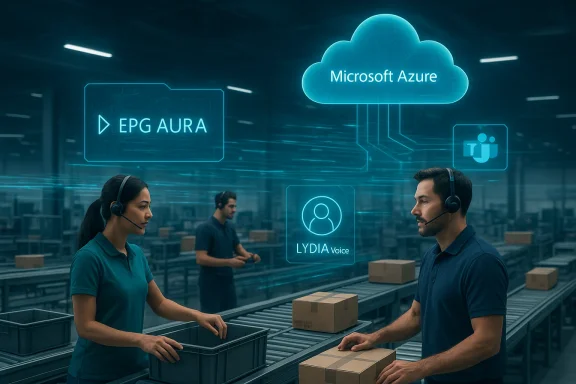
EPG’s new partnership with Microsoft is best understood as a strategic move to pull supply chain execution deeper into the AI era, while giving enterprise customers a more familiar route into modern cloud deployment. By placing its EPG AURA intelligence layer on Microsoft Azure, the German logistics software specialist is signaling that the next phase of warehouse and supply chain software will be less about isolated systems and more about context-aware decision support embedded in daily work. Microsoft, for its part, has been pushing hard into supply chain, manufacturing, and collaboration workflows, including AI-assisted capabilities in Dynamics 365 Supply Chain Management and tightly integrated experiences across Microsoft 365 and Teams
EPG, short for Ehrhardt Partner Group, has long built its reputation on execution technology for logistics, warehouse control, and voice-directed picking. Its EPG ONE suite positions the company as a specialist in operational processes that sit close to the physical flow of goods, not just the back-office planning layer. The company’s own materials emphasize its integrated platform, its LYDIA Voice technology, and its ability to connect ERP, WMS, OMS, and TMS environments across global operations
The timing of this Microsoft alliance matters. EPG has already been framing EPG AURA as an AI-native intelligence layer for logistics, one that “operates above existing execution systems” and turns live process data into decision-ready intelligence inside familiar workflows. That positioning suggests EPG is not trying to replace core execution software overnight. Instead, it is adding a cognitive layer on top of the operational stack, which is exactly where enterprise customers are starting to look for value from generative and agentic AI.
Microsoft has also been steadily strengthening its supply chain story. The company’s Dynamics 365 materials describe a supply chain platform designed to connect demand to delivery using AI agents and Copilot, while supporting collaboration across teams, suppliers, and customers in the flow of work. In parallel, Microsoft Teams remains one of the company’s core collaboration anchors, tightly integrated with Microsoft 365 and built on enterprise security and manageability foundations. That makes Teams a natural surface for operational intelligence that needs to reach users where they already spend time.
The EPG-Microsoft collaboration therefore fits a broader industry pattern: software vendors are increasingly combining domain expertise with hyperscaler cloud, AI, and collaboration infrastructure. In supply chain software, that is not just a technical preference. It is becoming a competitive necessity. Buyers want faster implementation, fewer integration headaches, and clearer answers about compliance, scalability, and support across regions.
This is a significant point because logistics customers are rarely uniform. Some want highly controlled private environments, while others are eager to scale globally with a managed cloud service. By offering both EPX-Hosting and Azure-based SaaS, EPG appears to be hedging smartly against divergent enterprise preferences rather than forcing one operating model on every customer.
That matters in a market where the difference between a general-purpose cloud and a vertical solution is often measured in implementation friction. Microsoft can point to partners like EPG as proof that Azure is not just a hosting layer; it is an ecosystem for operational AI.
For EPG, this is especially relevant if EPG AURA is meant to operate above execution systems and deliver guidance in real time. The platform needs a dependable foundation for inference, event handling, and secure data exchange. Azure gives EPG the chance to position AI not as a standalone dashboard, but as an operational companion.
That said, cloud infrastructure alone does not eliminate responsibility. Microsoft’s own cloud materials reinforce the shared responsibility model, meaning customers still carry significant obligations around data, configuration, and access control. In other words, Azure helps, but it does not magically simplify governance.
That matters because supply chain projects often fail not on core functionality, but on handoff friction. Data silos, duplicate entries, and unclear system ownership can slow down deployments and undermine user adoption. A standardized interface could reduce that burden if EPG and Microsoft deliver real depth rather than shallow connector marketing.
This is also where Microsoft’s ecosystem gives EPG a distribution advantage. Dynamics users already trust Microsoft to mediate business processes, identity, and collaboration. If EPG can become the execution layer that sits naturally beside Dynamics, it may win deals that would otherwise go to more generic WMS or supply chain platforms.
The key strategic question is whether Microsoft integration turns voice into a richer workflow layer. If voice can access ERP context, trigger tasks, and reflect operational status without forcing workers out of their normal process, the result is more than convenience. It is a smoother execution model that reduces cognitive load on the floor.
This is where the Microsoft partnership could create real value. It could make voice not just a picking tool, but an operational interface between systems. That is a meaningful step forward in supply chain execution design.
Microsoft has been building toward exactly this kind of embedded experience. Its Teams documentation emphasizes extensibility across Microsoft 365, while its Dynamics materials highlight in-flow collaboration and AI assistance in business processes. EPG is clearly trying to tap into that trend.
That is especially valuable in organizations where planning, execution, and exception management live in different departments. Teams can become the bridge, allowing logistics managers, IT staff, and business users to coordinate faster without leaving their communication environment.
For Microsoft, the upside is equally clear. A partner like EPG brings deeply specialized logistics knowledge that Microsoft itself does not need to build from scratch. Instead, Microsoft can enable the ecosystem while EPG owns the process layer. That division of labor is often how platform partnerships create durable value.
But global scale also raises the bar. A partnership like this will only matter if the companies can make the experience consistent across regions, industries, and deployment models. Without that, “global orientation” risks becoming little more than a sales slogan.
That could pressure smaller vendors that rely on custom integrations or limited cloud options. It may also force larger incumbents to accelerate their own partnerships with hyperscalers, especially where AI assistants, workflow orchestration, and collaboration surfaces are becoming purchasing criteria.
Still, the market will ultimately judge execution, not language. Enterprises will ask whether the partnership reduces time to value, improves resilience, and delivers measurable operational gains. If yes, the alliance will be seen as a blueprint. If not, it will be remembered as another cloud partnership announcement.
We should watch for evidence of actual productization, not just branding. If EPG AURA appears as a meaningful Azure-native service with documented Microsoft Dynamics and Teams integration, then this becomes a serious supply chain platform story. If the collaboration remains limited to broad partnership language, the market will treat it as another ecosystem announcement.
EPG’s partnership with Microsoft may not transform supply chain software overnight, but it does capture the direction of travel with unusual clarity. The winners in this next phase of logistics tech will be the companies that combine deep operational knowledge with cloud scale, embedded AI, and collaboration surfaces that fit the way people actually work. On that score, this collaboration looks less like a standalone announcement and more like an early marker of where supply chain execution is headed.
Source: Loginfo24 EPG collaborates with Microsoft for AI solutions
 Background
EPG, short for Ehrhardt Partner Group, has long built its reputation on execution technology for logistics, warehouse control, and voice-directed picking. Its EPG ONE suite positions the company as a specialist in operational processes that sit close to the physical flow of goods, not just the back-office planning layer. The company’s own materials emphasize its integrated platform, its LYDIA Voice technology, and its ability to connect ERP, WMS, OMS, and TMS environments across global operationsThe timing of this Microsoft alliance matters. EPG has already been framing EPG AURA as an AI-native intelligence layer for logistics, one that “operates above existing execution systems” and turns live process data into decision-ready intelligence inside familiar workflows. That positioning suggests EPG is not trying to replace core execution software overnight. Instead, it is adding a cognitive layer on top of the operational stack, which is exactly where enterprise customers are starting to look for value from generative and agentic AI.
Microsoft has also been steadily strengthening its supply chain story. The company’s Dynamics 365 materials describe a supply chain platform designed to connect demand to delivery using AI agents and Copilot, while supporting collaboration across teams, suppliers, and customers in the flow of work. In parallel, Microsoft Teams remains one of the company’s core collaboration anchors, tightly integrated with Microsoft 365 and built on enterprise security and manageability foundations. That makes Teams a natural surface for operational intelligence that needs to reach users where they already spend time.
The EPG-Microsoft collaboration therefore fits a broader industry pattern: software vendors are increasingly combining domain expertise with hyperscaler cloud, AI, and collaboration infrastructure. In supply chain software, that is not just a technical preference. It is becoming a competitive necessity. Buyers want faster implementation, fewer integration headaches, and clearer answers about compliance, scalability, and support across regions.
What the Partnership Actually Signals
At face value, the partnership says EPG wants more scale and Microsoft wants more relevance in real-world logistics execution. But beneath that, the deal signals a larger shift in how supply chain software is being packaged and sold. The old model revolved around monolithic deployments and long customization cycles. The new model is increasingly about preconfigured integration, cloud elasticity, and AI embedded in the workflow rather than bolted on afterward.A cloud-native wrapper around domain expertise
The reported plan to deliver EPG AURA via Azure suggests the platform will lean on Microsoft’s infrastructure for reliability, global availability, and security architecture. For EPG customers, that could mean fewer obstacles when moving from a private hosting model to a more flexible SaaS consumption model, especially for organizations balancing performance demands against compliance requirements.This is a significant point because logistics customers are rarely uniform. Some want highly controlled private environments, while others are eager to scale globally with a managed cloud service. By offering both EPX-Hosting and Azure-based SaaS, EPG appears to be hedging smartly against divergent enterprise preferences rather than forcing one operating model on every customer.
Why Microsoft benefits too
Microsoft benefits because it gets a more specialized operational use case for its cloud and AI stack. The company’s supply chain messaging increasingly emphasizes AI-driven planning, contextual assistance, and collaboration in the flow of work. A specialist like EPG helps Microsoft show that its platform can support not only generic productivity workloads, but also highly specific execution scenarios in warehouses and logistics centers.That matters in a market where the difference between a general-purpose cloud and a vertical solution is often measured in implementation friction. Microsoft can point to partners like EPG as proof that Azure is not just a hosting layer; it is an ecosystem for operational AI.
- The deal strengthens EPG’s cloud credibility.
- It expands Microsoft’s vertical AI story in logistics.
- It broadens the appeal of supply chain execution as a service.
- It lowers barriers for organizations that prefer standardized integration.
- It helps reposition AI from experiment to operational tool.
Why Azure Matters for Supply Chain Execution
Azure is not just a hosting decision here. It is the infrastructure layer that could make EPG AURA more viable for global deployments, data-heavy decision support, and cross-system orchestration. That is important because logistics operations generate a continuous stream of events, exceptions, scans, statuses, and location updates. AI becomes useful only when that data can be processed quickly, securely, and at scale.Scalability is the easy promise; orchestration is the real test
Many vendors talk about scalability, but the actual challenge is orchestration across distributed systems. Microsoft’s cloud stack is attractive because it pairs compute with identity, security, data services, and collaboration tools. That combination can help a logistics platform move beyond isolated analytics and into embedded decision workflows.For EPG, this is especially relevant if EPG AURA is meant to operate above execution systems and deliver guidance in real time. The platform needs a dependable foundation for inference, event handling, and secure data exchange. Azure gives EPG the chance to position AI not as a standalone dashboard, but as an operational companion.
Compliance and operating models remain crucial
The article’s emphasis on compliance, performance, and scaling requirements reflects a reality many vendors understate: supply chain software is often constrained less by technology than by governance. Companies in regulated industries need to know where data lives, how it is processed, and how it can be audited. Microsoft’s cloud and security posture helps EPG address those concerns more credibly than a smaller infrastructure stack might.That said, cloud infrastructure alone does not eliminate responsibility. Microsoft’s own cloud materials reinforce the shared responsibility model, meaning customers still carry significant obligations around data, configuration, and access control. In other words, Azure helps, but it does not magically simplify governance.
- Azure improves global deployment readiness.
- It can support faster scaling for AI-heavy workloads.
- It strengthens the case for managed SaaS delivery.
- It may ease integration with Microsoft security and identity services.
- It creates a clearer path for enterprise governance.
The Dynamics 365 Integration Story
One of the most consequential parts of the partnership is the planned standardized interface to Microsoft Dynamics. That detail may sound mundane, but for enterprise software buyers it can be the difference between a useful platform and a costly integration project. EPG says the interface is intended to reduce media disruptions and accelerate implementation, which is exactly what customers want when they are trying to connect warehouse execution with ERP processes.Fewer handoffs, fewer delays
Microsoft has already positioned Dynamics 365 Supply Chain Management as a platform for connecting planning, procurement, warehouse management, and fulfillment, with AI-driven tools to improve demand forecasting and operational response. If EPG’s execution layer plugs into that environment cleanly, customers may gain a more continuous operational chain from back office to warehouse floor.That matters because supply chain projects often fail not on core functionality, but on handoff friction. Data silos, duplicate entries, and unclear system ownership can slow down deployments and undermine user adoption. A standardized interface could reduce that burden if EPG and Microsoft deliver real depth rather than shallow connector marketing.
Why standardized integration is strategically important
Preconfigured integration is especially valuable in multinational environments. Global enterprises rarely run one ERP instance, one warehouse system, or one transport model. They live with complexity. The more EPG can reduce implementation variability across sites, the more attractive it becomes to enterprise buyers that want repeatable rollouts.This is also where Microsoft’s ecosystem gives EPG a distribution advantage. Dynamics users already trust Microsoft to mediate business processes, identity, and collaboration. If EPG can become the execution layer that sits naturally beside Dynamics, it may win deals that would otherwise go to more generic WMS or supply chain platforms.
Key integration benefits
- Faster onboarding for customers already using Dynamics.
- Less custom development at implementation time.
- Better alignment between ERP and execution data.
- More predictable global rollouts.
- Lower risk of process breaks across systems.
Voice Technology and the Warehouse Floor
The partnership also extends to EPG Voice Solutions, including LYDIA Voice, which will be connected to Microsoft Dynamics solutions. This is not a minor side note. Voice-directed logistics remains one of EPG’s strongest differentiators, and integrating it more deeply with Microsoft’s enterprise stack could make the solution more compelling for large-scale warehouse operations.Voice remains a practical AI use case
In logistics, voice has always been one of the most concrete forms of “AI” because it directly improves picking speed, worker accuracy, and hands-free operation. EPG has long emphasized LYDIA Voice as a core strength, and its recent product updates continue to frame voice as both efficient and worker-friendly.The key strategic question is whether Microsoft integration turns voice into a richer workflow layer. If voice can access ERP context, trigger tasks, and reflect operational status without forcing workers out of their normal process, the result is more than convenience. It is a smoother execution model that reduces cognitive load on the floor.
The operational logic of combining voice and ERP
Warehouse staff need speed, but they also need certainty. A tightly integrated voice workflow can help reduce errors by ensuring that workers hear the right task, at the right moment, with the right context. That becomes even more valuable when paired with ERP data from Dynamics, because exceptions can be handled in-line rather than routed through separate systems.This is where the Microsoft partnership could create real value. It could make voice not just a picking tool, but an operational interface between systems. That is a meaningful step forward in supply chain execution design.
- Voice can reduce manual errors.
- It supports hands-free warehouse work.
- It can improve training consistency.
- It may speed exception handling.
- It fits naturally with high-volume fulfillment environments.
Microsoft 365 and Teams as the New Operational Surface
EPG’s plan to integrate EPG AURA into the Microsoft 365 ecosystem, particularly Microsoft Teams, may prove just as important as the Azure hosting story. Teams has become a central work hub for many enterprises, and Microsoft has repeatedly positioned it as a collaboration platform that sits inside Microsoft 365 and connects directly to enterprise workflows.Bringing operational intelligence into the flow of work
This kind of integration changes how users consume supply chain information. Instead of logging into a dedicated application to inspect operational alerts, users could see relevant intelligence in the collaboration tools they already use all day. That makes AI less abstract and more actionable.Microsoft has been building toward exactly this kind of embedded experience. Its Teams documentation emphasizes extensibility across Microsoft 365, while its Dynamics materials highlight in-flow collaboration and AI assistance in business processes. EPG is clearly trying to tap into that trend.
Why this matters for decision speed
In supply chain operations, timing is everything. A delay in surfacing a disruption can turn a small issue into a costly bottleneck. If EPG AURA can surface alerts, insights, or recommended actions inside Teams, decision-making becomes more immediate and collaborative.That is especially valuable in organizations where planning, execution, and exception management live in different departments. Teams can become the bridge, allowing logistics managers, IT staff, and business users to coordinate faster without leaving their communication environment.
Practical implications of Teams integration
- Alerts can reach decision-makers faster.
- Users may spend less time switching applications.
- Cross-functional collaboration becomes easier.
- Exceptions can be discussed in context.
- Operational awareness becomes more continuous.
Global Expansion and Enterprise Go-to-Market
EPG says the cooperation is globally oriented, with an emphasis on international key accounts. That is an important clue about how the partnership will be used commercially. This is not just a regional hosting arrangement. It appears designed to support globally standardized deployment and support for multinational customers.A unified architecture for multinational accounts
Large enterprises often want one architectural story across countries, even if legal and operational requirements differ by region. A Microsoft-backed model gives EPG a more consistent platform narrative, especially for customers that already standardize on Azure and Microsoft 365. That could lower procurement resistance and shorten sales cycles.For Microsoft, the upside is equally clear. A partner like EPG brings deeply specialized logistics knowledge that Microsoft itself does not need to build from scratch. Instead, Microsoft can enable the ecosystem while EPG owns the process layer. That division of labor is often how platform partnerships create durable value.
How this changes implementation economics
Enterprise buyers care deeply about implementation cost, timeline, and supportability. If the Microsoft alliance helps EPG reduce project complexity, it could improve margins and adoption at the same time. Faster implementations also create a more compelling story for CIOs who want predictable rollouts across multiple business units.But global scale also raises the bar. A partnership like this will only matter if the companies can make the experience consistent across regions, industries, and deployment models. Without that, “global orientation” risks becoming little more than a sales slogan.
- Supports multinational enterprise rollouts.
- Improves the case for standardized architecture.
- Simplifies procurement for Microsoft-centric customers.
- Creates a stronger story for international support.
- Expands EPG’s addressable market.
Competitive Implications for the Supply Chain Software Market
This partnership should be read in the context of a broader race among supply chain software vendors to attach themselves to cloud and AI platforms. The market is moving toward intelligent execution, where vendors are expected to deliver not only automation but context, prediction, and embedded guidance. EPG is trying to compete from a position of domain depth, while Microsoft is trying to make its platform indispensable to vertical workflows.Why rivals should pay attention
The most direct competitive threat is not necessarily from another warehouse software vendor. It is from vendors that can offer integrated cloud, AI, and collaboration experiences with low friction. If Microsoft and EPG succeed, they will raise customer expectations for what a modern supply chain stack should look like. Competitors will need to match not just functional features, but the surrounding ecosystem.That could pressure smaller vendors that rely on custom integrations or limited cloud options. It may also force larger incumbents to accelerate their own partnerships with hyperscalers, especially where AI assistants, workflow orchestration, and collaboration surfaces are becoming purchasing criteria.
The vertical AI strategy becomes more credible
EPG’s own positioning as an AI Frontier Company suggests it wants to be seen not as a generic software provider, but as a specialized innovator in operational AI. That branding becomes more credible when paired with Microsoft, because the partnership adds platform legitimacy and global infrastructure to EPG’s logistics expertise.Still, the market will ultimately judge execution, not language. Enterprises will ask whether the partnership reduces time to value, improves resilience, and delivers measurable operational gains. If yes, the alliance will be seen as a blueprint. If not, it will be remembered as another cloud partnership announcement.
Market dynamics to watch
- More hyperscaler-backed vertical partnerships.
- Greater pressure on integration simplicity.
- Higher expectations for AI in execution software.
- Rising demand for workflow-native intelligence.
- Continued consolidation around ecosystem leaders.
Strengths and Opportunities
This partnership has several strengths that could make it genuinely meaningful rather than merely symbolic. The most obvious is the combination of EPG’s logistics domain depth with Microsoft’s cloud, identity, and collaboration infrastructure. That pairing can produce solutions that are both operationally credible and enterprise-ready.- EPG gains a stronger cloud and AI platform story.
- Microsoft gains deeper logistics relevance.
- Customers may get faster implementation cycles.
- The integration with Dynamics can reduce process friction.
- Teams integration can make operational intelligence easier to consume.
- Azure can support scalability across regions.
- Voice workflows may become more context-aware and useful.
- A dual hosting model gives customers flexibility.
Risks and Concerns
The biggest risk is that the partnership creates high expectations before the product integration is fully mature. Logistics buyers have seen many promising platform stories that became expensive customization projects in practice. The danger here is not the ambition; it is overpromising on interoperability.- Integration could prove more complex than marketed.
- Customers may still need significant customization.
- Compliance expectations vary sharply by region.
- AI features may need extensive tuning to be useful.
- Teams integration could add governance challenges.
- Dependence on Microsoft may reduce strategic flexibility.
- Competing platforms may respond aggressively.
What to Watch Next
The most important question now is not whether the partnership is interesting. It is whether EPG and Microsoft can turn the announcement into concrete, repeatable deployments. That will depend on how well the companies execute the integration roadmap and how clearly they define customer value.We should watch for evidence of actual productization, not just branding. If EPG AURA appears as a meaningful Azure-native service with documented Microsoft Dynamics and Teams integration, then this becomes a serious supply chain platform story. If the collaboration remains limited to broad partnership language, the market will treat it as another ecosystem announcement.
- A clearer technical architecture for EPG AURA on Azure.
- More detail on Dynamics integration depth.
- Confirmation of Teams-based operational workflows.
- Early customer references or pilot results.
- Expansion beyond initial key accounts into repeatable offers.
EPG’s partnership with Microsoft may not transform supply chain software overnight, but it does capture the direction of travel with unusual clarity. The winners in this next phase of logistics tech will be the companies that combine deep operational knowledge with cloud scale, embedded AI, and collaboration surfaces that fit the way people actually work. On that score, this collaboration looks less like a standalone announcement and more like an early marker of where supply chain execution is headed.
Source: Loginfo24 EPG collaborates with Microsoft for AI solutions
