

Microsoft used the May 2026 Gartner Supply Chain Symposium in Orlando to frame Dynamics 365 Supply Chain Management as a system where AI agents monitor disruption, reason across ERP data, and trigger governed actions before human teams lose time. The pitch is not that Microsoft has discovered volatility; everyone in supply chain already lives inside it. The pitch is that the next competitive advantage will come from compressing the distance between signal, decision, and execution. That is a much bigger claim than “Copilot can summarize a purchase order,” and it deserves a harder look.
For years, enterprise software vendors have sold visibility as the cure for supply chain chaos. If only the planner could see inventory across sites, if only procurement could see supplier status, if only finance could see exposure, the organization would act faster. That promise was always partly true and partly evasive, because visibility does not move freight, rework a production schedule, or renegotiate a delivery commitment.
Microsoft’s new agentic supply chain argument begins where the dashboard story runs out of road. A company can already know that a shipment is late, a supplier is unstable, a tariff change is looming, or warehouse capacity is constrained. The operational problem is that this knowledge lands in fragments: an email from a supplier, a Teams chat from operations, a planning exception in ERP, a customer commitment in CRM, a contract clause in a document library.
The company’s answer is to make agents the connective tissue between those fragments. In Microsoft’s telling, Dynamics 365 and Microsoft 365 Copilot do not merely expose information; they give agents governed access to the business processes where work actually changes. The agent reads a signal, relates it to orders and inventory, applies policy constraints, and either recommends or initiates the next step.
That framing matters because it moves AI from the edge of the workflow into the workflow itself. A chatbot that explains why a purchase order is late is useful. An agent that can connect the supplier delay to affected production orders, identify alternate stock, draft the supplier response, and prepare the transfer for approval is an entirely different category of system.
This is the line Microsoft is trying to cross with Dynamics 365 Supply Chain Management. It wants to turn ERP from a system of record into a system of action, while insisting that governance, permissions, and human oversight will keep the new machinery from becoming reckless automation in enterprise clothing.
A planner does not just need a better forecast. She needs to know whether a demand change affects material availability, supplier commitments, production capacity, warehouse labor, freight plans, and customer promises. A procurement lead does not just need to know that a supplier sent an apologetic email. He needs to understand whether that delay threatens a line stoppage, a premium customer order, or a low-priority replenishment that can wait.
That is why Microsoft’s blog leans so heavily on orchestration. The company is not presenting agents as isolated helpers that live inside a single screen. It is presenting them as participants in a chain of decisions stretching from forecast to plan, source to pay, plan to produce, inventory to deliver, order to cash, and service to deliver.
The operational ambition is obvious: reduce the number of moments where a human has to gather context before making a decision. In a conventional workflow, a disruption enters through one channel and then begins its slow tour through departments. Procurement checks the purchase order. Planning checks the bill of materials. Operations checks capacity. Sales checks customer exposure. Finance checks cost. By the time the organization agrees on a response, the best option may already be gone.
Agentic AI tries to invert that sequence. Instead of waiting for humans to assemble the picture, the agent assembles the picture first. Humans then review an already-contextualized choice: expedite, substitute, transfer, reschedule, split, promise later, or escalate.
That is the persuasive part of Microsoft’s thesis. The controversial part is whether enterprises are ready to let software operate close enough to execution to matter.
That is where the Dynamics 365 ERP model context protocol server enters the story. Microsoft describes it as a way for agents to connect to ERP data and business processes through governed interfaces, rather than scraping screens or improvising around brittle integrations. In plain English, it is the pipe that lets an agent understand and act within Dynamics 365 Finance and Supply Chain Management while respecting the system’s business logic.
That distinction is important. In enterprise operations, “the AI updated the order” is not a feature unless the organization can answer a long list of follow-up questions. Which agent acted? Which data did it rely on? Which policy allowed the action? Which human approved it, if approval was required? Could the action be reversed? Was the recommendation based on fresh data or a stale snapshot?
Without those answers, agentic AI becomes shadow automation. With those answers, it starts to resemble a governed execution layer.
Microsoft is also tying this story to Work IQ and Agent 365, two concepts that show how far the company wants to extend the agent fabric. Work IQ is meant to ground agents in the work context spread across Outlook, Teams, Word, and Dynamics 365. Agent 365 is positioned as the administrative layer for observing, governing, and securing agents across the organization.
This is a familiar Microsoft move. The company rarely wins enterprise categories by having the flashiest single product. It wins by embedding a new capability into identity, security, productivity, developer tooling, admin controls, and the system of record. If agentic AI becomes an enterprise platform shift rather than a point-solution feature, Microsoft wants the center of gravity to be Entra, Microsoft 365, Dynamics 365, Power Platform, Copilot Studio, and Azure.
That is also why this announcement should interest WindowsForum readers who do not spend their days inside supply chain planning. The Dynamics 365 supply chain story is one example of a broader Microsoft operating model: agents become new work identities, new security subjects, new audit objects, and new participants in business processes. The ERP demo is the sharp end of a much larger enterprise wedge.
Forecasts like this should be handled carefully. Gartner is not saying every company will automate 60 percent of its disruptions by 2031, nor that every automated resolution will be wise, cheap, or risk-free. It is describing a direction of travel: as AI-enabled supply chain systems mature, more exceptions will be handled without direct human action.
Even so, the prediction captures the core pressure facing chief supply chain officers. Disruption volume is rising faster than organizational capacity. Geopolitical instability, trade policy uncertainty, climate events, supplier insolvencies, cyber incidents, and freight volatility create too many exceptions for manual triage to scale. If every exception requires a meeting, the meeting becomes the bottleneck.
Agentic systems promise a way out by sorting disruptions into categories. Some exceptions can be monitored. Some can be recommended. Some can be executed automatically within tight boundaries. Some must be escalated because the cost, reversibility, compliance exposure, or customer impact is too high.
That classification problem may become one of the defining management disciplines of the AI era. The question will not be whether an agent is “autonomous” in the abstract. The question will be what kinds of actions an agent can take under what conditions, with what evidence, within what limits, and under whose accountability.
Microsoft’s blog repeatedly uses language about humans remaining in control. That is both necessary and strategically ambiguous. In the early market, “human in the loop” reassures buyers that AI will not run the warehouse into a wall. In mature deployments, the human loop may shrink to policy design, exception review, and post-action audit. The work changes from approving every move to designing the envelope in which moves can happen.
This is the kind of workflow where agentic AI can be genuinely useful because the pain is not mysterious. Supplier emails arrive in natural language. Purchase orders live in ERP. Production impact depends on bills of materials and schedules. Customer impact depends on sales orders, priority rules, and promise dates. Humans waste time stitching that context together.
A conventional automation system struggles here because the input is messy and the response depends on judgment. A pure chatbot is insufficient because explaining the delay does not solve it. An agent sits between those poles: flexible enough to interpret the supplier signal, integrated enough to query the operational record, and constrained enough to present an action for review.
The example also reveals the limits of the technology. If the agent recommends shifting stock from another location, the enterprise must trust that the inventory record is accurate, the transfer rules are current, the customer priority logic is valid, and the downstream consequences have been considered. Bad master data does not become good because a large language model reads it with confidence.
This is where Microsoft’s “frontier firm” language risks smoothing over the hard part. The companies most ready for agentic workflows are not merely the ones with aggressive AI strategies. They are the ones with clean process ownership, disciplined data governance, explicit business rules, and a willingness to redesign roles around exception handling rather than spreadsheet heroics.
For those organizations, agentic AI may feel like leverage. For the rest, it may feel like an expensive mirror held up to years of ERP compromise.
That is a sensible direction. The calendar-based planning ritual has always been a poor fit for volatile markets. A monthly planning cycle can be too slow when a viral demand spike, port disruption, regional conflict, supplier failure, or sudden regulatory change reshapes assumptions overnight. The cost of waiting for the next cycle is often paid in premium freight, missed revenue, excess inventory, or customer disappointment.
But continuous planning is not simply faster planning. It changes the organizational contract. If forecasts update continuously, then production, procurement, finance, and sales must agree on when a change is significant enough to act. Otherwise the business risks thrashing: chasing every signal, rescheduling too often, and creating instability in the name of responsiveness.
Agents can help by filtering noise, evaluating scenarios, and surfacing the changes that matter. They can also make the organization more reactive if the policies behind them are weak. A system that can move faster will amplify both good rules and bad ones.
The strategic question is whether enterprises will use agents to institutionalize better decision logic or merely accelerate existing dysfunction. A planner who spends less time consolidating data has more time to judge trade-offs. But only if the organization gives that planner clear authority, trustworthy context, and incentives that reward total system performance rather than local optimization.
Microsoft’s supply chain vision assumes that decisions and actions can be connected across the end-to-end process. That is the right ambition. It is also the exact place where many transformation programs stall.
Microsoft points to agents helping update production schedules, work orders, warehouse activities, and task priorities in response to material availability, labor capacity, or changing priorities. This is where the promise becomes powerful. A material shortage should not require a planner to manually notify half the operation before the schedule adjusts. A warehouse team should not be stuck executing yesterday’s priorities while customer commitments change upstream.
Still, execution systems are unforgiving. A bad recommendation can create congestion, starve a line, misallocate scarce labor, or cause a shipment to miss its carrier window. Even if the financial impact is modest, the credibility impact can be severe. Operations teams do not need AI that sounds plausible. They need AI that respects the ugly details of constraints.
That means successful deployments will likely begin with bounded actions. An agent may reorder task priority within a defined queue, suggest a schedule adjustment, or prepare a transfer order for approval. Over time, as performance is measured and trust grows, more actions can move from recommendation to execution.
The phrase human in the loop should not be treated as a magic charm. A rushed supervisor clicking approve on an opaque recommendation is not meaningful oversight. The human needs to see the reason, the data freshness, the alternatives considered, the policy constraints applied, and the expected consequence. Otherwise the loop is theater.
This is not just a sales convenience. In supply chain terms, customer-facing promises are where internal uncertainty becomes external liability. If the system promises inventory that is not truly available, commits to a date that production cannot support, or routes an order through a constrained channel, the customer experiences the failure even if the root cause was upstream.
An agentic order experience is valuable only if it is grounded in live supply chain reality. That means available-to-promise logic, inventory visibility, production status, logistics capacity, pricing rules, customer priority, and contractual commitments all need to inform the interaction. A slick AI front end attached to stale back-end data is worse than a slow conventional process because it creates false confidence at higher speed.
This is where Microsoft’s integrated stack gives it an argument. Dynamics 365 can span sales, finance, supply chain, commerce, and field service. Microsoft 365 contains much of the conversational and document context where exceptions are negotiated. Copilot provides the user interface metaphor. Agents become the connective mechanism.
The weakness is that few enterprises run a pristine Microsoft-only world. Real supply chains involve legacy ERPs, specialized warehouse systems, third-party logistics platforms, supplier portals, spreadsheets, data lakes, EDI feeds, and industry-specific tools that predate the current AI boom. Microsoft can orchestrate across its estate, but the hardest environments will demand integration beyond the boundaries of the demo.
That does not invalidate the strategy. It does mean the real competition is not merely between Microsoft, SAP, Oracle, and best-of-breed planning vendors. It is between platforms that can govern cross-system action and platforms that can only decorate existing workflows with AI summaries.
The security model must therefore account for agents as operational actors. They need identities, permissions, logs, policies, and revocation. They need separation of duties. They need escalation paths. They need a way for IT and business owners to know which agents exist, what tools they can use, and what actions they have taken.
This is why Agent 365 is potentially more important than the individual supply chain examples. If enterprises create hundreds or thousands of agents across departments, the agent registry becomes as important as device management or identity governance. Shadow AI is not just an employee pasting data into an external chatbot. It can also be a locally useful automation that quietly gains access to workflows no one centrally understands.
There is also a model-risk problem. Agents can reason incorrectly, overfit to recent signals, misread ambiguous language, or confidently recommend actions that violate informal business norms. In supply chain, informal knowledge matters. A supplier may be contractually low priority but strategically important. A customer may be unprofitable on paper but critical to market access. A warehouse workaround may not be documented but may be essential during peak season.
Good governance cannot mean freezing agents inside rigid rules that make them useless. It must mean designing a layered control system: policies for what agents may do, telemetry for what they actually do, evaluation for whether outcomes improve, and human accountability for the business logic they encode.
That is a more mature conversation than the industry was having during the first wave of generative AI pilots. Microsoft appears to understand that the enterprise buyer has moved from curiosity to control.
Planning vendors often begin with optimization. ERP vendors begin with transactions. CRM vendors begin with customer commitments. Workflow vendors begin with process orchestration. Hyperscalers begin with data, models, and infrastructure. Microsoft’s advantage is that it can plausibly claim several of these territories at once.
That breadth is why its supply chain message sounds less like a feature release and more like a platform doctrine. The company wants the AI agent to move through the same world as the employee: Outlook, Teams, Word, Excel, Dynamics, Power Platform, Fabric, Azure, identity, security, and admin controls. If that world becomes the enterprise work surface, Microsoft’s agents do not need to be perfect everywhere. They need to be present everywhere.
For customers, this creates a familiar trade-off. A unified Microsoft architecture may reduce integration friction, simplify governance, and speed adoption. It may also deepen dependency on one vendor’s assumptions about identity, workflow, AI tooling, licensing, and data architecture. The more agents act across systems, the more strategic the orchestration layer becomes.
Supply chain leaders should resist the temptation to evaluate this as a narrow Dynamics 365 feature set. The real decision is architectural. Where should business context live? Which platform should hold policy? Which system should authorize action? Which vendor should provide the audit trail when a machine-made recommendation changes a customer outcome?
Those are not questions procurement departments can settle through feature checklists. They are board-level questions disguised as software selection.
A late supplier notice sits in an inbox for two hours. A planner spends half a day pulling the impact analysis. A warehouse team executes an old priority list. A customer service rep promises based on outdated availability. A production scheduler waits for confirmation from procurement. None of these failures looks dramatic in isolation. Together they create the operational tax that companies have learned to tolerate because the alternative required too much coordination.
Agents attack that tax. They can monitor, correlate, draft, recommend, initiate, and escalate faster than a human team working across disconnected systems. If the data is good and the policies are sound, that speed can become margin protection.
The return will not be evenly distributed. High-volume, exception-heavy operations with relatively clear decision rules should see benefits earlier. Complex, bespoke, low-volume supply chains with messy data and informal decision logic may struggle. Regulated sectors will move more carefully. Companies with recent ERP modernization behind them will be better positioned than those trying to bolt agents onto fragmented legacy estates.
The ROI conversation should also include avoided loss, not just headcount efficiency. A faster response to a component delay can prevent a line stoppage. Better order promising can reduce penalties or churn. Earlier supplier risk detection can preserve optionality. More consistent execution can reduce premium freight and firefighting.
That is a more compelling argument than the lazy “AI will do the work” slogan. Agentic AI’s first supply chain dividend may be giving humans fewer bad options by the time they are asked to decide.
The messy version is what most enterprises will encounter first. Some data will be stale. Some integrations will be incomplete. Some policies will be implicit. Some agents will produce impressive summaries while failing at edge cases. Some teams will distrust recommendations they cannot interrogate. Some leaders will push for autonomy before the control model is ready.
That unevenness does not make the vision wrong. It makes the implementation politically and operationally difficult. Supply chain transformation is never just about software because supply chains encode the compromises of the business: who gets priority, who absorbs cost, which customers matter most, how risk is priced, and how much uncertainty leadership is willing to tolerate.
Agentic AI forces those compromises into machine-readable form. That may be its most disruptive effect. To let agents act, companies must define rules they previously left to meetings, favors, experience, and escalation. The work of “AI adoption” becomes the work of making the operating model explicit.
Microsoft’s advantage is that it can offer familiar enterprise scaffolding for that transition. Its challenge is that customers will expect the scaffolding to bear real operational weight. A supply chain agent that fails in a demo is embarrassing. A supply chain agent that fails in production can cost money, customers, and trust.
If the last decade of supply chain software was about visibility, the next one will be about governed agency: who or what is allowed to act, on which evidence, under which constraints, and with what accountability. Microsoft has drawn a plausible map for that future, but the road runs through the least glamorous parts of enterprise IT — master data, permissions, process design, audit trails, integration, and change management. The winners will not be the companies that buy the most agents; they will be the ones that teach their organizations, human and machine alike, how to act before disruption hardens into damage.
Source: Microsoft From intelligence to impact: How agentic AI is reshaping today's supply chain - Microsoft Dynamics 365 Blog
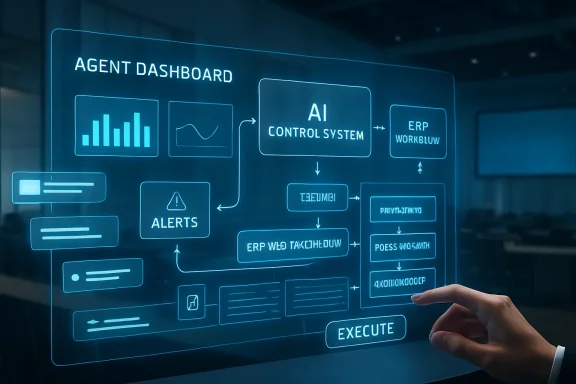 Microsoft Is Selling the End of the Dashboard Era
For years, enterprise software vendors have sold visibility as the cure for supply chain chaos. If only the planner could see inventory across sites, if only procurement could see supplier status, if only finance could see exposure, the organization would act faster. That promise was always partly true and partly evasive, because visibility does not move freight, rework a production schedule, or renegotiate a delivery commitment.Microsoft’s new agentic supply chain argument begins where the dashboard story runs out of road. A company can already know that a shipment is late, a supplier is unstable, a tariff change is looming, or warehouse capacity is constrained. The operational problem is that this knowledge lands in fragments: an email from a supplier, a Teams chat from operations, a planning exception in ERP, a customer commitment in CRM, a contract clause in a document library.
The company’s answer is to make agents the connective tissue between those fragments. In Microsoft’s telling, Dynamics 365 and Microsoft 365 Copilot do not merely expose information; they give agents governed access to the business processes where work actually changes. The agent reads a signal, relates it to orders and inventory, applies policy constraints, and either recommends or initiates the next step.
That framing matters because it moves AI from the edge of the workflow into the workflow itself. A chatbot that explains why a purchase order is late is useful. An agent that can connect the supplier delay to affected production orders, identify alternate stock, draft the supplier response, and prepare the transfer for approval is an entirely different category of system.
This is the line Microsoft is trying to cross with Dynamics 365 Supply Chain Management. It wants to turn ERP from a system of record into a system of action, while insisting that governance, permissions, and human oversight will keep the new machinery from becoming reckless automation in enterprise clothing.
Agentic AI Turns Supply Chain Work Into a Control Problem
The phrase agentic AI has already been stretched nearly to meaninglessness by vendors, consultants, and conference decks. In its most defensible form, it describes software that can pursue a goal across multiple steps, use tools, reason over context, and take or prepare actions rather than simply generate text. In the supply chain, that difference is not cosmetic. The business value appears only when the agent can cross boundaries that humans currently bridge by hand.A planner does not just need a better forecast. She needs to know whether a demand change affects material availability, supplier commitments, production capacity, warehouse labor, freight plans, and customer promises. A procurement lead does not just need to know that a supplier sent an apologetic email. He needs to understand whether that delay threatens a line stoppage, a premium customer order, or a low-priority replenishment that can wait.
That is why Microsoft’s blog leans so heavily on orchestration. The company is not presenting agents as isolated helpers that live inside a single screen. It is presenting them as participants in a chain of decisions stretching from forecast to plan, source to pay, plan to produce, inventory to deliver, order to cash, and service to deliver.
The operational ambition is obvious: reduce the number of moments where a human has to gather context before making a decision. In a conventional workflow, a disruption enters through one channel and then begins its slow tour through departments. Procurement checks the purchase order. Planning checks the bill of materials. Operations checks capacity. Sales checks customer exposure. Finance checks cost. By the time the organization agrees on a response, the best option may already be gone.
Agentic AI tries to invert that sequence. Instead of waiting for humans to assemble the picture, the agent assembles the picture first. Humans then review an already-contextualized choice: expedite, substitute, transfer, reschedule, split, promise later, or escalate.
That is the persuasive part of Microsoft’s thesis. The controversial part is whether enterprises are ready to let software operate close enough to execution to matter.
The Real Product Is Not the Agent — It Is the Permission Model
Microsoft’s strongest technical argument is not that its agents are clever. Clever agents are increasingly cheap. The harder claim is that Dynamics 365 can give agents secure, governed access to ERP processes without turning every workflow into an untraceable automation maze.That is where the Dynamics 365 ERP model context protocol server enters the story. Microsoft describes it as a way for agents to connect to ERP data and business processes through governed interfaces, rather than scraping screens or improvising around brittle integrations. In plain English, it is the pipe that lets an agent understand and act within Dynamics 365 Finance and Supply Chain Management while respecting the system’s business logic.
That distinction is important. In enterprise operations, “the AI updated the order” is not a feature unless the organization can answer a long list of follow-up questions. Which agent acted? Which data did it rely on? Which policy allowed the action? Which human approved it, if approval was required? Could the action be reversed? Was the recommendation based on fresh data or a stale snapshot?
Without those answers, agentic AI becomes shadow automation. With those answers, it starts to resemble a governed execution layer.
Microsoft is also tying this story to Work IQ and Agent 365, two concepts that show how far the company wants to extend the agent fabric. Work IQ is meant to ground agents in the work context spread across Outlook, Teams, Word, and Dynamics 365. Agent 365 is positioned as the administrative layer for observing, governing, and securing agents across the organization.
This is a familiar Microsoft move. The company rarely wins enterprise categories by having the flashiest single product. It wins by embedding a new capability into identity, security, productivity, developer tooling, admin controls, and the system of record. If agentic AI becomes an enterprise platform shift rather than a point-solution feature, Microsoft wants the center of gravity to be Entra, Microsoft 365, Dynamics 365, Power Platform, Copilot Studio, and Azure.
That is also why this announcement should interest WindowsForum readers who do not spend their days inside supply chain planning. The Dynamics 365 supply chain story is one example of a broader Microsoft operating model: agents become new work identities, new security subjects, new audit objects, and new participants in business processes. The ERP demo is the sharp end of a much larger enterprise wedge.
Gartner’s 2031 Forecast Gives the Pitch a Convenient Clock
Microsoft’s blog cites Gartner’s prediction that 60 percent of supply chain disruptions will be resolved without human intervention by 2031. That number is doing a lot of work. It gives Microsoft’s product narrative the aura of inevitability and places the industry on a five-year runway from assisted decision-making to substantial operational autonomy.Forecasts like this should be handled carefully. Gartner is not saying every company will automate 60 percent of its disruptions by 2031, nor that every automated resolution will be wise, cheap, or risk-free. It is describing a direction of travel: as AI-enabled supply chain systems mature, more exceptions will be handled without direct human action.
Even so, the prediction captures the core pressure facing chief supply chain officers. Disruption volume is rising faster than organizational capacity. Geopolitical instability, trade policy uncertainty, climate events, supplier insolvencies, cyber incidents, and freight volatility create too many exceptions for manual triage to scale. If every exception requires a meeting, the meeting becomes the bottleneck.
Agentic systems promise a way out by sorting disruptions into categories. Some exceptions can be monitored. Some can be recommended. Some can be executed automatically within tight boundaries. Some must be escalated because the cost, reversibility, compliance exposure, or customer impact is too high.
That classification problem may become one of the defining management disciplines of the AI era. The question will not be whether an agent is “autonomous” in the abstract. The question will be what kinds of actions an agent can take under what conditions, with what evidence, within what limits, and under whose accountability.
Microsoft’s blog repeatedly uses language about humans remaining in control. That is both necessary and strategically ambiguous. In the early market, “human in the loop” reassures buyers that AI will not run the warehouse into a wall. In mature deployments, the human loop may shrink to policy design, exception review, and post-action audit. The work changes from approving every move to designing the envelope in which moves can happen.
The Supplier Delay Demo Is the Whole Strategy in Miniature
The most concrete example in Microsoft’s post is the Procurement Agent inside Dynamics 365 Supply Chain Management. When a supplier flags a component delay, the agent triages the communication, matches it to the affected purchase order, summarizes downstream impact across inventory, sales orders, and production schedules, and highlights options such as available inventory elsewhere in the network.This is the kind of workflow where agentic AI can be genuinely useful because the pain is not mysterious. Supplier emails arrive in natural language. Purchase orders live in ERP. Production impact depends on bills of materials and schedules. Customer impact depends on sales orders, priority rules, and promise dates. Humans waste time stitching that context together.
A conventional automation system struggles here because the input is messy and the response depends on judgment. A pure chatbot is insufficient because explaining the delay does not solve it. An agent sits between those poles: flexible enough to interpret the supplier signal, integrated enough to query the operational record, and constrained enough to present an action for review.
The example also reveals the limits of the technology. If the agent recommends shifting stock from another location, the enterprise must trust that the inventory record is accurate, the transfer rules are current, the customer priority logic is valid, and the downstream consequences have been considered. Bad master data does not become good because a large language model reads it with confidence.
This is where Microsoft’s “frontier firm” language risks smoothing over the hard part. The companies most ready for agentic workflows are not merely the ones with aggressive AI strategies. They are the ones with clean process ownership, disciplined data governance, explicit business rules, and a willingness to redesign roles around exception handling rather than spreadsheet heroics.
For those organizations, agentic AI may feel like leverage. For the rest, it may feel like an expensive mirror held up to years of ERP compromise.
Demand Planning Becomes Continuous, Whether Organizations Are Ready or Not
Microsoft’s forecast-to-plan argument is that demand planning should no longer be limited to periodic forecast updates. Dynamics 365 Demand Planning can incorporate external signals such as promotions, market conditions, and changing demand patterns alongside operational data, allowing planners to continuously adjust forecasts and supply plans.That is a sensible direction. The calendar-based planning ritual has always been a poor fit for volatile markets. A monthly planning cycle can be too slow when a viral demand spike, port disruption, regional conflict, supplier failure, or sudden regulatory change reshapes assumptions overnight. The cost of waiting for the next cycle is often paid in premium freight, missed revenue, excess inventory, or customer disappointment.
But continuous planning is not simply faster planning. It changes the organizational contract. If forecasts update continuously, then production, procurement, finance, and sales must agree on when a change is significant enough to act. Otherwise the business risks thrashing: chasing every signal, rescheduling too often, and creating instability in the name of responsiveness.
Agents can help by filtering noise, evaluating scenarios, and surfacing the changes that matter. They can also make the organization more reactive if the policies behind them are weak. A system that can move faster will amplify both good rules and bad ones.
The strategic question is whether enterprises will use agents to institutionalize better decision logic or merely accelerate existing dysfunction. A planner who spends less time consolidating data has more time to judge trade-offs. But only if the organization gives that planner clear authority, trustworthy context, and incentives that reward total system performance rather than local optimization.
Microsoft’s supply chain vision assumes that decisions and actions can be connected across the end-to-end process. That is the right ambition. It is also the exact place where many transformation programs stall.
Warehouses and Factories Are Where AI Hype Meets Physical Consequences
It is easy to discuss agentic AI in the abstract when the workflow is an email, a forecast, or a purchase order. The stakes become more concrete when the agent’s recommendation changes a production schedule, reprioritizes warehouse work, or affects a customer delivery. The supply chain is not a purely digital system. It is a digital-physical system with forklifts, labor shifts, machine downtime, quality checks, dock doors, and trucks that do not wait politely for a model to reconsider.Microsoft points to agents helping update production schedules, work orders, warehouse activities, and task priorities in response to material availability, labor capacity, or changing priorities. This is where the promise becomes powerful. A material shortage should not require a planner to manually notify half the operation before the schedule adjusts. A warehouse team should not be stuck executing yesterday’s priorities while customer commitments change upstream.
Still, execution systems are unforgiving. A bad recommendation can create congestion, starve a line, misallocate scarce labor, or cause a shipment to miss its carrier window. Even if the financial impact is modest, the credibility impact can be severe. Operations teams do not need AI that sounds plausible. They need AI that respects the ugly details of constraints.
That means successful deployments will likely begin with bounded actions. An agent may reorder task priority within a defined queue, suggest a schedule adjustment, or prepare a transfer order for approval. Over time, as performance is measured and trust grows, more actions can move from recommendation to execution.
The phrase human in the loop should not be treated as a magic charm. A rushed supervisor clicking approve on an opaque recommendation is not meaningful oversight. The human needs to see the reason, the data freshness, the alternatives considered, the policy constraints applied, and the expected consequence. Otherwise the loop is theater.
Agentic Commerce Pushes the Same Logic Toward the Customer
Microsoft also connects agentic AI to order-to-cash and what it calls agentic commerce. The idea is that customers can be routed to the right distribution channel, quote-to-order can be accelerated, and accurate operational data can make the purchase experience faster and more reliable.This is not just a sales convenience. In supply chain terms, customer-facing promises are where internal uncertainty becomes external liability. If the system promises inventory that is not truly available, commits to a date that production cannot support, or routes an order through a constrained channel, the customer experiences the failure even if the root cause was upstream.
An agentic order experience is valuable only if it is grounded in live supply chain reality. That means available-to-promise logic, inventory visibility, production status, logistics capacity, pricing rules, customer priority, and contractual commitments all need to inform the interaction. A slick AI front end attached to stale back-end data is worse than a slow conventional process because it creates false confidence at higher speed.
This is where Microsoft’s integrated stack gives it an argument. Dynamics 365 can span sales, finance, supply chain, commerce, and field service. Microsoft 365 contains much of the conversational and document context where exceptions are negotiated. Copilot provides the user interface metaphor. Agents become the connective mechanism.
The weakness is that few enterprises run a pristine Microsoft-only world. Real supply chains involve legacy ERPs, specialized warehouse systems, third-party logistics platforms, supplier portals, spreadsheets, data lakes, EDI feeds, and industry-specific tools that predate the current AI boom. Microsoft can orchestrate across its estate, but the hardest environments will demand integration beyond the boundaries of the demo.
That does not invalidate the strategy. It does mean the real competition is not merely between Microsoft, SAP, Oracle, and best-of-breed planning vendors. It is between platforms that can govern cross-system action and platforms that can only decorate existing workflows with AI summaries.
The Governance Story Is Strong Because the Risk Is Real
Microsoft’s insistence on governed agents is not a compliance footnote. It is the condition for enterprise adoption. Supply chain agents will touch commercially sensitive data, supplier terms, customer commitments, production plans, inventory positions, and financial consequences. They may also interact with regulated processes, export controls, sustainability reporting, and industry-specific compliance regimes.The security model must therefore account for agents as operational actors. They need identities, permissions, logs, policies, and revocation. They need separation of duties. They need escalation paths. They need a way for IT and business owners to know which agents exist, what tools they can use, and what actions they have taken.
This is why Agent 365 is potentially more important than the individual supply chain examples. If enterprises create hundreds or thousands of agents across departments, the agent registry becomes as important as device management or identity governance. Shadow AI is not just an employee pasting data into an external chatbot. It can also be a locally useful automation that quietly gains access to workflows no one centrally understands.
There is also a model-risk problem. Agents can reason incorrectly, overfit to recent signals, misread ambiguous language, or confidently recommend actions that violate informal business norms. In supply chain, informal knowledge matters. A supplier may be contractually low priority but strategically important. A customer may be unprofitable on paper but critical to market access. A warehouse workaround may not be documented but may be essential during peak season.
Good governance cannot mean freezing agents inside rigid rules that make them useless. It must mean designing a layered control system: policies for what agents may do, telemetry for what they actually do, evaluation for whether outcomes improve, and human accountability for the business logic they encode.
That is a more mature conversation than the industry was having during the first wave of generative AI pilots. Microsoft appears to understand that the enterprise buyer has moved from curiosity to control.
The Competitive Landscape Is Becoming an Operating-System Fight
Microsoft is not alone in arguing that supply chains need AI orchestration. SAP, Oracle, Manhattan Associates, Blue Yonder, Kinaxis, o9 Solutions, ServiceNow, Salesforce, and a long tail of logistics and planning vendors all see the same opportunity. The difference is where each company believes the control plane should live.Planning vendors often begin with optimization. ERP vendors begin with transactions. CRM vendors begin with customer commitments. Workflow vendors begin with process orchestration. Hyperscalers begin with data, models, and infrastructure. Microsoft’s advantage is that it can plausibly claim several of these territories at once.
That breadth is why its supply chain message sounds less like a feature release and more like a platform doctrine. The company wants the AI agent to move through the same world as the employee: Outlook, Teams, Word, Excel, Dynamics, Power Platform, Fabric, Azure, identity, security, and admin controls. If that world becomes the enterprise work surface, Microsoft’s agents do not need to be perfect everywhere. They need to be present everywhere.
For customers, this creates a familiar trade-off. A unified Microsoft architecture may reduce integration friction, simplify governance, and speed adoption. It may also deepen dependency on one vendor’s assumptions about identity, workflow, AI tooling, licensing, and data architecture. The more agents act across systems, the more strategic the orchestration layer becomes.
Supply chain leaders should resist the temptation to evaluate this as a narrow Dynamics 365 feature set. The real decision is architectural. Where should business context live? Which platform should hold policy? Which system should authorize action? Which vendor should provide the audit trail when a machine-made recommendation changes a customer outcome?
Those are not questions procurement departments can settle through feature checklists. They are board-level questions disguised as software selection.
The ROI Case Will Be Measured in Latency, Not Magic
The most credible financial case for agentic supply chain AI is not that it will replace planners or procurement teams wholesale. It is that it will reduce latency in high-frequency, high-friction decisions. Delay has a cost, and supply chains are full of delay.A late supplier notice sits in an inbox for two hours. A planner spends half a day pulling the impact analysis. A warehouse team executes an old priority list. A customer service rep promises based on outdated availability. A production scheduler waits for confirmation from procurement. None of these failures looks dramatic in isolation. Together they create the operational tax that companies have learned to tolerate because the alternative required too much coordination.
Agents attack that tax. They can monitor, correlate, draft, recommend, initiate, and escalate faster than a human team working across disconnected systems. If the data is good and the policies are sound, that speed can become margin protection.
The return will not be evenly distributed. High-volume, exception-heavy operations with relatively clear decision rules should see benefits earlier. Complex, bespoke, low-volume supply chains with messy data and informal decision logic may struggle. Regulated sectors will move more carefully. Companies with recent ERP modernization behind them will be better positioned than those trying to bolt agents onto fragmented legacy estates.
The ROI conversation should also include avoided loss, not just headcount efficiency. A faster response to a component delay can prevent a line stoppage. Better order promising can reduce penalties or churn. Earlier supplier risk detection can preserve optionality. More consistent execution can reduce premium freight and firefighting.
That is a more compelling argument than the lazy “AI will do the work” slogan. Agentic AI’s first supply chain dividend may be giving humans fewer bad options by the time they are asked to decide.
The Microsoft Demo Points to a Future That Will Not Arrive Evenly
The clean version of Microsoft’s vision is attractive. A disruption appears. Agents gather context across systems. Policies define the available moves. Humans review the exceptional cases. Routine disruptions are resolved before customers feel them. The organization becomes faster, calmer, and more resilient.The messy version is what most enterprises will encounter first. Some data will be stale. Some integrations will be incomplete. Some policies will be implicit. Some agents will produce impressive summaries while failing at edge cases. Some teams will distrust recommendations they cannot interrogate. Some leaders will push for autonomy before the control model is ready.
That unevenness does not make the vision wrong. It makes the implementation politically and operationally difficult. Supply chain transformation is never just about software because supply chains encode the compromises of the business: who gets priority, who absorbs cost, which customers matter most, how risk is priced, and how much uncertainty leadership is willing to tolerate.
Agentic AI forces those compromises into machine-readable form. That may be its most disruptive effect. To let agents act, companies must define rules they previously left to meetings, favors, experience, and escalation. The work of “AI adoption” becomes the work of making the operating model explicit.
Microsoft’s advantage is that it can offer familiar enterprise scaffolding for that transition. Its challenge is that customers will expect the scaffolding to bear real operational weight. A supply chain agent that fails in a demo is embarrassing. A supply chain agent that fails in production can cost money, customers, and trust.
The Useful Lessons Are Hiding Behind the Buzzword
The immediate lesson from Microsoft’s announcement is not that every company should rush to automate disruption resolution. It is that the center of supply chain software is shifting from visibility to action. The companies that benefit will be those that treat agentic AI as an operating-model redesign, not a dashboard upgrade.- Microsoft is positioning Dynamics 365 Supply Chain Management as an execution platform for governed agents, not merely a place where Copilot explains ERP data.
- Gartner’s 2031 forecast gives the industry a direction of travel, but individual companies will move at very different speeds depending on data quality, process maturity, and risk tolerance.
- The most practical early use cases are likely to be exception-heavy workflows where agents can gather context, prepare recommendations, and initiate reversible actions within defined limits.
- Governance will decide whether agentic AI becomes trusted infrastructure or another layer of shadow automation.
- The biggest architectural question is where enterprises want the agent control plane to live, because that layer will increasingly mediate decisions across ERP, productivity tools, logistics systems, and customer-facing processes.
If the last decade of supply chain software was about visibility, the next one will be about governed agency: who or what is allowed to act, on which evidence, under which constraints, and with what accountability. Microsoft has drawn a plausible map for that future, but the road runs through the least glamorous parts of enterprise IT — master data, permissions, process design, audit trails, integration, and change management. The winners will not be the companies that buy the most agents; they will be the ones that teach their organizations, human and machine alike, how to act before disruption hardens into damage.
Source: Microsoft From intelligence to impact: How agentic AI is reshaping today's supply chain - Microsoft Dynamics 365 Blog
