Ericsson and Microsoft have announced a joint integration that embeds advanced 5G management capabilities into Windows 11, promising enterprises an easier, more secure, and more automated way to deploy and operate 5G‑connected laptops at scale.
The move builds on several years of trials and incremental feature work across Microsoft, Ericsson, and leading communications service providers (CSPs). Enterprise use of cellular‑connected PCs has long been hampered by manual provisioning, fragmented eSIM management, uneven roaming performance and inconsistent security controls compared with corporate Wi‑Fi. Ericsson’s enterprise portfolio — recently rebranded in part as Ericsson Enterprise 5G Connect (previously marketed as EVCN) — has offered centralized eSIM lifecycle management and policy orchestration in pilot programs since 2023–2024. Microsoft has in parallel pushed Surface Copilot+ PCs and Windows 11 platform features that support eSIM-capable 5G modems and local AI acceleration on certain Copilot+ devices.
The February 17, 2026 announcement formalizes a productized integration: Windows 11 will include 5G management capabilities that interoperate with Ericsson Enterprise 5G Connect and Microsoft Intune. The joint solution is positioned as an enterprise bundle that combines Surface Copilot+ devices, Microsoft 365 and Intune, and Ericsson’s connectivity orchestration to deliver zero‑touch provisioning, automated eSIM switching, policy‑driven network selection, and on‑device AI that makes real‑time connectivity decisions.
That said, several specific elements are either newly announced or framed primarily by vendor messaging and should be treated as such:
At the same time, the announcement remains a vendor‑led unveiling of capabilities and availability that will require rigorous validation in enterprise conditions. IT leaders should approach with optimism but temper adoption with careful pilots, strong contractual protections, and close attention to costs, privacy, and regulatory constraints. The greatest risk is not the technology itself but the operational and commercial complexity that can arise when carrier relationships, policy governance, and device behavior intersect across multiple countries and regulatory regimes.
If your organization is considering a move to 5G‑managed laptops, start small: validate compatibility, measure the true cost of ownership, test emergency and compliance scenarios, and insist on transparent security and data‑handling commitments from vendors. With those guardrails in place, the promise of always‑connected, policy‑driven enterprise laptops could genuinely reshape hybrid work — but the details will determine whether it becomes a strategic advantage or an avoidable source of complexity.
Source: Investing.com Ericsson, Microsoft add 5G management capabilities to Windows 11 By Investing.com
 Background
The move builds on several years of trials and incremental feature work across Microsoft, Ericsson, and leading communications service providers (CSPs). Enterprise use of cellular‑connected PCs has long been hampered by manual provisioning, fragmented eSIM management, uneven roaming performance and inconsistent security controls compared with corporate Wi‑Fi. Ericsson’s enterprise portfolio — recently rebranded in part as Ericsson Enterprise 5G Connect (previously marketed as EVCN) — has offered centralized eSIM lifecycle management and policy orchestration in pilot programs since 2023–2024. Microsoft has in parallel pushed Surface Copilot+ PCs and Windows 11 platform features that support eSIM-capable 5G modems and local AI acceleration on certain Copilot+ devices.The February 17, 2026 announcement formalizes a productized integration: Windows 11 will include 5G management capabilities that interoperate with Ericsson Enterprise 5G Connect and Microsoft Intune. The joint solution is positioned as an enterprise bundle that combines Surface Copilot+ devices, Microsoft 365 and Intune, and Ericsson’s connectivity orchestration to deliver zero‑touch provisioning, automated eSIM switching, policy‑driven network selection, and on‑device AI that makes real‑time connectivity decisions.
What Ericsson and Microsoft are promising
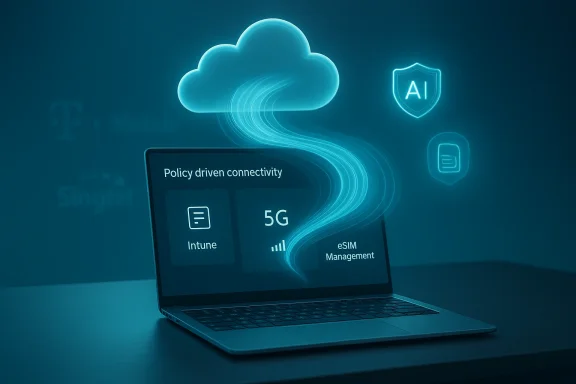
- Policy‑driven connectivity: IT admins can set enterprise policies in Microsoft Intune that determine how a device picks networks, prioritizes 5G for specific workflows, and enforces secure connectivity profiles automatically across a fleet.
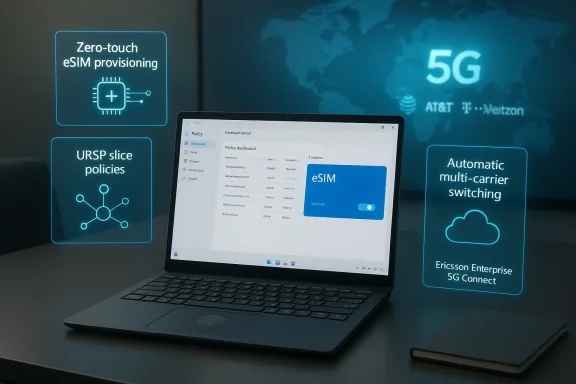
- Automated eSIM management and switching: Devices can download, activate, and switch between multiple eSIM profiles without user intervention, enabling automatic failover between CSPs or selected private networks.
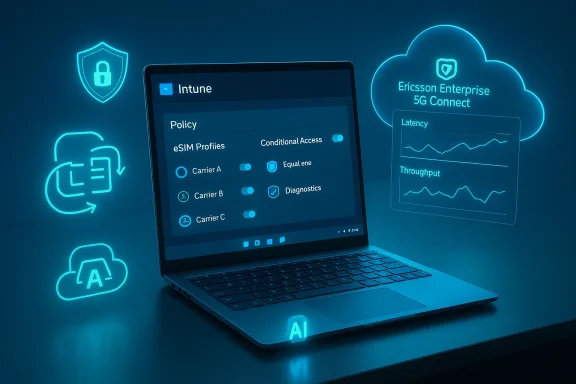
- Local AI agent for context‑aware decisions: An on‑device AI component is described as monitoring connection quality and making real‑time choices (for example, when to switch eSIM profiles or throttle traffic) to optimize performance and security.
- Centralized fleet provisioning: Zero‑touch provisioning means laptops can be shipped to users and automatically receive connectivity profiles, applications, and policies through Intune plus Ericsson’s backend orchestration.
- Carrier partnerships and staged availability: The announcement names a number of CSPs committed to early launch programs (including major operators in the United States, Sweden, Singapore and Japan) and signals broader rollouts through 2026.
Technical overview — how it works
The pieces and their roles
- Windows 11: Acts as the device platform that includes APIs and UI hooks to accept connectivity policies and to host a local agent responsible for device-side decisions.
- Surface Copilot+ and 5G modems: Provide the hardware — eSIM‑capable modems and NPUs for on‑device AI — required to perform local connectivity optimization and some inference locally to reduce latency and preserve privacy.
- Microsoft Intune: Serves as the management plane for device and policy provisioning, enabling admins to push connectivity profiles, compliance rules, and telemetry settings.
- Ericsson Enterprise 5G Connect: Provides carrier orchestration, eSIM lifecycle management, CSP interfaces and centralized analytics, and coordinates network profiles and enterprise subscriptions across operators.
- CSP networks and network slicing (where supported): Supply transport, network quality differentiation and, in some trials, slice selection to meet application SLAs.
eSIM lifecycle and automated switching
The integration uses eSIM profiles (remote SIM provisioning) to maintain multiple operator credentials on a single device. Ericsson’s platform centralizes the order, download, activation and lifecycle management of those eSIM profiles. Windows 11 + Intune then enforces enterprise policies to select among the available profiles based on rules such as geography, cost thresholds, application needs, or measured network performance. The stated behavior includes seamless switching between CSP profiles as a device moves, reducing user intervention and enabling predictable experiences for remote workers.Local AI agent and real‑time optimization
The partners describe a local AI agent that runs on Copilot+ PCs and analyzes context and telemetry (signal strength, latency, throughput, application priority, battery impact, user activity) to make decisions like switching eSIMs, prioritizing 5G over Wi‑Fi for specific apps, or throttling background syncs during poor connectivity. The agent is framed as a way to avoid constant cloud round trips for routine connectivity decisions, and to provide a privacy advantage by keeping certain telemetry local.Policy enforcement and security
Combining Intune device management with Ericsson’s connectivity control allows IT to enforce secure connectivity policies (for example, mandating VPNs for certain corporate resources, enforcing TLS minimums, or disallowing public Wi‑Fi for high‑risk workflows). The solution aims to make cellular connectivity a first‑class managed endpoint—subject to the same compliance checks as corporate laptops on Wi‑Fi.Where this matters most: practical enterprise benefits
- True zero‑touch deployment: Devices can be shipped preconfigured, with Intune and Ericsson provisioning eSIM and security policies automatically at first boot. This reduces IT overhead and simplifies logistics for distributed workforces.
- Consistent employee experience: Workers moving between cities or countries can enjoy consistent connectivity policies and predictable application behavior without manual carrier setup.
- Reduced dependence on public Wi‑Fi: For employees relying on coffee‑shop or hotel Wi‑Fi, corporate 5G connectivity reduces exposure to insecure networks and supports secure, always‑connected workflows like video conferencing and remote data access.
- Operational efficiency for IT: Centralized visibility into connectivity, automated troubleshooting triggers and fewer helpdesk tickets relating to “can’t connect” problems can reduce operational costs and speed mean time to repair.
- Better service quality for latency‑sensitive apps: With carrier selection, local AI optimization and, where available, network slicing, organizations can prioritize business‑critical traffic such as VoIP, remote desktop, or real‑time collaboration.
What’s been validated so far (and what remains vendor claims)
There is a documented history of trials and demonstrations that validate core components: Ericsson and Microsoft previously demonstrated network slicing and automated eSIM management in lab and field trials, and Microsoft’s Surface Copilot+ devices include AI NPUs and 5G-capable hardware. Press materials for the current announcement confirm early commercial pilots and operator commitments in several markets.That said, several specific elements are either newly announced or framed primarily by vendor messaging and should be treated as such:
- The existence of carrier early‑launch programs in the United States, Sweden, Singapore and Japan is documented in the announcement.
- The description of a local AI agent and seamless, policy‑driven cross‑carrier switching is specified in the partners’ joint materials; however, independent, third‑party performance metrics (for reliability, latency, time to switch, battery impact, and cost) have not been published yet.
- A referenced CSP partner name for an upcoming Spain launch appears in the announcement text in a form that looks like a transcription or typographic anomaly; this single‑word operator entry is not corroborated elsewhere and should be treated as potentially erroneous until clarified.
Risks, caveats and governance concerns
While the technical and operational promises are compelling, several practical and governance risks deserve attention.Vendor and carrier lock‑in
Centralized management that ties Intune to Ericsson’s orchestration and specific carrier bundles may create lock‑in pressure. Enterprises should examine contract terms carefully to understand portability of eSIM profiles, exit clauses, and costs for cross‑carrier/fallback scenarios.Cost and billing complexity
Automated switching across multiple carriers can inadvertently multiply roaming and data charges if policy and cost thresholds are not finely tuned. Companies need robust policy rules that incorporate cost controls, per‑user or per‑department caps, and clear reporting to avoid billing surprises.Privacy and data sovereignty
Even if a local AI agent reduces some telemetry sent to the cloud, the full solution relies on cross‑border exchanges between device telemetry, Intune, and Ericsson’s cloud services. Enterprises with strict data residency requirements should map what metadata and logs will be stored where and ensure contractual and technical controls align with regulatory obligations.Security surface and eSIM risks
eSIM offers operational convenience but concentrates risk: a compromised provisioning platform or weak authentication could allow unauthorized profile downloads or fraudulent profile activations. Enterprises must insist on strong authentication, audit trails, hardware‑backed keys, and vendor transparency about their supply chain security.Emergency services and regulatory compliance
Cellular devices are subject to local emergency calling and lawful intercept rules that vary widely. eSIM switching across operators and countries could inadvertently affect emergency‑call routing or regulatory obligations if not accounted for during deployment planning.Device battery and performance trade‑offs
Continuous network monitoring, frequent profile switching, and local AI inference may affect battery life and thermal behavior on laptops. Benchmarks under realistic use cases are necessary—expect IT pilots to measure battery impact and define policy thresholds that balance connectivity and device endurance.Practical guidance for IT teams (checklist)
- Inventory and compatibility
- Verify which laptop models in your fleet are eSIM‑capable and meet the Copilot+ hardware requirements if local AI features are required.
- Confirm Windows 11 build and Intune configuration items that the solution requires; pilot on a controlled set of devices.
- Carrier and contract readiness
- Confirm CSP support, coverage maps, and roaming behavior in your primary geographies.
- Negotiate clear Service Level Agreements and pricing terms (incl. data caps, roaming, and profile lifecycle costs).
- Policy design and cost controls
- Define policies that prioritize networks by cost bands and application priority.
- Implement cost‑based thresholds and alerts in Intune and Ericsson’s management console to avoid runaway roaming charges.
- Security and governance
- Ensure encryption, certificate management, and hardware‑backed identity (TPM/Pluton) are enforced.
- Map telemetry flows and audit trails to satisfy data residency and compliance needs.
- Pilot and measure
- Run a pilot across representative locations and workflows: remote office, urban commuting, international travel, and high‑density venues.
- Measure switching latency, application performance, battery impact, helpdesk tickets, and billed costs.
- Integration with security stack
- Integrate connectivity telemetry with existing SIEM/endpoint protection platforms to centralize alerts and automate remediation.
- Validate VPN and conditional access flows when switching carriers.
- Emergency readiness and regulatory checks
- Confirm emergency dialing behavior and legal intercept obligations for the operators and profiles you deploy.
- Where required, maintain local support processes that can disable profiles quickly.
Commercial and strategic implications
- For device makers and OS vendors: Windows becoming a managed host for 5G connectivity strengthens the PC platform’s relevance in hybrid work. OEMs that support eSIM and local AI will be advantaged in enterprise procurement cycles.
- For CSPs: The model enables new enterprise bundles (device + connectivity + management) and could shift revenue from SIM sales toward managed connectivity services and analytics.
- For MSPs and systems integrators: There is an opportunity to package deployment, policy and billing controls for verticals with high mobility needs (logistics, field services, finance, healthcare).
- For regulators and privacy officers: Expect scrutiny around cross‑border data flows, eSIM provisioning governance, and emergency services handling — companies will need to demonstrate safeguards.
What to watch next
- Early adopter reports: Look for independent case studies and technical benchmarks from pilot participants, which will surface real‑world switching times, application continuity and costs.
- MWC demonstrations: The partners plan to show capabilities at MWC Barcelona 2026; demos there should reveal more about UX, management consoles, and failover behavior.
- Carrier rollouts and pricing models: As CSPs shift to managed enterprise bundles, expect a range of commercial models — per‑device monthly, pooled data, or usage‑based add‑ons. Negotiate flexible terms.
- Standards and industry responses: Watch for industry guidance on eSIM security best practices, network slicing billing models, and any regulatory clarifications on cross‑border eSIM provisioning.
- Security audits and certifications: Enterprises will want independent audits of Ericsson’s orchestration and Microsoft’s policy controls; look for published audits and compliance attestations.
Final assessment — promise balanced with prudence
The joint Ericsson–Microsoft integration takes a logical, long‑anticipated step: treating the laptop as a first‑class, centrally managed 5G endpoint. For distributed workforces and organizations that want predictable, secure connectivity without manual user steps, the proposed stack — Windows 11 + Intune + Ericsson orchestration + 5G‑capable hardware — could substantially simplify operations and reduce friction.At the same time, the announcement remains a vendor‑led unveiling of capabilities and availability that will require rigorous validation in enterprise conditions. IT leaders should approach with optimism but temper adoption with careful pilots, strong contractual protections, and close attention to costs, privacy, and regulatory constraints. The greatest risk is not the technology itself but the operational and commercial complexity that can arise when carrier relationships, policy governance, and device behavior intersect across multiple countries and regulatory regimes.
If your organization is considering a move to 5G‑managed laptops, start small: validate compatibility, measure the true cost of ownership, test emergency and compliance scenarios, and insist on transparent security and data‑handling commitments from vendors. With those guardrails in place, the promise of always‑connected, policy‑driven enterprise laptops could genuinely reshape hybrid work — but the details will determine whether it becomes a strategic advantage or an avoidable source of complexity.
Source: Investing.com Ericsson, Microsoft add 5G management capabilities to Windows 11 By Investing.com