

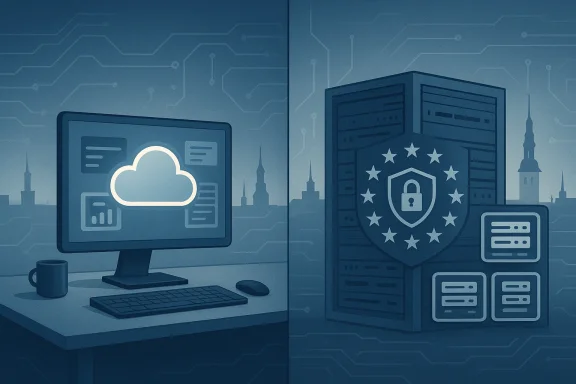
Estonia’s state IT centre is quietly running two contradictory but complementary bets at once: a fast, pragmatic migration of tens of thousands of government desktops into a centrally managed Microsoft-based workplace cloud, and a parallel program to prototype Europe-only alternatives that could be switched on if political, legal or operational circumstances force a break with US suppliers. (err.ee)
Estonia is shorthand for digital government in Europe: a decades-long national project of online identity, interoperable government registries and a “once-only” data economy that most countries still envy. That history shapes the country’s approach to vendor choice: pragmatic, standards-driven, and acutely aware that digital continuity is now a facet of national security rather than just an IT problem. The memory of the 2007 wave of denial-of-service attacks — which hammered government, media and banking infrastructure during the Bronze Soldier controversy — still drives investment in redundancy and resilience.
In recent years Estonia consolidated device management and productivity under Riigi IT Keskus (RIT), its central IT agency. RIT is actively migrating government workstations to a centrally managed cloud workplace service built largely on Microsoft 365 components while simultaneously planning tests of a “US‑free” alternative stack intended to prove whether a believable European alternative can be operationally viable. Those twin tracks — consolidation for efficiency and sovereign diversifications for contingency — explain the policy choices now playing out in Tallinn. (err.ee)
These are not off‑hand estimates: RIT’s own user counts and press interviews with director Ergo Tars supply the operational figures and the timeline for both the Microsoft-backed service and the planned trials of alternative stacks. The testing of a Europe‑based alternative was publicly framed as a pilot due in the second half of 2025 (an autumn trial window), with RIT signalling that the alternative is still immature but could be testable. (err.ee)
Estonia’s experiment matters to every European public‑sector CIO: it will test whether a small, digitally mature country can combine pragmatic consolidation with credible contingency — and whether that hybrid path can be a replicable model for democracies that want both capability and sovereignty.
Source: theregister.com Estonia tests Euro alternatives amid Microsoft rollout
 Background / Overview
Estonia is shorthand for digital government in Europe: a decades-long national project of online identity, interoperable government registries and a “once-only” data economy that most countries still envy. That history shapes the country’s approach to vendor choice: pragmatic, standards-driven, and acutely aware that digital continuity is now a facet of national security rather than just an IT problem. The memory of the 2007 wave of denial-of-service attacks — which hammered government, media and banking infrastructure during the Bronze Soldier controversy — still drives investment in redundancy and resilience. In recent years Estonia consolidated device management and productivity under Riigi IT Keskus (RIT), its central IT agency. RIT is actively migrating government workstations to a centrally managed cloud workplace service built largely on Microsoft 365 components while simultaneously planning tests of a “US‑free” alternative stack intended to prove whether a believable European alternative can be operationally viable. Those twin tracks — consolidation for efficiency and sovereign diversifications for contingency — explain the policy choices now playing out in Tallinn. (err.ee)
What RIT is actually doing today
The rollout: numbers, scope, timing
RIT reports it currently supports roughly 53 institutions and about 8,500 government workstations, and has already moved just over 7,000 users to its cloud workplace offering. The agency expects the managed service to grow — RIT’s public statements envisage managing roughly 12,500 workstations by the end of the year, and reaching about 15,000 of the state’s ∼25,000 workstations within two years under its staged roadmap. Critical ministries with the strictest security requirements (defence, interior, and parts of foreign affairs) remain on separate, higher-assurance platforms for now. (err.ee)These are not off‑hand estimates: RIT’s own user counts and press interviews with director Ergo Tars supply the operational figures and the timeline for both the Microsoft-backed service and the planned trials of alternative stacks. The testing of a Europe‑based alternative was publicly framed as a pilot due in the second half of 2025 (an autumn trial window), with RIT signalling that the alternative is still immature but could be testable. (err.ee)
Why keep Microsoft while testing alternatives?
RIT’s leadership has been explicit: the aim is not an ideological rejection of US vendors but operational preparedness. Officials say that the EU or national bodies could at some point rule that certain foreign-sourced products are not trustworthy for particular use cases, or that geopolitical or legal developments could make dependence on US cloud and productivity services untenable for specific workloads. Preparing a tested contingency is therefore a strategic hedge rather than a procurement populism. (err.ee)The strategic drivers: security, law, cost and geopolitics
Several concrete drivers are converging across Europe that make the RIT approach rational rather than eccentric.- Security and continuity: Estonia’s 2007 experience left an institutional belief that resilience requires redundancy, including geographically dispersed backups and legally robust escape routes for key services and data. The country’s data embassy concept — placing sovereign data under Estonian control in secure foreign facilities — embodies that thinking.
- Legal/regulatory risk: European regulators are increasingly assertive about control of data flows, government procurement and the governance of critical infrastructure. The prospect that EU-wide rules or national security decisions could restrict or complicate the use of non‑European cloud/comms providers is now a plausible planning assumption rather than a remote theoretical risk.
- Economic and industrial policy: public procurement is simultaneously a cost line and an industrial lever. There is growing appetite in EU capitals to capture more of the recurring licence and subscription spend inside the European tech ecosystem where possible — both to grow a domestic supplier base and to retain taxpayer money within the bloc. Analyst houses predict higher sovereign-oriented spend even while cautioning that hyperscalers will remain dominant for many workloads.
- Operational cost pressure: RIT and other public bodies calculate that some licence spend and the recurring costs of the modern workplace are significant — and those sums shape political choices. At the same time, RIT emphasises that migration costs, support, identity management and user training materially reduce any licence-only savings from switching to open-source or smaller suppliers. (See the “cost calculus” section below for a detailed look.) (err.ee)
Cross‑Europe context: the continent’s push for “digital sovereignty”
Europe-wide, governments and big corporates are experimenting with how to combine convenience and capability from large US cloud providers with legal defensibility and economic sovereignty. Two independent analyst trends are illustrative.- Forrester’s 2026 European predictions argue that Europe will intensify its pursuit of sovereign technology and regulation but that no European enterprise will wholly abandon US hyperscalers in 2026; the analysts expect selective migration and niche sovereign deployments rather than mass substitution.
- Gartner’s late‑2025 survey found that a majority of Western European CIOs were planning to increase reliance on local or regional cloud providers for geopolitical reasons, predicting that by 2030 most enterprises outside the U.S. will have a digital sovereignty strategy. That confirms a trend toward hybrid and layered sourcing rather than abrupt, wholesale swaps away from hyperscalers.
The technical and human reality of replacing Microsoft in government workplaces
The practical difficulty of substituting a full Microsoft-based workplace should not be underestimated. RIT’s own appraisal highlights multiple technical and human dependency layers:- Identity and authentication: Microsoft Entra (Azure AD) and Microsoft-managed identity constructs are not just single features — they are control planes for SSO, conditional access and device posture. Replacing them requires an equally robust IAM fabric, migration of certificates and a tested federated identity model. (err.ee)
- Productivity and file formats: the “familiarity friction” of replacing Word, Excel, Outlook and PowerPoint is real. RIT explicitly flagged the user learning curve — many civil servants have decades of muscle memory in these apps — as a major migration barrier. Simple UI differences cascade into productivity loss, support calls, and retraining costs. (err.ee)
- Management and support tooling: patching, device provisioning, telemetry, Intune/MDM policies and enterprise group policies form an administrative ecosystem. An open‑source stack or smaller match not only feature parity but manageability, automation and supportability at scale. (err.ee)
- Data portability and integrations: core registries, line‑of‑business apps and identity-linked services rely on a labyrinth of integrations. Even if documents can be exported, workflows and automated pipelines often break without careful mapping and migration tooling. ([err.ee](https://www.err.ee/1609926128/eesti-hakkab-katsetama-usa-vaba-riigihort, technical feasibility is only one axis; usability, manageability and governance are equally crucial. That explains RIT’s statement that a short-term wholesale switch would be “very hard” — not impossible, but expensive, risky and time-consuming. (err.ee)
The cost calculus: licence fees vs. total cost of ownership
Public commentary and RIT interviews have focused attention on licence economics — but beware of overly simplistic arithmetic.- The Register reported a figure attributing roughly €400 of a €2,000 per-workstation cost to Microsoft licence fees. That headline number illustrates why licence costs attract attention, but RIT’s publicly available statements emphasize that licence savings do not translate directly into net budget wins once migration, support, user management and retraining are accounted for. I was unable to find an independent, itemized confirmation of the exact €400/€2,000 split in official RIT releases; readers should treat that specific figure as reported but not independently corroborated in the public contract documents I reviewed. (err.ee)
- Real-world migrations flip costs from licences to people, integration and risk budgets: data migrations, identity rework, desktop image rebuilds, helpdesk ramping, and formal security approvals are primary line items that often outstrip licence savings in the near term. Schleswig‑Holstein’s migration to an open‑source stack (a large German state example repeatedly discussed in EU policy circles) vividly demonstrated that licence savings are offset by significant one‑off migration and integration costs.
- A sober procurement view therefore treats licence spend as a recurring component of a broader TCO model — one that should include contingency capacity, multi‑vendor resilience costs, and funds to support an emergent European supplier ecosystem if sovereignty goals are serious.
Operational models that make sense for governments
If the objective is practical digital sovereignty rather than symbolic rejection of big suppliers, the following layered options make sense:- Hybrid sourcing (recommended for most governments)
- Keep mainstream productivity and low‑sensitivity workloads on established hyperscalers where they deliver capability and resilience.
- Migrate high‑risk, high-sensitivity, or legally constrained workloads to EU-hosted, nationally controlled clouds or sovereign solutions.
- Enforce customer-managed keys, auditable access governance (e.g., mandatory customer lockbox and independent attestations) and exit clauses in contracts.
- Phased substitution pilots
- Start with small, well-scoped pilots (tax, municipal services, or non‑mission-critical back offices) for European stacks, measure migration friction and user experience, and scale what works.
- Invest public money upstream
- Use procurement to fund maintainers, create targeted R&D funding (for identity fabrics, federated directory services, office compatibility layers) and co‑invest in shared platform services across nearby governments.
- Contractual remediation and resilience
- Require robust SLAs, documented runbooks, escrowed code or data, and legally enforceable migration/exit assistance as part of any large public procurement.
Practical risks and red flags
- Vendor lock‑in is often more about control planes (identity, directory, conditional access) than individual apps. A naïve app swap leaves you exposed if the identity backbone stays proprietary. (err.ee)
- Migration projects often underestimate human costs. Expect a steep support curve post‑cutover and the need for sustained retraining budgets. (err.ee)
- Sovereign clouds need scale and interoperability. European suppliers face a paradox: to be credible they must match hyperscaler reliability and partner ecosystems; to scale they require large multi‑customer anchors — which governments must be willing to provide. Forrester and Gartner both note that a full market pivot away from US hyperscalers is improbable in the short term, and that practical sovereignty tends to mean layered resilience rather than replacement.
- Political signalling and market fragmentation. If every EU member state pursues its own incompatible sovereign stack, the result could be fragmentation that weakens interoperability and raises per‑unit costs. Coordinated procurement, shared reference architectures and common standards are necessary to avoid that trap.
What to watch next (signal set)
- Pilots and measurable KPIs: whether RIT’s trial of Europe‑based desktops produces test telemetry about user satisfaction, helpdesk loads and migration costs when it runs in the autumn testing window. That data will be decisive in moving from rhetoric to planning. (err.ee)
- Contract terms from big buyers: whether large industrial buyers (Airbus, major banks, EU institutions) require customer-managed keys, runbook obligations and legal exit assistance in their next cloud procurements. These contract terms set market incentives.
- Regional coordination: EU‑level procurement frameworks or joint investments that create scale for European cloud providers and open-source stacks. If national pilots remain isolated, they will be expensive; joint programmes change the economics.
- Regulatory clarifications: how the EU’s evolving legal corpus (digital markets, AI rules, data acts) interacts with procurement law and national security exceptions. New rules might raise the cost of foreign-sourced cloud use in some scenarios, which would make RIT-style contingency planning imperative.
Conclusion — realism over symbolism
Estonia’s two-track approach is smart risk management: accelerate operational benefits today while building contingency options for tomorrow. That posture recognises three hard truths:- Replacing a dominant vendor in a functioning, nationwide workplace is an expensive, slow, human-centred project — not a flip of a switch. (err.ee)
- Europe’s sovereignty ambitions are real and will shape procurement decisions, but they will rarely translate into instant wholesale vendor replacement; the medium term will be filled with hybrid models, targeted sovereign workloads and negotiated contractual protections.
- The leverage point for governments is procurement design, contract terms and co-investment in scale — not a doctrinaire boycott of technologies that remain operationally superior for many use cases. Governments that use procurement as strategic policy — insisting on key‑management, exit assistance, and open standards — will be best placed to convert sovereignty goals into tangible systems and resilient services.
Estonia’s experiment matters to every European public‑sector CIO: it will test whether a small, digitally mature country can combine pragmatic consolidation with credible contingency — and whether that hybrid path can be a replicable model for democracies that want both capability and sovereignty.
Source: theregister.com Estonia tests Euro alternatives amid Microsoft rollout
