

ETAS’ decision to put its flagship calibration toolchain on Microsoft Azure and into the unified Microsoft Marketplace is a significant, practical step toward cloud-first automotive development — and it will get its public unveiling during CES 2026 in Las Vegas, where live demos will show engineers how the ETAS Calibration Suite, Data Operator, EATB (ETAS Analytics Toolbox), and ETAS ASCMO (Advanced Simulation and Calibration Model) can run on Azure to speed calibration, analytics, and model-based validation workflows. This is the first time ETAS has offered its products on Azure, and the move reflects a broader industry shift: automotive development workflows are increasingly moving off isolated engineering desktops and into scalable, cloud-native environments that can host everything from big-data analytics to agentic AI assistants and simulation farms.
ETAS has long been a staple of automotive toolchains, providing measurement, calibration, and diagnostic tools used by OEMs and Tier 1 suppliers. The company’s announcement that those tools — specifically the ETAS Calibration Suite, Data Operator, EATB, and ASCMO — will be available through the Microsoft Marketplace and hosted on Microsoft Azure signals a new phase for automotive development: cloud-enabled, AI-assisted calibration and simulation workflows that promise shorter iteration cycles and earlier issue detection through so-called “shift-left” practices.
The debut at CES 2026 is strategic. CES gathers technologists, OEM software teams, and cloud vendors on a single stage, making it an ideal venue to demonstrate integration between a traditional automotive tooling vendor and a hyperscale cloud platform. The initial package ETAS is bringing to Azure is explicitly designed to let engineering teams scale compute, centralize data, and automate routine calibration and analytics tasks — while leaving latency-sensitive functions and in-vehicle real-time control where they belong: at the edge.
ETAS’ move to make calibration, analytics, and simulation tools available through the Microsoft Marketplace on Azure is a substantive step toward mainstreaming cloud-native automotive development. The promise is real: faster iteration cycles, better fleet-level insight, and more accessible compute for what were once resource-limited problems. But the path to realizing those benefits runs through careful architecture, disciplined governance, and pragmatic hybrid designs that keep safety and determinism where they belong — close to the metal — while using the cloud for scale, analytics, and intelligent automation. The CES 2026 demos will show how this hybrid reality can work in practice; the real work will be inside engineering organizations as they adapt processes, upskill teams, and build the guardrails that turn cloud potential into production reality.
Source: Embedded Computing Design ETAS To Debut Cloud-Native Calibration Suite on Microsoft Azure at CES 2026 - Embedded Computing Design
 Background / Overview
ETAS has long been a staple of automotive toolchains, providing measurement, calibration, and diagnostic tools used by OEMs and Tier 1 suppliers. The company’s announcement that those tools — specifically the ETAS Calibration Suite, Data Operator, EATB, and ASCMO — will be available through the Microsoft Marketplace and hosted on Microsoft Azure signals a new phase for automotive development: cloud-enabled, AI-assisted calibration and simulation workflows that promise shorter iteration cycles and earlier issue detection through so-called “shift-left” practices.The debut at CES 2026 is strategic. CES gathers technologists, OEM software teams, and cloud vendors on a single stage, making it an ideal venue to demonstrate integration between a traditional automotive tooling vendor and a hyperscale cloud platform. The initial package ETAS is bringing to Azure is explicitly designed to let engineering teams scale compute, centralize data, and automate routine calibration and analytics tasks — while leaving latency-sensitive functions and in-vehicle real-time control where they belong: at the edge.
Why this matters: Cloud-native calibration as a practical accelerator
Calibration has always been a resource-intensive part of vehicle development. It requires large amounts of measurement data, compute for parameter sweeps and simulations, and coordinated workflows to push new parameter sets onto ECUs during testing. By moving those workloads to Azure and packaging the tools in the Marketplace, ETAS and Microsoft are targeting several long-standing pain points:- Scalable compute for simulation and analytics. Instead of waiting for local servers to finish long runs, engineers can burst to cloud instances for large-scale parameter sweeps, Monte Carlo tests, or long-duration analytics jobs.
- Centralized data and machine learning. Cloud storage and processing make it easier to aggregate vehicle fleets’ telemetry, label data, and train models that improve calibration and anomaly detection.
- Shift-left validation. Early validation on virtual ECUs and cloud-hosted models can detect integration issues far earlier in the development cycle, reducing expensive late-stage road testing.
- Faster onboarding and orchestration. Marketplace packaging and integrated orchestration reduce the friction of bringing new teams or suppliers into a shared toolchain.
ETAS on Azure: What’s in the initial suite
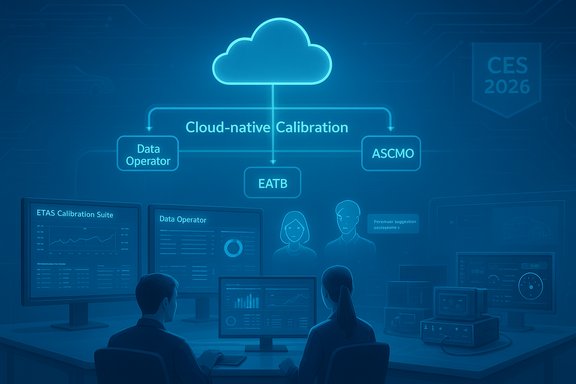
ETAS’ initial cloud offering centers on four components that map to distinct phases of calibration and analytics:- ETAS Calibration Suite — The core set of measurement and calibration tools, now able to operate with cloud-backed test data, remote orchestration, and centralized versioning.
- Data Operator — A cloud-capable data ingestion, transformation, and labeling layer to manage large volumes of vehicle telemetry and test data.
- EATB (ETAS Analytics Toolbox) — Analytics and model-training components designed to run at scale on Azure for tasks like fault detection, trend analysis, and feature extraction.
- ETAS ASCMO (Advanced Simulation and Calibration Model) — A simulation and model-based calibration engine that can leverage Azure compute to run high-fidelity virtual ECU tests and optimization loops.
How the Microsoft Marketplace and Azure change procurement and deployment
Placing ETAS tools in the Microsoft Marketplace does more than simplify buying; it alters lifecycle management and procurement options for enterprises:- Simplified procurement. Buyers can discover, trial, and subscribe to ETAS offerings directly via the Marketplace, accelerating procurement cycles and enabling consumption-based billing models.
- Unified billing and contracts. Enterprises with Azure consumption commitments can often fold software costs into existing cloud agreements, reducing vendor management overhead.
- Frictionless updates and multi-tenant deployments. Marketplace packaging enables ETAS to deliver continuous updates and manage multitenant deployments that align with corporate security standards and governance.
Technical architecture: What to expect and how it should be implemented
Any credible cloud-native calibration architecture must respect the real-time and safety-critical constraints of automotive ECUs while leveraging cloud strengths for compute, storage, and analytics. A practical architecture will typically look like this:- Edge/On-premise measurement layer. Real-time data acquisition and control — HIL rigs, test benches, and physical ECUs — remain close to the vehicle or laboratory. Local gateways handle deterministic connectivity and initial buffering.
- Secure ingestion and data staging. Gateways or edge nodes securely push sanitized telemetry and logs to cloud storage using encrypted channels and data governance policies.
- Cloud compute and simulation. ASCMO and EATB run large-scale simulations, optimization jobs, or ML training on Azure VMs, GPU instances, or managed services.
- Orchestration and agentic AI. Workflow orchestration coordinates jobs, runs agentic AI assistants for common tasks like parameter suggestions, and logs audit trails for compliance.
- Controlled deployment. Validated parameter updates are staged through CI/CD pipelines into local test benches or via secured OTA to test vehicles under controlled supervision.
Benefits for OEMs and suppliers — practical ROI and workflow gains
The combination of ETAS tooling and Azure infrastructure can produce measurable impact when used correctly:- Shorter time-to-market. Faster simulation and validation cycles reduce time spent on manual calibration loops and late-stage debugging.
- Reduced hardware footprint. Virtualization and cloud-backed testing can reduce dependence on large HIL farms and physical test variants.
- Better fleet-level analytics. Centralized data enables trend-based calibration updates, predictive maintenance algorithms, and broader fault pattern discovery.
- Accessible collaboration. Multiple engineering teams, suppliers, and consultants can access the same datasets and tool instances without complex VPN setups.
Security, compliance, and data governance: unavoidable complexities
Moving calibration and telemetry data to a public cloud brings immediate security and regulatory considerations:- Data sovereignty and cross-border transfers. Automotive telemetry may include personally identifiable or regulated data. Teams must design data partitioning and region-aware deployments to comply with EU and national rules.
- Automotive cybersecurity standards. Solutions must align with ISO/SAE 21434 and UN-R155 requirements for cybersecurity risk management, especially when tools influence ECU behavior or OTA updates.
- Confidential computing and IP protection. OEM IP and proprietary models must be protected. Azure offers confidential computing options and dedicated network configurations, but governance and contractual protections must be explicit.
- Auditability and traceability. Calibration decisions, agentic AI outputs, and model training steps must be logged for traceability in the event of regulatory audits or root-cause investigations.
Agentic AI: productivity gains and new risks
ETAS’ suite emphasizes agentic AI and improved orchestration to automate onboarding and routine tasks. The productivity promise is clear: AI agents can propose parameter changes, triage failed jobs, or summarize test runs. However, agentic AI introduces new obligations:- Human-in-the-loop is mandatory. AI suggestions that affect vehicle behavior must be validated by engineers with domain expertise before any deployment.
- Model provenance and guardrails. Training data, model lineage, fitness-for-purpose assessments, and conservative fallback behaviors are essential to mitigate hallucinations and unsafe suggestions.
- Explainability and defensibility. If a calibration change leads to an incident, organizations must demonstrate how the AI contributed, who approved it, and what safeguards existed.
- Operational governance. Role-based approvals, review workflows, and automated testing gates should be part of any agent-enabled pipeline.
Integration into existing toolchains and standards
ETAS’ cloud-delivered tools will need to coexist with legacy on-prem tools and industry standards. Integration priorities include:- ASAM interfaces. Support for ASAM standards (e.g., OpenXCU, XIL, MCD-3) will be critical for test-bench interoperability and automated calibration loops.
- AUTOSAR compatibility. For controller-level calibration and parameter management, seamless interaction with AUTOSAR artifacts and runtimes matters.
- CI/CD pipelines. Integrating calibration results into software CI/CD flows ensures calibration artifacts move with code releases.
- HIL/vHIL interoperability. A hybrid approach that mixes virtual ECUs (vECUs) and hardware-in-the-loop (HIL) systems will be the practical way forward, especially for late-stage validation.
Cost and operational considerations
Cloud migration often promises flexibility, but total cost of ownership depends on usage patterns:- Consumption model vs fixed HIL costs. For teams with bursty compute needs, consumption-based cloud costs can be lower than maintaining large on-prem clusters. For consistently high usage, committed on-prem hardware still may make economic sense.
- Data egress and storage costs. High-volume telemetry and long-term archives can become expensive. Lifecycle policies, hot/cold storage tiers, and local preprocessing are essential to control costs.
- Engineering productivity vs platform fees. Time saved through faster iterations and reduced manual labor must be weighed against subscription and compute expenses.
- Operational overhead. Teams need cloud architects and SRE-like roles to configure secure, resilient deployments, and to manage cost optimization.
Risk matrix and mitigation strategies
The major risks with cloud-native calibration are predictable and manageable when addressed early:- Latency / determinism risk. Mitigation: keep real-time control and critical loops on-premise; use cloud for non-deterministic, compute-heavy tasks.
- Security and IP leakage. Mitigation: use VNet isolation, private endpoints, confidential computing, strict IAM and zero-trust controls, plus contractual IP protections.
- Regulatory non-compliance. Mitigation: build region-aware deployments, data residency policies, and compliance-by-design workflows verified against ISO/SAE 21434 and relevant regulations.
- AI-driven errors. Mitigation: mandate human approval, logging, and conservative AI guardrails; use model validation suites and A/B control testing.
- Vendor lock-in. Mitigation: prefer open standards for artifacts, extractable data formats, and multi-cloud portability where practical.
Competitive context: who else is moving automotive tools to the cloud?
ETAS’ move is part of a broader industry trend where tooling vendors and OEMs partner with cloud hyperscalers:- Bosch and Microsoft are collaborating on a software-defined vehicle platform that likewise targets Azure for cloud-native orchestration and lifecycle management.
- Other vendors are working with AWS, Google Cloud, and Azure to deliver virtual test labs, HIL-as-a-service, and vECU farms—indicating a multi-cloud marketplace for automotive development tools.
- OEM initiatives are increasingly standardizing on cloud-led digital threads linking design, SW development, validation, and field operations.
What to expect at CES 2026 and near-term roadmap
At CES 2026, ETAS will host live demos at Booth 16203 in the Central Hall, showing the Microsoft Marketplace availability and how the toolchain performs on Azure. Visitors should expect:- Live demonstrations of cloud-hosted calibration and analytics workflows.
- Hybrid scenarios showing how cloud simulations feed into local test benches and vHIL setups.
- Agentic AI use cases demonstrating automated triage, parameter suggestions, and analytics-driven hints.
- Discussions of governance and security — ETAS and Microsoft will need to demonstrate security and compliance controls to win OEM trust.
Recommended checklist for engineering teams evaluating ETAS on Azure
Engineers and engineering managers should treat a cloud migration as a project, not a procurement checkbox. A practical evaluation checklist:- Define scope. Identify the exact calibration and analytics tasks to move to cloud (e.g., long-running simulations, ML training, fleet analytics).
- Pilot environment. Run a limited pilot on Azure with ETAS tools from the Marketplace to measure performance, cost, and integration effort.
- Security baseline. Validate IAM, VNet setup, confidential computing, and audit logging to meet organizational and regulatory needs.
- Data lifecycle policy. Establish retention, masking, and region-residency rules for telemetry and derived datasets.
- Integration plan. Map ASAM/AUTOSAR interfaces, CI/CD steps, and HIL interop for seamless artifact flow.
- AI governance. Define human approval gates, model validation tests, and explainability requirements before agentic AI suggestions affect live systems.
- Cost model simulation. Model expected compute, storage, and egress costs under realistic workload profiles.
- Stakeholder alignment. Get legal, security, and procurement stakeholders involved early to remove downstream blockers.
Final analysis: strengths, limits, and strategic advice
ETAS’ Azure debut is an important, pragmatic milestone in automotive toolchain modernization. The strengths are clear:- Domain expertise packaged for cloud consumption. ETAS brings decades of calibration experience; deploying those tools on Azure lowers the friction for teams ready to modernize.
- Scalability for compute- and data-intensive tasks. Azure enables parallelization and elastic capacity for simulation and ML.
- Marketplace distribution simplifies procurement and governance. For organizations already committed to Microsoft technology, this accelerates adoption.
- Latency and determinism constraints that demand hybrid architectures rather than full cloud replacement of on-vehicle and HIL real-time systems.
- Operational and cultural changes required of engineering groups; tool migration often fails when process and training are neglected.
- Regulatory and IP risks that must be mitigated by appropriate security, data-residency controls, and contractual protections.
- AI governance challenges where agentic assistants must be constrained by rigorous human-in-the-loop procedures.
ETAS’ move to make calibration, analytics, and simulation tools available through the Microsoft Marketplace on Azure is a substantive step toward mainstreaming cloud-native automotive development. The promise is real: faster iteration cycles, better fleet-level insight, and more accessible compute for what were once resource-limited problems. But the path to realizing those benefits runs through careful architecture, disciplined governance, and pragmatic hybrid designs that keep safety and determinism where they belong — close to the metal — while using the cloud for scale, analytics, and intelligent automation. The CES 2026 demos will show how this hybrid reality can work in practice; the real work will be inside engineering organizations as they adapt processes, upskill teams, and build the guardrails that turn cloud potential into production reality.
Source: Embedded Computing Design ETAS To Debut Cloud-Native Calibration Suite on Microsoft Azure at CES 2026 - Embedded Computing Design
