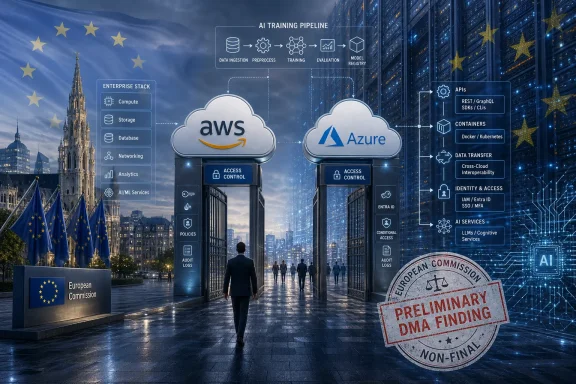
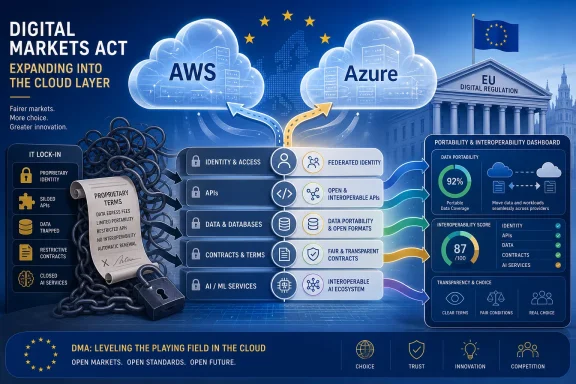
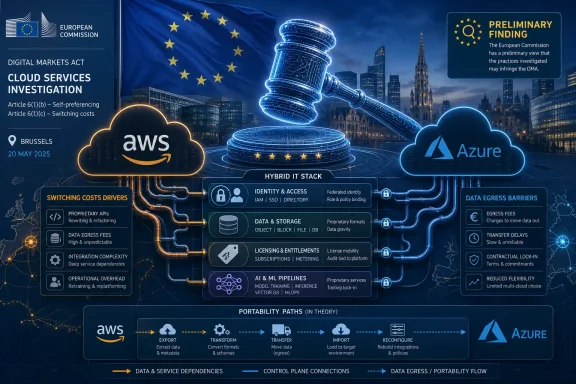
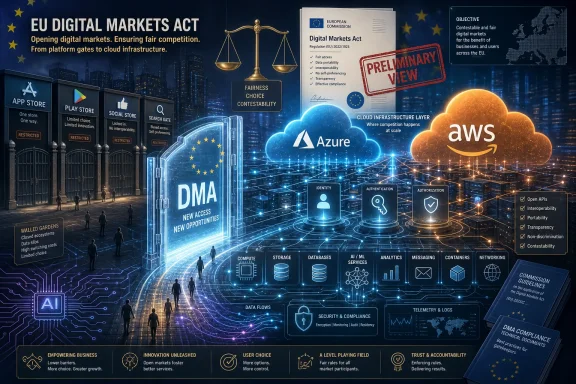
The European Union is moving toward treating Amazon Web Services and Microsoft Azure as Digital Markets Act “gatekeepers” after opening cloud market investigations in Brussels on November 18, 2025, with stakeholder roundtables scheduled for July 1, 2026. The decision is not merely another skirmish in Europe’s long-running fight with Big Tech. It is a recognition that the cloud has become the control plane for modern software, AI, procurement, security, and public-sector resilience. If the DMA began by policing app stores, search engines, browsers, and marketplaces, its next frontier is the infrastructure layer underneath almost everything else.
For years, the EU’s digital competition agenda was easiest to explain through consumer products: the phone in your hand, the browser choice screen, the app store fee, the search box, the marketplace ranking. Cloud computing was always in the statute’s orbit, but it sat awkwardly behind the scenes. The average citizen does not “use Azure” in the way they use Instagram or Google Search, yet the services they depend on increasingly run on Azure, AWS, or both.
That is what makes the Commission’s cloud push more consequential than a normal regulatory designation. The question is not whether AWS and Azure are large. Everyone in enterprise IT already knows they are. The question is whether their market position gives them the kind of gateway power the DMA was written to constrain.
The Commission’s own framing is revealing. It opened two investigations into whether AWS and Azure should be designated as gatekeepers for cloud computing services, even though they reportedly did not meet the DMA’s usual quantitative thresholds for that specific service. It also opened a third inquiry into whether the DMA’s current obligations are sufficient for cloud markets at all.
That third investigation may be the most important one. It implies Brussels is not simply trying to squeeze cloud into an existing rulebook. It is asking whether cloud lock-in, interoperability gaps, egress costs, bundled licensing, and contractual leverage require a sharper set of obligations than those designed for app stores and social networks.
That is now changing because cloud is no longer just rented compute and storage. Azure and AWS are developer ecosystems, identity layers, database platforms, AI deployment environments, security stacks, observability tools, procurement channels, and compliance wrappers. Once an organization builds deeply into one hyperscaler’s services, leaving is not a weekend migration. It can mean re-architecting applications, retraining staff, renegotiating contracts, moving data at scale, rewriting automation, and accepting a new operational risk profile.
This is the kind of dependency that competition law traditionally struggles to catch in time. By the moment abuse is obvious, customers may already be locked in. The DMA tries to act earlier by regulating structural power before every harmful practice has to be litigated as a bespoke antitrust case.
That is why the word “gatekeeper” matters. It is not a moral label, and it is not merely a size ranking. It is a finding that a company controls an important route between business users and end users, and that its role can shape market access for others.
The tension is that the same features that make a cloud platform useful can also make it sticky. Managed databases, proprietary serverless functions, integrated identity services, specialized AI accelerators, monitoring suites, and marketplace procurement can reduce operational burden. They also deepen technical dependency.
This is not sinister in itself. Platforms compete by integration. Windows became powerful because the operating system, developer model, management stack, and application ecosystem reinforced each other. Azure’s appeal to Windows-heavy enterprises follows a similar pattern: Entra ID, Microsoft 365, Defender, Intune, Windows Server, SQL Server, GitHub, Power Platform, and Azure services are increasingly sold as a fabric rather than a menu.
For IT pros, the problem is not integration. The problem is when integration becomes coercive. If licensing terms, data transfer fees, technical incompatibilities, or support models make it artificially expensive to use a rival cloud, the market stops rewarding only the best product and starts rewarding the strongest installed base.
Hybrid identity, device management, endpoint security, virtual desktops, Windows Server licensing, SQL Server workloads, developer workflows, and Microsoft 365 administration all increasingly intersect with Azure. A sysadmin can still run Windows infrastructure outside Microsoft’s cloud, but the path of least resistance often points back to Redmond’s own platform. The more Microsoft turns its software estate into cloud-attached services, the more cloud regulation becomes Microsoft regulation.
That does not mean Brussels is about to tell Microsoft how to design Windows Server or manage Active Directory. But it does mean regulators are watching the connective tissue: licensing portability, contractual conditions, data access, interoperability, and bundling. Those are precisely the places where enterprise customers feel the difference between a competitive bundle and a locked corridor.
Microsoft has already faced scrutiny in Europe over cloud licensing practices, with rivals arguing that customers can face worse economics when running Microsoft software on competing cloud platforms. Microsoft has made concessions in some areas, but the wider issue has not disappeared. The DMA investigation gives Brussels a broader instrument for asking whether the cloud market can remain contestable when software licensing, identity, productivity, security, and infrastructure are sold as a single strategic stack.
AWS lock-in is often more architectural than contractual. The deeper an organization goes into native AWS services, the harder it becomes to replicate the same application shape elsewhere. A workload built around EC2 and S3 is one thing. A workload built around Lambda, DynamoDB, IAM, CloudWatch, Kinesis, SageMaker, Bedrock, and a dozen managed networking and security assumptions is another.
The EU is therefore not just looking at old-fashioned exclusionary behavior. It is looking at modern infrastructure economics, where control can arise from convenience, ecosystem depth, technical defaults, and procurement scale. In that world, a customer may remain “free to leave” in theory while facing years of engineering cost in practice.
That is the regulatory challenge of cloud. The market can look competitive at the point of purchase and sticky at the point of exit. A procurement officer sees multiple providers. A platform engineer sees a migration cliff.
That convergence is exactly why Brussels is moving now. If AI services are built on top of the same hyperscaler clouds that already dominate enterprise infrastructure, today’s cloud lock-in can become tomorrow’s AI lock-in. The platform that hosts the data, controls the identity layer, provides the developer tools, and sells the model marketplace can shape what competing AI services are able to reach.
Microsoft is particularly exposed to this logic because Azure is tied to the company’s broader AI strategy. Copilot, Azure AI Foundry, GitHub, Microsoft 365, Windows endpoints, and OpenAI-related infrastructure form a stack that is hard to analyze one product at a time. Regulators increasingly see the stack, not the SKU.
AWS, meanwhile, is pushing its own AI platform through Bedrock, custom chips, managed model services, and enterprise data integrations. It does not need a consumer operating system to become central to AI deployment. It needs developers and businesses to decide that the safest place to build is already inside its cloud.
European governments, banks, hospitals, telecoms, manufacturers, and critical infrastructure operators depend heavily on non-European hyperscalers. That dependence raises questions that are bigger than competition law: jurisdiction, resilience, public procurement, cybersecurity, data governance, and continuity during geopolitical stress.
The cloud market is not like the market for photo apps. If a public agency cannot reasonably switch providers, if a hospital depends on a single vendor’s identity and cloud stack, or if a software supplier cannot serve customers without accepting one hyperscaler’s terms, then market concentration becomes a resilience issue. Europe’s policy language may sound grandiose, but the dependency it points to is real.
This is where the DMA intersects with a broader European push around cloud and AI development. The Commission is trying to avoid a future in which Europe’s AI ambitions are permanently rented from a small number of U.S. infrastructure providers. Whether it can do that without slowing adoption, raising costs, or creating bureaucratic drag is the real policy test.
The likely pressure points are already visible. Interoperability between cloud services would become harder to treat as a customer problem. Data portability would attract more scrutiny. Contractual terms that discourage multi-cloud strategies would be harder to defend. Bundling and tying practices would face sharper examination. Financial conditions, including data transfer and procurement terms, would move closer to the center of the debate.
For customers, the practical outcome may not be a sudden discount or a magical migration button. Regulation rarely works that cleanly. But over time, a successful DMA intervention could make it easier to run mixed environments, move workloads, compare prices, and resist unfavorable contract terms.
For vendors, the compliance burden will be real. Cloud platforms are complex, and blunt rules can create security and reliability problems if they are badly written. A demand for interoperability sounds simple until it touches identity federation, logging, networking, service-level commitments, incident response, data residency, and shared-responsibility boundaries.
That is because portability costs money. Engineers must design for abstraction, avoid provider-specific services, build independent observability, manage identity across platforms, and accept the loss of some native convenience. The cloud providers, understandably, have little incentive to make that sacrifice effortless.
Regulation can alter those incentives. It can require providers to document interfaces, reduce artificial switching costs, avoid discriminatory terms, and give customers clearer access to their own data. It cannot make distributed systems simple. It can make the market less hostile to customers who want the option to leave.
The danger is that policymakers mistake theoretical portability for practical portability. A virtual machine image can be moved more easily than a cloud-native application. Data can be exported more easily than business logic can be rebuilt. A useful cloud rulebook must understand these layers, or it will produce compliance theater rather than customer leverage.
That is why the EU’s focus on financial and contractual conditions matters. Interoperability is not only an API issue. It is also a pricing issue. A service can be technically portable but economically trapped if data egress, licensing penalties, or lost discounts make the alternative irrational.
The lesson for IT departments is to treat cloud architecture and cloud procurement as the same conversation. If your Windows Server licensing strategy, Microsoft 365 identity model, endpoint security platform, SIEM pipeline, and application hosting plan all point to the same vendor, you may have excellent integration. You may also have a negotiation problem five years from now.
This is not an argument against Azure, AWS, or deep platform adoption. It is an argument against pretending that technical elegance is the same as strategic freedom. The best time to price an exit is before you need one.
That does not mean the EU will back down. The DMA was designed precisely because Brussels concluded that traditional antitrust moved too slowly for digital markets. If anything, the cloud probe shows the Commission is prepared to use the law’s future-proofing mechanisms rather than wait for another decade of complaints.
The diplomatic risk is that cloud competition becomes entangled with tariffs, defense spending, AI export controls, transatlantic data flows, and public-sector procurement. The technical issues are already hard. The geopolitical overlay will make them harder.
For customers, this means uncertainty. A cloud contract signed today may live through a shifting regulatory environment, changing data rules, and possible vendor concessions. That uncertainty is not a reason to freeze projects, but it is a reason to avoid architectural complacency.
A meaningful intervention would not punish scale by itself. It would identify where scale becomes control: when switching costs are artificially magnified, when customers cannot access or move data on fair terms, when software licensing distorts cloud choice, when interoperability is withheld to preserve dependence, or when bundled services make rivals commercially invisible.
The danger is overreach. Cloud providers will argue that forced openness can compromise security, weaken performance, reduce innovation, and create ambiguity over responsibility when things break. Those arguments should not be dismissed automatically. In cloud operations, “just make it interoperable” can be the beginning of a serious engineering and security problem.
But the opposite danger is more familiar to IT departments: vendor lock-in normalized as innovation. If every proprietary dependency is defended as a feature, customers eventually become tenants in infrastructure they cannot meaningfully contest. The DMA’s cloud test is whether regulators can separate genuine product integration from market-closing leverage.
 Brussels Has Found the Platform Beneath the Platforms
For years, the EU’s digital competition agenda was easiest to explain through consumer products: the phone in your hand, the browser choice screen, the app store fee, the search box, the marketplace ranking. Cloud computing was always in the statute’s orbit, but it sat awkwardly behind the scenes. The average citizen does not “use Azure” in the way they use Instagram or Google Search, yet the services they depend on increasingly run on Azure, AWS, or both.That is what makes the Commission’s cloud push more consequential than a normal regulatory designation. The question is not whether AWS and Azure are large. Everyone in enterprise IT already knows they are. The question is whether their market position gives them the kind of gateway power the DMA was written to constrain.
The Commission’s own framing is revealing. It opened two investigations into whether AWS and Azure should be designated as gatekeepers for cloud computing services, even though they reportedly did not meet the DMA’s usual quantitative thresholds for that specific service. It also opened a third inquiry into whether the DMA’s current obligations are sufficient for cloud markets at all.
That third investigation may be the most important one. It implies Brussels is not simply trying to squeeze cloud into an existing rulebook. It is asking whether cloud lock-in, interoperability gaps, egress costs, bundled licensing, and contractual leverage require a sharper set of obligations than those designed for app stores and social networks.
The Gatekeeper Label Is Becoming an Infrastructure Test
The Digital Markets Act was built around the idea of a core platform service: a digital function so central that businesses need fair access to it in order to reach customers. In the first wave, that meant familiar services such as online marketplaces, search engines, operating systems, browsers, social networks, video-sharing platforms, messaging services, and advertising systems. Cloud computing was included in the DMA’s taxonomy, but no cloud service had yet become the defining battlefield.That is now changing because cloud is no longer just rented compute and storage. Azure and AWS are developer ecosystems, identity layers, database platforms, AI deployment environments, security stacks, observability tools, procurement channels, and compliance wrappers. Once an organization builds deeply into one hyperscaler’s services, leaving is not a weekend migration. It can mean re-architecting applications, retraining staff, renegotiating contracts, moving data at scale, rewriting automation, and accepting a new operational risk profile.
This is the kind of dependency that competition law traditionally struggles to catch in time. By the moment abuse is obvious, customers may already be locked in. The DMA tries to act earlier by regulating structural power before every harmful practice has to be litigated as a bespoke antitrust case.
That is why the word “gatekeeper” matters. It is not a moral label, and it is not merely a size ranking. It is a finding that a company controls an important route between business users and end users, and that its role can shape market access for others.
Cloud Lock-In Is Not a Bug; It Is the Business Model’s Gravity
Every major cloud provider says customers choose its platform because it offers better tools, faster innovation, stronger security, and broader global reach. Much of that is true. AWS and Azure became dominant not by accident, but by solving real infrastructure problems at a scale most enterprises could not match internally.The tension is that the same features that make a cloud platform useful can also make it sticky. Managed databases, proprietary serverless functions, integrated identity services, specialized AI accelerators, monitoring suites, and marketplace procurement can reduce operational burden. They also deepen technical dependency.
This is not sinister in itself. Platforms compete by integration. Windows became powerful because the operating system, developer model, management stack, and application ecosystem reinforced each other. Azure’s appeal to Windows-heavy enterprises follows a similar pattern: Entra ID, Microsoft 365, Defender, Intune, Windows Server, SQL Server, GitHub, Power Platform, and Azure services are increasingly sold as a fabric rather than a menu.
For IT pros, the problem is not integration. The problem is when integration becomes coercive. If licensing terms, data transfer fees, technical incompatibilities, or support models make it artificially expensive to use a rival cloud, the market stops rewarding only the best product and starts rewarding the strongest installed base.
Microsoft’s Cloud Problem Is Also a Windows Problem
For WindowsForum readers, Microsoft’s place in this story is especially important. Azure is not just another cloud. It is the gravitational center of Microsoft’s modern enterprise strategy, and Windows is one of the bodies caught in that orbit.Hybrid identity, device management, endpoint security, virtual desktops, Windows Server licensing, SQL Server workloads, developer workflows, and Microsoft 365 administration all increasingly intersect with Azure. A sysadmin can still run Windows infrastructure outside Microsoft’s cloud, but the path of least resistance often points back to Redmond’s own platform. The more Microsoft turns its software estate into cloud-attached services, the more cloud regulation becomes Microsoft regulation.
That does not mean Brussels is about to tell Microsoft how to design Windows Server or manage Active Directory. But it does mean regulators are watching the connective tissue: licensing portability, contractual conditions, data access, interoperability, and bundling. Those are precisely the places where enterprise customers feel the difference between a competitive bundle and a locked corridor.
Microsoft has already faced scrutiny in Europe over cloud licensing practices, with rivals arguing that customers can face worse economics when running Microsoft software on competing cloud platforms. Microsoft has made concessions in some areas, but the wider issue has not disappeared. The DMA investigation gives Brussels a broader instrument for asking whether the cloud market can remain contestable when software licensing, identity, productivity, security, and infrastructure are sold as a single strategic stack.
AWS Faces a Different Kind of Scrutiny
Amazon’s cloud business presents a different puzzle. AWS does not have Microsoft’s Windows and Office legacy, but it has something just as formidable: first-mover scale and a vast catalog of services that can become the default substrate for startups, enterprises, and public-sector buyers.AWS lock-in is often more architectural than contractual. The deeper an organization goes into native AWS services, the harder it becomes to replicate the same application shape elsewhere. A workload built around EC2 and S3 is one thing. A workload built around Lambda, DynamoDB, IAM, CloudWatch, Kinesis, SageMaker, Bedrock, and a dozen managed networking and security assumptions is another.
The EU is therefore not just looking at old-fashioned exclusionary behavior. It is looking at modern infrastructure economics, where control can arise from convenience, ecosystem depth, technical defaults, and procurement scale. In that world, a customer may remain “free to leave” in theory while facing years of engineering cost in practice.
That is the regulatory challenge of cloud. The market can look competitive at the point of purchase and sticky at the point of exit. A procurement officer sees multiple providers. A platform engineer sees a migration cliff.
The AI Boom Turns Cloud Competition Into Strategic Policy
The cloud investigation would matter even if AI had not exploded. But AI has transformed hyperscalers from infrastructure vendors into the operating layer for the next generation of applications. Compute capacity, model hosting, data pipelines, vector databases, identity controls, security tooling, and enterprise governance now converge inside cloud platforms.That convergence is exactly why Brussels is moving now. If AI services are built on top of the same hyperscaler clouds that already dominate enterprise infrastructure, today’s cloud lock-in can become tomorrow’s AI lock-in. The platform that hosts the data, controls the identity layer, provides the developer tools, and sells the model marketplace can shape what competing AI services are able to reach.
Microsoft is particularly exposed to this logic because Azure is tied to the company’s broader AI strategy. Copilot, Azure AI Foundry, GitHub, Microsoft 365, Windows endpoints, and OpenAI-related infrastructure form a stack that is hard to analyze one product at a time. Regulators increasingly see the stack, not the SKU.
AWS, meanwhile, is pushing its own AI platform through Bedrock, custom chips, managed model services, and enterprise data integrations. It does not need a consumer operating system to become central to AI deployment. It needs developers and businesses to decide that the safest place to build is already inside its cloud.
Europe’s Sovereignty Argument Is Not Just Protectionism
Whenever the EU targets American tech companies, the predictable response is that Brussels is punishing success or protecting weaker European rivals. There is some political theater in the way Europe talks about digital sovereignty, and regulators are not immune from industrial policy instincts. But dismissing the cloud probe as protectionism misses the operational reality.European governments, banks, hospitals, telecoms, manufacturers, and critical infrastructure operators depend heavily on non-European hyperscalers. That dependence raises questions that are bigger than competition law: jurisdiction, resilience, public procurement, cybersecurity, data governance, and continuity during geopolitical stress.
The cloud market is not like the market for photo apps. If a public agency cannot reasonably switch providers, if a hospital depends on a single vendor’s identity and cloud stack, or if a software supplier cannot serve customers without accepting one hyperscaler’s terms, then market concentration becomes a resilience issue. Europe’s policy language may sound grandiose, but the dependency it points to is real.
This is where the DMA intersects with a broader European push around cloud and AI development. The Commission is trying to avoid a future in which Europe’s AI ambitions are permanently rented from a small number of U.S. infrastructure providers. Whether it can do that without slowing adoption, raising costs, or creating bureaucratic drag is the real policy test.
The DMA’s Six-Month Clock Would Force Concrete Changes
If AWS and Azure are formally designated as gatekeepers for cloud computing services, Amazon and Microsoft would have six months to comply with DMA obligations for those services. That does not automatically mean a dramatic product redesign on day one. It does mean compliance teams, lawyers, product managers, and enterprise account executives would have to translate broad obligations into operational changes.The likely pressure points are already visible. Interoperability between cloud services would become harder to treat as a customer problem. Data portability would attract more scrutiny. Contractual terms that discourage multi-cloud strategies would be harder to defend. Bundling and tying practices would face sharper examination. Financial conditions, including data transfer and procurement terms, would move closer to the center of the debate.
For customers, the practical outcome may not be a sudden discount or a magical migration button. Regulation rarely works that cleanly. But over time, a successful DMA intervention could make it easier to run mixed environments, move workloads, compare prices, and resist unfavorable contract terms.
For vendors, the compliance burden will be real. Cloud platforms are complex, and blunt rules can create security and reliability problems if they are badly written. A demand for interoperability sounds simple until it touches identity federation, logging, networking, service-level commitments, incident response, data residency, and shared-responsibility boundaries.
The Multicloud Dream Has Always Needed a Regulator
Enterprise technology loves the word multicloud. It suggests flexibility, resilience, bargaining power, and architectural sophistication. In practice, many multicloud strategies are more PowerPoint than platform. Organizations may use multiple clouds, but often for separate workloads rather than genuinely portable systems.That is because portability costs money. Engineers must design for abstraction, avoid provider-specific services, build independent observability, manage identity across platforms, and accept the loss of some native convenience. The cloud providers, understandably, have little incentive to make that sacrifice effortless.
Regulation can alter those incentives. It can require providers to document interfaces, reduce artificial switching costs, avoid discriminatory terms, and give customers clearer access to their own data. It cannot make distributed systems simple. It can make the market less hostile to customers who want the option to leave.
The danger is that policymakers mistake theoretical portability for practical portability. A virtual machine image can be moved more easily than a cloud-native application. Data can be exported more easily than business logic can be rebuilt. A useful cloud rulebook must understand these layers, or it will produce compliance theater rather than customer leverage.
Sysadmins Should Watch the Contract, Not Just the Console
For Windows administrators and enterprise architects, the most important changes may appear first in procurement language rather than dashboard features. Cloud lock-in is often written into discounts, committed spend agreements, licensing restrictions, support tiers, marketplace terms, and renewal pressure. By the time the technical team is asked whether migration is possible, the commercial team may already have narrowed the answer.That is why the EU’s focus on financial and contractual conditions matters. Interoperability is not only an API issue. It is also a pricing issue. A service can be technically portable but economically trapped if data egress, licensing penalties, or lost discounts make the alternative irrational.
The lesson for IT departments is to treat cloud architecture and cloud procurement as the same conversation. If your Windows Server licensing strategy, Microsoft 365 identity model, endpoint security platform, SIEM pipeline, and application hosting plan all point to the same vendor, you may have excellent integration. You may also have a negotiation problem five years from now.
This is not an argument against Azure, AWS, or deep platform adoption. It is an argument against pretending that technical elegance is the same as strategic freedom. The best time to price an exit is before you need one.
Washington Will Read This as a Trade Fight
The United States is unlikely to view another EU action against Amazon and Microsoft as a neutral technocratic exercise. American officials and industry groups have repeatedly complained that European digital regulation disproportionately targets U.S. companies. With cloud and AI now central to economic and national-security strategy, the political temperature will rise.That does not mean the EU will back down. The DMA was designed precisely because Brussels concluded that traditional antitrust moved too slowly for digital markets. If anything, the cloud probe shows the Commission is prepared to use the law’s future-proofing mechanisms rather than wait for another decade of complaints.
The diplomatic risk is that cloud competition becomes entangled with tariffs, defense spending, AI export controls, transatlantic data flows, and public-sector procurement. The technical issues are already hard. The geopolitical overlay will make them harder.
For customers, this means uncertainty. A cloud contract signed today may live through a shifting regulatory environment, changing data rules, and possible vendor concessions. That uncertainty is not a reason to freeze projects, but it is a reason to avoid architectural complacency.
The First Real Cloud Gatekeeper Fight Will Be Won in the Details
The immediate story is simple: Brussels is advancing toward stricter DMA treatment for AWS and Azure. The larger story is more complicated. The EU is trying to decide what competition means when the market is not a storefront but a stack.A meaningful intervention would not punish scale by itself. It would identify where scale becomes control: when switching costs are artificially magnified, when customers cannot access or move data on fair terms, when software licensing distorts cloud choice, when interoperability is withheld to preserve dependence, or when bundled services make rivals commercially invisible.
The danger is overreach. Cloud providers will argue that forced openness can compromise security, weaken performance, reduce innovation, and create ambiguity over responsibility when things break. Those arguments should not be dismissed automatically. In cloud operations, “just make it interoperable” can be the beginning of a serious engineering and security problem.
But the opposite danger is more familiar to IT departments: vendor lock-in normalized as innovation. If every proprietary dependency is defended as a feature, customers eventually become tenants in infrastructure they cannot meaningfully contest. The DMA’s cloud test is whether regulators can separate genuine product integration from market-closing leverage.
Brussels Has Put the Exit Door on the Roadmap
The practical message for Windows shops, cloud architects, and procurement teams is not to panic. It is to recognize that cloud regulation is moving from theory to implementation, and the AWS-Azure duopoly at the top of enterprise infrastructure is now squarely inside the DMA conversation.- The Commission is investigating whether AWS and Azure should be treated as DMA gatekeepers for cloud computing services.
- A separate cloud inquiry is examining whether the DMA’s existing rules are strong enough for interoperability, data access, bundling, financial terms, and customer contracts.
- If designated, Amazon and Microsoft would have six months to bring the relevant cloud services into compliance.
- The July 1, 2026 stakeholder roundtables will focus on technical interoperability, procurement economics, and contractual conditions.
- Windows-heavy enterprises should pay particular attention to how Microsoft licensing, identity, security, endpoint management, and Azure commitments interact.
- The likely customer benefit is not instant portability, but stronger leverage against avoidable switching costs and restrictive terms.
References
- Primary source: breakingthenews.net
Published: Thu, 25 Jun 2026 10:08:00 GMT
EU sees Amazon, Microsoft cloud services as 'gatekeepers'
The European Commission released its preliminary opinion on Thursday, sharing that it believes Amazon.com Inc. and Microsoft Corp.'s cloud computing services, Amazon Web Services (AWS) and Microsoft A...breakingthenews.net - Independent coverage: Euractiv
Published: Thu, 25 Jun 2026 09:47:35 GMT
Amazon and Microsoft cloud services targeted under EU big tech rules | Euractiv
This would be the first time the bloc has designated cloud providers under the Digital Markets Act (DMA)www.euractiv.com - Related coverage: techspot.com
EU is considering new rules for cloud and AI under the Digital Markets Act | TechSpot
The DMA, which took effect in May 2023, currently applies to companies including Alphabet, Amazon, Apple, Booking.com, ByteDance, Meta, and Microsoft. These firms are designated as "gatekeepers,"...www.techspot.com - Related coverage: computerweekly.com
European Commission launches AWS and Microsoft-focused cloud competition probes | Computer Weekly
The European Commission has launched three investigations into how the continent's cloud market operates, with two focused specifically on Microsoft and Amazon Web Serviceswww.computerweekly.com - Related coverage: investing.com
EU rules reining in Big Tech will now target cloud services and AI, regulators say By Reuters
EU rules reining in Big Tech will now target cloud services and AI, regulators saywww.investing.com - Related coverage: digital-markets-act.ec.europa.eu
Roundtables - cloud computing services
The Commission is organising thematic roundtables as part of its market investigation on the application of the Digital Markets Act (DMA) to cloud markets.digital-markets-act.ec.europa.eu
- Related coverage: m.economictimes.com
EU rules reining in Big Tech will now target cloud services and AI, regulators say - The Economic Times
The European Union is expanding its Digital Markets Act to cover cloud and artificial intelligence services. This move aims to ensure fairer competition in these growing digital sectors. Regulators are examining if major companies like Amazon and Microsoft should be designated as gatekeepers for...m.economictimes.com
- Related coverage: ad-hoc-news.de
Cloud-Regulierung: EU stellt AWS und Azure als Gatekeeper unter DMA
Die EU will die Cloud-Dominanz von Amazon und Microsoft ab Juni 2026 per DMA-Gesetz brechen und strengere Regeln für den Milliardenmarkt einführen.www.ad-hoc-news.de - Related coverage: globalbankingandfinance.com
EU Digital Markets Act to Target Cloud and AI, Regulators Announce
EU expands the Digital Markets Act to regulate cloud and AI services, aiming for fairer competition and stricter oversight of Big Tech companies.www.globalbankingandfinance.com - Related coverage: thestar.com.my
EU rules reining in Big Tech will now target cloud services and AI, regulators say | The Star
BRUSSELS, April 28 (Reuters) - The European Union plans to turn the focus of its landmark rules curbing the power of Big Tech to cloud and artificial intelligence services, aiming to promote fairer competition after seeing positive results in other digital areas, EU regulators said.www.thestar.com.my
- Related coverage: ciodive.com
EU regulators launch trio of cloud market probes | CIO Dive
Microsoft Azure and AWS don’t meet gatekeeper thresholds under the EU’s Digital Markets Act. The European Commission is assessing whether they should still qualify.www.ciodive.com
- Related coverage: handelsblatt.com
Cloud: EU will Dienste von Amazon und Microsoft strenger überwachen
Wie das Handelsblatt exklusiv erfuhr, wird die EU-Kommission das Cloud-Geschäft von Amazon und Microsoft im Rahmen des DMA regulieren. Ein anderer US-Konzern könnte davon profitieren.www.handelsblatt.com
- Related coverage: techradar.com
Newly drafted EU cloud rules could stop US hyperscaler access to critical tenders | TechRadar
EU reportedly preparing new public sector cloud ruleswww.techradar.com - Related coverage: axios.com
What to know about the EU's big new laws regulating big tech
Europe's two major new tech laws give governments sweeping mandates to change tech platforms' behavior.www.axios.com
- Related coverage: lemonde.fr
Trump fires back at EU tech regulation
Donald Trump's administration is defending US tech giants against EU regulations. Brussels says it is 'determined to apply them.'www.lemonde.fr - Related coverage: cincodias.elpais.com
Bruselas investiga el control de acceso de Amazon y Microsoft a sus servicios en la nube | Empresas | Cinco Días
La Comisión Europa estudia si las dos tecnológicas deben someterse a las reglas más estrictas de la ley europea de mercados digitalescincodias.elpais.com