

Data and AI consultancy Eunoia has earned Microsoft’s Analytics on Microsoft Azure Specialisation shortly before appearing at Cloud Tech Expo in Limassol on May 15, 2026, giving the Malta-headquartered and Cyprus-operating firm a newly audited credential in enterprise cloud analytics. The badge is not merely a marketing flourish, because Microsoft ties this specialisation to partner performance, certified technical capacity, and independent review. But it also arrives at a moment when every consultancy in the region wants to be seen as an AI company, and that makes the distinction unusually useful. For Cyprus IT leaders, the more interesting story is not that another partner has joined Microsoft’s badge economy; it is that data architecture has become the proving ground for credible AI delivery.
Microsoft’s partner programme has always been part technical validation, part channel theatre. Badges, designations, specialisations, solution areas, co-sell eligibility, marketplace placement: the vocabulary can sound like a private dialect invented for procurement teams and partner managers. Yet the underlying logic is simple enough. Microsoft wants customers to find partners that can actually deploy its stack, and partners want some way to separate themselves from a crowded field of firms selling roughly the same transformation narrative.
The Analytics on Microsoft Azure Specialisation sits in the more demanding end of that system. It is available to partners that already hold the relevant Data & AI designation and then meet additional requirements around Azure consumption, certified staff, and delivery evidence. Microsoft’s documentation also makes clear that the analytics specialisation requires an audit, rather than being granted solely through self-declaration or a sales target.
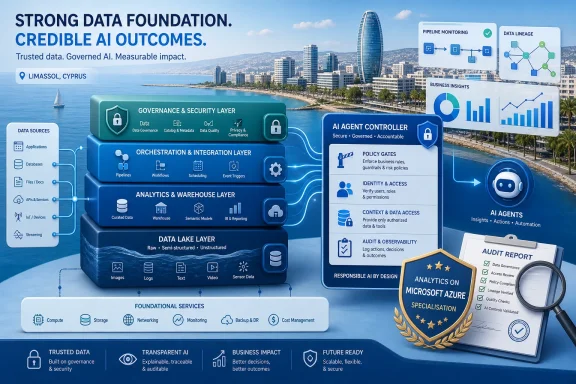
That matters because analytics projects are where cloud promises often collide with institutional reality. A PowerPoint deck can describe a modern data platform in a few neat boxes: ingestion, lake, warehouse, model, dashboard, AI layer. A live deployment must deal with source-system mess, identity boundaries, residency concerns, data quality, cost controls, lineage, governance, and the politics of who owns which metric. A partner that has been through an external review is not automatically the right partner for every workload, but it has cleared a higher bar than a firm simply claiming Azure expertise.
Eunoia’s announcement therefore lands in a market that has become more skeptical, not less. The AI boom has created a flood of vendors promising agents, copilots, automation, and predictive insight. Buyers have learned to ask a more basic question first: does this company understand our data estate well enough to make any of that safe, useful, and maintainable?
Financial services firms need auditable reporting, risk analytics, fraud detection, and regulatory control. Shipping companies deal with operational data, fleet telemetry, routing, documentation, and increasingly emissions reporting. Insurers rely on claims data, actuarial modelling, customer segmentation, and compliance-heavy workflows. Manufacturers want visibility into production, supply chains, energy use, and quality control. None of these sectors can afford a casual relationship with data governance.
That is where a Microsoft analytics specialisation becomes strategically useful. It tells local buyers that the partner has been assessed against a global Microsoft framework, not merely against the expectations of a small regional market. For organisations that may not have deep in-house cloud architecture teams, that third-party structure can reduce uncertainty during vendor selection.
It does not eliminate due diligence. A specialisation does not reveal whether a partner’s project team understands a specific legacy core banking system, maritime workflow, or manufacturing execution environment. It does not guarantee that a project will land on time or that business users will adopt the resulting platform. But it gives procurement and technology leaders a more concrete starting point than the usual claims about being “data-driven” or “AI-ready.”
Azure Data Factory handles movement and orchestration. Azure Data Lake provides storage for structured and unstructured data at scale. Synapse has long represented Microsoft’s integrated analytics pitch, combining warehousing, big data, and analytics services. Databricks brings the lakehouse model and a strong Spark-based ecosystem. Fabric is Microsoft’s newer, more unified analytics platform, designed to bring data engineering, data science, real-time analytics, warehousing, and Power BI-style consumption under a single umbrella.
For buyers, however, the tool list is not the hard part. Most enterprise failures do not happen because a cloud service lacks a button. They happen because nobody agreed on the target operating model, the data contracts were vague, identity design was bolted on late, costs were allowed to sprawl, or reporting logic was recreated differently in five departments.
That is why Eunoia CEO Stefan Farrugia’s emphasis on ISO 27001, certified engineers, and repeatable delivery frameworks is more important than the celebratory language around the badge. A credible analytics partner is not just a firm that can configure Azure services. It is a firm that can impose enough method on a messy organisation to produce durable systems.
There is a lesson here for the AI market more broadly. The companies most likely to succeed with agentic AI are not necessarily those with the flashiest demo. They are the companies that already know where their data lives, who can access it, how it is classified, how it changes, and which processes are safe to automate. Analytics competence is becoming the hidden infrastructure of AI credibility.
That makes it different from a vendor partner badge earned mainly through a commercial relationship. In the analytics specialisation, Microsoft expects partners to show evidence that they can deliver enterprise-scale solutions using specified Azure workloads. The qualification also includes skilling requirements, with multiple individuals holding relevant Microsoft certifications. In other words, the competence has to be distributed across the organisation rather than concentrated in one heroic architect.
That point matters in real projects. Customers do not buy a badge; they get a team. If the partner’s expertise lives only in the presales deck or in the head of one unavailable principal consultant, the deployment risk remains high. Microsoft’s certification and audit structure cannot fully solve that problem, but it nudges partners toward institutional capability rather than individual charisma.
There is also a subtle pressure on delivery consistency. Repeatable frameworks can sound bureaucratic, but in analytics they are often the difference between a pilot and a platform. A proof of concept can be built with shortcuts. A production data estate needs security review, naming conventions, backup and recovery assumptions, data retention policies, monitoring, cost management, and a plan for change control.
For Cyprus organisations, that is the practical value of the specialisation. It gives them a reason to ask sharper questions. Which delivery artefacts were audited? Which staff certifications support the specialisation? Which Azure workloads are actually in production at customer sites? How does the partner handle data governance before introducing AI agents? The badge should not end the conversation; it should improve it.
Farrugia is scheduled to discuss how agentic AI is transforming decision-making and redefining what it means to be a data-driven organisation. That framing will be familiar to anyone who has watched the enterprise AI narrative evolve over the past two years. The market has moved from chatbots and copilots toward agents that can execute workflows, retrieve context, call tools, and participate in operational processes.
The trouble is that “agentic AI” is a phrase that can expand to fill any sales conversation. In its serious form, it implies systems that can reason across business context, use approved data sources, trigger actions, and operate inside policy boundaries. In its unserious form, it is a chatbot with a workflow button. The dividing line is usually the quality of the underlying data and the maturity of the controls around it.
That is why Eunoia’s Azure analytics credential is relevant to its Cloud Tech Expo message. A company arguing for agentic AI needs to prove that it understands the data substrate first. Without governed, reliable, well-modelled data, agentic systems risk becoming fast, confident interfaces to organisational confusion.
For attendees, the useful question will not be whether AI can transform decision-making in the abstract. It will be whether Eunoia can show patterns that move from analytics foundations to production AI safely: ingestion, governance, semantic modelling, access control, monitoring, and then automation. The firms that can connect those steps will have a stronger claim than those selling AI as a layer sprinkled over the top.
A Fabric-centric deployment is not just a technical migration. It can alter how teams model data, share semantic definitions, manage capacity, and expose analytics to business users. It can also create new governance questions because more capabilities sit closer together. The same consolidation that simplifies architecture diagrams can intensify the need for disciplined administration.
Partners therefore need to be conversant not only with Azure’s traditional analytics stack but with Microsoft’s changing platform direction. Synapse, Data Factory, Data Lake, Databricks, and Fabric are not interchangeable logos. They reflect different architectural choices, different cost profiles, and different operational responsibilities. A qualified partner should be able to explain when to use each, when to combine them, and when a customer’s existing estate makes a slower transition wiser than a clean-sheet rebuild.
This is where local expertise can matter. Smaller markets often contain organisations with hybrid realities: some workloads in Microsoft 365, some legacy databases on-premises, some line-of-business applications maintained by niche vendors, and some compliance rules interpreted through local regulators. A partner with regional context and audited Microsoft capability can potentially bridge that gap more effectively than a remote global consultancy deploying a generic reference architecture.
But the risk runs the other way too. Microsoft’s platform integration can encourage partners to present the Microsoft stack as the answer to every data problem. Good architecture remains adversarial toward easy answers. If a customer’s data estate, skill base, or regulatory context calls for a phased approach, the partner’s job is to say so.
This is not unique to Cyprus. Around the world, the AI boom has compressed the distance between genuine specialists, traditional consultancies that have rebranded, software resellers adding services, and opportunistic vendors chasing budget. Customers have responded by looking for evidence: references, certified staff, security standards, implementation patterns, and post-deployment support models.
Eunoia’s specialisation gives it a stronger evidentiary claim. The company can point to a Microsoft-recognised credential that requires independent review. That will not settle every procurement contest, but it helps change the discussion from slogans to capability.
For IT leaders, the challenge is to use the credential correctly. It should be treated as a filter, not a substitute for architecture review. A Microsoft specialisation can establish that a partner has met a baseline for Azure analytics delivery. It cannot answer whether the proposed design fits the company’s data maturity, staffing model, latency needs, sovereignty requirements, or budget discipline.
The best buyers will combine both approaches. They will value the credential while still demanding project-specific clarity. They will ask for reference architectures, delivery plans, governance models, migration sequencing, support arrangements, and an honest account of trade-offs. In a crowded AI services market, the winners will be the partners that welcome those questions.
A modern analytics environment often contains customer information, financial records, operational telemetry, commercial forecasts, and internal performance data. Once AI enters the picture, the system may also include vector indexes, prompt logs, model outputs, retrieval configurations, and tool integrations. That creates new attack surfaces and new governance obligations.
Azure provides many of the building blocks: identity controls, role-based access, private networking options, monitoring, encryption, policy enforcement, and integration with Microsoft’s broader security ecosystem. But cloud platforms do not enforce good judgement by default. Misconfigured permissions, excessive data access, weak separation of environments, and poor lifecycle management can undermine an otherwise sophisticated deployment.
This is why analytics specialisation and security discipline increasingly belong in the same conversation. The data platform is no longer a back-office reporting utility. It is becoming the operational memory of the business. If agents and automation systems are going to act on that memory, the controls around it must be designed before the demos begin.
For regulated sectors in Cyprus, including finance and insurance, that should be a central evaluation criterion. A partner’s ability to build dashboards is useful. Its ability to design secure, auditable, governed analytics foundations is strategic.
Eunoia’s credential should be viewed against that backdrop. It is a sign that the regional partner ecosystem is maturing alongside customer demand. When local firms can meet global vendor standards, customers have more options than either building everything in-house or importing expertise from larger markets.
That has practical consequences for talent as well. Microsoft specialisations require certified professionals, which pressures partners to train and retain engineers. Over time, that can deepen the regional skills base. If those engineers work across financial services, shipping, manufacturing, and insurance, they carry patterns from one sector to another while adapting them to local constraints.
There is an economic angle here that goes beyond Eunoia. The ability to deliver serious cloud analytics locally can help keep higher-value transformation work within the region. It can also make Cyprus more attractive as a base for companies that need sophisticated data services but want proximity, language familiarity, and regional business context.
Still, maturity is not automatic. A stronger partner ecosystem does not guarantee that customers will fund governance, change management, or skills development. Many analytics projects fail not because the partner cannot build the platform, but because the client organisation cannot absorb the operating model. The cloud may be technical infrastructure, but data transformation remains an organisational project.
Customers should simply understand the incentive structure. A Microsoft-specialised partner is likely to be strongest inside the Microsoft ecosystem and may naturally prefer Azure-native answers. For many organisations already standardised on Microsoft 365, Entra ID, Power BI, Teams, and Azure, that alignment can be beneficial. Integration reduces friction, and enterprise IT often values fewer moving parts.
But alignment can become lock-in if decisions are made lazily. The right test is whether the architecture serves the workload, not whether it maximises platform purity. Some customers will benefit from Azure Databricks in a lakehouse pattern. Others may lean toward Fabric for integration and business analytics. Some may need multi-cloud or hybrid approaches because of existing systems, acquisitions, sovereignty concerns, or specialised tooling.
A good partner should be able to articulate the trade-offs without sounding like a vendor brochure. It should explain cost drivers, migration risk, skills requirements, operational complexity, and exit considerations. It should be comfortable saying that not every dataset belongs in the same place and not every AI use case justifies a new platform.
Eunoia’s specialisation gives it credibility in Azure analytics. The next test is how that credibility is used. The best Microsoft partners do not merely sell Microsoft’s roadmap; they translate it into architectures that survive contact with real businesses.
That is not an argument against agentic AI. It is an argument for sequencing. Organisations should not jump from fragmented reporting to autonomous decision support without first building a disciplined data layer. They need source-of-truth definitions, governed access, metadata, lineage, monitoring, and clear accountability for decisions.
The attraction of agents is obvious. They can help managers query complex data in natural language, automate repetitive analysis, draft recommendations, trigger follow-up tasks, and coordinate across systems. In sectors such as shipping, finance, and insurance, even modest workflow improvements can have material value.
But those benefits depend on trust. If users do not know why a recommendation was made, whether the data was current, or whether the agent had access to the right sources, adoption will stall. Worse, overconfident automation may introduce operational or compliance risk.
That is why the analytics specialisation is more than a cloud credential in this context. It is a signal that the partner has been assessed on the foundations that agentic AI will require. The future AI project begins with the less glamorous work of ingestion, modelling, governance, and platform operations.
A customer evaluating Eunoia, or any Microsoft analytics partner, should push past the headline credential. It should ask which workloads the partner has delivered, how it handles data classification, how it designs access controls, how it manages Fabric capacity or Databricks cost, how it documents lineage, and how it measures adoption after go-live. It should also ask what the partner refuses to do, because responsible boundaries are often the mark of a mature services firm.
The most telling answers will be specific. Vague claims about transformation are easy. Concrete explanations of migration sequencing, governance councils, semantic models, disaster recovery assumptions, and support responsibilities are harder. That is where audited capability becomes visible in practice.
Cloud Tech Expo gives buyers a useful opportunity to test the message in person. If Eunoia’s leadership can connect the specialisation to practical patterns for local industries, the announcement will have more staying power than a one-day news item. If the conversation collapses into generic agentic AI enthusiasm, the badge will still be valuable, but the market will have learned less.
Source: Cyprus Mail Data and AI firm Eunoia secures top-tier Microsoft Azure Analytics specialisation ahead of Cloud Tech Expo
 Microsoft’s Badge Economy Has Become a Trust Filter
Microsoft’s partner programme has always been part technical validation, part channel theatre. Badges, designations, specialisations, solution areas, co-sell eligibility, marketplace placement: the vocabulary can sound like a private dialect invented for procurement teams and partner managers. Yet the underlying logic is simple enough. Microsoft wants customers to find partners that can actually deploy its stack, and partners want some way to separate themselves from a crowded field of firms selling roughly the same transformation narrative.The Analytics on Microsoft Azure Specialisation sits in the more demanding end of that system. It is available to partners that already hold the relevant Data & AI designation and then meet additional requirements around Azure consumption, certified staff, and delivery evidence. Microsoft’s documentation also makes clear that the analytics specialisation requires an audit, rather than being granted solely through self-declaration or a sales target.
That matters because analytics projects are where cloud promises often collide with institutional reality. A PowerPoint deck can describe a modern data platform in a few neat boxes: ingestion, lake, warehouse, model, dashboard, AI layer. A live deployment must deal with source-system mess, identity boundaries, residency concerns, data quality, cost controls, lineage, governance, and the politics of who owns which metric. A partner that has been through an external review is not automatically the right partner for every workload, but it has cleared a higher bar than a firm simply claiming Azure expertise.
Eunoia’s announcement therefore lands in a market that has become more skeptical, not less. The AI boom has created a flood of vendors promising agents, copilots, automation, and predictive insight. Buyers have learned to ask a more basic question first: does this company understand our data estate well enough to make any of that safe, useful, and maintainable?
Eunoia’s Win Is Local, but the Standard Is Global
Eunoia is headquartered in Malta and operates locally from Limassol, with more than 30 data and AI specialists serving clients across financial services, shipping, insurance, manufacturing, and other sectors. That geographic detail is not incidental. Cyprus and Malta have smaller technology markets than the familiar hyperscale battlegrounds of London, Frankfurt, Amsterdam, or Dublin, but they sit inside industries with serious data requirements and cross-border obligations.Financial services firms need auditable reporting, risk analytics, fraud detection, and regulatory control. Shipping companies deal with operational data, fleet telemetry, routing, documentation, and increasingly emissions reporting. Insurers rely on claims data, actuarial modelling, customer segmentation, and compliance-heavy workflows. Manufacturers want visibility into production, supply chains, energy use, and quality control. None of these sectors can afford a casual relationship with data governance.
That is where a Microsoft analytics specialisation becomes strategically useful. It tells local buyers that the partner has been assessed against a global Microsoft framework, not merely against the expectations of a small regional market. For organisations that may not have deep in-house cloud architecture teams, that third-party structure can reduce uncertainty during vendor selection.
It does not eliminate due diligence. A specialisation does not reveal whether a partner’s project team understands a specific legacy core banking system, maritime workflow, or manufacturing execution environment. It does not guarantee that a project will land on time or that business users will adopt the resulting platform. But it gives procurement and technology leaders a more concrete starting point than the usual claims about being “data-driven” or “AI-ready.”
The Real Product Is Not Azure, It Is Delivery Discipline
The tools named in the announcement are familiar to anyone following Microsoft’s data platform strategy: Azure Synapse Analytics, Azure Data Lake, Azure Data Factory, Microsoft Fabric, and Azure Databricks. Each has a role in the modern analytics estate. Together they describe the gravitational pull of Microsoft’s cloud stack as it tries to become the default home for enterprise data and AI workloads.Azure Data Factory handles movement and orchestration. Azure Data Lake provides storage for structured and unstructured data at scale. Synapse has long represented Microsoft’s integrated analytics pitch, combining warehousing, big data, and analytics services. Databricks brings the lakehouse model and a strong Spark-based ecosystem. Fabric is Microsoft’s newer, more unified analytics platform, designed to bring data engineering, data science, real-time analytics, warehousing, and Power BI-style consumption under a single umbrella.
For buyers, however, the tool list is not the hard part. Most enterprise failures do not happen because a cloud service lacks a button. They happen because nobody agreed on the target operating model, the data contracts were vague, identity design was bolted on late, costs were allowed to sprawl, or reporting logic was recreated differently in five departments.
That is why Eunoia CEO Stefan Farrugia’s emphasis on ISO 27001, certified engineers, and repeatable delivery frameworks is more important than the celebratory language around the badge. A credible analytics partner is not just a firm that can configure Azure services. It is a firm that can impose enough method on a messy organisation to produce durable systems.
There is a lesson here for the AI market more broadly. The companies most likely to succeed with agentic AI are not necessarily those with the flashiest demo. They are the companies that already know where their data lives, who can access it, how it is classified, how it changes, and which processes are safe to automate. Analytics competence is becoming the hidden infrastructure of AI credibility.
The Audit Requirement Changes the Conversation
Microsoft’s specialisation model is sometimes easy to dismiss as channel machinery, but the audit requirement gives this particular credential weight. The process is designed to verify more than enthusiasm. It looks at planning and delivery practices, customer outcomes, certified personnel, and technical implementation standards.That makes it different from a vendor partner badge earned mainly through a commercial relationship. In the analytics specialisation, Microsoft expects partners to show evidence that they can deliver enterprise-scale solutions using specified Azure workloads. The qualification also includes skilling requirements, with multiple individuals holding relevant Microsoft certifications. In other words, the competence has to be distributed across the organisation rather than concentrated in one heroic architect.
That point matters in real projects. Customers do not buy a badge; they get a team. If the partner’s expertise lives only in the presales deck or in the head of one unavailable principal consultant, the deployment risk remains high. Microsoft’s certification and audit structure cannot fully solve that problem, but it nudges partners toward institutional capability rather than individual charisma.
There is also a subtle pressure on delivery consistency. Repeatable frameworks can sound bureaucratic, but in analytics they are often the difference between a pilot and a platform. A proof of concept can be built with shortcuts. A production data estate needs security review, naming conventions, backup and recovery assumptions, data retention policies, monitoring, cost management, and a plan for change control.
For Cyprus organisations, that is the practical value of the specialisation. It gives them a reason to ask sharper questions. Which delivery artefacts were audited? Which staff certifications support the specialisation? Which Azure workloads are actually in production at customer sites? How does the partner handle data governance before introducing AI agents? The badge should not end the conversation; it should improve it.
Cloud Tech Expo Gives the Announcement a Convenient Stage
The timing is convenient. Eunoia is due to participate in Cloud Tech Expo at the Parklane Resort & Spa in Limassol on May 15, 2026, an event billed around cloud technologies, AI-powered productivity, data strategy and governance, zero trust, optimisation, and collaboration hardware. For a regional IT market, that is exactly the kind of venue where Microsoft-aligned partners can turn certification into pipeline.Farrugia is scheduled to discuss how agentic AI is transforming decision-making and redefining what it means to be a data-driven organisation. That framing will be familiar to anyone who has watched the enterprise AI narrative evolve over the past two years. The market has moved from chatbots and copilots toward agents that can execute workflows, retrieve context, call tools, and participate in operational processes.
The trouble is that “agentic AI” is a phrase that can expand to fill any sales conversation. In its serious form, it implies systems that can reason across business context, use approved data sources, trigger actions, and operate inside policy boundaries. In its unserious form, it is a chatbot with a workflow button. The dividing line is usually the quality of the underlying data and the maturity of the controls around it.
That is why Eunoia’s Azure analytics credential is relevant to its Cloud Tech Expo message. A company arguing for agentic AI needs to prove that it understands the data substrate first. Without governed, reliable, well-modelled data, agentic systems risk becoming fast, confident interfaces to organisational confusion.
For attendees, the useful question will not be whether AI can transform decision-making in the abstract. It will be whether Eunoia can show patterns that move from analytics foundations to production AI safely: ingestion, governance, semantic modelling, access control, monitoring, and then automation. The firms that can connect those steps will have a stronger claim than those selling AI as a layer sprinkled over the top.
Microsoft Fabric Raises the Stakes for Partners
The inclusion of Microsoft Fabric in the specialisation’s eligible workloads is especially notable because Fabric has become central to Microsoft’s modern analytics story. Microsoft has been positioning Fabric as a unified platform that reduces fragmentation across data engineering, analytics, real-time intelligence, data science, and business intelligence. That is attractive to organisations tired of stitching together services, but it also changes what customers should expect from partners.A Fabric-centric deployment is not just a technical migration. It can alter how teams model data, share semantic definitions, manage capacity, and expose analytics to business users. It can also create new governance questions because more capabilities sit closer together. The same consolidation that simplifies architecture diagrams can intensify the need for disciplined administration.
Partners therefore need to be conversant not only with Azure’s traditional analytics stack but with Microsoft’s changing platform direction. Synapse, Data Factory, Data Lake, Databricks, and Fabric are not interchangeable logos. They reflect different architectural choices, different cost profiles, and different operational responsibilities. A qualified partner should be able to explain when to use each, when to combine them, and when a customer’s existing estate makes a slower transition wiser than a clean-sheet rebuild.
This is where local expertise can matter. Smaller markets often contain organisations with hybrid realities: some workloads in Microsoft 365, some legacy databases on-premises, some line-of-business applications maintained by niche vendors, and some compliance rules interpreted through local regulators. A partner with regional context and audited Microsoft capability can potentially bridge that gap more effectively than a remote global consultancy deploying a generic reference architecture.
But the risk runs the other way too. Microsoft’s platform integration can encourage partners to present the Microsoft stack as the answer to every data problem. Good architecture remains adversarial toward easy answers. If a customer’s data estate, skill base, or regulatory context calls for a phased approach, the partner’s job is to say so.
The AI Gold Rush Makes Verification More Valuable
The announcement’s most revealing line is not about Microsoft or Azure; it is the observation that the market is crowded with firms claiming data and AI expertise. That is the condition every buyer now faces. The terms have become cheap. “AI-enabled,” “data-driven,” “modern platform,” and “digital transformation” can appear on a website long before a company has delivered anything durable.This is not unique to Cyprus. Around the world, the AI boom has compressed the distance between genuine specialists, traditional consultancies that have rebranded, software resellers adding services, and opportunistic vendors chasing budget. Customers have responded by looking for evidence: references, certified staff, security standards, implementation patterns, and post-deployment support models.
Eunoia’s specialisation gives it a stronger evidentiary claim. The company can point to a Microsoft-recognised credential that requires independent review. That will not settle every procurement contest, but it helps change the discussion from slogans to capability.
For IT leaders, the challenge is to use the credential correctly. It should be treated as a filter, not a substitute for architecture review. A Microsoft specialisation can establish that a partner has met a baseline for Azure analytics delivery. It cannot answer whether the proposed design fits the company’s data maturity, staffing model, latency needs, sovereignty requirements, or budget discipline.
The best buyers will combine both approaches. They will value the credential while still demanding project-specific clarity. They will ask for reference architectures, delivery plans, governance models, migration sequencing, support arrangements, and an honest account of trade-offs. In a crowded AI services market, the winners will be the partners that welcome those questions.
Security Is the Unavoidable Subtext
Eunoia’s reference to ISO 27001 is not a decorative aside. Data and AI projects now sit directly inside the security conversation. The more organisations centralise data, enrich it, and expose it to analytics and AI interfaces, the more valuable and sensitive the platform becomes.A modern analytics environment often contains customer information, financial records, operational telemetry, commercial forecasts, and internal performance data. Once AI enters the picture, the system may also include vector indexes, prompt logs, model outputs, retrieval configurations, and tool integrations. That creates new attack surfaces and new governance obligations.
Azure provides many of the building blocks: identity controls, role-based access, private networking options, monitoring, encryption, policy enforcement, and integration with Microsoft’s broader security ecosystem. But cloud platforms do not enforce good judgement by default. Misconfigured permissions, excessive data access, weak separation of environments, and poor lifecycle management can undermine an otherwise sophisticated deployment.
This is why analytics specialisation and security discipline increasingly belong in the same conversation. The data platform is no longer a back-office reporting utility. It is becoming the operational memory of the business. If agents and automation systems are going to act on that memory, the controls around it must be designed before the demos begin.
For regulated sectors in Cyprus, including finance and insurance, that should be a central evaluation criterion. A partner’s ability to build dashboards is useful. Its ability to design secure, auditable, governed analytics foundations is strategic.
Regional Cloud Maturity Is Becoming a Competitive Issue
Cloud adoption in smaller markets often advances unevenly. Some firms operate near global best practice, while others still depend heavily on legacy infrastructure and spreadsheet-driven reporting. That unevenness can create a competitive gap. Companies that modernise their data foundations can move faster in pricing, risk management, compliance reporting, customer insight, and operational automation.Eunoia’s credential should be viewed against that backdrop. It is a sign that the regional partner ecosystem is maturing alongside customer demand. When local firms can meet global vendor standards, customers have more options than either building everything in-house or importing expertise from larger markets.
That has practical consequences for talent as well. Microsoft specialisations require certified professionals, which pressures partners to train and retain engineers. Over time, that can deepen the regional skills base. If those engineers work across financial services, shipping, manufacturing, and insurance, they carry patterns from one sector to another while adapting them to local constraints.
There is an economic angle here that goes beyond Eunoia. The ability to deliver serious cloud analytics locally can help keep higher-value transformation work within the region. It can also make Cyprus more attractive as a base for companies that need sophisticated data services but want proximity, language familiarity, and regional business context.
Still, maturity is not automatic. A stronger partner ecosystem does not guarantee that customers will fund governance, change management, or skills development. Many analytics projects fail not because the partner cannot build the platform, but because the client organisation cannot absorb the operating model. The cloud may be technical infrastructure, but data transformation remains an organisational project.
The Microsoft Stack Is Powerful, but It Is Not Neutral
Any article about a Microsoft specialisation should be honest about the commercial machinery behind it. Microsoft’s partner credentials are designed to help customers, but they are also designed to grow Microsoft cloud consumption. The Analytics on Microsoft Azure Specialisation is explicitly tied to Azure workloads and Azure consumption patterns. That is not a scandal; it is the business model.Customers should simply understand the incentive structure. A Microsoft-specialised partner is likely to be strongest inside the Microsoft ecosystem and may naturally prefer Azure-native answers. For many organisations already standardised on Microsoft 365, Entra ID, Power BI, Teams, and Azure, that alignment can be beneficial. Integration reduces friction, and enterprise IT often values fewer moving parts.
But alignment can become lock-in if decisions are made lazily. The right test is whether the architecture serves the workload, not whether it maximises platform purity. Some customers will benefit from Azure Databricks in a lakehouse pattern. Others may lean toward Fabric for integration and business analytics. Some may need multi-cloud or hybrid approaches because of existing systems, acquisitions, sovereignty concerns, or specialised tooling.
A good partner should be able to articulate the trade-offs without sounding like a vendor brochure. It should explain cost drivers, migration risk, skills requirements, operational complexity, and exit considerations. It should be comfortable saying that not every dataset belongs in the same place and not every AI use case justifies a new platform.
Eunoia’s specialisation gives it credibility in Azure analytics. The next test is how that credibility is used. The best Microsoft partners do not merely sell Microsoft’s roadmap; they translate it into architectures that survive contact with real businesses.
Agentic AI Will Expose Weak Data Foundations
The industry’s move toward agentic AI raises the stakes for analytics architecture because agents are only as reliable as the context and permissions they receive. A dashboard can be wrong and still require a human to act. An agent connected to workflow systems can compound mistakes faster.That is not an argument against agentic AI. It is an argument for sequencing. Organisations should not jump from fragmented reporting to autonomous decision support without first building a disciplined data layer. They need source-of-truth definitions, governed access, metadata, lineage, monitoring, and clear accountability for decisions.
The attraction of agents is obvious. They can help managers query complex data in natural language, automate repetitive analysis, draft recommendations, trigger follow-up tasks, and coordinate across systems. In sectors such as shipping, finance, and insurance, even modest workflow improvements can have material value.
But those benefits depend on trust. If users do not know why a recommendation was made, whether the data was current, or whether the agent had access to the right sources, adoption will stall. Worse, overconfident automation may introduce operational or compliance risk.
That is why the analytics specialisation is more than a cloud credential in this context. It is a signal that the partner has been assessed on the foundations that agentic AI will require. The future AI project begins with the less glamorous work of ingestion, modelling, governance, and platform operations.
Cyprus Buyers Get a Clearer Signal, Not a Shortcut
Eunoia’s announcement gives Cyprus organisations a clearer signal in a noisy market, but it should not tempt them into shortcut procurement. The right response is not to assume that the badge guarantees success. The right response is to use the badge as a basis for a more serious conversation.A customer evaluating Eunoia, or any Microsoft analytics partner, should push past the headline credential. It should ask which workloads the partner has delivered, how it handles data classification, how it designs access controls, how it manages Fabric capacity or Databricks cost, how it documents lineage, and how it measures adoption after go-live. It should also ask what the partner refuses to do, because responsible boundaries are often the mark of a mature services firm.
The most telling answers will be specific. Vague claims about transformation are easy. Concrete explanations of migration sequencing, governance councils, semantic models, disaster recovery assumptions, and support responsibilities are harder. That is where audited capability becomes visible in practice.
Cloud Tech Expo gives buyers a useful opportunity to test the message in person. If Eunoia’s leadership can connect the specialisation to practical patterns for local industries, the announcement will have more staying power than a one-day news item. If the conversation collapses into generic agentic AI enthusiasm, the badge will still be valuable, but the market will have learned less.
The Badge Is Worth Something Because the Work Is Hard
The practical reading of Eunoia’s Microsoft analytics specialisation is straightforward, but not simplistic. It means the company has passed a higher bar within Microsoft’s partner ecosystem, and it gives regional customers a stronger reason to include the firm in serious data and AI conversations.- Eunoia has earned Microsoft’s Analytics on Microsoft Azure Specialisation ahead of Cloud Tech Expo in Limassol on May 15, 2026.
- The specialisation is tied to Microsoft’s Data & AI partner framework and requires audited evidence of analytics delivery capability.
- The relevant Azure analytics stack includes services such as Synapse Analytics, Azure Data Lake, Azure Data Factory, Microsoft Fabric, and Azure Databricks.
- The credential is most useful to buyers when treated as a due-diligence filter rather than a guarantee of project success.
- The announcement matters because agentic AI depends on governed, secure, and reliable data foundations.
- For Cyprus organisations, the development strengthens the local pool of Microsoft-aligned cloud analytics expertise.
Source: Cyprus Mail Data and AI firm Eunoia secures top-tier Microsoft Azure Analytics specialisation ahead of Cloud Tech Expo
