

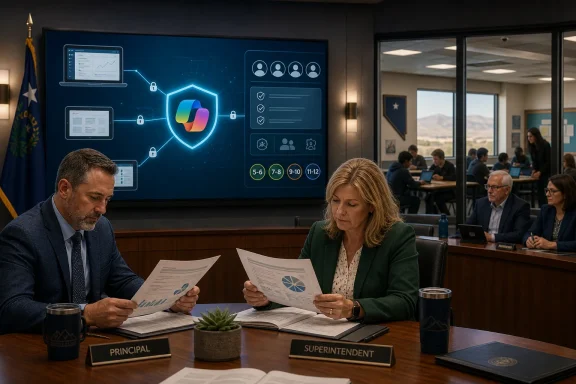
On July 1, the Eureka County School District Board approved an addendum to its Technology Plan that will bring Microsoft Copilot Education into classrooms, primarily for grades 5 through 12, while also approving Steven Sullivan’s contract as elementary principal for the 2026-2027 school year. The local decision, reported by the Eureka Sentinel, is small in geography but large in meaning. Eureka is not merely buying an AI tool; it is choosing a governance model for how children, teachers, administrators, and cloud vendors will share the classroom.
That choice matters because the school AI debate has already moved beyond whether students will use generative tools. They are using them, as Superintendent Tate Else acknowledged plainly at the meeting. The real fight is over whether districts pretend AI is an outside threat, tolerate it as an unmanaged shortcut, or fold it into the official machinery of school with rules, training, identity controls, and accountability.
The most telling detail in Eureka’s plan is not that the district approved AI. It is that Technology Director Elmer Porter framed Microsoft Copilot Education as the safer, more uniform alternative to open-ended tools and open-source experiments. That is the instinct of a district that has already learned the first law of school technology: what you cannot standardize, you cannot supervise.
Porter told the board the district had spent two years preparing for this transition. That timeline undercuts the cartoon version of school AI adoption, where dazzled administrators suddenly bolt a chatbot onto the curriculum because everyone else is doing it. Eureka’s move instead looks like the culmination of an infrastructure project: cloud migration, digital collaboration expansion, network access adjustments, and staff training all lined up before students begin using the tool more formally.
The district’s decision to focus primarily on grades 5 through 12 is also revealing. The old boundary for collaboration tools was grades 7 through 12, but Eureka has already expanded access to fifth and sixth graders. AI is now entering through the same corridor: not as a standalone novelty, but as the next layer on top of accounts, permissions, collaboration spaces, and teacher oversight.
That makes Microsoft’s pitch unusually powerful in K-12. Copilot is not just a chatbot in this context. It is a governance wrapper around a chatbot, attached to Microsoft 365 accounts, administrative controls, auditability, and the promise that school data will not be treated like consumer exhaust. Microsoft’s own documentation says Microsoft 365 Copilot Chat for work and education is covered by enterprise data protection when users sign in with managed work or school accounts, and that prompts and responses are protected under the same contractual framework used for Microsoft 365 customer data.
That does not make the system risk-free. It makes the risk legible to IT.
That sequence is exactly what Microsoft wants from education customers. The company’s 2026 AI in Education messaging, released around ISTELive in Orlando, emphasized moving schools from experimentation to responsible implementation. In Microsoft’s vocabulary, “responsible” usually means a familiar stack: Entra identity, Microsoft 365, administrative policy, safety filtering, compliance commitments, and analytics that let institutions see usage rather than merely hope for good behavior.
For a rural district, that is both attractive and constraining. Eureka does not have the staffing depth of a large suburban district with a dedicated AI governance office, privacy counsel, instructional technology coaches, and a security operations team. A bundled platform lowers the operational burden by making the vendor carry more of the architecture.
But it also means that the AI policy becomes inseparable from the vendor relationship. When a district chooses Copilot because it already has cloud subscriptions, the economic logic is clear. The district can use existing systems, reduce fragmentation, train teachers on one environment, and avoid a sprawl of free tools with uncertain data practices.
The tradeoff is lock-in by habit rather than decree. Once lesson planning, student coaching, grading support, collaboration, email, identity, and administrative monitoring all live in the same ecosystem, leaving becomes expensive even when the license line item looks manageable. The modern school platform does not trap districts with a single contract; it traps them with workflow gravity.
The problem is that “safe and ethical” can collapse into slogan if districts do not define it at the classroom level. A fifth grader using AI to brainstorm story ideas is not facing the same ethical problem as a high school senior using AI to draft a college essay, summarize a primary source, generate code, or polish a scholarship application. The district will need teachers to translate broad policy into age-appropriate habits: disclosure, verification, attribution, skepticism, and restraint.
This is where Eureka’s two-day pre-school in-service training matters. It is not enough to tell teachers that AI exists, or to show them a few prompt-writing tricks. Teachers need a shared language for when AI use is permitted, when it is required to be disclosed, when it undermines the assignment, and when it turns into academic misconduct.
The most successful districts will treat AI literacy less like an app tutorial and more like media literacy after the search-engine era. Students need to learn that fluent text is not the same as true text, that a plausible answer may be fabricated, and that an AI system’s confidence is not evidence. The danger is not only cheating; it is outsourcing judgment before judgment has had time to develop.
Microsoft’s newer education tools lean into this problem by presenting AI as a coach rather than an answer machine. Its Study and Learn Agent materials describe interactive practice, safety filters, and guardrails intended to support learning without simply doing the work. Those design choices matter, but they cannot substitute for teacher authority, assignment design, and a school culture that prizes process over polished output.
That can be a good thing. Administrators should know whether the system is being used, where it is being used, and whether teachers are receiving enough support. A tool that cannot be monitored becomes either performative procurement or a shadow system, neither of which helps students.
But there is a danger in mistaking usage dashboards for educational outcomes. A chart showing active users, prompts, or assignments touched by AI can make a rollout look successful before anyone has proved that students are reading better, reasoning more clearly, writing more independently, or understanding math more deeply. Software companies are very good at showing engagement; schools are supposed to care about learning.
This distinction is especially important because Else’s district goals for 2026-2027 include deeper integration of math and reading fundamentals across the curriculum. AI can support those goals, but it can also blur them. If students use AI to skip the struggle of comprehension, summarization, revision, or problem decomposition, the tool becomes a shortcut around the very fundamentals the district wants to strengthen.
That does not mean AI belongs outside the curriculum. It means the curriculum has to be redesigned around what AI changes. A writing assignment that can be completed by a chatbot in twenty seconds is no longer a writing assignment in the old sense; it is either a prompt-engineering task, a verification task, a revision task, an oral-defense task, or a failed assessment.
By fifth grade, students are old enough to benefit from guided digital tools but young enough to normalize whatever workflow the school gives them. If AI becomes a routine companion at that age, students may learn to ask for help earlier, iterate more often, and receive feedback in ways a single teacher with a full classroom cannot always provide. That is the optimistic version.
The pessimistic version is dependency. Students who reach for AI before reaching for memory, a classmate, a teacher, a book, or their own rough draft may grow fluent in delegation without becoming fluent in the subject. That risk is not theoretical; it is built into the convenience of the tool.
Microsoft’s own education guidance notes that Copilot Chat is available for students aged 13 and older, with administrators needing to manage school type and age-group classifications. That creates an interesting tension for districts serving younger students with adjacent Microsoft education tools and managed environments. The practical question is less “Is AI available?” than “Which AI experiences, under which accounts, with which permissions, for which ages, and with whose consent?”
That is why Eureka’s governance details will matter more than the headline approval. Parents will want to know whether AI interactions are logged, how long records are retained, whether teachers can review student use, whether prompts are treated as education records, and what happens when a student enters sensitive personal information. Those are not anti-technology questions. They are normal questions when a school turns a cloud AI system into part of the learning environment.
A new elementary principal will inherit not only buildings, teachers, families, and routines, but also a districtwide AI plan that reaches down into the upper elementary grades. Sullivan’s first year will therefore test the human side of the rollout. Technology directors can configure access; principals have to manage trust.
Sullivan’s comments at the meeting were warm and local. He said his wife and three boys already love the community, praised the district’s reputation, and described being excited to return to work. That kind of goodwill matters in a small district, where leadership is personal before it is bureaucratic.
But the job is complicated by timing. The district is asking teachers to absorb AI training during pre-school in-service, continue math and reading work, support career and technical education goals, and operate amid unresolved federal education fights. Sullivan’s elementary schools will be early proving grounds for whether the district can introduce AI without making teachers feel that another initiative has simply been dropped on their desks.
The best principals in this moment will not be AI evangelists. They will be translators. They will help teachers distinguish useful classroom practice from vendor demo magic, reassure parents that children are not being used as test subjects, and tell the central office when a policy that looked clean in a board packet turns messy in a classroom.
Large systems often spend years convening committees, pilots, procurement reviews, equity audits, and union consultations before reaching a uniform policy. Some of that process is necessary. Some of it is institutional drag disguised as caution.
A rural district has different constraints. It may have fewer specialists, fewer backup personnel, and less margin for implementation mistakes. But it also has a clearer line of sight from decision to practice. When Porter says the district has been preparing for two years, the board can test that claim against the lived reality of its own schools rather than against a sprawling bureaucracy.
That makes Eureka a useful case study for WindowsForum readers who think about technology deployments in practical terms. The question is not whether a district can produce a glossy AI framework. The question is whether identity, licenses, training, network access, support, and instructional expectations arrive in the same semester.
Eureka appears to be trying to synchronize those pieces. The risk is that synchronization becomes a one-time launch event rather than an operating discipline. AI systems change quickly, Microsoft’s product names and capabilities change quickly, and student workarounds change even faster.
Else’s response was cautious. He acknowledged the volatility and references to possible “deconsolidation” of the federal Department of Education, but said the district probably would not have much immediate clarity before school starts. He also said he had spoken with legal counsel.
That is exactly the posture local superintendents are forced into when national policy becomes unstable. They cannot wait for Washington to settle every fight before hiring principals, setting graduation dates, renewing insurance, approving emergency plans, or training teachers. Yet federal funding and federal rules still shape the ground under those decisions.
For Eureka, the federal litigation is not the main story, but it is part of the operating environment. The district approved temporary interfund loans to federal and state grant funds so grant expenditures can be paid from general funds while reimbursement is pending. That is a mundane financial mechanism, but it reveals the cash-flow reality beneath policy arguments: local districts often have to keep services moving while governments, courts, and agencies sort out timing.
The AI plan also sits in that same atmosphere of uncertainty. If federal privacy guidance, education technology rules, grant conditions, or Department of Education functions shift, districts will need vendor contracts and local policies that can adapt. In a stable era, a school AI rollout is a curriculum project. In this era, it is also a compliance hedge.
A district that teaches AI only as a cheating risk will underserve students entering trades, health care, agriculture, mining support, office administration, public service, and technical programs. Generative systems are already creeping into documentation, scheduling, drafting, diagnostics, analysis, customer communication, and software-adjacent workflows. Even when AI does not replace a worker, it changes what supervisors expect a worker to produce.
The challenge for schools is to teach AI without surrendering foundational competence. A student in a technical pathway may benefit from AI-assisted troubleshooting, but still needs to understand the system being troubleshot. A student using AI to draft a workplace email still needs judgment, tone, and accountability. A student summarizing safety procedures with AI still needs to know when the summary is wrong.
This is where Eureka’s small size may be an advantage. Else said the district’s size and flexibility allow it to tailor opportunities to individual students. If that flexibility carries into AI instruction, Eureka can connect AI use to actual student pathways rather than impose a generic “future of work” module.
The strongest AI education will not be abstract. It will ask students to use the tool inside real tasks, compare outputs against trusted sources, explain their revisions, and identify where the machine failed. That is not glamorous, but it is much closer to how adults will use AI responsibly.
That is a powerful advantage for Microsoft. The company already owns a deep footprint in school email, productivity, collaboration, endpoint management, and identity. Copilot turns that footprint into an AI distribution channel. A district already living in Microsoft 365 does not need to invent a new authentication model, procurement framework, or support workflow from scratch.
But WindowsForum readers know the other side of this bargain. Microsoft’s strength is integration, and integration is rarely neutral. Features appear inside existing workflows; defaults shape behavior; licensing tiers determine who gets which capability; administrative controls vary by subscription; and documentation becomes part of the real-world product.
That means districts must resist the temptation to outsource policy to the platform. Microsoft can provide enterprise data protection commitments, content safety filters, age controls, and admin tools. It cannot decide Eureka’s academic integrity norms, community expectations, teacher workload limits, or threshold for acceptable student dependency.
The board has approved a technology plan addendum, not a finished philosophy. The district’s next task is to make sure Microsoft is a tool inside Eureka’s educational judgment, not the place where that judgment quietly migrates.
Those items may seem unrelated, but together they show a district managing capacity. Insurance, emergency operations, discipline, literacy, staffing, grant cash flow, professional development, and AI are all parts of the same administrative machine. A school board meeting is where grand technology narratives meet purchase orders and staffing shortages.
The ISTELive travel approval is especially notable. The convention ran June 28 to July 1 in Orlando, exactly as Microsoft and other education technology vendors were pushing new AI features and responsible adoption messaging. Sending a district representative to that environment suggests Eureka is not treating AI as a one-and-done procurement decision.
The critical-need designation for the Crescent Valley fifth- and sixth-grade dual teaching position also matters in the AI context. If a district is short on specialized teaching capacity, technology can look like leverage. Sometimes it is. But when AI is introduced into classrooms where teachers are already stretched, implementation quality depends on whether the tool reduces friction or adds another layer of oversight.
That is the central administrative gamble. AI can give teachers faster feedback loops, differentiated materials, and support for planning. It can also generate more things to check, more student outputs to verify, more parent questions to answer, and more policy edge cases to resolve.
Eureka says ongoing, on-premise support will follow the initial training. That may be the difference between a sustainable rollout and a policy that exists mostly on paper. Teachers need help when a student submits AI-polished work that is not clearly dishonest, when a parent objects to AI use, when Copilot gives a bad explanation, when a student uses the tool outside the intended assignment, or when a feature changes midyear.
The district will also need feedback loops that are not merely technical. If math teachers find that AI explanations help some students but confuse others, that needs to reach administrators. If reading teachers find that summaries are undermining close reading, that matters. If students with different learning needs benefit from AI scaffolding, that should shape future practice.
The most mature version of Eureka’s plan would treat the 2026-2027 school year as an implementation year with explicit review points. The board should expect reports not only on usage but on teacher confidence, student outcomes, discipline issues, parent communication, privacy incidents, and changes to assignment design. AI governance cannot be set in July and revisited only when something breaks.
That is where many institutions fail. They launch AI as if the product is the reform. The product is only the beginning of the reform, and sometimes the easiest part.
That choice matters because the school AI debate has already moved beyond whether students will use generative tools. They are using them, as Superintendent Tate Else acknowledged plainly at the meeting. The real fight is over whether districts pretend AI is an outside threat, tolerate it as an unmanaged shortcut, or fold it into the official machinery of school with rules, training, identity controls, and accountability.
 Eureka Chooses the Walled Garden Before the Wild West Wins
The most telling detail in Eureka’s plan is not that the district approved AI. It is that Technology Director Elmer Porter framed Microsoft Copilot Education as the safer, more uniform alternative to open-ended tools and open-source experiments. That is the instinct of a district that has already learned the first law of school technology: what you cannot standardize, you cannot supervise.Porter told the board the district had spent two years preparing for this transition. That timeline undercuts the cartoon version of school AI adoption, where dazzled administrators suddenly bolt a chatbot onto the curriculum because everyone else is doing it. Eureka’s move instead looks like the culmination of an infrastructure project: cloud migration, digital collaboration expansion, network access adjustments, and staff training all lined up before students begin using the tool more formally.
The district’s decision to focus primarily on grades 5 through 12 is also revealing. The old boundary for collaboration tools was grades 7 through 12, but Eureka has already expanded access to fifth and sixth graders. AI is now entering through the same corridor: not as a standalone novelty, but as the next layer on top of accounts, permissions, collaboration spaces, and teacher oversight.
That makes Microsoft’s pitch unusually powerful in K-12. Copilot is not just a chatbot in this context. It is a governance wrapper around a chatbot, attached to Microsoft 365 accounts, administrative controls, auditability, and the promise that school data will not be treated like consumer exhaust. Microsoft’s own documentation says Microsoft 365 Copilot Chat for work and education is covered by enterprise data protection when users sign in with managed work or school accounts, and that prompts and responses are protected under the same contractual framework used for Microsoft 365 customer data.
That does not make the system risk-free. It makes the risk legible to IT.
The AI Plan Is Really a Cloud Plan
Eureka’s AI adoption would be easy to misunderstand if viewed only through the lens of curriculum. The quieter but more important story is that the district’s data and email have already moved to the cloud, with final network access tweaks scheduled before August. Copilot is being added after the district has shifted the center of gravity from local systems to managed cloud identity and services.That sequence is exactly what Microsoft wants from education customers. The company’s 2026 AI in Education messaging, released around ISTELive in Orlando, emphasized moving schools from experimentation to responsible implementation. In Microsoft’s vocabulary, “responsible” usually means a familiar stack: Entra identity, Microsoft 365, administrative policy, safety filtering, compliance commitments, and analytics that let institutions see usage rather than merely hope for good behavior.
For a rural district, that is both attractive and constraining. Eureka does not have the staffing depth of a large suburban district with a dedicated AI governance office, privacy counsel, instructional technology coaches, and a security operations team. A bundled platform lowers the operational burden by making the vendor carry more of the architecture.
But it also means that the AI policy becomes inseparable from the vendor relationship. When a district chooses Copilot because it already has cloud subscriptions, the economic logic is clear. The district can use existing systems, reduce fragmentation, train teachers on one environment, and avoid a sprawl of free tools with uncertain data practices.
The tradeoff is lock-in by habit rather than decree. Once lesson planning, student coaching, grading support, collaboration, email, identity, and administrative monitoring all live in the same ecosystem, leaving becomes expensive even when the license line item looks manageable. The modern school platform does not trap districts with a single contract; it traps them with workflow gravity.
“Safe and Ethical” Is a Curriculum Goal, Not a Checkbox
Superintendent Else’s strongest statement was also the one that will be hardest to execute: students are using AI, so the district wants to teach them to use it safely and ethically. That is the right frame. It also moves AI from the technology office into the moral and academic center of the school.The problem is that “safe and ethical” can collapse into slogan if districts do not define it at the classroom level. A fifth grader using AI to brainstorm story ideas is not facing the same ethical problem as a high school senior using AI to draft a college essay, summarize a primary source, generate code, or polish a scholarship application. The district will need teachers to translate broad policy into age-appropriate habits: disclosure, verification, attribution, skepticism, and restraint.
This is where Eureka’s two-day pre-school in-service training matters. It is not enough to tell teachers that AI exists, or to show them a few prompt-writing tricks. Teachers need a shared language for when AI use is permitted, when it is required to be disclosed, when it undermines the assignment, and when it turns into academic misconduct.
The most successful districts will treat AI literacy less like an app tutorial and more like media literacy after the search-engine era. Students need to learn that fluent text is not the same as true text, that a plausible answer may be fabricated, and that an AI system’s confidence is not evidence. The danger is not only cheating; it is outsourcing judgment before judgment has had time to develop.
Microsoft’s newer education tools lean into this problem by presenting AI as a coach rather than an answer machine. Its Study and Learn Agent materials describe interactive practice, safety filters, and guardrails intended to support learning without simply doing the work. Those design choices matter, but they cannot substitute for teacher authority, assignment design, and a school culture that prizes process over polished output.
Monitoring Usage Is Not the Same as Understanding Learning
Porter told the board the selected Microsoft platform includes built-in coaching and grading tools, with administrators able to monitor usage and ensure classroom integration. For IT readers, that sentence is the hinge of the whole story. The district is not only introducing AI into student work; it is introducing new telemetry into instruction.That can be a good thing. Administrators should know whether the system is being used, where it is being used, and whether teachers are receiving enough support. A tool that cannot be monitored becomes either performative procurement or a shadow system, neither of which helps students.
But there is a danger in mistaking usage dashboards for educational outcomes. A chart showing active users, prompts, or assignments touched by AI can make a rollout look successful before anyone has proved that students are reading better, reasoning more clearly, writing more independently, or understanding math more deeply. Software companies are very good at showing engagement; schools are supposed to care about learning.
This distinction is especially important because Else’s district goals for 2026-2027 include deeper integration of math and reading fundamentals across the curriculum. AI can support those goals, but it can also blur them. If students use AI to skip the struggle of comprehension, summarization, revision, or problem decomposition, the tool becomes a shortcut around the very fundamentals the district wants to strengthen.
That does not mean AI belongs outside the curriculum. It means the curriculum has to be redesigned around what AI changes. A writing assignment that can be completed by a chatbot in twenty seconds is no longer a writing assignment in the old sense; it is either a prompt-engineering task, a verification task, a revision task, an oral-defense task, or a failed assessment.
Fifth Grade Is Where the Policy Becomes Real
Eureka’s inclusion of fifth and sixth graders is one of the most consequential parts of the plan. High school AI policies often dominate public debate because the stakes are obvious: grades, graduation, college applications, career readiness. But elementary and middle school adoption will shape the habits students carry into those high-stakes years.By fifth grade, students are old enough to benefit from guided digital tools but young enough to normalize whatever workflow the school gives them. If AI becomes a routine companion at that age, students may learn to ask for help earlier, iterate more often, and receive feedback in ways a single teacher with a full classroom cannot always provide. That is the optimistic version.
The pessimistic version is dependency. Students who reach for AI before reaching for memory, a classmate, a teacher, a book, or their own rough draft may grow fluent in delegation without becoming fluent in the subject. That risk is not theoretical; it is built into the convenience of the tool.
Microsoft’s own education guidance notes that Copilot Chat is available for students aged 13 and older, with administrators needing to manage school type and age-group classifications. That creates an interesting tension for districts serving younger students with adjacent Microsoft education tools and managed environments. The practical question is less “Is AI available?” than “Which AI experiences, under which accounts, with which permissions, for which ages, and with whose consent?”
That is why Eureka’s governance details will matter more than the headline approval. Parents will want to know whether AI interactions are logged, how long records are retained, whether teachers can review student use, whether prompts are treated as education records, and what happens when a student enters sensitive personal information. Those are not anti-technology questions. They are normal questions when a school turns a cloud AI system into part of the learning environment.
The Principal Change Arrives at the Same Moment as the Platform Change
The board also approved Steven Sullivan’s contract as elementary principal for the 2026-2027 academic year, at $127,567, placing him over both Eureka Elementary and Crescent Valley Elementary School. On paper, that is a separate personnel item. In practice, it is part of the same transition.A new elementary principal will inherit not only buildings, teachers, families, and routines, but also a districtwide AI plan that reaches down into the upper elementary grades. Sullivan’s first year will therefore test the human side of the rollout. Technology directors can configure access; principals have to manage trust.
Sullivan’s comments at the meeting were warm and local. He said his wife and three boys already love the community, praised the district’s reputation, and described being excited to return to work. That kind of goodwill matters in a small district, where leadership is personal before it is bureaucratic.
But the job is complicated by timing. The district is asking teachers to absorb AI training during pre-school in-service, continue math and reading work, support career and technical education goals, and operate amid unresolved federal education fights. Sullivan’s elementary schools will be early proving grounds for whether the district can introduce AI without making teachers feel that another initiative has simply been dropped on their desks.
The best principals in this moment will not be AI evangelists. They will be translators. They will help teachers distinguish useful classroom practice from vendor demo magic, reassure parents that children are not being used as test subjects, and tell the central office when a policy that looked clean in a board packet turns messy in a classroom.
Rural Districts May Move Faster Because They Have Less Room to Drift
Else reportedly said Eureka is “further ahead than a lot of the districts” in managing the shift. That may be true, and not despite Eureka’s size but partly because of it. Smaller districts can sometimes make strategic technology moves faster because fewer layers stand between the board, superintendent, technology director, principals, and teachers.Large systems often spend years convening committees, pilots, procurement reviews, equity audits, and union consultations before reaching a uniform policy. Some of that process is necessary. Some of it is institutional drag disguised as caution.
A rural district has different constraints. It may have fewer specialists, fewer backup personnel, and less margin for implementation mistakes. But it also has a clearer line of sight from decision to practice. When Porter says the district has been preparing for two years, the board can test that claim against the lived reality of its own schools rather than against a sprawling bureaucracy.
That makes Eureka a useful case study for WindowsForum readers who think about technology deployments in practical terms. The question is not whether a district can produce a glossy AI framework. The question is whether identity, licenses, training, network access, support, and instructional expectations arrive in the same semester.
Eureka appears to be trying to synchronize those pieces. The risk is that synchronization becomes a one-time launch event rather than an operating discipline. AI systems change quickly, Microsoft’s product names and capabilities change quickly, and student workarounds change even faster.
Federal Volatility Is the Background Noise Behind Every Local Decision
The meeting’s AI discussion took place against a broader political backdrop: Nevada Attorney General Aaron Ford’s litigation against the U.S. Department of Education. According to the Nevada Attorney General’s office, one 2025 lawsuit challenged the freezing of roughly $6.8 billion in education grants shortly before the school year, with Nevada joining a coalition of states. A separate 2026 lawsuit challenged a Department of Education rule that Ford’s office said would limit access to federal student loans for professional degree programs, including health care fields.Else’s response was cautious. He acknowledged the volatility and references to possible “deconsolidation” of the federal Department of Education, but said the district probably would not have much immediate clarity before school starts. He also said he had spoken with legal counsel.
That is exactly the posture local superintendents are forced into when national policy becomes unstable. They cannot wait for Washington to settle every fight before hiring principals, setting graduation dates, renewing insurance, approving emergency plans, or training teachers. Yet federal funding and federal rules still shape the ground under those decisions.
For Eureka, the federal litigation is not the main story, but it is part of the operating environment. The district approved temporary interfund loans to federal and state grant funds so grant expenditures can be paid from general funds while reimbursement is pending. That is a mundane financial mechanism, but it reveals the cash-flow reality beneath policy arguments: local districts often have to keep services moving while governments, courts, and agencies sort out timing.
The AI plan also sits in that same atmosphere of uncertainty. If federal privacy guidance, education technology rules, grant conditions, or Department of Education functions shift, districts will need vendor contracts and local policies that can adapt. In a stable era, a school AI rollout is a curriculum project. In this era, it is also a compliance hedge.
Career Pathways Make the AI Decision More Than a Classroom Experiment
Else’s district goals also include strengthening Career and Technical Education and expanding dual and advanced enrollment opportunities through Great Basin College. That detail keeps the AI plan from being only a debate about essays and homework. For many students, AI will be a workplace tool before it is a college controversy.A district that teaches AI only as a cheating risk will underserve students entering trades, health care, agriculture, mining support, office administration, public service, and technical programs. Generative systems are already creeping into documentation, scheduling, drafting, diagnostics, analysis, customer communication, and software-adjacent workflows. Even when AI does not replace a worker, it changes what supervisors expect a worker to produce.
The challenge for schools is to teach AI without surrendering foundational competence. A student in a technical pathway may benefit from AI-assisted troubleshooting, but still needs to understand the system being troubleshot. A student using AI to draft a workplace email still needs judgment, tone, and accountability. A student summarizing safety procedures with AI still needs to know when the summary is wrong.
This is where Eureka’s small size may be an advantage. Else said the district’s size and flexibility allow it to tailor opportunities to individual students. If that flexibility carries into AI instruction, Eureka can connect AI use to actual student pathways rather than impose a generic “future of work” module.
The strongest AI education will not be abstract. It will ask students to use the tool inside real tasks, compare outputs against trusted sources, explain their revisions, and identify where the machine failed. That is not glamorous, but it is much closer to how adults will use AI responsibly.
Microsoft Wins When Schools Decide Trust Is an Architecture
The board’s choice of Microsoft over open-source alternatives or more free-form AI tools reflects a broader market truth. In education, trust is increasingly being sold as architecture. Districts are not only buying model capability; they are buying identity integration, data promises, administrator consoles, support channels, training materials, and a vendor that can sit across from counsel when something goes wrong.That is a powerful advantage for Microsoft. The company already owns a deep footprint in school email, productivity, collaboration, endpoint management, and identity. Copilot turns that footprint into an AI distribution channel. A district already living in Microsoft 365 does not need to invent a new authentication model, procurement framework, or support workflow from scratch.
But WindowsForum readers know the other side of this bargain. Microsoft’s strength is integration, and integration is rarely neutral. Features appear inside existing workflows; defaults shape behavior; licensing tiers determine who gets which capability; administrative controls vary by subscription; and documentation becomes part of the real-world product.
That means districts must resist the temptation to outsource policy to the platform. Microsoft can provide enterprise data protection commitments, content safety filters, age controls, and admin tools. It cannot decide Eureka’s academic integrity norms, community expectations, teacher workload limits, or threshold for acceptable student dependency.
The board has approved a technology plan addendum, not a finished philosophy. The district’s next task is to make sure Microsoft is a tool inside Eureka’s educational judgment, not the place where that judgment quietly migrates.
The Board Packet Shows a District Trying to Govern the Whole Machine
The AI vote landed alongside a cluster of routine but consequential approvals: insurance renewal through the Nevada Public Agency Insurance Pool, a graduation date change to May 21, 2027, the Emergency Operations Plan, out-of-state travel for Kelly Miller to attend ISTELive 2026 in Orlando, a critical-need designation for the Crescent Valley fifth- and sixth-grade dual teaching position, the Restorative Discipline Plan, the district’s five-year plan, and the Local Literacy Plan.Those items may seem unrelated, but together they show a district managing capacity. Insurance, emergency operations, discipline, literacy, staffing, grant cash flow, professional development, and AI are all parts of the same administrative machine. A school board meeting is where grand technology narratives meet purchase orders and staffing shortages.
The ISTELive travel approval is especially notable. The convention ran June 28 to July 1 in Orlando, exactly as Microsoft and other education technology vendors were pushing new AI features and responsible adoption messaging. Sending a district representative to that environment suggests Eureka is not treating AI as a one-and-done procurement decision.
The critical-need designation for the Crescent Valley fifth- and sixth-grade dual teaching position also matters in the AI context. If a district is short on specialized teaching capacity, technology can look like leverage. Sometimes it is. But when AI is introduced into classrooms where teachers are already stretched, implementation quality depends on whether the tool reduces friction or adds another layer of oversight.
That is the central administrative gamble. AI can give teachers faster feedback loops, differentiated materials, and support for planning. It can also generate more things to check, more student outputs to verify, more parent questions to answer, and more policy edge cases to resolve.
The Real Test Begins After the Training Days End
Two days of pre-school in-service training are a necessary start and an insufficient plan. Every serious technology rollout has the same pattern: launch training creates confidence, first use exposes confusion, edge cases multiply, and the real support burden emerges after everyone has already returned to normal schedules.Eureka says ongoing, on-premise support will follow the initial training. That may be the difference between a sustainable rollout and a policy that exists mostly on paper. Teachers need help when a student submits AI-polished work that is not clearly dishonest, when a parent objects to AI use, when Copilot gives a bad explanation, when a student uses the tool outside the intended assignment, or when a feature changes midyear.
The district will also need feedback loops that are not merely technical. If math teachers find that AI explanations help some students but confuse others, that needs to reach administrators. If reading teachers find that summaries are undermining close reading, that matters. If students with different learning needs benefit from AI scaffolding, that should shape future practice.
The most mature version of Eureka’s plan would treat the 2026-2027 school year as an implementation year with explicit review points. The board should expect reports not only on usage but on teacher confidence, student outcomes, discipline issues, parent communication, privacy incidents, and changes to assignment design. AI governance cannot be set in July and revisited only when something breaks.
That is where many institutions fail. They launch AI as if the product is the reform. The product is only the beginning of the reform, and sometimes the easiest part.
Eureka’s AI Bet Comes Down to Six Practical Tests
Eureka’s decision is neither reckless nor automatically visionary. It is a serious attempt to bring a fast-moving technology into a managed school environment before unmanaged use becomes the default. The district’s success will depend on execution more than intent.- The district has chosen Microsoft Copilot Education because it fits an existing cloud and identity environment, which should make supervision easier than a patchwork of unsanctioned AI tools.
- The rollout’s focus on grades 5 through 12 means Eureka must define age-appropriate AI expectations, especially for younger students who are still forming basic study habits.
- Teacher training will need to go beyond prompts and features, because academic integrity, assignment design, verification, and student dependency are instructional problems rather than IT problems.
- Administrative monitoring can help the district understand adoption, but usage data should not be confused with evidence that students are learning more effectively.
- The new elementary principal will play a central role in translating the district’s AI policy into parent trust and classroom routines at Eureka Elementary and Crescent Valley Elementary.
- Federal education lawsuits and funding uncertainty make local governance more important, because districts still have to operate while state and national policy remains unsettled.
References
- Primary source: The Eureka Sentinel
Published: 2026-07-07T21:31:08.326525
School board approves AI integration plan, welcomes new elementary principal
The Eureka County School District Board convened for its regular meeting on July 1. Board President Lynn Conley called the meeting to order at 5:30 p.m. In attendance were board members Melinda Fil…eurekasentinel.com - Related coverage: ag.nv.gov
- Official source: partner.microsoft.com
Increment tightens data security for Australia’s public schools
See how Increment supports Australia’s public schools by improving data security and compliance using Microsoft security solutions.partner.microsoft.com
- Related coverage: budget.nv.gov