

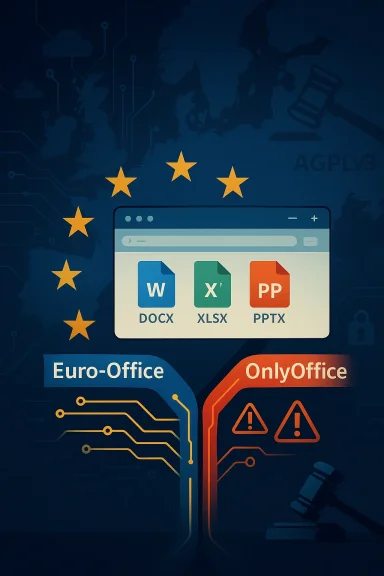
European open-source office software has entered a fresh and unusually combustible phase. Nextcloud and IONOS have launched Euro-Office, a fork of OnlyOffice pitched as a sovereign alternative for organizations that want browser-based productivity without American platform dependence or Russian code lineage concerns. OnlyOffice, predictably, has responded with legal fire and branding outrage, turning what might have been a routine community fork into a broader fight over licensing, attribution, digital sovereignty, and who gets to define the European open-source stack.
The immediate spark for this dispute is simple enough: Nextcloud and IONOS unveiled Euro-Office in late March 2026, describing it as a “true sovereign office suite” and a replacement for Microsoft Office with an intuitive interface and strong compatibility. The project is still young enough that, at launch, its backers were pointing users to GitHub instead of a polished product site, which tells you a lot about how early and politically charged this effort is. It is also a reminder that in the FOSS world, the announcement is sometimes the battle.
But Euro-Office is not a new codebase. It is a fork of OnlyOffice, itself a long-established cloud productivity suite distributed under the GNU AGPLv3, with branding and trademark restrictions layered on top by the original developer. That means the legal and technical questions are inseparable: the fork is allowed in principle by open-source licensing, but the exact boundaries of attribution, logo use, and modification rights are now being contested in public.
The sovereignty angle matters because the European software market has become highly sensitive to geopolitical risk. Nextcloud has spent years positioning itself as a European collaboration platform for government and enterprise, and it has repeatedly framed browser-based office tools as part of a broader digital autonomy story. The new fork fits neatly into that narrative, especially at a moment when many EU buyers are reevaluating dependency on US hyperscalers and, more broadly, on foreign-controlled infrastructure.
There is also a long historical shadow here. Nextcloud itself was born as a hostile fork of ownCloud, and LibreOffice emerged from the rupture between OpenOffice developers and Oracle. In other words, open-source productivity has always contained a strong fork-as-failsafe instinct: when governance, direction, or commercial control becomes intolerable, the code can walk away. Euro-Office is just the latest expression of that instinct, this time wrapped in the language of European sovereignty.
The broader market context is equally important. Microsoft continues to dominate workplace productivity, while browser-based office suites remain a key battleground for vendors that want to avoid lock-in and preserve local control. Nextcloud has already cycled through office integrations over the years, from OnlyOffice to Collabora, and Europe has seen a growing ecosystem of sovereign-workspace projects that aim to combine file storage, chat, documents, and identity under one umbrella. Euro-Office is entering a crowded, political, and commercially fragile field.
That same interface strategy also tells us what the project is not trying to be. Euro-Office does not seem aimed at power users seeking a radically new editing model; it is aiming at administrators, procurement teams, and public-sector buyers who need reassurance more than novelty. In that sense, the suite is a political product as much as a technical one.
It also helps explain why browser-based office suites keep gaining traction. A web app reduces client-side installation pain and makes cross-platform deployment much easier, particularly in mixed Windows, macOS, and Linux environments. For public institutions, that convenience is often the difference between pilot project and real adoption.
Still, compatibility is never just a technical checkbox. It is also a social promise that the new suite will not disrupt the daily routines of employees who already have enough change to absorb. Euro-Office is therefore competing as much on trust and familiarity as on code quality. That distinction matters.
Euro-Office’s backers insist the fork is a clean European answer to that problem, and Nextcloud says it can vouch for its version. That may satisfy some buyers, especially those in government procurement, but it does not erase the awkward reality that the codebase did not originate in Europe’s current sovereignty campaign. It was repurposed into one.
The stronger point, however, is that sovereignty in software is not only about authorship. It is also about control over maintenance, governance, hosting, and future roadmap decisions. By forking, Nextcloud and IONOS are trying to shift those levers decisively toward a European-led coalition.
That matters because Europe’s digital policy environment has become more assertive. Open-source alternatives, local hosting, and standards-based interoperability are increasingly treated as strategic assets rather than niche preferences. In that climate, a sovereign office suite can look less like a technology experiment and more like infrastructure planning.
Euro-Office’s developers, by contrast, removed those terms in a commit explicitly describing them as unenforceable and non-obligatory. Their position is that downstream recipients may remove terms that amount to “further restrictions” beyond what the AGPL permits, and they say that interpretation was supported by the Free Software Foundation. That is a classic open-source legal fault line: one side says “extra terms are allowed,” while the other says “not if they become restrictive enough to frustrate reuse.”
This is where the dispute becomes more than a branding squabble. If OnlyOffice is right, then Euro-Office’s distribution model may need substantial revision. If Euro-Office is right, OnlyOffice’s trademark overlay may be weaker than the company assumes. Either outcome has implications well beyond this one fork.
Legal opinion in the wider FOSS community appears divided, but there is an obvious practical concern: if upstream vendors can attach strong branding conditions to AGPL software, downstream forks may be constrained in ways that reduce the real-world utility of open-source code. That would not be a trivial outcome for the ecosystem. It would make some “free” software materially less forkable in the ways users expect.
There is also a governance angle. By anchoring the project in a coalition of enterprises and community organizations, Nextcloud can present Euro-Office as an ecosystem initiative rather than a single-vendor asset. That framing is useful because public procurement often prefers consortium-style legitimacy over pure vendor control.
Still, forking a mature office suite is not cheap. Browser editors are complex, compatibility issues are endless, and the maintenance burden can rise quickly once a fork starts diverging from upstream. Nextcloud is betting that enough organizations care about sovereignty to finance that burden sustainably. That is an ambitious bet.
But there is a subtle difference this time. Nextcloud is no longer just escaping a technical or organizational dispute; it is actively packaging geopolitical anxiety into product strategy. That can be powerful in Europe today, yet it also makes every future setback look like a setback for sovereignty itself.
This creates a strange dynamic. Everyone agrees that Europe needs stronger alternatives to Microsoft and Google, but the vendors and foundations building those alternatives are not necessarily working from the same playbook. Some prioritize desktop continuity, some prioritize web-first delivery, and some prioritize political provenance. That diversity is healthy in principle, but it can also dilute market momentum.
There is also the danger of mixed messaging. If one camp attacks another over origins, trademarks, or governance while all of them claim to be the real European answer, buyers may conclude that the ecosystem is still too immature for mission-critical migration. The irony is painful: the more sovereignty is politicized, the harder it may become to deliver practical interoperability.
Consumers and small teams, by contrast, will mostly notice the surface. They will care whether the suite is easy, whether documents open correctly, and whether collaboration feels fast enough to be useful. They are far less likely to care about AGPL sections or trademark theory unless those issues produce visible friction. That makes consumer adoption both simpler and less stable.
There is also a governance risk. Coalitions are powerful launch vehicles, but they can become difficult to coordinate once the excitement fades. If Euro-Office is to survive beyond the initial news cycle, it will need more than anti-lock-in sentiment and European branding; it will need a durable mechanism for decision-making, contribution review, and long-term funding.
The larger lesson is that Europe’s software sovereignty push is moving from policy slogan to procurement reality, and that shift will not be clean. Euro-Office is a case study in how technical forks, legal arguments, and geopolitical branding are converging in one of the most old-fashioned parts of the software stack: the office suite. Whether it becomes a durable European asset or a brief flash of open-source theater will depend less on the announcement than on the discipline that follows it.
Source: theregister.com Forking frenzy ensues after launch of Euro-Office
 Background
The immediate spark for this dispute is simple enough: Nextcloud and IONOS unveiled Euro-Office in late March 2026, describing it as a “true sovereign office suite” and a replacement for Microsoft Office with an intuitive interface and strong compatibility. The project is still young enough that, at launch, its backers were pointing users to GitHub instead of a polished product site, which tells you a lot about how early and politically charged this effort is. It is also a reminder that in the FOSS world, the announcement is sometimes the battle.But Euro-Office is not a new codebase. It is a fork of OnlyOffice, itself a long-established cloud productivity suite distributed under the GNU AGPLv3, with branding and trademark restrictions layered on top by the original developer. That means the legal and technical questions are inseparable: the fork is allowed in principle by open-source licensing, but the exact boundaries of attribution, logo use, and modification rights are now being contested in public.
The sovereignty angle matters because the European software market has become highly sensitive to geopolitical risk. Nextcloud has spent years positioning itself as a European collaboration platform for government and enterprise, and it has repeatedly framed browser-based office tools as part of a broader digital autonomy story. The new fork fits neatly into that narrative, especially at a moment when many EU buyers are reevaluating dependency on US hyperscalers and, more broadly, on foreign-controlled infrastructure.
There is also a long historical shadow here. Nextcloud itself was born as a hostile fork of ownCloud, and LibreOffice emerged from the rupture between OpenOffice developers and Oracle. In other words, open-source productivity has always contained a strong fork-as-failsafe instinct: when governance, direction, or commercial control becomes intolerable, the code can walk away. Euro-Office is just the latest expression of that instinct, this time wrapped in the language of European sovereignty.
The broader market context is equally important. Microsoft continues to dominate workplace productivity, while browser-based office suites remain a key battleground for vendors that want to avoid lock-in and preserve local control. Nextcloud has already cycled through office integrations over the years, from OnlyOffice to Collabora, and Europe has seen a growing ecosystem of sovereign-workspace projects that aim to combine file storage, chat, documents, and identity under one umbrella. Euro-Office is entering a crowded, political, and commercially fragile field.
What Euro-Office Actually Is
At the technical level, Euro-Office appears to be a repackaged and governed derivative of OnlyOffice editors, intended to slot into sovereign cloud and collaboration environments. The pitch is straightforward: keep the familiar Microsoft-style interface, preserve compatibility with mainstream file formats, and host the entire stack on European infrastructure under European governance. In the open-source office market, that combination is strategically attractive even when it is not especially novel.Familiarity as a product strategy
The “intuitive interface” claim in the launch materials is not accidental marketing fluff. It signals that the project wants to meet users where they already are, instead of asking them to learn the more traditional LibreOffice paradigm. For enterprise deployments, that can reduce training friction, lower support costs, and make migrations easier to sell to hesitant IT departments.That same interface strategy also tells us what the project is not trying to be. Euro-Office does not seem aimed at power users seeking a radically new editing model; it is aiming at administrators, procurement teams, and public-sector buyers who need reassurance more than novelty. In that sense, the suite is a political product as much as a technical one.
- It favors recognition over reinvention.
- It targets procurement comfort as much as user delight.
- It is designed to lower the barrier for Microsoft Office migrations.
- It depends on browser delivery and cloud workflows.
- It assumes compatibility is a feature, not a compromise.
Why compatibility matters
Compatibility is the other half of the pitch. When vendors say “strong compatibility,” they usually mean one thing in practice: being able to open and edit Microsoft formats without users noticing dramatic breakage. That matters because file format friction is one of the biggest reasons office migrations stall, especially in government and regulated industries.It also helps explain why browser-based office suites keep gaining traction. A web app reduces client-side installation pain and makes cross-platform deployment much easier, particularly in mixed Windows, macOS, and Linux environments. For public institutions, that convenience is often the difference between pilot project and real adoption.
Still, compatibility is never just a technical checkbox. It is also a social promise that the new suite will not disrupt the daily routines of employees who already have enough change to absorb. Euro-Office is therefore competing as much on trust and familiarity as on code quality. That distinction matters.
- Compatibility lowers migration anxiety.
- It supports legal and records-management workflows.
- It reduces the cost of mixed-format collaboration.
- It makes the browser model easier to justify.
- It can mask how much underlying change the organization still faces.
The Sovereignty Angle
The word sovereignty is doing most of the political work here. Euro-Office is being marketed not just as a software project, but as an answer to European concerns about data, governance, and foreign leverage. That framing has become far more persuasive in 2026 than it would have been even a few years ago.European ownership versus global code history
What complicates the story is that Euro-Office inherits code with a mixed lineage. OnlyOffice is headquartered in Latvia, but critics have long pointed to the project’s Russian roots, and Collabora has openly contrasted its own UK base with OnlyOffice’s origin story. Those arguments may be politically effective, but they also show how sovereignty debates often hinge on narrative as much as architecture.Euro-Office’s backers insist the fork is a clean European answer to that problem, and Nextcloud says it can vouch for its version. That may satisfy some buyers, especially those in government procurement, but it does not erase the awkward reality that the codebase did not originate in Europe’s current sovereignty campaign. It was repurposed into one.
The stronger point, however, is that sovereignty in software is not only about authorship. It is also about control over maintenance, governance, hosting, and future roadmap decisions. By forking, Nextcloud and IONOS are trying to shift those levers decisively toward a European-led coalition.
The procurement logic
Public-sector buyers tend to care about practical sovereignty, not ideological purity. They want to know where data lives, who can access it, which laws apply, and what happens if geopolitical conditions change. Euro-Office is trying to answer those questions with a more European branding package and a more European governance promise.That matters because Europe’s digital policy environment has become more assertive. Open-source alternatives, local hosting, and standards-based interoperability are increasingly treated as strategic assets rather than niche preferences. In that climate, a sovereign office suite can look less like a technology experiment and more like infrastructure planning.
- Procurement teams want auditability.
- Governments want jurisdictional clarity.
- Regulators want compliance stories they can defend.
- Vendors want a roadmap that survives elections.
- Users want something that simply works.
OnlyOffice’s Legal Counterattack
OnlyOffice’s response has been sharp and unapologetic. The company says Euro-Office violates its licensing terms and intellectual property rights, arguing that the fork cannot simply remove branding and trademark restrictions while keeping the rest of the code. This is not a polite disagreement about UI taste; it is a direct challenge to the fork’s legitimacy.Section 7 becomes the battlefield
The heart of the dispute is AGPLv3 Section 7, which allows copyright holders to add certain additional conditions, including reasonable legal notices and trademark-related restrictions. OnlyOffice says its own additional terms require preservation of the original logo and deny trademark rights, and it argues that Euro-Office cannot discard those conditions without breaching the license.Euro-Office’s developers, by contrast, removed those terms in a commit explicitly describing them as unenforceable and non-obligatory. Their position is that downstream recipients may remove terms that amount to “further restrictions” beyond what the AGPL permits, and they say that interpretation was supported by the Free Software Foundation. That is a classic open-source legal fault line: one side says “extra terms are allowed,” while the other says “not if they become restrictive enough to frustrate reuse.”
This is where the dispute becomes more than a branding squabble. If OnlyOffice is right, then Euro-Office’s distribution model may need substantial revision. If Euro-Office is right, OnlyOffice’s trademark overlay may be weaker than the company assumes. Either outcome has implications well beyond this one fork.
Who gets to define “additional terms”?
The deeper issue is how permissive copyleft should be interpreted in practice. AGPLv3 is designed to protect user freedom in networked software, but it also gives rights holders some room to require attribution and preserve notices. The dispute here is about whether OnlyOffice’s logo and trademark demands are valid safeguards or overreach dressed up as licensing hygiene.Legal opinion in the wider FOSS community appears divided, but there is an obvious practical concern: if upstream vendors can attach strong branding conditions to AGPL software, downstream forks may be constrained in ways that reduce the real-world utility of open-source code. That would not be a trivial outcome for the ecosystem. It would make some “free” software materially less forkable in the ways users expect.
- OnlyOffice says the fork violates its terms.
- Euro-Office says the removed terms are not enforceable.
- The AGPL wording leaves room for argument.
- Trademark law adds a second layer of complexity.
- A formal legal challenge could clarify the boundary.
Nextcloud’s Strategic Bet
For Nextcloud, Euro-Office is best understood as a strategic reset. The company has used both OnlyOffice and Collabora at different times, and its office-stack choices have always reflected the tension between user experience, licensing comfort, and ecosystem control. With Euro-Office, Nextcloud is trying to reduce dependency on a single third-party office vendor while staying within the sovereign-european story it has been telling for years.Why fork now?
The timing suggests that the market is finally ripe for a more explicit sovereign-office push. Interest in European alternatives has intensified, and Nextcloud itself has reported stronger demand for sovereign workspace solutions. In that environment, a fork can look less like rebellion and more like productization of a long-standing strategic preference.There is also a governance angle. By anchoring the project in a coalition of enterprises and community organizations, Nextcloud can present Euro-Office as an ecosystem initiative rather than a single-vendor asset. That framing is useful because public procurement often prefers consortium-style legitimacy over pure vendor control.
Still, forking a mature office suite is not cheap. Browser editors are complex, compatibility issues are endless, and the maintenance burden can rise quickly once a fork starts diverging from upstream. Nextcloud is betting that enough organizations care about sovereignty to finance that burden sustainably. That is an ambitious bet.
- It reduces vendor lock-in risk.
- It may improve procurement credibility.
- It could attract sovereign-data buyers.
- It creates a cleaner narrative for European institutions.
- It increases long-term maintenance responsibility.
The old fork pattern repeats
The Nextcloud story makes the move feel familiar. The company itself was born from dissatisfaction with ownCloud governance, and now it is using a fork of OnlyOffice to solve a different version of the same problem. That is not hypocrisy; it is almost the operating principle of open-source politics.But there is a subtle difference this time. Nextcloud is no longer just escaping a technical or organizational dispute; it is actively packaging geopolitical anxiety into product strategy. That can be powerful in Europe today, yet it also makes every future setback look like a setback for sovereignty itself.
Collabora, LibreOffice, and the Wider European Stack
Euro-Office arrives into a European open-source office market that is already far from quiet. Collabora has been pushing its own enterprise office stack for years, while LibreOffice remains the canonical desktop open-source suite with deep roots and a large community. The result is a landscape where “open source office” is not a single market, but several partially overlapping ones.Competition inside the camp
That internal competition matters because European sovereignty efforts often assume alignment where none actually exists. Collabora has been publicly skeptical about OnlyOffice’s origins, and it has also questioned whether Euro-Office is as European as its branding suggests. Meanwhile, The Document Foundation has its own concerns and has recently emphasized that there are already multiple open-source office options available in Europe.This creates a strange dynamic. Everyone agrees that Europe needs stronger alternatives to Microsoft and Google, but the vendors and foundations building those alternatives are not necessarily working from the same playbook. Some prioritize desktop continuity, some prioritize web-first delivery, and some prioritize political provenance. That diversity is healthy in principle, but it can also dilute market momentum.
- Collabora emphasizes enterprise office depth.
- LibreOffice emphasizes community and desktop tradition.
- Nextcloud emphasizes sovereign collaboration.
- Euro-Office emphasizes browser-based compatibility.
- Public buyers are left comparing overlapping stories.
The risk of fragmentation
Fragmentation is the central risk here. If European buyers get too many semi-compatible “sovereign office” options, each backed by a different coalition, the market may fail to coalesce around any one standard. That would help Microsoft by default, because inertia is often the strongest vendor of all.There is also the danger of mixed messaging. If one camp attacks another over origins, trademarks, or governance while all of them claim to be the real European answer, buyers may conclude that the ecosystem is still too immature for mission-critical migration. The irony is painful: the more sovereignty is politicized, the harder it may become to deliver practical interoperability.
Enterprise Versus Consumer Impact
For enterprises, especially in the public sector, the main appeal of Euro-Office is risk management. A browser-based suite with European governance, European hosting options, and a familiar interface can be easier to justify to compliance teams than a proprietary cloud product hosted abroad. It is not just about software features; it is about procurement defensibility.What enterprises care about
Enterprises will ask whether the fork has a sustainable roadmap, who provides support, and how closely it tracks upstream changes. They will also want clarity on file-format reliability, identity integration, audit logging, and whether legal disputes could become operational disruptions. In other words, the real product is the entire support and governance stack, not the editor UI alone.Consumers and small teams, by contrast, will mostly notice the surface. They will care whether the suite is easy, whether documents open correctly, and whether collaboration feels fast enough to be useful. They are far less likely to care about AGPL sections or trademark theory unless those issues produce visible friction. That makes consumer adoption both simpler and less stable.
- Enterprises buy risk reduction.
- Consumers buy convenience.
- Public bodies buy auditability.
- SMEs buy price and ease of use.
- All of them buy with compatibility in mind.
Strengths and Opportunities
Euro-Office has several genuine advantages, even with the controversy swirling around it. The project sits at the intersection of a real market need, a real geopolitical mood, and a real technical base that already has compatibility and browser-delivery baked in. If the coalition can convert attention into governance and support capacity, it may have something more durable than a protest fork.- It taps into European digital sovereignty at exactly the right moment.
- It inherits a mature browser-based office codebase instead of starting from zero.
- It offers a familiar Microsoft-style interface that may reduce migration resistance.
- It aligns with public-sector demand for local control and compliance.
- It can potentially leverage Nextcloud’s strong ecosystem and enterprise reach.
- It may attract contributors who want a politically neutral, EU-led office stack.
- It could serve as a rallying point for broader sovereign-workspace procurement.
Risks and Concerns
The risks are just as significant, and some are structural rather than temporary. Legal conflict with OnlyOffice is the obvious one, but it is only part of the story. The deeper danger is that the project becomes a symbol faster than it becomes a reliable product.- The license dispute could distract from shipping improvements.
- The fork may inherit a large maintenance burden with limited staffing.
- Public branding around sovereignty may outpace actual feature parity.
- Fragmentation among European office vendors could weaken the ecosystem.
- If compatibility slips, enterprise confidence could erode quickly.
- The project’s political framing may alienate users who just want software.
- A prolonged dispute could chill collaboration around upstream and downstream code.
There is also a governance risk. Coalitions are powerful launch vehicles, but they can become difficult to coordinate once the excitement fades. If Euro-Office is to survive beyond the initial news cycle, it will need more than anti-lock-in sentiment and European branding; it will need a durable mechanism for decision-making, contribution review, and long-term funding.
Looking Ahead
The most important question now is not whether Euro-Office can generate headlines. It already has. The question is whether it can evolve into a credible, independently governed office suite that enterprises and public institutions can trust over time. The legal dispute may sharpen that test rather than resolve it.What will decide success
The project’s future will likely hinge on execution in four areas: release quality, governance transparency, legal clarity, and ecosystem support. If Nextcloud and IONOS can show that Euro-Office is more than a branding exercise, they may convert political urgency into actual market share. If they cannot, the fork could become another cautionary tale about how fast sovereignty rhetoric outruns software maturity.- Release cadence and bug-fix responsiveness
- Compatibility with Microsoft document formats
- Whether the license issue is resolved or escalates
- How many partners stay committed after the launch wave
- Whether governments actually procure it at scale
The larger lesson is that Europe’s software sovereignty push is moving from policy slogan to procurement reality, and that shift will not be clean. Euro-Office is a case study in how technical forks, legal arguments, and geopolitical branding are converging in one of the most old-fashioned parts of the software stack: the office suite. Whether it becomes a durable European asset or a brief flash of open-source theater will depend less on the announcement than on the discipline that follows it.
Source: theregister.com Forking frenzy ensues after launch of Euro-Office
Last edited:
