

On June 8, 2026, WIRED published a timeline documenting dozens of European governments, companies, schools, NGOs, and public institutions moving or planning to move away from US technology providers including Microsoft, Google, Amazon, Meta, and GitHub. The story is not that Europe has suddenly unplugged from American Big Tech; it has not. The story is that a scattered set of compliance headaches, sovereignty projects, procurement arguments, and political anxieties has hardened into a recognizable direction of travel. Europe is no longer merely asking whether it can trust US platforms with its digital life — it is beginning to budget, legislate, and migrate as if the answer may be no.
For years, digital sovereignty was one of those phrases that could mean almost anything. It was invoked by Brussels policymakers, French industrial strategists, German privacy regulators, and open-source advocates, often with overlapping but not identical goals. Sometimes it meant keeping data inside Europe. Sometimes it meant preventing foreign intelligence access. Sometimes it meant building domestic champions capable of competing with Amazon Web Services, Microsoft Azure, Google Cloud, and the broader American software stack.
What makes the latest WIRED timeline significant is that it turns the slogan into a spreadsheet. The pattern is no longer confined to conference speeches or strategy papers. It includes the European Parliament switching default search away from Google toward France’s Qwant, French government workers moving toward a homegrown open-source office suite, Dutch authorities shifting code away from Microsoft-owned GitHub, Finland reportedly deciding not to move election data to AWS, and Belgium’s domain registry planning to leave Amazon’s cloud.
None of those moves, taken alone, amounts to a continental divorce. A search default is not a cloud migration, and a code repository is not an ERP stack. But enterprise technology shifts rarely begin with the most immovable workload. They begin with visible, bounded decisions that tell procurement teams, security officers, and political leaders which way institutional permission is flowing.
That permission has changed. A European CIO who proposed abandoning Microsoft 365 five years ago risked sounding ideological. In 2026, the same proposal can be framed as risk management, resilience planning, or compliance hygiene. That shift in tone may matter more than any single migration listed in WIRED’s timeline.
The problem is that data residency is not the same thing as sovereignty. A server in Frankfurt can still be operated by a US-headquartered company. A database in Paris can still sit inside a corporate control plane designed in Redmond, Seattle, or Mountain View. A European customer can still wonder what happens when US law, EU law, export controls, sanctions, or political pressure point in different directions.
That is why the US CLOUD Act and FISA remain politically potent even when lawyers argue over the practical limits of access. For European officials, the core concern is not only whether Washington can obtain specific files tomorrow morning. It is whether critical public systems should depend on vendors ultimately exposed to a foreign legal and geopolitical order.
The hyperscalers’ answer has been to create more separation: European legal entities, local operators, ring-fenced infrastructure, customer-managed keys, sovereign regions, and governance structures staffed by EU citizens. Those measures will satisfy many customers because they reduce risk without forcing a painful migration. But for the most sensitive workloads — elections, justice, health, defense, identity systems, domain infrastructure — “reduced exposure” may no longer be enough.
After Schrems II, every replacement framework arrived under a cloud. The EU-US Data Privacy Framework gave businesses another bridge, but the underlying anxiety remained: what happens when European data is processed by American companies subject to American law? Privacy professionals could draft transfer impact assessments, but they could not make geopolitics disappear.
The newer urgency is political rather than purely legal. US sanctions linked to the International Criminal Court became a cautionary tale for European institutions that had assumed cloud and productivity vendors were neutral utilities. The reported move by the ICC away from Microsoft technology landed with such force because it made the abstract concrete: a legal or diplomatic conflict can become an IT dependency problem.
That is the part many US vendors still underplay. European institutions are not only afraid of routine law-enforcement access requests. They are afraid that global platforms can become instruments, pressure points, or collateral damage in disputes between governments. The more unstable transatlantic politics looks, the more attractive boring local infrastructure becomes.
That breadth is Microsoft’s commercial triumph and its sovereignty liability. A government department that uses Entra ID, Microsoft 365, Teams, SharePoint, Intune, Defender, Azure, GitHub, and Copilot is not just buying tools from the same supplier. It is allowing one corporate ecosystem to shape authentication, communication, data storage, software development, endpoint policy, threat telemetry, and knowledge work.
The obvious counterargument is that Microsoft’s stack works because it is integrated. Administrators know the tooling, auditors understand the contracts, users expect Office formats, and security teams would rather defend a familiar platform than stitch together a patchwork of alternatives. For many organizations, abandoning Microsoft wholesale would create more risk than it removes.
But European sovereignty advocates are not necessarily trying to rip out every Windows desktop next quarter. They are trying to prevent default dependency from becoming permanent dependency. That means moving source code repositories, piloting open-source office suites, adopting sovereign cloud for sensitive workloads, restricting Teams or Zoom for official communications, and asking whether Copilot-style AI services create another layer of lock-in before Europe has built credible alternatives.
But the open-source argument has changed. It is no longer only about saving license fees or resisting proprietary formats. It is about auditability, portability, local support markets, public procurement leverage, and the ability to run software without asking a foreign platform owner for permission.
France’s LaSuite project, the coming Euro-Office effort, and city-level moves away from Microsoft Office and Google Docs should be read in that light. They are not merely “Office replacements.” They are attempts to make public administration less dependent on a software distribution model in which features, telemetry defaults, AI integrations, licensing bundles, and lifecycle policies are dictated from outside the jurisdiction.
The hard part is not the editor, spreadsheet, or chat client. The hard part is the surrounding ecosystem: templates, macros, compliance retention, identity integration, mobile access, accessibility, e-discovery, user training, and the thousands of invisible workflows that have grown around Microsoft and Google platforms. Europe can build credible alternatives, but only if it funds the unglamorous integration work that turns software into infrastructure.
European alternatives such as OVHcloud, Scaleway, Deutsche Telekom’s T-Systems, Orange Business, and a growing set of sovereign-cloud initiatives can serve many workloads. They may be especially compelling where locality, contractual control, or political assurance matter more than access to every cutting-edge managed service. But the European market cannot simply wish itself into hyperscaler parity.
The AI boom makes the gap wider. Cloud sovereignty in 2016 was about storage, compute, and SaaS. Cloud sovereignty in 2026 is about GPU access, model hosting, vector databases, AI development platforms, data-center power, chip supply chains, and developer ecosystems. If Europe leaves American cloud only to rent American GPUs, run American foundation models, or depend on American AI tooling, the dependency has changed shape rather than disappeared.
That is why Europe’s effort must be judged less as a clean break and more as portfolio diversification. The realistic goal is not “no US tech.” It is fewer single points of foreign control in systems that governments and critical industries cannot afford to lose.
That does not mean every American platform is suddenly toxic in Europe. Millions of users and thousands of organizations will keep using Windows, Office, Azure, Google Workspace, AWS, iPhones, Android, Meta platforms, GitHub, Zoom, Salesforce, Oracle, and a long tail of US software because they are useful and deeply embedded. The gravitational pull of incumbency is enormous.
But vendors now have to sell something harder than compliance. They have to sell survivability under diplomatic stress. They have to convince public institutions that a product roadmap will not become a policy weapon, that a sanctions dispute will not strand a court or regulator, that AI telemetry will not undermine confidentiality, and that a cloud region branded as sovereign is more than a data-center brochure.
European buyers, for their part, are learning that sovereignty has costs. Local alternatives can be less polished. Migration takes staff time. Procurement rules can slow experimentation. Smaller providers may lack scale or resilience. The question is not whether sovereignty is free; it is whether dependency has been underpriced.
This is where the debate becomes concrete for sysadmins. Can a public agency run Windows while reducing Microsoft cloud dependency? Can it use local identity infrastructure, alternative office suites, non-Microsoft collaboration tools, and sovereign storage without creating a support nightmare? Can it keep the security benefits of modern endpoint management while avoiding an all-in bet on one vendor’s control plane?
The answer will vary by organization. Some will accept Microsoft’s sovereign offerings as sufficient. Others will pursue hybrid models, keeping Windows but replacing selected SaaS layers. A smaller set will revisit Linux desktops, especially for controlled environments where browser-based work, open formats, and standardized applications make the migration less painful.
The practical lesson is that endpoint strategy and cloud strategy can no longer be separated. Every prompt to sign into a Microsoft account, every default OneDrive sync, every Copilot integration, and every Teams policy becomes part of a larger institutional question: who controls the user’s working environment?
The proposed and emerging European rules around cloud, AI, chips, data, and platform accountability should be read as attempts to create bargaining power. If sensitive public contracts require stronger sovereignty guarantees, US hyperscalers will adapt. If procurement points toward European alternatives, local vendors get revenue and credibility. If open-source tools become acceptable defaults, Microsoft and Google lose some ability to bundle customers into submission.
This is not pure industrial policy, and it is not pure privacy regulation. It is a hybrid response to a world in which compute capacity, software defaults, app stores, AI models, and cloud terms can shape national capability. Europe spent the first phase of the internet era regulating platforms it did not own. It now wants to own, or at least meaningfully control, more of the substrate.
The risk is that Europe mistakes regulation for execution. Rules can create demand, but they cannot conjure competitive products by decree. If European institutions are forced onto inferior tools without sustained investment, training, and interoperability work, the sovereignty push will breed cynicism. If, however, the rules create durable markets for credible alternatives, the current backlash against US Big Tech may become the start of a different European software economy.
That unevenness is already visible. A city may move to open-source productivity tools while its national government signs a cloud framework with Microsoft. A university may leave Google Workspace while researchers rely on US AI platforms. A critical infrastructure operator may adopt sovereign storage while keeping AWS for less sensitive workloads. A government may condemn dependency in speeches while its procurement teams renew familiar contracts because migration would disrupt services.
That does not make the trend fake. In enterprise IT, reality often looks contradictory from the outside because systems are replaced one dependency at a time. The mainframe does not vanish when the cloud contract is signed. The Exchange server does not disappear because a ministry pilots an open-source suite. GitHub can be replaced for public code while developers still use Visual Studio Code and Azure DevOps elsewhere.
The better measure is whether new projects default to US hyperscalers automatically. If they do, sovereignty remains rhetoric. If procurement teams are now required to justify American platforms against European or open-source alternatives, the market has already changed.
Expect more sovereign-cloud branding, more local control planes, more encryption features, more EU-only operational commitments, and more partnerships with European telecoms and defense-adjacent providers. Expect Microsoft to emphasize customer-managed keys, data boundary programs, compliance tooling, and the practical impossibility of replacing decades of enterprise integration. Expect AWS and Google to argue that Europe can have sovereignty without sacrificing innovation if it uses their platforms under locally governed models.
Some of that will be substantive. Some of it will be theater. The challenge for European buyers is to distinguish architectural separation from contractual fog. A sovereign cloud that still depends on foreign administrators, non-European support escalation, opaque telemetry, or parent-company control may be less sovereign than its label suggests.
The challenge for American vendors is harder: they cannot fully control Washington. Even the best-designed European cloud region cannot guarantee that future US policy will not unsettle European trust. That is the structural problem at the heart of this breakup: Big Tech can localize infrastructure, but it cannot localize its nationality.
But if a European stack emerges, it will not arrive as a single product suite. It will be assembled in layers: open-source collaboration tools here, sovereign hosting there, national cloud frameworks, EU procurement rules, local AI infrastructure, public-sector code repositories, interoperable identity systems, and legal requirements that make portability more than a slogan.
The most important layer may be procurement. Public money can normalize alternatives that private buyers would otherwise consider too risky. Once a sovereign office suite, cloud provider, or code-hosting platform survives real use by a ministry, municipality, or university network, it becomes easier for the next institution to adopt it. That is how credibility compounds.
The second layer is interoperability. Europe cannot defeat lock-in by building new lock-in with a different flag. If sovereign alternatives trap customers, ignore open standards, or fragment along national lines, they will recreate the same dependency problem at smaller scale. The European bet only works if portability, federation, and open formats become operational requirements rather than campaign language.
Still, dismissing the shift because it is incomplete would be a mistake. Enterprise technology markets turn slowly, then suddenly. A decade of small procurement decisions can reshape the default assumptions of an entire generation of public-sector IT.
The question is not whether every European agency leaves Microsoft 365 by 2027. The question is whether Microsoft 365 renewals become politically and legally contested in a way they were not before. The question is not whether AWS loses Europe overnight. The question is whether election systems, courts, hospitals, identity services, and domain infrastructure increasingly treat non-European cloud control as a risk requiring explicit sign-off.
That is the real acceleration WIRED’s timeline captures. The center of gravity has moved from “US tech is convenient and compliant enough” toward “US tech may be necessary, but it must be justified.” For incumbents, that is a dangerous change.
 Europe’s Cloud Breakup Has Moved From Slogan to Spreadsheet
For years, digital sovereignty was one of those phrases that could mean almost anything. It was invoked by Brussels policymakers, French industrial strategists, German privacy regulators, and open-source advocates, often with overlapping but not identical goals. Sometimes it meant keeping data inside Europe. Sometimes it meant preventing foreign intelligence access. Sometimes it meant building domestic champions capable of competing with Amazon Web Services, Microsoft Azure, Google Cloud, and the broader American software stack.What makes the latest WIRED timeline significant is that it turns the slogan into a spreadsheet. The pattern is no longer confined to conference speeches or strategy papers. It includes the European Parliament switching default search away from Google toward France’s Qwant, French government workers moving toward a homegrown open-source office suite, Dutch authorities shifting code away from Microsoft-owned GitHub, Finland reportedly deciding not to move election data to AWS, and Belgium’s domain registry planning to leave Amazon’s cloud.
None of those moves, taken alone, amounts to a continental divorce. A search default is not a cloud migration, and a code repository is not an ERP stack. But enterprise technology shifts rarely begin with the most immovable workload. They begin with visible, bounded decisions that tell procurement teams, security officers, and political leaders which way institutional permission is flowing.
That permission has changed. A European CIO who proposed abandoning Microsoft 365 five years ago risked sounding ideological. In 2026, the same proposal can be framed as risk management, resilience planning, or compliance hygiene. That shift in tone may matter more than any single migration listed in WIRED’s timeline.
The Hyperscalers Built Europe a Cloud, but Europe Wants Control
The US cloud giants did not ignore the sovereignty problem. Microsoft, Amazon, and Google have spent years expanding European data centers, announcing sovereign-cloud offerings, adding contractual controls, and surrounding their platforms with European compliance language. They understood that European governments and regulated industries wanted assurances that data would remain local, encrypted, audited, and handled according to EU rules.The problem is that data residency is not the same thing as sovereignty. A server in Frankfurt can still be operated by a US-headquartered company. A database in Paris can still sit inside a corporate control plane designed in Redmond, Seattle, or Mountain View. A European customer can still wonder what happens when US law, EU law, export controls, sanctions, or political pressure point in different directions.
That is why the US CLOUD Act and FISA remain politically potent even when lawyers argue over the practical limits of access. For European officials, the core concern is not only whether Washington can obtain specific files tomorrow morning. It is whether critical public systems should depend on vendors ultimately exposed to a foreign legal and geopolitical order.
The hyperscalers’ answer has been to create more separation: European legal entities, local operators, ring-fenced infrastructure, customer-managed keys, sovereign regions, and governance structures staffed by EU citizens. Those measures will satisfy many customers because they reduce risk without forcing a painful migration. But for the most sensitive workloads — elections, justice, health, defense, identity systems, domain infrastructure — “reduced exposure” may no longer be enough.
Schrems II Was the Legal Earthquake; Politics Supplied the Aftershock
The current wave did not begin with the second Trump administration, even if American politics has accelerated it. The deeper legal rupture came with the Court of Justice of the European Union’s 2020 Schrems II ruling, which invalidated the EU-US Privacy Shield and forced companies to confront the fragility of transatlantic data transfer arrangements. That ruling made plain that privacy paperwork could not fully erase conflicts between European fundamental-rights law and US surveillance powers.After Schrems II, every replacement framework arrived under a cloud. The EU-US Data Privacy Framework gave businesses another bridge, but the underlying anxiety remained: what happens when European data is processed by American companies subject to American law? Privacy professionals could draft transfer impact assessments, but they could not make geopolitics disappear.
The newer urgency is political rather than purely legal. US sanctions linked to the International Criminal Court became a cautionary tale for European institutions that had assumed cloud and productivity vendors were neutral utilities. The reported move by the ICC away from Microsoft technology landed with such force because it made the abstract concrete: a legal or diplomatic conflict can become an IT dependency problem.
That is the part many US vendors still underplay. European institutions are not only afraid of routine law-enforcement access requests. They are afraid that global platforms can become instruments, pressure points, or collateral damage in disputes between governments. The more unstable transatlantic politics looks, the more attractive boring local infrastructure becomes.
Microsoft Is the Most Exposed Because It Is the Most Embedded
For WindowsForum readers, Microsoft is the center of gravity here, not because it is uniquely distrusted, but because it is uniquely present. In much of European government and enterprise IT, Microsoft is not merely a vendor. It is the identity provider, the email system, the document platform, the endpoint management layer, the collaboration suite, the developer repository owner, the security console, the cloud platform, and increasingly the AI interface.That breadth is Microsoft’s commercial triumph and its sovereignty liability. A government department that uses Entra ID, Microsoft 365, Teams, SharePoint, Intune, Defender, Azure, GitHub, and Copilot is not just buying tools from the same supplier. It is allowing one corporate ecosystem to shape authentication, communication, data storage, software development, endpoint policy, threat telemetry, and knowledge work.
The obvious counterargument is that Microsoft’s stack works because it is integrated. Administrators know the tooling, auditors understand the contracts, users expect Office formats, and security teams would rather defend a familiar platform than stitch together a patchwork of alternatives. For many organizations, abandoning Microsoft wholesale would create more risk than it removes.
But European sovereignty advocates are not necessarily trying to rip out every Windows desktop next quarter. They are trying to prevent default dependency from becoming permanent dependency. That means moving source code repositories, piloting open-source office suites, adopting sovereign cloud for sensitive workloads, restricting Teams or Zoom for official communications, and asking whether Copilot-style AI services create another layer of lock-in before Europe has built credible alternatives.
The Open-Source Pitch Is Practical Now, Not Romantic
Europe’s turn toward open source is often caricatured as ideological nostalgia: Linux desktops, LibreOffice migrations, and public-sector experiments that eventually collapse under user resistance. That history exists, and it should make anyone cautious about triumphalist claims. Enterprise software is not replaced by moral clarity alone.But the open-source argument has changed. It is no longer only about saving license fees or resisting proprietary formats. It is about auditability, portability, local support markets, public procurement leverage, and the ability to run software without asking a foreign platform owner for permission.
France’s LaSuite project, the coming Euro-Office effort, and city-level moves away from Microsoft Office and Google Docs should be read in that light. They are not merely “Office replacements.” They are attempts to make public administration less dependent on a software distribution model in which features, telemetry defaults, AI integrations, licensing bundles, and lifecycle policies are dictated from outside the jurisdiction.
The hard part is not the editor, spreadsheet, or chat client. The hard part is the surrounding ecosystem: templates, macros, compliance retention, identity integration, mobile access, accessibility, e-discovery, user training, and the thousands of invisible workflows that have grown around Microsoft and Google platforms. Europe can build credible alternatives, but only if it funds the unglamorous integration work that turns software into infrastructure.
The Cloud Market Is Still an American Fortress
The most inconvenient fact for Europe’s sovereignty push is that the US hyperscalers remain very good at what they do. AWS, Azure, and Google Cloud offer global scale, mature security tooling, developer familiarity, managed databases, AI services, compliance certifications, and procurement channels that smaller European providers struggle to match. That gap is not marketing fluff; it is operational reality.European alternatives such as OVHcloud, Scaleway, Deutsche Telekom’s T-Systems, Orange Business, and a growing set of sovereign-cloud initiatives can serve many workloads. They may be especially compelling where locality, contractual control, or political assurance matter more than access to every cutting-edge managed service. But the European market cannot simply wish itself into hyperscaler parity.
The AI boom makes the gap wider. Cloud sovereignty in 2016 was about storage, compute, and SaaS. Cloud sovereignty in 2026 is about GPU access, model hosting, vector databases, AI development platforms, data-center power, chip supply chains, and developer ecosystems. If Europe leaves American cloud only to rent American GPUs, run American foundation models, or depend on American AI tooling, the dependency has changed shape rather than disappeared.
That is why Europe’s effort must be judged less as a clean break and more as portfolio diversification. The realistic goal is not “no US tech.” It is fewer single points of foreign control in systems that governments and critical industries cannot afford to lose.
US Big Tech Is Learning That Trust Is a Jurisdictional Product
For two decades, American technology companies sold trust as a combination of uptime, security, innovation, and brand reputation. If the service was reliable, the encryption strong, the compliance paperwork thick, and the features ahead of the market, customers accepted the bargain. Europe’s current shift adds another dimension: the nationality, legal exposure, and political entanglement of the provider.That does not mean every American platform is suddenly toxic in Europe. Millions of users and thousands of organizations will keep using Windows, Office, Azure, Google Workspace, AWS, iPhones, Android, Meta platforms, GitHub, Zoom, Salesforce, Oracle, and a long tail of US software because they are useful and deeply embedded. The gravitational pull of incumbency is enormous.
But vendors now have to sell something harder than compliance. They have to sell survivability under diplomatic stress. They have to convince public institutions that a product roadmap will not become a policy weapon, that a sanctions dispute will not strand a court or regulator, that AI telemetry will not undermine confidentiality, and that a cloud region branded as sovereign is more than a data-center brochure.
European buyers, for their part, are learning that sovereignty has costs. Local alternatives can be less polished. Migration takes staff time. Procurement rules can slow experimentation. Smaller providers may lack scale or resilience. The question is not whether sovereignty is free; it is whether dependency has been underpriced.
The Windows Desktop Becomes a Sovereignty Battleground
The obvious battlefield is cloud, but the subtler one is the endpoint. Windows remains central across European government and business, and Microsoft has steadily tied the desktop more tightly to cloud identity, Microsoft accounts, OneDrive, Teams, Edge, Defender, Intune, and now Copilot. For administrators, that integration can be a gift. For sovereignty-minded policymakers, it can look like cloud dependency creeping through the front door of the PC.This is where the debate becomes concrete for sysadmins. Can a public agency run Windows while reducing Microsoft cloud dependency? Can it use local identity infrastructure, alternative office suites, non-Microsoft collaboration tools, and sovereign storage without creating a support nightmare? Can it keep the security benefits of modern endpoint management while avoiding an all-in bet on one vendor’s control plane?
The answer will vary by organization. Some will accept Microsoft’s sovereign offerings as sufficient. Others will pursue hybrid models, keeping Windows but replacing selected SaaS layers. A smaller set will revisit Linux desktops, especially for controlled environments where browser-based work, open formats, and standardized applications make the migration less painful.
The practical lesson is that endpoint strategy and cloud strategy can no longer be separated. Every prompt to sign into a Microsoft account, every default OneDrive sync, every Copilot integration, and every Teams policy becomes part of a larger institutional question: who controls the user’s working environment?
Brussels Wants Leverage, Not Just Purity
It is tempting to frame Europe’s effort as anti-Americanism dressed up as data policy. That misses the more strategic reading. Brussels and national capitals want leverage in a world where technology supply chains have become instruments of power. The United States does this. China does this. Europe, belatedly, is trying to do it too.The proposed and emerging European rules around cloud, AI, chips, data, and platform accountability should be read as attempts to create bargaining power. If sensitive public contracts require stronger sovereignty guarantees, US hyperscalers will adapt. If procurement points toward European alternatives, local vendors get revenue and credibility. If open-source tools become acceptable defaults, Microsoft and Google lose some ability to bundle customers into submission.
This is not pure industrial policy, and it is not pure privacy regulation. It is a hybrid response to a world in which compute capacity, software defaults, app stores, AI models, and cloud terms can shape national capability. Europe spent the first phase of the internet era regulating platforms it did not own. It now wants to own, or at least meaningfully control, more of the substrate.
The risk is that Europe mistakes regulation for execution. Rules can create demand, but they cannot conjure competitive products by decree. If European institutions are forced onto inferior tools without sustained investment, training, and interoperability work, the sovereignty push will breed cynicism. If, however, the rules create durable markets for credible alternatives, the current backlash against US Big Tech may become the start of a different European software economy.
The Migration Will Be Uneven, Messy, and Real
No serious observer should expect a clean continental migration away from American technology. Europe is not one IT department. It is a patchwork of EU bodies, national governments, cities, universities, courts, hospitals, banks, manufacturers, NGOs, and private firms with different laws, budgets, risk appetites, and legacy systems.That unevenness is already visible. A city may move to open-source productivity tools while its national government signs a cloud framework with Microsoft. A university may leave Google Workspace while researchers rely on US AI platforms. A critical infrastructure operator may adopt sovereign storage while keeping AWS for less sensitive workloads. A government may condemn dependency in speeches while its procurement teams renew familiar contracts because migration would disrupt services.
That does not make the trend fake. In enterprise IT, reality often looks contradictory from the outside because systems are replaced one dependency at a time. The mainframe does not vanish when the cloud contract is signed. The Exchange server does not disappear because a ministry pilots an open-source suite. GitHub can be replaced for public code while developers still use Visual Studio Code and Azure DevOps elsewhere.
The better measure is whether new projects default to US hyperscalers automatically. If they do, sovereignty remains rhetoric. If procurement teams are now required to justify American platforms against European or open-source alternatives, the market has already changed.
The American Platforms Still Have Cards to Play
US Big Tech is not a passive target in this story. Microsoft, Amazon, Google, and Meta have legal teams, lobbyists, local subsidiaries, European data centers, partner ecosystems, and enormous engineering capacity. They can make concessions faster than many European rivals can scale.Expect more sovereign-cloud branding, more local control planes, more encryption features, more EU-only operational commitments, and more partnerships with European telecoms and defense-adjacent providers. Expect Microsoft to emphasize customer-managed keys, data boundary programs, compliance tooling, and the practical impossibility of replacing decades of enterprise integration. Expect AWS and Google to argue that Europe can have sovereignty without sacrificing innovation if it uses their platforms under locally governed models.
Some of that will be substantive. Some of it will be theater. The challenge for European buyers is to distinguish architectural separation from contractual fog. A sovereign cloud that still depends on foreign administrators, non-European support escalation, opaque telemetry, or parent-company control may be less sovereign than its label suggests.
The challenge for American vendors is harder: they cannot fully control Washington. Even the best-designed European cloud region cannot guarantee that future US policy will not unsettle European trust. That is the structural problem at the heart of this breakup: Big Tech can localize infrastructure, but it cannot localize its nationality.
The European Stack Will Be Built in Layers, Not Announced in One Piece
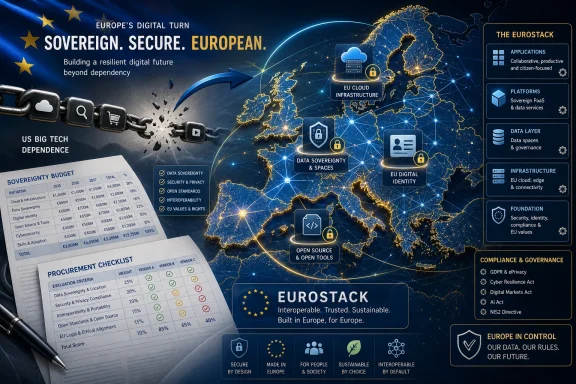
The phrase “Eurostack” has gained currency because it captures a desire for something more coherent than scattered alternatives. Europe wants cloud providers, office tools, identity services, AI models, chips, messaging systems, code repositories, social platforms, and public digital infrastructure that do not default to American control. That ambition is enormous.But if a European stack emerges, it will not arrive as a single product suite. It will be assembled in layers: open-source collaboration tools here, sovereign hosting there, national cloud frameworks, EU procurement rules, local AI infrastructure, public-sector code repositories, interoperable identity systems, and legal requirements that make portability more than a slogan.
The most important layer may be procurement. Public money can normalize alternatives that private buyers would otherwise consider too risky. Once a sovereign office suite, cloud provider, or code-hosting platform survives real use by a ministry, municipality, or university network, it becomes easier for the next institution to adopt it. That is how credibility compounds.
The second layer is interoperability. Europe cannot defeat lock-in by building new lock-in with a different flag. If sovereign alternatives trap customers, ignore open standards, or fragment along national lines, they will recreate the same dependency problem at smaller scale. The European bet only works if portability, federation, and open formats become operational requirements rather than campaign language.
The Numbers Matter Less Than the Direction of Default
The most dramatic phrase in the supplied framing is “mass exodus.” It captures the mood, but it risks overstating the current state of play. Europe has not abandoned US Big Tech at scale in the sense that revenue, workloads, and daily usage have suddenly collapsed. Microsoft, Amazon, Google, Meta, Apple, and other US firms remain deeply entrenched across the continent.Still, dismissing the shift because it is incomplete would be a mistake. Enterprise technology markets turn slowly, then suddenly. A decade of small procurement decisions can reshape the default assumptions of an entire generation of public-sector IT.
The question is not whether every European agency leaves Microsoft 365 by 2027. The question is whether Microsoft 365 renewals become politically and legally contested in a way they were not before. The question is not whether AWS loses Europe overnight. The question is whether election systems, courts, hospitals, identity services, and domain infrastructure increasingly treat non-European cloud control as a risk requiring explicit sign-off.
That is the real acceleration WIRED’s timeline captures. The center of gravity has moved from “US tech is convenient and compliant enough” toward “US tech may be necessary, but it must be justified.” For incumbents, that is a dangerous change.
Europe’s Tech Divorce Is Really a Dependency Audit
The concrete lessons for Windows admins, cloud architects, and public-sector technology leaders are less theatrical than the politics surrounding them. The useful response is not to rage-delete every American service. It is to map where dependency has become invisible.- Organizations should identify which workloads would become politically, legally, or operationally fragile if a US vendor relationship were disrupted.
- Public-sector buyers should treat data residency, operational control, support escalation, telemetry, identity, encryption keys, and parent-company jurisdiction as separate risk categories.
- Microsoft-heavy environments should distinguish between keeping Windows and accepting every cloud-tethered default in the Microsoft ecosystem.
- Open-source and European alternatives should be piloted first in bounded workflows where formats, training, support, and integration can be tested honestly.
- Sovereign-cloud claims should be evaluated architecturally, not just contractually, because branding alone does not remove foreign control.
- The most resilient strategy for many organizations will be selective diversification rather than symbolic purges.
References
- Primary source: The Tech Buzz
Published: 2026-06-08T06:30:08.974689
Europe's Mass Exodus From US Big Tech Accelerates | The Tech Buzz
Governments and companies across Europe shift away from American tech giantswww.techbuzz.ai - Related coverage: wired.com
All the Ways Europe Is Ditching American Technology | WIRED
A WIRED timeline shows how dozens of governments, companies, and other organizations across Europe are moving, or planning to shift, away from US Big Tech.www.wired.com - Related coverage: techspot.com
Europe is moving to block Microsoft, Amazon, and Google from handling government health, financial, and legal data | TechSpot
According to people familiar with the matter, the European Commission is preparing yet another unpleasant regulatory surprise for the current US administration. CNBC talked with two unnamed...www.techspot.com - Related coverage: euronews.com
Analysis: Will Big Tech's colossal AI spending crush Europe's data sovereignty? | Euronews
Big Tech companies are going all in on AI development, raising their projected capital expenditure to over $700bn (€590bn) this year, an increase of roughly 75% compared to 2025.www.euronews.com - Related coverage: techradar.com
Europe’s relationship with US Big Tech has reached a breaking point | TechRadar
Europe pushes back on Big Tech controlwww.techradar.com - Related coverage: techcrunch.com
What’s behind Europe’s efforts to ditch US software in favor of sovereign tech | TechCrunch
Governments across Europe are looking to rely less on American tech providers.techcrunch.com
- Related coverage: wired.it
Sovranità tecnologica, l’Europa prepara la sua partita (ancora lunga) contro il dominio tech americano | Wired Italia
Il piano sulla sovranità tecnologica punta a rafforzare chip, cloud, AI e open source europei. Ma Bruxelles deve ancora dimostrare di saper fare industriawww.wired.it - Related coverage: themeridiem.com
Europe Decouples From US Tech as Political Risk Triggers Digital Sovereignty Shift | The Meridiem
European governments move from strategic reliance to active rejection of US platforms after Trump administration unpredictability creates sanctions risk. France replaces Microsoft Teams and Zoom today—marking inflection from policy rhetoric to enforcement. www.themeridiem.com
- Related coverage: techxplore.com
- Related coverage: openrightsgroup.org
Tech giants and giant slayers: Digital Sovereignty and the Digital Commons
PDF documentwww.openrightsgroup.org
