

Choose an EV if you have dependable home charging and can accept planned charging stops on longer trips. Choose a plug-in hybrid if you can charge nightly but need gasoline backup for unpredictable, time-sensitive, or remote travel.
A Daily Herald road test dated July 11, 2026, provides a useful four-vehicle illustration of that choice. Craig Conover compared two all-electric vehicles—the 2026 Hyundai Ioniq 9 Calligraphy and 2026 Tesla Model Y—with two plug-in hybrids, the 2026 Lexus TX 550h+ and Toyota Prius Plug-in Hybrid Nightshade Edition—across commuting, family duty, and long-distance travel. His account suggested that both technologies can serve as primary transportation, but this remains an anecdotal comparison of four vehicles rather than proof of universal ownership outcomes.
Most comparisons between electric vehicles and plug-in hybrids begin with specifications: electric range, charging speed, fuel economy, battery capacity, cargo room, and acceleration. Those figures matter, but Conover’s account focused on what happened when the vehicles entered an active household schedule.
The test included work commutes, shopping, grandchildren’s sporting events, trips across Utah, and a long journey through the Colorado Rockies. That variety illustrated the difference between what an electrified vehicle can do and what it may ask its owner to do.
Conover reported quiet operation and immediate response from the vehicles during everyday driving. The sharper distinction appeared when journeys extended beyond convenient battery range. The EVs needed charging stops to continue, while the plug-in hybrids could bring their gasoline engines into service.
WindowsForum verdict: The road test is most useful as a decision-factor checklist, not as a controlled efficiency study. It illustrates how charging access, travel schedules, route predictability, and willingness to stop can shape the experience of each powertrain.
An EV offers the more direct powertrain proposition: charge the battery and drive without buying gasoline. A plug-in hybrid carries both electric and gasoline systems, allowing local electric driving without making the completion of a longer journey dependent on a charging stop.
The practical difference is not simply whether a household’s average commute fits within a battery estimate. Buyers also need to examine how often their plans change, whether their longest trips are scheduled or spontaneous, and whether stopping for 25 to 30 minutes fits the way they travel.
WindowsForum analysis: An EV generally places more responsibility for long-trip energy planning on the driver. A plug-in hybrid shifts some of that responsibility to an onboard gasoline system, but only regular charging allows it to deliver a substantial amount of electric driving.
For an EV, dependable home charging can eliminate the need to make a separate refueling stop during an ordinary week. The owner connects the vehicle after returning home and begins the next day with replenished range.
The Prius and Lexus followed a similar routine in Conover’s test. He reported plugging them in each evening, with the Prius providing around 41 miles of electric travel and the Lexus approximately 43 miles. Those figures are central to the purchase decision because they define how much typical daily driving could be completed before gasoline support was needed.
A plug-in hybrid does not need to remain electric across an entire interstate trip to provide practical value. It needs to cover enough recurring local mileage that nightly charging meaningfully reduces engine use. If a household normally drives within roughly 41 miles for the Prius or 43 miles for the Lexus before returning home, the tested pattern suggests that many routine days could remain largely electric.
Without reliable home or workplace charging, both propositions weaken. An EV owner becomes more dependent on public charging, while a plug-in-hybrid owner may operate primarily on gasoline if plugging in becomes inconvenient.
Buying threshold: Treat dependable overnight charging as a prerequisite for the strongest version of either ownership experience. If you cannot reliably charge where the vehicle normally sleeps—and do not have an equally dependable workplace option—resolve that issue before choosing based on electric range or advertised charging speed.
The journey required fast-charging stops. Conover reported that most of those sessions lasted about 25 to 30 minutes, giving buyers a concrete planning interval to consider.
A 25-to-30-minute stop may fit naturally into a meal or restroom break. It may feel more consequential to a driver trying to cover distance with minimal interruption. The same charging time can therefore be acceptable to one household and incompatible with another.
The reported journey was completed with charging incorporated into the route. That does not establish that every route, charger, vehicle, or weather condition will produce the same experience. It shows how this particular EV trip worked when the driver planned stops and adjusted the itinerary as conditions changed.
WindowsForum verdict: Do not evaluate a 25-to-30-minute charge as an abstract specification. Add the stops to one of your own frequent road trips. If the revised itinerary still works for your passengers, arrival commitments, and preferred travel pace, the EV case becomes stronger.
The road test does not prove that any network will eliminate uncertainty on every route. It does illustrate why buyers should evaluate a vehicle and its available charging options together. Charger location, stop duration, route placement, and the driver’s tolerance for detours can matter as much as a claimed range figure.
The Ioniq 9 and Model Y should not be assumed to provide identical charging experiences merely because Conover used Tesla charging infrastructure during the comparison. The account supports the narrower conclusion that charging access helped make the tested journeys possible. It does not independently establish identical connector behavior, charging speed, route integration, stall access, or network availability in every location.
Evidence-led question: On the routes you actually drive, can the specific EV you are considering use charging sites located where you would reasonably stop? A network logo or charger count is less informative than a route mapped with the exact vehicle, likely starting charge, and realistic stopping points.
The vehicle did not run out of energy. The driver noticed the changing estimate, revised the itinerary, charged, and continued. In this reported instance, active monitoring and an additional stop kept the journey on course.
Wind, speed, terrain, and temperature can affect energy use, but this single trip cannot establish how every EV will respond under every combination of conditions. Its value is more focused: the episode shows that a projected arrival plan can change while a trip is underway.
A plug-in hybrid handles that kind of change differently. Once its battery-only portion is depleted, the gasoline system can continue the trip without requiring an immediate charging decision. The result may be greater gasoline use, but the travel schedule can remain intact.
WindowsForum analysis: “Range management” is the appropriate label for the planning behavior illustrated by Conover’s Green River stop; it is not a universal conclusion established by one road test. Some drivers will accept that involvement as a normal part of EV travel. Others will prefer a powertrain that can respond to an unexpected energy shortfall with gasoline.
The Daily Herald account also indicated that the system required driver attention and occasional intervention. Buyers should therefore evaluate it as driver assistance rather than as permission to disengage from driving.
A successful demonstration can be impressive, especially when the system handles a complicated merge or intersection. One drive cannot establish flawless performance in different traffic, road, visibility, or construction conditions. The driver remains responsible for supervising the vehicle and responding when necessary.
The Model Y consequently represented two separate purchase considerations in Conover’s comparison. One was the battery-electric ownership model built around charging rather than gasoline. The other was a software-centered interface that combined vehicle controls, route information, charging decisions, and driver assistance.
WindowsForum verdict: Buyers attracted to the Model Y’s software should separate that interest from the EV-versus-PHEV decision. Home charging and travel patterns determine whether the powertrain fits; comfort with the interface and assistance features determines whether this particular EV fits.
Those are results from one reported test pattern, not guaranteed ownership figures. The very high displayed fuel-economy reading reflected the fact that electricity handled much of the week’s driving, leaving comparatively little gasoline consumption to record.
A later Saturday drive through Indian Canyon and beyond Price exceeded the familiar local pattern. According to Conover, the Prius continued with gasoline rather than requiring a charging stop.
The example illustrates the plug-in hybrid’s intended division of labor. Electricity can cover repeatable local driving when the owner charges consistently, while gasoline can support a trip that extends beyond the battery-only distance.
That flexibility carries a trade-off. The vehicle retains an engine and related components in addition to a battery, electric motors, and charging hardware. It therefore does not remove gasoline use or engine maintenance in the way a battery-electric vehicle can.
WindowsForum analysis: The Prius offers what can be called gasoline backup, but the value depends on behavior. A buyer who does not charge regularly will not reproduce the strongly electric usage pattern described in Conover’s week.
A consistently charged Prius can assign commuting, errands, school runs, and local appointments to its roughly 41-mile electric portion when those trips fit within the available range. If it is rarely charged, the gasoline system will do more of the work, reducing the practical distinction between the plug-in model and a vehicle purchased primarily for hybrid operation.
The best match is therefore a driver with dependable overnight charging, typical daily mileage near or below the reported electric range, and enough occasional longer travel to make the gasoline system useful.
There is also a behavioral risk. Because the Prius can continue without being plugged in, skipping a charging session produces no immediate mobility penalty. Repeatedly skipping it, however, undermines the reason to carry and pay for a larger plug-in battery.
Buying threshold: If most of your ordinary driving is within about 41 miles before the car returns to a charger—and you will actually connect it most nights—the Prius-style PHEV model is credible. If your daily mileage routinely exceeds that figure, expect more gasoline operation and evaluate whether the remaining electric portion justifies the plug-in configuration.
Those observations describe the reported week, not a guaranteed result for every TX owner. Passenger load, trip length, charging frequency, speed, and other conditions could produce different outcomes.
The important detail was how the Lexus fit into a variable family schedule. It could begin with electric driving after being plugged in and then continue with gasoline when travel extended beyond that portion. Conover characterized the experience as normal aside from the nightly charging routine.
For a family vehicle, that continuity can be more valuable than maximizing the percentage of miles driven electrically on every individual trip. Family schedules often include an unexpected pickup, an added passenger, a changed venue, or a longer-than-planned day.
WindowsForum analysis: “Schedule insurance” is our description of the gasoline backup illustrated by the TX, not a conclusion scientifically established by the road test. The phrase captures the practical benefit for a household that cannot always predict when a 20-mile day will become an 80-mile day.
The cost of that flexibility is continued fuel use and an internal-combustion powertrain that still requires maintenance. The benefit is that an unplanned extension does not automatically create a charging stop.
An EV may be exceptionally convenient for a commuter who starts each morning charged at home and takes only occasional planned road trips. It may be less convenient for a driver who lacks dependable overnight charging or regularly receives last-minute assignments far from the normal route.
A plug-in hybrid may provide many electric days when it is charged nightly and routine driving fits within its battery range. It may provide far less benefit if the owner rarely plugs it in or routinely drives far beyond that range before returning home.
The most useful buying research begins with the household calendar:
Infrastructure and vehicle capabilities can change over time, so buyers should check the exact routes and exact vehicle under consideration. The four-vehicle test illustrates the questions to ask; it cannot settle charger availability or performance for every buyer’s location.
Choose the Ioniq 9 or Model Y ownership model when home charging is dependable, long trips are generally foreseeable, and 25-to-30-minute charging pauses can become part of the itinerary. Choose the Prius or Lexus PHEV model when nightly charging can cover much of the daily routine but gasoline backup remains valuable for spontaneous, urgent, or remote travel.
The strongest EV candidate is not necessarily the buyer with the shortest commute. It is the buyer with reliable charging and a predictable relationship with long-distance travel. The strongest PHEV candidate is not someone unwilling to consider electric driving; it is someone prepared to charge consistently but unwilling to make every difficult journey dependent on a charging plan.
As charging options expand and vehicles improve, more households may find that an EV covers every journey they need to make. Until then, the most useful question is not which technology represents the future. It is which one fits the driveway, calendar, routes, and interruptions the buyer already has.
A Daily Herald road test dated July 11, 2026, provides a useful four-vehicle illustration of that choice. Craig Conover compared two all-electric vehicles—the 2026 Hyundai Ioniq 9 Calligraphy and 2026 Tesla Model Y—with two plug-in hybrids, the 2026 Lexus TX 550h+ and Toyota Prius Plug-in Hybrid Nightshade Edition—across commuting, family duty, and long-distance travel. His account suggested that both technologies can serve as primary transportation, but this remains an anecdotal comparison of four vehicles rather than proof of universal ownership outcomes.
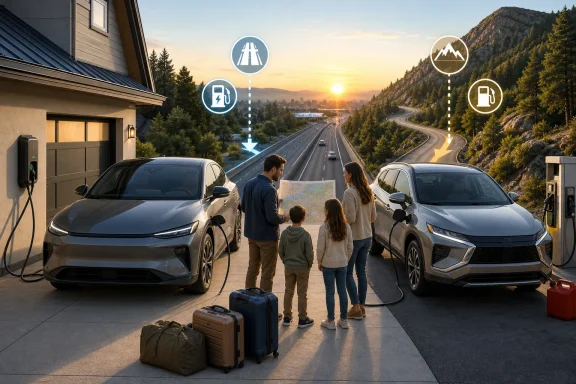 This Was an Ownership Test, Not a Specification Contest
Most comparisons between electric vehicles and plug-in hybrids begin with specifications: electric range, charging speed, fuel economy, battery capacity, cargo room, and acceleration. Those figures matter, but Conover’s account focused on what happened when the vehicles entered an active household schedule.The test included work commutes, shopping, grandchildren’s sporting events, trips across Utah, and a long journey through the Colorado Rockies. That variety illustrated the difference between what an electrified vehicle can do and what it may ask its owner to do.
Conover reported quiet operation and immediate response from the vehicles during everyday driving. The sharper distinction appeared when journeys extended beyond convenient battery range. The EVs needed charging stops to continue, while the plug-in hybrids could bring their gasoline engines into service.
WindowsForum verdict: The road test is most useful as a decision-factor checklist, not as a controlled efficiency study. It illustrates how charging access, travel schedules, route predictability, and willingness to stop can shape the experience of each powertrain.
Four Vehicles Reveal Two Different Ownership Contracts
The vehicles differed substantially in size, price category, and intended role. They nevertheless represented two clear approaches to electrified ownership: battery-electric vehicles that depend on charging for every mile, and plug-in hybrids that can continue on gasoline after their battery-only range is depleted.| Vehicle | Powertrain | Electric range reported in the test | Primary test role | Reported long-trip behavior |
|---|---|---|---|---|
| 2026 Hyundai Ioniq 9 Calligraphy | All-electric | Not stated | Colorado-to-Utah mountain journey | Used planned fast-charging stops |
| 2026 Tesla Model Y | All-electric | Not stated | Daily driving and technology evaluation | Used Tesla charging infrastructure |
| Toyota Prius Plug-in Hybrid Nightshade Edition | Plug-in hybrid | Around 41 miles | Commuting, errands, and a drive beyond Price | Continued with gasoline after electric operation |
| 2026 Lexus TX 550h+ | Plug-in hybrid | Approximately 43 miles | Family transportation and North Salt Lake trips | Used its gasoline engine after battery depletion |
The practical difference is not simply whether a household’s average commute fits within a battery estimate. Buyers also need to examine how often their plans change, whether their longest trips are scheduled or spontaneous, and whether stopping for 25 to 30 minutes fits the way they travel.
WindowsForum analysis: An EV generally places more responsibility for long-trip energy planning on the driver. A plug-in hybrid shifts some of that responsibility to an onboard gasoline system, but only regular charging allows it to deliver a substantial amount of electric driving.
Reliable Overnight Charging Is the First Threshold
The easiest miles in Conover’s account were those that began with a charged vehicle. When charging could occur while the car was parked overnight, both powertrain types were positioned to handle routine local driving electrically.For an EV, dependable home charging can eliminate the need to make a separate refueling stop during an ordinary week. The owner connects the vehicle after returning home and begins the next day with replenished range.
The Prius and Lexus followed a similar routine in Conover’s test. He reported plugging them in each evening, with the Prius providing around 41 miles of electric travel and the Lexus approximately 43 miles. Those figures are central to the purchase decision because they define how much typical daily driving could be completed before gasoline support was needed.
A plug-in hybrid does not need to remain electric across an entire interstate trip to provide practical value. It needs to cover enough recurring local mileage that nightly charging meaningfully reduces engine use. If a household normally drives within roughly 41 miles for the Prius or 43 miles for the Lexus before returning home, the tested pattern suggests that many routine days could remain largely electric.
Without reliable home or workplace charging, both propositions weaken. An EV owner becomes more dependent on public charging, while a plug-in-hybrid owner may operate primarily on gasoline if plugging in becomes inconvenient.
Buying threshold: Treat dependable overnight charging as a prerequisite for the strongest version of either ownership experience. If you cannot reliably charge where the vehicle normally sleeps—and do not have an equally dependable workplace option—resolve that issue before choosing based on electric range or advertised charging speed.
The Ioniq 9 Trip Put Charging Into the Itinerary
Conover assigned the Hyundai Ioniq 9 the longest and most demanding journey in the comparison. According to his account, the trip began near Denver, included the Denver Auto Show and Colorado Springs, crossed through Buena Vista and Tennessee Pass, stopped overnight in Parachute, and then continued toward Springville.The journey required fast-charging stops. Conover reported that most of those sessions lasted about 25 to 30 minutes, giving buyers a concrete planning interval to consider.
A 25-to-30-minute stop may fit naturally into a meal or restroom break. It may feel more consequential to a driver trying to cover distance with minimal interruption. The same charging time can therefore be acceptable to one household and incompatible with another.
The reported journey was completed with charging incorporated into the route. That does not establish that every route, charger, vehicle, or weather condition will produce the same experience. It shows how this particular EV trip worked when the driver planned stops and adjusted the itinerary as conditions changed.
WindowsForum verdict: Do not evaluate a 25-to-30-minute charge as an abstract specification. Add the stops to one of your own frequent road trips. If the revised itinerary still works for your passengers, arrival commitments, and preferred travel pace, the EV case becomes stronger.
The Model Y Made Infrastructure Part of the Vehicle Experience
Conover’s Model Y account presented charging infrastructure as a practical part of the vehicle’s appeal. The car was not evaluated solely through acceleration, cabin design, or battery operation; its relationship with Tesla charging locations also influenced the ownership impression.The road test does not prove that any network will eliminate uncertainty on every route. It does illustrate why buyers should evaluate a vehicle and its available charging options together. Charger location, stop duration, route placement, and the driver’s tolerance for detours can matter as much as a claimed range figure.
The Ioniq 9 and Model Y should not be assumed to provide identical charging experiences merely because Conover used Tesla charging infrastructure during the comparison. The account supports the narrower conclusion that charging access helped make the tested journeys possible. It does not independently establish identical connector behavior, charging speed, route integration, stall access, or network availability in every location.
Evidence-led question: On the routes you actually drive, can the specific EV you are considering use charging sites located where you would reasonably stop? A network logo or charger count is less informative than a route mapped with the exact vehicle, likely starting charge, and realistic stopping points.
A Reported Crosswind Changed the Plan
Conover described a strong crosswind between Grand Junction and Green River that reduced the Ioniq 9’s projected range. He responded by adding a charging stop in Green River rather than continuing toward Price under the original plan.The vehicle did not run out of energy. The driver noticed the changing estimate, revised the itinerary, charged, and continued. In this reported instance, active monitoring and an additional stop kept the journey on course.
Wind, speed, terrain, and temperature can affect energy use, but this single trip cannot establish how every EV will respond under every combination of conditions. Its value is more focused: the episode shows that a projected arrival plan can change while a trip is underway.
A plug-in hybrid handles that kind of change differently. Once its battery-only portion is depleted, the gasoline system can continue the trip without requiring an immediate charging decision. The result may be greater gasoline use, but the travel schedule can remain intact.
WindowsForum analysis: “Range management” is the appropriate label for the planning behavior illustrated by Conover’s Green River stop; it is not a universal conclusion established by one road test. Some drivers will accept that involvement as a normal part of EV travel. Others will prefer a powertrain that can respond to an unexpected energy shortfall with gasoline.
The Model Y Makes Software Part of the Purchase
The Model Y added a software-focused element through its driver-assistance capability. Conover reported watching the vehicle navigate city streets, merge onto highways, and negotiate intersections. He described the experience as initially unusual but increasingly familiar during the test.The Daily Herald account also indicated that the system required driver attention and occasional intervention. Buyers should therefore evaluate it as driver assistance rather than as permission to disengage from driving.
A successful demonstration can be impressive, especially when the system handles a complicated merge or intersection. One drive cannot establish flawless performance in different traffic, road, visibility, or construction conditions. The driver remains responsible for supervising the vehicle and responding when necessary.
The Model Y consequently represented two separate purchase considerations in Conover’s comparison. One was the battery-electric ownership model built around charging rather than gasoline. The other was a software-centered interface that combined vehicle controls, route information, charging decisions, and driver assistance.
WindowsForum verdict: Buyers attracted to the Model Y’s software should separate that interest from the EV-versus-PHEV decision. Home charging and travel patterns determine whether the powertrain fits; comfort with the interface and assistance features determines whether this particular EV fits.
The Prius Used Electricity for Routine Miles and Gasoline for the Exception
The Toyota Prius Plug-in Hybrid Nightshade Edition presented the clearest example of a daily routine fitting within a plug-in hybrid’s electric range. Conover reported about 41 miles of electric travel, fuel-economy readings above 99.9 mpg during much of the test week, and less than one-quarter of a tank consumed after several days of use and nightly charging.Those are results from one reported test pattern, not guaranteed ownership figures. The very high displayed fuel-economy reading reflected the fact that electricity handled much of the week’s driving, leaving comparatively little gasoline consumption to record.
A later Saturday drive through Indian Canyon and beyond Price exceeded the familiar local pattern. According to Conover, the Prius continued with gasoline rather than requiring a charging stop.
The example illustrates the plug-in hybrid’s intended division of labor. Electricity can cover repeatable local driving when the owner charges consistently, while gasoline can support a trip that extends beyond the battery-only distance.
That flexibility carries a trade-off. The vehicle retains an engine and related components in addition to a battery, electric motors, and charging hardware. It therefore does not remove gasoline use or engine maintenance in the way a battery-electric vehicle can.
WindowsForum analysis: The Prius offers what can be called gasoline backup, but the value depends on behavior. A buyer who does not charge regularly will not reproduce the strongly electric usage pattern described in Conover’s week.
The Prius Case Depends on Nightly Charging
The strongest Prius results in the account were built around plugging in each evening. Buying a plug-in hybrid does not by itself shift routine miles to electricity; connecting it regularly does.A consistently charged Prius can assign commuting, errands, school runs, and local appointments to its roughly 41-mile electric portion when those trips fit within the available range. If it is rarely charged, the gasoline system will do more of the work, reducing the practical distinction between the plug-in model and a vehicle purchased primarily for hybrid operation.
The best match is therefore a driver with dependable overnight charging, typical daily mileage near or below the reported electric range, and enough occasional longer travel to make the gasoline system useful.
There is also a behavioral risk. Because the Prius can continue without being plugged in, skipping a charging session produces no immediate mobility penalty. Repeatedly skipping it, however, undermines the reason to carry and pay for a larger plug-in battery.
Buying threshold: If most of your ordinary driving is within about 41 miles before the car returns to a charger—and you will actually connect it most nights—the Prius-style PHEV model is credible. If your daily mileage routinely exceeds that figure, expect more gasoline operation and evaluate whether the remaining electric portion justifies the plug-in configuration.
The Lexus Applied the Same Logic to Family Duty
The Lexus TX 550h+ applied plug-in-hybrid operation to a larger, three-row vehicle. Conover reported approximately 43 miles of electric range and an average of 46 mpg during the test week while the vehicle carried relatives, traveled to North Salt Lake, and supported family activities including a grandson’s baseball game.Those observations describe the reported week, not a guaranteed result for every TX owner. Passenger load, trip length, charging frequency, speed, and other conditions could produce different outcomes.
The important detail was how the Lexus fit into a variable family schedule. It could begin with electric driving after being plugged in and then continue with gasoline when travel extended beyond that portion. Conover characterized the experience as normal aside from the nightly charging routine.
For a family vehicle, that continuity can be more valuable than maximizing the percentage of miles driven electrically on every individual trip. Family schedules often include an unexpected pickup, an added passenger, a changed venue, or a longer-than-planned day.
WindowsForum analysis: “Schedule insurance” is our description of the gasoline backup illustrated by the TX, not a conclusion scientifically established by the road test. The phrase captures the practical benefit for a household that cannot always predict when a 20-mile day will become an 80-mile day.
The cost of that flexibility is continued fuel use and an internal-combustion powertrain that still requires maintenance. The benefit is that an unplanned extension does not automatically create a charging stop.
The Best Vehicle Depends on the Household’s Hardest Recurring Trip
Conover’s four-vehicle comparison suggested that credible choices exist on both sides, but it should not be read as proof that every EV or PHEV will suit every household. A “wrong household match” is WindowsForum’s interpretation of the risk created when charging access and travel patterns do not align with the selected vehicle.An EV may be exceptionally convenient for a commuter who starts each morning charged at home and takes only occasional planned road trips. It may be less convenient for a driver who lacks dependable overnight charging or regularly receives last-minute assignments far from the normal route.
A plug-in hybrid may provide many electric days when it is charged nightly and routine driving fits within its battery range. It may provide far less benefit if the owner rarely plugs it in or routinely drives far beyond that range before returning home.
The most useful buying research begins with the household calendar:
- Where does the vehicle park overnight?
- Can it charge there reliably?
- How many miles does it travel on a typical day before returning?
- How often does an ordinary day turn into an unplanned long trip?
- Are major road trips scheduled far enough in advance to map charging stops?
- Can passengers and deadlines accommodate 25-to-30-minute charging pauses?
- Does the household have another vehicle available for remote or urgent travel?
Infrastructure and vehicle capabilities can change over time, so buyers should check the exact routes and exact vehicle under consideration. The four-vehicle test illustrates the questions to ask; it cannot settle charger availability or performance for every buyer’s location.
The Questions That Actually Decide the Purchase
Use the following decision tool before comparing trim levels, acceleration, screens, or styling.Choose an EV when all four statements are true
- You have reliable overnight charging.
The vehicle can routinely begin the day charged without depending on an improvised or uncertain public stop. - Your typical daily driving fits comfortably within the EV’s usable range.
The exact threshold depends on the EV being considered, but ordinary days should not require public charging. - Unplanned long trips are infrequent.
Most journeys beyond the normal daily radius are known in advance and can be mapped around available chargers. - You accept 25-to-30-minute planned fast-charge stops on road trips.
Conover reported stops of roughly that length during the Ioniq 9 journey. If several such pauses would disrupt your deadlines or preferred pace, do not dismiss that concern as something you will automatically learn to tolerate.
Choose a Prius-style PHEV when these statements fit
- You can charge nearly every night.
- Your typical daily driving is about 41 miles or less before returning to the charger.
- You sometimes make unplanned, time-sensitive, or remote trips beyond that distance.
- You prefer gasoline backup to scheduling a fast-charge stop when plans change.
Choose a Lexus-style PHEV when these statements fit
- You need a larger family vehicle but still have reliable overnight charging.
- A substantial share of your daily driving is about 43 miles or less.
- Passenger duties and family schedules frequently change with little notice.
- You want the vehicle to continue beyond its electric range without adding a charging appointment.
Reconsider both plug-in options when charging is unreliable
If you cannot reliably charge overnight, pause before paying for either an EV or a PHEV on the assumption that public charging will fill the gap. The EV would depend more heavily on those public stops, while the PHEV could spend much of its life using gasoline rather than realizing its electric potential.The one-minute scorecard
| Question | If “yes” | If “no” |
|---|---|---|
| Can you charge reliably overnight? | Continue evaluating EVs and PHEVs | Resolve charging first or consider a non-plug-in alternative |
| Is ordinary daily driving within about 41 Prius miles or 43 Lexus miles? | A tested PHEV pattern could cover many routine miles electrically | Expect more gasoline use from these PHEVs |
| Are unplanned long trips rare? | EV ownership becomes easier to plan | PHEV gasoline backup gains practical value |
| Will you accept planned 25-to-30-minute charging stops on road trips? | An EV deserves strong consideration | A PHEV may better match your travel pace |
| Do you reliably plug in even when gasoline is available? | A PHEV can use both systems as intended | The plug-in premium may deliver limited benefit |
An Administrator’s Prepurchase Checklist
Before approving a household or fleet purchase, document the operating conditions rather than relying on a general preference for one technology.- Charging location: Confirm where the vehicle will charge overnight.
- Charging reliability: Verify that the space, electrical access, and parking routine are dependable.
- Typical daily mileage: Record a realistic week rather than estimating from memory.
- Return-to-base pattern: Determine whether the vehicle returns to its charger between driving days.
- PHEV range fit: Compare routine mileage with the Prius’s reported 41 miles or the Lexus’s reported 43 miles.
- Long-trip frequency: Count both scheduled and last-minute trips beyond the local routine.
- Road-trip tolerance: Decide whether 25-to-30-minute planned stops are acceptable.
- Deadline sensitivity: Identify trips where an added stop would create a real operational problem.
- Route review: Map recurring long routes with the specific EV under consideration.
- Backup vehicle: Note whether another household or fleet vehicle can absorb remote or urgent assignments.
- Plug-in discipline: For a PHEV, assign responsibility for connecting it regularly.
- Driver preference: Ask whether the primary driver wants active route planning or automatic gasoline backup.
The Practical Verdict
The four vehicles in Conover’s account do not prove that EVs are universally ready for every trip or that plug-in hybrids are the safer choice for every family. They illustrate four factors that buyers can evaluate directly: dependable overnight charging, daily mileage, frequency of unplanned long trips, and willingness to schedule fast-charging stops.Choose the Ioniq 9 or Model Y ownership model when home charging is dependable, long trips are generally foreseeable, and 25-to-30-minute charging pauses can become part of the itinerary. Choose the Prius or Lexus PHEV model when nightly charging can cover much of the daily routine but gasoline backup remains valuable for spontaneous, urgent, or remote travel.
The strongest EV candidate is not necessarily the buyer with the shortest commute. It is the buyer with reliable charging and a predictable relationship with long-distance travel. The strongest PHEV candidate is not someone unwilling to consider electric driving; it is someone prepared to charge consistently but unwilling to make every difficult journey dependent on a charging plan.
As charging options expand and vehicles improve, more households may find that an EV covers every journey they need to make. Until then, the most useful question is not which technology represents the future. It is which one fits the driveway, calendar, routes, and interruptions the buyer already has.
References
- Primary source: heraldextra.com
Published: 2026-07-12T00:10:11.340030
Electric or plug-in hybrid? After living with both, here’s what we learned
There may not be a more common question we hear these days than, “Should I buy an electric vehicle or a plug-in hybrid?” It’s a fair question. With more manufacturers introducing electric vehicles every year, buyers have more choices than ever before. At the same time, plug-in...www.heraldextra.com
- Related coverage: pressroom.toyota.com
Toyota Prius Plug-in Hybrid Gets Edgier with New Nightshade Edition - Toyota USA Newsroom
PLANO, Texas (June 16, 2025) – For 2026, Toyota is introducing the Prius Plug-in Hybrid Nightshade Edition – a bold new chapter in the Prius lineup that fuses sleek sophistication with an unmistakable edge. Built off the XSE grade, the Nightshade Edition elevates the iconic design with an array...pressroom.toyota.com
- Related coverage: tomsguide.com
I drove the Toyota Prius and Hyundai Elantra Hybrid for a week — here's the hybrid I'd actually buy | Tom's Guide
In a battle for the fuel economy crown, I drove the Toyota Prius and Hyundai Elantra Hybrid for a week each to find out which hybrid car you should buy.www.tomsguide.com - Related coverage: epa.gov
Electric & Plug-In Hybrid Electric Vehicles | US EPA
An introduction to the emissions, charging and driving range of electric vehicles and plug-in hybrid electric vehicles.www.epa.gov - Related coverage: newsroom.aaa.com
- Related coverage: pluginamerica.org
- Related coverage: chargevc.org