

Coforge’s new EvolveOps.AI promises to bring “Agentic AI” to the heart of enterprise IT operations, packaging a hybrid-cloud, open‑source stack of fine‑tuned small language models, deterministic decision engines, and 28 prebuilt agent personas to automate incident response, infrastructure provisioning, FinOps and more — with headline claims of up to 60% faster detection and resolution, 25% less downtime and a 40% reduction in IT operational expense.
EvolveOps.AI arrives at a moment when the market is shifting from “assistive” LLM tooling to agentic systems that can plan, coordinate and — under controlled governance — act on behalf of teams. Vendors and integrators increasingly describe an architectural pattern made up of a governed data fabric, retrieval/grounding layers (vector search), an agent orchestration fabric, and hybrid runtimes that place deterministic checks at the edge while running heavier reasoning in the cloud. This pattern is now common across enterprise agent initiatives and is explicitly cited in multiple recent platform announcements and integrator productizations.
Coforge positions EvolveOps.AI as a purpose‑engineered platform to accelerate the transition to an AI‑first operating model for IT teams. The company emphasizes open‑source foundations, a large adaptor library, a fine‑tuned small language model (SLM), and a catalog of agentic personas spanning Site Reliability Engineering (SRE), Cloud Engineering, Kubernetes engineering, Network Engineering, Service Management, Command Center and FinOps functions.
However, the promise of dramatic MTTR, downtime and OPEX reductions should be treated as vendor‑reported until validated with instrumented pilots and independent case studies. Enterprises that succeed with agentic operations will pair technical integration with disciplined governance, rigorous pilot measurement, and a staged rollout that places safety and auditability first. The payoff — fewer noisy alerts, faster incident resolution and more reliable systems — is real, but it depends on careful execution, not just adoption of a new platform.
Source: The Fast Mode Coforge Launches EvolveOps.AI, AI-Powered Platform for Autonomous IT Operations
 Background
EvolveOps.AI arrives at a moment when the market is shifting from “assistive” LLM tooling to agentic systems that can plan, coordinate and — under controlled governance — act on behalf of teams. Vendors and integrators increasingly describe an architectural pattern made up of a governed data fabric, retrieval/grounding layers (vector search), an agent orchestration fabric, and hybrid runtimes that place deterministic checks at the edge while running heavier reasoning in the cloud. This pattern is now common across enterprise agent initiatives and is explicitly cited in multiple recent platform announcements and integrator productizations.Coforge positions EvolveOps.AI as a purpose‑engineered platform to accelerate the transition to an AI‑first operating model for IT teams. The company emphasizes open‑source foundations, a large adaptor library, a fine‑tuned small language model (SLM), and a catalog of agentic personas spanning Site Reliability Engineering (SRE), Cloud Engineering, Kubernetes engineering, Network Engineering, Service Management, Command Center and FinOps functions.
What EvolveOps.AI claims to deliver
- End‑to‑end autonomous IT operations across incident detection, diagnosis, remediation and verification.
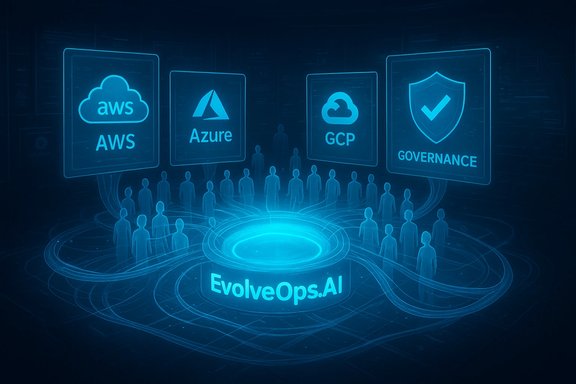
- A hybrid cloud architecture that supports AWS, Azure, GCP, OCI and private cloud environments with policy‑driven automation and full‑stack builds.
- An augmentation layer over existing investments in observability, data fabric and automation platforms that reduces noise and accelerates incident lifecycles.
- A library of 28 agentic personas capable of analysing, reasoning, deciding and acting in complex IT scenarios, switchable between human‑in‑the‑loop and fully autonomous modes.
- Vendor‑reported operational outcomes: 25% reduction in systems downtime; 40% reduction in IT OPEX; 60% reduction in Mean Time to Detect (MTTD) and Mean Time to Repair (MTTR); and 40% faster time to market for products. These are presented as customer/outcome figures in Coforge’s announcement materials.
Architecture highlights (vendor description)
- Built entirely on open‑source technologies, with a fine‑tuned SLM backed by deterministic models for verification and actioning.
- Large adaptor & plug‑in repository to accelerate deployments and reduce integration lift.
- Hybrid Cloud Manager for policy‑driven automation and governance across hyperscalers and private clouds.
- Guardrails and an enterprise control plane allowing a toggle between supervised and autonomous operational modes.
Overview: Why Coforge’s timing matters
The rush toward agentic IT operations is driven by three converging trends:- Observability data volumes and complexity have outpaced traditional human‑centric triage. Organizations want faster, contextualized root‑cause analysis and automated remediation.
- Hyperscalers and platform vendors are exposing agent runtimes, identity‑bound agent principals, and governance primitives — making production agent orchestration feasible in major clouds.
- Systems integrators and software vendors are packaging patterns (data fabric + retrieval + agent fabric + model runtime) into repeatable offerings for enterprise buyers to reduce integration risk.
Technical analysis: components, strengths and design choices
Hybrid model strategy: SLMs + deterministic models
Coforge combines a fine‑tuned small language model with deterministic decision engines. This hybrid approach is sensible for operations use cases:- Small Language Models (SLMs) reduce inference cost, latency, and data egress compared with very large public models, enabling on‑prem or private deployments when regulation or sensitivity matters.
- Deterministic models and rule engines supply verifiable checks, guardrails and idempotent operations — essential for change‑control in production environments.
Agent personas and orchestration
EvolveOps.AI’s catalogue of 28 agent personas is a key differentiator in messaging. Prebuilt personas reduce the engineering lift of authoring domain‑specialized agents and accelerate time to pilot. For enterprises, this translates into:- Faster proof‑of‑value for common SRE and cloud engineering tasks.
- A standard taxonomy of responsibilities and authorizations for AgentOps.
- A composable approach where agents can be orchestrated into multi‑step plans (detect → diagnose → propose → remediate → verify).
Integrations with hyperscalers and enterprise tooling
EvolveOps.AI’s Hybrid Cloud Manager claims support for AWS, Azure, GCP, OCI and private clouds, and for standard observability, ITSM and security stacks. That alignment is vital: enterprises will not rip out existing tooling to adopt an agentic platform. The architecture’s success depends on deep bi‑directional integrations (telemetry ingestion, runbook execution, ticketing state reconciliation) and consistent identity/Governance bindings across clouds. Industry trends show vendors packaging similar integrations, especially around Azure’s agentization patterns and identity‑bound agents.The vendor‑reported numbers: interpretation and verification
Coforge reports substantial improvements — e.g., 25% downtime reduction, 40% IT OPEX reduction, and 60% reduction in MTTD/MTTR — as outcomes seen by enterprises using EvolveOps.AI. These metrics are compelling, but they require context.- Vendor‑reported performance numbers are common in early product launches; independent, third‑party validation is rarely present at announcement time. Industry practice and analyst coverage advise treating such headline percentages as vendor claims until a published methodology, customer case study or independent benchmark is provided.
- Outcomes will vary by workload, observability fidelity, maturity of asset and CMDB data, and the rigor of pilot instrumentation. A 60% MTTR reduction in a highly mature Cloud‑native environment with full telemetry and a tested runbook library is feasible; the same outcome is unlikely in a heterogenous estate with poor telemetry coverage.
- Enterprises should request CFO‑grade KPIs, sample methodology for how reductions were measured, timeline windows, and the baseline definitions used for MTTR, MTBD and OPEX. Treat headline numbers as directional until validated through instrumented pilots.
Strengths: where EvolveOps.AI could add measurable value
- Accelerated incident lifecycle: By consolidating telemetry and offering agentic triage and remediation proposals, teams can reduce context switching and shorten detection→closure loops.
- Lowered integration cost for pilots: The adaptor/plug‑in repository and prebuilt personas reduce first‑mile engineering work, enabling faster PoCs.
- Hybrid and multi‑cloud governance: Policy‑driven full‑stack builds across hyperscalers reduce the complexity of rolling a single automation standard across AWS, Azure and GCP estates.
- Cost and latency controls: Purpose‑built SLMs and a hybrid runtime can reduce inference cost and allow sensitive workloads to stay on‑prem or in private cloud, which is attractive for regulated industries.
- Operational standardisation: Centralized AgentOps and a persona catalog can help standardize runbooks, audits, and SLO enforcement across teams.
Risks, limitations and the guardrails enterprises must demand
- Over‑automation and change cascade risk
Autonomous actions that change production infrastructure can cascade and amplify incidents. Start in proposal or shadow modes and require explicit approval gates for high‑impact actions. Vendors and analysts repeatedly warn that automation without staged validation risks systemic failure. - Hallucination and provenance concerns
Any LLM‑based reasoning needs robust grounding: retrieval‑augmented generation with immutable provenance and citations for diagnostic claims. Unverifiable model outputs must not be allowed to drive automated remediation without deterministic verification. - Integration and data quality debt
Automation is only as good as asset inventories, telemetry coverage and CMDB hygiene. Expect nontrivial effort to normalize identifiers, link telemetry to configuration items, and instrument critical paths. - Expanded attack surface and security posture
Allowing agents to operate across clouds and tools increases the privilege surface. Enterprises must enforce least‑privilege identities for agents, short‑lived credentials, and immutable audit trails that map actions to agent identities. Security teams should require red‑team testing and SIEM integration prior to granting execution rights. - Vendor ROI and measurement bias
Vendor KPIs frequently come from pilot environments or optimistic customer examples. Buyers must insist on instrumented pilots with defined methodologies, sample sizes, and control periods before scaling claims into procurement decisions. - Multi‑cloud parity and vendor lock‑in risk
If platform integrations are deeper in one cloud (for example, Azure‑native agent fabrics), multi‑cloud teams may experience uneven automation parity and end up being operationally constrained.
Recommended pilot and rollout blueprint
- Scoping (Weeks 0–2)
- Identify a narrow, high‑value use case (e.g., database incident triage for a critical product line).
- Define CFO‑grade KPIs: baseline MTTR, incident frequency, downtime cost per hour.
- Sandbox deployment (Weeks 2–6)
- Deploy EvolveOps.AI in proposal/observe‑only mode. Connect telemetry and ticketing systems.
- Validate adapters for your observability stacks and test connector fidelity.
- Shadow mode & human‑in‑the‑loop (Weeks 6–12)
- Enable agent proposals to route into a guarded workflow channel. No automated writes. Collect false positives/negatives and measure time savings.
- Limited production with gating (Months 3–6)
- Allow low‑risk, idempotent automations (e.g., autoscaling adjustments, cache restarts) behind approval gates. Instrument outcomes and rollback events.
- Scale with controls (Months 6+)
- Expand automation only after meeting PoC targets. Implement model versioning, agent inventories, and continuous testing for agent outputs. Apply cost quotas and monthly reviews.
Governance, auditability and responsible AgentOps
- Treat agents as first‑class principals: assign unique identities, least‑privilege access, explicit lifecycles and immutable logs of every plan, intermediate artifact and tool invocation.
- Capture prompts, chain‑of‑thought artifacts and all tool outputs as tamper‑evident artifacts for compliance and retraining.
- Use deterministic verification agents to re‑run critical checks before authorizing any state‑changing actions.
- Integrate agent telemetry with SIEM, change management and cost governance modules to ensure cross‑discipline visibility.
Cost, FinOps and observability economics
EvolveOps.AI claims reduced IT OPEX and faster time‑to‑market, but cost governance is essential:- Model and inference costs must be tracked against savings from reduced toil and downtime. Set quotas and monitoring for model usage at the tenant and team level.
- Observability ingestion and retention costs can balloon when richer telemetry is required for agent decisioning. Adopt targeted ingestion, sampling and retention policies to limit unbounded cost growth.
- FinOps agents (one of the persona types Coforge highlights) can automate cost optimizations, but buyers should validate the savings with pre/post billing analyses.
How EvolveOps.AI compares to the market
Coforge is not alone; systems integrators and platform vendors are packaging agentic operations offerings with similar component architectures: data fabric, retrieval, agent fabric and model runtimes. Recent market activity shows:- Hyperscaler agent platforms that bind agents to identity and governance primitives and expose agent orchestration surfaces.
- Integrator offerings that productize agentic DataOps or AgentOps for vertical sectors, typically combining prebuilt connectors, governance templates and runtime blueprints.
Practical procurement checklist
- Require an instrumented pilot with explicit definitions and measurement windows for MTTD, MTTR, downtime cost and OPEX impact.
- Ask for runbooks-as-code and evidence that agent actions are fully auditable and reversible.
- Demand a detailed connector list and verified adapters for your observability, ITSM, and identity stacks.
- Insist on human‑in‑the‑loop gating and progressive enablement — proposal → supervised execution → limited automated execution.
- Verify the model deployment options: on‑prem/private cloud SLM hosting vs. public inference endpoints, to satisfy compliance and data residency needs.
Conclusion
EvolveOps.AI captures the leading enterprise narrative for agentic IT operations: a governed, hybrid runtime that uses retrieval‑grounded SLM reasoning plus deterministic checks to accelerate detection, diagnosis and remediation across multi‑cloud estates. Coforge’s persona catalog and open‑source architecture make it an attractive candidate for teams that want a packaged, integrator‑led path to AgentOps.However, the promise of dramatic MTTR, downtime and OPEX reductions should be treated as vendor‑reported until validated with instrumented pilots and independent case studies. Enterprises that succeed with agentic operations will pair technical integration with disciplined governance, rigorous pilot measurement, and a staged rollout that places safety and auditability first. The payoff — fewer noisy alerts, faster incident resolution and more reliable systems — is real, but it depends on careful execution, not just adoption of a new platform.
Source: The Fast Mode Coforge Launches EvolveOps.AI, AI-Powered Platform for Autonomous IT Operations
