

Exolit OP 960 is described in a July 6, 2026 ad-hoc-news.de product-and-investor note as a Clariant halogen-free flame retardant aimed at engineering plastics for US electronics, EV components, connectors, and other electrical parts. The more important story is not one additive powder, but the quiet migration of the plastics industry away from brominated legacy systems and toward phosphorus-based fire protection. For WindowsForum readers, that matters because the same materials decisions sit inside chargers, power supplies, data-center gear, home electrical hardware, and the EV infrastructure increasingly sharing circuits with our PCs and networks.
The ad-hoc-news.de piece frames Exolit OP 960 as a product Clariant shareholders should know, and that framing is mostly right for the wrong reason. Nobody buying a gaming laptop, a wall charger, or an EV charging unit will see “Exolit OP 960” on the box. Yet the additives inside plastic housings and connectors can determine whether a fault becomes a scorch mark, a melted mess, or a spreading fire.
Clariant’s own materials describe Exolit OP as a halogen-free, phosphorus-based flame retardant family for polymer materials, with applications in electrical and electronics, transportation, e-mobility, batteries, components, and charging infrastructure. The company also says its Exolit OP phosphinate and synergist systems are used with polyamides and polyesters in connectors, switches, and other electrical parts. That aligns with the broad thrust of the ad-hoc-news.de report, even if OP 960 itself is less visible in public Clariant marketing than better-documented grades such as Exolit OP 1230, OP 1312, OP 1314, and OP 1400.
That distinction matters. The source article presents OP 960 as a current, application-specific grade for PA and PBT formulations, but the public trail is stronger for the Exolit OP platform than for this exact grade. A careful reading should treat the product note as a market-facing write-up anchored in a real Clariant technology family, not as a substitute for a technical data sheet, UL file, safety data sheet, or direct procurement confirmation.
Traditional brominated flame retardants did their job well enough to become industrial default choices in many applications. The trouble is that fire behavior is not just about whether a plastic burns. Smoke toxicity, corrosive by-products, recycling compatibility, regulatory pressure, and public concern over persistent chemicals have all pushed OEMs to ask whether a material that passes a burn test still fits the next decade of product design.
Clariant’s pitch for Exolit OP sits directly in that transition. The company markets the family as halogen-free and phosphorus-based, emphasizing fire resistance without the performance compromises that designers fear when they move away from older brominated systems. In practical terms, that means a compounder can try to meet UL 94 and glow-wire requirements while preserving the mechanical and electrical properties that made engineering plastics attractive in the first place.
For US electronics and EV suppliers, this is not a cosmetic sustainability badge. A connector housing that cracks, warps, tracks electrically, or migrates additive to the surface can fail even if the underlying flame retardant chemistry looks good in a brochure. The real product is not the powder; it is the compound recipe that survives manufacturing, certification, heat aging, vibration, moisture, and abuse.
The ad-hoc-news.de article puts OP 960 inside that platform as a grade aimed at PA and PBT formulations. That is plausible, because polyamides and polyesters are exactly the engineering plastics that dominate many high-performance electrical parts. PA6, PA66, and PBT show up wherever designers need stiffness, dimensional stability, heat resistance, and electrical insulation in small molded parts.
But platform branding can blur important differences between grades. One Exolit OP product may be optimized for polyamide, another for polyester, another for thin-wall electrical parts, another for renewable-carbon positioning, and another for different processing windows. For an engineer, “Exolit OP” is a starting point, not a bill of materials.
This is where the source article’s investor framing gets slightly ahead of the technical record. It is fair to say OP 960 belongs to a strategically important family if Clariant is positioning it for US electrical and EV applications. It is not fair to treat one grade as a standalone earnings engine without segment revenue, customer wins, capacity disclosure, or margin detail.
But the more interesting part of Clariant’s Exolit OP messaging is electrical performance, particularly comparative tracking index, or CTI. CTI measures how resistant an insulating material is to forming conductive paths across its surface under contamination and electrical stress. In plain English, it helps answer whether the plastic stays an insulator when real-world grime, moisture, and voltage try to make it misbehave.
That is why CTI matters for EV chargers, circuit breakers, terminal blocks, power distribution hardware, appliance electronics, and dense consumer devices. As voltages rise and packaging shrinks, the old answer of “just make it thicker and leave more space” becomes expensive or impossible. A flame retardant that preserves tracking resistance while allowing compact molded designs becomes more than a fire-safety additive; it becomes an enabler of smaller, denser electrical systems.
Clariant’s public materials say compounds made with Exolit OP can combine good mechanical properties with high CTI values. That is exactly the claim a supplier wants to make to OEMs trying to pack more current into smaller enclosures. The catch is that every final compound still needs testing, because resin grade, glass loading, pigment, stabilizers, processing history, and wall thickness all shape the result.
That does not mean every EV part suddenly depends on OP 960. Automotive qualification cycles are slow, conservative, and brutal. Materials must survive thermal cycling, humidity, vibration, chemical exposure, process variation, and long service lives. A promising additive can spend years moving from formulation work to validation to production.
Still, the EV relevance is credible because electrification changes the risk model. High-voltage connectors, busbar supports, charger housings, battery-adjacent modules, inverter components, and power electronics enclosures all need plastics that do not turn an electrical fault into a broader hazard. Fire safety is not a marketing afterthought in these systems; it is a gatekeeper.
The bigger market signal is that halogen-free engineering plastic compounds are becoming mainstream requirements rather than boutique options. If a supplier can deliver flame performance, CTI, processability, and mechanical strength without bromine-antimony packages, OEMs have a reason to qualify it. That creates room for specialty chemical companies like Clariant to defend pricing even in a procurement culture obsessed with cost-down programs.
That is a powerful selling point because the plastics industry hates requalification. If a greener input forces a new round of flame testing, mechanical testing, electrical testing, aging, supplier audits, customer approvals, and regulatory paperwork, many OEMs will walk away. Drop-in equivalence is the magic phrase.
But sustainability in flame retardants is not a slogan; it is a negotiation between hazard, durability, recyclability, performance, and lifecycle consequences. A material that avoids halogens but requires much higher loading could affect density, impact strength, flow, or cost. A material that passes fire tests but complicates recycling may merely move the environmental burden elsewhere.
The best case for Exolit OP 960, if the ad-hoc-news.de description holds in technical procurement documents, is that it gives compounders another route through that maze. It offers a halogen-free phosphorus chemistry inside a product family already marketed for demanding electrical uses. That is not revolutionary, but in materials engineering, dependable iteration often beats revolution.
Specialty additives can be attractive businesses because they are technically embedded. Once a material is qualified in a customer’s compound and certified in an end product, switching suppliers is not trivial. That can support pricing power and customer retention, especially in regulated applications where failure carries legal, safety, and brand consequences.
The limitation is disclosure. Clariant does not publicly break out OP 960 revenue in the ad-hoc-news.de article, and public company reporting generally will not tell investors how one additive grade performs. Even the broader Exolit OP line is best read as a strategic product family rather than a transparent financial segment.
So the stock relevance is real but modest. OP 960 can strengthen the narrative that Clariant is exposed to electrification, safer materials, and higher-value polymer additives. It cannot, on its own, justify an investment thesis without evidence of adoption, capacity utilization, margins, competitive position, and cyclicality in the customers it serves.
But the piece also uses the kind of synthetic product-news language that should make technical readers pause. It paints lab scenes, plant-floor walkthroughs, and engineering conversations without making clear whether those are reported observations, illustrative reconstructions, or AI-assisted narrative color. The page itself states that the article was AI-assisted and editorially reviewed.
That does not make it false. It does mean readers should separate confirmed facts from atmospheric prose. Clariant’s public pages confirm the Exolit OP family, its halogen-free phosphorus chemistry, its relevance to electrical and electronics applications, its use in polyamides and polyesters, and its e-mobility positioning. The exact commercial details around OP 960 require direct confirmation from Clariant, distributors, or customer-facing technical literature.
For WindowsForum’s audience, that skepticism is not pedantry. Sysadmins know the difference between a vendor slide and a deployment guide. Materials engineers live by the same distinction. A product family page can tell you what a chemistry is for; a data sheet, certification file, and tested formulation tell you whether it belongs in your design.
Data centers are an obvious example. They concentrate power, heat, airflow, and electronics into environments where component failure has operational and safety consequences. Even if Exolit OP 960 never appears in a server part, the same class of halogen-free engineering plastic compounds is relevant to the infrastructure that keeps cloud services, enterprise Windows fleets, and AI workloads running.
The home office is the quieter example. A user may plug a laptop, phone, display, dock, router, external drive, and charger into a power strip under a desk. Each device contains small plastic parts tasked with insulating live conductors, resisting heat, and failing safely. The user sees a brand; the safety engineer sees resin, wall thickness, tracking distance, and flame classification.
That is why specialty additives deserve attention even when they lack consumer glamour. Operating systems and silicon get the headlines, but the physical layer still matters. A smart device that cannot survive an electrical fault safely is not smart enough.
Qualification is the hidden moat. A compound that passes UL 94 at a target wall thickness still has to mold well, meet color requirements, avoid blooming, maintain impact strength, preserve CTI, withstand heat aging, and remain available at industrial scale. It must also survive purchasing scrutiny and multi-source risk management.
This is where Clariant’s broader Exolit OP platform gives OP 960, if commercially available as described, a credibility advantage. OEMs prefer suppliers with application labs, regional support, regulatory documentation, and a track record in similar compounds. A flame retardant is not purchased like a commodity bag of filler; it is adopted through a technical relationship.
At the same time, customers will not pay for chemistry alone. If antimony price volatility, regulatory pressure, and sustainability targets favor halogen-free systems, that helps Clariant. If a rival offers comparable performance at lower loading, better processability, or easier approvals, the market will move. Specialty does not mean immune.
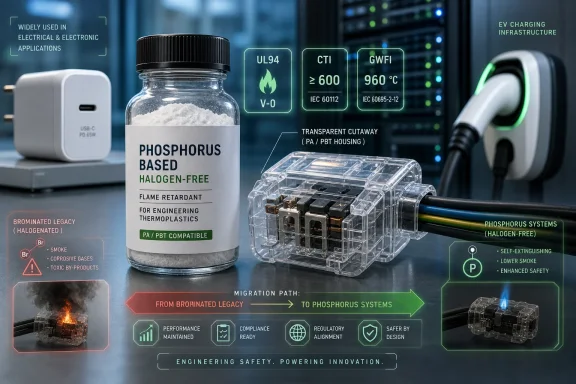 A White Powder Becomes a Supply-Chain Signal
The ad-hoc-news.de piece frames Exolit OP 960 as a product Clariant shareholders should know, and that framing is mostly right for the wrong reason. Nobody buying a gaming laptop, a wall charger, or an EV charging unit will see “Exolit OP 960” on the box. Yet the additives inside plastic housings and connectors can determine whether a fault becomes a scorch mark, a melted mess, or a spreading fire.Clariant’s own materials describe Exolit OP as a halogen-free, phosphorus-based flame retardant family for polymer materials, with applications in electrical and electronics, transportation, e-mobility, batteries, components, and charging infrastructure. The company also says its Exolit OP phosphinate and synergist systems are used with polyamides and polyesters in connectors, switches, and other electrical parts. That aligns with the broad thrust of the ad-hoc-news.de report, even if OP 960 itself is less visible in public Clariant marketing than better-documented grades such as Exolit OP 1230, OP 1312, OP 1314, and OP 1400.
That distinction matters. The source article presents OP 960 as a current, application-specific grade for PA and PBT formulations, but the public trail is stronger for the Exolit OP platform than for this exact grade. A careful reading should treat the product note as a market-facing write-up anchored in a real Clariant technology family, not as a substitute for a technical data sheet, UL file, safety data sheet, or direct procurement confirmation.
The Flame Retardant Wars Moved From Chemistry Class to the Garage
For decades, flame retardants were a niche concern unless you worked in plastics, appliance safety, or environmental regulation. That world has changed because electrification has dragged high-current systems into ordinary spaces. The garage wall is now a charging point, the kitchen counter is a USB-C power hub, and the home office is full of compact power electronics that must dissipate heat without becoming ignition sources.Traditional brominated flame retardants did their job well enough to become industrial default choices in many applications. The trouble is that fire behavior is not just about whether a plastic burns. Smoke toxicity, corrosive by-products, recycling compatibility, regulatory pressure, and public concern over persistent chemicals have all pushed OEMs to ask whether a material that passes a burn test still fits the next decade of product design.
Clariant’s pitch for Exolit OP sits directly in that transition. The company markets the family as halogen-free and phosphorus-based, emphasizing fire resistance without the performance compromises that designers fear when they move away from older brominated systems. In practical terms, that means a compounder can try to meet UL 94 and glow-wire requirements while preserving the mechanical and electrical properties that made engineering plastics attractive in the first place.
For US electronics and EV suppliers, this is not a cosmetic sustainability badge. A connector housing that cracks, warps, tracks electrically, or migrates additive to the surface can fail even if the underlying flame retardant chemistry looks good in a brochure. The real product is not the powder; it is the compound recipe that survives manufacturing, certification, heat aging, vibration, moisture, and abuse.
Clariant Is Selling a Platform, Not a Consumer Product
The strongest verified claim is that Clariant has built Exolit OP into a broad halogen-free flame retardant platform for engineering plastics and electrical applications. Its own product pages describe the line as non-halogenated, phosphorus-based, and suitable for polymers used in electrical and electronics, transportation, fibers, connectors, switches, printed electronics, and PET-related uses. Its electrical and electronics pages also call out high comparative tracking index values, mechanical property retention, and suitability for compact components.The ad-hoc-news.de article puts OP 960 inside that platform as a grade aimed at PA and PBT formulations. That is plausible, because polyamides and polyesters are exactly the engineering plastics that dominate many high-performance electrical parts. PA6, PA66, and PBT show up wherever designers need stiffness, dimensional stability, heat resistance, and electrical insulation in small molded parts.
But platform branding can blur important differences between grades. One Exolit OP product may be optimized for polyamide, another for polyester, another for thin-wall electrical parts, another for renewable-carbon positioning, and another for different processing windows. For an engineer, “Exolit OP” is a starting point, not a bill of materials.
This is where the source article’s investor framing gets slightly ahead of the technical record. It is fair to say OP 960 belongs to a strategically important family if Clariant is positioning it for US electrical and EV applications. It is not fair to treat one grade as a standalone earnings engine without segment revenue, customer wins, capacity disclosure, or margin detail.
UL 94 Is the Headline Test, but CTI Is the Quiet Killer Feature
Most consumer-facing talk about flame retardants gravitates toward UL 94 ratings, especially V-0. That rating matters because it tells manufacturers how a material behaves under a standardized vertical flame exposure. For a plastic component around live electrical parts, self-extinguishing behavior can be the difference between localized failure and propagation.But the more interesting part of Clariant’s Exolit OP messaging is electrical performance, particularly comparative tracking index, or CTI. CTI measures how resistant an insulating material is to forming conductive paths across its surface under contamination and electrical stress. In plain English, it helps answer whether the plastic stays an insulator when real-world grime, moisture, and voltage try to make it misbehave.
That is why CTI matters for EV chargers, circuit breakers, terminal blocks, power distribution hardware, appliance electronics, and dense consumer devices. As voltages rise and packaging shrinks, the old answer of “just make it thicker and leave more space” becomes expensive or impossible. A flame retardant that preserves tracking resistance while allowing compact molded designs becomes more than a fire-safety additive; it becomes an enabler of smaller, denser electrical systems.
Clariant’s public materials say compounds made with Exolit OP can combine good mechanical properties with high CTI values. That is exactly the claim a supplier wants to make to OEMs trying to pack more current into smaller enclosures. The catch is that every final compound still needs testing, because resin grade, glass loading, pigment, stabilizers, processing history, and wall thickness all shape the result.
The EV Angle Is Real, but It Should Not Be Overhyped
The ad-hoc-news.de report leans hard into EV components, and Clariant’s own marketing supports that direction. The company explicitly ties Exolit OP to e-mobility, EV batteries, components, and charging infrastructure. It also frames transportation as a market where halogen-free flame retardants can replace brominated legacy types while supporting lighter, tougher plastics.That does not mean every EV part suddenly depends on OP 960. Automotive qualification cycles are slow, conservative, and brutal. Materials must survive thermal cycling, humidity, vibration, chemical exposure, process variation, and long service lives. A promising additive can spend years moving from formulation work to validation to production.
Still, the EV relevance is credible because electrification changes the risk model. High-voltage connectors, busbar supports, charger housings, battery-adjacent modules, inverter components, and power electronics enclosures all need plastics that do not turn an electrical fault into a broader hazard. Fire safety is not a marketing afterthought in these systems; it is a gatekeeper.
The bigger market signal is that halogen-free engineering plastic compounds are becoming mainstream requirements rather than boutique options. If a supplier can deliver flame performance, CTI, processability, and mechanical strength without bromine-antimony packages, OEMs have a reason to qualify it. That creates room for specialty chemical companies like Clariant to defend pricing even in a procurement culture obsessed with cost-down programs.
The Sustainability Pitch Works Only If Performance Survives the Extruder
Clariant’s sustainability language is polished, and some of it is substantial. The company says Exolit OP flame retardants are halogen-free, phosphorus-based, and produced with green electricity, and it promotes Exolit OP Terra grades that use mass-balance renewable feedstock. Its thermoplastics brochure says Terra versions are designed to be physically and chemically equivalent to regular Exolit OP products, avoiding new approval burdens in some cases.That is a powerful selling point because the plastics industry hates requalification. If a greener input forces a new round of flame testing, mechanical testing, electrical testing, aging, supplier audits, customer approvals, and regulatory paperwork, many OEMs will walk away. Drop-in equivalence is the magic phrase.
But sustainability in flame retardants is not a slogan; it is a negotiation between hazard, durability, recyclability, performance, and lifecycle consequences. A material that avoids halogens but requires much higher loading could affect density, impact strength, flow, or cost. A material that passes fire tests but complicates recycling may merely move the environmental burden elsewhere.
The best case for Exolit OP 960, if the ad-hoc-news.de description holds in technical procurement documents, is that it gives compounders another route through that maze. It offers a halogen-free phosphorus chemistry inside a product family already marketed for demanding electrical uses. That is not revolutionary, but in materials engineering, dependable iteration often beats revolution.
The Investor Case Is Incremental, Not Explosive
For Clariant shareholders, the right way to think about OP 960 is as part of the company’s specialty-additives story, not as a single-product catalyst. Clariant is a Swiss specialty chemicals group listed on the SIX Swiss Exchange under CLN, and its portfolio includes additives, care chemicals, and catalysts. Flame retardants are one slice of that industrial mix.Specialty additives can be attractive businesses because they are technically embedded. Once a material is qualified in a customer’s compound and certified in an end product, switching suppliers is not trivial. That can support pricing power and customer retention, especially in regulated applications where failure carries legal, safety, and brand consequences.
The limitation is disclosure. Clariant does not publicly break out OP 960 revenue in the ad-hoc-news.de article, and public company reporting generally will not tell investors how one additive grade performs. Even the broader Exolit OP line is best read as a strategic product family rather than a transparent financial segment.
So the stock relevance is real but modest. OP 960 can strengthen the narrative that Clariant is exposed to electrification, safer materials, and higher-value polymer additives. It cannot, on its own, justify an investment thesis without evidence of adoption, capacity utilization, margins, competitive position, and cyclicality in the customers it serves.
The Source Article Gets the Direction Right and the Certainty Wrong
The ad-hoc-news.de article is useful because it points readers toward a real materials trend: halogen-free flame retardants for engineering plastics are becoming more important as electronics and EV infrastructure spread. It is also careful in some places, noting that pricing is business-to-business and not publicly listed. That is the correct posture for a specialty additive.But the piece also uses the kind of synthetic product-news language that should make technical readers pause. It paints lab scenes, plant-floor walkthroughs, and engineering conversations without making clear whether those are reported observations, illustrative reconstructions, or AI-assisted narrative color. The page itself states that the article was AI-assisted and editorially reviewed.
That does not make it false. It does mean readers should separate confirmed facts from atmospheric prose. Clariant’s public pages confirm the Exolit OP family, its halogen-free phosphorus chemistry, its relevance to electrical and electronics applications, its use in polyamides and polyesters, and its e-mobility positioning. The exact commercial details around OP 960 require direct confirmation from Clariant, distributors, or customer-facing technical literature.
For WindowsForum’s audience, that skepticism is not pedantry. Sysadmins know the difference between a vendor slide and a deployment guide. Materials engineers live by the same distinction. A product family page can tell you what a chemistry is for; a data sheet, certification file, and tested formulation tell you whether it belongs in your design.
The Windows Angle Is Hidden in the Power Path
This story may sound far from Windows, but it is not far from the Windows ecosystem. Modern PCs, docks, monitors, USB-C chargers, power supplies, server racks, UPS systems, networking gear, and smart-home controllers all rely on flame-retarded plastics. The move toward higher power delivery and denser electronics makes enclosure and connector materials more important, not less.Data centers are an obvious example. They concentrate power, heat, airflow, and electronics into environments where component failure has operational and safety consequences. Even if Exolit OP 960 never appears in a server part, the same class of halogen-free engineering plastic compounds is relevant to the infrastructure that keeps cloud services, enterprise Windows fleets, and AI workloads running.
The home office is the quieter example. A user may plug a laptop, phone, display, dock, router, external drive, and charger into a power strip under a desk. Each device contains small plastic parts tasked with insulating live conductors, resisting heat, and failing safely. The user sees a brand; the safety engineer sees resin, wall thickness, tracking distance, and flame classification.
That is why specialty additives deserve attention even when they lack consumer glamour. Operating systems and silicon get the headlines, but the physical layer still matters. A smart device that cannot survive an electrical fault safely is not smart enough.
The Real Competition Is Qualification Time
The market for halogen-free flame retardants is competitive, and Clariant is not alone in seeing the opportunity. Chemical suppliers, compounders, resin producers, and OEM materials teams all want formulations that satisfy fire safety, electrical performance, sustainability demands, and manufacturing economics. The winner is rarely the molecule with the best single property; it is the system that qualifies fastest with the least compromise.Qualification is the hidden moat. A compound that passes UL 94 at a target wall thickness still has to mold well, meet color requirements, avoid blooming, maintain impact strength, preserve CTI, withstand heat aging, and remain available at industrial scale. It must also survive purchasing scrutiny and multi-source risk management.
This is where Clariant’s broader Exolit OP platform gives OP 960, if commercially available as described, a credibility advantage. OEMs prefer suppliers with application labs, regional support, regulatory documentation, and a track record in similar compounds. A flame retardant is not purchased like a commodity bag of filler; it is adopted through a technical relationship.
At the same time, customers will not pay for chemistry alone. If antimony price volatility, regulatory pressure, and sustainability targets favor halogen-free systems, that helps Clariant. If a rival offers comparable performance at lower loading, better processability, or easier approvals, the market will move. Specialty does not mean immune.
The Useful Facts Are Smaller Than the Marketing, and More Important
The Exolit OP 960 story is most valuable when stripped of stock-promo gloss and read as a materials-supply signal. The exact grade needs procurement-level verification, but the underlying direction is clear: high-current electronics and electrified transport are pushing flame-retarded engineering plastics toward halogen-free phosphorus systems.- Exolit OP 960 is reported by ad-hoc-news.de as a Clariant halogen-free flame retardant for engineering plastics used in US electronics, EV components, connectors, and related electrical applications.
- Clariant’s public materials support the broader claim that Exolit OP is a halogen-free, phosphorus-based flame retardant family for electrical, electronics, transportation, e-mobility, polyamide, and polyester applications.
- Public Clariant pages more clearly document the Exolit OP platform than they document OP 960 specifically, so buyers should request the actual technical data sheet, safety data sheet, and certification support before specifying it.
- The practical value of this chemistry lies in passing flame tests while preserving CTI, mechanical strength, processability, and long-term reliability in compact electrical parts.
- For investors, OP 960 is best viewed as one indicator of Clariant’s specialty-additives positioning, not as a standalone reason to buy or sell CLN shares.
References
- Primary source: AD HOC NEWS
Published: 2026-07-06T03:20:30.781933
Loading…
www.ad-hoc-news.de - Related coverage: clariant.com
Loading…
www.clariant.com - Related coverage: clariant.cn
Loading…
www.clariant.cn - Related coverage: specialchem.com
Loading…
www.specialchem.com - Related coverage: ulprospector.ul.com
Loading…
ulprospector.ul.com