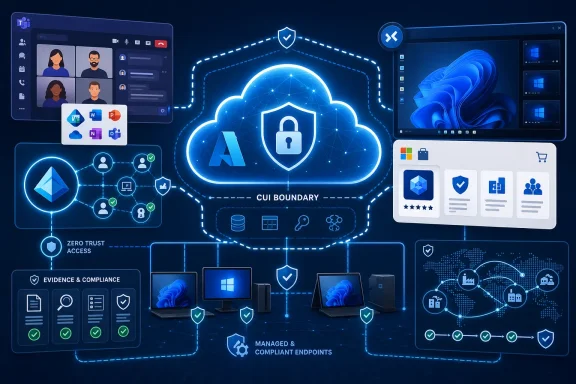
Exostar announced on June 3, 2026, that its Azure-based CMMC Ready Suite is now available through Microsoft Marketplace, giving Defense Industrial Base suppliers a Microsoft-procured route to buy managed identity, collaboration, enclave, and virtual desktop services for CMMC compliance. The move matters less because it adds another compliance product to the pile than because it ties CMMC preparation directly to the procurement machinery many contractors already use. For defense suppliers staring at certification deadlines, the sales channel is part of the product. Microsoft and Exostar are betting that the fastest way to shrink the compliance gap is to make the compliant path feel like an extension of the Microsoft estate already sitting inside the enterprise.
CMMC was always described as a cybersecurity program, but its practical effect is now commercial. Contractors that handle controlled unclassified information are not merely being asked to improve security hygiene; they are being asked to prove, in a contractually legible way, that their systems, users, devices, and subcontractor workflows meet a defined standard.
That distinction is crucial. A company can have reasonable security and still struggle to produce the evidence, boundaries, policies, and assessed environment that CMMC demands. The Defense Industrial Base is full of firms that know the mission, know their customers, and know their engineering niches, but do not have spare compliance architects waiting to redesign collaboration systems around federal control language.
Exostar’s pitch lands squarely in that gap. The company is not presenting CMMC Ready Suite as another generic managed security bundle with a defense logo attached. It is framing the product as a pre-integrated architecture for identity, collaboration, controlled data exchange, and managed endpoints, built on Microsoft Azure and sold through the same Marketplace channel that many enterprise buyers already know.
That is a telling evolution. When compliance programs mature, the question shifts from “What does the rule require?” to “How do I buy, deploy, operate, and defend the environment without rebuilding my business?” Exostar and Microsoft are answering the second question.
That matters because the Defense Industrial Base is not a single kind of organization. It includes giant primes with sophisticated procurement teams, mid-market manufacturers that live inside engineering and quality systems, software suppliers with remote workforces, and small shops that may have only recently discovered that a contract clause can drag them into a federal cybersecurity regime.
For larger organizations, Microsoft Marketplace can reduce vendor onboarding drag. For smaller ones, it can remove some of the fog around how to buy a cloud-hosted compliance stack without negotiating every piece separately. Either way, the commercial wrapper is doing real work.
There is also a strategic benefit for Microsoft. CMMC pushes defense suppliers toward controlled, auditable environments. If those environments are built around Azure, Microsoft 365, Teams, Entra-style identity patterns, and Azure Virtual Desktop, Microsoft becomes not merely an infrastructure vendor but part of the defense compliance fabric.
That is the quiet competition beneath announcements like this. Cloud platforms are no longer fighting only for compute workloads. They are fighting to become the default place where regulated work becomes defensible.
It moves through email threads, Teams channels, shared documents, engineering files, support tickets, virtual desktops, partner portals, and subcontractor exchanges. It is touched by employees, suppliers, consultants, and sometimes customers. The more broadly it spreads, the larger the compliance boundary becomes.
That boundary is where many CMMC projects become expensive. If a contractor cannot confidently identify and constrain where CUI lives, the assessment scope expands. More systems must be hardened, more endpoints must be managed, more users must be trained, and more evidence must be gathered.
Exostar’s announcement leans into that reality by emphasizing a smaller, controlled CUI footprint. Its suite combines identity management, a Microsoft 365-based collaboration enclave, and a managed secure desktop powered by Azure Virtual Desktop. The idea is straightforward: keep sensitive work in a known environment, control who enters it, and reduce the need to certify the messy sprawl of ordinary business IT.
This is not a magic wand. Contractors still own their policies, processes, training, incident response, supplier relationships, and evidence. But a well-bounded technical environment can make the difference between a CMMC program that is painful and one that is functionally unmanageable.
A contractor may lock down a cloud tenant, create secure collaboration spaces, enforce multifactor authentication, and restrict file sharing. Then a user downloads a document to an unmanaged laptop, opens it from a home network, syncs it to a personal folder, or copies a snippet into an unapproved tool. Suddenly the neat boundary is no longer neat.
Virtual desktops offer one way to fight that sprawl. Instead of treating every physical device as a fully trusted work surface, the organization can deliver a controlled workspace from the cloud. Users get device choice, but CUI remains inside a managed session with stronger administrative control over access, storage, copy-and-paste behavior, logging, and configuration.
This model has trade-offs. Virtual desktops need performance tuning, user training, cost management, and operational discipline. Engineers working with large models or specialized tools may not fit neatly into a generic hosted desktop. Remote users with weak connectivity will not thank an administrator for turning every task into a latency test.
Still, the compliance logic is strong. If CUI can be accessed through a managed virtual workspace rather than scattered across unmanaged endpoints, the organization has a better story to tell assessors and customers. The endpoint stops being an uncontrolled liability and becomes part of the managed boundary.
For Windows administrators, that is the practical takeaway. CMMC pressure will not simply produce more policy binders. It will accelerate adoption of virtualized workspaces, conditional access, device posture checks, identity governance, and locked-down collaboration environments.
Microsoft 365 can be configured to support regulated collaboration, but it does not become a compliant enclave by default. Tenant configuration, identity controls, guest access, retention policies, sensitivity labels, audit logging, data loss prevention, device compliance, and administrative separation all matter. A sloppy tenant can spread CUI faster than a file server ever did.
Exostar’s “Managed on Microsoft 365” component is designed to address that gap by creating a secure enclave within Teams for compliant collaboration and exchange of CUI. That is the right abstraction for many suppliers: do not ask every user to understand the full architecture; give them a controlled place to work and enforce the rules around it.
But this is also where vendor language deserves scrutiny. “Built on Microsoft 365” is not the same as “Microsoft 365 alone solves CMMC.” The value of a managed enclave depends on the rigor of its configuration, the clarity of its boundaries, the quality of its monitoring, and the ability of the organization to keep ordinary business collaboration from bleeding into controlled work.
The same caution applies to Azure. Azure can host compliant architectures, and Microsoft has deep public-sector credibility, but cloud infrastructure does not absolve a contractor of responsibility. Shared responsibility is not a slogan for auditors; it is the line between what the platform provides and what the customer must still prove.
That is why managed services are becoming central to CMMC. The underlying Microsoft stack is powerful, but the control implementation is the product.
Those claims are part marketing, of course, but they point to the core logic of the partnership. Microsoft brings the hyperscale cloud, productivity suite, identity platform, and Marketplace machinery. Exostar brings a long-established position inside the defense supplier network, where relationships, onboarding, and trust frameworks can be as important as feature checklists.
That combination is potent because CMMC is not a single-company problem. A prime contractor may have strong internal controls, but its CUI flows down to subcontractors. Those subcontractors may have their own suppliers. The risk compounds across tiers, and the weakest link may be a small business with limited IT staff but access to sensitive program information.
A compliance product that understands only enterprise IT will struggle in that environment. A product that understands only small-business simplicity may not satisfy primes. Exostar’s bet is that a purpose-built defense collaboration layer, sitting on Microsoft’s cloud and sold through Microsoft’s commercial channel, can speak to both.
This is also a reminder that CMMC is creating a market for intermediaries. The winners will not necessarily be the companies with the most elegant security dashboards. They will be the ones that can combine trust networks, procurement convenience, operational support, and credible assessment boundaries.
That mismatch has been one of the most persistent criticisms of the program. The federal government wants stronger protection for sensitive defense information, and the threat environment justifies that goal. But a rule that is easy to describe at the policy level can be punishing at the implementation level, especially for companies that never thought of themselves as cybersecurity operators.
A Marketplace-delivered managed suite does not eliminate the burden. It may, however, change the slope of the hill. If a supplier can buy a bounded, managed environment rather than assemble one from consultants, cloud services, endpoint tools, policy templates, and custom integration work, the path becomes more realistic.
The cost question remains. Managed compliance environments are not free, and Marketplace procurement does not magically make budgets appear. Some suppliers will still conclude that certain defense contracts no longer justify the compliance overhead.
But the commercial signal is clear. Microsoft and partners like Exostar see CMMC as a forcing function that will move regulated collaboration and secure desktop workloads into cloud-managed environments. The smaller the supplier, the more attractive an “already integrated” option becomes.
For WindowsForum readers, this is familiar terrain. Regulatory pressure often does what technical evangelism cannot: it turns best practices into purchasing decisions.
That can materially affect buying behavior. Security teams often lose time not because leadership doubts the risk, but because finance and procurement must decide where the money comes from. If CMMC preparation can be routed through a preexisting Microsoft commercial agreement, the internal debate changes.
It also makes Microsoft Marketplace more than a catalog. It becomes a budget conversion machine. A compliance project that might otherwise be treated as new vendor spend can become part of an existing cloud consumption strategy.
Microsoft has been pushing this pattern across the ecosystem. The company benefits when third-party solutions are hosted on Azure, sold through Marketplace, and aligned with customer commitments. Partners benefit from Microsoft’s procurement reach. Customers benefit when the purchase process is less bespoke.
The risk is lock-in by accumulation. A contractor may choose an Azure-native compliance suite for rational reasons today, only to discover later that identity, collaboration, endpoints, evidence, and procurement have all become tightly coupled to one cloud ecosystem. That may be acceptable, even desirable, for many organizations. It should still be a conscious choice.
This distinction matters because the compliance market has a tendency to overpromise. Products are sold as shortcuts to outcomes that require sustained operational maturity. Buyers under pressure may hear “ready” as “done,” especially when the product comes from a known vendor ecosystem.
Exostar’s architecture can plausibly reduce complexity by giving contractors a controlled place for identity-mediated collaboration and CUI handling. But assessors will still care how the environment is used. They will care whether users bypass it, whether policies match practice, whether logs are reviewed, whether incidents are handled properly, and whether subcontractor flows are understood.
Administrators should think of a suite like this as a scaffold. It can provide structure, reduce sprawl, and make evidence easier to collect. It cannot substitute for governance.
That may sound obvious, but it is where many compliance projects fail. The technical team implements the platform. The business continues operating around it. The assessor then discovers that the official system is only one of several places where sensitive work actually happens.
That is exactly the kind of boundary CMMC forces organizations to draw. Not a theoretical network perimeter, but a practical operational perimeter around sensitive information. Who touched it? From what device? Under which policy? Where was it stored? How was it shared? What evidence proves the answer?
Zero trust is often used so broadly that it becomes wallpaper. In this context, it has a more concrete meaning. The system should not trust a user merely because they are on a company laptop, inside a VPN, or part of a familiar domain. It should continuously condition access on identity, role, device posture, session controls, and data sensitivity.
For defense suppliers, that model is no longer aspirational. It is becoming table stakes. The traditional pattern of sprawling file shares, permissive guest access, and “we trust our subcontractors” workflows is colliding with a regime that asks for demonstrable controls.
The winners will be the organizations that make the compliant path the easy path. If the controlled workspace is slower, confusing, or hostile to real work, users will route around it. If it is integrated into familiar Microsoft tools and accessible from managed virtual desktops, the odds improve.
That dynamic will likely drive more standardization. Primes may not mandate a single tool for every supplier, but they will prefer ecosystems that produce predictable controls and evidence. If a supplier can say it uses a recognized, Azure-based, defense-focused environment for CUI collaboration, that conversation may be easier than explaining a one-off configuration assembled from scratch.
Exostar is well positioned for that kind of supply-chain standardization because it already operates as a collaboration and trust platform in regulated industries. Microsoft benefits because Azure and Microsoft 365 become the substrate for that standardization. Suppliers benefit if the standard does not become so expensive or rigid that it excludes smaller firms.
There is a delicate balance here. Too little standardization leaves every supplier reinventing the compliance wheel. Too much standardization can hand market power to a few platforms and raise costs for companies with legitimate alternative architectures.
CMMC will not resolve that tension. It will intensify it.
In many DIB companies, that someone is the Windows admin or infrastructure generalist who understands endpoints, identity, Microsoft 365, file access, user behavior, and the ugly reality of business exceptions. These are the people who know that the CFO uses an old macro workbook, the engineering team syncs files for travel, and the subcontractor portal has three different identity paths depending on the program.
A suite built on Azure Virtual Desktop and Microsoft 365 does not remove that work. It changes its shape. Administrators must think in terms of controlled tenants, conditional access, guest governance, session policies, device redirection, logging pipelines, and evidence production.
They also have to become translators. Executives need to understand that a “secure enclave” is not just another Teams channel. Users need to understand why some work must happen in a virtual desktop. Assessors need to understand the architecture. Procurement needs to understand why buying through Marketplace may reduce delay but not eliminate operational responsibility.
This is the unglamorous side of compliance modernization. The architecture may be cloud-native, but the success or failure will be human, procedural, and administrative.
But CMMC is aimed at a real problem. Sensitive defense information has long moved through a broad industrial base with uneven security maturity. Adversaries do not need to breach the Pentagon if they can steal from suppliers with weaker controls. The federal government is trying to raise the floor.
Exostar’s suite reflects a practical security lesson: collaboration is the attack surface. Identity, document sharing, endpoints, and supplier access are not secondary systems. They are where modern work happens, and therefore where sensitive data leaks, gets stolen, or becomes impossible to account for.
A well-designed CUI environment can deliver security benefits beyond passing an assessment. It can reduce accidental oversharing, improve user accountability, simplify offboarding, constrain unmanaged devices, and make incident investigations less chaotic. Those gains matter even if the compliance language is what unlocked the budget.
The danger is that organizations optimize for the audit rather than the threat. A clean assessment boundary that users resent or bypass will not protect much. A managed desktop that is secure but unusable will become shelfware. A Teams enclave that is not integrated into real workflows will be ignored.
The best version of this Microsoft-Exostar model is not compliance theater. It is a usable controlled workspace that makes secure behavior ordinary.
The first group will have an advantage. They will be easier for primes to trust, easier for assessors to evaluate, and faster to onboard into sensitive work. The second group may still win business, but the friction will grow.
Exostar and Microsoft are clearly selling to the first group, while trying to make the path accessible enough for the second group to join. The Marketplace route is part of that accessibility story. The Azure-native architecture is part of the scalability story. The managed services are part of the operational story.
There will be competitors, and there should be. Some contractors will prefer GCC High-focused strategies, specialized MSPs, alternative secure enclaves, or bespoke environments shaped around engineering workloads. CMMC is too broad for a single solution pattern.
But the direction is unmistakable. Compliance will increasingly be packaged as managed architecture, not as a binder plus a consulting engagement. The organizations that can buy, deploy, and operate that architecture cleanly will move faster.
 Compliance Has Become a Procurement Problem
CMMC was always described as a cybersecurity program, but its practical effect is now commercial. Contractors that handle controlled unclassified information are not merely being asked to improve security hygiene; they are being asked to prove, in a contractually legible way, that their systems, users, devices, and subcontractor workflows meet a defined standard.That distinction is crucial. A company can have reasonable security and still struggle to produce the evidence, boundaries, policies, and assessed environment that CMMC demands. The Defense Industrial Base is full of firms that know the mission, know their customers, and know their engineering niches, but do not have spare compliance architects waiting to redesign collaboration systems around federal control language.
Exostar’s pitch lands squarely in that gap. The company is not presenting CMMC Ready Suite as another generic managed security bundle with a defense logo attached. It is framing the product as a pre-integrated architecture for identity, collaboration, controlled data exchange, and managed endpoints, built on Microsoft Azure and sold through the same Marketplace channel that many enterprise buyers already know.
That is a telling evolution. When compliance programs mature, the question shifts from “What does the rule require?” to “How do I buy, deploy, operate, and defend the environment without rebuilding my business?” Exostar and Microsoft are answering the second question.
The Marketplace Listing Is the Message
The most important word in Exostar’s announcement may be Marketplace. Putting CMMC Ready Suite into Microsoft Marketplace is not just a distribution update. It converts a compliance architecture into something that can move through Microsoft-aligned procurement processes, appear on familiar invoices, and potentially count against existing Azure consumption commitments when eligible.That matters because the Defense Industrial Base is not a single kind of organization. It includes giant primes with sophisticated procurement teams, mid-market manufacturers that live inside engineering and quality systems, software suppliers with remote workforces, and small shops that may have only recently discovered that a contract clause can drag them into a federal cybersecurity regime.
For larger organizations, Microsoft Marketplace can reduce vendor onboarding drag. For smaller ones, it can remove some of the fog around how to buy a cloud-hosted compliance stack without negotiating every piece separately. Either way, the commercial wrapper is doing real work.
There is also a strategic benefit for Microsoft. CMMC pushes defense suppliers toward controlled, auditable environments. If those environments are built around Azure, Microsoft 365, Teams, Entra-style identity patterns, and Azure Virtual Desktop, Microsoft becomes not merely an infrastructure vendor but part of the defense compliance fabric.
That is the quiet competition beneath announcements like this. Cloud platforms are no longer fighting only for compute workloads. They are fighting to become the default place where regulated work becomes defensible.
CMMC Level 2 Turns Collaboration Into a Boundary Problem
CMMC Level 2 is aimed at organizations that handle controlled unclassified information, or CUI. In plain terms, that means many defense suppliers must protect sensitive government-related information as it is stored, processed, and transmitted across their systems. The hard part is that CUI rarely stays politely inside one folder or one application.It moves through email threads, Teams channels, shared documents, engineering files, support tickets, virtual desktops, partner portals, and subcontractor exchanges. It is touched by employees, suppliers, consultants, and sometimes customers. The more broadly it spreads, the larger the compliance boundary becomes.
That boundary is where many CMMC projects become expensive. If a contractor cannot confidently identify and constrain where CUI lives, the assessment scope expands. More systems must be hardened, more endpoints must be managed, more users must be trained, and more evidence must be gathered.
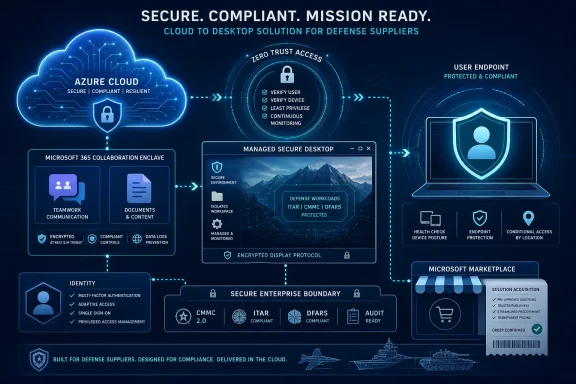
Exostar’s announcement leans into that reality by emphasizing a smaller, controlled CUI footprint. Its suite combines identity management, a Microsoft 365-based collaboration enclave, and a managed secure desktop powered by Azure Virtual Desktop. The idea is straightforward: keep sensitive work in a known environment, control who enters it, and reduce the need to certify the messy sprawl of ordinary business IT.
This is not a magic wand. Contractors still own their policies, processes, training, incident response, supplier relationships, and evidence. But a well-bounded technical environment can make the difference between a CMMC program that is painful and one that is functionally unmanageable.
The Endpoint Is Where the Compliance Story Usually Breaks
The new addition in Exostar’s pitch is Managed Secure Desktop, powered by Azure Virtual Desktop. That is not incidental. Endpoints are where attractive compliance diagrams go to die.A contractor may lock down a cloud tenant, create secure collaboration spaces, enforce multifactor authentication, and restrict file sharing. Then a user downloads a document to an unmanaged laptop, opens it from a home network, syncs it to a personal folder, or copies a snippet into an unapproved tool. Suddenly the neat boundary is no longer neat.
Virtual desktops offer one way to fight that sprawl. Instead of treating every physical device as a fully trusted work surface, the organization can deliver a controlled workspace from the cloud. Users get device choice, but CUI remains inside a managed session with stronger administrative control over access, storage, copy-and-paste behavior, logging, and configuration.
This model has trade-offs. Virtual desktops need performance tuning, user training, cost management, and operational discipline. Engineers working with large models or specialized tools may not fit neatly into a generic hosted desktop. Remote users with weak connectivity will not thank an administrator for turning every task into a latency test.
Still, the compliance logic is strong. If CUI can be accessed through a managed virtual workspace rather than scattered across unmanaged endpoints, the organization has a better story to tell assessors and customers. The endpoint stops being an uncontrolled liability and becomes part of the managed boundary.
For Windows administrators, that is the practical takeaway. CMMC pressure will not simply produce more policy binders. It will accelerate adoption of virtualized workspaces, conditional access, device posture checks, identity governance, and locked-down collaboration environments.
Microsoft 365 Is the Collaboration Layer, but Not Automatically the Compliance Layer
Many defense suppliers already use Microsoft 365. That familiarity can create a dangerous assumption: if the company has Teams, SharePoint, OneDrive, and Azure AD or Entra ID, then it must already be most of the way to CMMC. The truth is less comforting.Microsoft 365 can be configured to support regulated collaboration, but it does not become a compliant enclave by default. Tenant configuration, identity controls, guest access, retention policies, sensitivity labels, audit logging, data loss prevention, device compliance, and administrative separation all matter. A sloppy tenant can spread CUI faster than a file server ever did.
Exostar’s “Managed on Microsoft 365” component is designed to address that gap by creating a secure enclave within Teams for compliant collaboration and exchange of CUI. That is the right abstraction for many suppliers: do not ask every user to understand the full architecture; give them a controlled place to work and enforce the rules around it.
But this is also where vendor language deserves scrutiny. “Built on Microsoft 365” is not the same as “Microsoft 365 alone solves CMMC.” The value of a managed enclave depends on the rigor of its configuration, the clarity of its boundaries, the quality of its monitoring, and the ability of the organization to keep ordinary business collaboration from bleeding into controlled work.
The same caution applies to Azure. Azure can host compliant architectures, and Microsoft has deep public-sector credibility, but cloud infrastructure does not absolve a contractor of responsibility. Shared responsibility is not a slogan for auditors; it is the line between what the platform provides and what the customer must still prove.
That is why managed services are becoming central to CMMC. The underlying Microsoft stack is powerful, but the control implementation is the product.
Exostar Knows the Defense Supply Chain Microsoft Wants to Reach
Exostar’s advantage is not just technical. It is social and logistical. The company has long served regulated communities where trust, identity, and inter-company collaboration matter, including aerospace and defense. Its announcement says more than 200,000 companies and agencies use its platform, and that more than half of the Defense Industrial Base, including 98 of the top 100 firms, transact business over it.Those claims are part marketing, of course, but they point to the core logic of the partnership. Microsoft brings the hyperscale cloud, productivity suite, identity platform, and Marketplace machinery. Exostar brings a long-established position inside the defense supplier network, where relationships, onboarding, and trust frameworks can be as important as feature checklists.
That combination is potent because CMMC is not a single-company problem. A prime contractor may have strong internal controls, but its CUI flows down to subcontractors. Those subcontractors may have their own suppliers. The risk compounds across tiers, and the weakest link may be a small business with limited IT staff but access to sensitive program information.
A compliance product that understands only enterprise IT will struggle in that environment. A product that understands only small-business simplicity may not satisfy primes. Exostar’s bet is that a purpose-built defense collaboration layer, sitting on Microsoft’s cloud and sold through Microsoft’s commercial channel, can speak to both.
This is also a reminder that CMMC is creating a market for intermediaries. The winners will not necessarily be the companies with the most elegant security dashboards. They will be the ones that can combine trust networks, procurement convenience, operational support, and credible assessment boundaries.
The DIB’s Small Business Problem Is Becoming Microsoft’s Cloud Opportunity
The Defense Industrial Base depends heavily on small and mid-sized firms. Many of them build parts, write software, provide engineering support, or perform specialized services that large primes cannot easily replace. Yet these same firms often lack the internal security staff and compliance budgets needed to absorb CMMC smoothly.That mismatch has been one of the most persistent criticisms of the program. The federal government wants stronger protection for sensitive defense information, and the threat environment justifies that goal. But a rule that is easy to describe at the policy level can be punishing at the implementation level, especially for companies that never thought of themselves as cybersecurity operators.
A Marketplace-delivered managed suite does not eliminate the burden. It may, however, change the slope of the hill. If a supplier can buy a bounded, managed environment rather than assemble one from consultants, cloud services, endpoint tools, policy templates, and custom integration work, the path becomes more realistic.
The cost question remains. Managed compliance environments are not free, and Marketplace procurement does not magically make budgets appear. Some suppliers will still conclude that certain defense contracts no longer justify the compliance overhead.
But the commercial signal is clear. Microsoft and partners like Exostar see CMMC as a forcing function that will move regulated collaboration and secure desktop workloads into cloud-managed environments. The smaller the supplier, the more attractive an “already integrated” option becomes.
For WindowsForum readers, this is familiar terrain. Regulatory pressure often does what technical evangelism cannot: it turns best practices into purchasing decisions.
MACC Makes Compliance Spend Feel Less Like a New Budget Fight
The ability to use existing Microsoft Azure Consumption Commitments is not a footnote. Enterprise customers with MACC agreements have already committed to spend a certain amount on Azure or eligible Marketplace purchases over a defined term. If an Exostar purchase qualifies and is transacted through the right path, it can help consume that commitment rather than appear as an entirely separate procurement track.That can materially affect buying behavior. Security teams often lose time not because leadership doubts the risk, but because finance and procurement must decide where the money comes from. If CMMC preparation can be routed through a preexisting Microsoft commercial agreement, the internal debate changes.
It also makes Microsoft Marketplace more than a catalog. It becomes a budget conversion machine. A compliance project that might otherwise be treated as new vendor spend can become part of an existing cloud consumption strategy.
Microsoft has been pushing this pattern across the ecosystem. The company benefits when third-party solutions are hosted on Azure, sold through Marketplace, and aligned with customer commitments. Partners benefit from Microsoft’s procurement reach. Customers benefit when the purchase process is less bespoke.
The risk is lock-in by accumulation. A contractor may choose an Azure-native compliance suite for rational reasons today, only to discover later that identity, collaboration, endpoints, evidence, and procurement have all become tightly coupled to one cloud ecosystem. That may be acceptable, even desirable, for many organizations. It should still be a conscious choice.
“CMMC Ready” Is Not the Same as “CMMC Done”
The phrase CMMC Ready deserves careful handling. It signals that a product is designed to support compliance, not that the buyer is automatically certified. CMMC certification involves organizational controls, assessment scope, documentation, implementation evidence, and in many cases third-party assessment.This distinction matters because the compliance market has a tendency to overpromise. Products are sold as shortcuts to outcomes that require sustained operational maturity. Buyers under pressure may hear “ready” as “done,” especially when the product comes from a known vendor ecosystem.
Exostar’s architecture can plausibly reduce complexity by giving contractors a controlled place for identity-mediated collaboration and CUI handling. But assessors will still care how the environment is used. They will care whether users bypass it, whether policies match practice, whether logs are reviewed, whether incidents are handled properly, and whether subcontractor flows are understood.
Administrators should think of a suite like this as a scaffold. It can provide structure, reduce sprawl, and make evidence easier to collect. It cannot substitute for governance.
That may sound obvious, but it is where many compliance projects fail. The technical team implements the platform. The business continues operating around it. The assessor then discovers that the official system is only one of several places where sensitive work actually happens.
The Real Product Is a Defensible Boundary
The strongest reading of Exostar’s announcement is that it sells a boundary. Identity defines who can enter. The Microsoft 365 enclave defines where collaboration happens. Azure Virtual Desktop defines the user workspace. Managed services help keep the environment configured and operating in a way that can be explained.That is exactly the kind of boundary CMMC forces organizations to draw. Not a theoretical network perimeter, but a practical operational perimeter around sensitive information. Who touched it? From what device? Under which policy? Where was it stored? How was it shared? What evidence proves the answer?
Zero trust is often used so broadly that it becomes wallpaper. In this context, it has a more concrete meaning. The system should not trust a user merely because they are on a company laptop, inside a VPN, or part of a familiar domain. It should continuously condition access on identity, role, device posture, session controls, and data sensitivity.
For defense suppliers, that model is no longer aspirational. It is becoming table stakes. The traditional pattern of sprawling file shares, permissive guest access, and “we trust our subcontractors” workflows is colliding with a regime that asks for demonstrable controls.
The winners will be the organizations that make the compliant path the easy path. If the controlled workspace is slower, confusing, or hostile to real work, users will route around it. If it is integrated into familiar Microsoft tools and accessible from managed virtual desktops, the odds improve.
Primes Will Use Tools Like This to Push Standardization Downstream
Prime contractors have a strong incentive to make CMMC easier for their suppliers, but not out of charity. Their own program risk depends on whether the supply chain can protect CUI and remain eligible for work. A critical subcontractor that cannot meet requirements becomes a delivery risk.That dynamic will likely drive more standardization. Primes may not mandate a single tool for every supplier, but they will prefer ecosystems that produce predictable controls and evidence. If a supplier can say it uses a recognized, Azure-based, defense-focused environment for CUI collaboration, that conversation may be easier than explaining a one-off configuration assembled from scratch.
Exostar is well positioned for that kind of supply-chain standardization because it already operates as a collaboration and trust platform in regulated industries. Microsoft benefits because Azure and Microsoft 365 become the substrate for that standardization. Suppliers benefit if the standard does not become so expensive or rigid that it excludes smaller firms.
There is a delicate balance here. Too little standardization leaves every supplier reinventing the compliance wheel. Too much standardization can hand market power to a few platforms and raise costs for companies with legitimate alternative architectures.
CMMC will not resolve that tension. It will intensify it.
Windows Admins Are Back in the Center of Federal Cybersecurity
For years, some cloud security conversations treated the Windows administrator as a legacy figure. The future, supposedly, belonged to SaaS consoles, cloud-native identity, and policy-as-code. CMMC is a reminder that someone still has to make the working environment coherent.In many DIB companies, that someone is the Windows admin or infrastructure generalist who understands endpoints, identity, Microsoft 365, file access, user behavior, and the ugly reality of business exceptions. These are the people who know that the CFO uses an old macro workbook, the engineering team syncs files for travel, and the subcontractor portal has three different identity paths depending on the program.
A suite built on Azure Virtual Desktop and Microsoft 365 does not remove that work. It changes its shape. Administrators must think in terms of controlled tenants, conditional access, guest governance, session policies, device redirection, logging pipelines, and evidence production.
They also have to become translators. Executives need to understand that a “secure enclave” is not just another Teams channel. Users need to understand why some work must happen in a virtual desktop. Assessors need to understand the architecture. Procurement needs to understand why buying through Marketplace may reduce delay but not eliminate operational responsibility.
This is the unglamorous side of compliance modernization. The architecture may be cloud-native, but the success or failure will be human, procedural, and administrative.
The Security Upside Is Real, Even If the Market Is Messy
It is easy to be cynical about compliance-driven security markets. Vendors attach themselves to acronyms. Buyers rush to satisfy clauses. Consultants multiply. Some money is spent on paperwork rather than protection.But CMMC is aimed at a real problem. Sensitive defense information has long moved through a broad industrial base with uneven security maturity. Adversaries do not need to breach the Pentagon if they can steal from suppliers with weaker controls. The federal government is trying to raise the floor.
Exostar’s suite reflects a practical security lesson: collaboration is the attack surface. Identity, document sharing, endpoints, and supplier access are not secondary systems. They are where modern work happens, and therefore where sensitive data leaks, gets stolen, or becomes impossible to account for.
A well-designed CUI environment can deliver security benefits beyond passing an assessment. It can reduce accidental oversharing, improve user accountability, simplify offboarding, constrain unmanaged devices, and make incident investigations less chaotic. Those gains matter even if the compliance language is what unlocked the budget.
The danger is that organizations optimize for the audit rather than the threat. A clean assessment boundary that users resent or bypass will not protect much. A managed desktop that is secure but unusable will become shelfware. A Teams enclave that is not integrated into real workflows will be ignored.
The best version of this Microsoft-Exostar model is not compliance theater. It is a usable controlled workspace that makes secure behavior ordinary.
The CMMC Supply Chain Will Sort Winners From Survivors
The next phase of CMMC will expose a divide inside the Defense Industrial Base. Some firms will treat compliance as a strategic capability, investing in controlled environments, repeatable evidence, and secure collaboration that can scale across programs. Others will treat it as a contract hurdle and scramble when clauses arrive.The first group will have an advantage. They will be easier for primes to trust, easier for assessors to evaluate, and faster to onboard into sensitive work. The second group may still win business, but the friction will grow.
Exostar and Microsoft are clearly selling to the first group, while trying to make the path accessible enough for the second group to join. The Marketplace route is part of that accessibility story. The Azure-native architecture is part of the scalability story. The managed services are part of the operational story.
There will be competitors, and there should be. Some contractors will prefer GCC High-focused strategies, specialized MSPs, alternative secure enclaves, or bespoke environments shaped around engineering workloads. CMMC is too broad for a single solution pattern.
But the direction is unmistakable. Compliance will increasingly be packaged as managed architecture, not as a binder plus a consulting engagement. The organizations that can buy, deploy, and operate that architecture cleanly will move faster.
The Microsoft-Exostar Bet Comes Down to Five Practical Moves
The announcement is best read not as a product launch in isolation, but as a sign of how CMMC compliance will be commercialized across the defense supply chain. The technical pieces matter, but the larger story is the fusion of procurement, cloud architecture, identity, collaboration, and endpoint control into a single defensible operating model.- Exostar’s CMMC Ready Suite is now being positioned through Microsoft Marketplace as a simpler procurement path for defense suppliers already aligned with Microsoft purchasing.
- The suite’s value proposition depends on shrinking the CUI footprint by keeping sensitive collaboration inside a controlled Azure and Microsoft 365-based environment.
- Azure Virtual Desktop is becoming a compliance tool because it can move sensitive work away from unmanaged endpoints and into a managed virtual workspace.
- Microsoft benefits strategically when CMMC workloads standardize around Azure, Microsoft 365, Marketplace transactions, and existing Azure consumption commitments.
- Contractors still need governance, evidence, training, assessment readiness, and disciplined operations because no Marketplace purchase can make an organization automatically CMMC compliant.
- The suppliers that build usable controlled workspaces now will be better positioned than those that wait for contract clauses to force a rushed remediation effort.
References
- Primary source: StreetInsider
Published: Wed, 03 Jun 2026 12:09:12 GMT
Exostar Expands Collaboration with Microsoft to Accelerate CMMC Compliance Across the Defense Industrial Base
Exostar's Microsoft Azure-based CMMC Ready Suite now available through MicrosoftMarketplace, simplifying procurement and strengthening compliance for 80,000+defense...www.streetinsider.com - Official source: learn.microsoft.com
Frequently asked questions about using your MACC in Microsoft Marketplace - Marketplace customer documentation | Microsoft Learn
Find answers to the frequently asked questions about the Microsoft Azure Consumption Commitment (MACC) in Microsoft Marketplace.learn.microsoft.com - Official source: microsoft.com
Azure Purchasing Models Licensing Guidance
This page provides detailed information about Azure Purchasing Models and helps users understand key considerations, options, and scenarios related to this topic within Microsoft licensing programs. It supports informed decision-making and clarifies important requirements.www.microsoft.com - Related coverage: dupple.com
What Is MACC? Microsoft Azure Consumption Commitment Explained (2026) | Dupple
Microsoft Azure Consumption Commitment (MACC) explained for procurement and finance teams: how it works, what counts toward it, and how to maximize the commit.dupple.com - Related coverage: business.defense.gov
CMMC 2.0 Details and Links to Key Resources
The official site of the Office of Industrial Base Growthbusiness.defense.gov - Official source: techcommunity.microsoft.com
MACC Eligible Solutions | Microsoft Community Hub
Note: Please note that this discussion was carried over from a previous marketplace for partners community discussion. Original authorship has been... techcommunity.microsoft.com
- Related coverage: channelengine.com
ChannelEngine is now available on Microsoft Azure Marketplace
ChannelEngine is the only marketplace integration platform on Microsoft Azure Marketplace, enabling fast, MACC-eligible procurement. www.channelengine.com
- Related coverage: coneksion.com
MACC-Eligible Supply Chain & Logistics Data Connectivity | coneksion®
Use your Microsoft Azure Consumption Commitment (MACC) to streamline supply chain data connectivity. Coneksion is a MACC-eligible solution available in the Azure Marketplace. www.coneksion.com
- Related coverage: atonementlicensing.com
Microsoft MACC Guide: Azure Consumption Commitments
How Microsoft MACC works, the negotiation terms that matter, and how to avoid under-consumption forfeiture on your Azure commitment. Size the commit right.atonementlicensing.com
- Related coverage: seepath.com
Microsoft Azure Marketplace Partner | Seepath Solutions NJ
Buy Seepath's Azure Managed Services and Sitecore solutions directly from the Microsoft Azure Marketplace. MACC-eligible, Co-Sell Ready, Azure Lighthouse-powered. Serving NJ, NYC Metro and US-wide.www.seepath.com - Related coverage: media.defense.gov
- Related coverage: kpmg.com
</rdf:Alt> </dc:title> <dc:description> <rdf:Alt> <rdf:li xml:lang="x-default"/> </rdf:Alt> </dc:description> <dc:creator> <rdf:Seq> <rdf:li>RR Donn
</rdf:Alt> </dc:description> <dc:creator> <rdf:Seq> <rdf:li>RR Donnelleykpmg.com
- Related coverage: smithcurrie.com
- Related coverage: ifs.com