

ExpressVPN’s move to a shared Qt foundation for its desktop clients marks one of the most consequential product-architecture shifts the company has made in years, promising faster feature parity across Linux, macOS, and Windows while also introducing a slate of new tools — from integrated speed tests and Dedicated IP controls to WireGuard (with ExpressVPN’s post‑quantum extensions) and lighter headless installs for servers.
ExpressVPN has historically maintained separate native desktop applications for Linux, macOS, and Windows, a development model that produced platform-specific feature gaps and staggered update schedules. Moving to a single, cross‑platform UI framework like Qt lets engineering teams implement features once and ship them across multiple platforms, reducing divergence and accelerating parity. ExpressVPN’s Linux client is the first to ship on this new foundation, macOS is in beta, and Windows is slated for open beta in the near term. At the same time, this is a strategic product trade-off: cross‑platform frameworks simplify engineering and design consistency but require careful work to preserve platform-appropriate behaviors, performance, and deep OS integrations. The real user impact will be measured by whether ExpressVPN keeps the best native experiences of each OS while reaping the development and parity gains of a unified codebase. Evidence of the company’s intent and technical choices is documented in their blog and product announcements.
Caveats and technical trade-offs are real, however:
ExpressVPN’s public writings and the TechNadu coverage provide the product-level detail; ExpressVPN’s technical blog on WireGuard offers the clearest explanation of how they’re approaching post‑quantum concerns and WireGuard adoption at scale. Together, those documents give both a product roadmap and the engineering rationale for the switch to Qt — but technical users and administrators should still validate behaviors on their own hardware and test the beta releases before wide deployment.
ExpressVPN’s Qt rollout is not just a UI refresh — it’s an architectural bet that consolidates desktop development, tightens release cadence, and makes long-requested features more broadly available. If executed carefully, the result will be a cleaner, more consistent desktop experience across the major operating systems; if handled poorly, the risks are familiar: dependency-driven vulnerabilities, platform regressions, and higher resource footprints on constrained devices. The first Linux release and the macOS beta indicate that ExpressVPN is prioritizing meaningful feature parity and engineering transparency — a pragmatic development path that privacy-conscious users and system administrators should watch closely as Windows joins the Qt era.
Source: TechNadu ExpressVPN Unifies Its Desktop Apps With Qt: What’s New for Linux, macOS, and Windows
 Background
ExpressVPN has historically maintained separate native desktop applications for Linux, macOS, and Windows, a development model that produced platform-specific feature gaps and staggered update schedules. Moving to a single, cross‑platform UI framework like Qt lets engineering teams implement features once and ship them across multiple platforms, reducing divergence and accelerating parity. ExpressVPN’s Linux client is the first to ship on this new foundation, macOS is in beta, and Windows is slated for open beta in the near term. At the same time, this is a strategic product trade-off: cross‑platform frameworks simplify engineering and design consistency but require careful work to preserve platform-appropriate behaviors, performance, and deep OS integrations. The real user impact will be measured by whether ExpressVPN keeps the best native experiences of each OS while reaping the development and parity gains of a unified codebase. Evidence of the company’s intent and technical choices is documented in their blog and product announcements. What’s new and why it matters
Linux: the first full Qt client
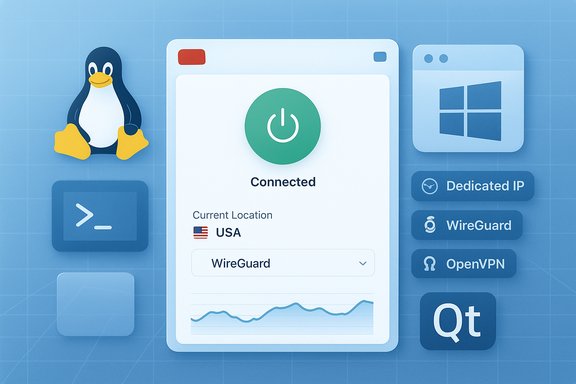
Linux is the initial beneficiary of the Qt transition. The new client reorganizes the interface around a card-based dashboard that surfaces connection status, server location, and protocol selection more clearly. But the release is more than UI polish — ExpressVPN adds tools that change how users test, manage, and deploy the VPN:- Integrated speed test that measures your baseline ISP performance and then the VPN-routed performance in the same session, making it easier to quantify VPN impact.
- Dedicated IP management directly within the app, so users no longer need to rely on separate web consoles to unlock or view their dedicated address.
- WireGuard support (ExpressVPN’s WireGuard implementation adds its own protections and orchestration) alongside Lightway and OpenVPN.
- Reduced dependency headless installation, aimed at server and container deployments where minimal runtime footprints matter.
macOS beta: split tunneling, WireGuard, CLI and automation
The macOS Qt beta returns long-requested features, notably split tunneling on modern macOS, letting users choose which apps use the VPN and which bypass it — essential for local network devices, printers, or corporate SSO flows. The beta also ships ExpressVPN’s take on WireGuard and introduces expressvpnctl, a full CLI for macOS that enables scripting, automation, and integration for power users and administrators. Network automation rules (e.g., auto‑connect on public Wi‑Fi) add policy-driven convenience. These are clear signs ExpressVPN wants to support both GUI-first users and automation-heavy workflows.Windows: coming into beta with security tooling and Network Lock
ExpressVPN’s Windows client will follow in beta with the same speed test and network automation tools and an Advanced Network Lock — an enhanced kill‑switch/traffic‑leak mitigation mechanism that goes beyond a simple “block on disconnect” pattern. The Windows release will be judged on how well it preserves native integrations (notifications, system tray behavior, battery/idle policies) while gaining the cross-platform parity.Technical analysis: why Qt, and what it gives ExpressVPN
Qt is a mature cross‑platform UI framework used widely across desktop and embedded products. The primary engineering benefits for ExpressVPN are straightforward:- Single codebase for UI logic — fewer duplicated implementations and less platform-specific drift.
- Faster feature parity — new features and fixes can propagate across desktop platforms with less manual work.
- Consistent UX — a harmonized design language reduces user confusion when switching platforms.
Caveats and technical trade-offs are real, however:
- Cross‑platform frameworks can introduce subtle performance and integration regressions if native platform APIs (e.g., credential stores, notification centers, power-management hooks) are not properly bridged.
- Memory and binary size can increase compared with highly optimized native clients; users on older or resource‑constrained machines may notice higher RAM or CPU usage.
- Third‑party library surfaces (like Qt) bring their own maintenance and security vectors — keeping those dependencies up to date is now a higher priority for ExpressVPN engineering. Recent high‑severity Qt advisories underscore that maintaining up-to-date Qt stacks matters.
Protocols, security posture, and the “post‑quantum” claim
ExpressVPN ships Lightway as its default protocol and has added WireGuard and OpenVPN as alternatives in the Qt clients. The company has also published a dedicated write‑up on their WireGuard implementation, explaining that their WireGuard rollout includes additional authentication and session-management layers — and that they have designed the deployment to be shareable with the wider industry. ExpressVPN positions this implementation as one that can offer post‑quantum‑resistant options when configured accordingly. Important technical clarifications:- WireGuard in its base specification is not natively “post‑quantum.” Post‑quantum protection requires adding quantum‑resistant key‑agreement or hybrid key-exchange schemes (KEMs) on top of existing protocols.
- ExpressVPN’s statements indicate they implement post‑quantum protections as part of their WireGuard deployment (wrapping or hybridizing the handshake), rather than claiming the standard WireGuard protocol itself became post‑quantum. This is a meaningful distinction — the protocol itself is unchanged, but the deployment architecture can incorporate PQ KEMs. ExpressVPN’s blog goes into detail about the approach and the reasons for the architecture decisions.
Security and privacy implications
Moving to Qt does not, in itself, change the privacy guarantees ExpressVPN offers (billing, account, logging practices are independent of UI). But the release touches multiple security-relevant areas:- Protocol diversity: offering Lightway, WireGuard (with PQ options), and OpenVPN gives users flexibility to choose performance or compatibility trade-offs depending on threat models and network environments. ExpressVPN’s TrustedServer approach (RAM-only servers) is maintained across protocols.
- Network Lock and automation: improved kill‑switch semantics and network-based automation reduce human error and help avoid accidental unprotected traffic on untrusted networks, increasing practical privacy.
- Surface area increase from shared libraries: Qt vulnerabilities affecting text rendering and parsers have been disclosed (notably allocation/resource exhaustion issues that can lead to DoS), and widely used Qt versions can be targeted by attackers who exploit parsing bugs in rendered content. This makes updating Qt libraries and watching for CVEs a higher operational priority.
- Install Qt‑based updates in a staged manner — test on a dedicated machine before broad deployment.
- Verify the application’s signed installer and use official channels (vendor site or official package repositories) to avoid tampered builds.
- Where possible, enable ExpressVPN features that reduce human error (auto‑connect on untrusted networks, an aggressive kill switch) and confirm behavior with a controlled leak test.
Enterprise and server implications: headless installs and packaging
ExpressVPN’s reduced dependency footprint for headless installs is significant for system administrators who deploy VPN clients on servers, containers, or minimal Linux images. Fewer dependencies mean:- Easier packaging for minimal base images.
- Lower risk of dependency conflicts in constrained environments.
- Simpler automation for containerized workloads or scripted deployments.
Risks, unknowns, and cautious notes
- Native integration trade-offs: Certain platform features — deep file‑system hooks, native notifications, privacy indicators, and OS-level authentication stores — can require extra engineering when you shift to a cross‑platform stack. Users should watch for regressions in platform-specific behavior (for example, notification reliability or Power/Battery handling) and report issues through beta channels.
- Third‑party dependency exposure: Large framework updates increase the importance of prompt patching. Recent Qt advisories demonstrate that parser-related vulnerabilities can have high availability impact; downstream vendors need a disciplined rebuild-and-ship cadence.
- “Post‑quantum” shorthand: Marketing language around “post‑quantum” can be imprecise. The crucial distinctions are (a) whether PQ algorithms are actually used in the default handshake, (b) whether the PQ mode is opt‑in, and (c) what the interoperability costs are. ExpressVPN documents their approach, but technical users should verify which PQ modes are enabled by default and assess performance overhead in their own environments.
- Performance on low‑end devices: Qt-based clients can have larger memory footprints than highly optimized native UIs. Users on older laptops or ARM devices should test the beta carefully and measure real-world CPU and memory usage under typical loads.
What users should do next
- Linux users (early adopters): Try the Qt client in a controlled environment. Validate the speed test, Dedicated IP workflow, and headless installation steps. If you run server/container deployments, test the reduced-dependency installer in your CI/CD pipeline before rolling it to production.
- macOS users (beta): If split tunneling, CLI automation, or WireGuard are features you need, enroll in the beta and validate your most frequent workflows. Pay attention to integration with local network devices and printing or file‑sharing use cases, as split tunneling can affect them.
- Windows users: Wait for the open beta if you rely on stable, polished native behavior; otherwise, plan to pilot the beta on a secondary device to see how Advanced Network Lock and automation behave with your security tools.
- Security teams and admins: Update patching policies to treat Qt framework updates with higher priority where desktop apps depend on newer Qt versions. Correlate any Qt CVE trackers with vendor-supplied rebuilds and apply updates to mitigate potential parsing‑related DoS or crash vectors.
Final appraisal
ExpressVPN’s migration to Qt is a practical and forward‑looking engineering decision that should produce faster feature parity and a more consistent user experience across Linux, macOS, and Windows. The early Linux release shows meaningful product gains: clearer UI, built-in speed testing, Dedicated IP management, and a lighter server install process. macOS beta features like split tunneling and an official CLI show the company wants to meet both GUI‑centric and automation-driven user needs. However, the transition also brings responsibilities: keeping the Qt dependency chain current, preserving deep native integrations, and clearly communicating nuanced security features (like how post‑quantum protections are implemented) so users can make informed choices. The move is a net positive for users who value consistent cross‑platform behavior and faster rollouts, provided ExpressVPN continues to prioritize native polish, performance, and prompt third‑party library maintenance.ExpressVPN’s public writings and the TechNadu coverage provide the product-level detail; ExpressVPN’s technical blog on WireGuard offers the clearest explanation of how they’re approaching post‑quantum concerns and WireGuard adoption at scale. Together, those documents give both a product roadmap and the engineering rationale for the switch to Qt — but technical users and administrators should still validate behaviors on their own hardware and test the beta releases before wide deployment.
ExpressVPN’s Qt rollout is not just a UI refresh — it’s an architectural bet that consolidates desktop development, tightens release cadence, and makes long-requested features more broadly available. If executed carefully, the result will be a cleaner, more consistent desktop experience across the major operating systems; if handled poorly, the risks are familiar: dependency-driven vulnerabilities, platform regressions, and higher resource footprints on constrained devices. The first Linux release and the macOS beta indicate that ExpressVPN is prioritizing meaningful feature parity and engineering transparency — a pragmatic development path that privacy-conscious users and system administrators should watch closely as Windows joins the Qt era.
Source: TechNadu ExpressVPN Unifies Its Desktop Apps With Qt: What’s New for Linux, macOS, and Windows
