

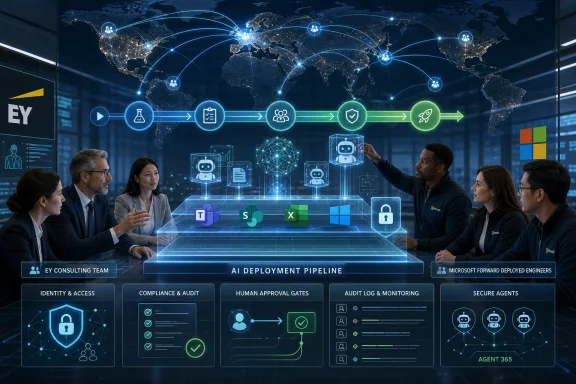
EY and Microsoft announced in London on May 21, 2026, that they will invest more than $1 billion over five years in a global enterprise AI initiative pairing EY consultants with Microsoft forward deployed engineers to help clients move AI projects from pilots into production. The announcement is less a routine partner expansion than a signal that Microsoft’s AI strategy is becoming a services-led operating model. The company is no longer merely selling Copilot seats, Azure capacity, and governance tools; it is sending engineering teams into the machinery of corporate work. For Windows and Microsoft 365 shops, that matters because the next phase of AI adoption will be won or lost inside the boring systems where finance closes, taxes reconcile, audits document evidence, HR routes cases, and supply chains absorb shocks.
The enterprise AI story has spent the past three years stuck between enthusiasm and procurement fatigue. Boardrooms have approved experiments, workers have tried assistants, and IT teams have watched a thousand proof-of-concepts bloom across Teams chats, SharePoint libraries, Power Platform apps, and Azure subscriptions. What has been harder is proving that any of it changes a business process enough to justify the cost, risk, and governance burden.
That is the problem EY and Microsoft are now packaging as a joint service. Their initiative combines EY’s industry and business-process consulting with Microsoft’s Forward Deployed Engineers, or FDEs, who are meant to work closer to customer environments than ordinary product teams or support engineers. The pitch is that AI transformation needs both code and operating-model change, not another demo in a conference room.
The money is not incidental. A more than $1 billion, five-year commitment gives the partnership the feel of an industrial buildout rather than a campaign around a single product launch. It also reflects a growing reality for Microsoft: the company can ship AI features at cloud speed, but many customers cannot absorb them at cloud speed.
That gap is where consultants live. EY has every incentive to turn agentic AI into the next large transformation practice, just as cloud migration, ERP modernization, cybersecurity compliance, and data-platform consolidation became durable consulting businesses. Microsoft has every incentive to make sure those projects land on Azure, Microsoft 365, Fabric, Foundry, Copilot Studio, Power Platform, and the security stack around them.
That is why EY’s adoption of Microsoft 365 E7: The Frontier Suite is important. Microsoft announced E7 earlier this year as a premium enterprise bundle built around Microsoft 365 E5, Microsoft 365 Copilot, Agent 365, identity, governance, and security capabilities. General availability began on May 1, 2026, at a published price of $99 per user per month, making it a major escalation from the familiar E3/E5 licensing conversation.
For administrators, the name E7 is almost less important than what it represents. Microsoft has created a higher enterprise shelf for AI-native work, and it wants customers to see AI governance not as an add-on but as part of the default productivity estate. That reframes Copilot from “Can we afford a chatbot for everyone?” to “Can we manage a workforce where agents act on behalf of people, teams, and processes?”
EY gives Microsoft a showcase customer for that argument. The firm says it first deployed Copilot to 150,000 users, recorded a 15 percent productivity boost, and is now scaling Copilot through E7 to more than 400,000 people worldwide. Those are the kinds of numbers Microsoft needs because skeptics are no longer impressed by a pilot group writing better emails.
The caveat is obvious but important: EY is not an ordinary customer. It is a services partner whose own business model benefits from proving that enterprise AI can be scaled. Its internal results should be treated as evidence, not as a universal benchmark.
It is also a powerful sales device. The Big Four have long sold transformation partly by pointing to their own internal programs: how they run finance, manage knowledge, use delivery centers, automate audit work, and standardize global methodologies. With AI, that pattern becomes even more valuable because clients are wary of being used as test subjects.
EY’s reported internal use cases are carefully chosen. In finance operations, it says Microsoft Power Platform and Copilot Studio agents helped produce 95 percent faster lead times and more than 37 percent lower operational costs. In Assurance, it says a multiagent framework integrated with Azure, Microsoft Foundry, and Microsoft Fabric is being embedded into EY Canvas for 130,000 professionals and 160,000 audit engagements. In Tax, it says Azure AI Document Intelligence reduced manual workload by up to 90 percent by extracting essential data from documents.
Those examples are not random productivity anecdotes. They sit in repeatable, document-heavy, compliance-heavy workflows where Microsoft’s enterprise footprint already has gravity. If AI agents can reliably extract, classify, route, summarize, reconcile, and escalate within those systems, the value is easier to measure than in generalized knowledge work.
But there is a second lesson for IT teams: the biggest productivity claims are not coming from Copilot alone. They come from Copilot plus workflow redesign, data integration, low-code automation, model services, identity, permissions, and domain-specific process knowledge. That is the difference between an assistant and an operating layer.
That is a real need. AI projects fail in mundane ways: data is scattered, permissions are wrong, owners are unclear, workflows differ by region, legal teams hesitate, model outputs cannot be trusted, and production monitoring is an afterthought. A forward-deployed engineering model can, in theory, shorten the loop between customer pain and working system.
It also changes the power balance inside the Microsoft partner ecosystem. Microsoft has always depended on systems integrators, independent software vendors, managed service providers, and consultants to implement its platforms. But if Microsoft engineers are now more visibly embedded in transformation projects, the company is taking a more direct role in shaping solutions that partners traditionally owned.
EY is a logical ally because it can wrap engineering work in business transformation language. Microsoft can bring product depth, Azure architecture, Copilot extensibility, Foundry tooling, Fabric data capabilities, identity controls, and security governance. EY can bring operating-model redesign, industry templates, risk frameworks, executive access, and the change-management muscle to make employees actually use the tools.
The risk is that “integrated teams” become another way to sell complexity. Enterprises already struggle to understand where Microsoft ends and the partner begins when something breaks, exceeds budget, or creates compliance exposure. Shared governance and aligned commercial models sound reassuring, but the proof will be in accountability when an AI workflow affects a regulated business decision.
That is why Microsoft is trying to attach agentic AI to E7, Agent 365, identity, observability, and security. The company knows that enterprises will not tolerate a shadow workforce of bots with unclear permissions and invisible audit trails. In a Windows and Microsoft 365 environment, every agent must eventually be treated like a managed actor: provisioned, scoped, monitored, logged, revoked, and investigated.
EY’s target functions make this especially sensitive. Finance, tax, risk, HR, and supply chain are not low-stakes productivity domains. They contain personally identifiable information, financial controls, legal records, market-sensitive data, privileged communications, and operational dependencies. A badly governed agent in those systems is not merely annoying; it can create audit findings, privacy incidents, regulatory exposure, and business disruption.
This is where Microsoft’s “trust” language becomes more than marketing. If customers are going to deploy agents across core functions, they need identity-aware access, data-loss prevention, retention policies, eDiscovery, compliance boundaries, secure connectors, model governance, and clear human approval gates. The Windows desktop may still be the daily surface for many users, but the real AI control plane is becoming Microsoft 365 plus Entra plus Purview plus Defender plus Azure.
That should shape how sysadmins read the EY deal. This is not just about whether users like Copilot in Word. It is about whether Microsoft can persuade enterprises that the Microsoft cloud is the safest place to run semi-autonomous work.
That is why the EY initiative lands at a strategic moment. Microsoft needs stories where AI is tied to measurable business outcomes, not just user satisfaction or time saved in meetings. EY needs a growth engine as clients scrutinize consulting spend and demand practical automation rather than slideware.
The two messages fit neatly together. Microsoft says companies are moving beyond experimentation; EY says it can help them do so with industry-aligned teams and change management. The implied criticism is that many enterprises bought tools before they changed how work happens.
That criticism is fair. Giving everyone a Copilot license can produce scattered gains, but enterprise value usually requires redesigning the process around the technology. A tax workflow that uses document intelligence, review queues, human signoff, and structured data extraction is more defensible than telling tax professionals to prompt better.
The danger is that “move beyond pilots” becomes the new pilot. Enterprises can spend millions on AI transformation programs that produce polished showcases but fail to survive contact with line-of-business exceptions, union concerns, privacy reviews, data-quality problems, and legacy application dependencies. The difference between a scaled AI program and a scaled consulting engagement will not always be obvious at the start.
Microsoft’s E7 packaging suggests that the company expects AI adoption to pull customers upward into more expensive governance and security tiers. That is not necessarily cynical. If agents are operating across corporate data, customers really do need stronger controls. But it does mean the economic story of Copilot is broader than the Copilot line item.
Admins should expect pressure from business units that have seen EY-style case studies and now want agents for every workflow. Some requests will be sensible, especially in repeatable document and approval processes. Others will be attempts to automate ambiguous judgment calls that should remain human-led.
The hard work will be classification. Which agents can read only public internal knowledge? Which can access HR data? Which can draft customer communications? Which can update records in ERP or CRM systems? Which require approval before execution? Which are allowed to learn from prompts, files, or user behavior?
Those are not merely technical decisions. They are governance decisions that require legal, HR, compliance, security, business process owners, and IT to agree on what an AI actor is allowed to do. Microsoft and EY can help design that model, but the customer owns the blast radius.
The cloud platform that becomes embedded in consulting transformation playbooks gains a structural advantage. If a finance modernization project begins with Microsoft-aligned AI architecture, it is more likely to end with Azure services, Fabric data layers, Power Platform automations, Copilot Studio agents, and Microsoft 365 governance. If a rival ecosystem wins that design phase, Microsoft may still be present, but it becomes one component among many.
This is why the EY alliance is strategic rather than ceremonial. Microsoft wants its AI stack to become the default substrate for enterprise transformation projects, and EY wants to be seen as the firm that can translate that stack into measurable industry outcomes. The language of “shared governance” and “aligned commercial models” is meant to reassure clients that they are not buying a patchwork.
Still, customers should remember that alliances are not neutral advice. EY may recommend Microsoft technologies because they are genuinely suitable, because the client already runs Microsoft, or because the alliance creates commercial momentum. Smart CIOs will welcome the engineering depth while still demanding architecture discipline, competitive evaluation, exit planning, and clear metrics.
The best consulting engagements leave clients more capable than they were before. The worst leave them dependent on a vendor-partner bundle they cannot operate without external help. Enterprise AI will amplify both outcomes.
They should not be dismissed out of hand. Professional services firms are full of structured, text-heavy, document-heavy work that can benefit from summarization, drafting, extraction, translation, search, and workflow automation. If any large organization can find measurable value in AI-assisted knowledge work, EY is a plausible candidate.
But the numbers are not interchangeable. “Productivity boost” is not the same as audited financial savings. “Faster lead times” may depend on the process baseline. “Up to” reductions in manual workload often describe the best-suited subset of tasks rather than the whole function. A tax document extraction win does not automatically prove the same model will work in procurement disputes or clinical workflows.
The more useful interpretation is that EY is showing where AI value is likely to appear first. Look for workflows with repetitive inputs, clear outputs, structured review, existing digital records, and enough volume to justify engineering investment. Avoid assuming that every white-collar task can be collapsed into an agent.
That distinction matters because it separates serious AI deployment from executive theater. Enterprise AI should not be judged by whether it can impress a board for twenty minutes. It should be judged by whether it survives month-end close, audit sampling, regulator questions, employee turnover, exception handling, and the next platform update.
E7 is the clearest expression of that ambition. It says the premium enterprise user is no longer defined only by mailbox size, compliance needs, desktop apps, and security features. The premium user now has governed access to copilots, agents, advanced identity controls, and AI-ready collaboration workflows.
This shift will be uncomfortable for organizations that already feel over-licensed. Microsoft 365 licensing has become a discipline of its own, with E3, E5, add-ons, security bundles, Teams changes, Copilot licenses, Power Platform capacity, and Azure consumption all competing for budget. E7 may simplify some buying decisions, but it also raises the ceiling on what Microsoft expects a fully modern enterprise seat to cost.
For Microsoft, the calculus is clear. AI infrastructure is expensive, investors expect monetization, and customers want outcomes rather than isolated tools. Bundling AI into a premium suite gives Microsoft a way to align margin, adoption, and governance.
For customers, the question is whether the bundle maps to actual maturity. Buying E7 before data governance, identity hygiene, retention policy, endpoint posture, and business ownership are ready may simply make expensive confusion easier to deploy. The license can enable transformation, but it cannot substitute for it.
There is also the labor question. EY and Microsoft frame the initiative around upskilling, change management, and reinvested productivity. That is the responsible language, and in many organizations AI will indeed remove drudgery rather than jobs. But when finance lead times fall by 95 percent or manual tax workload drops by up to 90 percent, employees will reasonably ask what happens after the “reinvestment” phase.
Enterprises will need to be more honest about that. Some work will be redesigned. Some roles will shift. Some offshore and shared-service models may be pressured. Some junior tasks that once trained future experts may be automated before firms know how to replace the learning path.
This is not a reason to reject the technology. It is a reason to treat change management as more than adoption emails and training videos. If AI is embedded into core workflows, workforce planning becomes part of the system architecture.
Microsoft and EY appear to understand that, at least rhetorically. The initiative emphasizes workforce upskilling and embedded change management, not just engineering. Whether that survives the commercial pressure to deliver quick savings is the open question.
 Microsoft and EY Turn the AI Pilot Problem into a Deployment Business
The enterprise AI story has spent the past three years stuck between enthusiasm and procurement fatigue. Boardrooms have approved experiments, workers have tried assistants, and IT teams have watched a thousand proof-of-concepts bloom across Teams chats, SharePoint libraries, Power Platform apps, and Azure subscriptions. What has been harder is proving that any of it changes a business process enough to justify the cost, risk, and governance burden.That is the problem EY and Microsoft are now packaging as a joint service. Their initiative combines EY’s industry and business-process consulting with Microsoft’s Forward Deployed Engineers, or FDEs, who are meant to work closer to customer environments than ordinary product teams or support engineers. The pitch is that AI transformation needs both code and operating-model change, not another demo in a conference room.
The money is not incidental. A more than $1 billion, five-year commitment gives the partnership the feel of an industrial buildout rather than a campaign around a single product launch. It also reflects a growing reality for Microsoft: the company can ship AI features at cloud speed, but many customers cannot absorb them at cloud speed.
That gap is where consultants live. EY has every incentive to turn agentic AI into the next large transformation practice, just as cloud migration, ERP modernization, cybersecurity compliance, and data-platform consolidation became durable consulting businesses. Microsoft has every incentive to make sure those projects land on Azure, Microsoft 365, Fabric, Foundry, Copilot Studio, Power Platform, and the security stack around them.
The New Frontier Is Not a Feature, It Is a Sales Motion
Microsoft’s preferred phrase for this moment is Frontier Transformation, and the EY announcement leans heavily into that vocabulary. Clients are to become “Frontier Firms,” a label that sounds like brand architecture but points to a real strategic pivot. Microsoft is trying to define the next enterprise tier not by device management or Office apps, but by the ability to govern humans, copilots, and autonomous agents in one corporate fabric.That is why EY’s adoption of Microsoft 365 E7: The Frontier Suite is important. Microsoft announced E7 earlier this year as a premium enterprise bundle built around Microsoft 365 E5, Microsoft 365 Copilot, Agent 365, identity, governance, and security capabilities. General availability began on May 1, 2026, at a published price of $99 per user per month, making it a major escalation from the familiar E3/E5 licensing conversation.
For administrators, the name E7 is almost less important than what it represents. Microsoft has created a higher enterprise shelf for AI-native work, and it wants customers to see AI governance not as an add-on but as part of the default productivity estate. That reframes Copilot from “Can we afford a chatbot for everyone?” to “Can we manage a workforce where agents act on behalf of people, teams, and processes?”
EY gives Microsoft a showcase customer for that argument. The firm says it first deployed Copilot to 150,000 users, recorded a 15 percent productivity boost, and is now scaling Copilot through E7 to more than 400,000 people worldwide. Those are the kinds of numbers Microsoft needs because skeptics are no longer impressed by a pilot group writing better emails.
The caveat is obvious but important: EY is not an ordinary customer. It is a services partner whose own business model benefits from proving that enterprise AI can be scaled. Its internal results should be treated as evidence, not as a universal benchmark.
Client Zero Is a Case Study and a Sales Funnel
EY’s “Client Zero” positioning is the most revealing part of the announcement. The phrase means EY is using its own global organization as the test bed for the AI operating model it plans to sell to clients. That makes sense: a firm with hundreds of thousands of workers, regulated workstreams, global delivery centers, professional liability exposure, and highly structured processes is a credible proving ground.It is also a powerful sales device. The Big Four have long sold transformation partly by pointing to their own internal programs: how they run finance, manage knowledge, use delivery centers, automate audit work, and standardize global methodologies. With AI, that pattern becomes even more valuable because clients are wary of being used as test subjects.
EY’s reported internal use cases are carefully chosen. In finance operations, it says Microsoft Power Platform and Copilot Studio agents helped produce 95 percent faster lead times and more than 37 percent lower operational costs. In Assurance, it says a multiagent framework integrated with Azure, Microsoft Foundry, and Microsoft Fabric is being embedded into EY Canvas for 130,000 professionals and 160,000 audit engagements. In Tax, it says Azure AI Document Intelligence reduced manual workload by up to 90 percent by extracting essential data from documents.
Those examples are not random productivity anecdotes. They sit in repeatable, document-heavy, compliance-heavy workflows where Microsoft’s enterprise footprint already has gravity. If AI agents can reliably extract, classify, route, summarize, reconcile, and escalate within those systems, the value is easier to measure than in generalized knowledge work.
But there is a second lesson for IT teams: the biggest productivity claims are not coming from Copilot alone. They come from Copilot plus workflow redesign, data integration, low-code automation, model services, identity, permissions, and domain-specific process knowledge. That is the difference between an assistant and an operating layer.
Forward Deployed Engineers Bring Palantir Energy to Microsoft’s Channel
Microsoft’s use of Forward Deployed Engineers is a notable cultural import. The phrase is most associated with companies that put engineers into customer environments to solve practical, messy deployment problems rather than handing off software to implementation partners. In Microsoft’s context, FDEs appear designed to close the gap between cloud platform ambition and enterprise execution.That is a real need. AI projects fail in mundane ways: data is scattered, permissions are wrong, owners are unclear, workflows differ by region, legal teams hesitate, model outputs cannot be trusted, and production monitoring is an afterthought. A forward-deployed engineering model can, in theory, shorten the loop between customer pain and working system.
It also changes the power balance inside the Microsoft partner ecosystem. Microsoft has always depended on systems integrators, independent software vendors, managed service providers, and consultants to implement its platforms. But if Microsoft engineers are now more visibly embedded in transformation projects, the company is taking a more direct role in shaping solutions that partners traditionally owned.
EY is a logical ally because it can wrap engineering work in business transformation language. Microsoft can bring product depth, Azure architecture, Copilot extensibility, Foundry tooling, Fabric data capabilities, identity controls, and security governance. EY can bring operating-model redesign, industry templates, risk frameworks, executive access, and the change-management muscle to make employees actually use the tools.
The risk is that “integrated teams” become another way to sell complexity. Enterprises already struggle to understand where Microsoft ends and the partner begins when something breaks, exceeds budget, or creates compliance exposure. Shared governance and aligned commercial models sound reassuring, but the proof will be in accountability when an AI workflow affects a regulated business decision.
Agentic AI Moves the Risk from Chat Windows to Business Processes
The announcement repeatedly invokes agentic AI, and that term deserves more scrutiny than it usually receives. A chatbot answers; an agent acts. Once AI systems are allowed to retrieve data, call tools, trigger workflows, draft records, update systems, or coordinate with other agents, the governance problem becomes far more serious.That is why Microsoft is trying to attach agentic AI to E7, Agent 365, identity, observability, and security. The company knows that enterprises will not tolerate a shadow workforce of bots with unclear permissions and invisible audit trails. In a Windows and Microsoft 365 environment, every agent must eventually be treated like a managed actor: provisioned, scoped, monitored, logged, revoked, and investigated.
EY’s target functions make this especially sensitive. Finance, tax, risk, HR, and supply chain are not low-stakes productivity domains. They contain personally identifiable information, financial controls, legal records, market-sensitive data, privileged communications, and operational dependencies. A badly governed agent in those systems is not merely annoying; it can create audit findings, privacy incidents, regulatory exposure, and business disruption.
This is where Microsoft’s “trust” language becomes more than marketing. If customers are going to deploy agents across core functions, they need identity-aware access, data-loss prevention, retention policies, eDiscovery, compliance boundaries, secure connectors, model governance, and clear human approval gates. The Windows desktop may still be the daily surface for many users, but the real AI control plane is becoming Microsoft 365 plus Entra plus Purview plus Defender plus Azure.
That should shape how sysadmins read the EY deal. This is not just about whether users like Copilot in Word. It is about whether Microsoft can persuade enterprises that the Microsoft cloud is the safest place to run semi-autonomous work.
The Consulting Layer Is Microsoft’s Answer to Copilot Skepticism
Microsoft has reported strong momentum for Copilot, but the market has been harder to convince than the product keynotes suggest. Adoption is growing, yet paid seat penetration across the broader Microsoft 365 base has remained a subject of debate, and many IT departments are still asking for clearer evidence of return on investment. The first wave of Copilot adoption taught a simple lesson: access does not equal transformation.That is why the EY initiative lands at a strategic moment. Microsoft needs stories where AI is tied to measurable business outcomes, not just user satisfaction or time saved in meetings. EY needs a growth engine as clients scrutinize consulting spend and demand practical automation rather than slideware.
The two messages fit neatly together. Microsoft says companies are moving beyond experimentation; EY says it can help them do so with industry-aligned teams and change management. The implied criticism is that many enterprises bought tools before they changed how work happens.
That criticism is fair. Giving everyone a Copilot license can produce scattered gains, but enterprise value usually requires redesigning the process around the technology. A tax workflow that uses document intelligence, review queues, human signoff, and structured data extraction is more defensible than telling tax professionals to prompt better.
The danger is that “move beyond pilots” becomes the new pilot. Enterprises can spend millions on AI transformation programs that produce polished showcases but fail to survive contact with line-of-business exceptions, union concerns, privacy reviews, data-quality problems, and legacy application dependencies. The difference between a scaled AI program and a scaled consulting engagement will not always be obvious at the start.
Windows Shops Should Watch the Identity and Governance Bill
For WindowsForum readers, the practical consequences will show up first in the Microsoft 365 admin center, Entra, Purview, Defender, Power Platform governance, Azure policy, and endpoint management. AI at enterprise scale means more apps, more connectors, more permissions, more service principals, more data movement, and more demand for auditability. The desktop is still the user’s front door, but identity is the lock.Microsoft’s E7 packaging suggests that the company expects AI adoption to pull customers upward into more expensive governance and security tiers. That is not necessarily cynical. If agents are operating across corporate data, customers really do need stronger controls. But it does mean the economic story of Copilot is broader than the Copilot line item.
Admins should expect pressure from business units that have seen EY-style case studies and now want agents for every workflow. Some requests will be sensible, especially in repeatable document and approval processes. Others will be attempts to automate ambiguous judgment calls that should remain human-led.
The hard work will be classification. Which agents can read only public internal knowledge? Which can access HR data? Which can draft customer communications? Which can update records in ERP or CRM systems? Which require approval before execution? Which are allowed to learn from prompts, files, or user behavior?
Those are not merely technical decisions. They are governance decisions that require legal, HR, compliance, security, business process owners, and IT to agree on what an AI actor is allowed to do. Microsoft and EY can help design that model, but the customer owns the blast radius.
The Big Four Race Is Really a Cloud Control Race
EY is not alone in aligning with Microsoft around forward-deployed AI work. Other large consultancies have also moved to build practices around Microsoft’s FDE model and enterprise AI stack. That competition matters because the Big Four and global systems integrators shape technology decisions at the executive level long before admins see a ticket.The cloud platform that becomes embedded in consulting transformation playbooks gains a structural advantage. If a finance modernization project begins with Microsoft-aligned AI architecture, it is more likely to end with Azure services, Fabric data layers, Power Platform automations, Copilot Studio agents, and Microsoft 365 governance. If a rival ecosystem wins that design phase, Microsoft may still be present, but it becomes one component among many.
This is why the EY alliance is strategic rather than ceremonial. Microsoft wants its AI stack to become the default substrate for enterprise transformation projects, and EY wants to be seen as the firm that can translate that stack into measurable industry outcomes. The language of “shared governance” and “aligned commercial models” is meant to reassure clients that they are not buying a patchwork.
Still, customers should remember that alliances are not neutral advice. EY may recommend Microsoft technologies because they are genuinely suitable, because the client already runs Microsoft, or because the alliance creates commercial momentum. Smart CIOs will welcome the engineering depth while still demanding architecture discipline, competitive evaluation, exit planning, and clear metrics.
The best consulting engagements leave clients more capable than they were before. The worst leave them dependent on a vendor-partner bundle they cannot operate without external help. Enterprise AI will amplify both outcomes.
The Productivity Numbers Need Context, Not Dismissal
The most eye-catching figures in the announcement are EY’s internal productivity claims: a 15 percent productivity boost from Copilot, 95 percent faster lead times in finance operations, more than 37 percent lower operational costs, and up to 90 percent less manual workload in a tax document process. These are substantial numbers, and they will almost certainly travel through Microsoft sales decks.They should not be dismissed out of hand. Professional services firms are full of structured, text-heavy, document-heavy work that can benefit from summarization, drafting, extraction, translation, search, and workflow automation. If any large organization can find measurable value in AI-assisted knowledge work, EY is a plausible candidate.
But the numbers are not interchangeable. “Productivity boost” is not the same as audited financial savings. “Faster lead times” may depend on the process baseline. “Up to” reductions in manual workload often describe the best-suited subset of tasks rather than the whole function. A tax document extraction win does not automatically prove the same model will work in procurement disputes or clinical workflows.
The more useful interpretation is that EY is showing where AI value is likely to appear first. Look for workflows with repetitive inputs, clear outputs, structured review, existing digital records, and enough volume to justify engineering investment. Avoid assuming that every white-collar task can be collapsed into an agent.
That distinction matters because it separates serious AI deployment from executive theater. Enterprise AI should not be judged by whether it can impress a board for twenty minutes. It should be judged by whether it survives month-end close, audit sampling, regulator questions, employee turnover, exception handling, and the next platform update.
Microsoft’s AI Stack Is Becoming the New Office Standard
For decades, Microsoft’s enterprise power came from making Office the default language of work. Documents, spreadsheets, email, calendars, meetings, directories, and Windows endpoints formed the practical operating system of business. The AI era gives Microsoft a chance to rebuild that default around intelligence embedded into every surface.E7 is the clearest expression of that ambition. It says the premium enterprise user is no longer defined only by mailbox size, compliance needs, desktop apps, and security features. The premium user now has governed access to copilots, agents, advanced identity controls, and AI-ready collaboration workflows.
This shift will be uncomfortable for organizations that already feel over-licensed. Microsoft 365 licensing has become a discipline of its own, with E3, E5, add-ons, security bundles, Teams changes, Copilot licenses, Power Platform capacity, and Azure consumption all competing for budget. E7 may simplify some buying decisions, but it also raises the ceiling on what Microsoft expects a fully modern enterprise seat to cost.
For Microsoft, the calculus is clear. AI infrastructure is expensive, investors expect monetization, and customers want outcomes rather than isolated tools. Bundling AI into a premium suite gives Microsoft a way to align margin, adoption, and governance.
For customers, the question is whether the bundle maps to actual maturity. Buying E7 before data governance, identity hygiene, retention policy, endpoint posture, and business ownership are ready may simply make expensive confusion easier to deploy. The license can enable transformation, but it cannot substitute for it.
The Real Test Is Whether AI Can Survive the Enterprise
The EY-Microsoft announcement is full of confident language, but the real test will be operational. Can integrated teams produce reusable solutions rather than bespoke projects? Can agents be governed without smothering their usefulness? Can Microsoft’s tooling make AI observable enough for risk committees and simple enough for business users?There is also the labor question. EY and Microsoft frame the initiative around upskilling, change management, and reinvested productivity. That is the responsible language, and in many organizations AI will indeed remove drudgery rather than jobs. But when finance lead times fall by 95 percent or manual tax workload drops by up to 90 percent, employees will reasonably ask what happens after the “reinvestment” phase.
Enterprises will need to be more honest about that. Some work will be redesigned. Some roles will shift. Some offshore and shared-service models may be pressured. Some junior tasks that once trained future experts may be automated before firms know how to replace the learning path.
This is not a reason to reject the technology. It is a reason to treat change management as more than adoption emails and training videos. If AI is embedded into core workflows, workforce planning becomes part of the system architecture.
Microsoft and EY appear to understand that, at least rhetorically. The initiative emphasizes workforce upskilling and embedded change management, not just engineering. Whether that survives the commercial pressure to deliver quick savings is the open question.
The Signal Inside the Billion-Dollar Bet
The most concrete reading of the announcement is that Microsoft and EY are trying to turn enterprise AI from a product purchase into a managed transformation engine. That has consequences that Windows, Microsoft 365, and Azure administrators should prepare for now.- EY and Microsoft are investing more than $1 billion over five years to pair EY industry teams with Microsoft forward deployed engineers for enterprise AI deployments.
- EY is using itself as “Client Zero,” citing large-scale Copilot adoption and internal AI use cases across finance, assurance, and tax as proof points for client work.
- Microsoft 365 E7: The Frontier Suite is becoming the commercial wrapper for Microsoft’s argument that AI productivity, agent governance, identity, and security belong in one premium enterprise tier.
- The initiative initially targets Finance, Tax, Risk, HR, and Supply Chain across sectors including financial services, industrials and energy, consumer and retail, government, and health care.
- IT teams should expect agentic AI projects to create new demands around permissions, audit logs, data classification, lifecycle management, and human approval workflows.
- The strongest near-term AI returns are likely to come from structured, document-heavy workflows with clear review processes, not from vague mandates to “use Copilot more.”
References
- Primary source: Microsoft Source
Published: Thu, 21 May 2026 11:04:23 GMT
- Official source: blogs.microsoft.com
Introducing the First Frontier Suite built on Intelligence + Trust - The Official Microsoft Blog
Today Microsoft is announcing: Wave 3 of Microsoft 365 Copilot Expanded model diversity with Claude and next-gen OpenAI models available today General availability of Agent 365 on May 1 for $15 per user General availability of the new Microsoft 365 E7: The Frontier Suite on May 1 for $99 per...blogs.microsoft.com - Official source: microsoft.com
Powering Frontier Transformation with Copilot and agents | Microsoft 365 Blog
Wave 3 of Microsoft 365 Copilot introduces Copilot Cowork, multi‑model intelligence, and enterprise‑ready AI—built to get real work done.www.microsoft.com - Related coverage: newsroom.accenture.com
Accenture Launches Microsoft Forward Deployed Engineering Practice to Help Organizations Scale AI Across the Enterprise
Accenture is collaborating with Microsoft to launch a forward deployed engineering (FDE) practice, designed to help organizations more rapidly design, build, and operationalize AI across the enterprise.newsroom.accenture.com - Related coverage: ey.com
Microsoft Copilot Implementation Services | EY - US
EY and Microsoft make Microsoft Copilot extraordinary. See how EY provides Copilot transformation through personal, process and enterprise innovation. www.ey.com
- Related coverage: windowscentral.com
Microsoft 365 premium E7 tier is "the First Frontier Suite" | Windows Central
Microsoft’s latest subscription tier promises AI power at $99/month, but analysts are skeptical about its benefits compared to existing plans.www.windowscentral.com

- Related coverage: techradar.com
Microsoft spent billions on Copilot, but only 3.3% of users are actually paying for the AI tools | TechRadar
Microsoft spent $37.5 billion on AI tools, with limited returns so farwww.techradar.com - Related coverage: itpro.com
Everything you need to know about the new E7 Microsoft 365 tier, including features, pricing, and release date | IT Pro
The new premium bundle for Microsoft 365 adds AI capabilities to traditional tierswww.itpro.com - Official source: adoption.microsoft.com
