

The Federal Aviation Administration is trying a new kind of recruiting pitch, and this one speaks fluent gamer. On April 10, 2026, the agency rolled out a campaign aimed at young adults who already spend their time managing pressure, tracking motion, and making split-second decisions — the same abilities the FAA says can translate into air traffic control. The move is more than a quirky marketing stunt; it is a response to a real staffing challenge, a long pipeline problem, and a labor market where the agency clearly believes it must widen its funnel.
The FAA’s campaign lands at a moment when the controller workforce has been under sustained strain for years, even as the agency says it has made progress on hiring. The FAA’s 2025 workforce plan reported that the controller workforce reached 14,264 in fiscal 2024, while newer recruitment materials now describe an elite squad of about 14,000 controllers protecting 2.9 million daily passengers. That is still an enormous operation, and the agency’s own materials show it intends to keep hiring thousands more over the next several years.
The timing matters because the agency is not merely filling a handful of vacancies; it is trying to stabilize a system where staffing shortages can ripple into delays, scheduling bottlenecks, and training backlogs. FAA leadership has repeatedly framed controller hiring as a safety and efficiency priority, not just a human-resources exercise. The new gamer-focused messaging is simply the freshest expression of that broader campaign.
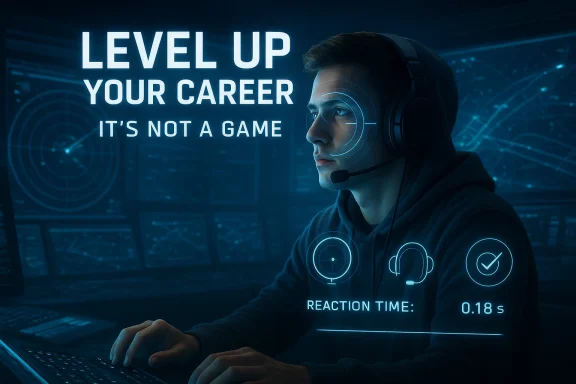
What makes the strategy noteworthy is that the FAA is explicitly connecting gaming to operational aptitude. Its new landing page leans into phrases like “Level Up Your Career” and “It’s not a Game,” while highlighting advanced radar, electronic flight strips, and other tools that make the job feel like a high-stakes systems role. In other words, the agency is not just borrowing gaming aesthetics; it is arguing that gaming habits map to a public-safety profession.
That is a significant cultural shift. For decades, government recruiting tended to avoid lifestyle signaling and instead emphasized duty, service, and formal qualifications. The FAA is now doing something closer to consumer marketing, using a subculture-specific message to attract a younger applicant pool that may not have considered air traffic control as a natural career path.
That argument is helped by the FAA’s own internal observation that nearly all of the air traffic control academy graduates in a 2024 poll identified as video game players. The agency’s public materials cite feedback from controller exit interviews reinforcing the same theme: controllers themselves mention gaming as an influence on how they think, focus, and manage complexity. That does not prove causation, but it gives the agency a plausible story to tell.
Still, it is important not to overstate the analogy. Gaming may help with reaction time, pattern recognition, and attention switching, but real-world controllers also need procedural discipline, communication clarity, and the ability to follow strict aviation protocols. The FAA’s campaign is smart to focus on transferable traits rather than pretending that a high rank in a game equals readiness for a control tower.
This nuance matters because public-facing recruiting campaigns can easily slide into gimmick territory. The FAA appears to be trying to avoid that by pairing gamer imagery with an unmistakably serious career offer: a role in national infrastructure, with significant responsibility and compensation that can reach six figures. That combination is probably more persuasive than pure hype.
There is another practical reason to go where gamers are: the labor market is competitive, and the FAA needs volume. It is much easier to recruit from a broad community of people already comfortable with high-intensity cognitive tasks than to rely solely on candidates who arrive because they have always dreamed of air traffic control. In that sense, the campaign is less about novelty and more about search efficiency.
The agency’s workforce plan and news releases suggest the FAA is trying to do two things at once: keep the pipeline moving and avoid losing momentum once new candidates enter it. The 2025–2028 workforce plan projected at least 8,900 new hires through 2028, and the FAA has also said it exceeded its FY2025 hiring goal by bringing on 2,026 new controllers. Those are encouraging signs, but they do not erase the structural challenge.
That limited window highlights a recurring issue in public-sector hiring: demand can exceed processing capacity even when the headline need is obvious. The FAA cannot simply post an opening and instantly absorb thousands of new controllers, because each applicant must pass screening, testing, training, and certification milestones. The bottleneck is not just recruitment; it is throughput.
The result is a familiar but frustrating reality for candidates and managers alike. The FAA needs more people quickly, but it cannot compromise standards without risking safety. So the campaign is trying to improve the odds that the right kinds of people self-select into the process. That is a very different problem from merely advertising more aggressively.
The campaign therefore has to do more than attract attention. It has to attract applicants who are both capable and likely to persist through a demanding training process. Gamers may be a promising audience precisely because many are already familiar with persistence, failure, repetition, and incremental mastery. Those are not trivial traits in a profession where mistakes are expensive.
The tone of the campaign is also telling. Phrases like “Level Up Your Career” and “Your Mission Starts” borrow directly from game culture, but the underlying message is classic public service: keep the skies safe. This hybrid of entertainment language and national-service rhetoric is a sign that government recruiters increasingly understand branding as part of workforce strategy.
That approach may also help the FAA compete against private-sector employers for technically inclined talent. While controllers are not software engineers, they are expected to operate in a highly structured technical environment with major consequences for error. If the FAA wants candidates to see the job as elite and mission-critical, it has to advertise it that way.
There is a strategic upside here that extends beyond recruitment. If the FAA can successfully associate its workforce with modern technology and analytical skill, it may improve how the public perceives the agency’s competence overall. That is not a small benefit in a period when aviation safety and operational efficiency remain politically sensitive.
It also shows the agency is comfortable using culture as a recruitment bridge. That can be risky, but it can also be effective if the message is authentic. In this case, the gaming connection has enough internal support from the FAA’s own polling and controller feedback to make it more than a random marketing gimmick.
The concern is familiar: when government or political communications borrow heavily from recognizable entertainment properties, rights holders often respond. Recent disputes involving gaming imagery in political or government-related posts have made publishers and platform owners more sensitive to unauthorized use. The FAA campaign could therefore become a test case for how carefully federal agencies need to tread when borrowing gaming aesthetics.
The safest interpretation is also the most boring one: the FAA may have cleared everything properly, and the public simply has not seen the documentation. But the fact that observers are asking the question tells you something important about the media environment. In 2026, visual shorthand can easily trigger a copyright or licensing debate, even when the core message is straightforward.
If the agency wants the campaign to age well, it will need the creative to stand on its own. That means the message should be strong enough that it does not depend on a particular console aesthetic or a borrowed brand cue. Otherwise, the recruitment ad risks becoming a conversation about IP instead of a conversation about careers.
The irony is that gamers may be more responsive to authenticity than to brand name-dropping anyway. The most effective creative here is likely the version that looks and feels like the real cognitive challenge of the job, not the one that shouts the loudest about gaming culture. The FAA would be wise to remember that credibility beats cosplay.
But the translation is not perfect. Gaming often rewards improvisation, while air traffic control is grounded in procedures, phraseology, and strict safety rules. The best candidates will be those who can combine quick thinking with discipline, not those who assume reflexes alone are enough.
There is also a psychological component that deserves attention. Gamers are often comfortable with repeated failure, feedback loops, and performance under observation. That can be useful in controller training, where mastery tends to come from repetition and close evaluation rather than from intuition alone.
At the same time, the profession demands emotional regulation that some people may not anticipate. Stress tolerance, communication discipline, and the ability to avoid tunnel vision are just as important as any form of virtual dexterity. The FAA’s message should therefore be read as invitation, not endorsement: gaming may help, but it is not a shortcut.
It also broadens the idea of who belongs in high-responsibility infrastructure jobs. That could be especially valuable in a labor market where traditional pipelines are under pressure and where employers need to fish in new ponds. In that sense, the FAA is not just recruiting gamers; it is recruiting cognitive habits.
For the broader aviation system, the implications are more consequential. Controller shortages can affect traffic flow, training throughput, and operational resilience, which in turn matter for airlines, business travelers, cargo carriers, and the economy at large. A better recruitment pipeline is not just a staffing win; it is a systems-stability win.
There is also a cultural upside for consumers who are part of the gaming audience. They may see a prestige profession acknowledging skills that are usually discussed only in the context of entertainment or esports. That kind of recognition can have a powerful signaling effect, especially for young adults choosing a first serious career path.
For the FAA itself, this is also an institutional reputational play. Successful recruiting can demonstrate modernization, responsiveness, and seriousness about workforce planning. If it falls flat, however, it could reinforce the perception that the agency is borrowing gimmicks to solve structural problems.
Just as importantly, the messaging is adaptable. If the gamer angle performs well, the FAA can refine it; if it overperforms with one audience segment, the agency can build adjacent campaigns around related traits such as STEM aptitude, simulation experience, or aviation interest. That flexibility is a major asset in a long hiring cycle.
The second risk is distraction. If the ad becomes a debate about IP usage, outdated console imagery, or political aesthetics, the recruitment message will be drowned out. The FAA needs the story to remain about staffing, safety, and opportunity — not about whether a splash screen looked old.
The medium-term story is even more important. The FAA has already signaled that controller recruitment is a multiyear effort, and the current campaign should be judged against that horizon rather than against a single hiring round. The question is not whether one ad fixes staffing. The question is whether the agency can build a durable, modern talent funnel that survives beyond this news cycle.
In the end, the FAA’s gamer campaign is less about video games than about workforce realism. The agency needs people who can handle complexity, sustain focus, and work calmly under pressure, and it is willing to speak the language of a new generation to find them. That is a sensible move — and in the sky business, sensible is usually the right place to start.
Source: games.gg The FAA Is Recruiting Gamers To Become Air Traffic Controllers | GAMES.GG
 Overview
The FAA’s campaign lands at a moment when the controller workforce has been under sustained strain for years, even as the agency says it has made progress on hiring. The FAA’s 2025 workforce plan reported that the controller workforce reached 14,264 in fiscal 2024, while newer recruitment materials now describe an elite squad of about 14,000 controllers protecting 2.9 million daily passengers. That is still an enormous operation, and the agency’s own materials show it intends to keep hiring thousands more over the next several years.The timing matters because the agency is not merely filling a handful of vacancies; it is trying to stabilize a system where staffing shortages can ripple into delays, scheduling bottlenecks, and training backlogs. FAA leadership has repeatedly framed controller hiring as a safety and efficiency priority, not just a human-resources exercise. The new gamer-focused messaging is simply the freshest expression of that broader campaign.
What makes the strategy noteworthy is that the FAA is explicitly connecting gaming to operational aptitude. Its new landing page leans into phrases like “Level Up Your Career” and “It’s not a Game,” while highlighting advanced radar, electronic flight strips, and other tools that make the job feel like a high-stakes systems role. In other words, the agency is not just borrowing gaming aesthetics; it is arguing that gaming habits map to a public-safety profession.
That is a significant cultural shift. For decades, government recruiting tended to avoid lifestyle signaling and instead emphasized duty, service, and formal qualifications. The FAA is now doing something closer to consumer marketing, using a subculture-specific message to attract a younger applicant pool that may not have considered air traffic control as a natural career path.
Why the FAA Is Targeting Gamers
The agency’s logic is straightforward: some of the cognitive skills associated with gaming are also useful in air traffic control. The FAA says it wants applicants who can process multiple inputs, sustain focus, and react quickly under pressure, and it has linked those qualities directly to skills often developed in video games. The campaign’s message is that a gaming background is not a distraction from the job; it may be a feature.That argument is helped by the FAA’s own internal observation that nearly all of the air traffic control academy graduates in a 2024 poll identified as video game players. The agency’s public materials cite feedback from controller exit interviews reinforcing the same theme: controllers themselves mention gaming as an influence on how they think, focus, and manage complexity. That does not prove causation, but it gives the agency a plausible story to tell.
The Skills Overlap
Air traffic control is a workload-management profession as much as a technical one. Controllers must monitor fast-changing traffic flows, coordinate with pilots, and maintain situational awareness across a dynamic airspace picture. Those demands resemble the mental load of real-time strategy, simulation, and some competitive gaming environments more than they resemble a simple desk job.Still, it is important not to overstate the analogy. Gaming may help with reaction time, pattern recognition, and attention switching, but real-world controllers also need procedural discipline, communication clarity, and the ability to follow strict aviation protocols. The FAA’s campaign is smart to focus on transferable traits rather than pretending that a high rank in a game equals readiness for a control tower.
This nuance matters because public-facing recruiting campaigns can easily slide into gimmick territory. The FAA appears to be trying to avoid that by pairing gamer imagery with an unmistakably serious career offer: a role in national infrastructure, with significant responsibility and compensation that can reach six figures. That combination is probably more persuasive than pure hype.
Why This Demographic Makes Sense
The agency is likely aiming at younger adults who are digitally fluent, comfortable with complex interfaces, and open to structured career paths. That is a sensible audience for a profession that increasingly depends on advanced systems and rapid information processing. It is also a demographic that may not respond strongly to traditional federal hiring language.There is another practical reason to go where gamers are: the labor market is competitive, and the FAA needs volume. It is much easier to recruit from a broad community of people already comfortable with high-intensity cognitive tasks than to rely solely on candidates who arrive because they have always dreamed of air traffic control. In that sense, the campaign is less about novelty and more about search efficiency.
- Targeting gamers expands the applicant funnel.
- Skill transferability gives the campaign a credible narrative.
- Youth-oriented messaging helps the FAA reach first-career candidates.
- Digital-native audiences are more likely to engage with an unconventional ad.
Staffing Pressure and the Recruitment Pipeline
The FAA has been candid that controller staffing has been a challenge for over a decade. In February 2025, Transportation Secretary Sean Duffy said the shortage was a known problem and that the administration was moving to solve it with a streamlined hiring process, increased starting salaries, and a faster path into the Academy. That broader effort frames the gamer campaign as one piece of a much larger recruitment machine.The agency’s workforce plan and news releases suggest the FAA is trying to do two things at once: keep the pipeline moving and avoid losing momentum once new candidates enter it. The 2025–2028 workforce plan projected at least 8,900 new hires through 2028, and the FAA has also said it exceeded its FY2025 hiring goal by bringing on 2,026 new controllers. Those are encouraging signs, but they do not erase the structural challenge.
The Hiring Window Problem
One of the most important practical details is that the hiring window opens on April 17, but the FAA says only 8,000 applicants will be accepted in that round. That means the agency is still using a controlled intake process rather than open-ended hiring, which is sensible for a pipeline constrained by Academy and training capacity. It also means interested candidates need to move fast.That limited window highlights a recurring issue in public-sector hiring: demand can exceed processing capacity even when the headline need is obvious. The FAA cannot simply post an opening and instantly absorb thousands of new controllers, because each applicant must pass screening, testing, training, and certification milestones. The bottleneck is not just recruitment; it is throughput.
The result is a familiar but frustrating reality for candidates and managers alike. The FAA needs more people quickly, but it cannot compromise standards without risking safety. So the campaign is trying to improve the odds that the right kinds of people self-select into the process. That is a very different problem from merely advertising more aggressively.
The Training Funnel
The FAA’s Academy in Oklahoma City remains the essential gate between interest and certification. Even when hiring improves, it can take years for new controllers to become fully certified in a specific facility, especially at complex airports or high-volume centers. That reality means the agency is managing a multi-year staffing curve, not a one-quarter hiring event.The campaign therefore has to do more than attract attention. It has to attract applicants who are both capable and likely to persist through a demanding training process. Gamers may be a promising audience precisely because many are already familiar with persistence, failure, repetition, and incremental mastery. Those are not trivial traits in a profession where mistakes are expensive.
- The pipeline is long, so recruiting has to be sustained.
- Academy capacity shapes how many applicants can be processed.
- Certification takes time, meaning near-term staffing relief is limited.
- High standards remain non-negotiable despite the urgency.
What the Campaign Says About FAA Strategy
The FAA’s gamer campaign reveals a more modern view of public-sector hiring. Rather than leading with bureaucracy or formal job taxonomy, the agency is framing the role as a mission-driven, technologically advanced, high-skill career. That is a deliberate repositioning meant to compete in a crowded attention economy.The tone of the campaign is also telling. Phrases like “Level Up Your Career” and “Your Mission Starts” borrow directly from game culture, but the underlying message is classic public service: keep the skies safe. This hybrid of entertainment language and national-service rhetoric is a sign that government recruiters increasingly understand branding as part of workforce strategy.
Why Branding Matters
Branding matters because air traffic control is often invisible to the general public until something goes wrong. Most people only notice controllers when delays mount or an incident appears in the news. A campaign like this tries to make the profession feel immediate, modern, and relevant before that happens.That approach may also help the FAA compete against private-sector employers for technically inclined talent. While controllers are not software engineers, they are expected to operate in a highly structured technical environment with major consequences for error. If the FAA wants candidates to see the job as elite and mission-critical, it has to advertise it that way.
There is a strategic upside here that extends beyond recruitment. If the FAA can successfully associate its workforce with modern technology and analytical skill, it may improve how the public perceives the agency’s competence overall. That is not a small benefit in a period when aviation safety and operational efficiency remain politically sensitive.
A Shift From Static to Adaptive Recruiting
The new campaign suggests the FAA is willing to adapt to audience behavior rather than expecting the audience to adapt to government language. That is a more agile model, and one that could be applied to other hard-to-fill federal occupations. It recognizes that attention is scarce and that messaging has to be situationally relevant.It also shows the agency is comfortable using culture as a recruitment bridge. That can be risky, but it can also be effective if the message is authentic. In this case, the gaming connection has enough internal support from the FAA’s own polling and controller feedback to make it more than a random marketing gimmick.
- Government branding is becoming more audience-specific.
- Mission language can coexist with modern cultural references.
- Attention capture is now part of workforce strategy.
- Authenticity matters more than flashy design alone.
The IP and Media Questions
One of the more awkward subplots around the campaign is the possibility that it leans on gaming imagery and sounds without clear public explanation of rights clearance. Reports around the ad mention Xbox sound effects and even an older Xbox One splash screen, which is an odd choice for a campaign targeting a current gaming audience. That does not automatically mean there is a legal problem, but it does invite scrutiny.The concern is familiar: when government or political communications borrow heavily from recognizable entertainment properties, rights holders often respond. Recent disputes involving gaming imagery in political or government-related posts have made publishers and platform owners more sensitive to unauthorized use. The FAA campaign could therefore become a test case for how carefully federal agencies need to tread when borrowing gaming aesthetics.
Why This Could Become a Bigger Issue
A recruitment video is not the same thing as an internal training clip. Public-facing campaigns are distributed widely, can be remixed by the press, and can spread far beyond their original intended audience. That makes any potential rights issue more visible, and more likely to become a distraction from the campaign’s actual message.The safest interpretation is also the most boring one: the FAA may have cleared everything properly, and the public simply has not seen the documentation. But the fact that observers are asking the question tells you something important about the media environment. In 2026, visual shorthand can easily trigger a copyright or licensing debate, even when the core message is straightforward.
If the agency wants the campaign to age well, it will need the creative to stand on its own. That means the message should be strong enough that it does not depend on a particular console aesthetic or a borrowed brand cue. Otherwise, the recruitment ad risks becoming a conversation about IP instead of a conversation about careers.
The Optics Problem
Optics matter because the FAA is a public institution, not a game publisher or lifestyle brand. A government agency can use modern imagery, but it also has to preserve a sense of institutional seriousness. If the ad feels too nostalgic or too derivative, it could undermine the professionalism the agency is trying to project.The irony is that gamers may be more responsive to authenticity than to brand name-dropping anyway. The most effective creative here is likely the version that looks and feels like the real cognitive challenge of the job, not the one that shouts the loudest about gaming culture. The FAA would be wise to remember that credibility beats cosplay.
- Possible IP clearance questions could distract from the recruitment message.
- Government ads face higher scrutiny when they use entertainment imagery.
- Brand nostalgia can age badly if it feels outdated.
- Professional tone still matters for public confidence.
How Gaming Skills Translate to the Tower
The FAA is betting that the overlap between gaming and air traffic control is real enough to be useful. At a high level, that seems reasonable. Both contexts reward people who can manage multiple moving objects, interpret fast-changing information, and stay calm when the stakes rise.But the translation is not perfect. Gaming often rewards improvisation, while air traffic control is grounded in procedures, phraseology, and strict safety rules. The best candidates will be those who can combine quick thinking with discipline, not those who assume reflexes alone are enough.
What Controllers Actually Need
A controller has to make decisions in a tightly constrained environment. The job is about sequencing, spacing, communication, and risk management under changing conditions. That is why the FAA’s recruiting language emphasizes hard skills rather than vague “love of games” rhetoric.There is also a psychological component that deserves attention. Gamers are often comfortable with repeated failure, feedback loops, and performance under observation. That can be useful in controller training, where mastery tends to come from repetition and close evaluation rather than from intuition alone.
At the same time, the profession demands emotional regulation that some people may not anticipate. Stress tolerance, communication discipline, and the ability to avoid tunnel vision are just as important as any form of virtual dexterity. The FAA’s message should therefore be read as invitation, not endorsement: gaming may help, but it is not a shortcut.
Why the Message Resonates
The campaign resonates because it validates a hobby that has long been treated as trivial in career discussions. For many younger adults, gaming is not a side interest but a legitimate domain of skill development. The FAA’s recognition of that reality may make the agency look more modern and more aware of how people actually build competencies.It also broadens the idea of who belongs in high-responsibility infrastructure jobs. That could be especially valuable in a labor market where traditional pipelines are under pressure and where employers need to fish in new ponds. In that sense, the FAA is not just recruiting gamers; it is recruiting cognitive habits.
- Situational awareness is a real overlap.
- Pressure management matters in both environments.
- Procedural discipline still differentiates the real job.
- Gaming familiarity may lower the intimidation factor.
Consumer Impact Versus Enterprise Impact
For ordinary job seekers, the campaign’s biggest effect is simple: it makes a specialized federal career look approachable. That matters for college students, career switchers, and gamers who may not have considered air traffic control because they assumed the field was closed off or hypertraditional. The FAA is telling them the opposite.For the broader aviation system, the implications are more consequential. Controller shortages can affect traffic flow, training throughput, and operational resilience, which in turn matter for airlines, business travelers, cargo carriers, and the economy at large. A better recruitment pipeline is not just a staffing win; it is a systems-stability win.
Consumer-Side Effects
The average traveler does not care whether the FAA found applicants through a gaming ad or a campus fair. What matters is whether flights run on time and whether the system remains safe under pressure. If the campaign helps stabilize staffing, consumers may eventually benefit in the form of fewer disruptions and better operational capacity.There is also a cultural upside for consumers who are part of the gaming audience. They may see a prestige profession acknowledging skills that are usually discussed only in the context of entertainment or esports. That kind of recognition can have a powerful signaling effect, especially for young adults choosing a first serious career path.
Enterprise and Industry Effects
For airlines and airport operators, the real question is whether the FAA can convert interest into certified controllers quickly enough to matter. The answer will depend on hiring quality, Academy capacity, and retention. If the campaign produces a steady stream of strong candidates, the industry gains a deeper labor pool and more predictability.For the FAA itself, this is also an institutional reputational play. Successful recruiting can demonstrate modernization, responsiveness, and seriousness about workforce planning. If it falls flat, however, it could reinforce the perception that the agency is borrowing gimmicks to solve structural problems.
- Consumers care about delays, safety, and reliability.
- Airlines care about staffing consistency and throughput.
- The FAA cares about applicant quality and retention.
- The labor market may respond positively to a more inclusive message.
Strengths and Opportunities
The campaign has several clear advantages. It is timely, culturally fluent, and rooted in an actual staffing need rather than a superficial branding exercise. It also gives the FAA a chance to broaden the applicant pool while reinforcing the idea that controller work is a high-skill, high-trust career.Just as importantly, the messaging is adaptable. If the gamer angle performs well, the FAA can refine it; if it overperforms with one audience segment, the agency can build adjacent campaigns around related traits such as STEM aptitude, simulation experience, or aviation interest. That flexibility is a major asset in a long hiring cycle.
- Authentic skills overlap gives the campaign credibility.
- Youth reach may help the FAA attract first-career applicants.
- Modern branding can improve awareness of a hidden profession.
- Public-service framing keeps the mission serious.
- Recruitment efficiency could improve if the right candidates self-select.
- Long-term pipeline building is more sustainable than crisis hiring.
- Cross-demographic appeal may extend beyond gamers alone.
Risks and Concerns
The biggest risk is overpromising the connection between gaming and controller readiness. If the public reads the campaign as suggesting that game skill alone is sufficient, the FAA could trivialize a profession that depends on rigorous training and strict adherence to procedure. That would be a messaging mistake, even if the underlying idea is sound.The second risk is distraction. If the ad becomes a debate about IP usage, outdated console imagery, or political aesthetics, the recruitment message will be drowned out. The FAA needs the story to remain about staffing, safety, and opportunity — not about whether a splash screen looked old.
- Oversimplification could undermine the seriousness of the role.
- IP disputes could create avoidable controversy.
- Outdated creative choices may weaken appeal to younger gamers.
- Hiring bottlenecks could limit the campaign’s short-term impact.
- Public skepticism may rise if the ad feels gimmicky.
- Retention challenges remain even if hiring improves.
- Training capacity limits could slow the payoff.
Looking Ahead
The real test begins on April 17, when the FAA opens the hiring window and the campaign moves from attention-getting to applicant conversion. If the agency sees meaningful interest from gamers and other digitally fluent candidates, it could validate a broader shift in how federal jobs are marketed. If not, the FAA will still have to rely on more conventional recruiting levers to fill the pipeline.The medium-term story is even more important. The FAA has already signaled that controller recruitment is a multiyear effort, and the current campaign should be judged against that horizon rather than against a single hiring round. The question is not whether one ad fixes staffing. The question is whether the agency can build a durable, modern talent funnel that survives beyond this news cycle.
What to Watch
- Whether the April 17 hiring window fills quickly.
- Whether the FAA provides more detail on creative rights and campaign partners.
- Whether applicants from gaming backgrounds perform well in screening and training.
- Whether the agency expands the campaign beyond gaming into other aptitude-based audiences.
- Whether staffing gains translate into smoother operations later in 2026.
In the end, the FAA’s gamer campaign is less about video games than about workforce realism. The agency needs people who can handle complexity, sustain focus, and work calmly under pressure, and it is willing to speak the language of a new generation to find them. That is a sensible move — and in the sky business, sensible is usually the right place to start.
Source: games.gg The FAA Is Recruiting Gamers To Become Air Traffic Controllers | GAMES.GG

