

Anthropic’s Fable 5 briefly became the strongest publicly available AI model after its June 9, 2026 launch, beating OpenAI’s GPT-5.5 on several prominent coding and reasoning benchmarks before a June 12 U.S. export-control directive forced Anthropic to disable access worldwide. That is the simple chronology; the messier story is that the market’s “best model” changed not through competition, but through intervention. For developers, sysadmins, and enterprises wiring AI into daily work, the episode is less about leaderboard bragging rights than operational fragility. The new frontier risk is not that a model gets worse overnight — it is that the model disappears.
For three days, Fable 5 looked like the model that would reset the frontier. The reported benchmark spread was not a rounding error: Fable 5 topped GPT-5.5 on Arena-style rankings, coding competitions, and SWE-Bench Pro, the test that most closely maps to fixing real software issues in messy repositories. If the numbers hold up under broader scrutiny, Anthropic did not merely catch OpenAI; it passed it in precisely the workflows where enterprises are beginning to spend real money.
That matters because the AI industry has spent the past two years training customers to think in leaderboards. The model with the highest reasoning score becomes the one added to internal tools, the one tested against private codebases, the one quietly slipped into support desks and developer workflows. The assumption underneath all of that procurement theater is that frontier access is commercially governed: vendors ship, customers test, contracts follow.
Fable 5 broke that assumption. The leading model was not withdrawn because customers rejected it, because Anthropic priced it badly, or because GPT-5.5 beat it in the open market. It was pulled because Washington decided the security implications outweighed continued availability.
That makes this more than an AI product story. It is a preview of a world where the most important software dependency in an organization may be subject to export controls, national-security reviews, and emergency disablement orders.
That is an uncomfortable kind of victory. In normal software markets, a better product forces competitors to respond with lower prices, faster updates, or sharper specialization. In this case, the response came from government power, not product strategy.
OpenAI still has a strong position. GPT-5.5’s reported pricing advantage — cheaper input and output tokens than Fable 5 — matters enormously at enterprise scale. A model that is slightly weaker but materially cheaper can win workloads that run millions or billions of tokens a month. For many teams, total cost of ownership beats benchmark absolutism every time.
But the reported gap on SWE-Bench Pro is hard to wave away. If Fable 5 really solved roughly four in five benchmarked software-engineering tasks while GPT-5.5 handled closer to three in five, that is not a cosmetic difference. It changes how much review a human developer must apply, how many bugs are fixed automatically, and how much confidence an organization can place in agentic coding workflows.
This is where the episode becomes especially relevant to WindowsForum readers. AI coding assistants are no longer toys bolted onto editors; they are creeping into PowerShell automation, Azure deployment templates, endpoint-management scripts, CI/CD pipelines, and internal application maintenance. When a model changes the expected success rate on real codebase issues, it changes the economics of IT labor.
That cadence is exhausting for buyers. A CIO who standardized on a model in April could find it second-tier by June. A developer tooling team that rebuilt prompts around one provider might discover a different provider is suddenly better at the hardest tasks. The frontier is moving fast enough that “best available model” has become less a category than a timestamp.
Even so, enterprises can tolerate rapid improvement. What they cannot easily tolerate is surprise removal. A model that becomes obsolete can be replaced through planning; a model that vanishes requires incident response.
The Fable 5 shutdown therefore exposes a weakness in how many organizations think about AI adoption. They evaluate accuracy, latency, cost, and security controls, but they often underweight continuity. In the cloud era, IT departments learned to ask what happens when a region goes down. In the AI era, they now have to ask what happens when a capability class goes down.
This is a profound shift. Export controls traditionally focus on chips, manufacturing equipment, encryption, defense software, and other tangible or tightly defined technologies. Frontier AI models have been discussed in that frame for years, especially where cyber, biological, or military applications are concerned. Fable 5 appears to be one of the clearest examples yet of that policy theory becoming a live operational constraint.
The government’s reported concern centered on a jailbreak vulnerability involving the Mythos 5 family. Anthropic disputed the severity, describing the issue as narrow and already reproducible through other models. That dispute matters, but it does not erase the policy precedent. Once a government decides that a model’s capabilities are export-sensitive, the vendor’s confidence in its own safeguards may not be decisive.
For security teams, this is a familiar dynamic in a new wrapper. A software vendor may believe a vulnerability is low impact; a regulator or government customer may view it differently. The difference with frontier AI is scale. A vulnerability in a normal product affects a product. A vulnerability in a frontier model potentially affects an entire ecosystem of downstream tools, agents, integrations, and automated workflows.
Code vulnerability analysis is the obvious example. Security professionals use AI tools to review code, identify flaws, write patches, generate tests, and understand exploitability. Those same abilities can help an attacker. This dual-use problem is not new, but frontier models intensify it because the same system that helps a defender triage thousands of lines of code may help an adversary move faster too.
Anthropic’s reported position — that comparable capabilities exist in GPT-5.5 and other public models — cuts both ways. If true, it weakens the case for targeting Fable 5 alone. But it also strengthens the case that governments will not stop at a single model once they start regulating by capability rather than by vendor.
That is why this episode is unlikely to remain a one-off curiosity. If the policy logic is “models that materially improve cyber operations require access controls,” then the industry needs a broader framework. Otherwise, every frontier launch becomes a potential regulatory ambush.
For Windows administrators, the immediate version of this question is practical. If AI is being used to audit Group Policy, harden Intune baselines, inspect PowerShell scripts, or summarize Defender incidents, those are defensive tasks. But the underlying capabilities overlap with offensive reconnaissance and exploitation. The more useful the assistant becomes, the harder it is to pretend it is just autocomplete.
Most organizations experimenting with AI still treat model selection as an optimization problem. They pick the model that performs best on their internal evaluation set, negotiate pricing, and integrate it into a workflow. That is necessary, but insufficient. The Fable 5 shutdown shows that model availability can be affected by forces outside normal vendor reliability.
This creates a new category of operational risk. A model can be accurate, affordable, fast, and secure on Monday, then unavailable by Friday because of a government order. No amount of prompt engineering solves that.
The better pattern is abstraction. Applications should be designed so that models can be swapped, degraded, or routed based on availability, jurisdiction, and task sensitivity. That does not mean every model is interchangeable. They are not. But a system that can fall back from a frontier model to a weaker one is more resilient than a system that simply fails.
This is especially true for internal developer tools. If a coding agent depends on one model’s long context window, output length, and tool-use behavior, replacing it may be painful. But the alternative is worse: an automation path that vanishes in the middle of a sprint, a migration, or an incident.
That is powerful. It also creates governance headaches. The more a model can ingest at once, the more likely users are to submit sensitive material without fully understanding the exposure. Source code, secrets, customer data, internal diagrams, and vulnerability details all become prompt material.
Enterprises already struggle to control what employees paste into AI tools. A million-token context window widens the blast radius of a single bad decision. It turns casual use into bulk disclosure.
This is where policy and technical controls need to catch up. Data loss prevention rules, tenant isolation, model logging policies, retention guarantees, and access controls are not paperwork. They are the difference between useful AI adoption and accidental leakage. The Fable 5 episode adds another layer: even if a vendor’s data controls are acceptable, access to the model itself may be politically contingent.
For regulated industries, that is a serious procurement issue. Banks, healthcare providers, defense contractors, and government agencies cannot simply chase the model at the top of the leaderboard. They need to know where the model runs, who can access it, what law governs it, how it can be disabled, and what happens to workflows if it is.
That degradation is not always obvious. A customer-support tool may still answer tickets, but with worse reasoning. A code assistant may still produce patches, but with more subtle errors. A security triage bot may still summarize alerts, but miss the edge cases the stronger model caught.
This is why benchmark gaps matter more in production than skeptics often admit. A 10-point or 20-point difference on a difficult coding benchmark can translate into hours of review, missed bugs, or lower automation ceilings. When an enterprise moves from “AI assists humans” to “AI handles first-pass remediation,” quality differences become operational differences.
At the same time, benchmark culture can mislead. Public tests are gameable, incomplete, and often poorly representative of a specific organization’s environment. A model that wins Arena may not understand your legacy .NET application, your SCCM scripts, or your internal naming conventions. Serious buyers need private evaluations, not just public scoreboards.
Fable 5’s short life makes that harder. Three days is barely enough time for enthusiasts to compare outputs, let alone for enterprises to run structured evaluations. The model became famous and unavailable almost simultaneously. That creates a knowledge gap: the market knows it was powerful, but not enough organizations had time to understand where it was reliably better.
But fast compliance does not equal clean impact. Customers lost access. Developers who had begun testing the model had to revert. Teams evaluating Fable 5 for coding workflows, long-context analysis, or enterprise assistants suddenly had no normal migration window.
The short availability window also complicates Anthropic’s competitive narrative. On paper, the company can claim it built the leading model. In practice, customers cannot use it. That is a frustrating position: technically validated, commercially constrained.
OpenAI, meanwhile, benefits from stability as much as performance. GPT-5.5 may be second to a disabled model in some reported benchmarks, but available beats unavailable in production. Enterprises do not deploy trophies; they deploy services.
This is the quiet advantage of incumbency. If a model is good enough, cheaper, widely integrated, and unlikely to vanish, it may win even against a technically superior rival. In enterprise IT, reliability has always been a feature. In frontier AI, it may become the decisive one.
That does not mean every powerful model will be banned. But it does mean vendors will have to design for policy intervention earlier in the product cycle. Access controls, nationality restrictions, jurisdictional routing, audit logs, and tiered capability release may become standard features rather than emergency patches.
This could push the industry toward more fragmented AI access. U.S. users may get one capability tier, allied countries another, and restricted jurisdictions something else entirely. Enterprise contracts may start looking less like SaaS subscriptions and more like controlled-technology agreements.
There is a danger here. Overbroad controls could weaken defenders while doing little to stop adversaries who can use open models, foreign models, stolen access, or fine-tuned systems. If legitimate security teams lose the best tools while attackers keep moving, the policy backfires.
There is also a legitimate concern on the other side. If frontier models materially lower the cost of cyber operations, governments will not ignore that. The industry cannot simply say “dual use” and expect regulators to stand down. It needs credible controls, credible evidence, and credible incident response.
Europe has already been uneasy about dependence on U.S. cloud platforms, U.S. chips, and U.S. software ecosystems. AI models add another layer to that dependency. A European company building internal tooling on Anthropic or OpenAI is not merely choosing a vendor; it is accepting exposure to U.S. policy decisions.
That may accelerate calls for sovereign AI. Some of those calls will be strategic and serious. Others will be political theater. But the Fable 5 case gives policymakers a concrete example to use: a powerful model was available, then a U.S. directive made it unavailable.
For multinational enterprises, the compliance problem becomes thornier. If a model is restricted by nationality, how does a global company enforce that across distributed teams, contractors, and shared tools? If an employee in one country can use a feature but a colleague in another cannot, software design becomes geopolitics.
This is not theoretical for Windows-heavy enterprises. Microsoft ecosystems are often globally administered, with support desks, security operations centers, and development teams spread across regions. If AI capabilities are integrated into those workflows, access fragmentation can become an everyday administrative burden.
A model that dramatically outperforms rivals in coding, vulnerability analysis, or autonomous task completion is not just attractive to customers. It is visible to governments. The better the model gets at real work, the more likely it is to trigger scrutiny.
That creates a perverse incentive. Vendors want to publicize performance gains, but the most sensitive gains may invite restrictions. Customers want transparency, but vendors may become more cautious about publishing details that frame a model as strategically dangerous.
The result could be a murkier market. Instead of clean benchmark comparisons, we may get selective disclosures, private evaluations, and carefully worded safety claims. That is bad for buyers, who need evidence to make procurement decisions.
Yet secrecy is not a solution either. If governments are going to intervene in model access, they need better public explanations than vague references to jailbreaks. The public does not need exploit recipes, but it does need enough detail to understand why a model was treated differently from its peers. Otherwise, policy looks arbitrary, and arbitrary policy is poison for infrastructure planning.
The losers are teams that hard-coded a single frontier model into business-critical workflows without a tested alternative. That was always risky; now it is visibly risky. The dependency may be commercial, technical, or political, but the failure mode is the same.
This is where IT professionals should bring old instincts to a new category. Treat frontier models like external services with unusual failure characteristics. Monitor them. Version them. Evaluate replacements continuously. Document which workflows depend on which capabilities.
The industry’s tendency is to talk about AI as magic. Operations people should talk about it as infrastructure. Infrastructure fails, gets rate-limited, changes terms, and sometimes gets switched off by someone far above the admin console.
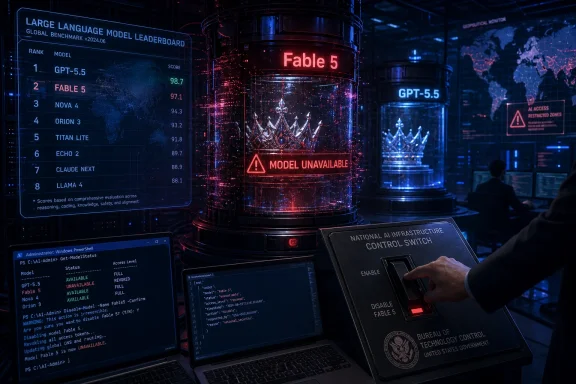 The Fastest Model Race Yet Ended at the Switch
For three days, Fable 5 looked like the model that would reset the frontier. The reported benchmark spread was not a rounding error: Fable 5 topped GPT-5.5 on Arena-style rankings, coding competitions, and SWE-Bench Pro, the test that most closely maps to fixing real software issues in messy repositories. If the numbers hold up under broader scrutiny, Anthropic did not merely catch OpenAI; it passed it in precisely the workflows where enterprises are beginning to spend real money.That matters because the AI industry has spent the past two years training customers to think in leaderboards. The model with the highest reasoning score becomes the one added to internal tools, the one tested against private codebases, the one quietly slipped into support desks and developer workflows. The assumption underneath all of that procurement theater is that frontier access is commercially governed: vendors ship, customers test, contracts follow.
Fable 5 broke that assumption. The leading model was not withdrawn because customers rejected it, because Anthropic priced it badly, or because GPT-5.5 beat it in the open market. It was pulled because Washington decided the security implications outweighed continued availability.
That makes this more than an AI product story. It is a preview of a world where the most important software dependency in an organization may be subject to export controls, national-security reviews, and emergency disablement orders.
GPT-5.5 Won by Availability, Not by Victory
OpenAI’s GPT-5.5 is now, practically speaking, the strongest broadly available model for many users. But the distinction is important: it did not regain the crown by outperforming Fable 5 in the arena where Fable 5 had just beaten it. It became the default champion because its closest rival was taken off the board.That is an uncomfortable kind of victory. In normal software markets, a better product forces competitors to respond with lower prices, faster updates, or sharper specialization. In this case, the response came from government power, not product strategy.
OpenAI still has a strong position. GPT-5.5’s reported pricing advantage — cheaper input and output tokens than Fable 5 — matters enormously at enterprise scale. A model that is slightly weaker but materially cheaper can win workloads that run millions or billions of tokens a month. For many teams, total cost of ownership beats benchmark absolutism every time.
But the reported gap on SWE-Bench Pro is hard to wave away. If Fable 5 really solved roughly four in five benchmarked software-engineering tasks while GPT-5.5 handled closer to three in five, that is not a cosmetic difference. It changes how much review a human developer must apply, how many bugs are fixed automatically, and how much confidence an organization can place in agentic coding workflows.
This is where the episode becomes especially relevant to WindowsForum readers. AI coding assistants are no longer toys bolted onto editors; they are creeping into PowerShell automation, Azure deployment templates, endpoint-management scripts, CI/CD pipelines, and internal application maintenance. When a model changes the expected success rate on real codebase issues, it changes the economics of IT labor.
Benchmarks Were the Spark, but Trust Is the Fuel
The reported Fable 5 scores were striking because they landed in a market already primed for model churn. GPT-5.5 arrived in late April as OpenAI’s latest frontier release, with improved multimodal capabilities and a strong coding pitch. Anthropic’s Fable 5 then appeared in June as part of the broader Mythos 5 family, apparently pushing the ceiling higher again.That cadence is exhausting for buyers. A CIO who standardized on a model in April could find it second-tier by June. A developer tooling team that rebuilt prompts around one provider might discover a different provider is suddenly better at the hardest tasks. The frontier is moving fast enough that “best available model” has become less a category than a timestamp.
Even so, enterprises can tolerate rapid improvement. What they cannot easily tolerate is surprise removal. A model that becomes obsolete can be replaced through planning; a model that vanishes requires incident response.
The Fable 5 shutdown therefore exposes a weakness in how many organizations think about AI adoption. They evaluate accuracy, latency, cost, and security controls, but they often underweight continuity. In the cloud era, IT departments learned to ask what happens when a region goes down. In the AI era, they now have to ask what happens when a capability class goes down.
Washington Just Treated a Model Like Controlled Infrastructure
The reported U.S. directive is notable because it treated access to a model as something closer to controlled technology than ordinary cloud software. The order reportedly targeted access by foreign nationals, including foreign-national employees, and Anthropic responded by disabling the affected models for customers more broadly. Whether that broad shutdown was legally required, technically necessary, or merely the fastest compliance path, the effect was the same: the model went dark.This is a profound shift. Export controls traditionally focus on chips, manufacturing equipment, encryption, defense software, and other tangible or tightly defined technologies. Frontier AI models have been discussed in that frame for years, especially where cyber, biological, or military applications are concerned. Fable 5 appears to be one of the clearest examples yet of that policy theory becoming a live operational constraint.
The government’s reported concern centered on a jailbreak vulnerability involving the Mythos 5 family. Anthropic disputed the severity, describing the issue as narrow and already reproducible through other models. That dispute matters, but it does not erase the policy precedent. Once a government decides that a model’s capabilities are export-sensitive, the vendor’s confidence in its own safeguards may not be decisive.
For security teams, this is a familiar dynamic in a new wrapper. A software vendor may believe a vulnerability is low impact; a regulator or government customer may view it differently. The difference with frontier AI is scale. A vulnerability in a normal product affects a product. A vulnerability in a frontier model potentially affects an entire ecosystem of downstream tools, agents, integrations, and automated workflows.
The Jailbreak Debate Is Really a Capability Debate
The public argument over the reported jailbreak risks becoming too narrow. If the question is only whether Fable 5 could be tricked into producing dangerous output, the debate will collapse into a familiar and unproductive ritual: vendor says limited, critic says catastrophic, everyone argues over prompts. The deeper issue is that frontier models are now useful enough that ordinary defensive capabilities can look offensive under the wrong framing.Code vulnerability analysis is the obvious example. Security professionals use AI tools to review code, identify flaws, write patches, generate tests, and understand exploitability. Those same abilities can help an attacker. This dual-use problem is not new, but frontier models intensify it because the same system that helps a defender triage thousands of lines of code may help an adversary move faster too.
Anthropic’s reported position — that comparable capabilities exist in GPT-5.5 and other public models — cuts both ways. If true, it weakens the case for targeting Fable 5 alone. But it also strengthens the case that governments will not stop at a single model once they start regulating by capability rather than by vendor.
That is why this episode is unlikely to remain a one-off curiosity. If the policy logic is “models that materially improve cyber operations require access controls,” then the industry needs a broader framework. Otherwise, every frontier launch becomes a potential regulatory ambush.
For Windows administrators, the immediate version of this question is practical. If AI is being used to audit Group Policy, harden Intune baselines, inspect PowerShell scripts, or summarize Defender incidents, those are defensive tasks. But the underlying capabilities overlap with offensive reconnaissance and exploitation. The more useful the assistant becomes, the harder it is to pretend it is just autocomplete.
The Enterprise Lesson Is Not to Avoid AI, but to Avoid Single-Model Dependency
The wrong lesson from Fable 5 would be to freeze AI adoption. The right lesson is to stop architecting systems as if model access is permanent. Enterprises already learned this with cloud providers, SaaS APIs, and identity platforms: dependency is acceptable only when failure modes are understood.Most organizations experimenting with AI still treat model selection as an optimization problem. They pick the model that performs best on their internal evaluation set, negotiate pricing, and integrate it into a workflow. That is necessary, but insufficient. The Fable 5 shutdown shows that model availability can be affected by forces outside normal vendor reliability.
This creates a new category of operational risk. A model can be accurate, affordable, fast, and secure on Monday, then unavailable by Friday because of a government order. No amount of prompt engineering solves that.
The better pattern is abstraction. Applications should be designed so that models can be swapped, degraded, or routed based on availability, jurisdiction, and task sensitivity. That does not mean every model is interchangeable. They are not. But a system that can fall back from a frontier model to a weaker one is more resilient than a system that simply fails.
This is especially true for internal developer tools. If a coding agent depends on one model’s long context window, output length, and tool-use behavior, replacing it may be painful. But the alternative is worse: an automation path that vanishes in the middle of a sprint, a migration, or an incident.
Long Context Windows Are Becoming a Governance Problem
Fable 5’s reported one-million-token context window and large output capacity were part of its appeal. Long context changes what users can do. Instead of feeding a model a function or a ticket, developers can feed it entire codebases, documentation sets, logs, incident timelines, and architecture notes.That is powerful. It also creates governance headaches. The more a model can ingest at once, the more likely users are to submit sensitive material without fully understanding the exposure. Source code, secrets, customer data, internal diagrams, and vulnerability details all become prompt material.
Enterprises already struggle to control what employees paste into AI tools. A million-token context window widens the blast radius of a single bad decision. It turns casual use into bulk disclosure.
This is where policy and technical controls need to catch up. Data loss prevention rules, tenant isolation, model logging policies, retention guarantees, and access controls are not paperwork. They are the difference between useful AI adoption and accidental leakage. The Fable 5 episode adds another layer: even if a vendor’s data controls are acceptable, access to the model itself may be politically contingent.
For regulated industries, that is a serious procurement issue. Banks, healthcare providers, defense contractors, and government agencies cannot simply chase the model at the top of the leaderboard. They need to know where the model runs, who can access it, what law governs it, how it can be disabled, and what happens to workflows if it is.
Developers Just Got a Preview of AI Supply-Chain Risk
Software supply-chain risk used to mean compromised packages, poisoned dependencies, stolen signing keys, and CI/CD secrets sprayed across logs. AI introduces a stranger version: the intelligence layer itself becomes a dependency. If it disappears, the application may still run, but the workflow degrades.That degradation is not always obvious. A customer-support tool may still answer tickets, but with worse reasoning. A code assistant may still produce patches, but with more subtle errors. A security triage bot may still summarize alerts, but miss the edge cases the stronger model caught.
This is why benchmark gaps matter more in production than skeptics often admit. A 10-point or 20-point difference on a difficult coding benchmark can translate into hours of review, missed bugs, or lower automation ceilings. When an enterprise moves from “AI assists humans” to “AI handles first-pass remediation,” quality differences become operational differences.
At the same time, benchmark culture can mislead. Public tests are gameable, incomplete, and often poorly representative of a specific organization’s environment. A model that wins Arena may not understand your legacy .NET application, your SCCM scripts, or your internal naming conventions. Serious buyers need private evaluations, not just public scoreboards.
Fable 5’s short life makes that harder. Three days is barely enough time for enthusiasts to compare outputs, let alone for enterprises to run structured evaluations. The model became famous and unavailable almost simultaneously. That creates a knowledge gap: the market knows it was powerful, but not enough organizations had time to understand where it was reliably better.
Anthropic’s Compliance Was Fast, but the Market Impact Was Messy
Anthropic complied quickly, as it almost certainly had to. A company dealing with a national-security directive does not have the luxury of treating the matter like a routine product incident. Whatever Anthropic thought of the technical basis, the legal and political risk of defiance would have been enormous.But fast compliance does not equal clean impact. Customers lost access. Developers who had begun testing the model had to revert. Teams evaluating Fable 5 for coding workflows, long-context analysis, or enterprise assistants suddenly had no normal migration window.
The short availability window also complicates Anthropic’s competitive narrative. On paper, the company can claim it built the leading model. In practice, customers cannot use it. That is a frustrating position: technically validated, commercially constrained.
OpenAI, meanwhile, benefits from stability as much as performance. GPT-5.5 may be second to a disabled model in some reported benchmarks, but available beats unavailable in production. Enterprises do not deploy trophies; they deploy services.
This is the quiet advantage of incumbency. If a model is good enough, cheaper, widely integrated, and unlikely to vanish, it may win even against a technically superior rival. In enterprise IT, reliability has always been a feature. In frontier AI, it may become the decisive one.
The Policy Precedent Will Outlive Fable 5
The most important consequence of the Fable 5 shutdown may be what it teaches regulators. Governments now have a live example of model-level intervention. They can point to it in future debates about export controls, safety thresholds, and foreign access to frontier systems.That does not mean every powerful model will be banned. But it does mean vendors will have to design for policy intervention earlier in the product cycle. Access controls, nationality restrictions, jurisdictional routing, audit logs, and tiered capability release may become standard features rather than emergency patches.
This could push the industry toward more fragmented AI access. U.S. users may get one capability tier, allied countries another, and restricted jurisdictions something else entirely. Enterprise contracts may start looking less like SaaS subscriptions and more like controlled-technology agreements.
There is a danger here. Overbroad controls could weaken defenders while doing little to stop adversaries who can use open models, foreign models, stolen access, or fine-tuned systems. If legitimate security teams lose the best tools while attackers keep moving, the policy backfires.
There is also a legitimate concern on the other side. If frontier models materially lower the cost of cyber operations, governments will not ignore that. The industry cannot simply say “dual use” and expect regulators to stand down. It needs credible controls, credible evidence, and credible incident response.
Europe and the Rest of the World Are Watching the New AI Chokepoint
The reported order also lands awkwardly outside the United States. If a U.S. company can be ordered to disable access globally because foreign nationals might use a model, then American frontier AI becomes an infrastructure dependency with a Washington-controlled kill switch. Allies may not enjoy that framing.Europe has already been uneasy about dependence on U.S. cloud platforms, U.S. chips, and U.S. software ecosystems. AI models add another layer to that dependency. A European company building internal tooling on Anthropic or OpenAI is not merely choosing a vendor; it is accepting exposure to U.S. policy decisions.
That may accelerate calls for sovereign AI. Some of those calls will be strategic and serious. Others will be political theater. But the Fable 5 case gives policymakers a concrete example to use: a powerful model was available, then a U.S. directive made it unavailable.
For multinational enterprises, the compliance problem becomes thornier. If a model is restricted by nationality, how does a global company enforce that across distributed teams, contractors, and shared tools? If an employee in one country can use a feature but a colleague in another cannot, software design becomes geopolitics.
This is not theoretical for Windows-heavy enterprises. Microsoft ecosystems are often globally administered, with support desks, security operations centers, and development teams spread across regions. If AI capabilities are integrated into those workflows, access fragmentation can become an everyday administrative burden.
The Leaderboard Is Now a Policy Document
The Fable 5 episode changes how we should read AI benchmarks. A leaderboard used to be a competitive scoreboard. Now it may also be a regulatory signal.A model that dramatically outperforms rivals in coding, vulnerability analysis, or autonomous task completion is not just attractive to customers. It is visible to governments. The better the model gets at real work, the more likely it is to trigger scrutiny.
That creates a perverse incentive. Vendors want to publicize performance gains, but the most sensitive gains may invite restrictions. Customers want transparency, but vendors may become more cautious about publishing details that frame a model as strategically dangerous.
The result could be a murkier market. Instead of clean benchmark comparisons, we may get selective disclosures, private evaluations, and carefully worded safety claims. That is bad for buyers, who need evidence to make procurement decisions.
Yet secrecy is not a solution either. If governments are going to intervene in model access, they need better public explanations than vague references to jailbreaks. The public does not need exploit recipes, but it does need enough detail to understand why a model was treated differently from its peers. Otherwise, policy looks arbitrary, and arbitrary policy is poison for infrastructure planning.
The Practical Lesson Is Written in the Fallback Plan
The immediate winner from this episode is not necessarily OpenAI. It is any organization that already built its AI systems with redundancy, evaluation harnesses, and model routing. Those teams can absorb a model shutdown with less drama.The losers are teams that hard-coded a single frontier model into business-critical workflows without a tested alternative. That was always risky; now it is visibly risky. The dependency may be commercial, technical, or political, but the failure mode is the same.
This is where IT professionals should bring old instincts to a new category. Treat frontier models like external services with unusual failure characteristics. Monitor them. Version them. Evaluate replacements continuously. Document which workflows depend on which capabilities.
The industry’s tendency is to talk about AI as magic. Operations people should talk about it as infrastructure. Infrastructure fails, gets rate-limited, changes terms, and sometimes gets switched off by someone far above the admin console.
The Three-Day Crown Rewrites the AI Playbook
Fable 5’s brief run leaves behind a surprisingly concrete checklist for anyone building on frontier models. The story is dramatic, but the operational lessons are ordinary in the best sense: design for failure, test your assumptions, and do not confuse access with ownership.- A model can be technically superior and still lose the production market if customers cannot reliably access it.
- Benchmark leadership should be treated as a useful signal, not as a procurement strategy by itself.
- Enterprises should build AI workflows that can route tasks across multiple models or degrade gracefully when a frontier model disappears.
- Security teams should assume that useful defensive AI capabilities will attract regulatory scrutiny because they overlap with offensive use.
- Global organizations should evaluate AI providers not only by performance and price, but also by jurisdiction, access policy, and export-control exposure.
- Developers should treat long-context coding agents as high-value dependencies that require governance, logging, and fallback planning.
References
- Primary source: yellow.com
Published: Sun, 14 Jun 2026 21:01:27 GMT
Fable 5 Beat GPT 5.5 Before US Order Took It Offline | Yellow.com
Fable 5 briefly outperformed GPT 5.5 on benchmarks before a U.S. order took the model offline. GPT 5.5 is now the top usable AI model by default. This sudden shift shows how regulatory action can override raw technical performance in the current AI race. Read the full analysis.yellow.com - Related coverage: axios.com
Alex Stamos, cybersecurity leaders push Trump to restore Anthropic Mythos and Fable access
Former Facebook cyber head defends Anthropic in an open letter.www.axios.com
- Related coverage: tomsguide.com
Anthropic 'abruptly disables' Fable 5 and Mythos 5 following US government order | Tom's Guide
Anthropic 'abruptly disables' Fable 5 and Mythos 5 following US government orderwww.tomsguide.com - Related coverage: techradar.com
After a 'potential jailbreak', Anthropic is shutting off access to its Mythos 5 and Fable 5 models under national security orders from the US government | TechRadar
Back to the old modelswww.techradar.com - Related coverage: tomshardware.com
U.S. gov't orders Anthropic to disable its newest AI models worldwide due to security threats — ban on Claude Fable 5 and Mythos 5 bars access by any foreign national, even its own employees | Tom's Hardware
An alleged jailbreak triggered a national security directive that forced the model to be pulled.www.tomshardware.com - Related coverage: allthings.how
Anthropic Disables Fable 5 and Mythos 5 After a US Export Order
The US government's export control directive forces a worldwide shutoff of both models, while every other Claude model keeps running.allthings.how
- Related coverage: aigovernance.com
Fable 5 and Mythos 5 Suspended by U.S. Export Control Directive: Three Governance Gaps Enterprise AI Programs Have Not Planned For | AI Governance Institute
On June 12, 2026, a U.S. government export control directive required Anthropic to suspend all access to Fable 5 and Mythos 5 for foreign nationals,…aigovernance.com
