

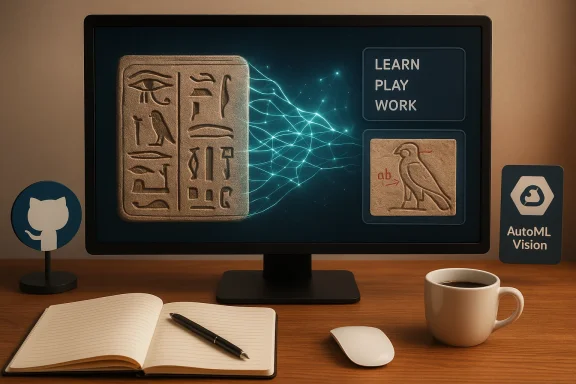
Google’s Arts & Culture team has quietly handed the public and academic Egyptologists a new kind of brush for reading the past: Fabricius, an AI-powered experiment that helps people read, write and begin to decode Egyptian hieroglyphs using machine learning and a desktop workbench built for researchers. Fabricius launched as an Arts & Culture experiment on July 15, 2020—timed to coincide with the anniversary of the Rosetta Stone’s discovery—and combines a playful phone-friendly learning experience with a more serious, open-source toolkit for experts that leans on Google Cloud’s AutoML Vision. (blog.google)
The Rosetta Stone unlocked ancient Egyptian scripts in the 19th century; Fabricius aims to accelerate parts of that same scholarly workflow for the 21st century by applying pattern recognition and classification at scale. Google positions the project as a three-part gateway—Learn, Play and Work—that invites newcomers to discover hieroglyphs through interactive steps, lets casual users generate message-like hieroglyphic renderings for fun, and provides a browser-based workbench where researchers can upload inscriptions and use machine-learned suggestions to speed transcription and analysis. (blog.google)
Fabricius was released as open-source software and its codebase and supporting services were published on GitHub so that institutions and developers can inspect, reuse and extend the tools. The project page and repositories document a stack that includes a web-based workbench, a classifier service that links to Google Cloud AutoML models, and translation/cluster-analysis components that map sequences of glyph identifiers to candidate readings. (github.com)
This lineage matters: the initial problem was practical (how to speed up large-scale digitisation and indexing of imagery used for a game), and the resulting tools were matured and retooled for scholarly and public-facing uses under Google's stewardship. The open-source release invites others to extend the dataset and tooling. (github.com)
Longer term, three developments will determine how transformative Fabricius and similar tools become:
For hobbyists and educators Fabricius is an engaging doorway into a millennia-old writing system; for researchers it’s a practical productivity tool—not a substitute for philological training. If you steward cultural data, treat Fabricius as a promising instrument in the toolkit, adopt careful human‑in‑the‑loop workflows, and contribute validated data back to the community so the tool can improve for everyone. (blog.google)
Fabricius shows how entertainment-driven R&D—here influenced by a games studio’s needs—can seed tools that benefit scholarship and public understanding. The next steps must be rigorous: independent metrics, robust datasets, and community governance to ensure the promises of machine learning are realized without compromising the standards and sensitivities of cultural heritage work.
Acknowledgement: this analysis synthesises Google’s Fabricius announcement and project materials with independent reporting and project repositories to provide a practical, evidence-based appraisal for Windows users considering how AI tools intersect with cultural heritage and research workflows. (blog.google)
Source: Mashable Translate ancient hieroglyphs with Google's new AI-powered tool
 Background / Overview
The Rosetta Stone unlocked ancient Egyptian scripts in the 19th century; Fabricius aims to accelerate parts of that same scholarly workflow for the 21st century by applying pattern recognition and classification at scale. Google positions the project as a three-part gateway—Learn, Play and Work—that invites newcomers to discover hieroglyphs through interactive steps, lets casual users generate message-like hieroglyphic renderings for fun, and provides a browser-based workbench where researchers can upload inscriptions and use machine-learned suggestions to speed transcription and analysis. (blog.google)Fabricius was released as open-source software and its codebase and supporting services were published on GitHub so that institutions and developers can inspect, reuse and extend the tools. The project page and repositories document a stack that includes a web-based workbench, a classifier service that links to Google Cloud AutoML models, and translation/cluster-analysis components that map sequences of glyph identifiers to candidate readings. (github.com)
How Fabricius works: Learn, Play, Work
Learn: an interactive primer for beginners
Fabricius’s Learn pathway is a short, guided introduction to hieroglyphic basics: reading direction, common sign categories, and sign tracing exercises that help users visualise how symbols are formed and grouped. The stepwise approach breaks centuries of specialist knowledge into approachable tasks and uses immediate visual feedback to teach recognition. This is the “gateway drug” for the rest of the experiment and is explicitly designed to be educational rather than academically exhaustive. (blog.google)Play: write your own hieroglyphic messages
The Play section converts modern words, phrases and even emojis into approximate hieroglyphic sequences for entertainment and social sharing. Google cautions that these outputs are “not academically correct” and intended for fun: the system relies on a finite dictionary of mapped terms and will grey out or struggle with anachronistic concepts (for example, there is no ancient sign for “coffee”). Play is an accessible demonstration of how sign-mapping and sequence rendering can be automated, but it’s not a full replacement for formal translation.Work: an expert-focused workbench with ML-assisted classification
The Work environment is the technically most significant component: a desktop-accessible web application where researchers can upload images of inscriptions, create a facsimile layer, annotate damaged regions, and use an ML classifier to suggest Gardiner codes (the standard sign-list identifiers used by Egyptologists) for detected signs. The classifier was trained using Google Cloud AutoML Vision and is intended to suggest likely sign matches—researchers still sequence, validate and interpret the results. The workbench couples image pre-processing, interactive editing and clustering/translation services to turn annotated sign streams into candidate readings. (github.com)Under the hood: technology and data
Fabricius is not a single monolithic model that “translates” hieroglyphs end-to-end. Instead, it stitches together components that handle discrete tasks:- Visual recognition/classification: a classifier service suggests Gardiner sign codes for cropped glyph images using models trained with Google Cloud’s AutoML Vision. That ML layer is the heart of the “what sign is this?” problem. (blog.google)
- Sequence handling / translation: a translation component maps sequences of sign codes to candidate lexical readings; this uses research corpora and datasets maintained by academic partners and published projects. The Fabricius translation repo references external scholarly datasets used under permissive licenses. (github.com)
- Human-in-the-loop UI: the workbench foregrounds manual editing—correcting damaged signs, reordering, and annotating—so final readings remain dependent on expert judgment. The system is explicitly collaborative, not fully automatic. (github.com)
Origins and collaborators: from Assassin’s Creed research to open source
Fabricius grew from an earlier research initiative—the Hieroglyphics Initiative—that began as a collaboration between Ubisoft (during development of Assassin’s Creed: Origins) and research partners to explore whether machine learning could assist cataloguing and interpreting hieroglyphs. Google Arts & Culture later partnered with the Australian Centre for Egyptology at Macquarie University, digital agency Psycle Interactive, Ubisoft and a network of Egyptologists to formalise and publish Fabricius as an Arts & Culture experiment and open-source project. The GitHub repositories and project history make those collaborative threads explicit.This lineage matters: the initial problem was practical (how to speed up large-scale digitisation and indexing of imagery used for a game), and the resulting tools were matured and retooled for scholarly and public-facing uses under Google's stewardship. The open-source release invites others to extend the dataset and tooling. (github.com)
Verified facts and timelines
- Fabricius was announced on July 15, 2020, on Google’s company blog and released on the Google Arts & Culture platform. (blog.google)
- The project uses Google Cloud’s AutoML Vision to train classifiers that suggest Gardiner sign codes for glyph images; the workbench and supporting services were published as open source on GitHub. (blog.google)
- Fabricius offers three gateways—Learn, Play and Work—and was published in English and Arabic to reach broad audiences across the regions most closely connected to Egyptology and the history of hieroglyphic study. (blog.google)
- Popular press reports and tech outlets repeated that the tool compares user-drawn glyphs to a library of more than 800 unique glyphs when determining matches; that figure appears consistently in contemporary coverage summarising Fabricius’s classifier scope. Readers should treat the exact “800+” number as a practical indicator of dataset coverage, not a scholarly claim about the full universe of hieroglyphic signs.
Strengths: what Fabricius brings to the table
- Democratisation of craft: Fabricius lowers the barrier to entry for learning hieroglyphic basics and brings an engaging, mobile-first entry point that can broaden public interest in Egyptology. The Learn and Play experiences convert pedagogical content into active practice, not passive consumption. (blog.google)
- Fast, repeatable classification: by automating the sign-recognition step, Fabricius can save researchers hours of manual lookup and cross-referencing when dealing with large image sets—especially useful for museum digitisation efforts or field teams documenting inscriptions. The classifier converts visual glyphs to Gardiner codes quickly, enabling scale. (github.com)
- Open-source model encourages community improvements: publishing code and APIs on GitHub allows universities, museums and independent developers to tune models, add training data from underrepresented corpora, and integrate Fabricius parts into local research pipelines. That can strengthen reproducibility and drive domain-specific enhancements. (github.com)
- Bridge between heritage and tech industries: Fabricius demonstrates a practical pathway for game studios, tech companies and academic institutions to collaborate on cultural computing problems—turning corporate R&D into public goods with clear scholarly relevance.
Risks, limitations and red flags
No tool of this kind is without caveats. Fabricius’s public documentation and independent reporting highlight several concrete limitations and potential hazards.- Not a replacement for philological expertise. Fabricius suggests signs and candidate readings; it does not produce definitive, peer-reviewable translations. Ancient Egyptian writing combines logograms, phonograms and determinatives—ambiguous signals that require context, dialectal knowledge, and grammatical analysis that a classifier alone cannot supply. Over-reliance on the tool risks shallow or incorrect interpretations if human verification is skipped. (blog.google)
- Dataset bias and representativeness. The classifier’s performance depends on the images and labels it was trained on. If training data under-represents certain materials (e.g., painted coffins vs. carved stelae), regional variants, degraded inscriptions, or non-canonical sign forms, the model’s suggestions may be systematically worse on those classes. The GitHub archives show the pipeline and links to translation corpora, but independent audits of coverage and per-sign accuracy have not been published in peer-reviewed venues. Users should treat this as an active research risk. (github.com)
- Provenance and attribution concerns. As with any model trained on cultural artefacts, provenance, licensing of images and the ethics of digitising and publishing cultural heritage must be considered. Fabricius’s open-source stance mitigates some transparency issues, but institutions using the tool should track permissions, especially for field images or unpublished museum holdings. (github.com)
- Misuse and trivialisation. The Play mode’s social-sharing affordances can encourage trivial or anachronistic uses of hieroglyphs that detach the signs from historical meaning. While harmless as entertainment, such trivialisation can shape public perceptions of the field—sometimes simplifying complex scripts into “ancient emojis.” Google itself cautions users about academic correctness. (blog.google)
- Accuracy and auditability. Machine learning outputs are probabilistic. For scholarship that demands token-level provenance (which letter on the stone corresponds to which output token), ML systems must provide reversible logs or image annotations that show exactly why a match was suggested. Fabricius offers annotated editing tools, but complete provenance trails and independent accuracy studies remain an open need. (github.com)
Best-practice checklist for researchers and institutions
If you plan to adopt Fabricius in a workflow—whether for cataloguing, field documentation, or classroom use—treat it as a component in a validated pipeline rather than a turnkey translator.- Use Fabricius for first-pass classification, not final translations. Accept ML suggestions, but mandate human verification before publication.
- Maintain provenance logs. Save original images, facsimile layers, classifier suggestions and final edits to enable audit and reproducibility.
- Cross-validate with multiple corpora. Complement Fabricius outputs with traditional sign-lists, lexical databases, and specialist consultation.
- Contribute back improvements. If you curate additional labeled images or regional corpora, consider contributing anonymised datasets or pull requests to the open-source repos to help the community reduce bias.
- Follow ethical and legal use rules. Verify image permissions and be mindful of cultural heritage protocols when sharing or publishing digital reproductions. (github.com)
What Fabricius means for the future of digital epigraphy
Fabricius is an early but instructive example of a broader shift: applying targeted machine learning to well-scoped humanities tasks where pattern recognition yields concrete productivity gains. The project’s combination of public-facing pedagogy and a researcher-grade workbench models how tech firms and cultural institutions can cooperate: public engagement funds interest and data collection, while open-source research tooling invites domain experts to iterate and improve.Longer term, three developments will determine how transformative Fabricius and similar tools become:
- Independent evaluations: peer-reviewed accuracy studies, benchmark datasets, and transparent error analysis will decide whether machine-assistance reaches publication standards.
- Expanded, representative training sets: contributions from museums, field teams and universities that broaden the visual and dialectal range of training data will reduce regional and material bias.
- Provenance-first tooling: adding tightly coupled provenance logs, token-level evidence and reversible edits will satisfy scholarly audit requirements and encourage adoption in formal publications. (github.com)
Practical takeaways for WindowsForum readers
- If you enjoy cultural-tech experiments, try the Learn and Play features on the Google Arts & Culture platform to get a hands-on sense of hieroglyphic sign-building. The front-end is mobile-friendly and intentionally playful. (blog.google)
- If you manage digitisation programmes, Fabricius’s workbench and classifier components are available as open-source building blocks you can deploy, adapt and integrate into Windows- or cloud-based pipelines—keep in mind the workbench is better suited to desktop workflows, and the classifier relies on cloud services for model inference. (github.com)
- For IT teams: evaluate network, storage and access controls before integrating Fabricius into enterprise repositories. Ensure secure handling of high-resolution images and compliance with institutional copyright or loan agreements. (github.com)
Final verdict: a pragmatic, promising but still maturing tool
Fabricius is an instructive step toward bridging machine learning and epigraphy. Its strengths are concrete: a usable workbench, ML-powered sign-suggestion that shortens repetitive manual tasks, and an open-source posture that enables community-driven improvement. Those strengths come with obvious limits: the classifier is only as good as its training data; semantic translation still requires human judgement; and scholarly publication demands provenance and independent validation that Fabricius does not itself fully provide out of the box. (blog.google)For hobbyists and educators Fabricius is an engaging doorway into a millennia-old writing system; for researchers it’s a practical productivity tool—not a substitute for philological training. If you steward cultural data, treat Fabricius as a promising instrument in the toolkit, adopt careful human‑in‑the‑loop workflows, and contribute validated data back to the community so the tool can improve for everyone. (blog.google)
Fabricius shows how entertainment-driven R&D—here influenced by a games studio’s needs—can seed tools that benefit scholarship and public understanding. The next steps must be rigorous: independent metrics, robust datasets, and community governance to ensure the promises of machine learning are realized without compromising the standards and sensitivities of cultural heritage work.
Acknowledgement: this analysis synthesises Google’s Fabricius announcement and project materials with independent reporting and project repositories to provide a practical, evidence-based appraisal for Windows users considering how AI tools intersect with cultural heritage and research workflows. (blog.google)
Source: Mashable Translate ancient hieroglyphs with Google's new AI-powered tool
