

Faegre Drinker said Thursday that it has given all lawyers, consulting professionals, and staff access to Harvey and Microsoft Copilot while expanding AI ethics training across the firm’s operations, including its major Indianapolis office. The move is not just another Big Law technology rollout; it is a signal that generative AI has crossed from experimental committee work into the daily infrastructure of legal practice. For WindowsForum readers, the Microsoft angle matters because Copilot is becoming the default enterprise doorway through which AI enters regulated professional work. The law firm is betting that productivity gains are real, but only if governance grows at the same pace as access.
The important word in Faegre Drinker’s announcement is not “AI.” It is “all.” The firm is not describing a sandbox available to a handful of innovation partners or a research tool locked behind a specialist team; it is extending access across lawyers, consulting professionals, and staff.
That changes the nature of the project. A narrow pilot is about curiosity, proof points, and vendor evaluation. A firmwide deployment is about process, risk allocation, training, support, and cultural permission.
The legal industry has spent the past three years talking about generative AI as if adoption were inevitable but implementation were optional. Faegre Drinker’s move suggests that, for large firms, the optional phase is ending. The competitive question is no longer whether lawyers will use AI, but which tools they are allowed to use, under whose supervision, and with what audit trail.
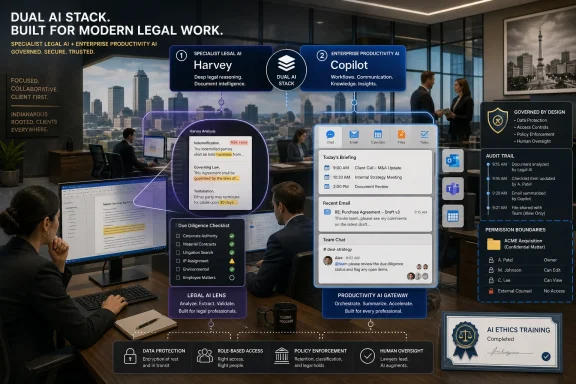
That is why pairing Harvey with Microsoft Copilot is more interesting than either tool alone. Harvey speaks to domain-specific legal work: research, drafting, document comparison, due diligence, and issue spotting. Copilot speaks to the Microsoft 365 layer where lawyers already live: Outlook, Word, Teams, SharePoint, and the broader enterprise data graph.
That split matters because law firms are not ordinary knowledge-work businesses. Their raw material is privileged, confidential, and often commercially explosive. A bad summary is not merely embarrassing; it can distort legal advice, miss a contractual trap, or leak strategy into the wrong system.
Copilot’s advantage is integration. If a firm already runs Microsoft 365, the AI assistant can operate where documents, calendars, chats, and email already exist. That lowers friction, which is the enemy of enterprise adoption.
Harvey’s advantage is context. It is built for legal and professional services users who need answers shaped by legal conventions, deal structures, litigation posture, and document-heavy workflows. The firm’s described use cases — contract review, legal drafting, risk identification, due diligence, comparison, and analysis — are exactly the tasks where general-purpose chatbots can appear fluent while missing the point.
The strategic bet is that neither category fully replaces the other. Copilot may help a lawyer synthesize a meeting, draft a client update, or navigate internal materials. Harvey may help interrogate a purchase agreement, compare versions, or accelerate document review in a transaction.
That matters because AI adoption in law is often narrated through coastal headquarters, London magic-circle firms, or Silicon Valley legal-tech investors. Here, the rollout lands in a major Midwestern legal market tied to corporate transactions, health care, life sciences, manufacturing, insurance, and regulated industries. These are precisely the sectors where clients are asking their own AI governance questions.
The firm showcased Harvey to hundreds of attorneys at its 13th Annual Indianapolis M&A Conference last month, which is a telling venue. M&A work is one of the clearest business cases for legal AI because transactions produce large document sets, repeated review tasks, and time-sensitive diligence demands. If AI can make a dent anywhere without pretending to replace legal judgment, deal work is an obvious place to start.
But the M&A context also sharpens the risk. A due diligence miss can survive long enough to become a post-closing dispute. A hallucinated clause summary can feed into a negotiation strategy. A model that confidently finds “no issue” where an experienced associate would hesitate is not a productivity tool; it is a liability generator.
Legal work contains plenty of repetitive labor. Lawyers compare drafts, summarize depositions, extract obligations, build issue lists, review contract portfolios, and turn messy source material into polished advice. These are exactly the places where generative AI can compress first-pass work.
But compression is not deletion. The time saved on initial review can reappear as time spent verifying output, refining prompts, checking citations, testing assumptions, and explaining to clients how AI-assisted work was supervised. In professional services, speed only counts if confidence survives.
This is where law firms differ from ordinary office adopters of AI. A marketing department may tolerate several drafts to get to something useful. A lawyer cannot treat a model-generated legal analysis as merely “directionally right” when a client relies on it for a decision.
The best case for AI in law is not that it replaces lawyers. It is that it changes where lawyer attention is spent. That is a much more modest claim than the hype cycle promised, but it is also a more durable one.
The firm says the training focuses on effective use in legal workflows, when and when not to rely on AI, and how to understand limitations rather than simply learn features. That emphasis is exactly right. The risk is not that lawyers fail to click the right button. The risk is that they mistake a fluent answer for a reliable answer.
Legal ethics questions around AI are not abstract. Lawyers have duties of competence, confidentiality, supervision, candor, and communication. Generative AI touches all of them. If a lawyer submits fake cases, exposes client data, relies on unverified analysis, or delegates judgment to a system that cannot hold a law license, the problem is not merely technical.
The phrase “used with judgment and care,” from firm chair Gina Kastel’s statement, is doing a lot of work. It acknowledges that AI is not a neutral appliance. It is a system that can accelerate both good practice and bad practice.
Training also creates a defensible internal norm. If every professional has access, then every professional needs shared expectations. Otherwise, a firmwide rollout becomes a patchwork of personal habits, private prompt libraries, and uneven risk tolerance.
That is both the attraction and the anxiety. Copilot can operate inside a familiar enterprise boundary, honoring the access controls and document permissions already configured in Microsoft 365. But that also means Copilot may reveal how messy those permissions are.
Many organizations discover during Copilot readiness work that too many users can access too many files. That was already a security problem before AI. Copilot makes it more visible because it can surface buried information faster than a human browsing SharePoint folders.
For law firms, this is especially sensitive. Matter files, client communications, lateral-hire materials, compensation documents, conflicts data, and internal strategy documents do not belong in the same loose permission universe. If AI can summarize what a user is technically allowed to see, the old excuse that “nobody would find it anyway” collapses.
That is why Copilot deployment is as much about information architecture as artificial intelligence. The firm that wants AI productivity has to earn it by cleaning up governance. In practice, that means data loss prevention policies, sensitivity labels, retention rules, access reviews, conditional access, endpoint hygiene, and administrator discipline.
The appeal is straightforward. General chatbots can draft prose, but legal work depends on structure, precedent, jurisdiction, defined terms, document hierarchy, and professional judgment. A legal-specific AI platform promises to bring the model closer to the work rather than forcing the work into a generic assistant.
That promise is especially strong in contract-heavy practices. A system that can compare language across agreements, surface missing provisions, summarize risks, and help with diligence can shave time from work that clients often view as expensive but necessary. Nobody loves paying a senior associate to manually reconstruct a clause matrix.
Still, specialist branding does not eliminate model risk. Legal AI systems can still misunderstand context, overweight irrelevant language, miss unusual drafting choices, or produce confident but incomplete analysis. The fact that a tool is built for lawyers does not make it a lawyer.
The practical question is how Faegre Drinker will embed Harvey into review workflows. If the tool becomes a first-pass accelerator with human verification, it can be valuable. If it becomes a shortcut around expertise, it will eventually find the edge case that punishes haste.
In the near term, clients may see faster turnaround on routine document work, more efficient status reporting, and better use of institutional knowledge. Lawyers may be able to produce first drafts more quickly, prepare for calls more thoroughly, and identify issues earlier in a matter’s lifecycle.
But clients may also ask harder questions. Was AI used on my matter? Which tool? Was my data uploaded into a third-party system? Were outputs verified? Are time entries reduced when AI accelerates work? Who bears responsibility if an AI-assisted analysis is wrong?
Those questions are not hostile. They are rational. Many corporate legal departments are building their own AI policies and will expect outside counsel to meet or exceed them.
The billing issue may be the most awkward. If AI reduces the hours required for certain work, clients will expect value to flow back to them. Law firms that use AI to preserve old billing models while reducing internal labor may face uncomfortable conversations.
If a task once took six hours and now takes two, the client may reasonably ask why the invoice should look like the old world. The firm may respond that the value lies in the answer, not the time spent producing it. Both positions have logic, and the negotiation between them will shape AI’s commercial impact.
Faegre Drinker’s announcement does not spell out pricing changes, and it would be surprising if it did. Firms rarely announce billing-model disruption in the same breath as internal technology deployment. But the issue is unavoidable.
AI may push more work toward fixed fees, success fees, subscription counsel, and blended arrangements. It may also reward firms that can show repeatable processes and measurable efficiency without reducing quality. Clients will not simply take law firm AI claims on faith.
This is where operational discipline becomes a market advantage. A firm that can explain how AI was used, supervised, measured, and controlled may have a stronger client story than a firm that merely says its lawyers have licenses.
That does not mean firms should preserve inefficient work for nostalgia’s sake. Nobody needs to romanticize endless document review. But legal judgment is built partly through exposure to tedious details. Lawyers learn patterns by doing the work before they learn to supervise the work.
A firmwide AI rollout must therefore answer a developmental question: how do junior lawyers learn if machines perform more of the initial grind? The answer cannot be simply “they will do higher-value work.” Higher-value work requires foundations.
The best firms will redesign training around AI-assisted practice. They will teach associates how to test outputs, identify weak reasoning, compare machine summaries against source documents, and understand why a partner rejects a superficially plausible answer. That may produce better lawyers, but only if firms are deliberate.
Faegre Drinker’s expanded ethics instruction is a start. Over time, the more difficult challenge will be professional formation. AI competence is becoming part of legal competence, but it cannot replace legal education by osmosis.
For Microsoft, the pitch is that Copilot can bring AI into the enterprise without breaking the governance model that large organizations already depend on. That is why data protection, tenant boundaries, permission inheritance, and compliance controls dominate serious Copilot conversations.
For Harvey, the pitch is that legal AI should be grounded in the realities of legal work. The company’s public positioning emphasizes attorney oversight, reviewability, secure collaboration, and domain-specific workflows. That is the language buyers need before they let AI near privileged material.
These assurances matter, but they are not self-executing. A secure platform can still be used carelessly. A reviewable answer can still go unreviewed. A model that cites sources can still lead a rushed user toward the wrong conclusion.
The buyer’s job is to turn vendor promises into operating controls. That means policies, permissions, logging, training, escalation paths, and consequences. AI governance is not a PDF in a shared drive; it is a set of habits enforced by systems and leadership.
A hospital, accounting firm, insurer, university, manufacturer, or government contractor will recognize the pattern. Microsoft 365 provides the productivity substrate. A vertical AI tool handles domain-specific work. Governance sits awkwardly across both.
That creates a new burden for IT teams. They must understand not only whether a tool is secure in isolation, but how it interacts with identity, document repositories, mobile devices, browser sessions, third-party connectors, and user behavior. The perimeter is now semantic as well as technical.
For Windows admins, Copilot readiness is not just a licensing conversation. It is a permissions conversation. It is a SharePoint hygiene conversation. It is a Purview conversation. It is an executive-expectations conversation.
AI has a way of making old IT debt newly visible. Messy groups, stale guest accounts, unmanaged devices, forgotten file shares, and unclear retention policies become more dangerous when an assistant can synthesize across them. The smarter the interface becomes, the less forgiving the back end can be.
When everyone has access, AI use becomes normal rather than exceptional. The partner who experiments no longer looks like a hobbyist. The associate who asks whether Harvey can help with a diligence pass is not freelancing outside the approved stack. The staff member using Copilot to summarize a meeting is not sneaking consumer AI into client work.
That cultural normalization can be powerful. It can also create pressure to use AI even where it is not appropriate. That is why the firm’s stated training focus on “when and when not to rely” on AI is more important than any product demo.
The firms that succeed will resist both extremes. They will not ban AI out of fear, and they will not treat it as a universal solvent. They will define categories of acceptable use, restricted use, and prohibited use, then update those categories as the tools and risks evolve.
This is less glamorous than keynote-stage AI futurism. It is also where the real work happens.
That model does not satisfy those predicting robot lawyers. It also does not comfort those hoping AI will remain peripheral. It is a middle path, and it is probably the one the profession will actually take.
Faegre Drinker’s deployment fits that path. Harvey is not being described as a replacement for lawyers. Copilot is not being presented as a substitute for professional judgment. The firm is emphasizing workflow efficiency, operational excellence, client value, and ethics training.
The real test will come months from now, not on announcement day. How often are the tools used? Which practice groups change their workflows? Do clients notice faster or better service? Do lawyers trust the outputs? Do risk teams see fewer unsanctioned AI experiments because approved tools are good enough?
AI adoption should be judged by observed behavior, not press-release vocabulary. The difference between a transformation and a license purchase is whether daily work actually changes.
 Faegre Drinker Moves AI From Pilot Theater to Production Reality
The important word in Faegre Drinker’s announcement is not “AI.” It is “all.” The firm is not describing a sandbox available to a handful of innovation partners or a research tool locked behind a specialist team; it is extending access across lawyers, consulting professionals, and staff.That changes the nature of the project. A narrow pilot is about curiosity, proof points, and vendor evaluation. A firmwide deployment is about process, risk allocation, training, support, and cultural permission.
The legal industry has spent the past three years talking about generative AI as if adoption were inevitable but implementation were optional. Faegre Drinker’s move suggests that, for large firms, the optional phase is ending. The competitive question is no longer whether lawyers will use AI, but which tools they are allowed to use, under whose supervision, and with what audit trail.
That is why pairing Harvey with Microsoft Copilot is more interesting than either tool alone. Harvey speaks to domain-specific legal work: research, drafting, document comparison, due diligence, and issue spotting. Copilot speaks to the Microsoft 365 layer where lawyers already live: Outlook, Word, Teams, SharePoint, and the broader enterprise data graph.
The Legal AI Stack Is Splitting in Two
Faegre Drinker’s rollout reflects a pattern now emerging across professional services: firms want one AI layer for the business platform and another for the domain platform. Microsoft Copilot is the general-purpose productivity assistant. Harvey is the specialist trained and packaged around legal workflows.That split matters because law firms are not ordinary knowledge-work businesses. Their raw material is privileged, confidential, and often commercially explosive. A bad summary is not merely embarrassing; it can distort legal advice, miss a contractual trap, or leak strategy into the wrong system.
Copilot’s advantage is integration. If a firm already runs Microsoft 365, the AI assistant can operate where documents, calendars, chats, and email already exist. That lowers friction, which is the enemy of enterprise adoption.
Harvey’s advantage is context. It is built for legal and professional services users who need answers shaped by legal conventions, deal structures, litigation posture, and document-heavy workflows. The firm’s described use cases — contract review, legal drafting, risk identification, due diligence, comparison, and analysis — are exactly the tasks where general-purpose chatbots can appear fluent while missing the point.
The strategic bet is that neither category fully replaces the other. Copilot may help a lawyer synthesize a meeting, draft a client update, or navigate internal materials. Harvey may help interrogate a purchase agreement, compare versions, or accelerate document review in a transaction.
Indianapolis Is Not a Side Note in This Rollout
Faegre Drinker’s Indianapolis presence gives the announcement a local business significance beyond the usual Big Law press release. The firm has roughly 167 attorneys and about 320 employees in Indianapolis, making the office a substantial node in the firm’s broader operations rather than a symbolic regional outpost.That matters because AI adoption in law is often narrated through coastal headquarters, London magic-circle firms, or Silicon Valley legal-tech investors. Here, the rollout lands in a major Midwestern legal market tied to corporate transactions, health care, life sciences, manufacturing, insurance, and regulated industries. These are precisely the sectors where clients are asking their own AI governance questions.
The firm showcased Harvey to hundreds of attorneys at its 13th Annual Indianapolis M&A Conference last month, which is a telling venue. M&A work is one of the clearest business cases for legal AI because transactions produce large document sets, repeated review tasks, and time-sensitive diligence demands. If AI can make a dent anywhere without pretending to replace legal judgment, deal work is an obvious place to start.
But the M&A context also sharpens the risk. A due diligence miss can survive long enough to become a post-closing dispute. A hallucinated clause summary can feed into a negotiation strategy. A model that confidently finds “no issue” where an experienced associate would hesitate is not a productivity tool; it is a liability generator.
The Productivity Pitch Is Real, but It Is Not Magic
Faegre Drinker’s public framing is familiar: AI can reduce routine and time-intensive work, freeing lawyers to spend more time on legal analysis, strategy, and client service. That claim is plausible. It is also incomplete.Legal work contains plenty of repetitive labor. Lawyers compare drafts, summarize depositions, extract obligations, build issue lists, review contract portfolios, and turn messy source material into polished advice. These are exactly the places where generative AI can compress first-pass work.
But compression is not deletion. The time saved on initial review can reappear as time spent verifying output, refining prompts, checking citations, testing assumptions, and explaining to clients how AI-assisted work was supervised. In professional services, speed only counts if confidence survives.
This is where law firms differ from ordinary office adopters of AI. A marketing department may tolerate several drafts to get to something useful. A lawyer cannot treat a model-generated legal analysis as merely “directionally right” when a client relies on it for a decision.
The best case for AI in law is not that it replaces lawyers. It is that it changes where lawyer attention is spent. That is a much more modest claim than the hype cycle promised, but it is also a more durable one.
Ethics Training Is the Real Deployment Mechanism
Faegre Drinker’s expanded ethics training is not a compliance garnish. It is the mechanism that makes firmwide AI deployment possible.The firm says the training focuses on effective use in legal workflows, when and when not to rely on AI, and how to understand limitations rather than simply learn features. That emphasis is exactly right. The risk is not that lawyers fail to click the right button. The risk is that they mistake a fluent answer for a reliable answer.
Legal ethics questions around AI are not abstract. Lawyers have duties of competence, confidentiality, supervision, candor, and communication. Generative AI touches all of them. If a lawyer submits fake cases, exposes client data, relies on unverified analysis, or delegates judgment to a system that cannot hold a law license, the problem is not merely technical.
The phrase “used with judgment and care,” from firm chair Gina Kastel’s statement, is doing a lot of work. It acknowledges that AI is not a neutral appliance. It is a system that can accelerate both good practice and bad practice.
Training also creates a defensible internal norm. If every professional has access, then every professional needs shared expectations. Otherwise, a firmwide rollout becomes a patchwork of personal habits, private prompt libraries, and uneven risk tolerance.
Copilot Makes AI an IT Governance Problem, Not Just a Legal-Tech Problem
For WindowsForum’s audience, Microsoft Copilot is the infrastructure story. Once Copilot enters a firm, AI becomes entangled with identity, permissions, data classification, retention, eDiscovery, endpoint management, and the everyday realities of Microsoft 365 administration.That is both the attraction and the anxiety. Copilot can operate inside a familiar enterprise boundary, honoring the access controls and document permissions already configured in Microsoft 365. But that also means Copilot may reveal how messy those permissions are.
Many organizations discover during Copilot readiness work that too many users can access too many files. That was already a security problem before AI. Copilot makes it more visible because it can surface buried information faster than a human browsing SharePoint folders.
For law firms, this is especially sensitive. Matter files, client communications, lateral-hire materials, compensation documents, conflicts data, and internal strategy documents do not belong in the same loose permission universe. If AI can summarize what a user is technically allowed to see, the old excuse that “nobody would find it anyway” collapses.
That is why Copilot deployment is as much about information architecture as artificial intelligence. The firm that wants AI productivity has to earn it by cleaning up governance. In practice, that means data loss prevention policies, sensitivity labels, retention rules, access reviews, conditional access, endpoint hygiene, and administrator discipline.
Harvey Carries the Promise and Pressure of Legal-Specific AI
Harvey’s growth has made it one of the defining names in legal AI. The company says its platform is used by more than 142,000 legal professionals across more than 1,500 organizations, and it has become a fixture in large-firm AI conversations.The appeal is straightforward. General chatbots can draft prose, but legal work depends on structure, precedent, jurisdiction, defined terms, document hierarchy, and professional judgment. A legal-specific AI platform promises to bring the model closer to the work rather than forcing the work into a generic assistant.
That promise is especially strong in contract-heavy practices. A system that can compare language across agreements, surface missing provisions, summarize risks, and help with diligence can shave time from work that clients often view as expensive but necessary. Nobody loves paying a senior associate to manually reconstruct a clause matrix.
Still, specialist branding does not eliminate model risk. Legal AI systems can still misunderstand context, overweight irrelevant language, miss unusual drafting choices, or produce confident but incomplete analysis. The fact that a tool is built for lawyers does not make it a lawyer.
The practical question is how Faegre Drinker will embed Harvey into review workflows. If the tool becomes a first-pass accelerator with human verification, it can be valuable. If it becomes a shortcut around expertise, it will eventually find the edge case that punishes haste.
The Client-Service Argument Cuts Both Ways
Faegre Drinker’s leadership frames the rollout around better client service. That is the right commercial language, because clients are unlikely to care whether a firm has a fashionable AI stack unless it changes cost, speed, responsiveness, or quality.In the near term, clients may see faster turnaround on routine document work, more efficient status reporting, and better use of institutional knowledge. Lawyers may be able to produce first drafts more quickly, prepare for calls more thoroughly, and identify issues earlier in a matter’s lifecycle.
But clients may also ask harder questions. Was AI used on my matter? Which tool? Was my data uploaded into a third-party system? Were outputs verified? Are time entries reduced when AI accelerates work? Who bears responsibility if an AI-assisted analysis is wrong?
Those questions are not hostile. They are rational. Many corporate legal departments are building their own AI policies and will expect outside counsel to meet or exceed them.
The billing issue may be the most awkward. If AI reduces the hours required for certain work, clients will expect value to flow back to them. Law firms that use AI to preserve old billing models while reducing internal labor may face uncomfortable conversations.
The Billable Hour Meets the Automation Layer
Legal AI threatens to expose the tension at the center of Big Law economics. Firms sell expertise, but they often bill time. AI attacks time more directly than expertise.If a task once took six hours and now takes two, the client may reasonably ask why the invoice should look like the old world. The firm may respond that the value lies in the answer, not the time spent producing it. Both positions have logic, and the negotiation between them will shape AI’s commercial impact.
Faegre Drinker’s announcement does not spell out pricing changes, and it would be surprising if it did. Firms rarely announce billing-model disruption in the same breath as internal technology deployment. But the issue is unavoidable.
AI may push more work toward fixed fees, success fees, subscription counsel, and blended arrangements. It may also reward firms that can show repeatable processes and measurable efficiency without reducing quality. Clients will not simply take law firm AI claims on faith.
This is where operational discipline becomes a market advantage. A firm that can explain how AI was used, supervised, measured, and controlled may have a stronger client story than a firm that merely says its lawyers have licenses.
The Human Capital Question Is Hiding in Plain Sight
The most sensitive long-term issue is training young lawyers. If AI absorbs first-pass drafting, summarization, comparison, and diligence work, it may also absorb some of the apprenticeship labor through which associates learn.That does not mean firms should preserve inefficient work for nostalgia’s sake. Nobody needs to romanticize endless document review. But legal judgment is built partly through exposure to tedious details. Lawyers learn patterns by doing the work before they learn to supervise the work.
A firmwide AI rollout must therefore answer a developmental question: how do junior lawyers learn if machines perform more of the initial grind? The answer cannot be simply “they will do higher-value work.” Higher-value work requires foundations.
The best firms will redesign training around AI-assisted practice. They will teach associates how to test outputs, identify weak reasoning, compare machine summaries against source documents, and understand why a partner rejects a superficially plausible answer. That may produce better lawyers, but only if firms are deliberate.
Faegre Drinker’s expanded ethics instruction is a start. Over time, the more difficult challenge will be professional formation. AI competence is becoming part of legal competence, but it cannot replace legal education by osmosis.
Vendors Are Selling Confidence as Much as Software
Harvey and Microsoft are not just selling features. They are selling institutional confidence.For Microsoft, the pitch is that Copilot can bring AI into the enterprise without breaking the governance model that large organizations already depend on. That is why data protection, tenant boundaries, permission inheritance, and compliance controls dominate serious Copilot conversations.
For Harvey, the pitch is that legal AI should be grounded in the realities of legal work. The company’s public positioning emphasizes attorney oversight, reviewability, secure collaboration, and domain-specific workflows. That is the language buyers need before they let AI near privileged material.
These assurances matter, but they are not self-executing. A secure platform can still be used carelessly. A reviewable answer can still go unreviewed. A model that cites sources can still lead a rushed user toward the wrong conclusion.
The buyer’s job is to turn vendor promises into operating controls. That means policies, permissions, logging, training, escalation paths, and consequences. AI governance is not a PDF in a shared drive; it is a set of habits enforced by systems and leadership.
The Windows Enterprise Lesson Is Bigger Than Law
This rollout has implications beyond law firms because it illustrates how AI is entering serious organizations: not through a single revolutionary app, but through layered access to general and specialist systems.A hospital, accounting firm, insurer, university, manufacturer, or government contractor will recognize the pattern. Microsoft 365 provides the productivity substrate. A vertical AI tool handles domain-specific work. Governance sits awkwardly across both.
That creates a new burden for IT teams. They must understand not only whether a tool is secure in isolation, but how it interacts with identity, document repositories, mobile devices, browser sessions, third-party connectors, and user behavior. The perimeter is now semantic as well as technical.
For Windows admins, Copilot readiness is not just a licensing conversation. It is a permissions conversation. It is a SharePoint hygiene conversation. It is a Purview conversation. It is an executive-expectations conversation.
AI has a way of making old IT debt newly visible. Messy groups, stale guest accounts, unmanaged devices, forgotten file shares, and unclear retention policies become more dangerous when an assistant can synthesize across them. The smarter the interface becomes, the less forgiving the back end can be.
A Firmwide Rollout Is Also a Cultural Declaration
Technology adoption in law firms is famously uneven. Some lawyers embrace new tools quickly. Others wait until clients, courts, or managing partners force the issue. A firmwide deployment changes the internal politics.When everyone has access, AI use becomes normal rather than exceptional. The partner who experiments no longer looks like a hobbyist. The associate who asks whether Harvey can help with a diligence pass is not freelancing outside the approved stack. The staff member using Copilot to summarize a meeting is not sneaking consumer AI into client work.
That cultural normalization can be powerful. It can also create pressure to use AI even where it is not appropriate. That is why the firm’s stated training focus on “when and when not to rely” on AI is more important than any product demo.
The firms that succeed will resist both extremes. They will not ban AI out of fear, and they will not treat it as a universal solvent. They will define categories of acceptable use, restricted use, and prohibited use, then update those categories as the tools and risks evolve.
This is less glamorous than keynote-stage AI futurism. It is also where the real work happens.
The Legal Profession Is Choosing Supervised Acceleration
The most defensible model for legal AI is supervised acceleration. The machine accelerates intake, organization, drafting, comparison, and search. The lawyer remains responsible for judgment, strategy, client communication, and final work product.That model does not satisfy those predicting robot lawyers. It also does not comfort those hoping AI will remain peripheral. It is a middle path, and it is probably the one the profession will actually take.
Faegre Drinker’s deployment fits that path. Harvey is not being described as a replacement for lawyers. Copilot is not being presented as a substitute for professional judgment. The firm is emphasizing workflow efficiency, operational excellence, client value, and ethics training.
The real test will come months from now, not on announcement day. How often are the tools used? Which practice groups change their workflows? Do clients notice faster or better service? Do lawyers trust the outputs? Do risk teams see fewer unsanctioned AI experiments because approved tools are good enough?
AI adoption should be judged by observed behavior, not press-release vocabulary. The difference between a transformation and a license purchase is whether daily work actually changes.
The Details That Will Decide Whether This Works
Faegre Drinker’s announcement gives a clear direction but leaves the hard implementation questions where they belong: inside the firm. Those questions are practical, not philosophical.- The firm is making AI access broad rather than experimental, which means governance and training must scale with usage.
- Harvey is positioned for legal-specific workflows such as research, document analysis, contract review, risk identification, and due diligence.
- Microsoft Copilot gives the rollout an enterprise productivity layer tied to the Microsoft 365 environment where many legal professionals already work.
- Ethics training is central because legal AI risk comes less from the existence of tools than from misplaced trust in their outputs.
- Clients are likely to care about speed and cost, but they will also expect transparency, confidentiality, and accountable human supervision.
- The long-term challenge is not merely adopting AI, but preserving legal judgment and professional development while automating more first-pass work.
References
- Primary source: The Indiana Lawyer
Published: 2026-06-12T18:39:20.679876
- Related coverage: hokai.io
Harvey AI 2026: Enterprise Legal AI for Law Firms | HokAI
Harvey is enterprise legal AI by Counsel AI for law firms and in-house teams. It drafts, reviews, and researches contracts and case law. Read our 2026 review. hokai.io
- Related coverage: blockchain.news
Harvey AI Expands Beyond Law Firms With 500 In-House Legal Teams Now on Platform
Legal AI startup Harvey now serves 500+ corporate legal departments alongside 1,000 law firm customers, enabling firm-client collaboration as company eyes $11B valuation.blockchain.news - Related coverage: faegredrinker.com
</rdf:Alt> </dc:title> <dc:description> <rdf:Alt> <rdf:li xml:lang="x-default"/> </rdf:Alt> </dc:description> <dc:creator> <rdf:Seq> <rdf:li>Creamer
</rdf:Alt> </dc:description> <dc:creator> <rdf:Seq> <rdf:li>Creamer, Emily N.www.faegredrinker.com
